German Wine Festivals

Germans love to party: more than 1,250 wine festivals are held throughout the country every year.
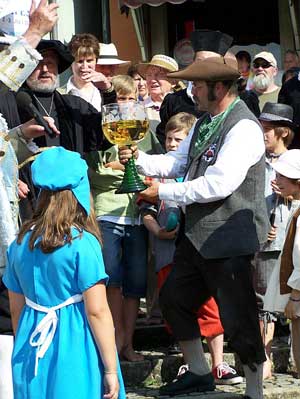
Sharing a huge glass of wine at a festival in the Franconia region of Germany.

By Sharon Hudgins
Photos by the author

Germans love to party, especially when food and drink are involved. And public partying is a tradition in Germany, from Munich’s annual Oktoberfest beer bash to more than 1,250 wine festivals held throughout the country every year.

The eighth largest wine-producing country in the world, Germany is known for its excellent white wines and an increasing number of fine reds, too. Wines from Germany’s 13 designated wine regions each have their own character, depending on the kind of grapes they’re made from, the climate and terrain where the grapes are grown, and the skill of the winemakers themselves. Even wines from a small microclimate within one of the specified wine regions will differ from wines made on the other side of the hill or a kilometer down the road. Connoisseurs can distinguish not only among wines from the Ahr, Rheingau, Franconia, Pfalz and Baden regions, but can also taste the difference between wines from one vineyard and another.
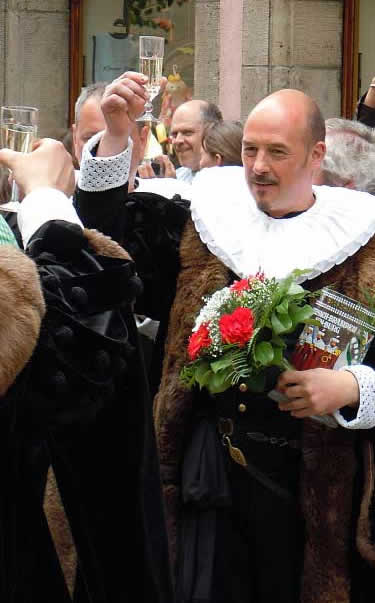
Raising a toast at at the Meistertrunk (Master Draught) festival in Rothenburg ob der Tauber

Although Germany exports wines to other countries, much of its production is consumed in Germany itself, usually not far from where the wine was made. A fun way to sample these local wines is to attend one of the many wine festivals held annually in each region. Most occur between March and the end of harvest, in late October. Some are quiet little fests in small villages, held on only one day. Others are boisterous celebrations lasting for a weekend or a week or even longer, attracting people from all over the country. Some of these festivals are combined with other events, like open-air markets, outdoor concerts, art exhibits and craft fairs, food festivals and fireworks displays. Whatever the venue, a German wine festival is a good place to taste the local wines, eat regional specialties, meet friendly Germans and have a rousing good time.

Drawing Sturm (fermenting grape juice on its way to becoming wine) at a wine festival

From mid-March until mid-November, more than 200 festivals are scheduled along the Deutsche Weinstrasse, the German Wine Route that extends for 50 miles through Germany’s Pfalz region between the foothills of the forested Haardt Mountains and the flat Rhine River plain. The giant of all wine festivals is held in this region: the nearly-600-year-old Bad Dürckheimer Wurstmarkt (Sausage Market), the Pfalz’s equivalent of Munich’s beery Oktoberfest. Despite its meaty name, the Wurstmarkt claims to be the largest wine festival in the world, offering more than 150 local wines and attracting half a million visitors to Bad Dürckheim every year. During nine days in mid-September, they down more than 400,000 liters of the local brew!

Get away from the crush of Bad Dürckheim’s crowds at the many smaller, more intimate wine festivals along the German Wine Route, usually held for one to three days over a single weekend. The best time to go is in the early autumn, during the grape harvest season. Local vintners open their cellars to the public and their courtyards to customers who sit on benches at long tables, eating regional specialties and sipping wines in the shade of a grape arbor. This is a great way to meet Germans and enjoy the regional wines in a quiet, relaxed atmosphere.

Wiesbaden is known as “The Gateway to the Rheingau,” the romantic vineyard region on the north side of the Rhine River, home to some of Germany’s most famous wineries, including those around the villages of Rüdesheim, Eltville and Assmannshausen. During August, you can sample excellent Rhine wines from the local vintners at more than 120 booths set up in the Wiesbaden city center for the annual 10-day Rheingau Wine Festival.
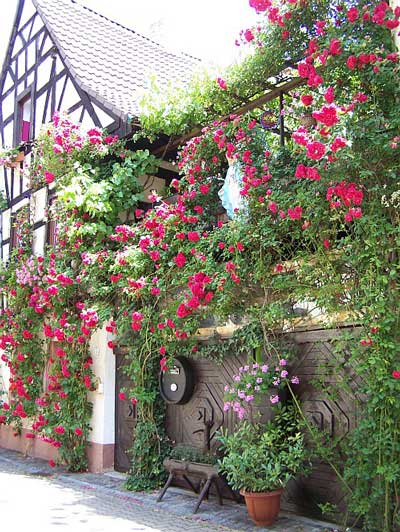
Wineries like this one on the German Wine Route in the Pfalz open their cellars to the public during local wine festivals.

In late August and early September, you can also indulge at the 10-day Rheingau Wine Festival in nearby Frankfurt, tasting more than 600 wines from the Rheingau region at 30 vintners’ stands set up in the “Fressgass” food street along Bockenheimer Strasse and the Opernplatz, and in the nearby shopping district along the Goethestrasse. Food stalls operated by local businesses provide the sustenance you’ll need to keep from getting totally tipsy on all that good Rhine wine.

Farther north along the Rhine, the Mittelrhein (Middle Rhine) region is also the site of several wine festivals in the picturesque villages that line the river valley, a UNESCO World Heritage Site that includes the city of Koblenz. Among other wine festivals in this region, the Middle Rhine celebrates “Golden Wine Autumn” on two Saturdays in October, with wine tastings, live music, dancing and spectacular fireworks displays. The best way to enjoy this special festival is to book a day-long cruise on a river boat that includes stops at the festival towns along the Rhine and concludes with fireworks that night.

Zwiebelkuchen (onion tart) is the traditional accompaniment to Federweisse (fermenting grape juice on its way to becoming wine) in the autumn.

Another popular region for wine festivals is along the Mosel River, where dozens of local celebrations are held from April to October. The largest and best known is the Wine Festival of the Middle Mosel in Bernkastel-Kues in early September, which includes fireworks at the Landshut Castle, crowning of the Middle Mosel Wine Queen, wine tastings at 30 booths and a colorful parade of vintners through the narrow streets of this beautiful half-timbered town. Another good option is to visit the Mosel for a week or so during harvest time, from August through October, when you can watch the grapes being picked and experience the smaller, more intimate wine festivals in the little villages lining the river between Koblenz and Trier.

There’s a long tradition of wine festivals in the Baden wine region, in southwestern Germany, which produces some of Germany’s finest wines. Baden is well known for its excellent cuisine, too, which attracts gourmets from all over Europe. Among the many wine festivals in this region, one is held in July in the pretty city of Freiburg, where you can taste wines from 40 Baden vintners.

One of the largest wine festivals in Germany is the Stuttgarter Weindorf (Stuttgart Wine Village), held in early September in the heart of the city, the capital of Baden-Württemberg, where 120 vendors sell 250 kinds of Württemberg wines, as well as classic regional Schwabian foods. Stuttgart claims this festival attracts more than a million visitors annually, which would make it even larger than the Bad Durckheimer Wurstmarkt.

And finally, the Franconia wine region, along the Main River, hosts a number of wine festivals, too, featuring Franconia’s excellent wines in their characteristic green Bocksbeutel bottles. Small festivals in the villages of the Main River valley, such as Sommerhausen and neighboring Winterhausen, are especially fun to attend, for their fine wines and local character.

Würzburg, the regional capital of Lower Franconia, is the site of the Würzburger Weindorf (Würzburg Wine Festival), where you can sample more than 100 kinds of Franconian wines at the booths and stands set up in the city center in late May and early June. Würzburgers like to party. In late August Würzburg hosts an 11-day Weinparade am Marktplatz (Wine Festival on the Market Square), offering a chance to taste more than 100 different wines from Würzburg’s local wineries, along with plenty of regional food specialties.

At many of the autumn wine festivals in Germany, the traditional food and drink are Zwiebelkuchen (onion tart) and Federweisser (one of the many German names for “new wine”), which is fermenting grape juice that’s still on its way to becoming real wine. Don’t be fooled by the pleasantly sweet taste of this bubbly, cloudy brew—usually served in .25-liter glasses—which you’ll want to quaff like thirst-quenching fruit juice. Be forewarned: Federweisser does contain alcohol, more or less depending on how long the fermentation has been going on, and it can easily seduce you into drinking so much that when you stand up you’ll wish you’d been more prudent.

For information about a variety of German wine festivals see:

For more information about specific German wine festivals see:

Making Tracks to Dinner on the Diner

From tea in a British buffet car, to luxury dining on the Trans-Siberian Express, eating on trains can be a true culinary adventure.

By Sharon Hudgins
Photos by the author

I grew up riding trains across America just before the era of classic passenger service ended on the railroads and before Amtrak was a gleam in the government’s eye. Later I rode trains all over Europe from northern Scotland to central Italy, from the coast of France to the plains of Hungary. And in Russia I’ve logged nearly 40,000 miles on the legendary Trans-Siberian Railroad, crossing the continents of Europe and Asia between Moscow and Vladivostok several times.

That’s also a lot of dining on trains, snacking on railroad station platforms and eating at station buffets.

DINING ON BRITISH TRAINS
I remember riding first class on British Rail across England and Scotland many years ago, when smartly uniformed stewards served tea in your private train compartment, first spreading a starched white cloth on the little table under the window, then pouring the hot brown brew from a silver-plated teapot into a porcelain cup (with milk added first or last depending on where you stand on that contentious issue). A small plate of sweet biscuits (cookies, in American English) always accompanied the tea. What a civilized way to spend a morning or afternoon, sipping tea, nibbling on biscuits, and watching the British countryside roll by outside the window.

Morning coffee and afternoon tea were included in the price of the ticket. But like many travelers on trains all over the world, I often chose to save money on meals by purchasing food from station vendors to eat on the train. Once in a while, however, I’d splurge on a meal in the dining car, luxuriating in the “white-tablecloth service” and the selection of foods that were so different from those I’d eaten on American trains.

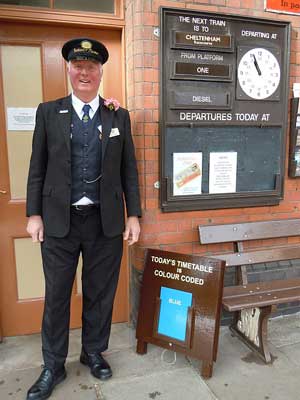
(left) Conductor on the Cheltenham Flyer, historic steam train of the Gloucestershire Warwickshire line of the British Great Western Railway.

Traditional English pork pie from the buffet aboard the Cheltenham Flyer

Alas, in 2011 contemporary trains in Britain did away with the last of their full-service dining cars, replacing them with airline-type meals served at the seats of first-class passengers and microwaved snacks sold in the buffet car for everyone else. But there’s hope for the future: In 2013 the First Great Western Railway re-introduced full-service “Pullman dining,” with fine wines and locally-sourced foods, on the UK’s only remaining regularly scheduled train with a real restaurant car. But, strangely, the dining services don’t operate on weekends or public holidays!

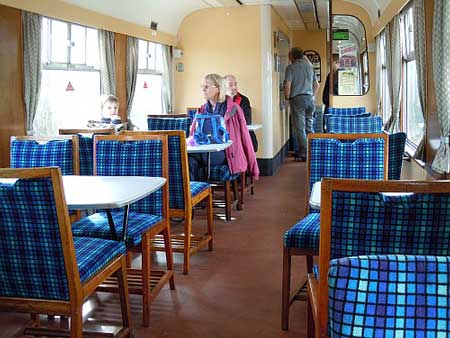
Restored 1950s-era buffet saloon car on the Cheltenham Flyer

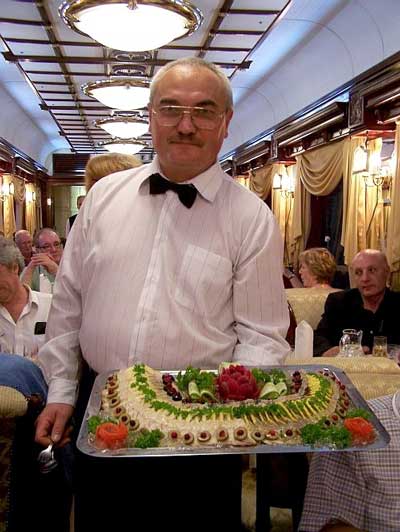
However, special tourist trains in Britain, including many historic trains, still provide a range of enjoyable culinary experiences. Recently I traveled through England’s lovely Cotswolds countryside on the historic Cheltenham Flyer, a 1930s-era steam train that chugs along the Gloucestershire Warwickshire branch of the Great Western Railway, which has been operating trains in western England since 1838. The train included a restored 1950s “buffet saloon car” whose menu offered Scotch eggs, pork pies, bacon rolls, homemade flapjacks and homemade cakes, along with a range of hot and cold drinks, alcoholic and non-. At certain times of the year, the historic trains running on these rails also offer special culinary tours, from Fish & Chips Specials to Ale & Steam Weekends (sampling 24 real English ales) to Luxury Pullman Style Dining Experiences with multi-course meals served on china plates, accompanied by wines poured into crystal glasses.

CONTINENTAL RAILROAD DINING
The railroad dining experience on the European continent varies from country to country, type of train, and distance of travel. Some local trains have no dining facilities at all. Others have only a small snack bar or buffet, or vendors who come through the train with a cart stacked with packaged foods and canned drinks. Some have a full-service dining car, with a menu featuring multi-course meals and a selection of wines. If fine food and white-tablecloth dining are an important to you on a rail journey, then you need to seek out the trains that have a separate dining car and well rated menus.

For the ultimate in Old World luxury train travel (and dining), book a journey on the Venice-Simplon Orient Express, a modern revival of that classic train, which operates several tours of different lengths between London and Istanbul. The trains also feature three beautifully restored dining cars from the 1920s, with haute cuisine to match. Wear period dress to dinner, and you’ll feel like you’ve stepped back in time into an Agatha Christie novel.

Who could resist the special Swiss Chocolate Train that takes you on a day trip to a cheese-making factory, Gruyères Castle, and the Cailler-Nestlé Chocolate Factory in Broc for cheese and chocolate tastings at those stops? Travel in a vintage Pullman Belle Epoque-era train car or in a sleek, ultramodern panoramic car with large windows for viewing the Swiss Alps, the vineyards surrounding Montreux and the medieval town of Gruyères along the route. Bring along a shopping bag and leave your calorie counter behind.

Don’t overlook the foods to be found inside train stations, too. If you don’t want to spend big bucks to travel on a luxury train but you still like to eat well, you’ll find plenty of choices at many of Europe’s train stations, particularly those in the larger cities. I’ve been especially impressed with the train station buffets and take-out selections at major Swiss, German and French stations, as well as those in capital cities such as Budapest and Madrid. But for the ultimate in elegant, nostalgic, train-station dining, don’t miss the beautifully restored Le Train Bleu (The Blue Train) restaurant in Paris’s Gare de Lyon—a Belle Epoque-style restaurant with a pricey French menu and a gorgeous decor to match.

DINING ACROSS CONTINENTS
Finally, for the travel adventure of a lifetime, board the British-owned, Russian-operated Golden Eagle Trans-Siberian Express whose route covers nearly 6,000 miles between Moscow and Vladivostok. Almost half that distance is on the European side of Russia, from Moscow to Kazan to the Ural Mountains. Each comfortable cabin on this luxury train has its own private bathroom. And three times a day, professional chefs in the a fully equipped kitchen car turn out freshly cooked meals featuring regional specialties, all served in an elegant dining car designed to evoke the Golden Age of train travel. During the 12-day journey across Europe and Asia, the menu is different at every meal except breakfast. On this longest train trip on earth, you’ll have plenty of time to enjoy the best of Russian cuisine and international wines while watching the fascinating changes of scenery outside the dining car windows.

So wherever you travel by train in Europe, enjoy the experience of dining on (and off) the diner. It’s a great way to taste a wide variety of regional foods and expand your culinary and geographic horizons at the same time.

For more information see:

Enjoy Coffee in Leipzig: Hot, Strong and Sweet

Photos courtesy Leipzig Tourism and Marketing

Coffee and Leipzig, Germany are inseparable. It was in the Saxon metropolis where the first palm court musicians of Germany entertained their guests: Georg Philipp Telemann made music in the coffee shops at the Market Square together with the collegium musicum, founded in 1701.

For more than two decades Johann Sebastian Bach visited the Zimmermannsche Kaffeehaus on Katharinenstrasse twice a week. His Coffee Cantata is seen as the highlight of Saxon palm court music of the 18th century. The lyrics had been written by the Leipzig poet Christian Friedrich Henrici (pen name Picander) in 1732.

Even the canon “C-a-f-f-e-e” was invented in the coffee country of Saxony. The composer was a concerned music teacher from Zittau, who wrote the song to warn his pupils of the harmful effects of the “brown Turkish drink.”

Coffee beans from Ethiopia

In the first half of the 18th century, while in other places canon balls were cast, Leipzig became the most important place of coffee mill production. After the first load of coffee beans arrived in Leipzig in 1693, more and more coffee shops began to open.

Consequently, Europe’s oldest coffee shop (after the Café Procope in Paris) is in Leipzig. Adam Heinrich Schütze opened the Baroque Coffe Baum on Kleine Fleischergasse 4 in 1694 and sold the first coffee drink.

In the course of the following three centuries this became the place where the intellectual elite of the city met to enjoy the popular drink. Among the guests there was the literature professor Johann Christoph Gottsched, the painter Max Klinger, the poet E. T. A. Hoffmann and the composer Richard Wagner. Also Goethe, Lessing, Bach and Grieg were often here. In a room in the ground-floor (now the Schumann Room) Robert Schumann regularly met his circle of friends between 1828 and 1844. Even revolutionaries like Robert Blum, Karl Liebknecht and August Bebel established their “second living-room” here. In 1990 Helmut Kohl and Lothar de Maizière discussed the possibilities of German unification in this place.

The sandstone relief above the entrance to Coffe Baum is famous. A Turk with a big coffee is proffering a cup of coffee to a cherub. This symbolizes the encounter of Christian occident with Islamic orient. August the Strong is said to have donated of this relief in 1720 in gratitude for amorous services provided by the landlady.

On the third floor there is the coffee museum—one of the most important worldwide. In 15 rooms more than 500 selected exhibits from 300 years of Saxon coffee and cultural history are presented. Among the table roasters and coffee mills from different epochs, a high-tech sample roaster is an attraction for visitors.

Real bean coffee and original Meissen porcelain have always been the most outstanding identification marks of the “Coffee-Saxons,” who received their nickname from Frederic the Great during the Seven Years War. The lack of coffee resulted in a lack of motivation among the Saxon soldiers, and they refused to fight, complaining: “Ohne Gaffee gönn mer nich gämpfn,” which means in English, ” No coffee, no fighting!” The insulting remark of the Prussian monarch, who called them “Coffee Saxons,” did not disturb them in the least, as feasting on cake and coffee suited their taste much better than fighting on Europe’s battlefields.

But how do people like their coffee in Leipzig? “Siesse muss d’r Coffe sein,” says a Saxon proverbial expression, which means that the coffee must be sweet. When the caffeine drink is too weak the spoiled Coffee Saxons despise it as “Plempe” or “Lorke.”

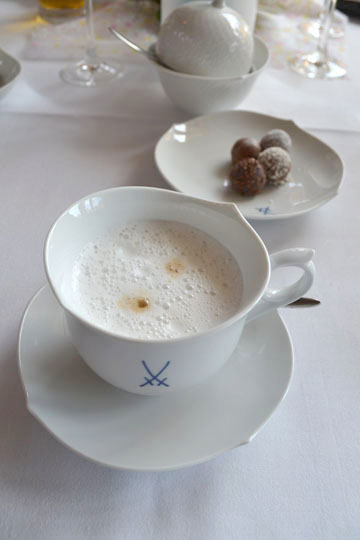
As in hard times, even coffee fans of the wealthier classes had to count their coffee beans; they served so-called “sword coffee” when they had guests. The concentration of the coffee was so low that the blue swords from the bottom of the Meissen porcelain cups could shimmer through. Since 1729 this is also called Blümchenkaffee”—the coffee is so weak that you can see the little flowers (Blümchen) on the bottom of the cup. An anecdote from the 18th century tells about an economical host who roasted and ground 14 beans for 15 “Schälchen Heessen” (cups of the hot drink).

The basic rule for a good Leipzig cup of coffee could be the following historic statement of Cardinal Talleyrand:

“The coffee must be
As black as the devil
As hot as hell
As pure as an angel
As sweet as love.”

Leipzig’s guests who visit the cafés and coffee shops can confirm his words: coffee is magic, coffee is erotic and coffee is spirit.

Those who would like to learn more about Leipzig’s coffee history can join a two-hour guided city tours under the headline “Ey, wie schmeckt der Coffee süsse…” (“O, how sweet the coffee tastes …”).

For more information, go to: Leipzig Tourism

THE SAXONS AND THEIR COFFEE: BLIEMCH’NGAFFEE AND MUGGEFUKK

The first exhibition of coffee beans was the Leipzig Trade Fair in 1670. Lehmann, Chocolatier to the Royal Polish and Saxon courts, opened the first coffee stall in the marketplace in 1694. In 1719 coffee lovers were flocking to a café in the Kleine Fleischergasse, the “Coffe Baum,” which had been made famous by Robert Schumann.

A quick lesson in the Saxon dialect will aid you in understanding these strange terms.

Bliemch’ngaffee is the dialect form of “Blümchenkaffee,” or “flower coffee”—so-called because it has so much water in it that when the coffee was poured into a traditional Meissen porcelain cup, it was still possible to see the typical floral design on the bottom. You could say it’s a coffee that’s easy on the heart.

Muggefukk—”Moka faut” was the call of French soldiers as Napoleon’s troops entered Leipzig. This was a coffee with malt or large amounts of chicory mixed into it. The phrase “moka faut” was mangled by the Saxons into “Muggefukk.”

Experience Meissen Culture

The Meissen Manufactory in Meissen, Germany, home of the famous Meissen porcelain, should be added to any visit of this German city. Taking a tour of Albrechtsburg Castle, where it all began, is also necessary to learn the origins of this porcelain, followed by a factory tour in town.

At the factory, you can also sign up for special events, such as the two listed below, led by the knowledgeable Beate Debernitz.

TEA, COFFEE AND HOT CHOCOLATE—THE THREE EXOTIC HOT BEVERAGES
Funny and interesting facts about the three exotic hot beverages—tea, coffee and hot chocolate, and about the varied shapes of Meissen tableware are presented in an entertaining manner. Coffee, tea and hot chocolate are served in an appropriate cup of Meissen porcelain, together with a small sweet delicacy. Visitors can enjoy the proverbial Saxon Gemutlichkeit. The tour takes about an hour.

TABLE CULTURE AT MEISSEN
A three-course meal served on famous Meissen porcelain services from three centuries provides pleasant insights into table culture, past and present. Entertaining stories are shared about table culture, table manners and the delights of the table, as well as table arrangements then and now. Duration of the program is approximately two hours.

For more information, go to Meissen.com

All This Country’s Culinary Delights Are There for the Eating…

By Don Heimburger
Photos by the author

Grabbing a “taste” of Germany today doesn’t mean just visiting its Medieval castles like Neuschwanstein or Wartburg Castle, or visiting its thousands of half-timbered buildings such as you’ll find in Wernigerode, Bamberg and Cochem, or being one of the millions who take pictures of the famous Cologne Cathedral.

A “taste” of Germany in 2018 takes on a special meaning: this year Germany’s National Tourist Board officially unlocks its treasure chest of culinary delights as part of its promotion of the country, and there are many appetizing foods to be enjoyed, and 16 federal states in which to enjoy them.

With eight straight years of record growth in tourism, Germany is primed for more tourists in the year ahead who can also appreciate this country’s flavorful foods. In 2017, a total of 83.9 million overnight stays by foreign visitors in establishments with at least 10 beds were recorded, according to Petra Hedorfer, chief executive officer of the German National Tourist Board (GNTB).

The German Tourist Board is trying to get travelers’ attention by saying “Attention foodies: Germany is now open for tasting.” And there are many towns and regions in which to conduct this culinary research, as well as numerous restaurants, wineries, breweries and farms that are eager to show visitors what Germany has to offer.

HANNOVER CURRYWURST
In Hannover you can stop in at an interesting restaurant called the Ständige Vertretung at Friedrichswall 10. The “StäV” as it is named, is not just any cafe, but a political reading book … where the history of political happenings and famous German politicians from past decades can be found on the walls and in photos. But go also for the famous “explosive” currywurst offerings. There’s the German Chancellor Filet “Schröder Art,” the Bundestag Filet, and the Chancellor Tarte, all part of the currywurst menu. All come with spicy sauce.

THE ARISTOCRAT OF VEGETABLES
At Fritz Bormann’s 25-acre asparagus farm near Nienburg in Lower Saxony northeast of Hannover, vast fields of white asparagus (Spargel) covered by large plastic tarps, sit waiting for harvest. In early spring, workers pour into the fine sand-like fields, armed with long, sharp cutting tools and a bucket to pluck the revered savory asparagus stalks from underneath the heaped mounds of dirt.

The “white gold” is then cleaned, graded and quickly delivered to farmstands and markets where it is snapped up by eager eaters. Combined with a hollandaise sauce or hot melted butter, and perhaps a plate of potatoes and pork or ham, the pale, long-stemmed vegetables are a nationwide sensation.

Germany sets aside about 62,000 acres for growing asparagus every year, and it’s estimated the country consumes up to 125,000 tons of it, but some of that is grown in other nearby countries. And nearly every restaurant in the asparagus-growing regions feature Spargel specials on their lunch and dinner menus. The picking season ends promptly on June 24 every year.

If you’re lucky, you can even meet one of the local Spargel queens, like the 2017/2018 queen, Nicole Cybin from Nienburg, or visit the local asparagus museum, part of which is housed in an original 1663 building. The museum displays, among other things, old tools which were once used for harvesting asparagus, dishes and serving plates with asparagus themes painted on them and even molds in the shape of a bunch of asparagus.

ASPARAGUS ROUTE
There’s even an Asparagus Route (Spargelstrasse) which begins in the town of Schwetzingen (it also claims the title of “Asparagus Capital of the World”). When you walk through the city, look for the statue of the Spargelfrau (literally means asparagus woman). The town holds an annual Spargelfest and in 2018 celebrates 350 years as a major Spargel grower.

While you are in Nienburg, be sure to stroll around this fascinating 1,000-year-old village and find the 16th century half-timbered Rathaus built in 1533, as well as the same period St. Martins Church. There are also medieval mansions, other carefully restored half-timbered homes, and a large town center with wide streets. The castle and town of Nienburg were once the residence of the Counts of Hoya, and their tombs can be found in St. Martins Church.

You can also visit the Dobberschuetz Fishery & Smokehouse alongside the banks of the Weser River which flows through the town and get the catch of the day. Eels are their speciality. Get there on a Saturday and enjoy their Saturday fisherman breakfast.

No sleepy little village, Nienberg today has as many as 100 trains a week stop there.

OTHER GERMAN CULINERY DELIGHTS
At the sprawling Rotkäppchen winery in Freyburg, Sekt or sparkling wine is produced, with brothers Moritz and Julius Kloss and a friend establishing a wine store and producing Rotkäppchen champagne as early as 1856. The first 6,000 bottles were bottled in an apartment in the back of the house of the Kloss family.

In the large historic Rotkäppchen building in Freyburg, select grapes are used to make various cuvees, and the brand today is the most successful in Germany, and also holds a 30% international market share. This Sekt takes its name from the unique red cap on its bottles.

Every year the company sponsors a Jungweinprobe, where last years wines are sampled in the courtyard of the Rotkäppchen winery. It’s always a popular and crowded affair with everyone allowed to pour their own glass of wine from a staggering selection. Here, too, you can meet the local Wine Queen, and ask her which cuvees she prefers. In 2017/2018 the reigning queen was Juliana Beer, 22. Not just a queen in name only, she enjoys the aged wines, and can explain the nuances of wine growing and wine-making.

The Rotkäppchen winery boasts one of the largest storage barrels in Germany (from 1856) which can hold 160,000 bottles of wine. And you can also enjoy a great German meal as you sit near the giant wooden barrel and try to figure out how they made such an elaborate wooden vessel.

WEINGUT PAWIS IS A STANDOUT
Also in Freyburg, Weingut Pawis is a standout winery housed in a renovated stone building. As a 10-year-old boy, Bernard Pawis didn’t have much luck with a hoe in his father’s vineyard. But when he learned the wine profession in Radebeul years later, he was on his way to gaining national recognition with his wine production.

Taking over from his father in 1998, he constructed a new wine cellar and later rebuilt an old horse stable into a modern, welcoming and innovative winery with 30 acres of vineyards.

The family produces a number of wine varieties, including Müller-Thurgau, Silvaner, Riesling, Bacchus, Kerner, Pinot Blanc and Pinot Gris, Portuguese, Dornfelder, Pinot Noir and Regent.

Their unique operating philosophy includes sustainable economics, conscious handling of nature, respecting the soil and the vine as their most important commodity, and they work according to environmentally friendly cultivation methods.

The innovative Pawises offer wine tastings, art exhibitions, guided vineyard tours, champagne receptions, a Christmas market, and even a lookout tower on the historic estate.

BLUEBERRY HEAVEN
At Bickbeernhof, you’ll find just about every conceivable way to serve blueberries that you can think of. Owner Sylke Herse has already done the planting, growing, and the packaging for you, and draws upwards of 1,000 visitors a day to her blueberry world in Landesbergen. “Very busy, very organized. Long wait lines at peak times, but worth it. Big juicy blueberries. Every year a must!” are the typical comments from customers.

Blueberry fields are located right behind the processing plant and company store, and there is a wide variety of blueberry-made products offered in the gift shop including blueberry wines, jams, juices, books about blueberries and much more. In their restaurant, customers can order salads with blueberry dressing, blueberry marmalade blueberry pudding, blueberry smoothies and many other blueberry delicacies.

BORN FAMILY VINEYARD
Motorcycle-riding Jochen Born and the small Born Family Weingut in Höhnstedt, located near the famous Luther Walking Trail, produces a variety of wines from its mostly “vertical” vineyards lining the slopes of the area hills. The hills around Höhnstedt contain a lot of limestone, and help from the sun, the wind and the rain make it an ideal place to grow grapes. Jochen is an amicable host and willing to tell his guests about the intricacies of his wine brands and its production in his compact and cozy tasting room adjacent to the wine gift shop.

SCHLOSS WACKENBARTH
Schloss Wackenbarth in Radebeul, is a well-situated, picturesque winery, and one of the oldest sparkling wine producers in Europe. On the well-manicured grounds is a Mediterranean-style palace erected by Augustus the Strong. Since the 18th century Schloss Wackerbarth has attracted hundreds of thousands of visitors because of the charming setting, and of course the delicious wines.

Tours through the winery and grounds are conducted, and many social events, including weddings and banquets, take place on the grounds each year. Interestingly, the federal state of Saxony owns the winery. The winery calls itself an ambassador for the state of Saxony, and indeed it has the stature and appeal of something regal.

While every year Germany is certain to attract millions of visitors for its culture, history, sights and its uniqueness, 2018 calls out for a visit for all of the above, and especially its many and varied succulent, edible delights.
Guten appetit!

For more information go to www.germany.travel.com or www.germany.travel/culinary-germany