Savoring Sicily

Sunny climate, ancient ruins…and delicious cuisine on Italy’s largest island

By Sharon Hudgins
Photos by the author

Savvy travelers have long known that Sicily is a part of Italy well worth seeing. But in recent years this largest island in the Mediterranean has suddenly become a popular tourist mecca, attracting visitors from all over the world. They come for Sicily’s sunny climate and rugged scenery, its ancient archeological sites, sleepy villages, historic cities and colorful markets, and to see nature’s own spectacle, Mt. Etna, Europe’s largest volcano, spouting steam from its fumaroles and sometimes spewing lava down its slopes.

Tourists come to taste Sicily, too—whether on short day trips from cruise ships docked near its shores, or on longer culinary tours (often with cooking classes included) that focus in depth on the history and variety of Sicilian cuisine.

CULINARY CROSSROADS
Located only two miles from the Italian mainland, Sicily has long been a magnet for invaders, colonizers, and rulers—from the early Phoenicians in 800 BC to the Germans, French, Spanish, Austrians and British at various times over the past one thousand years. But it was the ancient Greeks, Byzantines and Arabs who had the greatest influence on Sicilian cuisine.

The Greeks (800-200 BC) brought advanced agricultural methods and introduced new vegetables, fruits and fowl. They cultivated barley, wheat and millet, planted olive groves and vineyards, kept bees (for honey) and improved the breeding of livestock, especially sheep, which were important for cheese production. Even today, Sicily is famous for its ricotta and pecorino cheeses made from sheep’s milk.

The Romans (200-400 BC) focused on growing wheat on large landed estates, turning Sicily into a granary of the Mediterranean. But the influence of the earlier Greeks remained strong. When the Byzantines annexed Sicily to the Eastern Roman Empire (550-900 AD), Sicily was again immersed in Greek traditions and customs, including the kinds of foods favored on Sicilian tables.

During the relatively short time that Arab Muslims controlled Sicily (900-1100 AD), Sicily became one of the wealthiest and most progressive cultures of medieval Europe. The Arabs also had an important impact on the local cuisine. In addition to upgrading traditional agricultural practices, such as irrigation technology, they added a variety of new crops, including rice and sugar cane. They planted orchards of lemons, oranges, almonds and pistachios, and imported spices from Asia and the Middle East.

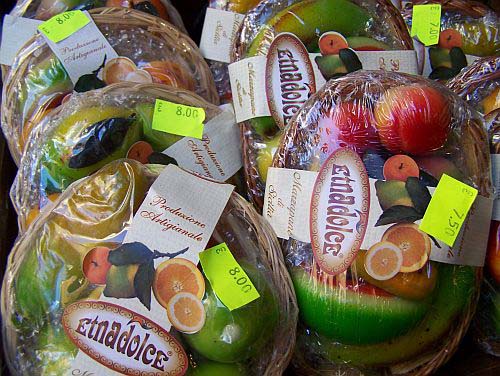
During this time the Sicilians developed their famous “sweet tooth.” Today Sicily is still renowned for its magnificent marzipan confections (crafted from sugar and almond paste); frozen-fruit treats (ice creams, sorbets and granitas); and cannoli dessert, deep-fried tubes of thin pastry made with Sicilian Marsala wine, stuffed with sweetened ricotta cheese combined with candied orange peel, chopped pistachios and chopped chocolate. All these seductive sweets have their roots in medieval Arab cuisine (except the New World chocolate, of course).

Even after the Norman French conquered Sicily at the end of the 11th century—and other Europeans came to rule over Sicily after that—local Arab culinary traditions remained strong on the island. When many Arab Muslims were forced out of Sicily by the Christian conquerors, the arts of Arab confectionery fortunately were not lost. As in Spain, with the later expulsion of Muslims from that country, the recipes were secretly and safely stowed away in Catholic convents, where the nuns made these sinfully sweet treats to give away as presents and later to sell to support their convents. Today these marzipan candies, chewy nougats and sugary pastries are among the most important culinary legacies of the Arabs in Sicily.

FEASTS & FESTIVALS
Holidays are often the best times for travelers to taste the special dishes of any country. Like the rest of Italy, Sicily celebrates many religious holidays every year, from small festivals honoring a local saint to national holidays observed throughout all of Italy. Festival foods range from ritual breads for Christmas and New Year, to cannoli during the spring Carnival season just before Lent, to little marzipan confections shaped like lambs for Easter.

For St. Joseph’s Day (March 19), Sicilians build ornate altars adorned with bread-dough decorations and fresh flowers in their homes, and each community prepares a special ritual meal, often with at least a hundred different dishes, to honor the good saint. Since St. Joseph is also the patron saint of pastry cooks, many of the festive dishes are sweet, including the traditional deep-fried, custard-filled “St. Joseph’s pastries.”

Easter is the time for highly decorated candy eggs, sweet breads and fancy cakes, especially Sicily’s cassata, a multilayered baroque concoction of sponge cake, marzipan, pistachio paste and sweetened ricotta cheese, glazed with white icing and ornately decorated with crystallized orange and pear wedges, curving ribbons of candied squash and grated chocolate.

In Palermo, the Feast of Saint Rosalia (July 13-15) features street foods sold from carts colorfully painted like old Sicilian farm carts: salted and sugar-coated nuts, toasted pumpkin seeds, roasted fava beans and pink-white-green-striped nougat candy. The traditional dessert eaten during this festival is gelato di campagna—not ice cream, as its name implies, but an elaborate confection-cake constructed of multicolored fondants. This rich confection looks like an ice cream cake with four layers: white (almond paste), brown (hazelnut paste), green (pistachio paste) and pink (strawberry paste)—all assembled in a cake mold and studded with pistachios and candied fruits.

For All Saints’ and All Souls’ Days at the beginning of November, Sicilian children receive special gifts supposedly from their deceased ancestors: pupi di cena, candy dolls shaped like knights, ballerinas, clowns and even contemporary figures like Batman, all made of melted sugar poured into molds and then painted in bright colors. Other traditional foods include colored marzipan shaped like fruits and vegetables; fava beans, a symbol of death, since this is a holiday honoring the dead; fave dei morti, little cookies shaped like fava beans; and ossi di morto (“bones of the dead”), cookies shaped like leg bones or skeletons, made of ground almonds, egg whites and sugar.

Roasted turkey and roasted chestnuts are traditional for St. Martin’s Day on November 11. Other typical Sicilian treats for this holiday include biscotti di San Martino, little hard, thrice-baked cookies flavored with anise, cinnamon or orange; and sfinci, fried beignets made of mashed potatoes and flour, sometimes filled with custard cream, and usually drizzled with honey.

On Saint Lucy’s Day (December 13), Sicilians eat arancine, potato-and-rice croquettes the size and shape of an orange, filled with meat or cheese and fried until golden. (These are also popular year-round in Sicily, a savory treat not to be missed!) Christmas Eve (December 24) is celebrated with eel or salted swordfish, followed by a large Christmas Day feast that includes nuts (symbols of fertility) and honey (so the coming year will be sweet). And Christmas in Sicily wouldn’t be complete without sweet almond torrone (nougat) and rich buccellato, a special wreath-shaped bread spiced with cinnamon, cardamom and cloves, filled with figs, raisins, almonds, walnuts and apricot jam, and decorated with candied fruits on top—a legacy of the culinary influence of those Greeks and Arabs who ruled Sicily so long ago.

For more information about the foods of Sicily see:

Eat Smart in Sicily, by Joan Peterson and Marcella Croce (Ginkgo Press, 2008), the best portable guidebook to Sicilian food, with a summary of Sicilian culinary history and a very good menu translator. You’ll definitely want to take this little book with you when you travel to Sicily.

Pomp and Sustenance: Twenty-five Centuries of Sicilian Food, by Mary Taylor Simeti (Knopf, 1989), probably the best single book you can read about the history of Sicilian food (republished in 2009 as Sicilian Food: Recipes from Italy’s Abundant Isle).

Bitter Almonds: Recollections and Recipes from a Sicilian Girlhood, by Mary Taylor Simeti and Mari Grammatico (Bantam Books, 2003).

Sweet Sicily: The Story of an Island and Her Pastries, by Victoria Granof (William Morrow Cookbooks, 2001).

Celebrating Italy, by Carol Field (William Morrow, 1990), which covers other regions of Italy, too, but includes much information about the festival foods of Sicily.

For more books about Sicilian cuisine, search “Sicily cooking” on Amazon.com.

Enjoy Coffee in Leipzig: Hot, Strong and Sweet

Photos courtesy Leipzig Tourism and Marketing

Coffee and Leipzig, Germany are inseparable. It was in the Saxon metropolis where the first palm court musicians of Germany entertained their guests: Georg Philipp Telemann made music in the coffee shops at the Market Square together with the collegium musicum, founded in 1701.

For more than two decades Johann Sebastian Bach visited the Zimmermannsche Kaffeehaus on Katharinenstrasse twice a week. His Coffee Cantata is seen as the highlight of Saxon palm court music of the 18th century. The lyrics had been written by the Leipzig poet Christian Friedrich Henrici (pen name Picander) in 1732.

Even the canon “C-a-f-f-e-e” was invented in the coffee country of Saxony. The composer was a concerned music teacher from Zittau, who wrote the song to warn his pupils of the harmful effects of the “brown Turkish drink.”

Coffee beans from Ethiopia

In the first half of the 18th century, while in other places canon balls were cast, Leipzig became the most important place of coffee mill production. After the first load of coffee beans arrived in Leipzig in 1693, more and more coffee shops began to open.

Consequently, Europe’s oldest coffee shop (after the Café Procope in Paris) is in Leipzig. Adam Heinrich Schütze opened the Baroque Coffe Baum on Kleine Fleischergasse 4 in 1694 and sold the first coffee drink.

In the course of the following three centuries this became the place where the intellectual elite of the city met to enjoy the popular drink. Among the guests there was the literature professor Johann Christoph Gottsched, the painter Max Klinger, the poet E. T. A. Hoffmann and the composer Richard Wagner. Also Goethe, Lessing, Bach and Grieg were often here. In a room in the ground-floor (now the Schumann Room) Robert Schumann regularly met his circle of friends between 1828 and 1844. Even revolutionaries like Robert Blum, Karl Liebknecht and August Bebel established their “second living-room” here. In 1990 Helmut Kohl and Lothar de Maizière discussed the possibilities of German unification in this place.

The sandstone relief above the entrance to Coffe Baum is famous. A Turk with a big coffee is proffering a cup of coffee to a cherub. This symbolizes the encounter of Christian occident with Islamic orient. August the Strong is said to have donated of this relief in 1720 in gratitude for amorous services provided by the landlady.

On the third floor there is the coffee museum—one of the most important worldwide. In 15 rooms more than 500 selected exhibits from 300 years of Saxon coffee and cultural history are presented. Among the table roasters and coffee mills from different epochs, a high-tech sample roaster is an attraction for visitors.

Real bean coffee and original Meissen porcelain have always been the most outstanding identification marks of the “Coffee-Saxons,” who received their nickname from Frederic the Great during the Seven Years War. The lack of coffee resulted in a lack of motivation among the Saxon soldiers, and they refused to fight, complaining: “Ohne Gaffee gönn mer nich gämpfn,” which means in English, ” No coffee, no fighting!” The insulting remark of the Prussian monarch, who called them “Coffee Saxons,” did not disturb them in the least, as feasting on cake and coffee suited their taste much better than fighting on Europe’s battlefields.

But how do people like their coffee in Leipzig? “Siesse muss d’r Coffe sein,” says a Saxon proverbial expression, which means that the coffee must be sweet. When the caffeine drink is too weak the spoiled Coffee Saxons despise it as “Plempe” or “Lorke.”

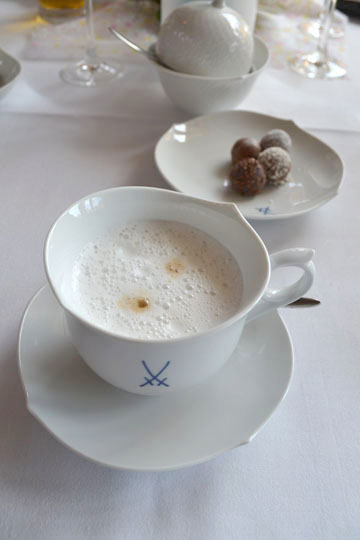
As in hard times, even coffee fans of the wealthier classes had to count their coffee beans; they served so-called “sword coffee” when they had guests. The concentration of the coffee was so low that the blue swords from the bottom of the Meissen porcelain cups could shimmer through. Since 1729 this is also called Blümchenkaffee”—the coffee is so weak that you can see the little flowers (Blümchen) on the bottom of the cup. An anecdote from the 18th century tells about an economical host who roasted and ground 14 beans for 15 “Schälchen Heessen” (cups of the hot drink).

The basic rule for a good Leipzig cup of coffee could be the following historic statement of Cardinal Talleyrand:

“The coffee must be
As black as the devil
As hot as hell
As pure as an angel
As sweet as love.”

Leipzig’s guests who visit the cafés and coffee shops can confirm his words: coffee is magic, coffee is erotic and coffee is spirit.

Those who would like to learn more about Leipzig’s coffee history can join a two-hour guided city tours under the headline “Ey, wie schmeckt der Coffee süsse…” (“O, how sweet the coffee tastes …”).

For more information, go to: Leipzig Tourism

THE SAXONS AND THEIR COFFEE: BLIEMCH’NGAFFEE AND MUGGEFUKK

The first exhibition of coffee beans was the Leipzig Trade Fair in 1670. Lehmann, Chocolatier to the Royal Polish and Saxon courts, opened the first coffee stall in the marketplace in 1694. In 1719 coffee lovers were flocking to a café in the Kleine Fleischergasse, the “Coffe Baum,” which had been made famous by Robert Schumann.

A quick lesson in the Saxon dialect will aid you in understanding these strange terms.

Bliemch’ngaffee is the dialect form of “Blümchenkaffee,” or “flower coffee”—so-called because it has so much water in it that when the coffee was poured into a traditional Meissen porcelain cup, it was still possible to see the typical floral design on the bottom. You could say it’s a coffee that’s easy on the heart.

Muggefukk—”Moka faut” was the call of French soldiers as Napoleon’s troops entered Leipzig. This was a coffee with malt or large amounts of chicory mixed into it. The phrase “moka faut” was mangled by the Saxons into “Muggefukk.”

Experience Meissen Culture

The Meissen Manufactory in Meissen, Germany, home of the famous Meissen porcelain, should be added to any visit of this German city. Taking a tour of Albrechtsburg Castle, where it all began, is also necessary to learn the origins of this porcelain, followed by a factory tour in town.

At the factory, you can also sign up for special events, such as the two listed below, led by the knowledgeable Beate Debernitz.

TEA, COFFEE AND HOT CHOCOLATE—THE THREE EXOTIC HOT BEVERAGES
Funny and interesting facts about the three exotic hot beverages—tea, coffee and hot chocolate, and about the varied shapes of Meissen tableware are presented in an entertaining manner. Coffee, tea and hot chocolate are served in an appropriate cup of Meissen porcelain, together with a small sweet delicacy. Visitors can enjoy the proverbial Saxon Gemutlichkeit. The tour takes about an hour.

TABLE CULTURE AT MEISSEN
A three-course meal served on famous Meissen porcelain services from three centuries provides pleasant insights into table culture, past and present. Entertaining stories are shared about table culture, table manners and the delights of the table, as well as table arrangements then and now. Duration of the program is approximately two hours.

For more information, go to Meissen.com

Bites of Brittany

This French province with a strong regional identity has Celtic traditions of food, music and language that make it unique.

The rugged rocky coast of Brittany at San Malo

By Sharon Hudgins
Photos by the author

A CONFUSION OF NAMES
No, it’s not Great Britain. It’s Brittany—a region in the far northwestern corner of France. It’s also the largest peninsula in France, with a 1,700-mile coastline bordering on the English Channel to the north, the Atlantic Ocean to the west and the Bay of Biscay to the south. The westernmost part of Brittany juts so far into the sea that it’s even called “Finistere”—the end of the earth.

Typical Breton village house.

When I was a kid in the U.S., I was confused by that geographic name. How could something called “Brittany” be in France? Later I moved to Europe and began eating my way through all the regions of France, where I learned that the French term for this region is “Bretagne.” The Bretons living there call it “Breizh” in their own Celtic language, which is related to Irish and Welsh. And they have a strong regional identity that makes Brittany very different from other parts of France—in customs, traditions, costumes, music, language and cuisine.

GIFTS FROM THE SEA
The traditional cooking of Brittany is rustic, hardy, elemental. Fresh, local, sustainable ingredients have been the foundation of Breton cuisine for centuries, long before those terms became buzzwords on trendy urban menus. Surrounded by the sea on three sides, Brittany is also a region where fish, shellfish and crustaceans are daily fare.

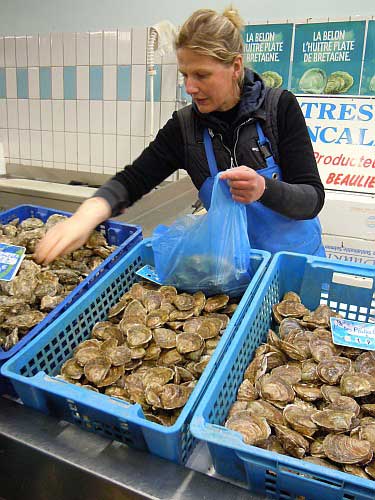
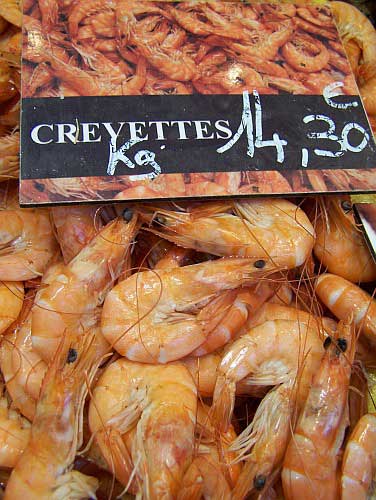
On my first trip to this part of France, I indulged in one of the glories of the Breton table, a plateau de fruits de mer—a huge serving platter heaped with fresh oysters, lobsters, clams, mussels, scallops, langoustines, prawns and periwinkles, all still in their shells and smelling of the sea. This massive meal for two was garnished simply with lemon slices and a bowl of mayonnaise (for dipping), along with slices of baguette and the best salted butter I’d ever tasted. A bottle of crisp white muscadet from the Loire-Atlantique wine region, which borders on Brittany, paired perfectly with the fine food. This classic seafood mélange is also a delightfully messy meal, eaten mostly with your fingers. But novice that I was, I had to watch the French couple at the next table to figure out how to use a straight pin (provided by the waitress) to pry out the flesh from those little periwinkles.

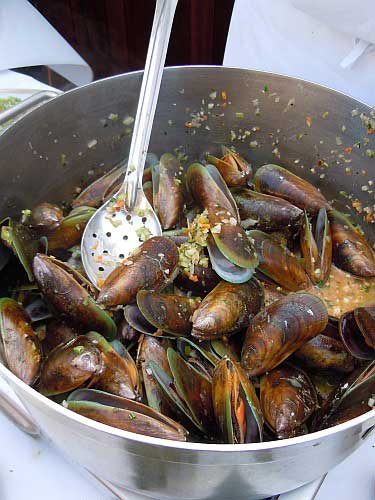
Another notable seafood dish is cotriade, originally a humble fishermen’s stew made with potatoes, onions, garlic, leeks and the catch-of-the-day, all boiled up in a pot of salty water. Modern cooks are likely to throw in some herbs and white wine, too. Whatever the variety of ingredients that find their way into the stew pot, cotriade combines all the characteristics of Breton cooking—freshness, simplicity, nourishment—in one delicious dish. And if you aren’t in the mood for fish stew, then try the local moules marinières, mussels steamed in their shells over a bit of white wine, cider or beer. Or ask for a big bowl of moule frites, steamed mussels with a side dish of perfectly cooked French fries.

CLASSIC REGIONAL SPECIALTIES
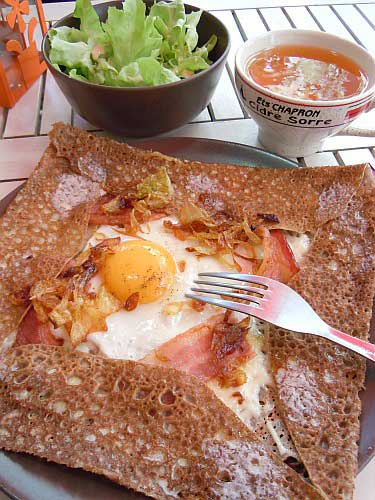
Crêpes and galettes are another favorite food in Brittany, sold at street stalls in every town, featured at festivals, and served in restaurants, some of which specialize in these big flat pancakes. Dainty crêpes are made from a thin batter of wheat flour, milk, and eggs, cooked on a large griddle. Usually sprinkled with sugar or slathered with jam, caramel spread, chocolate sauce or sweetened chestnut purée, the crêpes are then folded into quarters for serving. Galettes, which are slightly thicker, are made with a buckwheat-flour batter, cooked like crêpes on a griddle, and often garnished with sliced ham, fried eggs, shredded cheese, browned onions, or other savory ingredients. The classic drink with crêpes and galettes is a cup or ceramic bowl of cold Breton cider, the famous fermented apple juice of this region, in your choice of dry, semi-dry, or sweet.

Pork is a prime product in Brittany’s interior—cured into ham, stuffed into sausages—along with root vegetables grown on the rocky, windswept peninsula. Many of these go into the meat-and-vegetable stew known as kig ha farz (similar to French pot-au-feu), an old-fashioned rural dish. Buckwheat moistened with milk, meat bouillon, and lard is wrapped in a clean cloth and put into the pot to cook in the stew, to make a savory dumpling that’s later broken up with a fork and eaten with the meat, vegetables, and broth.

Nearer the sea, lambs that have grazed on the salt-marsh grasses are considered a delicacy, as are the artichokes, asparagus, strawberries and samphire that grow in the sandy soil. And along the coast, Brittany’s famous fleur de sel—mineral-rich, slightly gray, delicately flaky sea salt—is raked by hand off the top of shallow evaporation ponds flooded with sea water and left to dry in the sun and wind. Travelers to Brittany often return home with a big bag of fleur de sel purchased in one of the colorful open-air markets there.

SWEET FINISH
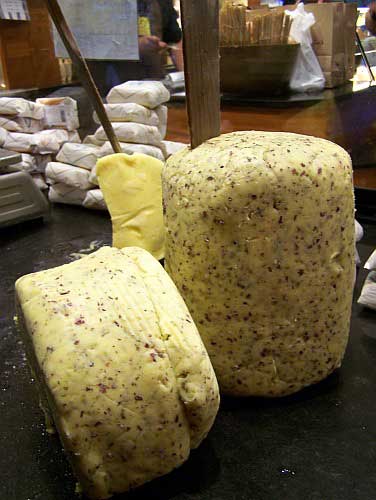
The Bretons have a sweet tooth, too. In every town, shops are filled with pretty tin boxes holding rich butter cookies and creamy caramels made with Brittany’s renowned butter and sea salt. An old farmhouse dish, also sold in pastry shops and restaurants, is far Breton, a simple custardy tart, made with an eggy batter poured over sliced apples, plums, or liquor-soaked prunes or raisins, then baked in a hot oven. And a gateau Breton is another simple (but simply delicious) flat cake, halfway between a shortbread and a pound cake, made with a large proportion of butter and sometimes ground almonds or hazelnuts, too.

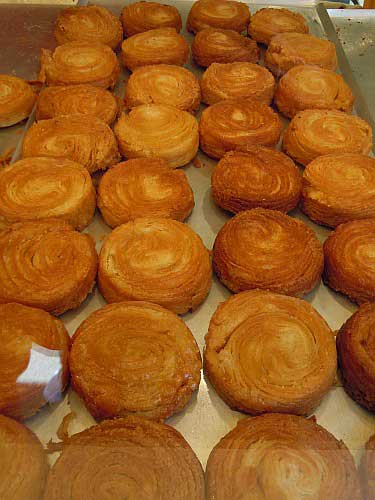
But the most famous Breton pastry is kouign-amann (pronounced queen-ah-MAHN), which just means “butter cake.” This classic Breton sweet is much like my great aunt’s irresistible cinnamon rolls—layers of yeast dough folded around plenty of butter, cinnamon and sugar, cut into large rounds, and pressed into muffin tins. But the Breton recipe differs from hers in leaving out the cinnamon, adding salt and going a step further to heavily butter and sugar those muffin tins. When the kouign-amann bakes, sugar syrup forms between the layers of dough, and a crunchy, chewy, caramelized shell forms on the outside. Tasting these warm, buttery, caramely rolls, fresh from the oven, is reason enough to travel to Brittany.

Learn the Delicious History of Chocolate

A variety of Belgian chocolates

By Danielle Pruger
Photos courtesy Giraffe Childcare and Early Learning

Europe is famous for its decadent chocolate and many countries are known for their tasty treats. However, chocolate was originally only enjoyed in Central America where cacao beans grew. The Olmec Indians were the first to harvest the cacao beans and 1,000 years later the Mayans were the first to bring the cacao tree from the rain forest onto plantations in modern day Mexico and Guatemala. It wasn’t until 1530 that chocolate was introduced to the European population by Hernan Cortes, who added cane sugar to “xocaltl,” a traditional chocolate drink, to make it more appealing to Spanish royalty and aristocracy. From there many new chocolate concoctions were created throughout Europe, such as Pralines and chocolate milk and many other treats we enjoy today. 

For more information visit the timeline created by Giraffe Childcare and Early Learning that covers more than 4,000 years of chocolate’s history: Chocolate History Timeline

Cacao beans