German Wine Festivals

Germans love to party: more than 1,250 wine festivals are held throughout the country every year.
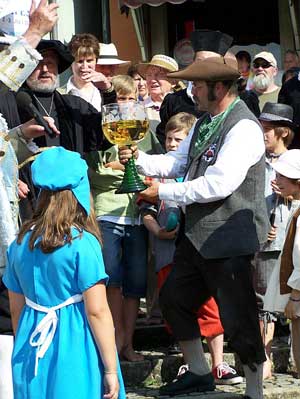
Sharing a huge glass of wine at a festival in the Franconia region of Germany.

By Sharon Hudgins
Photos by the author

Germans love to party, especially when food and drink are involved. And public partying is a tradition in Germany, from Munich’s annual Oktoberfest beer bash to more than 1,250 wine festivals held throughout the country every year.

The eighth largest wine-producing country in the world, Germany is known for its excellent white wines and an increasing number of fine reds, too. Wines from Germany’s 13 designated wine regions each have their own character, depending on the kind of grapes they’re made from, the climate and terrain where the grapes are grown, and the skill of the winemakers themselves. Even wines from a small microclimate within one of the specified wine regions will differ from wines made on the other side of the hill or a kilometer down the road. Connoisseurs can distinguish not only among wines from the Ahr, Rheingau, Franconia, Pfalz and Baden regions, but can also taste the difference between wines from one vineyard and another.
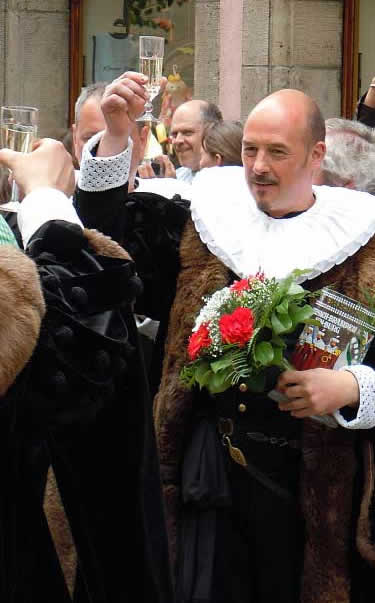
Raising a toast at at the Meistertrunk (Master Draught) festival in Rothenburg ob der Tauber

Although Germany exports wines to other countries, much of its production is consumed in Germany itself, usually not far from where the wine was made. A fun way to sample these local wines is to attend one of the many wine festivals held annually in each region. Most occur between March and the end of harvest, in late October. Some are quiet little fests in small villages, held on only one day. Others are boisterous celebrations lasting for a weekend or a week or even longer, attracting people from all over the country. Some of these festivals are combined with other events, like open-air markets, outdoor concerts, art exhibits and craft fairs, food festivals and fireworks displays. Whatever the venue, a German wine festival is a good place to taste the local wines, eat regional specialties, meet friendly Germans and have a rousing good time.

Drawing Sturm (fermenting grape juice on its way to becoming wine) at a wine festival

From mid-March until mid-November, more than 200 festivals are scheduled along the Deutsche Weinstrasse, the German Wine Route that extends for 50 miles through Germany’s Pfalz region between the foothills of the forested Haardt Mountains and the flat Rhine River plain. The giant of all wine festivals is held in this region: the nearly-600-year-old Bad Dürckheimer Wurstmarkt (Sausage Market), the Pfalz’s equivalent of Munich’s beery Oktoberfest. Despite its meaty name, the Wurstmarkt claims to be the largest wine festival in the world, offering more than 150 local wines and attracting half a million visitors to Bad Dürckheim every year. During nine days in mid-September, they down more than 400,000 liters of the local brew!

Get away from the crush of Bad Dürckheim’s crowds at the many smaller, more intimate wine festivals along the German Wine Route, usually held for one to three days over a single weekend. The best time to go is in the early autumn, during the grape harvest season. Local vintners open their cellars to the public and their courtyards to customers who sit on benches at long tables, eating regional specialties and sipping wines in the shade of a grape arbor. This is a great way to meet Germans and enjoy the regional wines in a quiet, relaxed atmosphere.

Wiesbaden is known as “The Gateway to the Rheingau,” the romantic vineyard region on the north side of the Rhine River, home to some of Germany’s most famous wineries, including those around the villages of Rüdesheim, Eltville and Assmannshausen. During August, you can sample excellent Rhine wines from the local vintners at more than 120 booths set up in the Wiesbaden city center for the annual 10-day Rheingau Wine Festival.
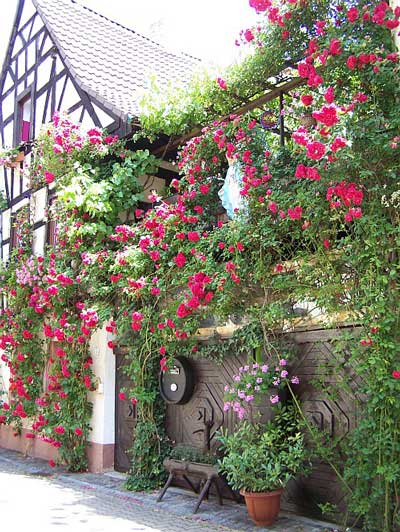
Wineries like this one on the German Wine Route in the Pfalz open their cellars to the public during local wine festivals.

In late August and early September, you can also indulge at the 10-day Rheingau Wine Festival in nearby Frankfurt, tasting more than 600 wines from the Rheingau region at 30 vintners’ stands set up in the “Fressgass” food street along Bockenheimer Strasse and the Opernplatz, and in the nearby shopping district along the Goethestrasse. Food stalls operated by local businesses provide the sustenance you’ll need to keep from getting totally tipsy on all that good Rhine wine.

Farther north along the Rhine, the Mittelrhein (Middle Rhine) region is also the site of several wine festivals in the picturesque villages that line the river valley, a UNESCO World Heritage Site that includes the city of Koblenz. Among other wine festivals in this region, the Middle Rhine celebrates “Golden Wine Autumn” on two Saturdays in October, with wine tastings, live music, dancing and spectacular fireworks displays. The best way to enjoy this special festival is to book a day-long cruise on a river boat that includes stops at the festival towns along the Rhine and concludes with fireworks that night.

Zwiebelkuchen (onion tart) is the traditional accompaniment to Federweisse (fermenting grape juice on its way to becoming wine) in the autumn.

Another popular region for wine festivals is along the Mosel River, where dozens of local celebrations are held from April to October. The largest and best known is the Wine Festival of the Middle Mosel in Bernkastel-Kues in early September, which includes fireworks at the Landshut Castle, crowning of the Middle Mosel Wine Queen, wine tastings at 30 booths and a colorful parade of vintners through the narrow streets of this beautiful half-timbered town. Another good option is to visit the Mosel for a week or so during harvest time, from August through October, when you can watch the grapes being picked and experience the smaller, more intimate wine festivals in the little villages lining the river between Koblenz and Trier.

There’s a long tradition of wine festivals in the Baden wine region, in southwestern Germany, which produces some of Germany’s finest wines. Baden is well known for its excellent cuisine, too, which attracts gourmets from all over Europe. Among the many wine festivals in this region, one is held in July in the pretty city of Freiburg, where you can taste wines from 40 Baden vintners.

One of the largest wine festivals in Germany is the Stuttgarter Weindorf (Stuttgart Wine Village), held in early September in the heart of the city, the capital of Baden-Württemberg, where 120 vendors sell 250 kinds of Württemberg wines, as well as classic regional Schwabian foods. Stuttgart claims this festival attracts more than a million visitors annually, which would make it even larger than the Bad Durckheimer Wurstmarkt.

And finally, the Franconia wine region, along the Main River, hosts a number of wine festivals, too, featuring Franconia’s excellent wines in their characteristic green Bocksbeutel bottles. Small festivals in the villages of the Main River valley, such as Sommerhausen and neighboring Winterhausen, are especially fun to attend, for their fine wines and local character.

Würzburg, the regional capital of Lower Franconia, is the site of the Würzburger Weindorf (Würzburg Wine Festival), where you can sample more than 100 kinds of Franconian wines at the booths and stands set up in the city center in late May and early June. Würzburgers like to party. In late August Würzburg hosts an 11-day Weinparade am Marktplatz (Wine Festival on the Market Square), offering a chance to taste more than 100 different wines from Würzburg’s local wineries, along with plenty of regional food specialties.

At many of the autumn wine festivals in Germany, the traditional food and drink are Zwiebelkuchen (onion tart) and Federweisser (one of the many German names for “new wine”), which is fermenting grape juice that’s still on its way to becoming real wine. Don’t be fooled by the pleasantly sweet taste of this bubbly, cloudy brew—usually served in .25-liter glasses—which you’ll want to quaff like thirst-quenching fruit juice. Be forewarned: Federweisser does contain alcohol, more or less depending on how long the fermentation has been going on, and it can easily seduce you into drinking so much that when you stand up you’ll wish you’d been more prudent.

For information about a variety of German wine festivals see:

For more information about specific German wine festivals see:

Savoring Sicily

Sunny climate, ancient ruins…and delicious cuisine on Italy’s largest island

By Sharon Hudgins
Photos by the author

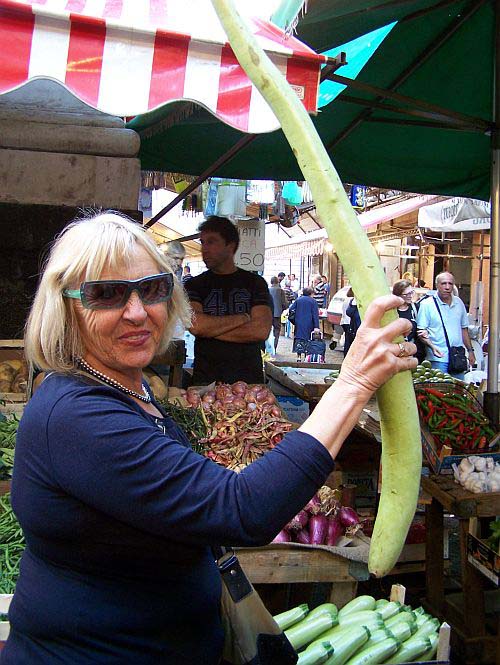
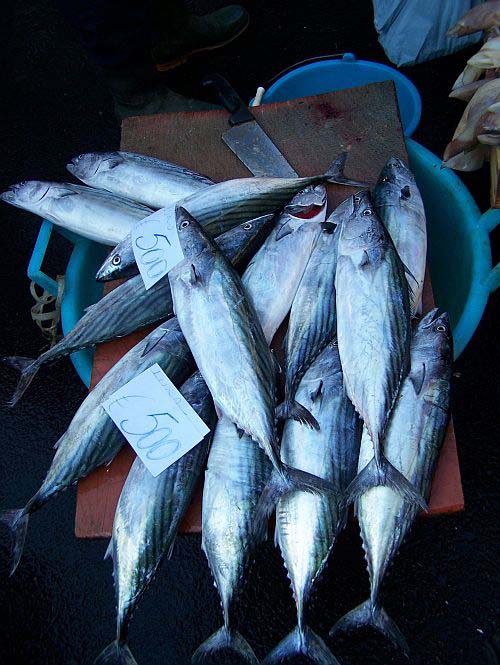
Savvy travelers have long known that Sicily is a part of Italy well worth seeing. But in recent years this largest island in the Mediterranean has suddenly become a popular tourist mecca, attracting visitors from all over the world. They come for Sicily’s sunny climate and rugged scenery, its ancient archeological sites, sleepy villages, historic cities and colorful markets, and to see nature’s own spectacle, Mt. Etna, Europe’s largest volcano, spouting steam from its fumaroles and sometimes spewing lava down its slopes.

Tourists come to taste Sicily, too—whether on short day trips from cruise ships docked near its shores, or on longer culinary tours (often with cooking classes included) that focus in depth on the history and variety of Sicilian cuisine.

CULINARY CROSSROADS
Located only two miles from the Italian mainland, Sicily has long been a magnet for invaders, colonizers, and rulers—from the early Phoenicians in 800 BC to the Germans, French, Spanish, Austrians and British at various times over the past one thousand years. But it was the ancient Greeks, Byzantines and Arabs who had the greatest influence on Sicilian cuisine.

The Greeks (800-200 BC) brought advanced agricultural methods and introduced new vegetables, fruits and fowl. They cultivated barley, wheat and millet, planted olive groves and vineyards, kept bees (for honey) and improved the breeding of livestock, especially sheep, which were important for cheese production. Even today, Sicily is famous for its ricotta and pecorino cheeses made from sheep’s milk.

The Romans (200-400 BC) focused on growing wheat on large landed estates, turning Sicily into a granary of the Mediterranean. But the influence of the earlier Greeks remained strong. When the Byzantines annexed Sicily to the Eastern Roman Empire (550-900 AD), Sicily was again immersed in Greek traditions and customs, including the kinds of foods favored on Sicilian tables.

During the relatively short time that Arab Muslims controlled Sicily (900-1100 AD), Sicily became one of the wealthiest and most progressive cultures of medieval Europe. The Arabs also had an important impact on the local cuisine. In addition to upgrading traditional agricultural practices, such as irrigation technology, they added a variety of new crops, including rice and sugar cane. They planted orchards of lemons, oranges, almonds and pistachios, and imported spices from Asia and the Middle East.

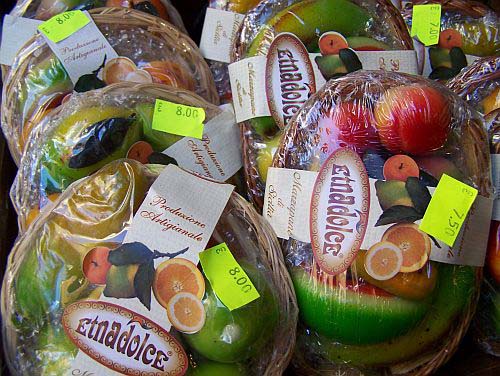
During this time the Sicilians developed their famous “sweet tooth.” Today Sicily is still renowned for its magnificent marzipan confections (crafted from sugar and almond paste); frozen-fruit treats (ice creams, sorbets and granitas); and cannoli dessert, deep-fried tubes of thin pastry made with Sicilian Marsala wine, stuffed with sweetened ricotta cheese combined with candied orange peel, chopped pistachios and chopped chocolate. All these seductive sweets have their roots in medieval Arab cuisine (except the New World chocolate, of course).

Even after the Norman French conquered Sicily at the end of the 11th century—and other Europeans came to rule over Sicily after that—local Arab culinary traditions remained strong on the island. When many Arab Muslims were forced out of Sicily by the Christian conquerors, the arts of Arab confectionery fortunately were not lost. As in Spain, with the later expulsion of Muslims from that country, the recipes were secretly and safely stowed away in Catholic convents, where the nuns made these sinfully sweet treats to give away as presents and later to sell to support their convents. Today these marzipan candies, chewy nougats and sugary pastries are among the most important culinary legacies of the Arabs in Sicily.

FEASTS & FESTIVALS
Holidays are often the best times for travelers to taste the special dishes of any country. Like the rest of Italy, Sicily celebrates many religious holidays every year, from small festivals honoring a local saint to national holidays observed throughout all of Italy. Festival foods range from ritual breads for Christmas and New Year, to cannoli during the spring Carnival season just before Lent, to little marzipan confections shaped like lambs for Easter.

For St. Joseph’s Day (March 19), Sicilians build ornate altars adorned with bread-dough decorations and fresh flowers in their homes, and each community prepares a special ritual meal, often with at least a hundred different dishes, to honor the good saint. Since St. Joseph is also the patron saint of pastry cooks, many of the festive dishes are sweet, including the traditional deep-fried, custard-filled “St. Joseph’s pastries.”

Easter is the time for highly decorated candy eggs, sweet breads and fancy cakes, especially Sicily’s cassata, a multilayered baroque concoction of sponge cake, marzipan, pistachio paste and sweetened ricotta cheese, glazed with white icing and ornately decorated with crystallized orange and pear wedges, curving ribbons of candied squash and grated chocolate.

In Palermo, the Feast of Saint Rosalia (July 13-15) features street foods sold from carts colorfully painted like old Sicilian farm carts: salted and sugar-coated nuts, toasted pumpkin seeds, roasted fava beans and pink-white-green-striped nougat candy. The traditional dessert eaten during this festival is gelato di campagna—not ice cream, as its name implies, but an elaborate confection-cake constructed of multicolored fondants. This rich confection looks like an ice cream cake with four layers: white (almond paste), brown (hazelnut paste), green (pistachio paste) and pink (strawberry paste)—all assembled in a cake mold and studded with pistachios and candied fruits.

For All Saints’ and All Souls’ Days at the beginning of November, Sicilian children receive special gifts supposedly from their deceased ancestors: pupi di cena, candy dolls shaped like knights, ballerinas, clowns and even contemporary figures like Batman, all made of melted sugar poured into molds and then painted in bright colors. Other traditional foods include colored marzipan shaped like fruits and vegetables; fava beans, a symbol of death, since this is a holiday honoring the dead; fave dei morti, little cookies shaped like fava beans; and ossi di morto (“bones of the dead”), cookies shaped like leg bones or skeletons, made of ground almonds, egg whites and sugar.

Roasted turkey and roasted chestnuts are traditional for St. Martin’s Day on November 11. Other typical Sicilian treats for this holiday include biscotti di San Martino, little hard, thrice-baked cookies flavored with anise, cinnamon or orange; and sfinci, fried beignets made of mashed potatoes and flour, sometimes filled with custard cream, and usually drizzled with honey.

On Saint Lucy’s Day (December 13), Sicilians eat arancine, potato-and-rice croquettes the size and shape of an orange, filled with meat or cheese and fried until golden. (These are also popular year-round in Sicily, a savory treat not to be missed!) Christmas Eve (December 24) is celebrated with eel or salted swordfish, followed by a large Christmas Day feast that includes nuts (symbols of fertility) and honey (so the coming year will be sweet). And Christmas in Sicily wouldn’t be complete without sweet almond torrone (nougat) and rich buccellato, a special wreath-shaped bread spiced with cinnamon, cardamom and cloves, filled with figs, raisins, almonds, walnuts and apricot jam, and decorated with candied fruits on top—a legacy of the culinary influence of those Greeks and Arabs who ruled Sicily so long ago.

For more information about the foods of Sicily see:

Eat Smart in Sicily, by Joan Peterson and Marcella Croce (Ginkgo Press, 2008), the best portable guidebook to Sicilian food, with a summary of Sicilian culinary history and a very good menu translator. You’ll definitely want to take this little book with you when you travel to Sicily.

Pomp and Sustenance: Twenty-five Centuries of Sicilian Food, by Mary Taylor Simeti (Knopf, 1989), probably the best single book you can read about the history of Sicilian food (republished in 2009 as Sicilian Food: Recipes from Italy’s Abundant Isle).

Bitter Almonds: Recollections and Recipes from a Sicilian Girlhood, by Mary Taylor Simeti and Mari Grammatico (Bantam Books, 2003).

Sweet Sicily: The Story of an Island and Her Pastries, by Victoria Granof (William Morrow Cookbooks, 2001).

Celebrating Italy, by Carol Field (William Morrow, 1990), which covers other regions of Italy, too, but includes much information about the festival foods of Sicily.

For more books about Sicilian cuisine, search “Sicily cooking” on Amazon.com.

Christmas in Paris

By Sharon Hudgins
Photos by the author

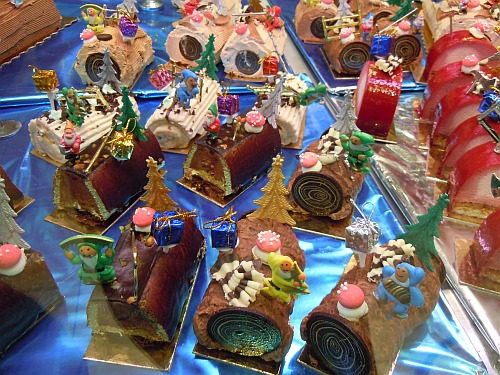
Parisian bakeries sell many versions of the traditional Buche de Noel (Yule Log) Christmas cake.

Paris is a great city to visit any time of the year—for fine foods, outstanding museums, and romantic walks along the Seine in the pink glow that often suffuses the city at twilight.

Many tourists want to see Paris in the spring. Remember the song, “April in Paris”? Or the movie of that name, with Ray Bolger and Doris Day? And who could forget Gene Kelly dancing among the blossoms with Leslie Caron in An American in Paris? But did you know that Paris is also a wonderful place to spend the winter holidays?

WINTER ROMANCE
Paris in winter has something for everyone. Open-air and indoor Christmas markets throughout the city. Nativity scenes and sacred music concerts in historic churches. Menorahs and special Hanukkah foods in the Jewish delis and bakeries. Strings of sparkling lights across the grand boulevards. Outdoor ice-skating rinks decorated with Christmas trees. Children’s noses pressed against the glass of department store windows animated with fanciful displays. Cheerful families toting wrapped packages in the subway. Smiling vendors at the food stalls. Even friendly waiters in the restaurants.

More than a dozen colorful Christmas markets brighten up the city, some open for only a few days in December, others lasting six weeks or longer, from the start of Advent (the fourth Sunday before Christmas) through Epiphany (Three Kings Day on January 6). Some Christmas markets specialize in products from a particular part of France, such as Alsace, whereas others feature handmade crafts by local artisans. Paris’s newest food fair, Noël Gourmand, is also held in December, at the Carrousel du Louvre, a glitzy underground shopping mall in the heart of the city. There you can taste French regional products such as artisanal cheeses from the Basque region, wines from the Loire, meats from the Ardennes, and sweets from Provence. And no Christmas market anywhere in Paris would be complete without roasted chestnuts, chewy nougat, and hot spiced wine.

CHRISTMAS DINNER
If you want to enjoy a special meal at a restaurant on Christmas Eve, make reservations early. Many restaurants are closed on the evening of December 24, and even more are shut on Christmas Day. A fun alternative is to pick up some good wine, cheese, bread, and a traditional French Christmas cake, a bûche de Noël (Yule log), to take back to your hotel for a private holiday picnic in your room. Then head to one of the gorgeous gothic churches for a memorable midnight service by candlelight.

You can feast even more lavishly if you rent an apartment through Airbnb or one of the other agencies that offer apartments in Paris year round. Have fun (and save money) by purchasing foods and wines at little local grocery stores and big open-air markets, then bring them back to your apartment for a cozy dinner at home. Even if you don’t want to cook, you can buy excellent prepared foods such as pâtés, cheeses, rotisserie chickens, cooked seafood, Burgundy beef stew, Spanish paella, North African couscous, fresh breads, and luscious French pastries at the delis, department stores, bakeries, and pastry shops all over Paris. Wine shops will also recommend the best vintages to accompany your store-bought meal. And if you don’t feel like lugging all that food back to your apartment, some stores will even deliver groceries and wines free of charge or for a small fee.

RING IN THE NEW YEAR
New Year’s Eve on December 31 is the time to party at a restaurant, with friends and strangers, until the early hours of the morning. Many Parisian restaurants offer a special Réveillon dinner, a fixed-price, multi-course, New Year’s Eve meal with champagne. Some smaller places charge as little as €50 per person (with wine extra), or you can splurge at the high-end eateries for several hundred euros apiece. Wherever you choose to eat, reservations are a must.

On a recent New Year’s Eve, my husband and I celebrated at Restaurant Polidor, a relic of France’s culinary heritage. Polidor still serves the same kind of simple, old-fashioned, very affordable comfort food like you could find in little Paris bistros half a century ago. Nothing trendy or minimalist-modern here—just small wooden tables covered with red-and-white checked paper tablecloths, bentwood chairs set close together, dark wood wainscoting, big mirrors on the wall, and plenty of nostalgia atmosphere. Filmgoers will recognize Polidor as the place in Woody Allen’s film, Midnight in Paris, where Gil Pender meets Ernest Hemingway back in the 1920s. And indeed, Polidor has been feeding the famous and the not-so-famous ever since it was established in 1845.

If you’re a cat lover and missing your own felines when you’re away from home, you can even celebrate New Year’s Eve in the company of 16 rescue cats at the cozy Cafe des Chats Bastille, one of Paris’s two cat cafes, where the furry friends roam free among the tables. And wherever you choose to party, you don’t have to worry about drinking that extra glass of champagne and staying out really late. From 6 p.m. on New Year’s Eve until 5 a.m. the next day, the Paris subway runs continually overnight, and it’s even free of charge.

GIFTS OF THE MAGI
Finally, finish up your Parisian holiday with a special treat on January 6, Three Kings Day. In all the pastry shop windows you’ll see round, flat pastries with a gold paper crown on top. These are galettes des Rois, the traditional King’s Cakes of northern France. A small porcelain or plastic prize is baked inside the cake, which is made from layers of puff pastry often with a frangipane filling. Whoever gets the slice with the prize inside is crowned “king for a day.” At some Three Kings Day parties, the prize-winner also has to buy drinks for everyone around the table.

So let Paris wish you not only a bon appetit, but also a Joyeux Noël (Merry Christmas), a Bonne Année (Happy New Year), and a Bonne Fête des Rois (Happy Three Kings Day) on your next trip to France!

For more information:

Paris Christmas markets 2016

Noël Gourmand 2016

Restaurant Polidor

Le Cafe des Chats

Apartment rentals in Paris (Airbnb)

Apartment rentals in Paris