Christmas Is a Time of Food and Fun

European Traveler has gathered Christmas holiday recipes from around Europe, and we present them here in a special tribute to the countries from which they come. You’ll find a variety of tasty foods in these selections, from desserts and breads to main dishes, to cookies and candies. As December progresses, we plan to add more, so stay tuned!

Please note that some of the recipes are in metric measurements and may need to be converted.

Bon Appetit!

AUSTRIA

VIENNESE VANILLA CRESCENTS (VANILLEKIPFERL)

Eva Draxler / Vienna Tourist Board

INGREDIENTS
1 1/2 sticks (6 ounces) unsalted butter
2/3 cup finely ground nuts (almonds or hazelnuts)
1/2 cup confectioner’s sugar
2 egg yolks
1 1/2 cups all purpose flour
dash of salt

PREPARATION
Knead all ingredients together quickly – keep them cool. Cool in refrigerator for several hours. When forming crescents, take out only the amount of dough you are working with. Form into large, sausage-like rolls with a diameter of about 2 inches. Cut thin slices and quickly roll each of them in the palms of your hands, thus forming small crescents. Place on greased cookie sheet. Bake at 325 degrees Fahrenheit for about 20 minutes. Let cool for no more than five minutes. While still warm, roll in vanilla sugar.

THE AZORES

HOTEL MARINA ATLANTICO
THE AZORES

Courtesy Monica Bensaude Fernandes/Bensaude Turismo

COD “COM TODOS” STYLE

INGREDIENTS
2 cod steaks
300 grs of cooked chickpeas
1 Portuguese cabbage
200 grs carrots chopped in thin circles
2 dls extra virgin olive oil
30 grs fresh coriander
1 salted pickled red pepper cut length wise
6 dry garlic cloves
200 grs crumbed corn bread
100 ml cream
Salt and white pepper
PREPARATION
Boil cod for 5 minutes. Remove skin and bones. Grate chickpeas in a tasse-vite. Add cream and season with salt and pepper. Blanch cabbage, drain and sauté in olive oil and garlic.
Sauté carrots in olive oil and garlic.
PLATE PRESENTATION
Using a rim, first layer chickpeas, and then carrots. On top, place cod, broken apart. Cover it with sautéed cabbage and lastly, the crumbed corn bread. Give it a little color by briefly placing in a very hot oven. Decorate with olive oil and fresh coriander.

DUCK BREAST WITH ORANGE AND DRIED FRUITS
INGREDIENTS
2 boneless duck breasts
300 grs red cabbage, julienned
4 oranges
300 grs potatoes, cut in extra fine rounds (chip style)
50 grs crushed walnuts
50 grs crushed pine nuts
50 grs S.Jorge cheese sliced thin
½ cup Brandy
Salt and white pepper
2 tablespoons balsamic vinegar
10 grs sugar
PREPARATION
Sauté duck in high heat for 5 minutes. Season with salt and pepper. Zest the orange. Set aside. Juice the oranges and add it to pan. Let it reduce and set aside the sauce. Bake potatoes in a fan format with the thinly sliced cheese on top. Sauté cabbage with a little olive oil. Add balsamic vinegar, sugar and dried fruit.
PLATE PRESENTATION
At the top, place the fanned potatoes. In the center, place red cabbage and beneath position the laminated duck. Cover with sauce and orange zest.

VEAL LOIN VERDELHO
INGREDIENTS
400 grs veal loin
300 grs potatoes
400 grs carrots
Verdelho wine from Pico Island
Onions
Leeks
Salt and pepper (local, if possible)
PREPARATION
Season veal with salt and pepper. Blush or sauté loin in high heat for 5 minutes. Remove veal, add onions and leeks and brown. Add red wine and let it reduce. Season and sift sauce. Grate carrots and sauté in a little olive oil. Bake potatoes, which have been previously stuffed with a bay leaf and bacon, in alternating cuts.
PLATE PRESENTATION
Place carrots at the center, potatoes in the back, veal in the front of plate, and cover with sauce.

GERMANY

MULLED WINE
(GLUHWEIN)
Victoria Keefe Larson/German National Tourist Office

Perfect for those dark and cold winter evenings.

INGREDIENTS:
2 bottles red wine
1 cup sugar
3 cups water
1 lemon, sliced
20 whole cloves
6 to 8 cinnamon sticks
1 orange, sliced for garnish

PREPARATION:
Mix water, lemon and spices and simmer for an hour. Strain. Heat but do not boil the red wine. Add wine to hot water mixture. Ladle into cups and serve with half a slice of orange.

HUNGARY
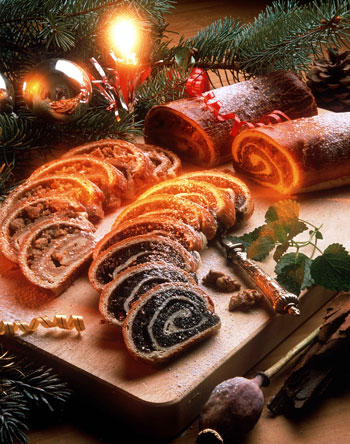
Dios es Makos beigli
Poppy seed and nut rolls (bagels)

From Culinary Hungary/courtesy Elvira Vida/Hungarian National Tourist Office

Makes 4 rolls; the filling ingredients are calculated for 2 rolls respectively.

INGREDIENTS
For the dough:
1 cup sugar
1/2 cup/120 ml milk
1 cake/15 g compressed yeast
1/2 cup/5O g confectioner’s sugar
3 1/4 cup/500 g flour
6 1/2 tbsp/100 g butter
6 1/2 tbsp/100 g lard
2 eggs
1 tsp grated lemon zest
pinch of salt

For the nut filling:
Scant 1/2 cup/100 ml milk
1OO g superfine sugar
1 envelope of vanilla sugar
1/2 tsp grated lemon zest
3 tbsp/30 g raisins
Pinch of cinnamon
3 cups/250 g ground nuts
3-4 tsp honey (or 1-2 apples or 2-3 tsp apricot jam)

For the poppy seed filling:
Scant 1/2 cup/lOO ml milk
1 1/4 cups/250 g confectioners sugar
1 sachet of vanilla sugar
1 2/3 cups/250 g ground poppy seeds
3 tbsp/30 g raisins
1 tsp grated lemon zest
4 tbsp honey

Other:
Butter or lard for the baking sheet
1 egg yolk for glazing

PREPARATION:
Dissolve the sugar in the lukewarm milk, then add the yeast. Mix the remaining dough ingredients wilh the yeast mixture and knead thoroughly. Cover the dough with a dish towel and leave to rise for about 30 minutes.

To make the nut filling, put the milk in a pan with the sugar and vanilla sugar and bring to a boil. Add the lemon zest, raisins, cinnamon, nuts, and honey (or peeled, grated apples or apricot jam).

For the poppy seed filling, mix the milk with the confectioners’ sugar and vanilla sugar. Bring to a boil and add the poppy seeds and raisins. Simmer for a few minutes, stirring constantly, then remove from the heat and stir in the lemon zest and honey.

Divide the dough into four and roll out each piece into a rectangle measuring about 12 x 14 inches/30 x 35 cm. Spread the dough with the nut or poppy seed filling and roll up lengthwise, ensuring that the rolls remain firm. Grease a baking sheet and carefully transfer the rolls onto the sheet and brush with egg yolk.

Bake in a preheated (medium) oven until golden brown. Only remove from the oven when completely cool. If kept covered and stored in a cool, dry place the bagel will stay fresh for a long time. Do not slice until just before serving, arranging the slices like roof tiles on a plate, and sprinkle with confectioners’ sugar.

PORTUGAL

REBANADAS CASA OS MOINHOS

INGREDIENTS

16 egg yolks
500 g sugar
1 kg Portuguese white bread
Cinnamon
Lemon

PREPARATION
Mix the eggs with 16 tablespoons sugar until it is a thick mix — make a thin syrup out of the rest of the sugar. Use one glass of water for this, then slice the bread, — after letting it sit for one day. Dip the slices into the syrup, drain, and dip in the egg yolk mix. Gently pan sear on a medium stove top, and sprinkle with cinnamon and lemon zest.

SPAIN

ROSCON DE REYES
(Holiday Bread)

This recipe is from The Foods and Wines of Spain by Penelope Casas
Courtesy Patricia Wood Winn/Tourist Office of Spain

No holiday is more eagerly awaited in Spain than El Dia de los Reyes Magos-the Day of the Three Kings (Epiphany) on January 6. On this date every year, so the legend goes, the Three Wise Men journey to Spain on camels, bearing gifts for all Spanish children. They use ladders to gain access to city apartments aud leave presents in the children’s shoes, which have been carefully laid out the night before, along with fodder for the hungry camels. Kids who have not been good during the year fear the worst: that the kings will fill their shoes with black coal instead of toys.

Rascon de Reyes is baked and eaten only at this time of year. It is a delicious sweetened bread, coated with sugar and candied fruits, and it always contains a surprise-either a coin or a small ceramic figurine, which is to bring luck for the year to the fortunate person who finds it in his piece of bread.

Makes 1 large bread ring

INGREDIENTS
1 package dry yeast
3/4 cup warm water
1 tablespoon orange flower water (often found in Italian food shops. If unavailable, substitute strong tea)
1/2 teaspoon grated lemon rind 6 cloves
1/4 pound butter
1 tablespoon lard or vegetable shortening
1/2 cup sugar
1/2 teaspoon salt
2 eggs
1 tablespoon brandy, preferably Spanish brandy, or Cognac
1/2 cup milk, scalded and cooled
5 cups unbleached, all-purpose flour
Candied fruit slices (orange, lemon, etc.)
1 egg, lightly beaten
1 1/2 tablespoons sugar, preferably coarse, for sprinkling

PREPARATION
Dissolve the yeast in 1/4 cup of the warm water. Simmer the remaining 1/2 cup of warm water with the orange flower water, lemon rind, and cloves for 10 minutes, covered. Cool. Discard the cloves. Cream the butter, lard, the sugar, and the salt. Beat in the 2 eggs, then add the brandy, milk, the water-and-lemon mixture, and the softened yeast. Gradually mix in the flour with a wooden spoon until a soft and slightly sticky dough is obtained. Knead on a floured working surface, adding more flour as needed, about 5 minutes, until smooth and elastic. Place the dough in a large oiled bowl, turn to coat with the oil, cover with a towel, and place in a warm spot, such as an unlit oven, to double in size, about 2 hours. Punch down and knead again 5 minutes. Insert a good luck coin – perhaps a silver dollar or half-dollar – or some other appropriate object, such as a cute miniature ceramic animal.

Shape the dough into a large ring, pinching the ends to seal. Place on a lightly greased cookie sheet. Decorate with the fruit slices, pushing them slightly into the dough. Let the ring rise in a warm spot about 1 hour, or until double in size. Brush with the egg, which has been mixed with a teaspoon of water, sprinkle with sugar, and bake in a 350° F oven 35-40 minutes, or until a deep golden brown.
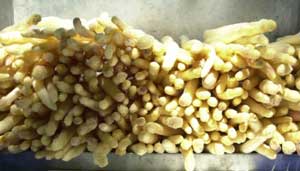
A Culinary Tour in Germany: Stalking White Asparagus in Baden-Wuerttemberg

In Germany, the arrival of asparagus, or Spargel, is an eagerly anticipated sign of spring.

Baden-Wuerttemberg is Germany’s third largest state and home to the famed Black Forest, the premier spa town Baden-Baden, Cuckoo clocks, and one of the most productive asparagus regions in Germany. Located in southern Germany and west of Bavaria, Baden-Wuerttemberg also borders France in the west and Switzerland and the Alps in the south.

In Germany, the arrival of asparagus, or Spargel, is an eagerly anticipated sign of spring. During the season, which lasts from April until mid-June, almost every eatery in Germany, from the tiniest Brauhaus to the most elegant restaurant offers a Spargelkarte, a special asparagus menu, in addition to their regular menu.

Although there are variations depending on the region, most have the same staples: asparagus with butter or hollandais; with cooked potatoes; and asparagus with salmon or ham. You can also choose between a serving of one pound or a half pound of asparagus; some restaurants even offer an all-you-can-eat feast. In Baden-Wuerttemberg a regional speciality awaits the hungry guest: Black Forest ham, a spiced and smoked version of ham.

Baden-Wuerttemberg has established an “Asparagus Road” which winds through some of the most famous asparagus producing towns in the region, including Schwetzingen, Reilingen, Karlsruhe and Rastatt. Along with asparagus farms, visitors can delight in various asparagus festivals and enjoy local asparagus dishes found along this scenic route. In fact, the sandy soil around Schwetzingen in Baden-Wuertemberg is ideal for growing asparagus, and it has helped this area become famous for its excellent quality of asparagus.

Once a year during the asparagus season Schwetzingen devotes an entire day to the “royal vegetable.” On “Asparagus Saturday” (May 3) a plethora of food stalls tempt visitors with asparagus-based delicacies, while dancing and music keep visitors entertained. The day just wouldn’t be the same without its asparagus peeling competition, and every year the program includes the crowning of the asparagus king. (www.schwetzingen.de – German only)

The Pfaelzer Forest in Baden-Wuerttemberg’s northwest corner is famous for its asparagus production and the spring festival celebrating this. In Buechenau the asparagus season is celebrated with creative and traditional asparagus treats, presented by local and international exhibitors from May 31 to June 2. (www.harmonie-buechenau.de – German only)

Europe’s largest asparagus festival however is held in Bruchsal, near Stuttgart, which lies on the Upper Rhine plain. Local and international vendors offer visitors a tasty delight from May 16 – 18. Visitors can also admire the baroque palace of Bruchsal with its magnificent Balthasar Neumann staircase. (www.germany-tourism.de)

Along with the tasty asparagus dishes goes another specialty of Baden-Wuerttemberg: the famous wines of the region. Mostly known for its red wines, the variety in Baden-Wuerttemberg ranges from the famous reds including “Trollinger” and “Spätburgunder” to white wines such as “Riesling.” The main production area is along the Neckar river between Stuttgart and Heilbronn. More wine is consumed in this region than anywhere else in Germany–actually twice as much! The grape varieties of the red wine Trollinger, Schwarzriesling and Lemberger are well-known even beyond Baden-Wuerttemberg’s borders and have received various international awards.

For more information also visit: www.tourismus-bw.co.uk

Chocolate Cravings

By Sharon Hudgins
Photos by the author

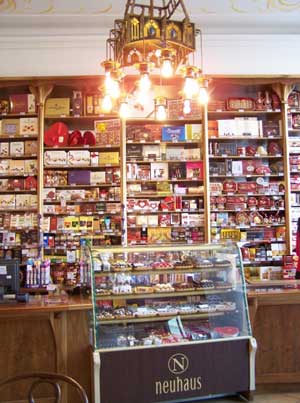
Crave chocolate? Do you salivate when someone utters those sweet syllables? Whether you call it chocolate (Spanish, Portuguese), xocolata (Catalan), chocolat (French), chocola (Dutch), Schokolade (German), Schoggi (Swiss-German), cioccolato (Italian), choklad (Swedish), sjokolade (Norwegian), czekolada (Polish), suklaa (Finnish) or okolaad (Estonian), it’s all the same: delicious!

As a woman at a Swiss chocolate factory told me, “You don’t need to know any other languages to talk about chocolate. Chocolate speaks for itself!”

FROM BEAN TO BAR
The Olmecs, Mayans, and Aztecs were enjoying chocolate as a drink for centuries before Christopher Columbus bumped into the Western Hemishphere on his way to the spice-producing lands of the East. Both Columbus and Hernán Cortés are credited with bringing cacao beans (from which chocolate is made) back to Spain in the early 1500s, where the Spanish eventually figured out that the bitter beverage of Central America tasted a lot better with sugar, vanilla and spices such as cinnamon and cloves added to the brew.

Sweet, foamy, dark and thick, hot chocolate soon became a favorite drink of the Spanish nobility, and Spain monopolized the market for cacao beans for nearly a century. In the 1600s, the popularity of chocolate—still consumed only as a beverage—began to spread to other parts of Europe, including France, England, Austria and the Netherlands. By the early 1700s, chocolate-drinking establishments in London were already competing with the popular coffeehouses there.

It was the Europeans who turned a ceremonial drink of the Aztec aristocracy into the affordable chocolate products that we enjoy today: chocolate powder, chocolate candy, chocolate syrup, chocolate spread.

In 1828 a Dutchman named Coenraad van Houten developed a process for removing the natural fat (cocoa butter) from the cacao beans and turning the remaining solids into powder. By the mid-1800s, European chocolatiers had figured out how to combine sugar and cocoa butter with a paste of ground cacao beans to make bars of “eating chocolate.”

The British were also pioneers in the development of chocolate technology, but the Swiss were the leaders in the field. Cailler, the first brand of Swiss chocolates, was established in 1819. In 1875, Daniel Peter in Switzerland invented milk chocolate, soon to be marketed by Nestlé. Four years later, Rodolphe Lindt created the world’s first “melting chocolate” for use in pastry- and candy-making. And in 1913, Jules Séchaud introduced a process for manufacturing filled chocolates. By that time, the Swiss were already the largest producers of chocolate in the world.

SWEET TOOTH
Today, the Swiss, Belgians, and Germans lead the world in chocolate consumption, happily eating 24 to 26 pounds of chocolate per person every year. The British, Austrians, and Norwegians are close behind, consuming 18 to 22 pounds each. And what tourist traveling in Europe can resist those triangular Toblerone and purple-packaged Milka bars, square Ritter Sports, round Mozart Kugeln, gold-wrapped Ferrero Rochers, fancy French and Belgian handmade bon-bons, chocolate Santas at Christmas, chocolate bunnies and cream-filled eggs at Easter time?

When I told a Swiss hotelier that I was surprised to learn that the Swiss eat an average of 12 kilograms (over 26 pounds) of chocolate per person annually, she looked surprised, too. “So little?” she asked incredulously. “I eat 200 grams of chocolate every day. Let’s see, that’s…”—she stopped to calculate in her head—”3 pounds each week, which is about 150 pounds a year. And I’m such a happy person!”

CHOCOLATE TOURS
Several countries in Europe have fascinating museums that focus on the history and process of making chocolate, from bean to bar. And many chocolate producers—from major multinational companies to small independent artisans—offer tours of their facilities, with a chocolate tasting included. The Swiss even have a Chocolate Train that takes you on a round trip from Montreux to visit the Cailler-Nestlé chocolate factory in Broc, as well as a cheese factory in Gruyères.

For more information on European chocolate museums and factory tours, check out the following sweet links:

Multi-country
www.chocolatetourism.com

Switzerland
www.alprose.ch
www.chocolatfrey.ch
www.schoggi-land.ch
www.cailler.ch
www.raileurope.com (search “Swiss Chocolate Train”)
www.goldenpass.ch (search “Swiss Chocolate Train”)

Germany
www.schokoladenmuseum.de

Belgium
www.mucc.be
www.choco-story.be

France
www.planetemuseeduchocolat.com
www.museeduchocolat.fr

Italy
www.museodelcioccolato.com
www.eurochocolate.com

Spain
www.pastisseria.com/en/PortadaMuseu

England
www.cadburyworld.co.uk

European Easter Egg Traditions

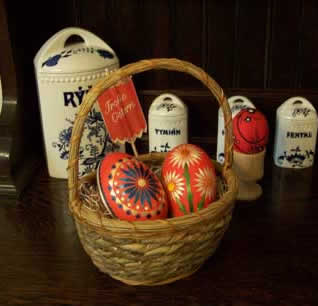
Goose and duck eggs from Poland, decorated with paint and colored straw.

By Sharon Hudgins
Photos by the author and courtesy German National Tourist Board

Europeans take their Easter egg traditions seriously.

From Scandinavia and Britain in the north to Italy and Greece in the south, from the Slavic countries to Germany, Romania and Hungary, eggs at Easter time are dyed in many colors, decorated with intricate designs, hung from tree branches, strung onto wires, buried in the ground, featured in games, exchanged among friends, baked into breads and taken to church to be blessed on Easter morning.

Easter egg tree at a Russian Orthodox church.

PRE-CHRISTIAN TRADITION
Although colored eggs are the most salient symbol of Easter today, their association with springtime reaches much farther into the past. Archeologists in Europe have uncovered egg-shaped artifacts with ornate designs made thousands of years before the Christian era.

Etched goose and duck eggs from the Czech Republic.

Folklorists say that decorated eggs were part of pagan spring festivals, for which eggs were painted in bright colors to symbolize blossoming plants. So it’s not surprising that the egg, representing the creation of new life, would also find a place in religious celebrations of the resurrection of Christ. The decorating of Easter eggs is a long-established folk art in many parts of Europe, still practiced today. During the 40-day Lenten fast preceding Easter, many Christians abstain from eating certain foods, including eggs. But the hens keep on laying. Some of these excess eggs are dyed a solid color: red is especially symbolic, representing drops of Christ’s blood as well as the regeneration of life.

Others are decorated with intricate floral or geometric motifs. Several countries and regions in Europe—Poland, Ukraine, Belarus, Moravia, Slovakia, Bohemia, Hungary, Slovenia, Romania, Germany, Austria—are well known for their production of beautifully decorated eggs, using age-old techniques and designs, many of which are unique to that particular place. The connoisseur of folk art eggs can tell at a glance whether an egg has come from the eastern or western part of the Czech Republic, from Slovakia, from northern Croatia or from central Austria.

Easter fountain in Ginsheim/Rhine near Mainz, Germany. Photo: Eric Eichberger

MAUNDY THURSDAY
In many parts of Europe, Maundy Thursday (the day before Good Friday) is the traditional day for decorating Easter eggs. Up through the 19th century, superstitions from earlier times survived in the belief that eggs laid on Maundy Thursday, Good Friday or Easter Sunday had magical powers: to prevent illness, to bring good luck, to act as an aphrodisiac, to ensure that the next baby will be a boy, to forestall an early death, to foretell the future. In some places, Easter eggs were fed to the livestock to protect the animals, or buried in the fields to help produce abundant crops. And Eastern European bee-keepers put a colored Easter egg under each hive to guarantee a good supply of honey.

A charming custom that dates from the 19th century is the making of an egg tree at Easter. Long branches of budding pussy willows or yellow forsythia are arranged in a vase, and eggs are hung on the branches like Christmas ornaments on an evergreen tree. Traditionally the eggs are hollow chicken or duck eggs, the whites and yolks first removed through pin holes before the eggshells are dyed and decorated, then a loop of ribbon or yarn pulled through the holes for suspending the eggs from the boughs. Sometimes brightly painted wooden eggs are also hung from the branches, along with little wooden birds. These egg trees are especially popular in Germany (where they’re known as Ostersträusse, Easter bouquets, or Osterbäume, Easter trees) and in several other parts of Central Europe, too.

Easter fountain in St. Wendel, in Germany’s Saarland region. Photo: Amt fuer Stadtmarketing, St. Wendel

OUTDOOR EASTER TREES
In some regions you’ll even see outdoor Easter trees, with real or plastic eggs suspended from the branches of live bushes or trees. In the Franconian Alps of northern Bavaria, the fountain or well in the center of many villages is decorated with garlands of evergreens, colorful streamers, fresh flowers and hundreds of painted eggs. For two weeks beginning on Good Friday, more than 200 of these traditional Osterbrunnen (Easter wells) are on display in Franconian towns.

In Europe today, Easter eggs are made from a wide variety of materials: natural egg shells—chicken, duck, goose—with the egg white and yolk blown out of the shell; uncooked eggs with their shells intact; hard-boiled eggs; edible substances such as sugar, chocolate and marzipan; precious metals, enameled metals, wood, wax, porcelain, onyx, marble, glass, cinnabar, cardboard and papier-mâché.

Decorations range from solid colors to painted, etched or batiked designs. Beads, lace, straw, colored paper and decals are also glued onto eggshells. The designs can be geometric, floral, symbolic—whatever suits the egg decorator’s fancy. And sizes extend from miniature jeweled eggs made with precious stones to the giant chocolate eggs, up to a meter tall, so beloved by Italian children.

An Easter egg tree decorated with eggs from many Central and Eastern European countries.

You can see hundreds of handcrafted eggs at the many Easter markets held in Europe during the spring. Prices range from just a few euros for simply painted hens’ eggs to several thousand euros for large exotic-bird eggs painted by internationally renowned artists. One of the most stunning eggs I saw at a Munich Ostereiermarkt (Easter egg market) was a huge ostrich egg acid-etched to look like lace. It was priced way beyond my budget, but I still came home with some lovely smaller samples of folk-art eggs by local artists. Now it’s time for me to find some pussy willow boughs and start decorating my own egg tree for the season.

Goose eggs from the Czech Republic, decorated with colored straw.

A SELECTION OF EUROPEAN EASTER EGG MARKETS

Germany
www.ostereier-maerkte.de/ (German only)
www.german-easter-holiday.com
www.voelkerkundemuseum.com

www.burgsatzvey.de/eng_index
www.volkskultur.sorben.com (German only)
www.ostereiermarkt.com (German Only)
www.ostern-in-deutschland.de (German only) 
www.stripes.com/

Austria
www.ostermarkt.co.at/
www.tyrol.tl/en/news_141
www.virtualvienna.net/

Czech Republic
www.pragueexperience.com
www.carnifest.com/
www.marys.cz/
www.jizni-morava.cz

Slovakia
www.goeasteurope.about.com

Poland
www.wieninternational.at

Hungary
www.budapesttimes.hu

Switzerland
www.swissinfo.ch

European Christmas Sweets

From Advent to Three Kings Day

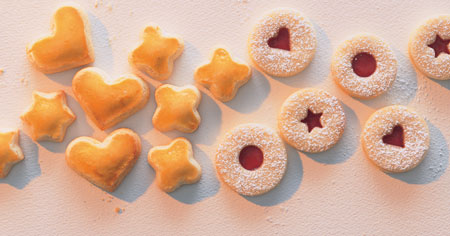
Two famous Swiss Christmas cookies: on the left are the Mailänderli, on the right, Spitzbuebli. Both will be devoured throughout Switzerland this season. Courtesy Swissmilk.ch/Ursula Beamish

by Sharon Hudgins

Christmas is my favorite holiday season in Europe. Advent, the period leading up to Christmas itself, begins on November 30 or on the fourth Sunday before Christmas, whichever comes first on the calendar. And in most places, the Christmas season doesn’t end until six weeks later, on January 6, known as Three Kings Day (or Epiphany).

Special foods are prepared and eaten at this time of year, some of them with roots in Europe’s pre-Christian past. During the cold, dark days leading up to the winter solstice (December 21 or 22) and Christmas (December 25), people have a natural craving for caloric cookies, cakes, and confections to tide them over until warmer, sunnier weather arrives. Yet not so long ago, Advent was a time of fasting for members of the Catholic Church, which forbade the consumption of butter, eggs, and other animal products during this holy period, in solemn preparation for the coming of the Christ Child.

Today, only a few people still deny themselves such temptations during the days leading up to Christmas. In many parts of northern Europe the annual Christmas baking binge begins as early as October, when home cooks make hundreds of cookies and dozens of cakes and puddings whose flavors are better if they “ripen” for several weeks before serving. Commercial bakers and confectioners hire extra help to produce thousands of holiday sweets for this most lucrative quarter of their business year. And colorful open-air Christmas markets in large cities and small towns sell the seasonal specialties of their own particular region.

Bakers in the British Isles start making their Christmas puddings several weeks or even months in advance of the special December day. Old-fashioned Christmas Plum Pudding—originally made with mutton, beefsteak, and fruits, including plums—has morphed in modern times into a dense, rich, dessert full of currants, raisins, and sultanas, with mixed fruit peel and candied cherries, steamed in a covered bowl and served with a brandy hard sauce made from sugar, butter, and brandy beaten together until fluffy. A sixpence coin is cooked inside the pudding, which supposedly brings good fortune to whoever finds it in his or her serving.

Also popular in Britain are a variety of fruit cakes, sometimes covered with a layer of marzipan and decorated with marzipan “fruits” and sprigs of holly—and small mince pies, their pasty cases filled with a fruity mincemeat mixture of apples, raisins, currants, sultanas, almonds, beef suet, brown sugar, and several spices. In earlier times, the oval shape of these mince pies was said to represent Christ’s crib, with the spices symbolizing the gifts from the East that the Three Kings brought to Bethlehem.

In Scotland, slices of densely textured Dundee Cake, filled with dried and candied fruits and decorated with almond halves on top, are served on “Boxing Day” (December 26). Buttery Scottish shortbread, taken with a dram of Scotch whisky, is traditional for the New Year. And in Ireland the holiday season is the time for loaves of fruit-and-nut-filled breads, as well as several kinds of round or oblong puddings made from wheat or potato doughs, sugar, spices, and dried fruits, wrapped in a cloth and boiled in a big cooking pot.

In the Scandinavian countries the Christmas season begins on St. Lucia’s Day (December 13), which is celebrated with coiled yeast buns colored with saffron. You’ll also find a number of yeast-raised Christmas breads (JulekakaJulekage) made with plenty of butter and eggs, filled with raisins, nuts, and candied fruits, and seasoned with cardamom. Norwegian Almond Ring Cake (Kransekake) is a tower of baked almond-paste rings, the largest on the bottom and the smallest on the top, fancily decorated with white icing. Crispy molasses-spice cookies called pepparkakor are popular throughout Scandinavia, where they’re made in many holiday shapes and sometimes hung as ornaments on the branches of a special “pepparkakor tree” made of wooden dowels. And a traditional Christmas Eve dessert is rice pudding, with a whole almond hidden inside. Whoever finds the almond will be married before the next Christmas (in Sweden) or will have a series of lucky adventures throughout the coming year (in Denmark).

The Netherlands, Belgium, and northern Germany are home to crispy brown Christmas cookies known as Speculaas or Spekulatius, the dough spiked with ginger or black pepper and pressed into special wooden molds that outline the cookies’ shapes and imprint designs on them. Cookies in the form of windmills and little sailor boys are especially popular. And throughout all of Germany, the Christmas season seems to bring out the best in home bakers, whose kitchens are filled with the aromas of sugar, yeast, spices, nuts, and candied fruits combined in myriad ways to produce some of Europe’s best-known holiday treats.

German gingerbread cookies (Lebkuchen) have been famous throughout Central Europe since the Middle Ages, especially those from the city of Nürnberg. The stiff dough made of rye or wheat flour, honey, almonds, hazelnuts, finely chopped candied fruit peel, and spices—ginger, cinnamon, nutmeg, cloves, allspice, cardamom, and coriander—is pressed into wooden molds that imprint intricate designs on the cookies. Other Lebkuchen cookies are made in simple shapes—circles, hearts, squares—and decorated with white or chocolate icing. No German Christmas season would be complete without plenty of Lebkuchen to nibble on during the entire six weeks from Advent to Epiphany.

Other traditional German Christmas sweets include flat, white, anise-flavored cookies (Springerle), made with pretty designs printed on them with wooden molds; spicy, round “pepper nuts” (Pfeffernüsse) containing ginger or black pepper; six-pointed “cinnamon stars” (Zimtsterne), redolent of that spice and covered with thick white icing; marzipan confections made of sweetened almond paste, shaped and colored to resemble tiny fruits, vegetables, animals, and other figures; Stollen, an oblong fruit-nut-raisin bread covered with a thick layer of confectioners’ sugar and said to represent the Christ Child in swaddling clothes; and Striezel, a braided bread whose three strands of dough symbolize the Holy Trinity.

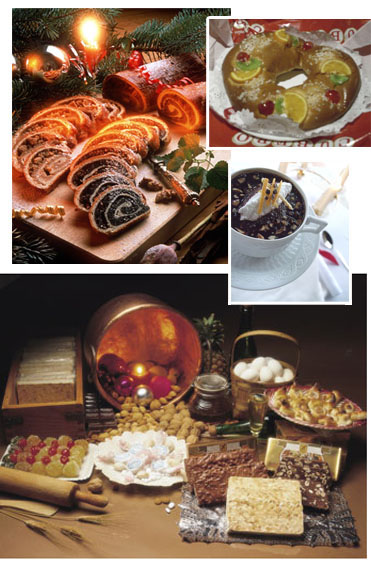
Holiday treats very similar to these can be found throughout Switzerland, Austria, the Czech Republic, Slovakia, Poland, and Ukraine. Many Poles and Ukrainians also begin their Christmas Eve dinner with kutia, an ancient kind of pudding made with whole wheat grains boiled with honey, figs, dates, raisins, nuts, lemon peel, and poppy seeds. And they conclude the meal with a sweet compote containing twelve kinds of dried fruits, symbolizing the Twelve Apostles. In Hungary, poppy-seed rolls and cakes are popular at this time of year, harking back to the pre-Christian era when the tiny seeds were eaten as a fertility charm on the night of the winter solstice to ensure a bountiful harvest in the coming year.

Christmas traditions are a bit different in the Latin lands. In France, especially in the south, it’s customary to have thirteen desserts for the Christmas Eve dinner that follows Midnight Mass—including fruits, nuts, dates, marzipan, nougat, and always a “Jule log cake” (Bûche de Noël), a long cylindrical cake rolled up around a buttercream filling and decorated on the outside with chocolate icing swirled to look like tree bark, with marzipan “leaves” and meringue “mushrooms” attached to the log-shaped cake. The French end the Christmas season with the celebration of Three Kings Day (January 6), when they eat a special “kings’ cake” (galette des Rois), a round, somewhat flat, golden-colored cake made of puff pastry, often enriched with an almond-paste filling, which has a single bean or a porcelain or plastic good-luck charm baked into it. Whoever finds the charm in his or her piece of cake becomes king for the day and gets to wear the gold-foil crown that was perched atop the cake when it was served.

In Italy, bakers turn out a number of yeasty Christmas breads (pane di Natale), full of butter, eggs, nuts, raisins, and dried and candied fruits. Particularly popular throughout the country is panettone from Milan, a tall, delicate, dome-shaped yeast bread studded with raisins, almonds, and candied orange peel. The northern Italians like their own Alpine fruit bread (Zelten), another yeast-raised bread chock full of dates, sultanas, candied citron, almonds, walnuts, and pine nuts, scented with cinnamon and cloves. The Italian sweet tooth finds satisfaction in all the confections traditionally eaten during the Christmas season, too, including chewy almond nougat (torrone) and marzipan; candied orange halves, candied pumpkin slices, and candied whole chestnuts; and medieval panforte from Siena, a flat, dense, highly spiced, confection-like fruit-and-nut cake containing almonds, hazelnuts, walnuts, pine nuts, honey, candied fruit peel, cinnamon, cloves, white pepper, and coriander seeds. And on Three Kings Day the Italians eat puff pastries filled with apricot preserves, as well as a type of sweet focaccia (flat bread) with a single black bean baked inside for the lucky eater who finds it and gets to be “king for the day.”

The Christmas season in Spain is a time for consuming large quantities of the confections for which the country is famous: marzipan from Toledo, often formed in fanciful shapes and sometimes decorated with white icing and colorful candied fruits; almond nougat (turrón), the hard variety from Alicante and the soft version from Jijona, as well as numerous other types of turrón containing hazelnuts, pine nuts, coconut, and chocolate; candied chestnuts; sugar-coated almonds; candied fruits and dried dates; the rich chocolates for which Spain is gaining an international reputation; and “fig bread” (pan de higos), a thick, chewy confection of dried figs, hazelnuts, almonds, and sesame seeds, flavored with grated orange peel and anise liquor.

The special meal on Christmas Eve in Spain often concludes with a sweet soup made of ground almonds, walnuts, or chestnuts, sprinkled with cinnamon. But for children the main event of the holiday season is Three Kings Day, when they receive gifts from the Magi who carried presents to the baby Jesus. As in other Latin countries, the traditional sweet is Three Kings Cake (Roscón de Reyes), a ring-shaped cake studded with raisins, nuts, and candied fruit, and with a coin, a bean, or a small toy baked into it—the lucky charm for the finder, who then gets to wear a king’s paper crown for the rest of the day.

The holiday season in Greece is also a time for indulging in sweets: pencil-thin bread-dough fritters fried in olive oil and drizzled with honey; coiled flaky baklava filled with ground almonds and roasted chick peas; spice cookies made with cinnamon, cloves, and olive oil, then soaked in a sweet syrup; delicate ground-almond cookies (kourabiedes) covered with a thick coating of confectioners’ sugar and with a whole clove baked inside to symbolize the spices that the Three Kings brought to the Christ Child.

Many kinds of special Christmas breads (Christópsomo) are baked in Greece during this season, too. Depending on each family’s own traditions, the Christmas bread might contain walnuts, almonds, raisins, dried figs, lemon or orange zest, cinnamon, cloves, coriander seeds, black pepper, and aniseeds. The shapes of these breads vary according to family preferences, too, as do the decorations on top, which range from symbolic shapes made of dough to sugar glazes and garnishes of chopped candied fruits. After the midnight church service on Christmas Eve, the family and guests gather around the table to share the Christmas bread. The first piece is set aside for Christ, and the rest is distributed among the diners, one of whom will find a coin baked into the bread, bringing that person the blessing of good luck. And on New Year’s Eve, the Greeks share another special bread called Vasilópita (St. Basil’s Bread), a yeast bread flavored with aniseeds or mahlepi seeds, honey, olive oil, and grated orange zest, sprinkled on top with sesame seeds and often decorated with the number of the new year made out of dough. The head of the household breaks the bread at the last stroke of midnight, giving a piece to each person at the table—and whoever finds the coin baked inside will have good fortune throughout the year.