Chocolate Cravings

By Sharon Hudgins
Photos by the author

Crave chocolate? Do you salivate when someone utters those sweet syllables? Whether you call it chocolate (Spanish, Portuguese), xocolata (Catalan), chocolat (French), chocola (Dutch), Schokolade (German), Schoggi (Swiss-German), cioccolato (Italian), choklad (Swedish), sjokolade (Norwegian), czekolada (Polish), suklaa (Finnish) or okolaad (Estonian), it’s all the same: delicious!

As a woman at a Swiss chocolate factory told me, “You don’t need to know any other languages to talk about chocolate. Chocolate speaks for itself!”

FROM BEAN TO BAR
The Olmecs, Mayans, and Aztecs were enjoying chocolate as a drink for centuries before Christopher Columbus bumped into the Western Hemishphere on his way to the spice-producing lands of the East. Both Columbus and Hernán Cortés are credited with bringing cacao beans (from which chocolate is made) back to Spain in the early 1500s, where the Spanish eventually figured out that the bitter beverage of Central America tasted a lot better with sugar, vanilla and spices such as cinnamon and cloves added to the brew.

Sweet, foamy, dark and thick, hot chocolate soon became a favorite drink of the Spanish nobility, and Spain monopolized the market for cacao beans for nearly a century. In the 1600s, the popularity of chocolate—still consumed only as a beverage—began to spread to other parts of Europe, including France, England, Austria and the Netherlands. By the early 1700s, chocolate-drinking establishments in London were already competing with the popular coffeehouses there.

It was the Europeans who turned a ceremonial drink of the Aztec aristocracy into the affordable chocolate products that we enjoy today: chocolate powder, chocolate candy, chocolate syrup, chocolate spread.

In 1828 a Dutchman named Coenraad van Houten developed a process for removing the natural fat (cocoa butter) from the cacao beans and turning the remaining solids into powder. By the mid-1800s, European chocolatiers had figured out how to combine sugar and cocoa butter with a paste of ground cacao beans to make bars of “eating chocolate.”

The British were also pioneers in the development of chocolate technology, but the Swiss were the leaders in the field. Cailler, the first brand of Swiss chocolates, was established in 1819. In 1875, Daniel Peter in Switzerland invented milk chocolate, soon to be marketed by Nestlé. Four years later, Rodolphe Lindt created the world’s first “melting chocolate” for use in pastry- and candy-making. And in 1913, Jules Séchaud introduced a process for manufacturing filled chocolates. By that time, the Swiss were already the largest producers of chocolate in the world.

SWEET TOOTH
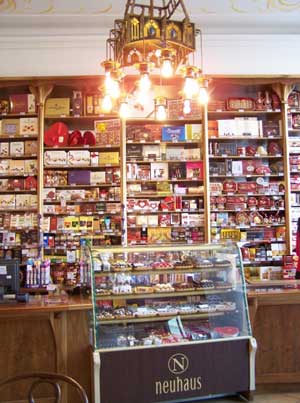
Today, the Swiss, Belgians, and Germans lead the world in chocolate consumption, happily eating 24 to 26 pounds of chocolate per person every year. The British, Austrians, and Norwegians are close behind, consuming 18 to 22 pounds each. And what tourist traveling in Europe can resist those triangular Toblerone and purple-packaged Milka bars, square Ritter Sports, round Mozart Kugeln, gold-wrapped Ferrero Rochers, fancy French and Belgian handmade bon-bons, chocolate Santas at Christmas, chocolate bunnies and cream-filled eggs at Easter time?

When I told a Swiss hotelier that I was surprised to learn that the Swiss eat an average of 12 kilograms (over 26 pounds) of chocolate per person annually, she looked surprised, too. “So little?” she asked incredulously. “I eat 200 grams of chocolate every day. Let’s see, that’s…”—she stopped to calculate in her head—”3 pounds each week, which is about 150 pounds a year. And I’m such a happy person!”

CHOCOLATE TOURS
Several countries in Europe have fascinating museums that focus on the history and process of making chocolate, from bean to bar. And many chocolate producers—from major multinational companies to small independent artisans—offer tours of their facilities, with a chocolate tasting included. The Swiss even have a Chocolate Train that takes you on a round trip from Montreux to visit the Cailler-Nestlé chocolate factory in Broc, as well as a cheese factory in Gruyères.

For more information on European chocolate museums and factory tours, check out the following sweet links:

Multi-country
www.chocolatetourism.com

Switzerland
www.alprose.ch
www.chocolatfrey.ch
www.schoggi-land.ch
www.cailler.ch
www.raileurope.com (search “Swiss Chocolate Train”)
www.goldenpass.ch (search “Swiss Chocolate Train”)

Germany
www.schokoladenmuseum.de

Belgium
www.mucc.be
www.choco-story.be

France
www.planetemuseeduchocolat.com
www.museeduchocolat.fr

Italy
www.museodelcioccolato.com
www.eurochocolate.com

Spain
www.pastisseria.com/en/PortadaMuseu

England
www.cadburyworld.co.uk

European Christmas Sweets

From Advent to Three Kings Day

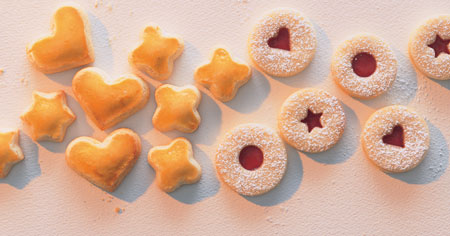
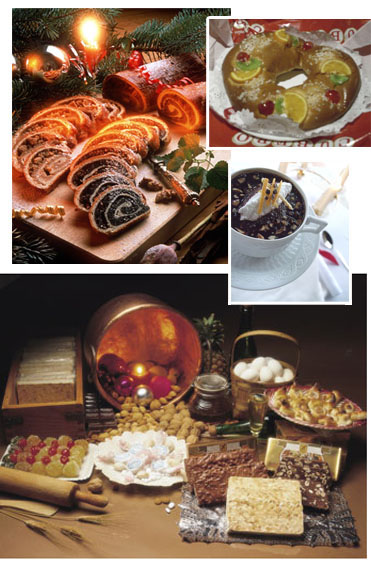
Two famous Swiss Christmas cookies: on the left are the Mailänderli, on the right, Spitzbuebli. Both will be devoured throughout Switzerland this season. Courtesy Swissmilk.ch/Ursula Beamish

by Sharon Hudgins

Christmas is my favorite holiday season in Europe. Advent, the period leading up to Christmas itself, begins on November 30 or on the fourth Sunday before Christmas, whichever comes first on the calendar. And in most places, the Christmas season doesn’t end until six weeks later, on January 6, known as Three Kings Day (or Epiphany).

Special foods are prepared and eaten at this time of year, some of them with roots in Europe’s pre-Christian past. During the cold, dark days leading up to the winter solstice (December 21 or 22) and Christmas (December 25), people have a natural craving for caloric cookies, cakes, and confections to tide them over until warmer, sunnier weather arrives. Yet not so long ago, Advent was a time of fasting for members of the Catholic Church, which forbade the consumption of butter, eggs, and other animal products during this holy period, in solemn preparation for the coming of the Christ Child.

Today, only a few people still deny themselves such temptations during the days leading up to Christmas. In many parts of northern Europe the annual Christmas baking binge begins as early as October, when home cooks make hundreds of cookies and dozens of cakes and puddings whose flavors are better if they “ripen” for several weeks before serving. Commercial bakers and confectioners hire extra help to produce thousands of holiday sweets for this most lucrative quarter of their business year. And colorful open-air Christmas markets in large cities and small towns sell the seasonal specialties of their own particular region.

Bakers in the British Isles start making their Christmas puddings several weeks or even months in advance of the special December day. Old-fashioned Christmas Plum Pudding—originally made with mutton, beefsteak, and fruits, including plums—has morphed in modern times into a dense, rich, dessert full of currants, raisins, and sultanas, with mixed fruit peel and candied cherries, steamed in a covered bowl and served with a brandy hard sauce made from sugar, butter, and brandy beaten together until fluffy. A sixpence coin is cooked inside the pudding, which supposedly brings good fortune to whoever finds it in his or her serving.

Also popular in Britain are a variety of fruit cakes, sometimes covered with a layer of marzipan and decorated with marzipan “fruits” and sprigs of holly—and small mince pies, their pasty cases filled with a fruity mincemeat mixture of apples, raisins, currants, sultanas, almonds, beef suet, brown sugar, and several spices. In earlier times, the oval shape of these mince pies was said to represent Christ’s crib, with the spices symbolizing the gifts from the East that the Three Kings brought to Bethlehem.

In Scotland, slices of densely textured Dundee Cake, filled with dried and candied fruits and decorated with almond halves on top, are served on “Boxing Day” (December 26). Buttery Scottish shortbread, taken with a dram of Scotch whisky, is traditional for the New Year. And in Ireland the holiday season is the time for loaves of fruit-and-nut-filled breads, as well as several kinds of round or oblong puddings made from wheat or potato doughs, sugar, spices, and dried fruits, wrapped in a cloth and boiled in a big cooking pot.

In the Scandinavian countries the Christmas season begins on St. Lucia’s Day (December 13), which is celebrated with coiled yeast buns colored with saffron. You’ll also find a number of yeast-raised Christmas breads (JulekakaJulekage) made with plenty of butter and eggs, filled with raisins, nuts, and candied fruits, and seasoned with cardamom. Norwegian Almond Ring Cake (Kransekake) is a tower of baked almond-paste rings, the largest on the bottom and the smallest on the top, fancily decorated with white icing. Crispy molasses-spice cookies called pepparkakor are popular throughout Scandinavia, where they’re made in many holiday shapes and sometimes hung as ornaments on the branches of a special “pepparkakor tree” made of wooden dowels. And a traditional Christmas Eve dessert is rice pudding, with a whole almond hidden inside. Whoever finds the almond will be married before the next Christmas (in Sweden) or will have a series of lucky adventures throughout the coming year (in Denmark).

The Netherlands, Belgium, and northern Germany are home to crispy brown Christmas cookies known as Speculaas or Spekulatius, the dough spiked with ginger or black pepper and pressed into special wooden molds that outline the cookies’ shapes and imprint designs on them. Cookies in the form of windmills and little sailor boys are especially popular. And throughout all of Germany, the Christmas season seems to bring out the best in home bakers, whose kitchens are filled with the aromas of sugar, yeast, spices, nuts, and candied fruits combined in myriad ways to produce some of Europe’s best-known holiday treats.

German gingerbread cookies (Lebkuchen) have been famous throughout Central Europe since the Middle Ages, especially those from the city of Nürnberg. The stiff dough made of rye or wheat flour, honey, almonds, hazelnuts, finely chopped candied fruit peel, and spices—ginger, cinnamon, nutmeg, cloves, allspice, cardamom, and coriander—is pressed into wooden molds that imprint intricate designs on the cookies. Other Lebkuchen cookies are made in simple shapes—circles, hearts, squares—and decorated with white or chocolate icing. No German Christmas season would be complete without plenty of Lebkuchen to nibble on during the entire six weeks from Advent to Epiphany.

Other traditional German Christmas sweets include flat, white, anise-flavored cookies (Springerle), made with pretty designs printed on them with wooden molds; spicy, round “pepper nuts” (Pfeffernüsse) containing ginger or black pepper; six-pointed “cinnamon stars” (Zimtsterne), redolent of that spice and covered with thick white icing; marzipan confections made of sweetened almond paste, shaped and colored to resemble tiny fruits, vegetables, animals, and other figures; Stollen, an oblong fruit-nut-raisin bread covered with a thick layer of confectioners’ sugar and said to represent the Christ Child in swaddling clothes; and Striezel, a braided bread whose three strands of dough symbolize the Holy Trinity.

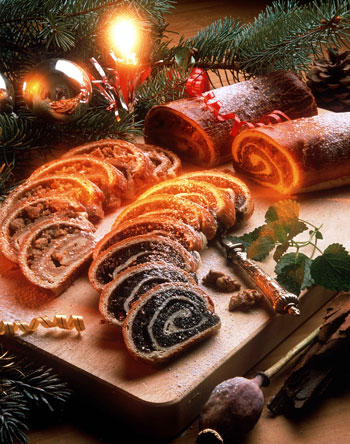
Holiday treats very similar to these can be found throughout Switzerland, Austria, the Czech Republic, Slovakia, Poland, and Ukraine. Many Poles and Ukrainians also begin their Christmas Eve dinner with kutia, an ancient kind of pudding made with whole wheat grains boiled with honey, figs, dates, raisins, nuts, lemon peel, and poppy seeds. And they conclude the meal with a sweet compote containing twelve kinds of dried fruits, symbolizing the Twelve Apostles. In Hungary, poppy-seed rolls and cakes are popular at this time of year, harking back to the pre-Christian era when the tiny seeds were eaten as a fertility charm on the night of the winter solstice to ensure a bountiful harvest in the coming year.

Christmas traditions are a bit different in the Latin lands. In France, especially in the south, it’s customary to have thirteen desserts for the Christmas Eve dinner that follows Midnight Mass—including fruits, nuts, dates, marzipan, nougat, and always a “Jule log cake” (Bûche de Noël), a long cylindrical cake rolled up around a buttercream filling and decorated on the outside with chocolate icing swirled to look like tree bark, with marzipan “leaves” and meringue “mushrooms” attached to the log-shaped cake. The French end the Christmas season with the celebration of Three Kings Day (January 6), when they eat a special “kings’ cake” (galette des Rois), a round, somewhat flat, golden-colored cake made of puff pastry, often enriched with an almond-paste filling, which has a single bean or a porcelain or plastic good-luck charm baked into it. Whoever finds the charm in his or her piece of cake becomes king for the day and gets to wear the gold-foil crown that was perched atop the cake when it was served.

In Italy, bakers turn out a number of yeasty Christmas breads (pane di Natale), full of butter, eggs, nuts, raisins, and dried and candied fruits. Particularly popular throughout the country is panettone from Milan, a tall, delicate, dome-shaped yeast bread studded with raisins, almonds, and candied orange peel. The northern Italians like their own Alpine fruit bread (Zelten), another yeast-raised bread chock full of dates, sultanas, candied citron, almonds, walnuts, and pine nuts, scented with cinnamon and cloves. The Italian sweet tooth finds satisfaction in all the confections traditionally eaten during the Christmas season, too, including chewy almond nougat (torrone) and marzipan; candied orange halves, candied pumpkin slices, and candied whole chestnuts; and medieval panforte from Siena, a flat, dense, highly spiced, confection-like fruit-and-nut cake containing almonds, hazelnuts, walnuts, pine nuts, honey, candied fruit peel, cinnamon, cloves, white pepper, and coriander seeds. And on Three Kings Day the Italians eat puff pastries filled with apricot preserves, as well as a type of sweet focaccia (flat bread) with a single black bean baked inside for the lucky eater who finds it and gets to be “king for the day.”

The Christmas season in Spain is a time for consuming large quantities of the confections for which the country is famous: marzipan from Toledo, often formed in fanciful shapes and sometimes decorated with white icing and colorful candied fruits; almond nougat (turrón), the hard variety from Alicante and the soft version from Jijona, as well as numerous other types of turrón containing hazelnuts, pine nuts, coconut, and chocolate; candied chestnuts; sugar-coated almonds; candied fruits and dried dates; the rich chocolates for which Spain is gaining an international reputation; and “fig bread” (pan de higos), a thick, chewy confection of dried figs, hazelnuts, almonds, and sesame seeds, flavored with grated orange peel and anise liquor.

The special meal on Christmas Eve in Spain often concludes with a sweet soup made of ground almonds, walnuts, or chestnuts, sprinkled with cinnamon. But for children the main event of the holiday season is Three Kings Day, when they receive gifts from the Magi who carried presents to the baby Jesus. As in other Latin countries, the traditional sweet is Three Kings Cake (Roscón de Reyes), a ring-shaped cake studded with raisins, nuts, and candied fruit, and with a coin, a bean, or a small toy baked into it—the lucky charm for the finder, who then gets to wear a king’s paper crown for the rest of the day.

The holiday season in Greece is also a time for indulging in sweets: pencil-thin bread-dough fritters fried in olive oil and drizzled with honey; coiled flaky baklava filled with ground almonds and roasted chick peas; spice cookies made with cinnamon, cloves, and olive oil, then soaked in a sweet syrup; delicate ground-almond cookies (kourabiedes) covered with a thick coating of confectioners’ sugar and with a whole clove baked inside to symbolize the spices that the Three Kings brought to the Christ Child.

Many kinds of special Christmas breads (Christópsomo) are baked in Greece during this season, too. Depending on each family’s own traditions, the Christmas bread might contain walnuts, almonds, raisins, dried figs, lemon or orange zest, cinnamon, cloves, coriander seeds, black pepper, and aniseeds. The shapes of these breads vary according to family preferences, too, as do the decorations on top, which range from symbolic shapes made of dough to sugar glazes and garnishes of chopped candied fruits. After the midnight church service on Christmas Eve, the family and guests gather around the table to share the Christmas bread. The first piece is set aside for Christ, and the rest is distributed among the diners, one of whom will find a coin baked into the bread, bringing that person the blessing of good luck. And on New Year’s Eve, the Greeks share another special bread called Vasilópita (St. Basil’s Bread), a yeast bread flavored with aniseeds or mahlepi seeds, honey, olive oil, and grated orange zest, sprinkled on top with sesame seeds and often decorated with the number of the new year made out of dough. The head of the household breaks the bread at the last stroke of midnight, giving a piece to each person at the table—and whoever finds the coin baked inside will have good fortune throughout the year.

European Easter Breads

A Mix of Symbolism and Satisfying Taste

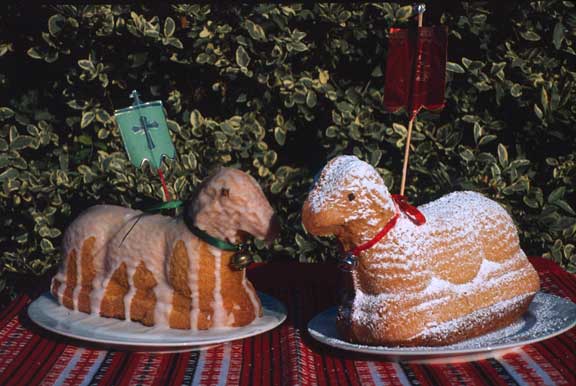
Lamb-shaped cakes and breads for Easter are made in the Alsace region of France, as well as in Germany, Austria and Eastern Europe. Photo by Sharon Hudgins


by Sharon Hudgins

When the Easter season approaches, European kitchens are filled with the yeasty aromas of freshly baked breads, as cooks all over the Continent prepare the special loaves and buns traditionally associated with this important religious holiday.

In the past, devout Christians observed a strict fast during Lent, the six or seven weeks before Easter, when they abstained from eating animal products of any kind: red meat, poultry, milk, butter, lard, cheese and eggs.

In some parts of Europe, even sugar, honey, olive oil, and certain kinds of fish were on the list of forbidden foods. When Easter finally arrived, people celebrated with a huge meal featuring dishes made from all the ingredients that had been prohibited during Lent. Even though few people follow such strict fasts today, the tradition of feasting on special foods at Easter is still an important part of many European cultures.

Rich, yeast-raised breads full of milk, butter and eggs are an essential element of the Easter meal in most European countries. Often the breads are made in symbolic shapes and elaborately decorated with sugar icing, candied fruits or colored eggs. Homemade or bakery bought, these breads represent a continuity of traditions from centuries past, including much earlier, pre-Christian times.

Different countries, regions and towns of Europe have their own characteristic breads baked especially for Easter. In some places, these special breads are taken to church to be blessed at the Easter midnight mass or the Easter Sunday morning service, before proudly being displayed on the festive dinner table at home. And in Russia and many Eastern European countries, the table also has a little three-dimensional lamb modeled out of butter, for spreading on the bread after it is cut.

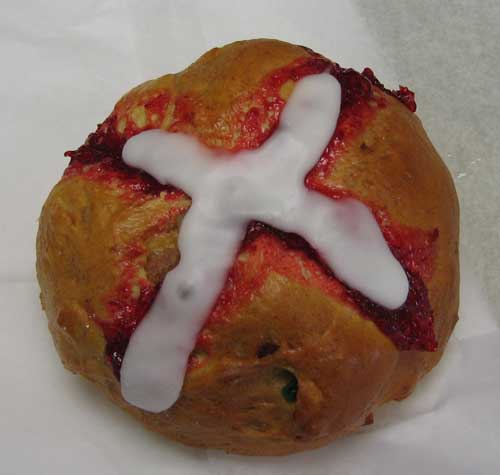
Hot cross buns are an Easter favorite.
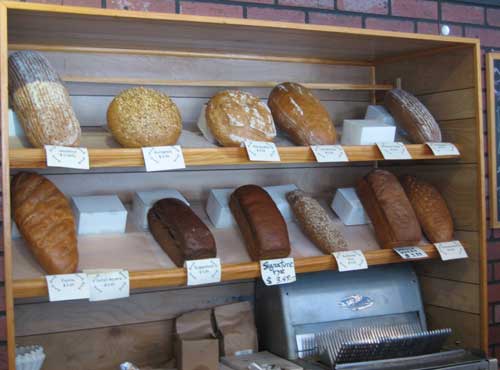
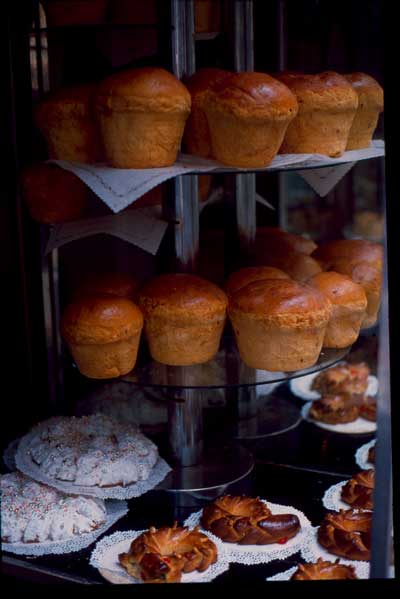
Breads of all kinds are offered at Easter-time; these were baked by Michael Mikusch at his Austrian bakery.

GERMANY AND CENTRAL EUROPE

Bakers in Germanic communities make Easter breads in a variety of shapes, secular and religious. Breads shaped like rabbits, lambs, baby chicks and fish are symbols of springtime, fertility and birth. Braided loaves—long and straight, round or wreath-shaped—are made with three strands of dough representing the Holy Trinity of Father, Son and Holy Spirit. Germans and Austrians make several versions of Osterzopf (Easter braid), Osterkranz (Easter wreath or crown), and Striezel (stacked braided bread), as well as Osternester (Easter nests) or Eier im Nest (Easter-egg nest) with white or colored hard-boiled eggs surrounded by the dough. The circular braided Osterkranz is also symbolic of Christ’s crown of thorns, and the red-dyed eggs decorating many Easter breads are said to represent Christ’s blood and resurrection—although the egg’s significance as a symbol of rebirth and regeneration actually dates further back in time to the pre-Christian era.

Other special Germanic Easter breads include the Osterfladen—a flat, rectangular bread with a sweet filling of apples, raisins and almonds—and several varieties of Osterbrot (Easter bread) flavored with raisins, currants, candied orange peel, grated lemon zest, anise and cardamom. The Osterkarpfen (Easter carp) is a bread shaped like a fish, glazed with white icing, and studded with sliced almonds to represent fish scales. Germans also make Osterkorbe breads formed like Easter baskets and rabbit-shaped Osterhasen breads, all of them holding real or candy eggs. And the Eiermännle (Little Egg Man) is a flat bread shaped like a boy or man, with an unshelled hard-boiled Easter egg baked in the center of his body or inside a basket that he carries on his back.

Lamb-shaped cakes and breads can be found at Easter-time from Alsace to Austria, from Germany to the Czech Republic, Poland, Slovakia and Hungary. Baked in three dimensional metal or pottery molds, these represent Christ as the sacrificed Lamb of God, although their origin can probably be traced to earlier, pre-Christian rites in which baked dough effigies of sacrificial animals were substituted for live animals. Lamb breads are made from the same kind of sweet, yeast-raised doughs used for Alsatian Kugelhopf, Austrian Gugelhupf,and Polish baba (or babka). The cake versions are made from a simple white cake batter, although both chocolate and marble (mixed chocolate and white) lamb cakes sometimes show up in the flocks of Easter lambs sitting in bakery windows at this time of year.

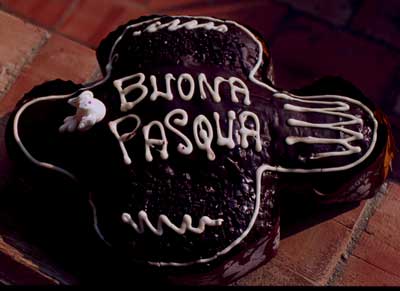
The simplest lamb breads and cakes are merely dusted with a coating of confectioners’ sugar or drizzled with a light glaze of sugar icing. More elaborate cakes are covered with fluffy white frosting, sometimes garnished with shredded coconut, or spread with chocolate icing decorated with white icing swirls. The eyes are made from raisins, whole cloves, or coffee beans, and a small silk ribbon, often with a tiny bell attached, is tied around the lamb’s neck. Many of these lambs also hold a colored foil banner bearing the emblem of a lamb or a cross—recalling similar banners carried by Christian crusaders to the Holy Land a thousand years ago.

When you’re in Europe around Easter, look for the special Easter breads in local bakeries. You’ll likely be tempted by all the good pastries as well.
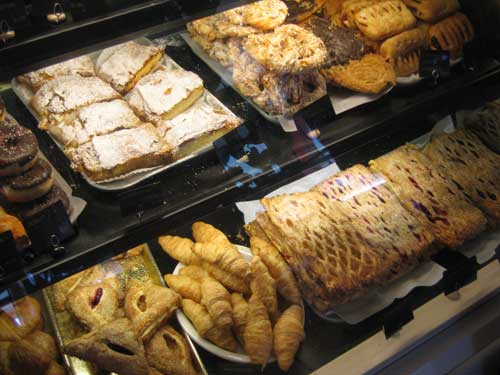
This shop offers Austrian breads and pastries which are as good as they look.

ITALY

Italy offers a rich variety of regional Easter breads, including Genoa’s pane dolce (sweet bread) full of raisins, candied fruit peel and pine nuts; Umbria’s cylindrical, cheese-flavored crescia; Venice’s large fugassa di Pasqua buns; and Cesenatico’s ring-shaped ciambelle, seasoned with anise and lemon peel. In Sicily, the edible centerpiece of the Easter meal is a large yeast bread shaped like a crown, with colored hard-boiled eggs embedded in the top. In some parts of Italy an old custom is still followed when Easter breads are made: the shell of the first egg put into the dough is cracked on the head of a young boy—supposedly to keep bad luck at bay.

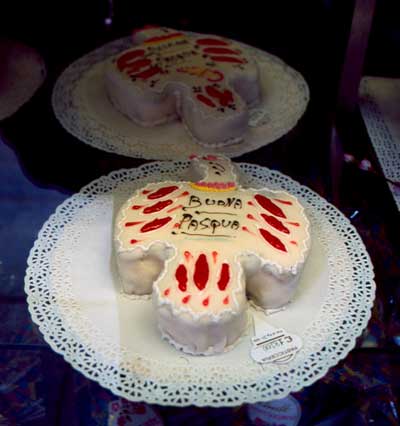
The Easter bread most popular throughout all of Italy is a specialty originally from Lombardy—the columba di Pasqua (or columba pasquale), a sweet yeast bread full of candied orange peel, raisins, and almonds, made in the shape of a dove. Some of the fancier columbe have pockets of orange- or champagne-flavored pastry cream inside. Others are made with swirls of light and dark (chocolate-flavored) dough, like marble cakes. The plainest ones are garnished with only a simple sugar glaze, but the more elegant columbe are elaborately decorated with almond paste, white or pastel icing, chocolate, nuts or sugar-paste flowers.

(bottom left and right) Italian Easter dove cakes (columbe di Pascua) are a symbol of springtime, the Holy Spirit, and peace.; Italian cheese-flavored crescia loaves for Easter, at a bakery in Umbria

GREECE

Maundy Thursday, three days before Easter, is the time when Greeks bake their holiday breads. Known as tsoureki or lambropsomo, these sweet, eggy breads are traditionally flavored with mahlepi, an unusual spice made from the finely-ground seeds of a type of cherry. Other Greek bakers add mastikha, pulverized crystals of sap from mastic shrubs that grow on the island of Chios. Cinnamon, nutmeg, cardamom and allspice can also go into the dough, as well as orange and lemon peel.

Greek Easter bread is made in different shapes from one region to another: a long braid, a braided wreath, a round loaf with bread-dough decorations on top in the form of leaves, flowers or a Byzantine cross. Each shape has its own symbolism. The three strands of braided dough represent the Holy Trinity. Wreaths and rings not only recall Christ’s crown of thorns but are also pre-Christian fertility symbols. Round shapes represent the life-giving sun, rebirth and resurrection. And no Greek Easter bread would be complete without one or more red-colored eggs—customarily dyed on Maundy Thursday—pressed into the top before baking.

SPAIN

The Spanish corona de Pascua (Easter crown) is another bread whose shape and symbolism is similar to Easter breads in many Mediterranean countries. Made from a sweet yeast-raised dough, the corona de Pascua is flavored with raisins, almonds, candied fruit peel, lemon and olive oil. Three strands of dough are first braided together, then formed into a ring. Whole, hard-boiled eggs are nestled into the top of the braid, usually one egg for each member of the family. Some people leave the eggshells white; others dye them red or a variety of spring colors.

Another Spanish Easter bread known as monja (nun) probably got its name from the nuns who traditionally baked breads, pastries and confections to sell from behind their convent walls. This orange-flavored bread—much like ones also found in Greece, Macedonia and Bulgaria—is round in shape, with a cross made of bread dough on top and four red-dyed eggs embedded at each point of the cross.

In the Castile region of Spain, Easter is celebrated with a large round loaf of bread in which shelled hard-boiled eggs, diced bacon,and chunks of Spanish sausages were imbedded in the dough before baking. And at Easter-time in some parts of Spain, godparents give their godchildren tortas de aceite, small savory buns made from yeast dough seasoned with orange, anise, and olive oil, with a single hard-boiled egg nestled in the center.

RUSSIA AND UKRAINE

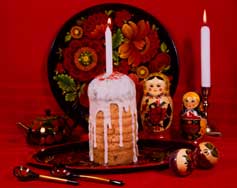
Since Easter is a springtime celebration of new life, it’s not surprising that many traditional Easter breads are made in the form of ancient fertility symbols. The most graphic of these are the tall, cylindrical breads with a puffy dome on top, whose phallic symbolism is unmistakable. Festive breads of this shape are made in both France and Italy, but the most famous is Russia’s kulich, a saffron-scented yeast bread flavored with raisins, almonds and candied fruit peel. The domes are frosted with white icing that dribbles down the sides in a further reinforcement of the fertility image. The kulichi can also be decorated with colored sugar sprinkles or candied fruits, and a long thin red candle is usually stuck into the top of the dome. On Easter, Russian Orthodox churches are often filled with these special breads, their candles lighted, awaiting blessing by the priest.

Velikodnia babka is the Ukrainian version of this tall, yeasty Easter bread, with raisins, almonds and candied peel kneaded into the dough. Another traditional Ukrainian Easter bread is velikodnia paska, made from a rich yeast dough containing plenty of butter, sugar, and eggs, and shaped into large rounds. The tops are fancily decorated with ornaments made out of dough, usually with a cross as the center motif surrounded by elaborate swirls, small birds, leaves,or flowers. Perekladnets is a special, colorful Easter treat, a kind of coffee-cake loaf made with lemon-scented yeast dough and three different layers of filling: chopped dried peaches or apricots with candied fruits; chopped figs, dates and walnuts; and chopped almonds with candied cherries.

Russian kulich, a tall cylindrical Easter bread often baked in a coffee can.

GREAT BRITAIN

Hot-cross buns are the most typical Easter bread in Great Britain. Baked on Good Friday, these round, slightly sweet buns often have chopped fruit peel and currants, raisins or sultanas in the dough. A cross is cut into the top of each bun before baking, or a strip of dough is used to make the form of a cross on top, to keep away evil on this sad day of remembering Christ’s crucifixion.

In some parts of Britain, a hot-cross bun is hung up in the house to keep away bad luck (fire, theft, illness) until Good Friday of the following year. Buns are also hung in the barns to protect the grain from rodents. As in the rest of Europe, these British hot-cross buns are an example of the powerful symbolism of breads baked for the Easter season.

Chill Out With Cool Summer Soups

Photos courtesy World Soups

By Sharon Hudgins

Now that global warming seems to be raising temperatures in Europe, you can beat the heat on your next summer trip by eating cold soup. That’s right. If the thought of eating a chilled soup leaves you cold, think again. Chilled soups have been popular in Europe for centuries, from Scandinavia in the north to Spain in the south. Why not try them yourself?

Some of these soups are made with fruits and berries, often combined with milk products. Others are based on vegetables and meat stocks, sometimes spiked with wine. They can be cooked or uncooked, thick or thin, smooth or chunky, sweet or savory, plain or garnished.

Most cold soups are eaten at the start of a meal, but in elaborate dinners they are sometimes served as palate cleansers between courses. In various parts of Europe, chilled soups are also eaten for breakfast, for snacks, as a main dish of a light meal and even for dessert. Some cold soups are considered solely summer fare, whereas others are served year round.

The next time you travel in Europe, look for these classic chilled soups, some of which are regional or national specialties.

SCANDINAVIA
The Scandinavians have a large repertoire of colorful cold soups made from fruits and berries (fresh or dried, bottled or frozen). The bounty of summer’s harvest turns up in many Scandinavian soup bowls: apples, cherries, apricots, plums, peaches and pears; blueberries, cranberries, raspberries, lingonberries, strawberries, blackberries, gooseberries, currants and raisins; and even other ingredients such as rhubarb and rosehips. Often these are combined with buttermilk, soured milk, yoghurt or sour cream, with a little lemon juice, sugar and cinnamon added, too.

Uncooked cold soups of this type are made simply by mixing the fruits and berries with the liquid and other flavorings, which are mashed together or puréed in a blender or food processor (much like a fruit smoothie). Cooked cold soups start with heating the ingredients together, then thickening them with flour, potato starch, cornstarch, arrowroot, sago, tapioca, semolina, ground rice or beaten eggs, before the soup is chilled for serving. Often these cold soups are garnished with a dollop of whipped cream or with heavy cream poured over the top.

The Danes make a cold buttermilk soup, which can be cooked or uncooked, seasoned with sugar and lemon juice and thickened with eggs or ground rice. Sometimes this pale-colored soup is poured over crumbled oatcakes in a bowl, topped with whipped cream and served at the end of a meal.

Surely the most famous Danish cold soup is rødgrød—literally “red groats”—a kind of thin pudding made from red fruits and berries (cherries, red raspberries, strawberries, red currants) cooked together, lightly thickened, then served cold, garnished with milk or cream. Occasionally blueberries, blackberries and black currants are added, which give the mixture a deeper, darker color. Considered a “national dish” of Denmark, this chilled pudding-soup is actually very popular throughout the Nordic countries, where you’ll find it on the table for breakfast, served as a soup before the meat course of the day’s main meal, or eaten as a summer dessert.

GERMANY & AUSTRIA
Rote Grütze is the German version of this same dish. It’s considered a specialty from the northern part of Germany, particularly the region of Schleswig-Holstein (near Denmark), where it’s known as Rodgrütt. You’ll now find Rote Grütze served throughout Germany, especially in the summer, from hotel breakfast buffets to the dessert menus of fancy restaurants, from beer halls to local festivals—the ruby-red mélange is topped with vanilla sauce, whipped cream or vanilla ice cream.

In the German language, cold soups in general are called Kaltschalen (“cold bowls”). Germans and Austrians both enjoy a variety of cold fruit-and-berry soups, at the beginning or end of a meal, as much as their northern neighbors do. Germans also make a chilled beer soup with currants and grated pumpernickel bread, seasoned with lemon, sugar, cinnamon and cloves, and garnished with pumpernickel croutons or little airy egg-white dumplings; cold spiced red or white wine soup, adorned with crunchy almond macaroons; a refreshing buttermilk soup embellished with stewed fruit or whipped cream; and a pale-green sorrel soup containing dill, sour cream, diced cucumbers and chopped hard-boiled eggs, served with an ice cube in each bowl.

The Austrians have their own versions of cold wine soups, such as lemon soup with sugar, egg yolks and white wine, sprinkled with a dusting of ground cloves, and a rich beef consommé (clarified meat stock) spiked with dry white wine, with a thin slice of orange and some finely chopped parsley floating on top. Austrian cold tomato soup combines white wine with a purée of tomatoes and onions cooked in beef stock, spiced with garlic and paprika, and with finely chopped cucumbers stirred into the soup just before serving.

The Austrians also like lightly gelled cold consommés enhanced with chilled green grapes, diced ham and minced herbs (parsley, chives, chervil, tarragon). And the unusual Austrian Kalte Paradeissuppe (Cold Paradise Soup) consists of chilled cantaloupe, cucumber and melon balls in a shallow soup plate surrounded by a cold purée of tomatoes and sour cream with strips of cooked ham, decorated with chopped parsley and mint—a combination worthy of being labeled “Baroque.”

POLAND, UKRAINE & BELARUS
Cold soups are as prevalent in Eastern Europe as in the central and northern parts of the continent. Poland in particular has a rich heritage of chilled soups based on a variety of fruits, berries and vegetables mixed with meat stocks, dairy products and pickled or fermented foods that give a slightly sour taste to some of these soups.

Sweet soups include pear and buttermilk with cloves and lemon rind, as well as soups made of strawberries, gooseberries, blueberries, apples and plums, sometimes partnered with rhubarb, scented with cinnamon or vanilla and garnished with fried bread croutons or little puff-pastry pellets. The Poles also make Zupa Nic (Nothing Soup), a sweet, ice-cold, custardy concoction, with frothy egg-white dumplings, much like the French dessert, Oeufs à la Neige (Snow Eggs).

Polish cold savory soups are often based on cooked or raw vegetables mixed with a sour liquid. In addition to several cold versions of barszcz (borshch) made with red beets and garnished with sour cream, the Poles make beet and buttermilk soup poured over hard-boiled egg slices; buttermilk and pickle brine soup; cold cucumber soup with soured milk, dill pickles, and hard-boiled egg quarters; and a creamy green cold soup of soured milk and buttermilk with sorrel, dill pickles, green onions, parsley, chives, dill weed, garlic and hard-boiled eggs.

Borshch, served hot or cold, is the national dish of Ukraine, where you’ll find as many versions as cooks who prepare it. Usually based on beets, which give it a bright red color, borshch can also contain potatoes, onions, carrots, cabbage, peppers, cucumbers, radishes, dill, garlic, meat stock, buttermilk or sour cream, pickle brine or sauerkraut juice, hard-boiled eggs, chopped beef or ham and even crayfish or shrimp. You name it, and the Ukrainians are likely to throw it into the soup pot. And in the summer they’ll often serve it chilled.

Sweetened fruit soups are popular in Ukraine and Belarus, too. On hot summer days, a light meal in these countries might consist of a bowl of cold fruit soup or chilled borshch, accompanied by a fresh vegetable salad or a fruit compote.

HUNGARY & ROMANIA
Hungarians love cold fruit soups. You’ll find chilled cherry soup on many Hungarian restaurant menus—a pretty pink soup made with tart Morello cherries, flavored with red or white wine, sugar, cinnamon and lemon, with a dash of sour cream or a dollop of whipped cream as a final flourish. Cold raspberry and strawberry soups are also popular, as is the simple but elegant fruit soup composed of puréed peaches and peach seeds, sugar, sparkling wine and Hungarian Riesling wine. Hungarian chilled vegetable soups include beet soups similar to Slavic borshch and a creamy yellow squash soup seasoned with dill.

Romanian fruit and berry soups range from apple, apricot, cherry and plum, to gooseberry and red currant. Some are sweet and creamy, garnished with puffs of sweet meringue and sliced nuts. Others are slightly sour, from lemon juice or soured milk products, and some even contain chopped or slivered smoked meats. The Romanians also make a cold vegetable soup containing cucumbers, carrots, onions, celeriac, veal stock, sour cream and dill.

FRANCE
Surely the most famous “French” cold soup is Vichyssoise—the classic potato and leek cream soup—which was actually created in New York by a French chef, Louis Diat, in the early 20th century. But the French can claim plenty of cold soups on their home soil, from seafood bisques to Crème Cyrano Froid, a cold chicken soup thickened with eggs and seasoned with mustard, tarragon and cayenne pepper, along with pieces of finely diced chicken or ham, all lightened by whipped cream folded into the mixture.

Other cold and creamy French soups include such flavors as broccoli, asparagus, cucumber with tarragon or mint, tomato with garlic and dill, carrot with cayenne, pumpkin with ginger and nutmeg, and green pea with diced chicken or turkey. These are often served in a bowl placed on a bed of crushed ice to keep the soup chilled while you eat.

In summer the French have a penchant for chilled consommés with pieces of cooked meats or vegetables suspended in the slightly gelatinous stock. They also make a lovely cold sorrel soup seasoned with garlic and lemon juice, mixed with heavy cream, chopped hard-boiled eggs, and thin slices of cucumber, then poured over diced black bread for serving.

SPAIN
Gazpacho is the king of cold soups in Spain. A regional specialty from Andalucía, in southern Spain, gazpacho can now be found on tourist menus all over the country, especially in the summer. The most common kind of gazpacho is a reddish-colored purée of tomatoes, cucumbers, onions, bell peppers, white bread, garlic, olive oil and wine vinegar. Served at the beginning of a meal, this type of gazpacho is often garnished with fried croutons and diced raw onions, cucumbers and peppers.

Before tomatoes and peppers arrived in Spain from the Western hemisphere 500 years ago, Andalucían gazpacho was simple peasant fare, made with the cheapest ingredients—only bread, water, salt, garlic, olive oil and vinegar or lemon juice—mashed together in a wooden bowl and eaten as the midday meal by farm workers in the fields. Today you’ll find many kinds of gazpachos in Spain: red, white, green and yellow, thick or thin, containing a wide range of ingredients from fruits and nuts to eggs, fish, meat and milk.

Salmorejo is a version of red, tomato-based gazpacho from Córdoba, where chopped hard-boiled eggs, canned tuna and strips of Spanish serrano ham are added to the cold mélange. Córdoban cooks also concoct a chilled white gazpacho made with almonds and sometimes pine nuts. Granada and Málaga both claim ajo blanco, a smooth white garlic and almond gazpacho garnished with green grapes. And Spanish gazpachuelo frio is another chilled white soup, prepared from thick homemade mayonnaise whisked with plenty of ice water before chopped red tomatoes and black olives are stirred in.

SOUTHERN & SOUTHEASTERN EUROPE
Given the torrid summers in southern Europe, it’s surprising that Italy, Greece and parts of the Balkans don’t have a tradition of many chilled soups in their regional or national cuisines. The Italians do have a minestrone freddo alla milanese, a rice and vegetable soup from Milan, garnished with basil leaves and grated cheese. But even that soup is eaten only at room temperature, not chilled.

Greeks cool off with tzatziki soupa, cold cucumber and yoghurt soup blended with lemon juice, olive oil, garlic and fresh mint. And around Thessaloniki, Greeks eat a sweet cherry soup made with dry white wine, heavy cream, cherry liqueur and cinnamon—much like the fruit soups favored in many northern European countries.

Tarator is a classic Bulgarian cold cucumber-and-yoghurt soup, very similar to the version eaten in Greece. But Bulgarian tarator is enriched with a paste of pounded walnuts, garlic, salt and olive oil swirled into it, often with chopped walnuts or dill sprinkled over the top. Bulgarians make other chilled soups from yoghurt combined with zucchini, sorrel, mushrooms and fresh herbs (especially dill). Cold tomato soups can sometimes be found in the Balkans, too. And on Christmas Eve the Bulgarians even serve a cold soup made of sauerkraut and sauerkraut juice, chopped leeks, onions and paprika, accompanied by a bowl of grilled hot peppers!

Chowing Down in Catalonia

Spanish hams and sausages at Barcelona’s La Boqueria food market

By Sharon Hudgins
Photos by the author

Catalonia has long been one of my favorite gastronomic regions in Spain, years before star chefs such as Ferran Adrià, Santi Santamaria and Carme Ruscalleda catapulted it to fame on the international stage.

During two recent trips there, I ate at my favorite old restaurants, dined at new ones, and visited wineries and food producers throughout the area. And I was pleased to confirm that Catalonia is in no danger of losing its reputation for fine food, from traditional to modern, from home cooking to haute cuisine.

Tempting sweets at La Colmena pastry shop in Barcelona.

BEGIN IN BARCELONA
Barcelona, the capital of Catalunya (as it’s called in the Catalan language), is a prime destination for connoisseurs of good food. You could easily spend a couple of weeks eating your way around the city and still barely scratch the surface of its culinary possibilities.

Foodies flock to the colorful Mercat de Sant Josep (also known as La Boqueria), Barcelona’s best known big covered market, with its tantalizing displays of edibles from freshly caught Mediterranean fish to aged mountain cheeses, from exotic tropical fruits to pigs’ private parts. Grazers stroll from one tapas bar to another along the busy boulevards and the casual waterfront, drinking a glass of wine or beer and nibbling on tasty tidbits at each stop. Anyone’s sweet tooth will soon be satisfied at the city’s elegant pastry and confection shops, including Caelum which features pastries made in the many monasteries and convents around Spain. And don’t miss a visit to the Chocolate Museum, followed by a cup of thick hot chocolate at the bar in the museum’s shop.

But Barcelona is just the beginning of a memorable culinary experience in Catalonia. To understand the roots of Catalan cuisine, you need to spend time in the countryside, slowly savoring the sights, sounds and smells of a land that produces some of the best wines and food products in Spain.

Turbot with eggplant slices at El Rincon de Diego restaurant in Cambrils.

WINE COUNTRY
Catalonia is famous for its wines, including sparkling white and rosé cavas. Drive south from Barcelona into the picturesque Penedès wine country, the largest of Catalonia’s wine districts and one of the oldest wine-making regions in Europe. Although best known for its cava wines, processed in the same manner as French Champagnes, Penedès also produces many other fine wines, especially whites.

To learn about the history of wine-making in Catalonia, start at the Wine Museum in Vilafranca del Penedès. Then visit two of the largest producers of cava, Cordoníu and Freixenet, both located in Sant Sadurní d’Anoia. After seeing how those big commercial wineries operate, you’ll learn even more on a personal guided tour around one of the smaller, family-run wineries, such as J. Miquel Jané in Font Rubí, which provides very informative vineyard tours, cellar tours, and wine tastings, in English, and Pagès Entrena in Sant Jaume Sesoliveres, which also offers wine seminars and other activities such as horseback riding and bicycle excursions.

The rugged district of Priorat is known for its outstanding wines, particularly reds. Visit the new Wine Museum in Falset, the capital of this wine region, then drive to the little town of Gratallops, on a hill high above the Siurana River, to taste some of the excellent wines produced at the Buil & Giné winery there.

Not far inland from the popular coastal cities of Cambrils and Tarragona, the sparsely populated, mountainous Priorat region is a place of medieval villages, old monasteries and dramatic landscapes. Although off the beaten tourist path, it’s well known for its high-quality olive oils as well as its wines. Take the winding road up to the little village of Siurana, perched on a cliff with vertiginous views over the olive orchards and distant valleys below. Then enjoy a good meal accompanied by local wines at the little Restaurant els Tallers, in the small (six-room) Hotel la Siuranella.

Finally, finish up your tour of this part of the Catalan wine country by heading north a few miles into the Conca de Barberà wine district to see the Wine Museum in L’Espluga de Francolí. Housed in a landmark Modernist-style building constructed in 1913, it features three floors of exhibits on the history of grape growing and wine making in this area.

MÓN SANT BENET
For a completely different culinary experience, spend a weekend at Món Sant Benet, a complex of old and new buildings set amid the quiet countryside of Bages, a rural region just northwest of Barcelona, near the town of Manresa. Check into the ultramodern Hotel Món and enjoy a stroll through the nearby gardens before dining at either the Restaurant Món or Restaurant L’Angle (one Michelin star) within the hotel. Another restaurant, La Fonda, offers moderately priced lunches and snacks in the Factory building nearby on the complex’s grounds. The Factory also has an interesting shop selling local wines, food products and handicrafts.

Make a reservation to take a one-hour tour of the Alicia Foundation, a unique scientific and gastronomic research center established by Ferran Adrià at Món Sant Benet. You’ll visit the cutting-edge research laboratories and participate in an instructive workshop that focuses on the relationship between all of our senses and the foods we eat.

A highlight of the Món Sant Benet experience is a tour of the 10th century monastery there. The impressive multi-media tour cleverly uses video projections, 3-D holographic images and surround sound to tell the dramatic story of the monastery’s history. A separate, equally fascinating multi-media tour through the adjacent villa of the Modernist artist Ramon Casas gives an intimate glimpse into the daily life of the family who lived in the opulent villa during their summer holidays in the early 1900s. The combined tours through the monastery and villa take a total of two hours, leaving you plenty of time to relax in the soothing atmosphere of Món Sant Benet.

Wherever you choose to travel in Catalonia, from bustling Barcelona to tranquil Món Sant Benet, from the sunny seacoast to the high mountains of the Priorat, you’re never far from a fine meal with excellent wines. As the Catalans say when you begin to eat, “Bon profit!” (may you eat and drink well!).

Bread basket at El Rincon de Diego restaurant in Cambrils.
Handpainted Spanish ceramic coffee service at the Ramon Casas villa at Mon Sant Benet.

Where to eat:


Wineries to visit:


Wine Museums: