European Easter Breads

A Mix of Symbolism and Satisfying Taste
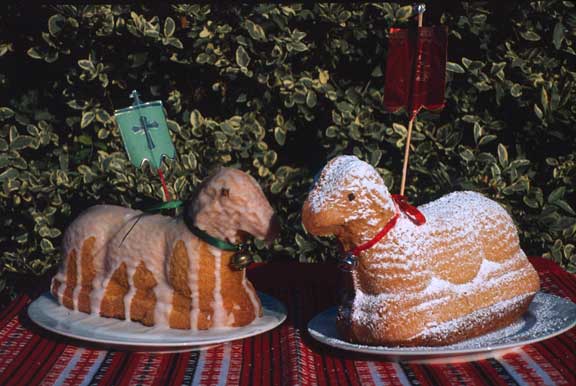
Lamb-shaped cakes and breads for Easter are made in the Alsace region of France, as well as in Germany, Austria and Eastern Europe. Photo by Sharon Hudgins


by Sharon Hudgins

When the Easter season approaches, European kitchens are filled with the yeasty aromas of freshly baked breads, as cooks all over the Continent prepare the special loaves and buns traditionally associated with this important religious holiday.

In the past, devout Christians observed a strict fast during Lent, the six or seven weeks before Easter, when they abstained from eating animal products of any kind: red meat, poultry, milk, butter, lard, cheese and eggs.

In some parts of Europe, even sugar, honey, olive oil, and certain kinds of fish were on the list of forbidden foods. When Easter finally arrived, people celebrated with a huge meal featuring dishes made from all the ingredients that had been prohibited during Lent. Even though few people follow such strict fasts today, the tradition of feasting on special foods at Easter is still an important part of many European cultures.

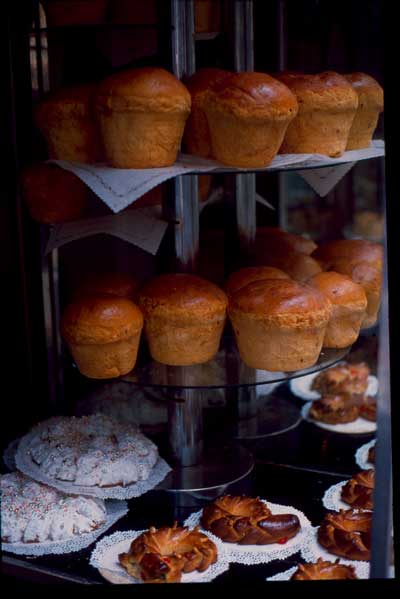
Rich, yeast-raised breads full of milk, butter and eggs are an essential element of the Easter meal in most European countries. Often the breads are made in symbolic shapes and elaborately decorated with sugar icing, candied fruits or colored eggs. Homemade or bakery bought, these breads represent a continuity of traditions from centuries past, including much earlier, pre-Christian times.

Different countries, regions and towns of Europe have their own characteristic breads baked especially for Easter. In some places, these special breads are taken to church to be blessed at the Easter midnight mass or the Easter Sunday morning service, before proudly being displayed on the festive dinner table at home. And in Russia and many Eastern European countries, the table also has a little three-dimensional lamb modeled out of butter, for spreading on the bread after it is cut.
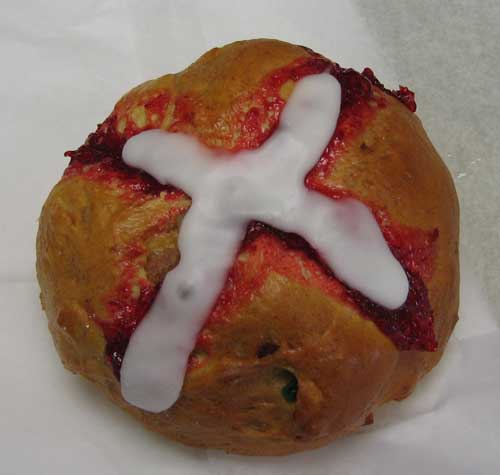
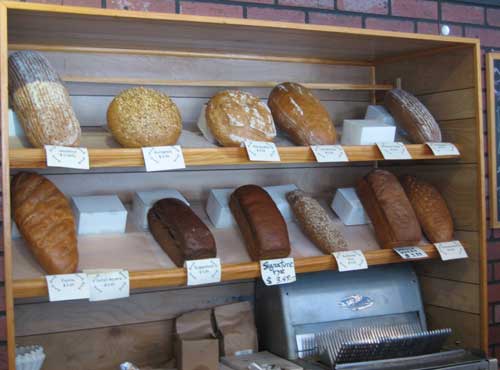
Hot cross buns are an Easter favorite.
Breads of all kinds are offered at Easter-time; these were baked by Michael Mikusch at his Austrian bakery.

GERMANY AND CENTRAL EUROPE

Bakers in Germanic communities make Easter breads in a variety of shapes, secular and religious. Breads shaped like rabbits, lambs, baby chicks and fish are symbols of springtime, fertility and birth. Braided loaves—long and straight, round or wreath-shaped—are made with three strands of dough representing the Holy Trinity of Father, Son and Holy Spirit. Germans and Austrians make several versions of Osterzopf (Easter braid), Osterkranz (Easter wreath or crown), and Striezel (stacked braided bread), as well as Osternester (Easter nests) or Eier im Nest (Easter-egg nest) with white or colored hard-boiled eggs surrounded by the dough. The circular braided Osterkranz is also symbolic of Christ’s crown of thorns, and the red-dyed eggs decorating many Easter breads are said to represent Christ’s blood and resurrection—although the egg’s significance as a symbol of rebirth and regeneration actually dates further back in time to the pre-Christian era.

Other special Germanic Easter breads include the Osterfladen—a flat, rectangular bread with a sweet filling of apples, raisins and almonds—and several varieties of Osterbrot (Easter bread) flavored with raisins, currants, candied orange peel, grated lemon zest, anise and cardamom. The Osterkarpfen (Easter carp) is a bread shaped like a fish, glazed with white icing, and studded with sliced almonds to represent fish scales. Germans also make Osterkorbe breads formed like Easter baskets and rabbit-shaped Osterhasen breads, all of them holding real or candy eggs. And the Eiermännle (Little Egg Man) is a flat bread shaped like a boy or man, with an unshelled hard-boiled Easter egg baked in the center of his body or inside a basket that he carries on his back.

Lamb-shaped cakes and breads can be found at Easter-time from Alsace to Austria, from Germany to the Czech Republic, Poland, Slovakia and Hungary. Baked in three dimensional metal or pottery molds, these represent Christ as the sacrificed Lamb of God, although their origin can probably be traced to earlier, pre-Christian rites in which baked dough effigies of sacrificial animals were substituted for live animals. Lamb breads are made from the same kind of sweet, yeast-raised doughs used for Alsatian Kugelhopf, Austrian Gugelhupf,and Polish baba (or babka). The cake versions are made from a simple white cake batter, although both chocolate and marble (mixed chocolate and white) lamb cakes sometimes show up in the flocks of Easter lambs sitting in bakery windows at this time of year.

The simplest lamb breads and cakes are merely dusted with a coating of confectioners’ sugar or drizzled with a light glaze of sugar icing. More elaborate cakes are covered with fluffy white frosting, sometimes garnished with shredded coconut, or spread with chocolate icing decorated with white icing swirls. The eyes are made from raisins, whole cloves, or coffee beans, and a small silk ribbon, often with a tiny bell attached, is tied around the lamb’s neck. Many of these lambs also hold a colored foil banner bearing the emblem of a lamb or a cross—recalling similar banners carried by Christian crusaders to the Holy Land a thousand years ago.
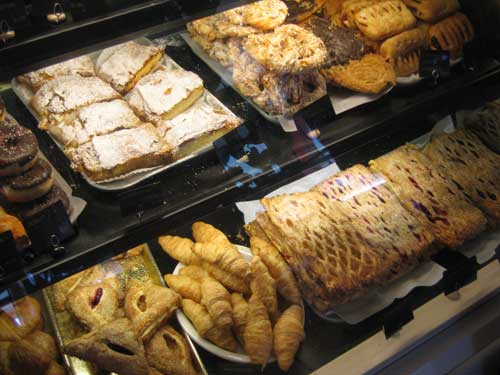
When you’re in Europe around Easter, look for the special Easter breads in local bakeries. You’ll likely be tempted by all the good pastries as well.
This shop offers Austrian breads and pastries which are as good as they look.

ITALY

Italy offers a rich variety of regional Easter breads, including Genoa’s pane dolce (sweet bread) full of raisins, candied fruit peel and pine nuts; Umbria’s cylindrical, cheese-flavored crescia; Venice’s large fugassa di Pasqua buns; and Cesenatico’s ring-shaped ciambelle, seasoned with anise and lemon peel. In Sicily, the edible centerpiece of the Easter meal is a large yeast bread shaped like a crown, with colored hard-boiled eggs embedded in the top. In some parts of Italy an old custom is still followed when Easter breads are made: the shell of the first egg put into the dough is cracked on the head of a young boy—supposedly to keep bad luck at bay.

The Easter bread most popular throughout all of Italy is a specialty originally from Lombardy—the columba di Pasqua (or columba pasquale), a sweet yeast bread full of candied orange peel, raisins, and almonds, made in the shape of a dove. Some of the fancier columbe have pockets of orange- or champagne-flavored pastry cream inside. Others are made with swirls of light and dark (chocolate-flavored) dough, like marble cakes. The plainest ones are garnished with only a simple sugar glaze, but the more elegant columbe are elaborately decorated with almond paste, white or pastel icing, chocolate, nuts or sugar-paste flowers.
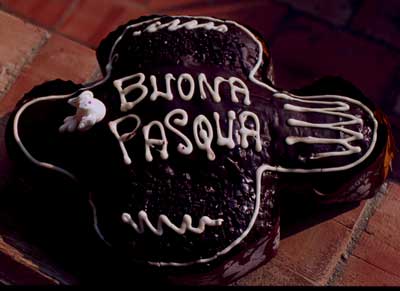
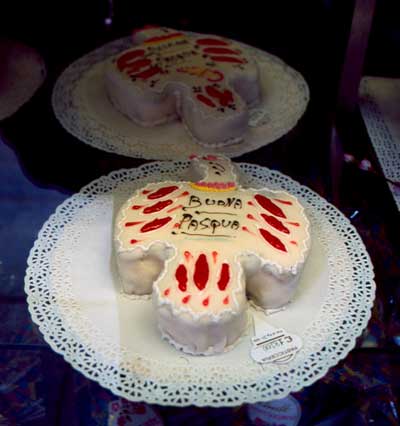
(bottom left and right) Italian Easter dove cakes (columbe di Pascua) are a symbol of springtime, the Holy Spirit, and peace.; Italian cheese-flavored crescia loaves for Easter, at a bakery in Umbria

GREECE

Maundy Thursday, three days before Easter, is the time when Greeks bake their holiday breads. Known as tsoureki or lambropsomo, these sweet, eggy breads are traditionally flavored with mahlepi, an unusual spice made from the finely-ground seeds of a type of cherry. Other Greek bakers add mastikha, pulverized crystals of sap from mastic shrubs that grow on the island of Chios. Cinnamon, nutmeg, cardamom and allspice can also go into the dough, as well as orange and lemon peel.

Greek Easter bread is made in different shapes from one region to another: a long braid, a braided wreath, a round loaf with bread-dough decorations on top in the form of leaves, flowers or a Byzantine cross. Each shape has its own symbolism. The three strands of braided dough represent the Holy Trinity. Wreaths and rings not only recall Christ’s crown of thorns but are also pre-Christian fertility symbols. Round shapes represent the life-giving sun, rebirth and resurrection. And no Greek Easter bread would be complete without one or more red-colored eggs—customarily dyed on Maundy Thursday—pressed into the top before baking.

SPAIN

The Spanish corona de Pascua (Easter crown) is another bread whose shape and symbolism is similar to Easter breads in many Mediterranean countries. Made from a sweet yeast-raised dough, the corona de Pascua is flavored with raisins, almonds, candied fruit peel, lemon and olive oil. Three strands of dough are first braided together, then formed into a ring. Whole, hard-boiled eggs are nestled into the top of the braid, usually one egg for each member of the family. Some people leave the eggshells white; others dye them red or a variety of spring colors.

Another Spanish Easter bread known as monja (nun) probably got its name from the nuns who traditionally baked breads, pastries and confections to sell from behind their convent walls. This orange-flavored bread—much like ones also found in Greece, Macedonia and Bulgaria—is round in shape, with a cross made of bread dough on top and four red-dyed eggs embedded at each point of the cross.

In the Castile region of Spain, Easter is celebrated with a large round loaf of bread in which shelled hard-boiled eggs, diced bacon,and chunks of Spanish sausages were imbedded in the dough before baking. And at Easter-time in some parts of Spain, godparents give their godchildren tortas de aceite, small savory buns made from yeast dough seasoned with orange, anise, and olive oil, with a single hard-boiled egg nestled in the center.

RUSSIA AND UKRAINE

Since Easter is a springtime celebration of new life, it’s not surprising that many traditional Easter breads are made in the form of ancient fertility symbols. The most graphic of these are the tall, cylindrical breads with a puffy dome on top, whose phallic symbolism is unmistakable. Festive breads of this shape are made in both France and Italy, but the most famous is Russia’s kulich, a saffron-scented yeast bread flavored with raisins, almonds and candied fruit peel. The domes are frosted with white icing that dribbles down the sides in a further reinforcement of the fertility image. The kulichi can also be decorated with colored sugar sprinkles or candied fruits, and a long thin red candle is usually stuck into the top of the dome. On Easter, Russian Orthodox churches are often filled with these special breads, their candles lighted, awaiting blessing by the priest.

Velikodnia babka is the Ukrainian version of this tall, yeasty Easter bread, with raisins, almonds and candied peel kneaded into the dough. Another traditional Ukrainian Easter bread is velikodnia paska, made from a rich yeast dough containing plenty of butter, sugar, and eggs, and shaped into large rounds. The tops are fancily decorated with ornaments made out of dough, usually with a cross as the center motif surrounded by elaborate swirls, small birds, leaves,or flowers. Perekladnets is a special, colorful Easter treat, a kind of coffee-cake loaf made with lemon-scented yeast dough and three different layers of filling: chopped dried peaches or apricots with candied fruits; chopped figs, dates and walnuts; and chopped almonds with candied cherries.
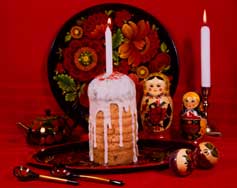
Russian kulich, a tall cylindrical Easter bread often baked in a coffee can.

GREAT BRITAIN

Hot-cross buns are the most typical Easter bread in Great Britain. Baked on Good Friday, these round, slightly sweet buns often have chopped fruit peel and currants, raisins or sultanas in the dough. A cross is cut into the top of each bun before baking, or a strip of dough is used to make the form of a cross on top, to keep away evil on this sad day of remembering Christ’s crucifixion.

In some parts of Britain, a hot-cross bun is hung up in the house to keep away bad luck (fire, theft, illness) until Good Friday of the following year. Buns are also hung in the barns to protect the grain from rodents. As in the rest of Europe, these British hot-cross buns are an example of the powerful symbolism of breads baked for the Easter season.
Magnificent Marzipan

By Sharon Hudgins
Photos by the author

I’ve been in love marzipan ever since I first tasted it as a child. Back then, marzipan candy was a rare and expensive treat, often difficult to find in the United States. But when I later moved to Europe, I discovered a whole world of marzipan, enough to nourish my lifelong love affair with this seductive sweet.

I’ll admit it: I’ve never met a marzipan I didn’t like.

Marzipan is nothing more than a smooth paste of finely ground blanched sweet almonds mixed with sugar. Other ingredients are sometimes added, too, such as water, egg whites, sugar syrup, honey, almond extract, a small amount of bitter almonds, rosewater, orange blossom water and food colorings. But that description doesn’t do justice to the tantalizing taste of this tempting treat, nor to the many ways in which marzipan is used today by professional confectioners and home cooks.

On the grocery shelf, the difference between “almond paste” and “marzipan” is mainly the ratio of sugar to almonds, with marzipan containing more sugar. That ratio varies, depending on the individual producers and the various countries where this confection is made, some of which have laws regulating the proportion of each ingredient. The finest German marzipans contain two parts (or more) of ground almonds to one part of sugar. Others contain 50% almonds and 50% sugar. Danish Odense marzipan, the European brand marketed widely in the United States, has only 28% almonds. (Odense “Pure Almond Paste” contains 45% almonds.)

MARZIPAN MIGRATION
Culinary historians think that marzipan originally came to Europe from the Middle East, where almond trees and sugar cane have been grown since ancient times, and where there’s a long history of making sweets from almond paste. Even though the early Greeks and Phoenicians planted almond trees around the Mediterranean region, it was the Arabs who expanded the almond orchards, introduced sugar cane cultivation, and began producing marzipan in the areas of southern Europe they conquered and colonized between the 8th and 11th centuries. After Arab power waned in those parts of the Mediterranean, during the 11th to 15th centuries, the secrets of marzipan-making were preserved by nuns in Catholic convents, who produced these sinful sweets for sale to support themselves. That’s why former Arab-ruled lands such as Spain, Sicily, and Malta still have strong marzipan traditions today.

Historians surmise that marzipan spread to northern Europe from Venice and the eastern Mediterranean during the time of the Christian Crusades, from the 11th through 13th centuries. Certainly by the Middle Ages marzipan was known in France, England, and Germany, although in many places it was considered a costly medicine, sold only in pharmacies. It soon became a favored confection of the upper classes, whose cooks molded marzipan into elaborate and fantastic shapes for use as showy centerpieces or edible finales to medieval feasts.

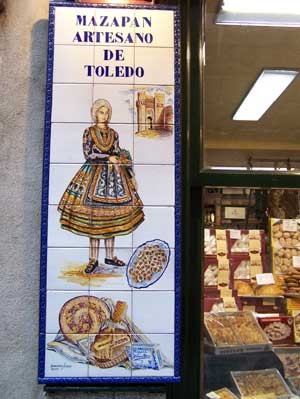
Sign for the Mazapan Artesano

MARZIPAN MANUFACTURE
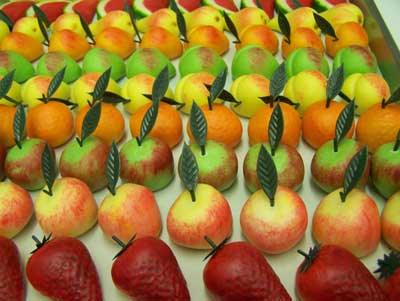
A traditional confection in Europe for several centuries, marzipan is made today by both artisan confectioners and big industrial plants. Centers of marzipan manufacture include Toledo, Spain; Palermo, Sicily; Budapest, Hungary; and Lübeck, Germany. Each has its own style of marzipan, with more or less sugar, baked or unbaked, and modeled into more shapes than you can imagine. At marzipan stores in Europe, I’ve seen this sweetened, colored almond paste formed into fruits, vegetables and flowers, from miniature to life-size; animals from penguins, polar bears and “good luck” pigs (for the New Year) to walruses, lions, hedgehogs and squirrels; Easter eggs and Easter rabbits; Santas and angels; fish and shellfish; lifelike sandwiches, cheeses and sausages; even modern marzipan cell phones and McDonald’s-like cardboard packets full of french fries.

Marzipan has other uses, too. Europeans fill chocolates with marzipan; wrap it around nuts, candied fruits and other sweet fillings; bake it inside cookies; and stuff dates, prunes, peaches and apples with it. They roll marzipan into thin sheets as a covering for fancy cakes and use it as ingredient in tortes and tartes, pies and pastries, sorbets and ice creams, even sweet dumplings, ravioli and roast pork. I once ate at a restaurant in Lübeck that featured “marzipan lasagna” for dessert, made with layers of white marzipan “pasta” and a red and green fondant filling.

MARZIPAN MUSEUMS
Several cities in Europe have marzipan museums, most of them attached to a confection company’s coffee shop, candy shop or factory store. The Niederegger Marzipan Salon, on the second floor of the Konditorei-Café Niederegger in Lübeck, Germany, has a display about the history of marzipan. But the actual shop on the ground floor is even more interesting, where you can buy more than 300 types of the company’s products, including whimsical edibles made out of marzipan and Niederegger’s irresistible Cuandolé marzipan liqueur.

Leu’s Marzipan-Land in Lübeck features a “Marzipan-Show” on Tuesdays, Wednesdays, and Thursdays. You’ll see all the stages in the manufacture of marzipan, as well as an unusual exhibition of large marzipan sculptures, before pigging out in the shop where you’ll be tempted to buy more marzipan than you should ever eat in one sitting.

Hungary boasts three marzipan museums, all owned by the Szabo confectionery company. My favorite is the Szabo Marzipan Museum in Szentendre, a pleasant (but now overly touristy) little artists’ village not far from Budapest. This small museum is chock full of displays of colored marzipan shaped into Disney characters, a Cinderella coach, a massive wedding cake, a cactus garden and even a detailed replica of the Hungarian parliament building. On the ground floor there’s a traditional confectionery kitchen where you can watch marzipan being made and a shop where you can buy goodies to go. Next door the Szabo café-and-pastry shop offers a wide variety of luscious Hungarian cakes, tortes, ice cream concoctions, marzipan candies, coffees and teas.

The smaller Szabo Marzipan Museum in Budapest features large marzipan sculptures of the Matthias Church, the Fishermen’s Bastion, and the Chain Bridge across the Danube (all local landmarks), a Chinese pagoda, several Harry Potter characters and other curiosities, some made from more than 100 pounds of marzipan. And there’s another Szabo Marzipan Museum in Pécs, also connected with one of their coffee-and-pastry shops.

In Sonseca, Spain, just south of historic Toledo, you can visit the interesting Delaviuda Marzipan Museum at the Delaviuda candy factory, which shows how Spain’s distinctive (and delicious) marzipan is made. And finally, Tallinn, the capital of Estonia, also has a couple of small marzipan museums in the Old Town. I just haven’t managed to eat my way that far north yet.

ADDRESSES AND WEBSITES:
Konditorei-Café Niederegger, Breit Strasse 89, Lübeck, Germany
www.niederegger.de/en/cafe_niederegger/marzipansalon/
marzipansalon.php

Leu’s Marzipan-Land, Drechlerstrasse 6, Lübeck, Germany
www.marzipanland.de/eng.html

Szabo Marzipan Museum, Hilton Budapest, Hungary
Szabo Marzipan Museum, Dumtsa Jeno St. 14, Szentendre, Hungary
Szabo Marzipan Museum, Apaca St. 1, Pécs, Hungary
www.szabomarcipan.hu/angol.html

Delaviuda Marzipan Museum, Calle Santa Maria 4, Sonseca, Spain www.delaviuda.com

Gingerbread Galore!

By Sharon Hudgins
Photos by the author

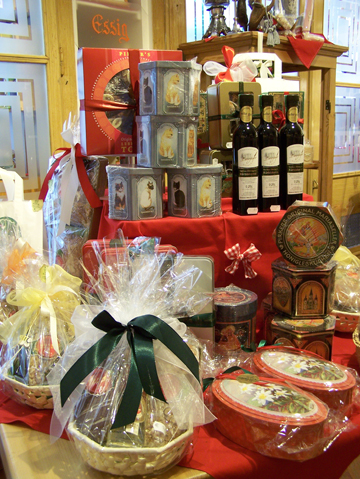
‘Tis the season when a young elf’s fancy turns to thoughts of gingerbread. Although these sweet-spicy cakes and cookies are popular year-round in many countries of Europe, they’re particularly associated with the winter holidays. Bakeries from Sweden to Slovakia to Switzerland turn out tons of commercial gingerbread products, often packaged in brightly colored wrappings and tin boxes. And home bakers dig through kitchen drawers and recipe files to find favorite cookie cutters and family recipes for their own Christmas gingerbreads.

Although flatcakes made with honey and spices were baked by the ancient Egyptians, Greeks, and Romans, the gingerbreads of northern Europe probably date only from the Middle Ages, when honey was still the main type of sweetener available locally, and exotic, expensive spices such as cinnamon, black pepper and ginger were increasingly being imported from faraway lands in the East. A taste for gingerbread eventually spread throughout Europe, with certain cities becoming known for their own particular types: Strasbourg and Dijon in France, Torun in Poland, Tula in Russia, Aachen and Nürnberg in Germany, Basel and St. Gallen in Switzerland.

MANY VARIETIES
Gingerbread recipes evolved over time and in diverse places. Various kinds of gingerbread were, and still are, made with different combinations of honey, sugar, flour, eggs, almonds, hazelnuts, walnuts, raisins, lemons, candied orange peel, candied citron, rosewater, rum, brandy, black pepper, ginger, cinnamon, nutmeg, cloves, allspice, cardamom, coriander, aniseed and saffron. Although these baked goods are often referred to as “gingerbread” in English, some of them don’t contain any ginger at all.

The variety of possible ingredients and textures causes some confusion about what “gingerbread” actually is. A cake, a cookie, or a loaf? Hard or soft? Thick or thin? Glazed or unglazed? Decorated with fancy frostings, or with fruits and nuts, or even with expensive gold leaf? At various times in its history, gingerbread has been all of these.

GERMAN GINGERBREAD
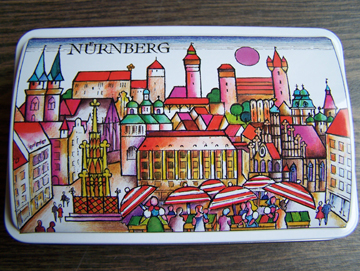
In the Middle Ages, the city of Nürnberg became one of the most famous places for making gingerbreads in Germany, where these seductive sweets have long been known as Lebkuchen (or sometimes Pfefferkuchen, when their spiciness comes from black pepper instead of ginger). Records show that Lebkuchen was being baked in Nürnberg as early as the 14th century. Traditionally, the stiff dough was pressed into highly detailed molds made of wood, metal, or terra cotta, which imprinted intricate designs on the Lebkuchen before it was removed from the molds and baked in a hot oven. Nürnberg Lebkuchen contained such costly ingredients, and was of such high quality, that it was accepted as payment for city taxes and given as gifts to nobles, princes, and heads of state.

Over time, as the prices of ingredients fell and the demand for Lebkuchen increased, faster production methods became necessary. The elaborate handmade molds were replaced by less detailed, often mass-produced, molds. Simpler decorations―such as nuts, candied fruit, and sugar frostings―were applied to the tops of many cookies. And the shapes were simplified, too, evolving into the basic human, animal, and geometric forms common today.

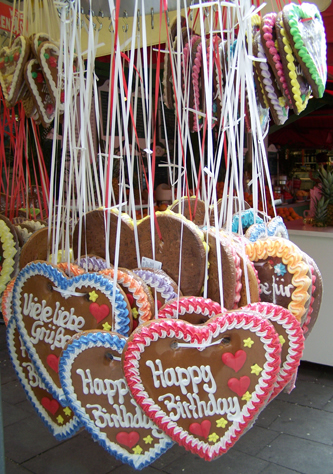
In the early 1800s, gingerbread houses became popular in Germany after the publication of the Grimm brothers’ fairy tale, Hansel and Gretel. And during the 19th century, ornately decorated Lebkuchen hearts also became the rage. Covered with fancy designs and romantic sayings made from colored icing, these large heart-shaped cookies were often exchanged between sweethearts. You can still buy them at almost every German festival and special market, including the Christmas markets held in many German cities throughout December.

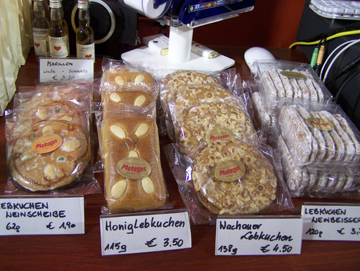
The Lebkuchen produced in Germany today comes in all sorts of sizes, shapes, flavors, colors and textures: rounds, rectangles, squares, hearts, stars, pretzel forms, St. Nicholas (for Christmas), lucky pigs (for New Year) and rabbits (for Easter). The Lebkuchen dough can be “white” (light colored) or different shades of brown. Some Lebkuchen are also covered with white or chocolate icing, and some are filled with marzipan or jam. Honey Lebkuchen is sweetened only (or primarily) with honey. Oblaten Lebkuchen are cookies with the dough mounded on top of a thin wafer before baking. And delicate, elegant Elisen Lebkuchen are made with at least 25% ground almonds, hazelnuts, or walnuts, and no more than 10% flour.

GINGERBREADS ACROSS EUROPE
You’ll also find similar spicy cookies of different shapes, colors and textures called Printen (in Aachen, Germany), Pfefferkuchen (in Pulsnitz, Germany), Spekulatius (in the German Rhineland), Leckerli (in Basel, Switzerland), Biberli (in the Appenzell region of Switzerland), speculaas Holland, speculoos in Belgium, pepperkaker in Norway, pepparkakor in Sweden, piperkakut in Finland, pebernǿdder in Denmark, pain d’épices in France, licitar in Croatia, mézeskalács in Hungary, perníky in the Czech Republic and Slovakia, pierniki in Poland and prianiki in Russia. Other towns and regions have their own specific names for the many varieties of gingerbreads produced there.

Europeans also use gingerbread cookies as ingredients in other dishes. You’ll find crumbled gingerbread used as a stuffing for pork and for pasta, as a thickener for sauces, a flavoring for soups, a crunchy texture in salad dressings, and a base for many puddings and desserts. There’s even a German-Italian “fusion” dessert called ” Nürnberger Tiramisu”! And for people who just can’t get enough of that sweet, spicy, Christmasy taste of gingerbread, the Belgians have recently invented a gingery, caramely speculoos spread, similar in texture to Nutella, made from crushed gingerbread cookies.

If I’ve whetted your appetite for these European gingerbreads, my best suggestion is to travel there and taste them for yourself. You can also mail order many of them from the websites listed below. Costard, the clown in Shakespeare’s play, “Love’s Labour’s Lost,” had the right idea when he said, “An’ I had but one penny in the world, thou shouldst have it to buy gingerbread.”

Nürnberg Lebkuchen information www.lebkuchen.nuernberg.de/englische_version/index.html

Lebkuchen-Schmidt, Nürnberg
ww2.lebkuchen-schmidt.com/eng_index.php

Metzger Lebkuchen, Vienna
www.lebkuchenmetzger.at/

Lebkuchen-Pirker, Mariazell, Austria
www.lebkuchen-pirker.at/home/index.php?&lang+eng

Kerner Lebkuchen, Mariazell, Austria
www.lebzelterei-kerner.at/index.htm

Lebkuchen-Gandl, St. Wolfgang, Austria
www.lebkuchen-gandl.com/

Appenzeller Biberli, Switzerland
www.baerli-biber.ch/

Basel Läckerli, Switzerland
www.laeckerli-huus.ch/

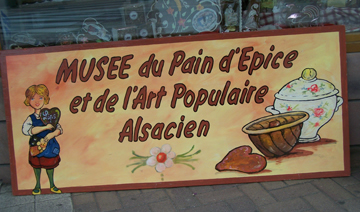
French-Alsatian Pain d’Épices
www.paindepices-lips.com
www.fortwenger.fr/

Alte Pfefferkuechlerei (small gingerbread museum in Weissenberg,Germany) www.museum.stadt-weissenberg.de/

Speculoos Spread
www.thenibble.com/zine/archives/speculoos-spread.asp

YouTube video about how to make decorated European gingerbread
www.youtube.com/watch?v=OVX5wiv_oMk

American online sources for ordering European gingerbreads
www.germandeli.com
www.germangrocery.com

Vienna’s Sweet Treats

By Sharon Hudgins
Photos by the author

Vienna has a well deserved reputation as a capital of cakes, confections and coffeehouses. The Viennese can’t seem to get through the day without stopping for a mid-morning pick-me-up snack at their favorite coffeehouse and for mid-afternoon coffee-and-cakes at a neighborhood pastry shop. And who could resist buying a little box of handmade chocolates at one of the many tempting candy stores, to nibble on at home?

Winter is a great time to visit Vienna, when the city is decorated for the holidays and the colorful Christmas markets are in full swing. Even after the holidays, Vienna remains a festive city, with concerts, operas and other events to brighten up the gray winter days.

At this time of year, everyone needs more calories to cope with the cold weather. So let that be your excuse for sampling the many sweet treats that Vienna has to offer. Besides, what could be more romantic than sitting on a plush banquette under a sparkling chandelier in an elegant pasty shop, eating a rich torte and sipping hot coffee topped with whipped cream, while watching the snowflakes outside settle silently over the city?

KAFFEEHÄUSER & KONDITOREIEN
Vienna’s coffeehouses (Kaffeehäuser) are an institution dating back to the 17th century. The city claims to have more than 800 of them, including 150 “classic” coffeehouses with their traditional wooden floors, dark wood paneling, little marble-top tables, racks of newspapers on the wall, and waiters dressed in black.

Cafe Central, one of Vienna’s most elegant coffeehouses.

Most of them serve more than 20 different kinds of coffee drinks, hot and cold. If you don’t know the differences among a Grosser Brauner, a Franziskaner, a Kapuziner and an Einspänner, then ask the waiter to explain the coffees listed on the menu. Each will be served with a small glass of cold water on the side. And for the price of just one drink you’ve bought the right to sit in that spot for as long as you want, lingering over a newspaper or magazine, or writing your own journal or poetry, just like the historic figures who frequented that same coffeehouse in the past. Coffeehouses also serve a limited selection of sweet cakes and pastries as well as light meals (and sometimes more substantial fare).

Vienna’s most famous old coffeehouses include the elegant Café Central (corner of Herrengasse and Strauchgasse); Café Bellaria (Bellaria Strasse 6); Mozart bei der Oper (Albertinaplatz 2); Café Diglas (Wollzeile 10); Café Hofburg in the Imperial Palace (Hofburg/Innerer Burghof); Café Dommayer (Dommayergasse 1); Café Sperl (Gumpendorfer Strasse 11); and Café Sacher (Philharmonikerstrasse 4).

Vienna is equally famous for its pastry shops (Konditoreien), which are often packed with customers getting their mid-morning or mid-afternoon sugar fix. The 200-year-old Demel pastry shop (Kohlmarkt 14) attracts hordes of locals and tourists to its elegant showrooms and cafe. Demel’s high-quality cakes, pastries and confections are a temptation that can’t be resisted. After admiring the wares in the display cases downstairs, go upstairs to the chandeliered cafe to order your coffee and cake, stopping along the way to peer through the glass into the kitchens where the goodies are being made.

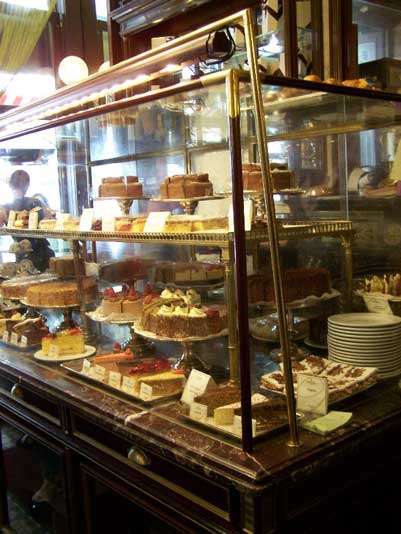
Cake counter at Demel’s pastry shop

Founded in 1847, A. Gerstner is another outstanding traditional Viennese Konditorei. Visit its original location at Kärntner Strasse 13-15 for a taste of Gerstner’s top-quality delights, perhaps dolled up with a dollop of Schlagobers (whipped cream). Both Demel and Gerstner have been official providers of sweets to the Hapsburg court in Austria, so you’ll eat like an emperor at either establishment.

(top) Making marzipan roses at Demel’s pastry and confection shop; (below) Stretching the dough for an apple strudel

Although there used to be a stronger distinction between coffeehouses and pastry shops in Vienna, that difference is now somewhat blurred. You can often get the same range of coffee drinks at a pastry shop as at a coffeehouse, and a good (but usually more limited) selection of pastries at a coffeehouse. Formerly Kaffeehäuser were mainly for men, whereas Konditoreien primarily served the ladies (and also sold prettily boxed pastries to take home). In our modern era these gender differences have almost faded away.

TORTE WARS
Every visitor to Vienna wants to eat a slice of Sachertorte. Many pastry shops sell their own version of this rich chocolate cake, flavored with one or more layers of apricot jam and covered with a semi-sweet chocolate icing. But there are only two places that can claim to make the true Sachertorte: Hotel Sacher and Demel.

Pastry cook Franz Sacher invented this cake in 1832, and much later the recipe was further developed by one of Sacher’s sons while working at Demel’s bakery. In the 20th century a legal battle developed between the Hotel Sacher and Demel over who had the right to call this popular cake “The Original Sacher Torte.” After years of legal wrangling, the Hotel Sacher was given the right to attach a circular chocolate seal on top of its cakes and sell them as “The Original Sacher-Torte,” whereas Demel was allowed to attach a triangular seal on its cakes and call them “Eduard Sacher-Torte,” after the Sacher son who developed his recipe at Demel’s. (Now you’ll also see the cakes identified as “Demel’s Sachertorten.”) Each version is slightly different, so you’ll want to taste both of them, at their bakeries of origin, to decide which you like best!

(left) Marzipan confections cleverly colored and shaped to look like Austrian open-face sandwiches

HAVE A BALL
If your sweet tooth is hungering for more, you can easily satisfy it at any of Vienna’s many candy shops, some of which make their own special confections. A number of them are concentrated around St. Stephen’s Cathedral in the heart of Vienna’s Altstadt. Look for Confiserie Heindl (Stephansplatz 11), which has 22 stores throughout Vienna; Manner (Stephansplatz 7); Metzger (also at Stephansplatz 7), which sells handmade confections, gingerbread and beeswax candles; and Lipizzaner (Stephansplatz 6), long known for its excellent chocolates, including some of the world’s first white chocolate candies.

Beyond St. Stephen’s, but still in the Altstadt, are Schokolade König (Freisingergasse 1), featuring handmade chocolates; City Confiserie (Bognergasse 5), with its extensive array of whimsical marzipan confections; Christian Rosenauer (Fleischmarkt 12), an old-fashioned Viennese candy store chock full of Mozartkugeln and other traditional sweets; and Leonidas (Fleischmarkt 9), which sells luxurious Belgian chocolates. Blühendes Konfect (Schmalzhofgasse 19) specializes in confections made from, and decorated with, flowers; and Xocolat (Strauchgasse 1) is a mecca for chocolate connoisseurs.

Wherever you go in Vienna, you can’t get away from those Austrian confections called Mozartkugeln. Invented in Salzburg in 1890, they’ve now taken all of Austria by storm. The original Mozart balls have a round center of sweetened green pistachio paste surrounded by a layer of hazelnut nougat, dipped in dark chocolate to coat the outside. Like all Mozartkugeln, they’re about the size of a small walnut. Other candy companies make their own versions, too, each a slightly different variation of the original confection. Mirabell-brand Mozart balls are the most widely marketed, in their distinct red-and-gold packages. You can’t leave Vienna without tasting this typical Austrian sweet.

MEHLSPEISEN
Finally, any discussion of Viennese sweets should include mention of Mehlspeisen, those “flour foods” so beloved by the Austrians. This category of dishes made with flour includes Palatschinken, thin panckakes spread with jam, folded into quarters, and garnished with chocolate sauce and whipped cream; Kaiserschmarrn, a large buttery and sugary, raisin-studded pancake that looks like it has been hit by an earthquake; sweet Knödel, fruit-or jam-filled round dumplings garnished with confectioners’ sugar; Nockerln, big light-and-airy egg-white dumplings, sometimes served with berry sauce; and Strudel, layers of flaky pastry surrounding a filling of sweetened fruit, berries, or soft cheese. These are often listed in the dessert sections of restaurant menus, although they might be found under their own menu category, Mehlspeisen, reflecting the time when these dishes were also eaten as a main course, especially during fasting periods when meat products were prohibited.

Shelves of Mozart Kugeln at a Viennese candy store

► For more information about places to eat in Vienna (including restaurants, cafes, coffeehouses, pastry shops, and candy stores), get the 67-page booklet titled “Shopping, Wining & Dining” from the Vienna tourist office, WienTourismus (Albertinaplatz/Maysedergasse, www.vienna.info/en).

Savoring Sicily

Sunny climate, ancient ruins…and delicious cuisine on Italy’s largest island

By Sharon Hudgins
Photos by the author

Savvy travelers have long known that Sicily is a part of Italy well worth seeing. But in recent years this largest island in the Mediterranean has suddenly become a popular tourist mecca, attracting visitors from all over the world. They come for Sicily’s sunny climate and rugged scenery, its ancient archeological sites, sleepy villages, historic cities and colorful markets, and to see nature’s own spectacle, Mt. Etna, Europe’s largest volcano, spouting steam from its fumaroles and sometimes spewing lava down its slopes.

Tourists come to taste Sicily, too—whether on short day trips from cruise ships docked near its shores, or on longer culinary tours (often with cooking classes included) that focus in depth on the history and variety of Sicilian cuisine.

CULINARY CROSSROADS
Located only two miles from the Italian mainland, Sicily has long been a magnet for invaders, colonizers, and rulers—from the early Phoenicians in 800 BC to the Germans, French, Spanish, Austrians and British at various times over the past one thousand years. But it was the ancient Greeks, Byzantines and Arabs who had the greatest influence on Sicilian cuisine.

The Greeks (800-200 BC) brought advanced agricultural methods and introduced new vegetables, fruits and fowl. They cultivated barley, wheat and millet, planted olive groves and vineyards, kept bees (for honey) and improved the breeding of livestock, especially sheep, which were important for cheese production. Even today, Sicily is famous for its ricotta and pecorino cheeses made from sheep’s milk.

The Romans (200-400 BC) focused on growing wheat on large landed estates, turning Sicily into a granary of the Mediterranean. But the influence of the earlier Greeks remained strong. When the Byzantines annexed Sicily to the Eastern Roman Empire (550-900 AD), Sicily was again immersed in Greek traditions and customs, including the kinds of foods favored on Sicilian tables.

During the relatively short time that Arab Muslims controlled Sicily (900-1100 AD), Sicily became one of the wealthiest and most progressive cultures of medieval Europe. The Arabs also had an important impact on the local cuisine. In addition to upgrading traditional agricultural practices, such as irrigation technology, they added a variety of new crops, including rice and sugar cane. They planted orchards of lemons, oranges, almonds and pistachios, and imported spices from Asia and the Middle East.

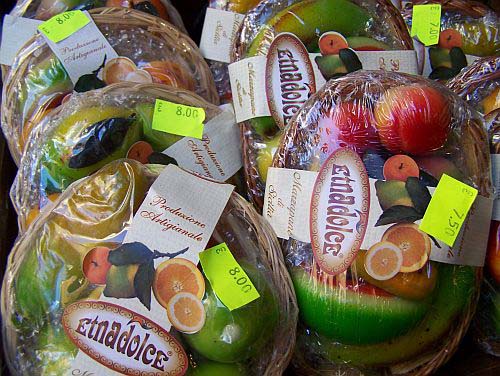
During this time the Sicilians developed their famous “sweet tooth.” Today Sicily is still renowned for its magnificent marzipan confections (crafted from sugar and almond paste); frozen-fruit treats (ice creams, sorbets and granitas); and cannoli dessert, deep-fried tubes of thin pastry made with Sicilian Marsala wine, stuffed with sweetened ricotta cheese combined with candied orange peel, chopped pistachios and chopped chocolate. All these seductive sweets have their roots in medieval Arab cuisine (except the New World chocolate, of course).

Even after the Norman French conquered Sicily at the end of the 11th century—and other Europeans came to rule over Sicily after that—local Arab culinary traditions remained strong on the island. When many Arab Muslims were forced out of Sicily by the Christian conquerors, the arts of Arab confectionery fortunately were not lost. As in Spain, with the later expulsion of Muslims from that country, the recipes were secretly and safely stowed away in Catholic convents, where the nuns made these sinfully sweet treats to give away as presents and later to sell to support their convents. Today these marzipan candies, chewy nougats and sugary pastries are among the most important culinary legacies of the Arabs in Sicily.

FEASTS & FESTIVALS
Holidays are often the best times for travelers to taste the special dishes of any country. Like the rest of Italy, Sicily celebrates many religious holidays every year, from small festivals honoring a local saint to national holidays observed throughout all of Italy. Festival foods range from ritual breads for Christmas and New Year, to cannoli during the spring Carnival season just before Lent, to little marzipan confections shaped like lambs for Easter.

For St. Joseph’s Day (March 19), Sicilians build ornate altars adorned with bread-dough decorations and fresh flowers in their homes, and each community prepares a special ritual meal, often with at least a hundred different dishes, to honor the good saint. Since St. Joseph is also the patron saint of pastry cooks, many of the festive dishes are sweet, including the traditional deep-fried, custard-filled “St. Joseph’s pastries.”

Easter is the time for highly decorated candy eggs, sweet breads and fancy cakes, especially Sicily’s cassata, a multilayered baroque concoction of sponge cake, marzipan, pistachio paste and sweetened ricotta cheese, glazed with white icing and ornately decorated with crystallized orange and pear wedges, curving ribbons of candied squash and grated chocolate.

In Palermo, the Feast of Saint Rosalia (July 13-15) features street foods sold from carts colorfully painted like old Sicilian farm carts: salted and sugar-coated nuts, toasted pumpkin seeds, roasted fava beans and pink-white-green-striped nougat candy. The traditional dessert eaten during this festival is gelato di campagna—not ice cream, as its name implies, but an elaborate confection-cake constructed of multicolored fondants. This rich confection looks like an ice cream cake with four layers: white (almond paste), brown (hazelnut paste), green (pistachio paste) and pink (strawberry paste)—all assembled in a cake mold and studded with pistachios and candied fruits.

For All Saints’ and All Souls’ Days at the beginning of November, Sicilian children receive special gifts supposedly from their deceased ancestors: pupi di cena, candy dolls shaped like knights, ballerinas, clowns and even contemporary figures like Batman, all made of melted sugar poured into molds and then painted in bright colors. Other traditional foods include colored marzipan shaped like fruits and vegetables; fava beans, a symbol of death, since this is a holiday honoring the dead; fave dei morti, little cookies shaped like fava beans; and ossi di morto (“bones of the dead”), cookies shaped like leg bones or skeletons, made of ground almonds, egg whites and sugar.

Roasted turkey and roasted chestnuts are traditional for St. Martin’s Day on November 11. Other typical Sicilian treats for this holiday include biscotti di San Martino, little hard, thrice-baked cookies flavored with anise, cinnamon or orange; and sfinci, fried beignets made of mashed potatoes and flour, sometimes filled with custard cream, and usually drizzled with honey.

On Saint Lucy’s Day (December 13), Sicilians eat arancine, potato-and-rice croquettes the size and shape of an orange, filled with meat or cheese and fried until golden. (These are also popular year-round in Sicily, a savory treat not to be missed!) Christmas Eve (December 24) is celebrated with eel or salted swordfish, followed by a large Christmas Day feast that includes nuts (symbols of fertility) and honey (so the coming year will be sweet). And Christmas in Sicily wouldn’t be complete without sweet almond torrone (nougat) and rich buccellato, a special wreath-shaped bread spiced with cinnamon, cardamom and cloves, filled with figs, raisins, almonds, walnuts and apricot jam, and decorated with candied fruits on top—a legacy of the culinary influence of those Greeks and Arabs who ruled Sicily so long ago.

For more information about the foods of Sicily see:

Eat Smart in Sicily, by Joan Peterson and Marcella Croce (Ginkgo Press, 2008), the best portable guidebook to Sicilian food, with a summary of Sicilian culinary history and a very good menu translator. You’ll definitely want to take this little book with you when you travel to Sicily.

Pomp and Sustenance: Twenty-five Centuries of Sicilian Food, by Mary Taylor Simeti (Knopf, 1989), probably the best single book you can read about the history of Sicilian food (republished in 2009 as Sicilian Food: Recipes from Italy’s Abundant Isle).

Bitter Almonds: Recollections and Recipes from a Sicilian Girlhood, by Mary Taylor Simeti and Mari Grammatico (Bantam Books, 2003).

Sweet Sicily: The Story of an Island and Her Pastries, by Victoria Granof (William Morrow Cookbooks, 2001).

Celebrating Italy, by Carol Field (William Morrow, 1990), which covers other regions of Italy, too, but includes much information about the festival foods of Sicily.

For more books about Sicilian cuisine, search “Sicily cooking” on Amazon.com.