Second Breakfast in Europe

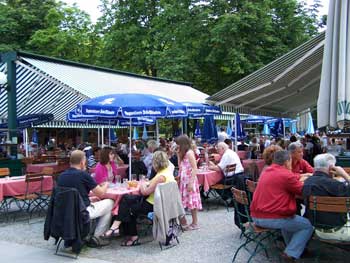
Munich’s beer gardens are popular places to eat “second breakfast” in nice weather.

By Sharon Hudgins
Photos by the author

Sausages and beer for breakfast? Sure, especially if you’re chowing down on the second meal of the day before lunch.

If breakfast is good for you, a second one is even better. Between 10 and 11 in the morning, Germans head to their favorite restaurant or cafe for a zweites Frühstück (second breakfast), while Austrians sit down at a Gabelfrühstück (fork breakfast). The British pause for tea at “elevenses,” the Spanish pop into the nearest bar for coffee and a mid-morning snack, las onces (the elevens), and the French stop for a similar pick-me-up at home, at work and at school.

DINING DOUBLE
The custom of double dining originated centuries ago in rural areas where farmhands ate a light, early breakfast before going out to take care of the animals and work in the fields, then ate again in the late morning after all that hard physical labor. The practice was later adopted by urban dwellers, as a way to stave off hunger pangs until the mid-afternoon main meal in Mediterranean countries, and to stay warm in northern Europe, where most housing didn’t have central heating and lunch wasn’t served before one o’clock. Second breakfast served a social function, too, as an informal occasion to meet friends at a cafe for conversations over coffee, tea or beer.

Today, both on the farm and in the city, many south Germans and Austrians still start the day with a light meal of hot coffee, bread or small rolls spread with butter and jam, perhaps accompanied by a boiled egg or a few slices of ham and cheese. Their second breakfast might be more or less substantial: ham, sausage, fish or cheese stuffed into rolls; a bowl of goulash soup or a small plate of goulash stew with bread on the side; cakes or pastries for those with a sweet tooth; and more cups of hot coffee or a even a glass of beer.

MUNICH’S SECOND BREAKFAST
In southern Germany the Bavarians have their own special kind of second breakfast particularly associated with Munich, the capital city. In mid- to late-morning, Müncheners head to their favorite traditional Bavarian restaurant for a meal of Weisswurst (white sausage) and Weizenbier (wheat beer, also known as Weissbier), consumed in the cozy comfort of an old-fashioned, wood-paneled inn. If they’re in a hurry, they’ll just stop off at the nearest little Stehcafe for a standup snack of white sausages and beer.

Invented in 1857 by Sepp Moser, a Munich butcher and innkeeper, Weisswurst is a fresh, mild-tasting sausage made of finely chopped veal, pork fat and onion, combined with a bit of fresh green parsley and other seasonings that remain the secret of each butcher: salt, white pepper, nutmeg, cardamom, cloves, mace, ginger, sugar and lemon peel. The mixture is stuffed into pigs’ intestines, tied into plump sausages about five inches long, and simmered for a few minutes in hot water. The cooked sausages are served immersed in hot water, too, in a ceramic or stainless-steel tureen. Locals always order them by the Stück (piece), not the pair, even if they want only two. Why? It’s just a Munich tradition.
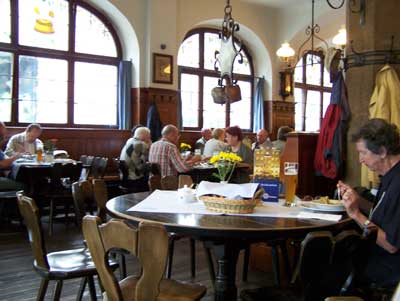
Munich’s Weisses Braeuhaus is a favorite spot for locals to gather for a “second breakfast” of Weisswurst and Weissbier.

EATING ETIQUETTE
Once you’ve speared a Weisswurst with your fork and transferred it to your plate, the trick is to free the soft white sausage meat from the tough-textured pigs’ casings, which are not meant to be eaten. Some Müncheners will tell you to slice off one end of the sausage and suck out half the filling, then cut off the other end and aspirate the rest. Others insist that the sausage should be cut in half, crosswise, and the stuffing sucked out from the middle. But better manners suggest slicing the Weisswurst lengthwise and peeling off the skin with your fork or just scraping the meat away from it.

Munich’s Weisswurst is always accompanied by a dab of sweet, mild, grainy brown mustard; soft, yeasty pretzels about 6 inches wide, with coarse salt baked on the crust; and a half liter of wheat beer served in a classic tall Weizenbier glass, narrow at the bottom and bulbous at the top.

No later than noon, their second breakfast completed, Müncheners will have moved on to other pursuits before lunch. Anyone ordering Weisswurst after twelve is obviously an outsider—and many restaurant menus state that Weisswurst is not served after 12:00 p.m. The custom derives from the era before widespread refrigeration, when fresh raw sausages had to be cooked and eaten soon, before they spoiled. A Munich Weisswurst made in the morning is never supposed to hear the clock strike noon.

WHERE TO EAT WEISSWURST IN MUNICH
Weisses Bräuhaus, Tal 7. Open daily 7 a.m. – 2 a.m., www.weisses-brauhaus.de

Zum Spöckmeier, Rosenstrasse 9. Open daily from 9:30 a.m. – 1:00 a.m.

Gastätte Grossmarkthalle, Kochelseestrasse 13. Open Monday – Friday, 7 a.m. – 7 p.m., Saturday 7 a.m. – 1 p.m., www.gaststätte-grossmarkthalle.de

Franziskaner Fuchsnstubn, Perusastrasse 5. Open daily, 9 a.m. – midnight

Stammhaus Zum Augustiner, Neuhauserstrasse 27. Open daily 10 a.m. – midnight, www.augustiner-restaurant.com
Lisbon on a Plate

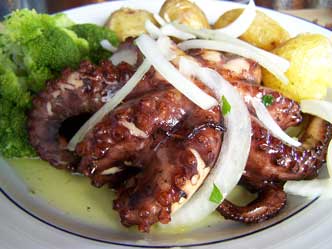
Freshly grilled octopus at Restaurante Leao d’Ouro in Lisbon

By Sharon Hudgins
Photos by the author

Some people travel to climb mountains, swim in the sea, lie on beaches or devour museums. While I’m partial to mountains and museums, I really travel to eat. One of the delights of visiting a new place is discovering its cuisine—from restaurants to home cooking, from street stands to picnic fare, from little food shops to bustling open-air markets that assault your eyes with bright colors and tickle your nose with unexpected aromas.

Although Spanish food gets all the limelight these days, the cuisine of next-door Portugal is well worth exploring, too. It’s not just a variation on Spanish cooking, but a different cuisine on its own, influenced by Portugal’s history, geography and religions. And the best place to begin your culinary journey of discovery is in the capital city, Lisbon.

Shopping at the Mercado de Ribeira

Seafood is supreme in this seafaring country, from fresh sardines and salt cod to octopus and clams. At the Mercado da Ribeira, the largest of several covered food markets in the city, you’re likely to see fish and shellfish that you never dreamed existed. The market also has large sections featuring fruits, vegetables, freshly slaughtered meat and preserved meat products such as sausages and hams. Go early on Saturday mornings for the liveliest action. By noon the vendors are already packing up their wares.

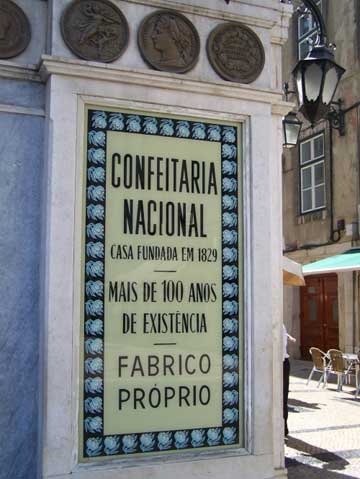
The best way to discover Lisbon’s culinary treasures is to wander through the different districts into which the city is divided, concentrating on one district at a time. In the Baixa commercial district, on the landmark Praça da Figueira square, Confeitaria Nacional is a classic pastry shop that has been selling sweets on that site since 1829. Taste their pasteis de nata (custard tart) or their signature Bolo Rei (King’s Cake), along with a cup of rich coffee. The tea room upstairs also serves a light, reasonably priced lunch. Nearby is a classic old-fashioned food shop, Manuel Tavares, which has been selling hams, sausages, cheeses, wines and confections since 1860. And from this same square, walk up Poço do Borratém Street toward the Martim Moniz tram stop, where you’ll find an excellent kitchenware store with hundreds of local and imported products.

Back at Figueira Square, walk along Rua D. Antão de Amada to visit Manteigaria e Bacahoaria Silva, another classic old shop purveying salt cod, dried beans, hams, cheeses and Portuguese canned products. At the top of that street, on Largo de São Domingos 8, an even smaller shop sells nothing but bottles of ginginha, classic Portuguese cherry liquor. For only one euro, you can taste before you buy.

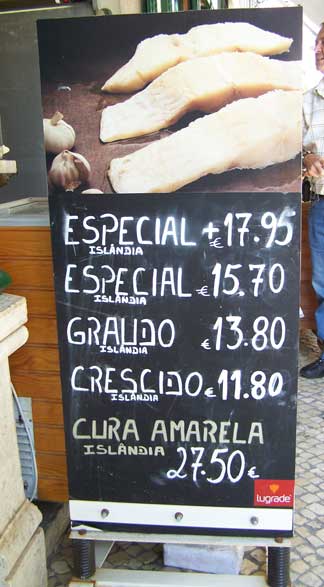
Signboard for Icelandic cod, a popular fish in Portugal
Fishmongers at the Mercado de Ribeira

Around Rossio Square, the hub of the Baixa district, several sidewalk cafes will tempt you to while away the day over a coffee drink (choose from at least eight different types that the Portuguese make). Indulge in excellent gelato at Fragoleto, a couple blocks off the Rua Augusta shopping street that leads into Rossio Square. And just across the street from the main train station near Rossio Square, the Restaurante Leão d’Ouro, built in 1842, serves simple, well prepared Portuguese food (especially seafood), at reasonable prices, in a delightful dining room with walls covered in beautiful blue-and-white ceramic tiles.

The tony Chiado shopping district, adjacent to Baixa, is another good place for palate pleasers. Stop for a freshly made juice drink or your choice of coffees at Quiosque de Refresco, a little old-fashioned iron kiosk in Camões Square. Sip a foaming beer at Cervejaria Trindade, the oldest brewery in Portugal, with its woody interior and beautifully tiled walls. Perk up with an espresso at A Brasileira, one of the city’s most famous old coffeehouses, decorated in Art Nouveau style. And for fine dining make a reservation at Restaurante Largo, a modern restaurant located inside part of an historic convent in the Chiado district. Celebrated Chef Miguel Castro Silva has a refreshingly no-nonsense attitude toward cooking: he prepares good, honest food with an emphasis on traditional Portuguese dishes updated for today’s tastes and artistically plated, but never pretentious.

The proprietor of As Marias com Chocolate makes cookies at her shop in Lisbon

Portuguese chefs are making a name for themselves in other parts of the city, too. At Bocca, an intimate, friendly little restaurant that has garnered rave reviews, one of Lisbon’s top young chefs, Alexandre Silva, presents ultra-modern dishes made from seasonal ingredients and arranged like miniature works of art. On the top floor of the tall Sheraton Hotel tower, the Restaurante Panorama lives up to its name, with stunning views over the city. The five-course “Temptation Menu,” with matching wines, showcases Chef Leonel Pereira’s specialties, which include fish and meat dishes that combine traditional ingredients with contemporary techniques.

Custard tarts from Pasteis de Belem

Outside the central part of Lisbon, in the Belém district along the coast, a magnificent Hieronymite Monastery was built in the early 16th century with money made from the spice trade after Vasco da Gama’s historic voyage around the southern tip of Africa to the lucrative pepper markets of India. A block from the monastery, the Antiga Confeitaria de Belém has been serving its famous custard tarts, pastéis de Belém, since 1837. Farther along the same street, other small pastry shops sell their own special sweet little tarts, one made with beer, another with fresh white cheese and ground almonds. Try them all.

Finally, foodies should also head to the Alfama district (the old Moorish quarter), where they’ll find the 19th-century Mercado Municipal de Santa Clara behind the São Vicente church. The city’s first covered food market has now been transformed into an educational center for culinary arts (in the interior), with several little shops around the outside, including As Marias com Chocolate, a tiny shop specializing in tempting handmade chocolate drinks and desserts. I dare you to eat or drink only one.

As they say in Portugese, bom apetite! Enjoy your meal!

NOTE: Portuguese meal times differ somewhat from neighboring Spain. Breakfast is any time after 7:00 a.m., when many people just stop at a pastry shop for a little custard tart or sweet bun and a galão, a big glass of hot coffee liberally laced with milk. Lunch lasts from 12:30 to 2:00 p.m., and dinner is usually any time from 8:00 or 8:30 p.m. until 10:00 p.m., although fashionable folk are known to arrive at a restaurant at 10:00 p.m. and dine until midnight.

● Lisbon Tourist Office, Rua do Arsenal 23
www.visitlisboa.com

● Mercado da Ribeira, Avenida 24 de Julho, near the Cais do Sodré train station, www.thelisbonconnection.com/market-mercado-da-ribeira-since-1882/

● Confeitaria Nacional, Praça da Figueira 18-B
confeitarianacional.com/english/home.html

● Fragoleto, Rua da Prata 80

● Restaurante Leão d’Ouro, Rua 1 de Decembro 105 www.restauranteleaodouro.com.pt/.

● Quiosque de Refresco, Camões Square quiosquederefresco.blogspot.com/

● Cervejaria Trindade, Rua Mova da Trindade 20-C www.cervejariatrindade.pt/trindade_english.html

A Brasileira, 120 Rua Garrett
en.wikipedia.org/wiki/A_Brasileira

● Restaurante Largo, Rua Serpa Pinto 10-A
www.largo.pt/en/

● Bocca, Rua Rodrigo da Fonseca 87-D
bocca.pt/en/

● Restaurante Panorama, Rua Latino Coelho 1 www.sheraton.com/lisboa

● Antiga Confeitaria de Belém, Rua de Belém 84-92 pasteisdebelem.pt/en.html

Chowing Down in Catalonia

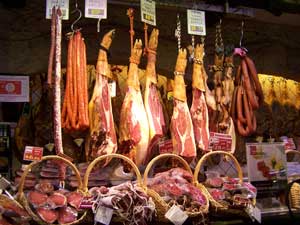
Spanish hams and sausages at Barcelona’s La Boqueria food market

By Sharon Hudgins
Photos by the author

Catalonia has long been one of my favorite gastronomic regions in Spain, years before star chefs such as Ferran Adrià, Santi Santamaria and Carme Ruscalleda catapulted it to fame on the international stage.

During two recent trips there, I ate at my favorite old restaurants, dined at new ones, and visited wineries and food producers throughout the area. And I was pleased to confirm that Catalonia is in no danger of losing its reputation for fine food, from traditional to modern, from home cooking to haute cuisine.

Tempting sweets at La Colmena pastry shop in Barcelona.

BEGIN IN BARCELONA
Barcelona, the capital of Catalunya (as it’s called in the Catalan language), is a prime destination for connoisseurs of good food. You could easily spend a couple of weeks eating your way around the city and still barely scratch the surface of its culinary possibilities.

Foodies flock to the colorful Mercat de Sant Josep (also known as La Boqueria), Barcelona’s best known big covered market, with its tantalizing displays of edibles from freshly caught Mediterranean fish to aged mountain cheeses, from exotic tropical fruits to pigs’ private parts. Grazers stroll from one tapas bar to another along the busy boulevards and the casual waterfront, drinking a glass of wine or beer and nibbling on tasty tidbits at each stop. Anyone’s sweet tooth will soon be satisfied at the city’s elegant pastry and confection shops, including Caelum which features pastries made in the many monasteries and convents around Spain. And don’t miss a visit to the Chocolate Museum, followed by a cup of thick hot chocolate at the bar in the museum’s shop.

But Barcelona is just the beginning of a memorable culinary experience in Catalonia. To understand the roots of Catalan cuisine, you need to spend time in the countryside, slowly savoring the sights, sounds and smells of a land that produces some of the best wines and food products in Spain.

Turbot with eggplant slices at El Rincon de Diego restaurant in Cambrils.

WINE COUNTRY
Catalonia is famous for its wines, including sparkling white and rosé cavas. Drive south from Barcelona into the picturesque Penedès wine country, the largest of Catalonia’s wine districts and one of the oldest wine-making regions in Europe. Although best known for its cava wines, processed in the same manner as French Champagnes, Penedès also produces many other fine wines, especially whites.

To learn about the history of wine-making in Catalonia, start at the Wine Museum in Vilafranca del Penedès. Then visit two of the largest producers of cava, Cordoníu and Freixenet, both located in Sant Sadurní d’Anoia. After seeing how those big commercial wineries operate, you’ll learn even more on a personal guided tour around one of the smaller, family-run wineries, such as J. Miquel Jané in Font Rubí, which provides very informative vineyard tours, cellar tours, and wine tastings, in English, and Pagès Entrena in Sant Jaume Sesoliveres, which also offers wine seminars and other activities such as horseback riding and bicycle excursions.

The rugged district of Priorat is known for its outstanding wines, particularly reds. Visit the new Wine Museum in Falset, the capital of this wine region, then drive to the little town of Gratallops, on a hill high above the Siurana River, to taste some of the excellent wines produced at the Buil & Giné winery there.

Not far inland from the popular coastal cities of Cambrils and Tarragona, the sparsely populated, mountainous Priorat region is a place of medieval villages, old monasteries and dramatic landscapes. Although off the beaten tourist path, it’s well known for its high-quality olive oils as well as its wines. Take the winding road up to the little village of Siurana, perched on a cliff with vertiginous views over the olive orchards and distant valleys below. Then enjoy a good meal accompanied by local wines at the little Restaurant els Tallers, in the small (six-room) Hotel la Siuranella.

Finally, finish up your tour of this part of the Catalan wine country by heading north a few miles into the Conca de Barberà wine district to see the Wine Museum in L’Espluga de Francolí. Housed in a landmark Modernist-style building constructed in 1913, it features three floors of exhibits on the history of grape growing and wine making in this area.

MÓN SANT BENET
For a completely different culinary experience, spend a weekend at Món Sant Benet, a complex of old and new buildings set amid the quiet countryside of Bages, a rural region just northwest of Barcelona, near the town of Manresa. Check into the ultramodern Hotel Món and enjoy a stroll through the nearby gardens before dining at either the Restaurant Món or Restaurant L’Angle (one Michelin star) within the hotel. Another restaurant, La Fonda, offers moderately priced lunches and snacks in the Factory building nearby on the complex’s grounds. The Factory also has an interesting shop selling local wines, food products and handicrafts.

Make a reservation to take a one-hour tour of the Alicia Foundation, a unique scientific and gastronomic research center established by Ferran Adrià at Món Sant Benet. You’ll visit the cutting-edge research laboratories and participate in an instructive workshop that focuses on the relationship between all of our senses and the foods we eat.

A highlight of the Món Sant Benet experience is a tour of the 10th century monastery there. The impressive multi-media tour cleverly uses video projections, 3-D holographic images and surround sound to tell the dramatic story of the monastery’s history. A separate, equally fascinating multi-media tour through the adjacent villa of the Modernist artist Ramon Casas gives an intimate glimpse into the daily life of the family who lived in the opulent villa during their summer holidays in the early 1900s. The combined tours through the monastery and villa take a total of two hours, leaving you plenty of time to relax in the soothing atmosphere of Món Sant Benet.

Wherever you choose to travel in Catalonia, from bustling Barcelona to tranquil Món Sant Benet, from the sunny seacoast to the high mountains of the Priorat, you’re never far from a fine meal with excellent wines. As the Catalans say when you begin to eat, “Bon profit!” (may you eat and drink well!).

Bread basket at El Rincon de Diego restaurant in Cambrils.
Handpainted Spanish ceramic coffee service at the Ramon Casas villa at Mon Sant Benet.

Where to eat:


Wineries to visit:


Wine Museums:

Flavors of Christmas in Spain

Photos courtesy Spain Tourist Office

Christmas delights the palate in Spain. You will have no shortage of opportunities to give way to temptation as you experience Spanish gastronomy during the festive Christmas season.

Dinner on Christmas Eve and New Year’s Eve, lunch on Christmas Day and New Year’s Day, along with January 6, Feast of the Epiphany, are the most essential dates. However, throughout the month of December, bars, restaurants and hotels are decked out for the season. Their tables are decorated with candles, bows and Christmas motifs, and they offer special menus and delicious dishes.

HEAVENLY TABLES
Christmas meals are usually copious. They tend to start with a selection of starters and appetizers, either hot or cold. Then comes several courses and dessert. You can try a bit of everything: shellfish, fish, meat, roasted meat, soups, Iberian cured meats—all prepared in an especially delicious way. Some of the most popular foods include turkey, lamb, red cabbage, sea bream, oysters, elvers and ham. As the dishes are served, you will see how hard it is to resist. And to accompany them are good Spanish wines, both white and red. At the end of the meal, good wishes are toasted with a glass of cava sparkling wine or cider.

SWEETS
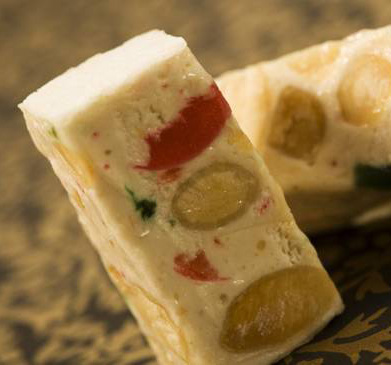
Sweets deserve a mention of their own, filling the table with color when it is time for dessert. Made with almonds, honey, sugar, chocolate and fruit, among other ingredients, they are a real treat for those with a sweet tooth. There is a wide array, and each region of Spain has its own typical recipes. However, the real star at Christmas is “turrón,” with a flavor admired around the world.

There are many different types of turrón, but you should try the Jijona variety—soft and sweet—and the Alicante type, which is hard and crunchy. Other traditional desserts are marzipan, polvorones (a crumbly shortbread) and mantecados (made with almonds and lard). Finally, on January 6, Day of the Three Kings (Epiphany), children are excited to receive their presents, while grownups get to savour a Roscón de Reyes (seasonal cake) with a cup of hot chocolate.

For more info, go to Spain Tourism

Great Goulashes!

Although goulash originated in Hungary, this popular dish later spread beyond its borders, first to the Austrian Empire, Germany, and the Balkans, and finally around the world.

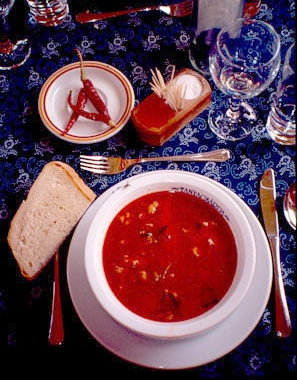
Classic Hungarian goulash at a restaurant on Hungary’s Great Plain

By Sharon Hudgins
Photos by the author

Everyone loves a good goulash. But ask a dozen people what a goulash is—and you’ll get a dozen different answers: a soup, a stew, a meat dish served on a plate; brown, red, mild, hot-spicy; made with beef, pork, mutton, game, even vegetarian.

Although goulash originated in Hungary, this popular dish later spread beyond its borders, first to the Austrian Empire, Germany, and the Balkans, and finally around the world. That’s why there are so many versions of goulash today.

GOULASH ROOTS
Hungarian goulash traces its roots back to nomadic Magyar herdsmen in the ninth century. Shepherds cut meat into cubes and slowly stewed them in a heavy iron kettle over an open fire until the liquid evaporated. Then they spread the meat out in a single layer to further dry in the sun. This dried meat, an early convenience food, could be carried with them as they followed their flocks across the vast expanse of Hungary’s Great Plain. To reconstitute the meat they simply added water and heated it—sometimes with other ingredients, too—in a pot over a fire. If a lot of liquid was added, the dish was called goulash soup. With less liquid, it was simply goulash meat. In both cases it was eaten with spoons dipped into the communal cooking pot.

Goulash got its name from those early herdsmen, who were called gulyás in Hungarian. But goulash as we know it today did not develop until the end of the 18th century and beginning of the 19th, with the widespread cultivation of peppers in Hungary and the use of paprika as a popular spice. Originally it was considered peasant food, eaten primarily by country folk—farmers, shepherds, cowboys, and swineherds. With the rise of Hungarian nationalism in the second half of the 19th century, paprika-seasoned goulash moved from the campsites and farmhouses to the tables of middle class and wealthy city dwellers, to the menus of fashionable restaurants and eventually across the globe.

GOULASH VARIETIES
Goulash is now the Hungarian dish most widely known abroad. But in many parts of the world, dishes called “goulash” bear little resemblance to the gulyás that originated in Hungary and is eaten there today. In Hungary, gulyás is a meat dish halfway between a soup and a stew, made with small cubes of meat (usually beef), no more than 3/4-inch in size, and flavored with bacon or lard, onions and paprika. Gulyás is traditionally served in a bowl and eaten with a spoon.

Over time, Hungarian cooks also developed many variations on this theme, using such ingredients as garlic, tomatoes, mild banana peppers and hot cherry peppers, caraway seeds, root vegetables, cabbage, beans and tiny egg dumplings, as well as pork, mutton, venison and boar meat. Regional recipes abound, with each cook claiming his or her own version of goulash to be the best and most authentic.

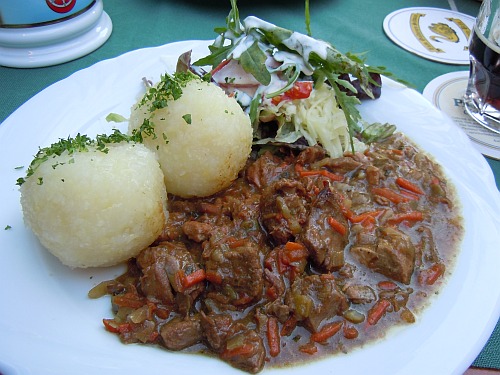
Germans adapted the basic Hungarian goulash recipe to their own tastes, producing the Gulaschsuppe (goulash soup) that is now so popular throughout Germany, where it’s traditionally served with a slice of rye bread and a mug of beer. Germans and Austrians also make a variety of thick, paprika-flavored meat stews called Gulasch, served on a plate and accompanied by boiled potatoes, egg noodles or dumplings. (The Hungarians, however, would call this kind of stew a pörkölt, not a goulash.) And Kesselgulasch (kettle goulash)—cooked outdoors in a pot suspended by an iron tripod over an open fire—is a Hungarian specialty that many Central Europeans now eat at their own backyard dinner parties and local festivals.

German “Beer Goulash” at brewery beer garden in Erfurt

As part of the former Austro-Hungarian Empire, the Austrians certainly love their own versions of Gulasch. There’s even a Cafe-Restaurant Gulaschmuseum in Vienna, where the menu lists more than a dozen varieties of goulash, including turkey or chicken-liver goulash with potatoes, bean goulash with paprika-seasoned sausage, veal goulash with little spinach dumplings, and even a dessert called Schokogulasch (chocolate goulash) containing cake, chocolate sauce and rum. In Prague I purchased a Czech cookbook devoted entirely to the subject of goulash—including versions identified as German, Austrian, Slovakian, Slovenian, Serbian, Bulgarian, even Chinese and Mexican! And recently in New Mexico I came across a Cajun goulash. What a mixture of geography and culinary cultures! From its humble beginnings on the plains of Hungary more than a thousand years ago, this simple peasant food has now become a truly global dish.

GOULASH-SPEAK
“Goulash” has also entered several languages as a word meaning more than just “a soup or stew.” In Hungary, “Goulash Communism” was a term for the Hungarians’ attempt in the late 1960s to create their own, more market-oriented, economic system distinct from the Soviet model. In Germany and Switzerland, a “goulash cannon” is military slang for a mobile field kitchen—a big, heavy, black, iron stewpot on wheels, with a cover on the top and a built-in firebox—which is also used for feeding crowds at festivals and other public events. And in the Czech Republic, political parties had a tradition of setting up their own “goulash cannons” in front of polling places at election time, where they dished out free goulash in a blatant attempt to influence voters’ choices on the ballot. As the Czechs said to each other when they headed to the polls to vote, “Have a good goulash!”