Castles, Christmas Markets and Cruising

By Marilyn Heimburger
Photos by Don Heimburger

Taking a river cruise is always a good idea. A river cruise that includes both historic castles and colorful Christmas Markets along Germany’s Rhine River is the best idea ever. So on Thanksgiving Day I happily ignored Black Friday and escaped the pre-Christmas shopping frenzy of the USA to spend a week on the AmaKristina, cruising from Amsterdam to Basel, Switzerland. Romantic castles and Christmas Markets along the Rhine River ushered in the Christmas spirit for me this year.

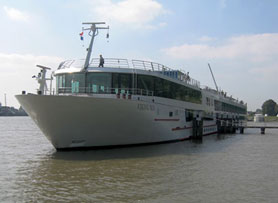
The newest AMA ship, the AmaKristina

The AmaKristina is essentially a floating luxury hotel for 158 guests. Our roomy cabin had a queen-sized bed, private bathroom with shower and double sink, desk, large format Apple screen and keyboard for internet, TV, or movies. Built in 2017, the ship’s hallways and guest suites were filled with Gustav Klimt art prints, and seasonally decorated with lights, Christmas trees, wreaths, garlands, and gingerbread houses. We boarded in Amsterdam, unpacked, and had our first dinner on board. Open seating at each meal encourages mingling of guests.

AMSTERDAM ATTRACTIONS
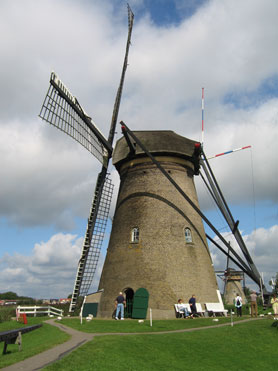
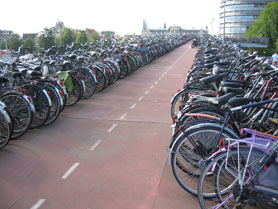
Fortified with a sumptuous on-board breakfast buffet, including an omelet station and daily vitamin “shot,” we departed the ship for an informative canal cruise, a panoramic city bus tour of Amsterdam with an up-close look at a local working windmill, and free time for exploring. Although there were no Christmas markets in Amsterdam, there were plenty of opportunities for shopping near the central train station, and street entertainment in Dam Square: a saxophone player, giant bubble maker, dancing dinosaurs, and impromptu yoga. Just be sure to watch out for the numerous killer bicycles that demand the right-of-way.

The AmaKristina set sail from Amsterdam in the afternoon, and I had time to explore the ship’s main lounge and bar, massage and hair salon, fitness room, gift shop, and even a heated pool and giant chess set on the sun deck. A cruise overview presented by our cruise director, plus Christmas tree decorating and an evening classical music performance by the three talented string players known as “La Strada” kept passengers entertained. The cruise ships cleverly bring nightly entertainment on and off the ship when stopped at the locks on the river.
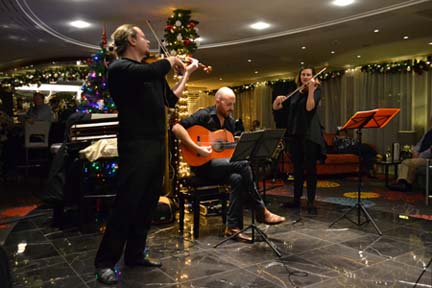
Onboard entertainment by La Strada

COLORFUL COLOGNE
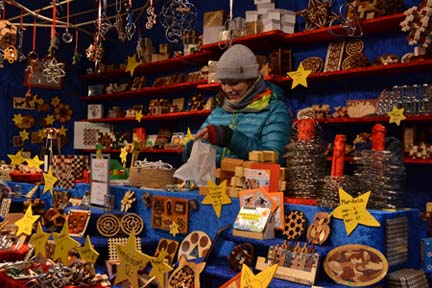
After cruising all morning, we docked in Cologne, Germany, where shuttle buses brought us to our first Christmas Market in Cathedral Square. Although the earliest Christmas Markets in Germany date from the late Middle Ages, the one in the shadow of Cologne’s impressive Cathedral is a relative newcomer, opening in 1995. Under a dazzling canopy of thousands of tiny lights, 150 vendor huts with bright red awnings and brilliant multi-faceted stars displayed handicrafts, comfort foods, gifts of all types, decorations, wooden toys and much more.
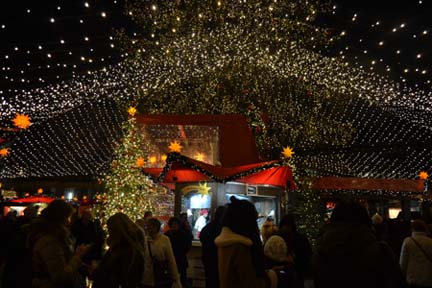
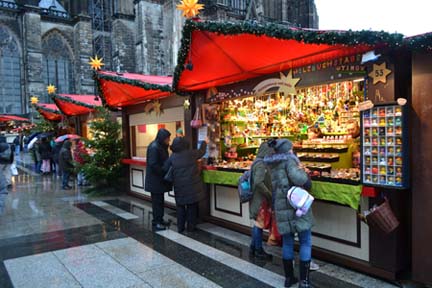
Canopy of Christmas lights in Cologne’s Cathedral Square

Cologne Cathedral Square market

HOME OF THE ELVES
A few blocks away in the Altstadt and Heumarkt was an older and much larger Christmas Market called the “Heimat der Heinzel” or Home of the Elves. These were little creatures from a Cologne legend who used to do all the housework until they were annoyed by an inquisitive housewife, and disappeared. I loved this market. Aisles were arranged by theme, and the large wooden huts had Old World, wood-carved details, thick green garlands and costumed vendors. Little “Heinzelmännchen” rode in gondolas above an expansive ice rink. Each souvenir mug of Glühwein (the traditional hot mulled wine so popular at the Christmas Markets) had a different elf pictured on one side, and his particular work specialty described in verse on the other. Cologne boasted three additional smaller markets, but time was too short to visit all of them on this trip.

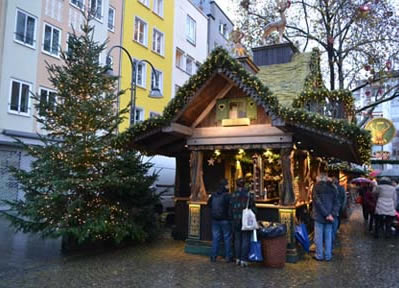
Home of the Elves’ Market in Cologne

CASTLE DAY ON THE RIVER
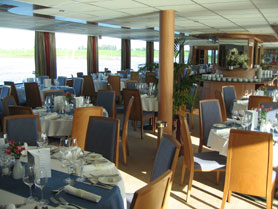
The morning cruise from Cologne to the next stop in Rüdesheim passed through the UNESCO World Heritage Rhine Gorge. What a treat to sit in the ship’s expansive lounge with panoramic windows, coffee in hand, gazing at vineyard- covered slopes, picturesque villages, historic castles, and the famous Lorelei Rock, with commentary by the cruise director. This romantic part of the trip alone is a highlight of any Rhine River cruise.

RÜDESHEIM’S CHRISTMAS MARKET OF THE NATIONS
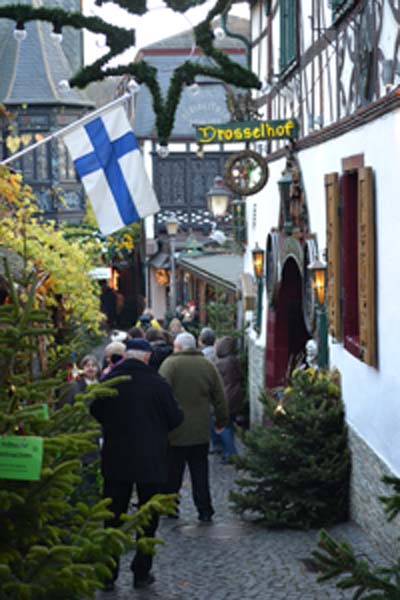
After a gourmet lunch of traditional German specialties, we docked in Rüdesheim, where the “Christmas Market of the Nations” wound up and down the narrow streets of this wine town of about 7,000 citizens. Vendors from France sold mushrooms, lavender and cheese, Tunesia vendors brought wares made of olive wood, smoked salmon came from Norway, furs came from Finland and even the United States was represented with a local vendor offering homemade cookies, Dr. Pepper, Fanta, marshmallows, and Hershey’s chocolate. Christmas choir music piped throughout the market added to the festive atmosphere as shoppers strolled past inviting vendor stalls and village shops. A new discovery at this market was hot mulled Glühbier from Belgium.

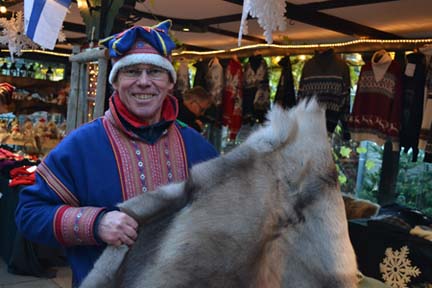
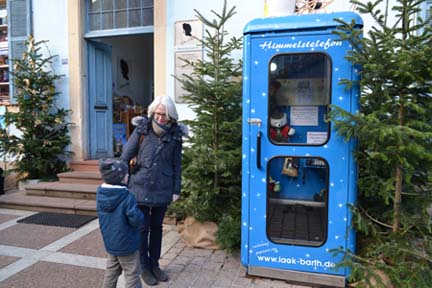
(clockwise) Hot lunch in Rüdesheim; Fur from Finland at Rüdesheim’s Christmas Market of the Nations; “Hallo” from the gnomes in Rüdesheim; Placing a phone call to the Christkind in Speyer

Throughout the ship’s seven-day cruise, each day’s program offered passengers quiet, regular and active excursions. Rüdesheim excursions offered by the AMAKristina included wine tasting, a hike, bike or gondola tour through the vineyards. A late night, fun option was experiencing Rüdesheimer coffee – coffee set on fire with Asbach brandy and sugar, topped with whipped cream and chocolate flakes – at Eiscafe Engel on Rüdesheim’s famous Drosselgasse.
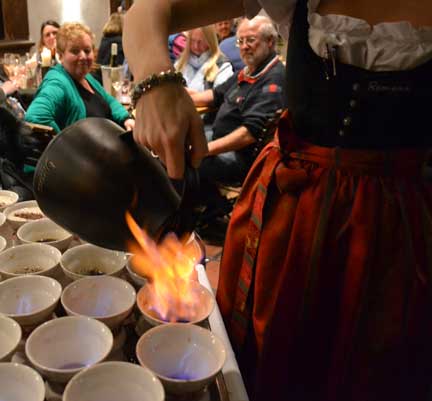
Rüdesheimer coffee
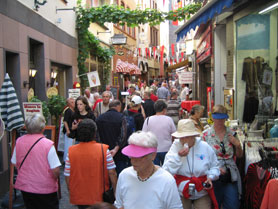
Atmospheric narrow Rüdesheim street

THE IMPERIAL CITY OF SPEYER
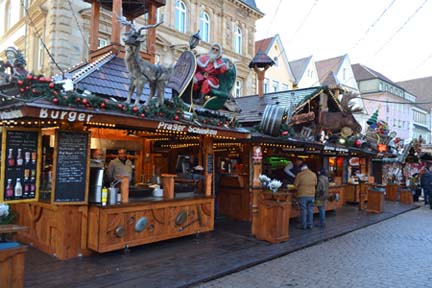
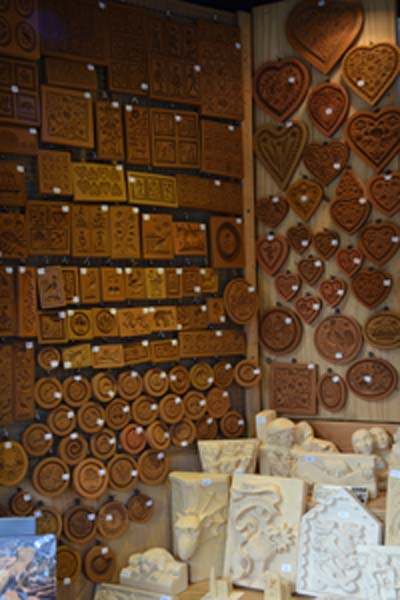
By noon the next day we docked in Mannheim and could choose a bus excursion to Heidelberg or to Speyer. Having visited Heidelberg several times already, we chose to see the 2,000-year-old Imperial city of Speyer. Here the Christmas Market extended down Maximilianstrasse from the UNESCO World Heritage Speyer Cathedral, the largest Romanesque cathedral in the world. Though smaller than the Cologne Christmas Markets, Speyer’s market had all the requisite comfort foods: Glühwein, grilled sausages, roasted almonds, and even waffles, potato soup and dumplings. Vendors offered wood handicrafts, colorful candles, jewelry, scarves, kitchen gadgets and unique cookie cutters. Especially for children were an ice rink, kiddie car rides and a telephone booth with direct access to the Christkind in Heaven!
Back onboard the AmaKristina we had a tea time treat of traditional Spekulatius cookies and Stollen, while we set sail for our next stop: Strasbourg and Le Petite Alsace in France.

INVITING STRASBOURG AND LE PETITE ALSACE
As with each stop on our route, AmaWaterways provided an energetic and knowledgable guide for a walking tour of the area on the way to the Christmas Markets. This morning we learned about the Alsace region, which changed hands between France and Germany four times in 75 years. The name “Alsace” derives from a German phrase meaning “seated on the Ill.” While our guide led us along the Ill River, past the beautiful half-timbered houses lining both sides, she explained that this charming area was historically the least desirable place to live. It had been the site of fortifications and a prison, the home of executioners and the location of the tanning trade, with its smelly byproducts. Today it is a photographic highlight of any trip.

CHRISTMAS MARKETS WITH A FRENCH TWIST
Christmas Markets first appeared in Strasbourg in 1570, making this German/French town the location of one of the oldest markets in Europe. Although much was similar to the Christmas Markets we saw in Germany, here the food vendors offered toasted baguettes topped with cheese as the warm comfort food, instead of the ubiquitous wursts in the German markets.

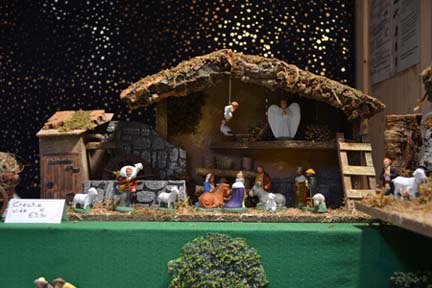
The traditional market was near the cathedral, with some vendor huts topped with storks, that famously nest in Strasbourg’s Parc de l’Orangerie. More than 300 vendor chalets filled the historic city center. Entertaining metal sculptures depicting different professions caught my eye, as did the detailed, intricately carved figures for nativity sets. A market area featuring Strasbourg’s service organizations surrounded a towering decorated Christmas tree and grassy area which was perfect for family photos. A small market in Gutenberg Square annually invites vendors from other countries: this year it welcomed Iceland.
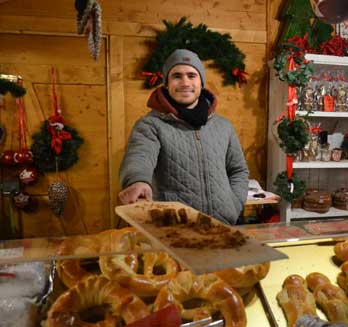
Try some gingerbread in Gengenbach

GENGENBACH’S GIGANTIC ADVENT CALENDAR
We were back on the German side of the Rhine River by late afternoon, and on a shuttle bus from the AmaKristina to the beautiful village of Gengenbach. A guided tour down Engelgasse led to the Christmas Market which stretched down the main street from the town hall square.
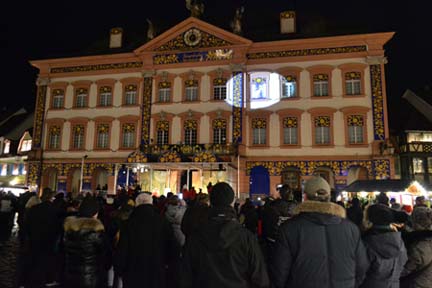
Gengenbach Town Hall Advent Calendar

Gengenbach boasts the world’s largest Advent calendar in its neo-classical town hall, where each night one of its 24 windows is opened to reveal a picture by a famous artist. This year’s calendar featured paintings by Andy Warhol. We arrived just in time for the first night’s opening ceremony: a narrated short skit performed by children from the town. After browsing through the market’s matching vendor huts, with hot Glühwein in a mug depicting the town hall Advent calendar, we returned to the ship to be delightfully entertained by a French cabaret singer and her accordion accompanist.
LAST FULL DAY ONBOARD
Shuttle busses from the AmaKristina were the order of the day with options to Riquewihr, France, or to Freiburg and Breisach, Germany. Deciding to aim for German-speaking vendors, we took the second option, and explored the market in the heart of Freiburg’s beautiful old quarter. Traditional craft products, including glass blowing and colorful wooden toys were offered beneath the green and white lights that trimmed the roofs of the more than 130 vendor huts.

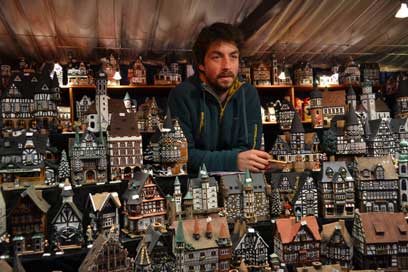
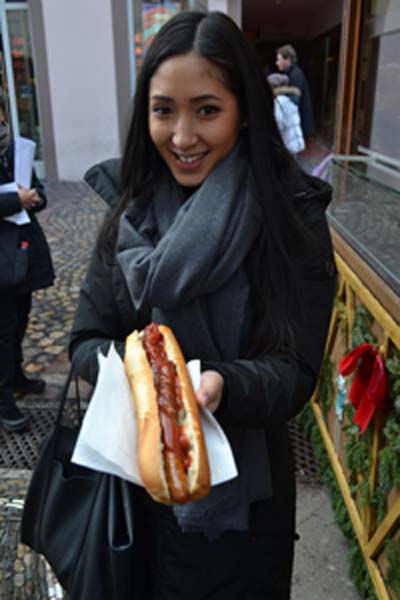
Time was too short to see all of the ceramics, candles, hand puppets, amber jewelry and Christmas decorations, but we enjoyed a quick wurst and Glühwein lunch before leaving for Breisach. Unfortunately this town’s tiny Christmas Market was not yet open for business, so after strolling down the pedestrian-only shopping zone, we walked back to the boat dock, to sail to Basel and enjoy the captain’s farewell dinner and our final evening on board.

Early the next morning, with our luggage packed with Christmas Market treasures, we left for home filled with Christmas spirit and with wonderful memories from this romantic river cruise of Christmas Markets and Castles on the Rhine.

TIPS AND FINAL NOTES
An AmaWaterways river cruise makes visiting so many sites along the Rhine extremely easy. You unpack only once in a roomy cabin. Meals are well-planned, complete and delicious, with perfect portions and special dietary options. Wine and beer are included with lunch and dinner. The fabulous coffee bar is open all the time. Special surprises delight passengers as well, such as serving a location’s specialty treats during afternoon tea time, recognizing St. Nicholas Tag by putting treats in passengers’ shoes left outside cabin doors, and providing hot towels and beverages upon re-boarding after cold excursions. The company will cheerfully arrange for your transfers to and from the cruise ship.

The cruise director is the key to having a wonderful time on any cruise, and this AmaWaterways trip had a great one. David Rosell was organized, energetic, accommodating and entertaining.

Most Christmas Markets are open from the beginning of Advent through Christmas, although some larger markets stay open longer, and some smaller ones have limited open hours. Bring euros – most small vendors don’t accept credit cards.

Pack warm layers of clothes, boots and umbrellas. The weather can be chilly and damp during November and December.

AmaWaterways provides a post-cruise option, if you want to extend your trip. This Christmas Market/Rhine River castle cruise offered an excursion to Lucerne and Zurich after disembarkation in Basel. For more AmaWaterways information and schedules, go to: www.amawaterways.com.

If you go: The Mövenpick Hotel Central in Amsterdam is a great place to stay before you board. This new, 4-star hotel is located within walking distance of the train station, the city center and the cruise ship loading docks. A sumptuous breakfast buffet is included with the room, and a knowledgable concierge team can help you plan your free time in Amsterdam before the cruise. For more information go to: www.movenpick.com/en/europe/netherlands/amsterdam.

Rhine River Magic

A dozen days of unique European history, adult fun, fantastic food, and a good bit of pampering

Photo: Courtesy Viking River Cruises

By Don Heimburger
Photos by the author

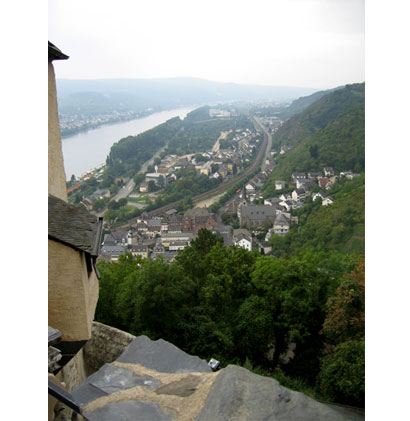
Gazing down on the wide and meandering Rhine River, from a spot at the outer courtyard of high Marksburg Castle that overlooks the 1,300-year-old German town of Braubach, the historic significance of where I am begins to sink in. And it hits me hard, in a good sort of way.

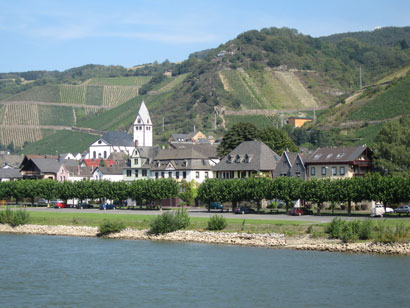
I’m in the midst of fortresses and castles, neatly-planted vineyards, small ancient villages, all in close proximity to the driving force behind this beautiful valley–Germany’s beautiful and romantic Rhine River.

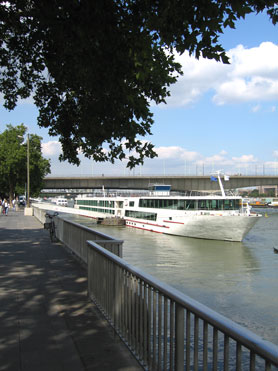
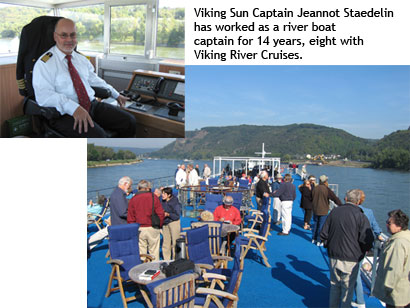
My adventure is a 12-day floating history tour on the sleek Viking Sun, one of many cruise ships that Viking operates on the Rhine, Main, Moselle and Danube rivers in Europe and elsewhere. This ship, a three-deck, 198-passenger liner with its own restaurant with panoramic views, large observation lounge, library and an internet cafe, cruises from Antwerp to Basel, Switzerland, a 677-mile journey back into time.

BRUSSELS AND BAGS

Many passengers arrive in Brussels, a 45-minute train ride away, before boarding the ship that caters to English-speaking travelers. With bags tucked away in the cabin (there are 89 deluxe and 10 standard cabins on the ship, all with outside river views), passengers settle into a sit-down dinner in the evening.

But the meals are only a small, but very inviting, reason for taking this cruise. The historic sights and beautiful scenery is dazzling, and it is laid out before me every day, all the time, from the comfort of a lounge chair, or a sundeck chair, or even the comfort of my on-board bedroom if I chose not to wander about the ship.

BRUGGE IS BEAUTIFUL

The first off-ship tour was by bus to Brugge, a beautifully preserved medieval town from 1128 that was famous for its wool and weaving. Much of the historic city center remains intact. The town boasts the Church of Our Lady with one of the world’s highest brick towers at 400 feet high. Walking through the historic section, with classic buildings and elegant houses of former wealthy textile merchants, I felt like time had stood still, and that I was a resident of this quiet village in its heyday.

At Rotterdam, passengers boarded buses for a trip to Delft to see the birthplace of the famous Dutch Master Jan Vermeer. Delft is known for its pottery called delftware, produced in this town for more than 500 years. A tour through this small but amazing factory, and a look at the numerous products it makes, gave me an insight into what makes this blue-and-white glazed earthenware, highly prized throughout the world.

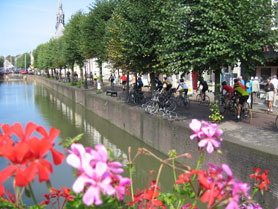
Holland is more water than land, it seems, and the Viking Sun floats through Rhine waterways and canals until it reaches Schoonhoven, a quaint 12,000-population riverside town, full of charm, canals of its own, and a large Town Gate (Ferry Gate) as you enter.

The town formed around a castle that was built here in 1220, and shipping, brewing, fishing and agriculture have been the main industry. Little shops, with plenty of jewelry stores loaded with tempting rings, necklaces and bracelets, line the main street, which is divided by–you guessed it—a canal. This was an inviting town to visit, and the local beer tasted good as well which I sampled under a cafe umbrella on the town square.

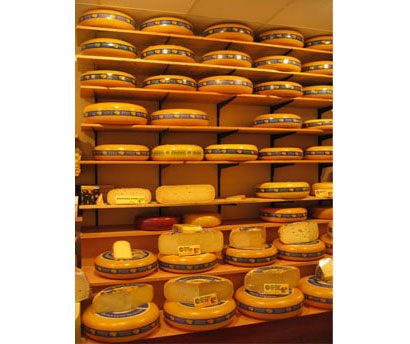
Next up on the land tours was Gouda, one of Holland’s most famous cheese-making towns. In the center of town and the market square, a beautiful Gothic Town Hall sits smack in the middle, drawing lots of attention to itself. Try the cheeses while you’re there!

AMSTERDAM AND ANNE FRANK
The Viking Sun’s arrival on a Sunday in Amsterdam was greeted by a crowd of, I’d guess, 50,000 people near the dock. Well, at least I thought they were welcoming us, until I realized that they were attending an annual Music Festival that weekend which was held right at the main cruise ship dock in downtown Amsterdam.
Let me say a bit about Amsterdam. I had not been to this city of three-quarters of a million people before, but I had heard about the red light district and how multi-cultural the city was. Well, it’s true.

During the Dutch Golden Age, this 12th century fishing village was the most important port in the world, and likely because of its location, the city has attracted people from 177 different nationalities who now live there. With all the canals running through the city (it’s called the Venice of the North), trams, autos, cabs, trains and especially bikes, there is no shortage of means to get around town, and it’s densely populated. The “extra fare” entertainment districts (red light area) and the “liberal” coffeeshops that dot the city are interesting only by the fact that they exist. There is no redeeming social value to that segment of the city.

On a higher plane, what is worth seeing is Anne Frank’s home where she hid from the Nazis until she was betrayed and sent to her death in Bergen-Belsen. This is not a long walk (20-25 minutes) from the Central Train Station, but a cab, tram or a bicycle is also an alternative. There are 50 museums in Amsterdam that beckon you as well—more museums per square mile than any other European city.

After a busy day in this large city, relaxing in the evening on the boat was welcome. After breakfast the next morning, the ship had docked at Arnhem, the last Netherlands port before entering Germany.

THREE DELICIOUS MEALS A DAY
At this point in the trip, passengers had already became spoiled with dinners such as Greek salad and warm bread; cream of cauliflower soup; pink grilled Duck breast with orange sauce; or napkin dumplings with creamy mushroom ragout and herbs; and cr̬eme brulee with chocolate ice cream. Of course, each dinner menu had several choices of appetizers, main dish and dessert. There was also a complimentary selection of international cheeses offered at each meal, as well as beers, wines and apertifs (at additional cost).
Wait staff on board the Viking Sun.;
Sven Hansen, Viking Sun’s Maitre d’ (left) and Executive Chef Reiner Eggert. 

A lighter buffet-style luncheon was offered in the lounge or a more complete sit-down meal at noon in the restaurant. I found that the lighter lunch was more than I would eat anyway, and usually opted for that. For breakfast a complete menu was available by 7 a.m. of hot and cold meats, cereals, eggs, waffles, fruits, breads and rolls, juices, coffee, and even champagne and made-to-order dishes like omelets and French Toast. Believe me, I never eat that much at breakfast, and there was a treasure trove of goodies each morning that the cooks had been working on the night before. For early birds, there were even fresh pastries and richly-flavored coffee from 6 to 7 a.m. Meals on board were always delicious, there was plenty of food, and it was displayed as a work of art. The servers were often funny and always accommodating (hello Cata and Michael–may I have another cup of coffee please?).
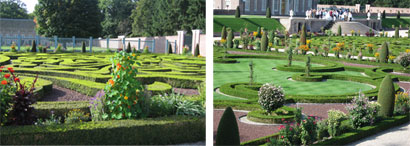
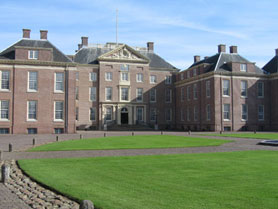
From the dock at Arnhem, we boarded buses (it took five busloads to hold all the ships’ passengers, plus local tour guides), and traveled to the magnificent Paleis Het Loo, and I emphasize the word magnificent. This large, sprawling complex was the summer residence of the Royal House of Orange from 1686 to 1975, and royal indeed it was–and still is. Walking through the house or the colorful formal gardens is a rare treat to the eye. The gardens, especially, combine classical planting symmetry with intricate landscaping. You can, and I did, spend a lot of time in the gardens. If you have time, grab a hot coffee and sweet pastry at the coffee shop and enjoy it outside in the palace courtyard. Then stroll down a long row of trees to the barns where a large collection of royal sleighs, carriages and coaches are on display. It’s worth the walk.

INTO THE DEUTSCHE DOMAIN

Around dinnertime, our ship got under way again and headed for Cologne, arriving there the next morning around breakfast. Many passengers were eager to enter the German Rhine because the Middle Rhine, where the many fortresses and castles are located, was something they had heard about, and it was a main draw of the trip.

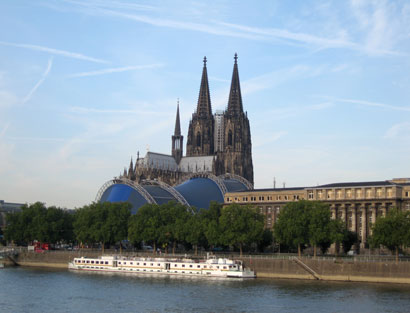
Cologne is noted for the tall, striking Gothic cathedral seen from anywhere in the old part of the city. Passengers crowded along the sundeck railings as we entered Cologne to admire the stately church spires and the city’s imposing skyline.

In Cologne we received a guided walking tour, after which there was just enough time to check out the shops selling Erzgebirge items such as smokers and nutcrackers, or visit the Roman Museum or visit the Brauhaus (included in the ship’s tour) to partake of one of the city’s delights: Kolsch beer, a very tasty beverage made in Cologne. Many passengers returned to the city for an evening walk after dinner on the boat. I could have easily spent more time here, but the rest of Germany beckoned, and I literally didn’t want to miss the boat.

Stained glass windows inside
the Gothic cathedral in Cologne.

Next up was Koblenz, the spot where the Moselle and Rhine rivers come together; the exact spot is called the German Corner, punctuated by a massive statue of Wilhelm I on a horse. Our ship docked right down from the statue.

Koblenz was originally a Roman outpost, so when they said the town was 2,000 years old, I could believe it; it was founded in 9 B.C. Even the fortress across the Rhine at Kolenz, the Ehrenbreitstein, with its vast fortified construction and enormous parade ground, was built in the 11th century, and was re-built in 1816-1823. It was never attacked, but looking up at it from across the river, I could see why an army would have difficulty making any headway.

MOSELLE MOMENTS

To see the Moselle and its neat, green vineyards, we boarded buses and headed to Cochem, located about 30 miles west of Koblenz. In this little riverside town, dominated by the 1,000-year-old Reichsburg Castle built by the Palatinate Dukes, the atmosphere was that of fun, with local wine being sold in many shops. Half-timbered houses dot the cityscape, narrow cobblestone streets lead to taverns and quaint cafes, and everyone seemed to be in a party mood.

At Braubach, a treat was in store. The Marksburg Castle, one of the few along the Rhine that was never destroyed, sits high above the town, and passengers were taken by bus to the castle “parking lot” where we walked steep steps to continue to the castle gate. From there, a tour guide with a very large castle key gave a detailed tour in English. References to this remarkable fortress go back as early as the 13th century, and little has changed inside since then. You can see the Knight’s Hall and the castle chapel, dedicated to Saint Mark, from whom the castle gets its name.

From the garden area of the castle, I could look down on the Rhine and see the vast, commanding view of the entire countryside north, south and east. I could see why enemies would not be able to storm the castle as they could be easily watched from this fortress.

On the way to Rudesheim, we pass the cat-and-mouse castles (Katz Castle and Maus Castle–neither of which have anything to do with animals), and the Pfalzgrafenstein fortress that sits on a rock in the river. In high water, you can’t even see the rock: the castle appears as if it’s floating.

At this point the Viking Sun also passed the Lorelei, a 440-foot-high legendary rock that I could see on the left as the ship cruised south. The Lorelei gets its name from the German word ley or rock, and the Middle High German word lure, which means treacherous.

Docking at Rudesheim, a small village next to the Rhine, allowed passengers to walk the streets to visits shops and cafes, or to visit a colorful, narrow street called the Drosselgasse, featuring live German music and dancing, charming taverns and restaurants, and beckoning shops. An evening stroll down this street with twinkling lights, delicious smells and friendly laughter is a must.

(left to right) The Kammerzell House is a famous restaurant in Strasbourg, France.;
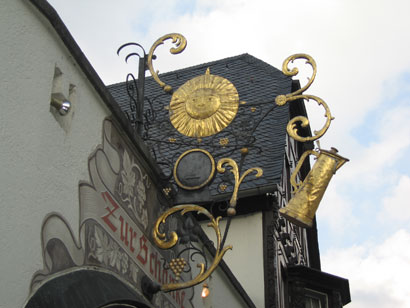
A store-front sign in Rudesheim, Germany.

At Mannheim, tour buses whisked passengers to romantic Heidelberg, noted as a university town which sits in a narrow gorge on the Neckar River. Built in the 17th century, the beautiful city is dominated by Heidelberg Castle which sits above the city, and which is being restored. A guided tour of this vast fortress was part of our tour package. Another dominate marker of the city is the handsome, turreted Old Bridge, built in 1788 on the banks of the Neckar. Not far from that is a very long street which winds its way for seemingly miles. It’s a good place to sit for a while and order some German food and bier (during warm weather), and watch people.

GRAND SPEYER

Speyer, an important center of Jewish culture, is best described as a grand city. Everything is large here–the buildings, the monuments, the city park and the Kirches (churches). The town’s Old Gate, a centerpiece of the city, still stands today, dating to 1176. The massive tower is 180 feet high. The Kaiserdom, founded in 1030 and consecrated in 1060, is Germany’s largest Romanesque building and is a UNESCO World Heritage site. Peeking in one of the churches further up the street, I listened to a men’s choir practice for an upcoming service. In the quiet of the church, with only a handful of others listening before the service, I was awestruck at the power of mens’ singing voices, and grateful for the chance to hear the soothing German songs in such a magnificant setting.

Docked in the Strasbourg suburb of Kehl, we boarded buses for a guided tour of this multicultural city. Strasbourg is where the Palais de L’Europe is located and where the European Parliament meets. It’s one of the richest medieval cities in Europe, and its Old Town is completely surrounded by the Ill River. Cozy cafes and restaurants abound here, such as the Kammerzell House, next to the Hirsch Chemist (www.maison-kammerzell.com).

My trip was nearing an end, but not without a bit of fanfare! At the captain’s farewell dinner on board, passengers and crew were in a celebratory mood, with a special menu of meat pate with cumberland sauce and Waldorf salad; cappuccino of forest mushrooms; honey glazed salmon or grilled beef tenderloin with truffle crust, vegetable basket and macaire potatoes; baked Alaska and pralines. Music and sparklers added a festival atmosphere during the dessert, followed by brief remarks from the crew.

On the last day before docking in Basel, our end point, the ship came into Breisach in the early morning, and after breakfast, the group took an excursion to the Black Forest. This densely-forested, mountainous region encompasses 7,500 square miles in southwestern Germany. It’s long and narrow (124 miles long, 37 miles wide), and tourism is the most important industry in the region. Pines and firs make up the foliage, and a number of birds and small creatures populate the forest. Cuckoo clocks, wood carvings and cherry schnapps are favorite souvenirs for visitors. I could have spent more time in the Black Forest area–the villages seemed so neat, tranquil and friendly, and the surrounding forests and mountains were unbelievably quiet and beautiful.

BASEL BECKONS

After 12 days, the cruise ship pulled quietly into Basel, which borders Switzerland and France, and is Switzerland’s third largest city. After our final breakfast–at which everyone lingered a bit longer–and farewells were made to friends that we met on board, we all departed for planes, trains or other transportation to take us home or to continue our journey.

It had been a dozen days of cruising one of the most famous rivers in Europe in total comfort and passing some of the most important historical towns and places in Europe. It had been educational, relaxing and fun, and I’d do it again in a heartbeat.

The trip was an up-close, personal encounter with European history, people and culture that would have been hard to duplicate on my own. And it was done in style, with a shipload of friends, and at a pace that was relaxing and enjoyable. Hopefully, my first river adventure down the Rhine won’t be my last!

HELPFUL HINTS:

To catch any of the numerous river cruises that Viking offers, call 877-668-4546 or visit vikingrivercruises.com. There is a wide range of itineraries, rivers, countries and prices to choose from. Viking cruises may also have add-on features that allow you to extend your vacation even longer. Viking can also book flights to your ship’s arrival and departure destinations.

All meals on board are included in the price. You won’t go hungry. Room service is not provided.

All off-ship tours are included in the price, except those that are announced as special tours once you board. Viking offers English-speaking tours (such as this one), as well as international tours that encompass other languages.

The three-deck Viking Sun (built in 2005/2006) holds 198 passengers and has a crew of 44. Rooms have a private bathroom/shower, phone, television, safe, hairdryer and individual climate controls. On-board voltage is 220V; razor outlet is 115V.

The ship’s Category A, B and C cabins at 155 square feet are larger than I thought they would be. Standard cabins are 120 square feet. The queen-size bed in my room was quite wide. There were drawers in the room to hold all of my belongings.

The ship’s promenade deck and its many panoramic windows allowed passengers good viewing in all kinds of weather.

The ship’s personnel will do your laundry (for a fee), sell you a limited amount of clothing should you need it, or if you forget something, provide internet service and phone service for a fee, and offer you a special drink package that saves money.

Shore excursion details were announced the evening before by the Cruise Manager in the lounge. His talks were detailed and informative, as well as funny, and passengers depended on him and his able assistants for answers to their many questions. He made the trip fun.

Special demonstrations and activities on board during the evenings–such as dancing troupes, silversmithing exhibits or games—were entertaining, and helped passengers mingle with others on board.

A galley tour, and a tour of the wheelhouse with the captain, were provided for those to wanted to participate.

A doctor was not on board, but the ship was always within a few minutes of the shore if a medical emergency arose, which it did not. All the crew are trained in life-saving techniques.

By all means, bring comfortable clothing and comfortable shoes. Ties and jackets are not required, but I found that many passengers dressed up for evening dinners. Tipping on board was also not required, but was encouraged, although it was not a hard sell. By the end of the trip, I wanted to offer some of the crew a tip for the excellent service I received.

Was 12 days on board a ship too long? Viking offers shorter trips, but I found that passengers took numerous shore excursions that made the time on board go quickly. The 12 days were nicely offset by the guided land tours.

I found a number of passengers had already been on a river cruise–a Viking cruise, in fact–and a number of them had been on at least two previous Viking river cruises. A number of passengers were vacationing with another couple or a group of friends.

The crew made the trip very pleasant; they were always accommodating. Returning from some land trips, the crew stood at the ship’s entrance with hot towels and glasses of fresh, chilled orange juice.

For those who get seasick easily, the Rhine is tame. I barely felt a wave all trip.

Cruising Canals in France with “Panache”

By Marilyn Heimburger
Photos by Don Heimburger

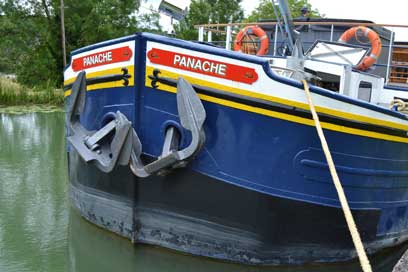
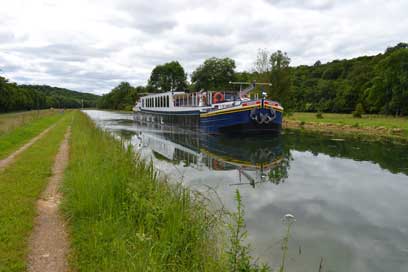
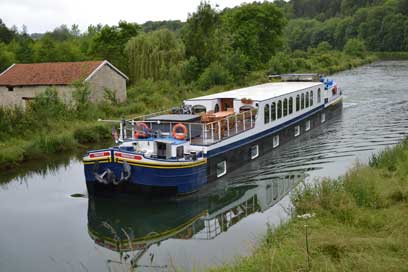
The word “panache” means style, energy, verve — and it’s also an apt name for a luxury hotel barge from European Waterways that cruises the canals of France.

Why cruise on a canal? Why are the canals there at all? Of France’s more than 5,000 miles of inland waterways, half consist of a vast network of canals, some built as early as the 17th century, to connect France’s rivers and provide a freight transportation route from the English Channel and the Atlantic Ocean to the Mediterranean. Narrow locks raised and lowered the barges over land elevations between the riverbeds. When trucks and railroads provided a cheaper and faster means of freight transport beginning in the 1970’s, the idea of redesigning commercial freight barges for passengers was born.

LUXURY ACCOMMODATIONS
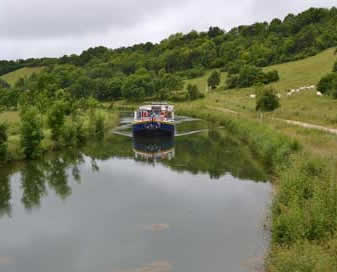
Our home during the six-day cruise on the Canal de la Marne au Rhin of Lorraine in eastern France was the 129-foot Panache, built in 1959 as a commercial freight barge and converted to a luxury hotel barge in 1998.

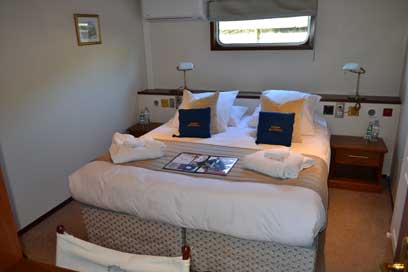
Rooms are below deck.

The six person crew — captain, pilot, deckhand, chef, hostess and housekeeper — greeted us on the sun deck with a Champagne toast and three appealing appetizers, and led us to our air-conditioned suite, with a queen-sized bed, private bathroom, plenty of storage space, desk, bedside tables, lamps and a television for watching onboard DVDs. Six roomy suites on the lower deck accommodate up to 12 passengers.

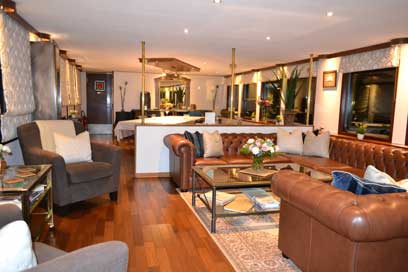
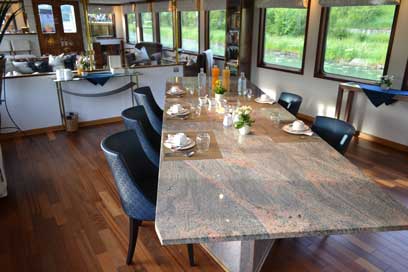
The main deck held the dining area with a gorgeous granite table that seats 12, a lounge area with a sectional leather sofa and coffee table for relaxing and reading, a fully stocked open bar, books and games, all surrounded by panoramic windows so guests can watch rural France glide by.

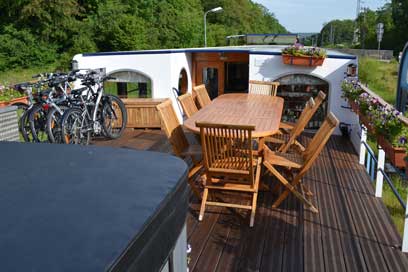
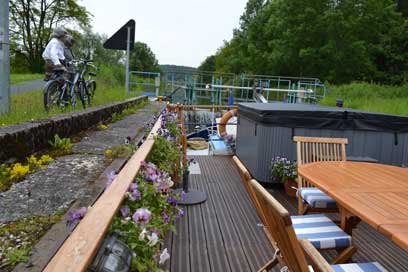
Another large table and folding chairs and a hot tub were on the sun deck, along with a supply of bicycles for guests to ride on the paved towpath that runs alongside the canal.

GOURMET MEALS
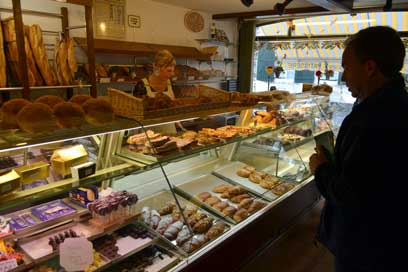
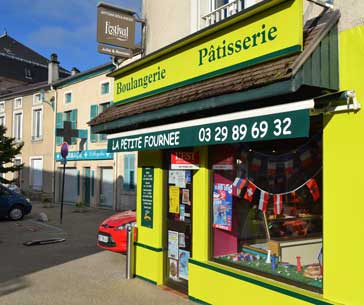
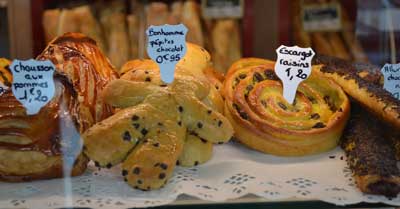
Each morning a continental breakfast of fresh fruit, juices, cheese and meats, coffee and fresh breads and pastries awaited us in the dining area. A made-to-order hot dish, such as scrambled eggs with smoked salmon, French toast, or an egg-in-ramekin creation, was also offered. By the second morning we were invited to accompany the captain on his early morning visit to the local patisserie to help select the freshly baked French pastries, croissants and baguettes for the day.

Going for fresh bread and pastries in the morning.

Both red and white wines were served with lunch menus that included mussels, a pesto and mozzarella tart, slices of smoked duck, carrot soup, mullet fish, chicken with wild mushrooms, sea bream, and fresh salads and cheese.

Each day ended with a four course, candlelit dinner in true French style. Red and white wines were presented to accompany each course:

  • Appetizers such as goat cheese and sun-dried tomato tart; crab, avocado and mango stack; chicken livers with shallots and capers; or seared scallops in cauliflower puree with crisps and chive oil.
  • Entrees including filet mignon wrapped in parma ham, rack of lamb, pork loin with dauphinois potatoes, beef filet with seared foie gras.
  • A cheese course with two or three selections meticulously paired with complementary dried fruits, jam or nuts.
  • And a dessert course – ah, the dessert course – banana souffle with double chocolate glace, chocolate mousse with iced amaretto, a fresh, citrusy lemon tart, a ramekin of molten chocolate lava with vanilla ice cream, and a strawberries and cream confection with crumbled merengue called the Eton mess.

One meal not prepared on board by Chef Todd was a special dinner at the intimate Table la Viktor in nearby Lucy on our second-to-last evening of the trip. With Captain Arnault as our genial host, we ordered local French cuisine – appetizers, entrees and desserts – from the menu, paired with appropriate wines, of course! It was a delicious dinner in an intimate setting.

EXCURSIONS ON LAND
The shady towpath alongside the canal immediately tempted us to take advantage of bicycles available for guests. The crew gave us bicycle helmets and readied the bikes for off-loading as we approached one of the many, many locks. Just as the deck reached ground level, we stepped out with our “wheels,” and rode off, easily out-pacing the barge (whose maximum cruising speed on the canals is 3 mph) past flower and vegetable gardens, through a small town and a playground filled with children, eventually meeting the barge at another lock to re-board.

The crew somehow managed to hopscotch two multi-passenger vans from dock to dock each day, so that a vehicle was always available for excursions and errands. Hence the early morning trips to the patisserie for fresh pastries, and the crew’s ability to shop for fresh local ingredients for our gourmet meals.

During the first afternoon we enjoyed an excursion to the Domaine Trepo Leriguier family-owned Champagne house for a private tour and tasting.

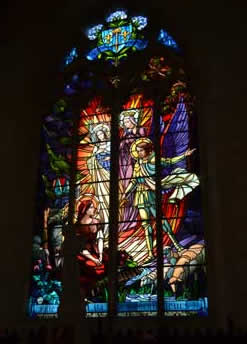
The next day featured a trip to the town of Vaucouleurs and the Musee de Jeanne d’Arc. The museum is filled with statues and paintings from artist’s imaginings of how Joan of Arc might have looked. There was even a pristine framed WWI poster with her image, asking for support for the war effort. We also sat in the Castle Chapel where she prayed before departing with an escort in 1429 to request an army from Charles VII to fight the English in France.

(left to right) Joan of Arc Castle Chapel; Joan of Arc statue in Vaucouleurs; Armored head; Stained glass windows in Castle Chapel

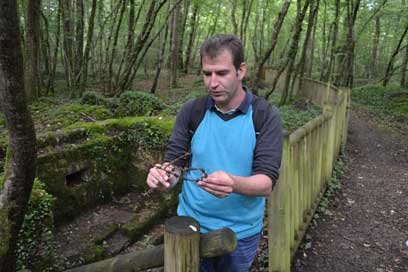
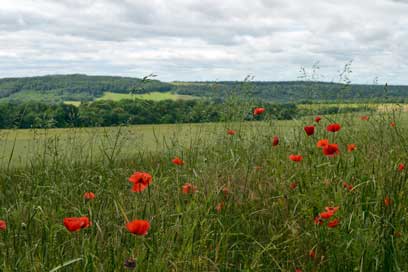
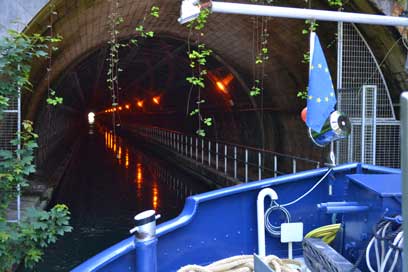
One morning, while the barge traveled through a three-mile tunnel, we drove to the town of St. Mihiel and had an excellent, informative tour guide show us the WWI trenches preserved nearby. Since it had recently rained, he easily found German and French bullets, barbed wire and shell remnants washed up in the mud. The majestic hilltop World War I Montsec American Monument dominates the landscape, and commemorates, among other things, the four-day battle in September 1918 when the American army liberated the St. Mihiel Salient.

Viewing the trenches of WWI; A U.S.-led WWI attack occurred in the strategically important Saint-Mihiel Salient, a triangular area of land between Verdun and Nancy occupied by the German army.

Our second-to-the-last day of cruising brought us to the town of Toul. A tour of the cathedral was followed by a private wine tasting at Domaine Lelievre. In addition to offering several of their wines, our hosts served us a traditional Lorraine meat filled pastry called Pate Lorraine.

Bertrand Trepo of Domaine Treop Leriguier offers tours of his Champagne vineyards. Domaine Lelievre in Lucey is a family-owned winery producing floral AOC Côtes wines.

By now we had switched from the canal to the Moselle River (where cruising speed increased somewhat) and our last stop was in Nancy, the ancient capital of Lorraine. We walked from the dock through beautiful gardens to the immense Saint Stanislas Square, which is surrounded by ornate gold and wrought iron and gates and stately buildings, and then used English language audio guides for a tour of the old town. A visit to the covered market and a stroll through the high end shopping district showed Nancy to be a popular stop for locals and tourists alike.

Saint Stanislaw Square; Porte de la Craffe in Nancy, built in the 14th century.

ENERGETIC CREW
The Panache lived up to its stylish name in accommodations and gourmet food, but every trip is only as good as its crew. Their energy and attitude were first class every day.

Chef Todd from England left an office job to study and follow his passion for cooking, and surprised us each day with menus derived from local ingredients, all with a perpetual smile on his face that revealed how much he loved his job.

Pilot Andre skillfully guided the barge through locks and tunnels with literally 2” of clearance on each side. He was phenomenal.

Hostesses Gabi and Kim enthusiastically presented wine selections, tempted us to try new cheese courses, delighted us with napkin folding and table-settings, and put fresh towels in our rooms every time we turned around.

Deckhand Anteo energetically did whatever needed to be done…from securing the barge inside each of the many locks, to off-loading bicycles, to painting scrapes on the boat when the pilot didn’t quite make it unscathed through the locks, to entertaining us with his guitar on the sun deck after hours.

Our unflappable captain Arnault, mini-bus chauffeur, evictor of spiders from air-conditioning units, tour leader, and story teller, met every challenge with tenacity and good humor, insuring that satisfaction was guaranteed on the cruise.

Consider a luxury hotel barge trip for a relaxing, comfortable week of gourmet meals and informative excursions while gliding through the backwaters of France. You won’t be disappointed.

Note: The itinerary for our cruise from Tronville-en-Barrois to Nancy was unique in the European Waterways system because a damaged lock prevented the barge from navigating its originally planned route.

For more information on this luxury hotel barge excursion, contact European Waterways:
USA 1-877-879-8808
Canada 1-877-574-3404
Email: sales@GoBarging.com
website: www.GoBarging.com