Flanders is a bucket-list destination for music lovers—big bands, unique scenes and tons of genres. With more than 280 festivals each year, there’s plenty to choose from.
Every summer millions of people gather in Flanders—a region full of history. You can enjoy live music in cities such as Antwerp, Ghent, Brugg and Boom as well as historical sites, exquisite food and shopping possibilities.
JAZZ MIDDELHEIM
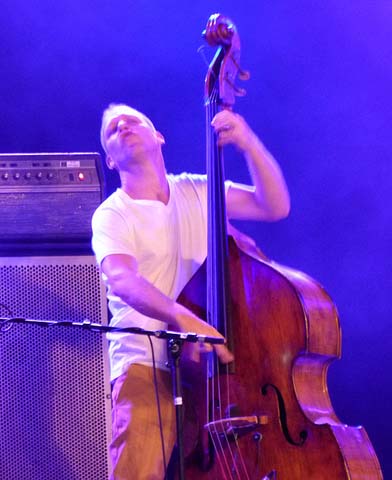
Jazz Middelheim, founded in the late 1960s, has become an iconic jazz festival. The festival grounds in Antwerp are within walking distance of the famous sculpture park. The green surroundings of the Park den Brandt with a high quality infrastructure, including a playground for children and gourmet catering, attract not only a vast jazz crowd but also families with children who love to linger in the park and enjoy the live music.
GHENT FESTIVALS After more than 160 years of existence, the Ghent Festivities have become one of the best festivals in Europe. Four international festivals take place there over a period of 10 days, with free music on 10 squares, children’s entertainment at various different locations in the city and hundreds of indoor and outdoor activities.
MAFESTIVAL One of the oldest classical music festivals with an international reputation takes place in Brugge. Daily concerts, competitions, workshops and lectures focus on the historical performance.
TOMORROWLAND Yesterday is History, Today is a Gift, Tomorrow is Mystery. What started out in 2005 as a one-day festival has grown into a three-day festival. Two weekends are being organized for the 10th anniversary of Tomorrowland in Boom. Tomorrowland is one of the largest festivals with 360,000 attendees. Tickets sell out in one day for this popular festival.
If a short break is on your agenda for St. Valentine’s Day, perhaps you need a push from the man himself — St. Valentine. Wouldn’t you know it? The Irish actually have relics (some of the remains) of the patron saint of lovers.
You need to head to Dublin for this. The St. Valentine’s Shrine is in Whitefriar Carmelite Church, Aungier Street, a few minutes walk from Grafton Street, St. Stephen’s Green and the famous Temple Bar, the center of Dublin’s shopping, culture and craic in the Irish capital.
If you can, visit St. Valentine’s Shrine on February 14 itself—the saint’s actual feast day, and the origin of the annual celebration of love, although it’s still a place of pilgrimage for those celebrating love at any time.
You can do a lot in Dublin on a long weekend. In Europe’s friendliest city; you can talk to anyone. It’s said the city is as intimate as a pub. But it’s probably better not to over-prepare for Dublin, or anywhere in Ireland. Be ready to go with the flow, build in one or two key activities and expect the locals to throw a surprise or two your way.
Dublin hotels and restaurants will be pulling out the stops to create a traditional romantic atmosphere on Valentine’s night, so candle-lit dinners will be the norm. Flowers are no problem either— Smithfield Flower Market — and one Dublin temple to the art of all things— chocolate— is actually not far from St. Valentines’ Shrine. Chocolatier Cocoa Atelier on Drury Street oozes handmade Irish chocolate deliciousness.
Finally, the all-important card.The Emerald Isle’s charm is more along the style of literary son Sheridan: “Won’t you come into the garden? My roses should like to meet you.”
Ireland is a land that reaches deep into the heart, lifts spirits and stirs you to your very core.
By Marilyn Heimburger Photos by Don Heimburger and courtesy Munich Tourist Office
I have always liked Munich. Actually, it’s more than just liking the city. I feel moved by its vibrant life, its stimulating nature and its friendly people. Apparently many more feel the way I do, since it is Germany’s most-visited city.
Last year, during Munich’s 850th birthday, the city of 1.3 million hosted the following:
City Foundation Festival in June in the heart of the city, featuring traditional Bavarian culture and international folk culture. A highlight of the fest was a Gaufest, or regional festival, of the many associations for folk culture where dancing and costumes from the Isargau region were prominent. As many as 10,000 participants were involved in this. A group of 100 rafters from the Oberland region showed how to build a raft. Dance masters showed how to learn the “Munich-Francaise” dance.
In July, the Old Town Ring, which was free from automobile traffic, served as the center for a celebration of theater, music, dance, games and sports on many stages. Scenes from peasant life in Munich with markets, street theater and beer gardens were staged. There also was music from international bands and more.
In August, the three-day Isar Bridges Festival, centered around the Cornelius, Ludwig and Maximilian bridges, highlighted the Isar River (which flows through the city) as the city’s life-giving artery. There was music under the bridge, dancing along its banks, glittering lights on the water, and with this came Munich’s famous culinary delights. An action theater group, which encouraged audience participation, also presented skits. There were also night-time water and laser shows
Additional highlights included the world premier of a work commissioned from composer Victoria Borisova-Ollas especially for the 850th anniversary. In June the Cuvillies Theater, one of German’s most elegant Rococo theaters, reopened after a spectacular renovation. In the newly re-designed St. Jakobs-Platz, many of the local museums and community organizations held programs of music ranging from classical to klezmer (a musical genre), dancing and creative street theater, exhibitions, tours and more.
Many of Munich museums featured exhibits of famous Munich artists, writers and Munich’s cultural heritage.
As Munich’s Lord Mayor Christian Ude said, “(Munich’s) celebrating its 850th foundation day…is nothing exceptional. What is remarkable is the city’s rapid growth from a monastery on a hill to a European metropolis with over a million inhabitants and a high-tech hub.”
As Ude says, the city is special because of its enduring and much-praised flair as a place with a zest for life.
The settlement of Munichen was originally granted the right to market goods and mint coins in June of 1158. In 1214 it was granted status as a town, and in 1255 it became the seat of the Wittelsbach dynasty. Under Kind Ludwig I, many famous buildings were erected, making Munich a major cultural center, and in 1918 the Free State of Bavaria was formed.
For travelers, the city offers 355 hotels and pensions with 45,500 hotel beds available. In 2006, 4.4. million tourists booked nearly nine million overnight stays, with 47% of them from overseas, with the USA bringing in the most, followed by Italy, Great Britain, Austria and Switzerland.
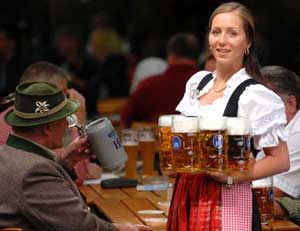
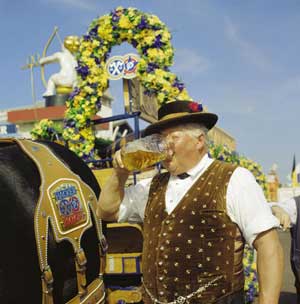
The city boasts three universities and eight colleges, 60 theaters and an opera house, 45 major museums, three symphony orchestras—and it hosts the famous 16-day Octoberfest beginning on the Saturday two weeks before October.
Favorites for visitors to see in Munich include:
The city’s twin onion-domed towers of the Frauenkirche, Church of our Lady, Frauenplatz 1, is the city’s best-known landmark.
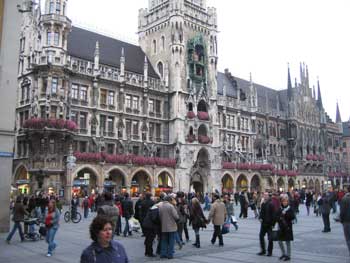
Marienplatz and the glockenspiel on the Marienplatz in the city center displays the mechanical dancers in the tower of the Rathaus (Town Hall) at 11 a.m. and noon (and 5 p.m. in the summer).
Schloss Nymphenburg is the impressive Baroque palace built as the summer residence for the Bavarian Electors. Today the main building houses a museum.
The Viktualienmarkt is Munich’s oldest market, originally begun as a farmer’s market and now a favorite place for a wide range of produce, Bavarian specialties and more.
The Hofbrauhaus deserves a visit, as its one of Munich’s best-known restaurant-breweries at Am Platz 9. Great dining is available, or just casual drinking and listening to oom-pah music. For information on the Hofbrauhaus, visit www.hofbraeuhaus.de.
There are many churches to visit, including the Asamkirche built by the Asam brothers in the 18th century with its spectacular interior at Sendlinger Strasse 62; Church of the Sacred Heart, a cubed-shaped structure with an innovative facade at Romanstrasse 6; and Saint Peter’s, Munich’s oldest parish at Rindermarkt 1.
The Deutsches Museum at Museumsinsel 1 houses sailboats, windmills, space probes, robots, ships, trains, planes and much more. Allot a whole day for this attraction.
Octoberfest Museum, at Sterneckerstrasse 2, will tell you all about the history of beer including how it started as a drink at monasteries, and all about the city’s famous Octoberfest celebration.
The expanded BMW Museum is a must-see if you are fascinated with automobiles and engineering. Tours are available.
Munich is waiting to wow you.
IF YOU GO… You can arrive at Munich’s Airport, which is like a city within itself. Flights from numerous major hubs arrive and depart from here daily. Train is another good option if you are coming from another European city.
If you’ll be in town for at least a day, pick up the City Tour Card (one- and three-day tickets are available), which is good not only for all public transportation, but also includes discounts of up to 50% on more than 30 attractions such as sights, bike rentals, museums, theaters and restaurants. www.citytourcard.com.
A close-in, convenient four-star hotel is the Platzl Hotel at Sparkassenstrasse 10. It is located near the Hofbrauhaus and is within a a couple of minutes walk of the Marienplatz. Visit www.platzl.de.
Guided tours of Munich are available. Visit www.muenchen.de for more information. The tourism office is located in the Rathaus, first floor, at Marienplatz.
Wine festivals in August and September are spread throughout Germany’s 13 wine-producing regions. There is no better way to get to know Germany and its people than whiling away a few hours (or days) at local wine festivals. There is little doubt you will end up in discussion with the people at the next table or with the owner about the harvest or quality of the grapes, this year’s weather and local goings-on. And, before you know it, you have made some nice acquaintances, learned some German, soaked up the atmosphere and tried some wines that you might never find outside Germany.
More than 2,000 years ago, the Romans identified the mineral-rich terrain in Germany and laid the foundations of the vineyards that today cover more than 245,000 acres. Winding rivers, steep hillsides and medieval castle ruins characterize the various regions and their wine towns.
At the tip of the southern Black Forest in Germany’s southernmost wine region of Baden, Freiburg offers a taste of the academic pace of life in one of Germany’s oldest university towns. A direct high-speed rail connection from Frankfurt to Basel is available, as well as the local Black Forest Bahn, which offers views of the Black Forest hills and villages. A typical day is characterized by spending time at the open air market with all of the products from the local farmers and craftspeople, and then enjoying a glass of wine in the Weinhaus Alte Wache with a view of the marketplace activities. The Landmann Winery is particularly notable for its organic wines and the local wine festival from September 2 to September 9 is a particularly festive time. In November Freiburg hosts the Plaza Culinaria, a culinary trade fair with many local products from Freiburg’s partner cities.
Nestled between two of Germany’s most famous wine regions, where the Moselle and the Rhine come together, Koblenz stars as the host to the National Garden Show. In honor of the show, Koblenz opened a new winery at the Fortress Ehrenbreitstein, which boasts not only wines from the region, but also offers a history of the 2,000 years of wine-making in the Rhineland Pfalz. Koblenz has long been a stop for wine lovers. The well-known brand of Deinhard offers tastings of sparkling wine in the middle of the old city and the Weinbar Gerhards wine cellar and bar can be found nearby.
Deep in the Rhineland but still only a half hour from Frankfurt, Mainz is known as the Great Wine Capital, as it is the only German city belonging to this worldwide network. It’s easy to while away a few afternoon hours in Mainz’s wine market at the cathedral square. On Saturdays, local farmers bring in an endless stream of regional and seasonal foods and wines that you can try as well as buy in a friendly and relaxed atmosphere.
One particularly sweet time is August 25-28 and September 1-4, when the Mainz Wine Festival takes place. You can wend your way from stand to stand trying different wines, enjoy music and peruse the crafts for sale. Two tips: The new Hofgut Laubenheimer Hoehe winery, along with the Wine Institute created the Riesling Lounge, where rieslings from each of Germany’s 13 wine-producing regions are offered. An especially enjoyable stop is the Zum Beichtstuhl wine bar.
In the middle of Germany’s oldest wine territory, close to the steeps banks of the Moselle River and famous for its Roman gate and walls, Trier is where the Romans first planted their vines in Germany. The oldest winery is the Vereinigte Hospitien, where you can still see the wall of the original Roman storehouse. The wine producer Bischoefliche Weingueter can be found underground in the center of Trier; most tourists don’t realize as they walk through the pedestrian zone in the central city that a famous wine cellar lies beneath them. The Bar Weinsinnig is where you can get a sense of the region’s great variety, as the list of wines offered changes daily.
In the spa town of Wiesbaden, the Rheingau Wine Week in August kicks off a celebration smack in the middle of town on the Castle Square. Known for its ornate and elaborate casino, beautiful spa buildings and hotels, elegant streets and antique galleries, Wiesbaden is a prime starting point to explore the Rheingau. The State Winery of Hessen in Eberbach, a former Cistercian monastery, is one such example, and it is also worthwhile to take the tour and a tasting at Henkel, the famous producer of sparkling wine.
On the other side of Frankfurt is the baroque city of Wuerzburg in the heart of the Franconian wine region, where wine is bottled only in the famous bulbous bottles, called Bocksbeutel. The wines of Franconia are outstanding and one place to enjoy them is in Wuerzburg’s Residenz (castle). The wine cellar recently won an architectural prize for its renovation.
WINE FESTIVALS August 31 – September 9, 2011 Rheingau Wine Festival, Frankfurt More than 600 wines and sparkling wines from the Rheingau region will be tasted at 30 vintner stands. These range from the finest wines to light and zesty summer wines, with wines from alternative grape varieties being offered alongside the dominant Rheingau riesling. www.frankfurt-tourismus.de
September 1 – 5, 2011 Middle Moselle Wine Festival, Bernkastel Kues The “Middle Mosel Wine Festival” enjoys legendary fame. The fireworks, the winemakers’ procession, the artisan market and all of the happenings on the wine road and at the locales in Old Town as well as the large amusement park are the attractions featured at the Moselle region’s largest wine festival. More than 30 wine booths present famous riesling wines. www.bernkastel.de
September 2 -12, 2011 Vintners’ Festival, Bingen in Rhinehessen near Frankfurt There is something special about the wine in Bingen. Here the so-called ice wine was invented in the suburb of Dromersheim. It is no coincidence that the festival lasts 11 days, because so much time is needed to taste all the wines offered. www.bingen.de
September 24 – October 3, 2011 Red Wine Festival, Ingelheim, close to Mainz and Frankfurt There is virtually no other wine festival in the Rhine Hessen region which takes place in such an attractive setting, surrounded by vineyards, as the Ingelheim Red Wine Festival. Every year on the last weekend in September this popular wine festival is opened with the ceremonial crowning of the Red Wine Queen. www.ingelheim.de
Pinkel! The word is strange enough, but I recently learned how these six little letters can stir a whole region to party the day away in true Germanic style.
I thought I knew roughly what to expect in terms of German traditions and festivities. I was familiar, of course, with festivals like Oktoberfest and Weihnachtsmarkt, and with traditional victuals like cabbage and wurst. But little did I know I had yet to discover one of Bremen, Germany’s most unique traditions–one centered on green cabbage, a mysterious meat product called Pinkel, and plenty of alcoholic spirits.
It’s called “Kohlfahrt” (translation— “cabbage tour”) and recently I was told what this festival was all about.
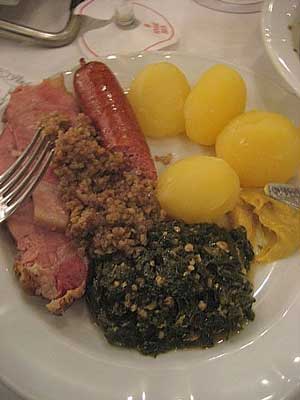
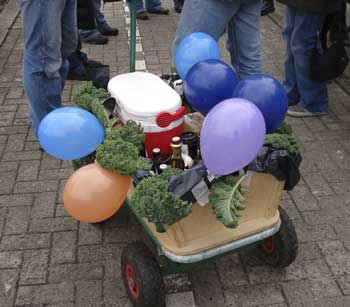
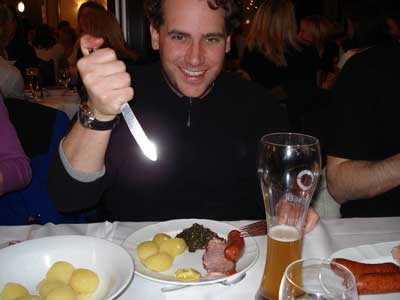
Kohlfart is a tradition practiced only in Northwest Germany, and is a beloved annual ritual in the Bremen area. The idea is that a group of friends or colleagues assemble on a Saturday afternoon in January or February, load up a “Bollerwagen” with an assortment of schnapps, whiskeys and beer, and amble through the countryside playing wacky party games and replenishing liquor at every opportunity. The event is organized months in advance by the group’s Kohlkoenig and Kohlkoenigin— the cabbage king and queen. After a couple hours of walking, when the participants’ bladders are full and their stomachs growling, the group descends on a pub or restaurant to enjoy the culmination of the day’s festivities–a meal of Kohl und Pinkel (the Kohl is green cabbage and Pinkel is something along the lines of bacon, oats, lard and spices packed together). And then they dance the night away—literally. I never knew the Germans loved to dance so much, especially to cheesy ’80’s cover bands. Although I will admit I hit the dance floor for several numbers (who can resist the Abba and AC/DC tribute?).
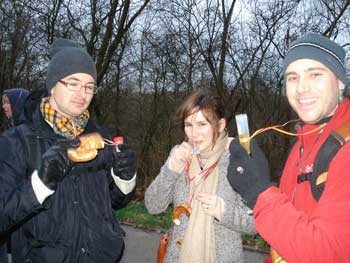
I didn’t know much about Kohlfahrt going into it, but once our group was assembled, and we were handed pretzels (sustenance is crucial) and plastic scientific sample vials to wear around our necks (it really is a cheap and logical way to hold liquor), I knew we were in for some surprises. It only got more interesting when our first two games tested who could maneuver a spoon down their shirt and pants the fastest, and who could throw a teabag the farthest using only their teeth.
Kohlfahrt was definitely worth experiencing for the sheer fun and folly of it all. But it’s a serious business here in Bremen, as evidenced by the multiple Kohlfahrt parties we passed on the road, some of which sported Bollerwagens decked out with flashing lights and loud speakers. The restaurant resembled more of a banquet hall, with about 100 long tables full of rosy-cheeked Kohlfahrters, swaying arm in arm and singing along to “Que Sera, Sera.” It’s experiences like these that remind me how different some things are here than in the States. Germans have no open container law to contend with and are perfectly free (and encouraged, in this case) to walk around toting shot-glass necklaces, singing songs, and pulling a wagon full of alcohol.
Although my observation is that even during the public inebriation and silliness of Kohlfahrt, Germans still manage to act fairly civilized. But civilized or not, it was obvious that everyone was having what seemed like the best Kohlfahrt ever. Until next year, that is…







 European Traveler