Swiss cuisine combines influences from France, Northern Italy, Germany and Austria. And specialities vary greatly from region to region closely aligned with the language borders. Many local specialities have become firm favorites throughout Switzerland.
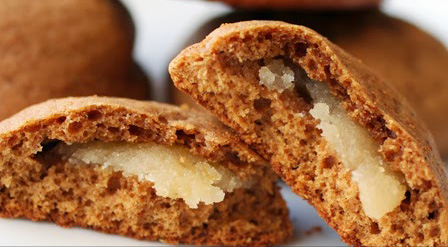
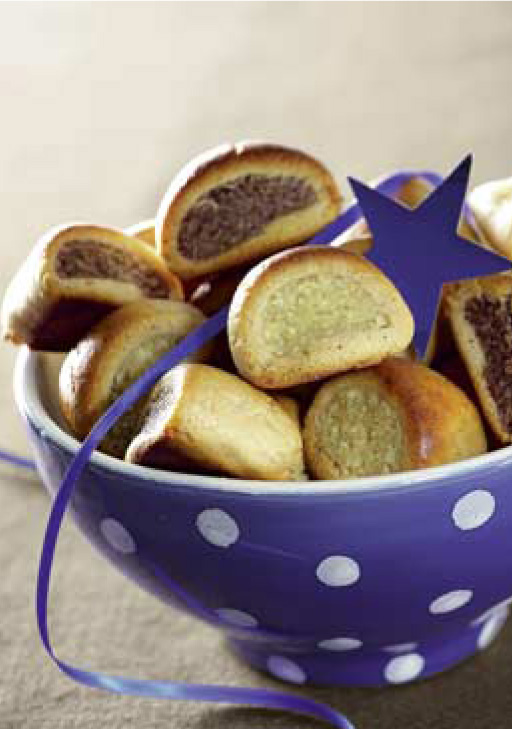
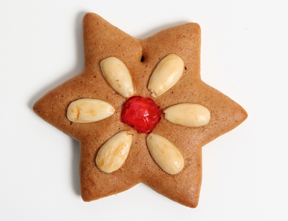
ST. GALLER & APPENZELLER BIBER St. Galler & Appenzeller Biber are two types of gingerbread with filling. One is from St. Gallen, the other from Appenzell. One is loaded with a hazelnut, the other with a white almond filling. But both are called “Biber” (beaver) or “Biberli” (little beaver) and have two layers of soft honey dough and one layer of yummy stuffing, so they might be totally different from the gingerbread you’ve had so far. No matter which one you try, they can be highly addictive.
BIBERLI WITH LEMONGRASS MARZIPAN Preparation time: approx. 50 minutes. Cooling time: approx. 13 hours. Baking time per baking sheet: approx. 8 minutes. Yield: 50 Biberli cookies
FOR DOUGH Mix in a bowl: 1 1/2 c. flour 1 teaspoon spice mix for Lebkuchen zest of 1/2 lime
Heat: 1/4 cup honey 2/3 cup powdered sugar 1 teaspoon water
Add sugar to flour with: 1 tablespoon milk 1 teaspoon baker’s salt (baker’s salt is ammonium bicarbonate and is available at pharmacies)
Knead into a soft, smooth dough and let rest for 12 hours in the refrigerator
FOR LEMONGRASS MARZIPAN Finely chop in a bowl: 2/3 cup peeled almonds 2–3 blades of Lemon grass (only the inside), cut in small pieces 1/4 cup white chocolate, broken up
Add and knead into a dense ball: 50 g Acacia honey ½ tablespoon lime juice
Shaping: Roll the dough with a little flour into a square shape (about 8 x 8″). Halve the squares lengthwise. Moisten edges with water. Halve the marzipan. Form 2 rolls (each about 12″ long, by 3/4″ diameter). Place 1 roll on the long side of the dough, form into a roll, cover and store in a cool place for 1 hour. Form a second roll. Cut the rolls diagonally into 1″ wide trapeze-shaped pieces. Place the Biberli on a baking sheet lined with parchment paper. Glaze with heavy cream.
Baking: Approx. 8 minutes in the center of the pre-heated oven, pre-heated to 400 degrees. Remove from oven and pull the parchment paper with the Biberli onto a wire cooling rack. Glaze once more with cream, let cool completely.
Storage: Biberli can be stored for approx. 1 week in a tin with a close fitting lid.
Alternate hazelnut-cinnamon filling: 2/3 cup hazelnuts, 1 teaspoon of cinnamon, 1/4 cup milk chocolate, broken into pieces; finely chop with a cutter. Add slightly less than 1/2 cup sweetened condensed milk and 1 tablespoon of water; knead until it forms a compact mass.
Grabbing a “taste” of Germany today doesn’t mean just visiting its Medieval castles like Neuschwanstein or Wartburg Castle, or visiting its thousands of half-timbered buildings such as you’ll find in Wernigerode, Bamberg and Cochem, or being one of the millions who take pictures of the famous Cologne Cathedral.
A “taste” of Germany in 2018 takes on a special meaning: this year Germany’s National Tourist Board officially unlocks its treasure chest of culinary delights as part of its promotion of the country, and there are many appetizing foods to be enjoyed, and 16 federal states in which to enjoy them.
With eight straight years of record growth in tourism, Germany is primed for more tourists in the year ahead who can also appreciate this country’s flavorful foods. In 2017, a total of 83.9 million overnight stays by foreign visitors in establishments with at least 10 beds were recorded, according to Petra Hedorfer, chief executive officer of the German National Tourist Board (GNTB).
The German Tourist Board is trying to get travelers’ attention by saying “Attention foodies: Germany is now open for tasting.” And there are many towns and regions in which to conduct this culinary research, as well as numerous restaurants, wineries, breweries and farms that are eager to show visitors what Germany has to offer.
HANNOVER CURRYWURST In Hannover you can stop in at an interesting restaurant called the Ständige Vertretung at Friedrichswall 10. The “StäV” as it is named, is not just any cafe, but a political reading book … where the history of political happenings and famous German politicians from past decades can be found on the walls and in photos. But go also for the famous “explosive” currywurst offerings. There’s the German Chancellor Filet “Schröder Art,” the Bundestag Filet, and the Chancellor Tarte, all part of the currywurst menu. All come with spicy sauce.
THE ARISTOCRAT OF VEGETABLES At Fritz Bormann’s 25-acre asparagus farm near Nienburg in Lower Saxony northeast of Hannover, vast fields of white asparagus (Spargel) covered by large plastic tarps, sit waiting for harvest. In early spring, workers pour into the fine sand-like fields, armed with long, sharp cutting tools and a bucket to pluck the revered savory asparagus stalks from underneath the heaped mounds of dirt.
The “white gold” is then cleaned, graded and quickly delivered to farmstands and markets where it is snapped up by eager eaters. Combined with a hollandaise sauce or hot melted butter, and perhaps a plate of potatoes and pork or ham, the pale, long-stemmed vegetables are a nationwide sensation.
Germany sets aside about 62,000 acres for growing asparagus every year, and it’s estimated the country consumes up to 125,000 tons of it, but some of that is grown in other nearby countries. And nearly every restaurant in the asparagus-growing regions feature Spargel specials on their lunch and dinner menus. The picking season ends promptly on June 24 every year.
If you’re lucky, you can even meet one of the local Spargel queens, like the 2017/2018 queen, Nicole Cybin from Nienburg, or visit the local asparagus museum, part of which is housed in an original 1663 building. The museum displays, among other things, old tools which were once used for harvesting asparagus, dishes and serving plates with asparagus themes painted on them and even molds in the shape of a bunch of asparagus.
ASPARAGUS ROUTE There’s even an Asparagus Route (Spargelstrasse) which begins in the town of Schwetzingen (it also claims the title of “Asparagus Capital of the World”). When you walk through the city, look for the statue of the Spargelfrau (literally means asparagus woman). The town holds an annual Spargelfest and in 2018 celebrates 350 years as a major Spargel grower.
While you are in Nienburg, be sure to stroll around this fascinating 1,000-year-old village and find the 16th century half-timbered Rathaus built in 1533, as well as the same period St. Martins Church. There are also medieval mansions, other carefully restored half-timbered homes, and a large town center with wide streets. The castle and town of Nienburg were once the residence of the Counts of Hoya, and their tombs can be found in St. Martins Church.
You can also visit the Dobberschuetz Fishery & Smokehouse alongside the banks of the Weser River which flows through the town and get the catch of the day. Eels are their speciality. Get there on a Saturday and enjoy their Saturday fisherman breakfast.
No sleepy little village, Nienberg today has as many as 100 trains a week stop there.
OTHER GERMAN CULINERY DELIGHTS At the sprawling Rotkäppchen winery in Freyburg, Sekt or sparkling wine is produced, with brothers Moritz and Julius Kloss and a friend establishing a wine store and producing Rotkäppchen champagne as early as 1856. The first 6,000 bottles were bottled in an apartment in the back of the house of the Kloss family.
In the large historic Rotkäppchen building in Freyburg, select grapes are used to make various cuvees, and the brand today is the most successful in Germany, and also holds a 30% international market share. This Sekt takes its name from the unique red cap on its bottles.
Every year the company sponsors a Jungweinprobe, where last years wines are sampled in the courtyard of the Rotkäppchen winery. It’s always a popular and crowded affair with everyone allowed to pour their own glass of wine from a staggering selection. Here, too, you can meet the local Wine Queen, and ask her which cuvees she prefers. In 2017/2018 the reigning queen was Juliana Beer, 22. Not just a queen in name only, she enjoys the aged wines, and can explain the nuances of wine growing and wine-making.
The Rotkäppchen winery boasts one of the largest storage barrels in Germany (from 1856) which can hold 160,000 bottles of wine. And you can also enjoy a great German meal as you sit near the giant wooden barrel and try to figure out how they made such an elaborate wooden vessel.
WEINGUT PAWIS IS A STANDOUT Also in Freyburg, Weingut Pawis is a standout winery housed in a renovated stone building. As a 10-year-old boy, Bernard Pawis didn’t have much luck with a hoe in his father’s vineyard. But when he learned the wine profession in Radebeul years later, he was on his way to gaining national recognition with his wine production.
Taking over from his father in 1998, he constructed a new wine cellar and later rebuilt an old horse stable into a modern, welcoming and innovative winery with 30 acres of vineyards.
The family produces a number of wine varieties, including Müller-Thurgau, Silvaner, Riesling, Bacchus, Kerner, Pinot Blanc and Pinot Gris, Portuguese, Dornfelder, Pinot Noir and Regent.
Their unique operating philosophy includes sustainable economics, conscious handling of nature, respecting the soil and the vine as their most important commodity, and they work according to environmentally friendly cultivation methods.
The innovative Pawises offer wine tastings, art exhibitions, guided vineyard tours, champagne receptions, a Christmas market, and even a lookout tower on the historic estate.
BLUEBERRY HEAVEN At Bickbeernhof, you’ll find just about every conceivable way to serve blueberries that you can think of. Owner Sylke Herse has already done the planting, growing, and the packaging for you, and draws upwards of 1,000 visitors a day to her blueberry world in Landesbergen. “Very busy, very organized. Long wait lines at peak times, but worth it. Big juicy blueberries. Every year a must!” are the typical comments from customers.
Blueberry fields are located right behind the processing plant and company store, and there is a wide variety of blueberry-made products offered in the gift shop including blueberry wines, jams, juices, books about blueberries and much more. In their restaurant, customers can order salads with blueberry dressing, blueberry marmalade blueberry pudding, blueberry smoothies and many other blueberry delicacies.
BORN FAMILY VINEYARD Motorcycle-riding Jochen Born and the small Born Family Weingut in Höhnstedt, located near the famous Luther Walking Trail, produces a variety of wines from its mostly “vertical” vineyards lining the slopes of the area hills. The hills around Höhnstedt contain a lot of limestone, and help from the sun, the wind and the rain make it an ideal place to grow grapes. Jochen is an amicable host and willing to tell his guests about the intricacies of his wine brands and its production in his compact and cozy tasting room adjacent to the wine gift shop.
SCHLOSS WACKENBARTH Schloss Wackenbarth in Radebeul, is a well-situated, picturesque winery, and one of the oldest sparkling wine producers in Europe. On the well-manicured grounds is a Mediterranean-style palace erected by Augustus the Strong. Since the 18th century Schloss Wackerbarth has attracted hundreds of thousands of visitors because of the charming setting, and of course the delicious wines.
Tours through the winery and grounds are conducted, and many social events, including weddings and banquets, take place on the grounds each year. Interestingly, the federal state of Saxony owns the winery. The winery calls itself an ambassador for the state of Saxony, and indeed it has the stature and appeal of something regal.
While every year Germany is certain to attract millions of visitors for its culture, history, sights and its uniqueness, 2018 calls out for a visit for all of the above, and especially its many and varied succulent, edible delights. Guten appetit!
I didn’t know travel and culinary adventures could be so entertaining until I happen to watch my first episode of Phil Rosenthal’s “I’ll Have What Phil’s Having.” First I was drawn in by the name of the show which I heard about on my Chicago PBS station, and I thought, “Who has a television series name like this?”…but I was even more curious— “What does it mean?” I thought and thought, but couldn’t figure it out.
Then I happen to just be sitting down in the family room after supper and one of Phil’s episodes came on….it was his Barcelona program. It started with a flashback photo of Phil as a small kid…he was wrinkling up his nose at something in the photo. “Meat was a punishment,” he remembers from his childhood.
But today, Rosenthal, an Emmy award winner and a very funny guy, is visiting one of Spain’s — and the world’s — hippest spots, Barcelona. In this city, food is taken very seriously, with people in Barcelona planning supper while eating lunch, and when they plan a day trip, their most important concern is where they are going to eat. Just “grabbing a bite” is not an option here. In Barcelona eating comes first, and you have to think about it.
“The world can be a beautiful, delicious and friendly place when we travel and eat food together,” announces Phil as he begins his Barcelona food experience. Since Barcelona is located beside the Mediterranean, seafood abounds, with the long Catalan coast sheltering more than 30 fishing ports, and fish is a supreme passion with local gourmets.
Rosenthal, the creator of the TV hit “Everybody Loves Raymond,” is a passionate foodie who makes friends fast and warms up to excellent dishes even faster. “I’m Phil Rosenthal, and I’m here to say come on, you can have what I’m having.” His one-hour shows (I’ve also seen his Paris and Italy episodes), which focus on international culinary exploration, tend to grab you after just the first three or four minutes, as he investigates, samples, pokes and smells — and samples again — the culinary delights he discovers.
In Barcelona, he quips, “They start at 8 at night and they go from bar to bar eating tapas, and they’ll have three or four small plates, and then they go to the next bar— ‘Oh, we’ve got to try these small plates’ — until they’re full, which is around midnight, and then….dinner.”
Rosenthal apologizes on a late food outing that he might not make it through the evening: “They (the Barcelonians), love life. This is going to be a little difficult for me, because usually I’m in bed by 9,” he admits.
On a rooftop with new-found friends celebrating the Feast of San Juan, Phil savors a taste of grilled sausage and beef, talks to partygoers and his hosts, and generally adapts to his surroundings, shooting firecrackers off the roof when one comes sailing at him. “The only thing we can do,” he slyly suggests, “is retaliate” as he sends off a bright rocket into the sky, thus joining the aerial melee.
Following the party, he recovers the next morning just in time for breakfast, visiting the Boqueria Market where he discovers all varieties of fresh fish, fruits and vegetables; he ends up helping a market restauranteur and his brothers with the cooking, but says because of the tiny booth, “If my family worked here, we wouldn’t last five minutes.”
To add a bit of culture to the show, Phil drops in on two of Antoni Gaudi’s structures in the city, the 1882 Sagrada Familia church he started (when finished in 2028 it will be the tallest church in the world), and an apartment building—Çasa Mila— with an unusually distinctive roof.
With the mantra, “Why stop when you’re full?” Phil continues his Barcelona eating binge, devouring octopus, mullet, friend schrimp and eel, grouper and asparagus. Keeping in touch with his parents by Skype when overseas, he asks if they’d like to know what he’s been eating. At nearly the same time, his father responds, “Not really,” while his mother shouts, “Go ahead.”
Sitting down to the table at the restaurant Tickets, Rosenthal literally “hops for joy” when eating a plateful of tomato mozzarella. His last stop in town is at Vila Viniteca, where he puts on a humorous display of “jamon” slicing, devouring half of what he slices. As he leaves the store with a ham strapped to his bicycle—and says goodbye to Barcelona—he concludes that the city will give him memories for the rest of his life, and the jamon will last only about a week to a week and a half.
I can’t wait for the rest of the series — I do think I’ll have what Phil is having, and I’ll enjoy it.
THE SHOW: The PBS series features six one-hour episodes exploring a variety of foods and cultures as seen from Rosenthal’s perspective. Host Rosenthal explores culinary capitals of the world and dines on regional specialties, all the while pushing the boundaries of his palate – and the viewers’ – in his funny, unforgettable travels. In his search for the best of a city’s specialty, or one of its most unusual cuisines, Rosenthal entertains the audience while making connections all over the world.
PHIL SAYS: “My mother was not a fantastic cook; our oven had a setting for ‘shoe.’ But I’ve always loved family, food, travel and humor. That’s how I connect with people. I’m not your typical adventurer. So, I’m hoping folks will look at a nebbish like me exploring the world and trying new things and say, ‘If that guy can go outside maybe I can, too.’”
By Don Heimburger Photos by Don Heimburger and Leipzig Tourism Office
If you were to spoon out Leipzig and put it on a plate, you’d discover a salad, a main meat course, vegetable course, a sorbet interlude and a delicious dessert.
I’d designate the salad course as the city’s unusual green belt at the Auenwald; the meat course is the art, architecture and music; the vegetable course Martin Luther and the Peaceful Revolution; the sorbet interlude is this town’s love of coffee; and the dessert is the city’s zest for living and its nightlife.
The city of Leipzig in central Germany, population 500,000, has a colorful history stretching back more than 800 years, and many events have shaped this former East German city. The city’s people and several major historical events have fashioned this town, and made it what it is.
SORBS FIRST SETTLED HERE
Sorbs first settled here in the 7th century, establishing a trading post known as Lipzk or “place near the lime trees.” After Leipzig was granted a town charter and market privileges around 1165, it quickly developed into an important center of commerce.
Maximilian I decided to award Leipzig imperial trade fair privileges in 1497, which helped turn the city into one of Europe’s leading trade fair centers, and it remains so today. Following the world’s first samples fair held in Leipzig in 1895, the city remained one of the global trading hubs until World War II put a hold on that.
Leipzig Zoo’s Gondowanaland
It’s hard to believe, but Leipzig has a floodplain forest that runs straight through its center, one of the largest of its kind in Europe. Consisting of eight square miles of trees, every year more trees are planted, and the green space is enlarged. A variety of protected plants and animals are found here, including a rare butterfly species.
This “salad area” or greenbelt is easy to spot on a roadmap, with a large green area running north to south through the city. Four streams also flow through the city. Another part of the city that has been “greened up” is the Leipzig Zoo, where tropical Gondowanaland just opened. This lush section of the zoo, larger than two football fields, allows visitors to come into close contact with the tropical rain forests of Africa, Asia and South America. It features 40 exotic animal species and approximately 500 different plant and animal species, and more than 17,000 plants started their journey in nursery gardens in Thailand, Malaysia and Florida to create this tropical environment.
The Alte Börse, built in 1678-87 by Christian Richter, was originally used as a trading floor for merchants.
MAIN COURSE: ART-ARCHITECTURE AND MUSIC As Leipzigers are fond of saying, for the young and creative Leipzig is no longer an insider’s tip. Word has spread that the city’s working and living conditions are just right, and three universities with an artistic or cultural profile, as well as Leipzig University, constantly feed the pool of ideas. Leipzig is known for its vibrant arts, music and festival scene; this place not only appeals to artists and actors, but is also becoming a trendy destination for leisure travelers.
Leipzig’s dynamic art scene enjoys an excellent reputation worldwide. Interestingly, a former cotton mill, Spinnerei, in the trendy Plagwitz district, is home to a number of galleries and studios. Formerly the largest cotton mill in continental Europe, Spinnerei now has the highest density of galleries in Germany. In this old factory complex are 80 artists, 14 galleries and exhibition spaces which house creative professionals like architects, designers, craftspeople, retailers and printers.
Spinnerei Museum
Artist and professor Neo Rauch of the New Leipzig School, whose paintings combine his personal history with the politics of industrial alienation, reflects on the influence of social realism. Hollywood star Brad Pitt recently purchased one of his works.
The GRASSI Museum of Applied Art, with its world class collection, opened as Germany’s second museum of applied arts in 1874. It is considered one of Europe’s leading museums of arts and crafts. The high point of the year within the GRASSI museum’s special exhibition is a trade fair for applied art and design, an international forum of contemporary applied art and experimental design.
Then there’s another part of the Grassimesse, the Designers’ Open, which is a well-established independent design festival. An extensive program including lectures, workshops, movies and fashion shows complete the fair.
In 1996 the Leipzig Fair’s new exhibition complex opened, featuring trailblazing architecture, spacious avenues and the stunning Glass Hall at its core.
THE CITY OF MUSIC
If you go to Leipzig, a visit to St. Thomas’s Church is a must, since it is the home of the world-famous St. Thomas Boys Choir and where Johann Sebastian Bach was employed for 27 years as organist and choirmaster.
His grave can be seen in the chancel. Motets are performed every Friday and Saturday by the choir, and there are concerts in front of the statue of Bach outside in July and August. The Bach Museum is located opposite the church.
St. Thomas Boys Choir
Another regular musical highlight is the Sunday recitals at Mendelssohn House. Felix Mendelssohn-Bartholdy used to live in the building, which now contains the only museum dedicated to the composer.
There are two additional important centers of music in Leipzig: the Leipzig Opera House and the Gewandhaus Concert Hall.
The Gewandhaus Orchestra, dating back more than 250 years, regularly performs in both venues. The Opera House is the third oldest civilian music theater stage in Europe. And Schumann House is dedicated to the memory of Robert Schumann, one of the greatest composers of the 19th century Romantic era.
Bach concert at St. Thomas Church
Leipzig also hosts several music festivals, large and small, including the International Bach Festival, the A Capella Festival, the Leipzig Jazz Festival and the Mendelssohn Festival.
MARTIN LUTHER AND THE PEACEFUL REVOLUTION Our vegetable course includes reformer Martin Luther, who was known to come to Leipzig to face the Catholic Church hierarchy to explain his ideas about Christianity and indulgences. Martin Luther, who lived in nearby Wittenberg, stayed in Leipzig on no less than 17 occasions. His most important visit was for his participation in the Leipzig Disputation, or series of debates, held in Pleissenburg Castle in the summer of 1519.
After Duke George died, the Reformation was introduced in Leipzig in 1539. On August 12, 1545 Luther inaugurated the former Dominican monastery church of St. Paul’s as a protestant university church.
St. Nicholas Church exterior
Leipzig was particularly significant in the rise of the Reformation movement, because Luther’s writings and numerous evangelical hymn books were distributed in large numbers from this city of printing shops and publishing houses. In Melchior Lotter’s printing shop alone, between 1517 and 1520, more than 40 works written by the great reformer were published.
In the Grafisches Viertel or Graphics Quarter of the city, the publishing industry flourishes. In 1912, 300 printers and nearly 1,000 publishing houses and specialized book shops, as well as 173 bookbinders, operated in Leipzig.
Leipzig is also known for helping overcome the GDR government. St. Nicholas Church—the oldest and biggest church in Leipzig—rose to fame in 1989 as the cradle of the Peaceful Revolution. Services for peace were and still are held there every Monday, and the following demonstrations at the end of the 1980s toppled the East German government, paving the way for German reunification. In the church, note the interior columns: they are designed to resemble palms.
St. Nicholas Church interior
A few other important sights to see in the city include:
The Monument to the Battle of the Nations—the tallest monument in Germany—was erected to commemorate those who fell during the Battle of the Nations (also known as the Battle of Leipzig) fought against Napoleon’s forces in October 1813.
In the Battle of the Nations, Austrians, Prussians, Russians and Swedes fought —500,000 soldiers in all— the biggest battle ever in world history, marking the decisive turning point in the war of liberation from Napoleonic rule.
(left to right) Battle of the Nations Monument; Porsche Leipzig Headquarters
The Mädler Passage, for centuries the city’s most exclusive arcade (one of 30 arcades in the city), is home to the famous Auerbachs Keller. Serving wine since 1525, this tavern/restaurant was immortalized in Faust by Johann Wolfgang Goethe, the father of German literature.
YOUR SORBET IS SERVED The café-cum-restaurant Zum Arabischen Coffe Baum is one of Europe’s oldest coffee houses (dating from 1694) and it used to number composer Robert Schumann among its regulars. Today the coffee museum on the third floor of the building contains 500 exhibition items on the history of coffee, the Saxons’ “national drink.”
Zum Coffe Baum
The Old City Hall, one of the finest Renaissance buildings in Germany, can be admired on the Market Square; it houses the Museum of City History. Inside is Katharina von Bora’s (Martin Luther’s wife) wedding ring and a pulpit in which Luther preached.
Town Hall Museum where a number of Martin Luther artifacts are exhibited.
NIGHTLIFE ABOUNDS If you happen to be a night person, there is plenty to do in the evening, with all the city’s theaters, concert halls, variety shows and casinos. There are several dining and nightlife districts as well, such as Drallewatsch, Schauspielviertel, Südmeile, Münzgasse, Gohlis and Plagwitz. And when you arrive in one of the many clubs or bars, you’ll learn that often the term “closing time” is not in the vocabulary. There are 1,400 pubs and restaurants in this city, so dessert is not a problem.
And there you have it: a complete Leipzig meal with all the courses. Emperor Maximilan I knew something in 1497 when he granted the town imperial trade fair rights. He knew that one day Leipzig would be a multi-course city, and he was correct.
Auerbachs Keller Restaurant, located below the Mädlerpassage, is the best known and second oldest restaurant in Leipzig, described in Johann Wolfgang von Goethe’s play Faust I, as the first place Mephistopheles takes Faust on their travels. The restaurant owes much of its fame to Goethe, who frequented Auerbach’s Cellar as a student and called it his favorite wine bar.
Not far from the main train station in Leipzig is the Hotel Fuerstenhof, a five-star gem with marble, gold-rimmed archways, high ceilings and soaring windows.
At one time a classic patrician’s palace, the 92-room air-conditioned hotel with 12 suites, features myrtle wood furniture, marble bathrooms and a friendly, dedicated staff. The staff is geared to making your stay a pleasant one, knowing your name when you come to the registration desk for questions, and providing service with a smile. I had more than a few special requests from the staff which were quickly and pleasantly taken care of.
There’s an indoor 7,000-square-foot pool area, equipped with saunas, fitness room, solarium, cosmetic and massage stations. Also, the hotel features a nice piano bar area with comfortable, plush seats, and tables, fine dining in the 18th-century style neo-classical Villers restaurant (with a choice of more than 200 wines), a complete breakfast area and a wine bar round out some of the amenities of this hotel.
The hotel was first mentioned in 1770 when Karl Eberhard Loehr, a banker, lived in the palatial home, built between 1770 and 1772. It was called the Loehr Haus. It opened as a hotel in 1889, and underwent a complete renovation and restoration in 1993. It is part of the Luxury Collection of Hotels, one of 62 worldwide luxury hotels.
Over 60% of world trade in flowers and plants takes place via Dutch auctions.
The Netherlands may be a small country, but it’s packed with world famous icons. Discover bulb fields, windmills, cheese markets, wooden shoes, the canals of Amsterdam, masterpieces of the Old Masters, Delft Blue earthenware, innovative water management and millions of bicycles. Find out more about these and other typical Dutch highlights. www.holland.com