Leipzig on a Platter

This city is a multi-course meal for visitors
By Don Heimburger
Photos by Don Heimburger and Leipzig Tourism Office

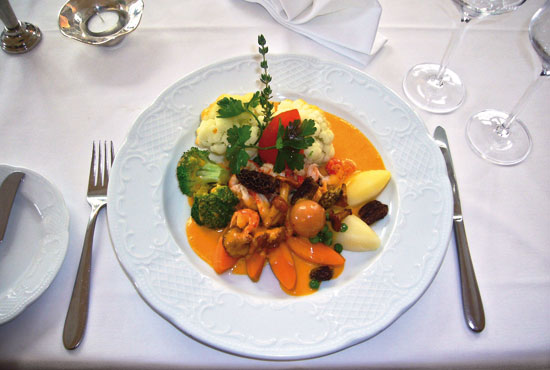
If you were to spoon out Leipzig and put it on a plate, you’d discover a salad, a main meat course, vegetable course, a sorbet interlude and a delicious dessert.

I’d designate the salad course as the city’s unusual green belt at the Auenwald; the meat course is the art, architecture and music; the vegetable course Martin Luther and the Peaceful Revolution; the sorbet interlude is this town’s love of coffee; and the dessert is the city’s zest for living and its nightlife.

The city of Leipzig in central Germany, population 500,000, has a colorful history stretching back more than 800 years, and many events have shaped this former East German city. The city’s people and several major historical events have fashioned this town, and made it what it is.

SORBS FIRST SETTLED HERE

Sorbs first settled here in the 7th century, establishing a trading post known as Lipzk or “place near the lime trees.” After Leipzig was granted a town charter and market privileges around 1165, it quickly developed into an important center of commerce.

Maximilian I decided to award Leipzig imperial trade fair privileges in 1497, which helped turn the city into one of Europe’s leading trade fair centers, and it remains so today. Following the world’s first samples fair held in Leipzig in 1895, the city remained one of the global trading hubs until World War II put a hold on that.
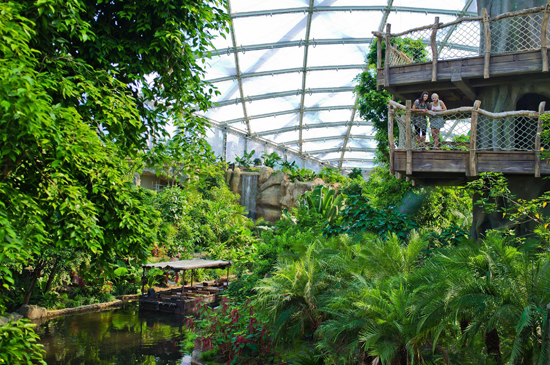
Leipzig Zoo’s Gondowanaland

It’s hard to believe, but Leipzig has a floodplain forest that runs straight through its center, one of the largest of its kind in Europe. Consisting of eight square miles of trees, every year more trees are planted, and the green space is enlarged. A variety of protected plants and animals are found here, including a rare butterfly species.

This “salad area” or greenbelt is easy to spot on a roadmap, with a large green area running north to south through the city. Four streams also flow through the city. Another part of the city that has been “greened up” is the Leipzig Zoo, where tropical Gondowanaland just opened. This lush section of the zoo, larger than two football fields, allows visitors to come into close contact with the tropical rain forests of Africa, Asia and South America. It features 40 exotic animal species and approximately 500 different plant and animal species, and more than 17,000 plants started their journey in nursery gardens in Thailand, Malaysia and Florida to create this tropical environment.
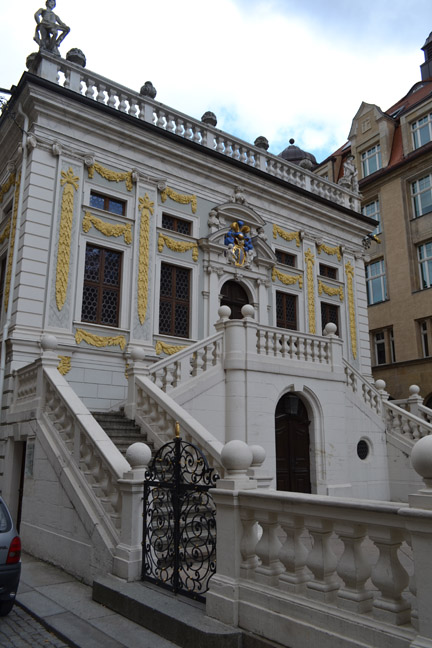
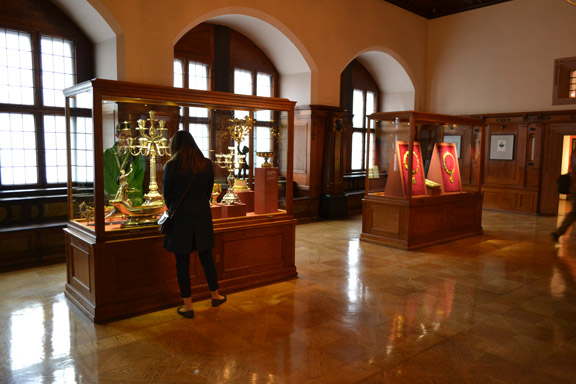
The Alte Börse, built in 1678-87 by Christian Richter, was originally used as a trading floor for merchants.

MAIN COURSE: ART-ARCHITECTURE AND MUSIC
As Leipzigers are fond of saying, for the young and creative Leipzig is no longer an insider’s tip. Word has spread that the city’s working and living conditions are just right, and three universities with an artistic or cultural profile, as well as Leipzig University, constantly feed the pool of ideas. Leipzig is known for its vibrant arts, music and festival scene; this place not only appeals to artists and actors, but is also becoming a trendy destination for leisure travelers.

Leipzig’s dynamic art scene enjoys an excellent reputation worldwide. Interestingly, a former cotton mill, Spinnerei, in the trendy Plagwitz district, is home to a number of galleries and studios. Formerly the largest cotton mill in continental Europe, Spinnerei now has the highest density of galleries in Germany. In this old factory complex are 80 artists, 14 galleries and exhibition spaces which house creative professionals like architects, designers, craftspeople, retailers and printers.
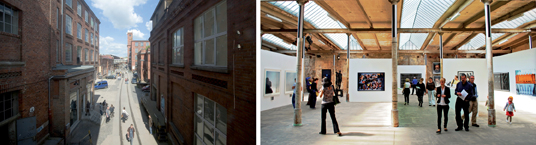
Spinnerei Museum

Artist and professor Neo Rauch of the New Leipzig School, whose paintings combine his personal history with the politics of industrial alienation, reflects on the influence of social realism. Hollywood star Brad Pitt recently purchased one of his works.

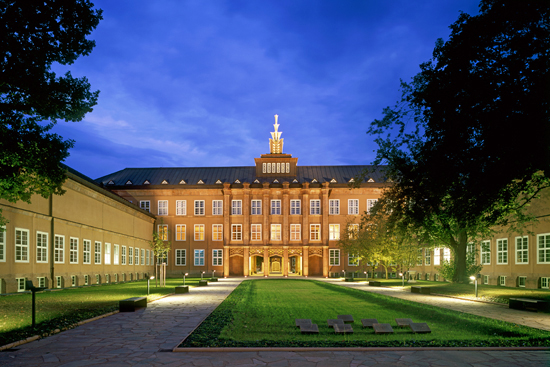
The GRASSI Museum of Applied Art, with its world class collection, opened as Germany’s second museum of applied arts in 1874. It is considered one of Europe’s leading museums of arts and crafts. The high point of the year within the GRASSI museum’s special exhibition is a trade fair for applied art and design, an international forum of contemporary applied art and experimental design.
Then there’s another part of the Grassimesse, the Designers’ Open, which is a well-established independent design festival. An extensive program including lectures, workshops, movies and fashion shows complete the fair.

In 1996 the Leipzig Fair’s new exhibition complex opened, featuring trailblazing architecture, spacious avenues and the stunning Glass Hall at its core.

THE CITY OF MUSIC

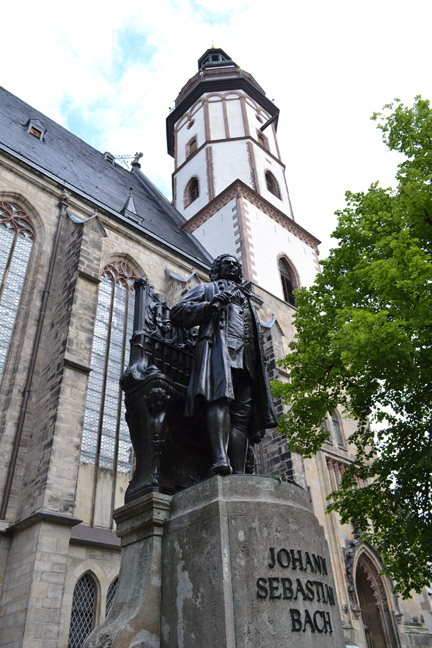
If you go to Leipzig, a visit to St. Thomas’s Church is a must, since it is the home of the world-famous St. Thomas Boys Choir and where Johann Sebastian Bach was employed for 27 years as organist and choirmaster.

His grave can be seen in the chancel. Motets are performed every Friday and Saturday by the choir, and there are concerts in front of the statue of Bach outside in July and August. The Bach Museum is located opposite the church.
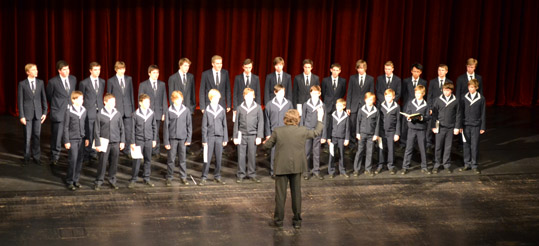
St. Thomas Boys Choir

Another regular musical highlight is the Sunday recitals at Mendelssohn House. Felix Mendelssohn-Bartholdy used to live in the building, which now contains the only museum dedicated to the composer.

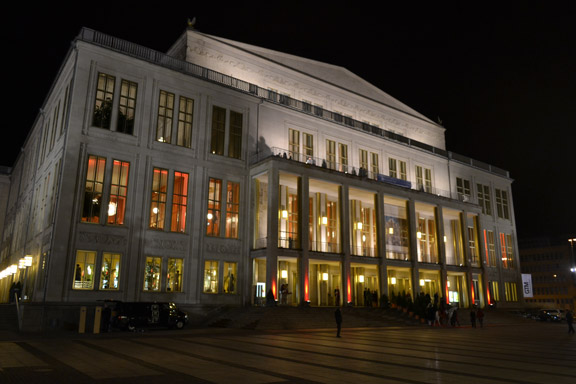
There are two additional important centers of music in Leipzig: the Leipzig Opera House and the Gewandhaus Concert Hall.

The Gewandhaus Orchestra, dating back more than 250 years, regularly performs in both venues. The Opera House is the third oldest civilian music theater stage in Europe. And Schumann House is dedicated to the memory of Robert Schumann, one of the greatest composers of the 19th century Romantic era.

Bach concert at St. Thomas Church

Leipzig also hosts several music festivals, large and small, including the International Bach Festival, the A Capella Festival, the Leipzig Jazz Festival and the Mendelssohn Festival.

MARTIN LUTHER AND THE PEACEFUL REVOLUTION
Our vegetable course includes reformer Martin Luther, who was known to come to Leipzig to face the Catholic Church hierarchy to explain his ideas about Christianity and indulgences. Martin Luther, who lived in nearby Wittenberg, stayed in Leipzig on no less than 17 occasions. His most important visit was for his participation in the Leipzig Disputation, or series of debates, held in Pleissenburg Castle in the summer of 1519.

After Duke George died, the Reformation was introduced in Leipzig in 1539. On August 12, 1545 Luther inaugurated the former Dominican monastery church of St. Paul’s as a protestant university church.

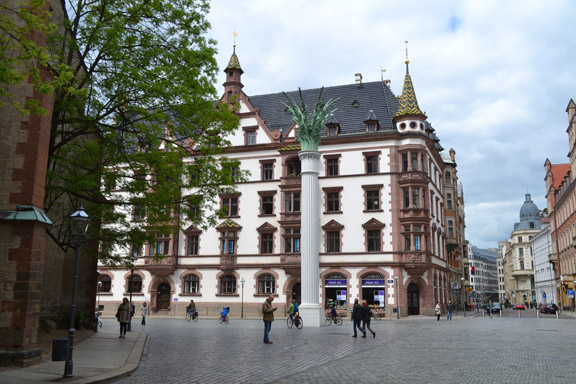
St. Nicholas Church exterior

Leipzig was particularly significant in the rise of the Reformation movement, because Luther’s writings and numerous evangelical hymn books were distributed in large numbers from this city of printing shops and publishing houses. In Melchior Lotter’s printing shop alone, between 1517 and 1520, more than 40 works written by the great reformer were published.

In the Grafisches Viertel or Graphics Quarter of the city, the publishing industry flourishes. In 1912, 300 printers and nearly 1,000 publishing houses and specialized book shops, as well as 173 bookbinders, operated in Leipzig.

Leipzig is also known for helping overcome the GDR government. St. Nicholas Church—the oldest and biggest church in Leipzig—rose to fame in 1989 as the cradle of the Peaceful Revolution. Services for peace were and still are held there every Monday, and the following demonstrations at the end of the 1980s toppled the East German government, paving the way for German reunification. In the church, note the interior columns: they are designed to resemble palms.
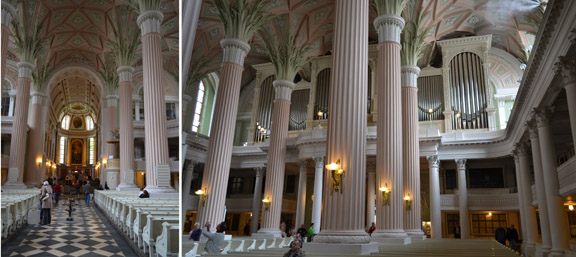
St. Nicholas Church interior

A few other important sights to see in the city include:

  • The Monument to the Battle of the Nations—the tallest monument in Germany—was erected to commemorate those who fell during the Battle of the Nations (also known as the Battle of Leipzig) fought against Napoleon’s forces in October 1813.
  • In the Battle of the Nations, Austrians, Prussians, Russians and Swedes fought —500,000 soldiers in all— the biggest battle ever in world history, marking the decisive turning point in the war of liberation from Napoleonic rule.
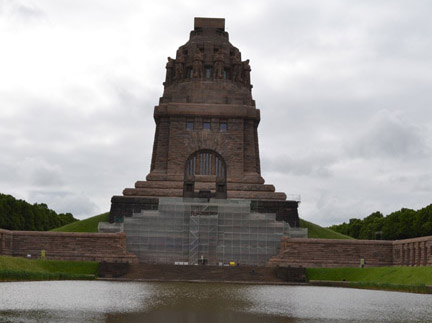
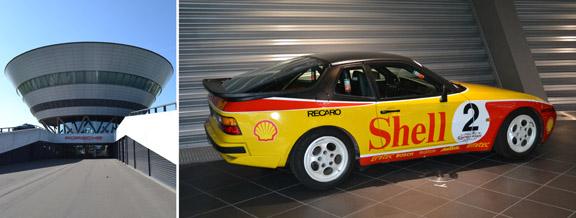
(left to right) Battle of the Nations Monument; Porsche Leipzig Headquarters

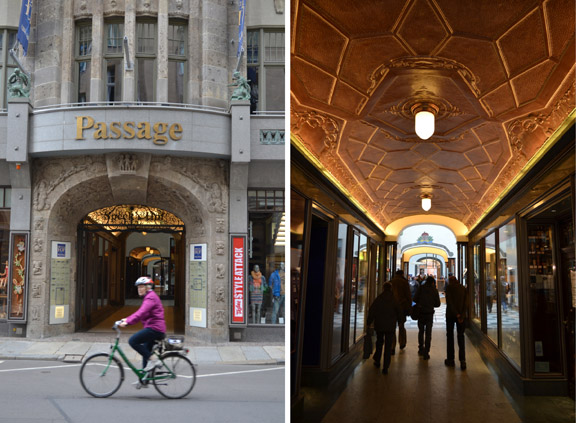
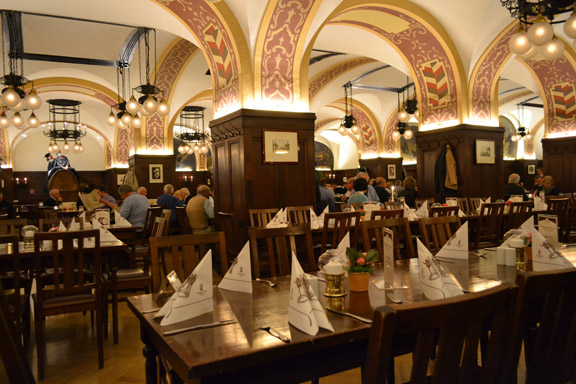
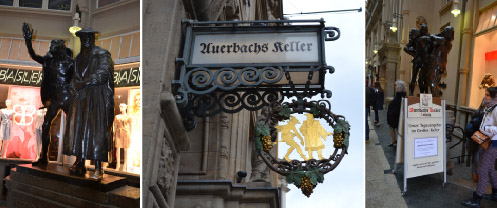
The Mädler Passage, for centuries the city’s most exclusive arcade (one of 30 arcades in the city), is home to the famous Auerbachs Keller. Serving wine since 1525, this tavern/restaurant was immortalized in Faust by Johann Wolfgang Goethe, the father of German literature.

YOUR SORBET IS SERVED
The café-cum-restaurant Zum Arabischen Coffe Baum is one of Europe’s oldest coffee houses (dating from 1694) and it used to number composer Robert Schumann among its regulars. Today the coffee museum on the third floor of the building contains 500 exhibition items on the history of coffee, the Saxons’ “national drink.”
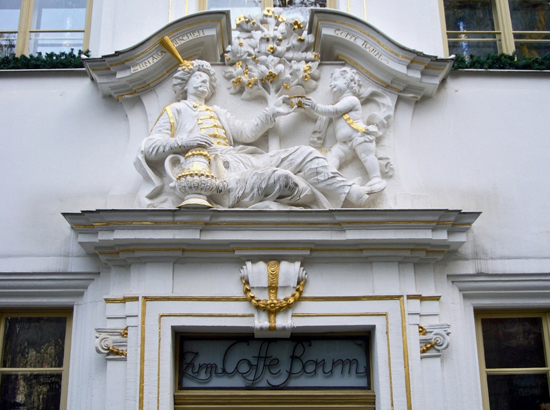
Zum Coffe Baum
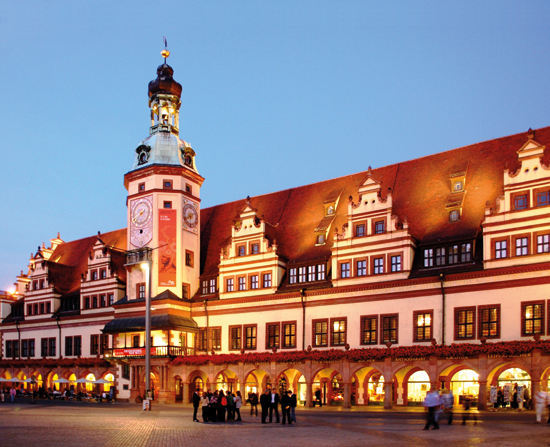
  • The Old City Hall, one of the finest Renaissance buildings in Germany, can be admired on the Market Square; it houses the Museum of City History. Inside is Katharina von Bora’s (Martin Luther’s wife) wedding ring and a pulpit in which Luther preached.
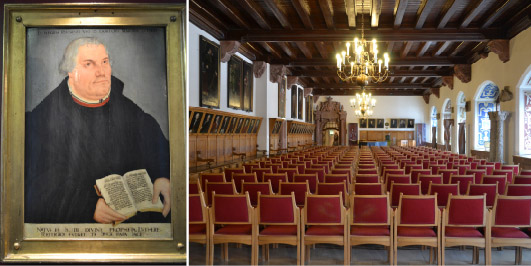
Town Hall Museum where a number of Martin Luther artifacts are exhibited.

NIGHTLIFE ABOUNDS
If you happen to be a night person, there is plenty to do in the evening, with all the city’s theaters, concert halls, variety shows and casinos. There are several dining and nightlife districts as well, such as Drallewatsch, Schauspielviertel, Südmeile, Münzgasse, Gohlis and Plagwitz. And when you arrive in one of the many clubs or bars, you’ll learn that often the term “closing time” is not in the vocabulary. There are 1,400 pubs and restaurants in this city, so dessert is not a problem.

And there you have it: a complete Leipzig meal with all the courses. Emperor Maximilan I knew something in 1497 when he granted the town imperial trade fair rights. He knew that one day Leipzig would be a multi-course city, and he was correct.

Auerbachs Keller Restaurant, located below the Mädlerpassage, is the best known and second oldest restaurant in Leipzig, described in Johann Wolfgang von Goethe’s play Faust I, as the first place Mephistopheles takes Faust on their travels. The restaurant owes much of its fame to Goethe, who frequented Auerbach’s Cellar as a student and called it his favorite wine bar.

For more information, go to www.leipzig.dewww.leipzig.travel, or www.germany.travel


Hotel Fuerstenhof
An upscale Leipzig tradition

Not far from the main train station in Leipzig is the Hotel Fuerstenhof, a five-star gem with marble, gold-rimmed archways, high ceilings and soaring windows.

At one time a classic patrician’s palace, the 92-room air-conditioned hotel with 12 suites, features myrtle wood furniture, marble bathrooms and a friendly, dedicated staff. The staff is geared to making your stay a pleasant one, knowing your name when you come to the registration desk for questions, and providing service with a smile. I had more than a few special requests from the staff which were quickly and pleasantly taken care of.

There’s an indoor 7,000-square-foot pool area, equipped with saunas, fitness room, solarium, cosmetic and massage stations. Also, the hotel features a nice piano bar area with comfortable, plush seats, and tables, fine dining in the 18th-century style neo-classical Villers restaurant (with a choice of more than 200 wines), a complete breakfast area and a wine bar round out some of the amenities of this hotel.

The hotel was first mentioned in 1770 when Karl Eberhard Loehr, a banker, lived in the palatial home, built between 1770 and 1772. It was called the Loehr Haus. It opened as a hotel in 1889, and underwent a complete renovation and restoration in 1993. It is part of the Luxury Collection of Hotels, one of 62 worldwide luxury hotels. 

For more information, go to www.hotelfuerstenhofleipzig.com/en

Hotel Fuerstenhof

Traditional Holland

By Don Heimburger

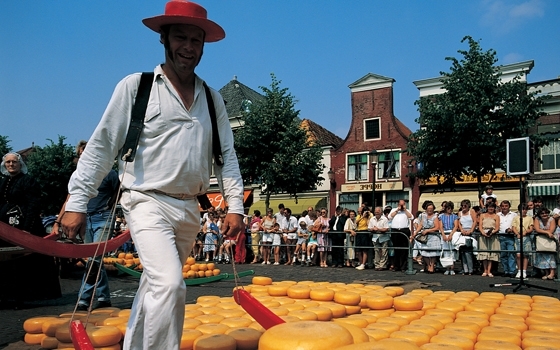
The Netherlands may be a small country, but it’s packed with world famous icons. Discover bulb fields, windmills, cheese markets, wooden shoes, the canals of Amsterdam, masterpieces of the Old Masters, Delft Blue earthenware, innovative water management and millions of bicycles. Find out more about these and other typical Dutch highlights. www.holland.com

Turkey’s Wild and Rugged Black Sea Coast

Turkey’s Wild and Rugged Black Sea Coast

Photos courtesy the Turkish Tourist and Culture Office of New York

Encompassing much of the country’s northern boundary and isolated by the rugged Kackar mountains, the narrow coastal Black Sea region of Turkey is well off the beaten path of many international travelers but treasured by those who discover its unique charms.

In addition to fascinating reminders of Turkey’s extraordinary history, the region is renowned for its magnificent coastline, scenic seaside and hilltop towns, World Heritage sites, lakes, national parks and some of the wildest natural landscapes in the country that draw intrepid trekkers, climbers and mountaineers from all over.
 
It should not be surprising that the Black Sea’s history was shaped by the nations that ruled the seas. Ancient Greece, the Roman Empire, the Byzantine Empire, Genoese, the Venetians and, until the early 20th century and afterwards Ottoman Empire, all put their cultural imprint on the region. They left behind castles overlooking the sea, churches, monasteries and mosques and distinctive architecture – much still intact or lovingly restored.

Today, visiting Turkey’s Black Sea by cruise ship (a number of lines based in North America offer itineraries that include one or two Turkish Black Sea ports) is one option, but for a more in-depth experience, travelers are advised to fly to Samsun or Trabzon, two of the larger towns, from Istanbul or Ankara, and rent a car or four-wheel drive vehicle. Comfortable and friendly accommodations are plentiful except in some of the more remote mountain villages. 
 
Though the coastal areas are blessed with moderate temperatures year-round, weather in the mountainous interior can be colder, therefore spring time is the most popular season for exploring the mountains.
 
Traveling from west to east through the Black Sea region, you might begin in Bolu. From coastal beaches to its famous multi-colored forests of oak, alder, pine, hazelnut and many more varieties of trees, visitors can virtually travel through all four seasons of the year within the course of a short drive. Yedigoller or Seven Lakes National Park is the centerpiece, but explorers will also discover hot springs, hiking and walking opportunities and, in winter, one of Turkey’s best ski centers.
 
As early as the 6th century BC, the coastal town of Amasra went by the name of Sesamus, and today offers a number of historic attractions, including 14th century Genoese forts, a Roman bridge, Byzantine city walls and historic mosques. Nearby, along the sea, the fishing villages of Cide and Abana are popular excursions, particularly known for their seaside restaurants.

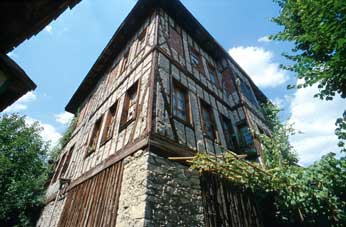
Just inland from Amasra is one of the region’s best known attractions: Safranbolu. Its beautifully preserved and restored buildings from the Ottoman Empire, including konaks, or mansions distinctively made of timber and stone, have earned the town a World Heritage Site designation. Other reasons to visit include the Koprulu Mehmet Pasa Mosque and the Kazdagi Mosque, Turkish baths, Shoemakers Street (the town once supplied the Turkish army with shoes) and the scenic Market Street.
 
Also inland is the town of Kastamonu, with its 12th century castle, ethnographic and archaeology museums, and famous handicrafts, including fabrics, tablecloths, woolens and fruit jams. The expansive pastures in the vicinity offer some of the best trail riding in Turkey, and nearby Ilgaz Mountain National Park is noted for its deer, foxes and bear as well as culinary traditions that include whole lamb cooked slowly in clay ovens.
 
Back on the Black Sea coast, the town of Samsun is where Mustafa Kemal Ataturk drew plans for what became the modern Turkish Republic; the hotel where he stayed became the Gazi Museum. Samsun also offers an Archaeological and Ethnologic Museum, with an impressive collection of antiquities, and not far away, at Bafra, are excavations dating back to the Hittite Iron Age civilization. The thermal springs of Havza, approximately 50 miles away, are another popular day trip.
 
Continuing eastward, Trabzon is the largest city in the region and a cruise port dating back to 7,000 B.C. It remains a major trading port, evolving from an early Greek colony to an important cultural center on the busy Black Sea. Under the Venetians, the town became an important feature of the famous Silk Route before the rule of Ottomans in 1461. Today visitors will find historic churches and mosques as well as other landmarks, including a villa belonging to Ataturk on the town’s periphery. Built by Maneul I in the 13th century, Ayasofia Church sits on top of a hill in the center of the city; the origins of the Church of Saint Eugenios, now the Yeni Cuma Mosque, are lost in time.
 
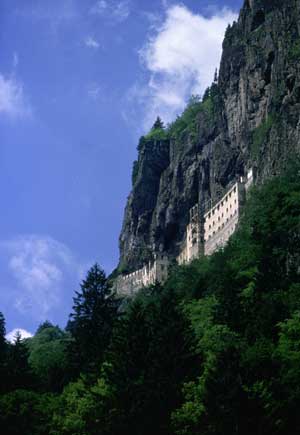
Just inland from Trabzon is the Sumela Monastery, a true treasure of the Black Sea region. Begun in the 4th century by the Greek monks, Barnabas and Sophronius, and built high into the cliffs of Mt. Mela, the monastery has been restored and rebuilt over the centuries.
 
Not far away, the alpine region of Zigana in the Kalkanli Mountains is renowned for its natural beauty and popular for day trips. The 3,200-feet high alpine lake at Uzungol is popular among campers, hikers and fishermen, who prize the lake’s trout. Even more rugged is the Yusufeli designated conservation area inland from the Georgian border. This remote area of lakes and historic Georgian and Armenian churches offers white water rafting as well as ecotours on the famous Coruh River.
 
Offering more cultural comforts is the nearby town of Artvin, which is famous throughout Turkey for its many festivals celebrating regional cultures and featuring music, food, costumes, dancing and other traditional celebrations. The most popular is the Bull Fighting Festival. Visitors will also find other picturesque rural villages in the area as well as the Karagol-Sahara National Park, which is noted for its forests and lakes.
 
Visitors to the region will also discover unique culinary traditions such as Black Sea cuisine, including the roots of the world-famous Turkish tea. Strongly influenced by geography and climate, mountains and sea, food featured in this region includes the black anchovy, or “hamsi,” corn served in endlessly interesting ways, pickled green beans, an abundance of other vegetables and Akcabat Kofte (meatballs). Sweet helva, made with corn, butter and local honey, is another local favorite, as are a great variety of Black Sea and river fish (including farm-raised trout), considered by many to be the tastiest in the world.
 
The Turkish tea industry is based in the town of Rize, where a moist, moderate climate provides perfect growing conditions. While green tea is exported all over the world, travelers should be prepared to enjoy the local favorite, the strong, smoky black variety that, traditionally served with sugar, is as much a social event as it is a beverage. But tea is not the only appeal of Rize and its surroundings. Not far away are the dramatic Kackar Mountains, with their waterfalls, highlands and peaks – magnets for hikers and climbers. Glacial lakes are adorned with yellow rhododendrons, found nowhere else in Turkey at these altitudes, and Mt. Kackar itself, one of the world’s ecological treasures, is home to bears, wolves, lynxes and mountain goats.
 
For more information on Turkey and its Black Sea region, contact the Turkish Culture and Tourist Offices in New York at (212) 687-2194; Washington, D.C. at (202) 612-6800; and Los Angeles at (323) 937-8066. Information is also available at www.tourismturkey.org.

The Cult of Currywurst

By Sharon Hudgins
Photos by the author

This multi-cultural fast food has overcome its humble origins to obtain cult status in Germany, even rating its own museum.

What could be more German than currywurst: chunks of sausage slathered with a sauce based on the same ingredients as Anglo-American tomato ketchup spiced with English Worcestershire sauce, Hungarian paprika and Indian-inspired curry powder (by way of Britain), served with French fries on the side?

Some German cooks even add another multicultural twist: spiking the sauce with Caribbean and South American peppers, as a challenge to macho munchers competing for the top-dog spot in their local currywurst “Hall of Fame.”

From its humble origin as a street food in the country’s war-torn capital, currywurst has risen to culinary cult status in Germany, even rating its own museum. That’s right: a museum devoted entirely to currywurst opened in Berlin in 2009, on the dish’s 60th birthday, with exhibits on everything you always wanted to know about currywurst (but didn’t know you wanted to ask).

SUCCESS STORY
Currywurst was invented in Berlin in 1949, when a woman named Herta Heuwer supposedly acquired some English curry powder (and maybe also Worcestershire sauce) from soldiers stationed in the British sector of the occupied city. Experimenting in her home kitchen, she concocted a tomato-based sauce as a topping for cooked sausages, which she sold at a street stand to construction workers rebuilding the rubble-strewn metropolis.

Heuwer’s currywurst was such a success that she was able to open a small restaurant in the red light district, which soon became a popular hangout for celebrities. In 1951, early in her career as the queen of currywurst, she also patented the secret recipe for her seductive sauce, which she called “Chillup,” its name a contraction of “chili” and “ketchup.”

Currywurst went on to take the country by storm. All over Germany street stands, festival stalls, food trucks and even restaurants now sell their own versions of this simple dish. More than 800 million currywursts are consumed annually in Germany—that’s nearly 10 sauce-covered sausages for every man, woman, child and foreign tourist in the whole country.

VARIETY SPICES LIFE
Currywurst sausages, sauces and sides vary widely, not only from one region of Germany to another, but also from one vendor to the next, even in the same neighborhood.

The recipe for Herta Heuwer’s original Berliner currywurst sauce remains a secret, although many cooks have tried to replicate it. Some street vendors and restaurant chefs take pride in making their own signature sauce from scratch, refusing to reveal their personal recipes. Others take the easy way out by merely adding spices to bottled ketchup. And big companies such as Heinz and Knorr market a variety of “Curry Ketchups” in Germany. Just squeeze the bottle and squirt.

Most sauce recipes include curry powder and paprika, along with other seasonings such as vinegar, sugar, garlic and onion. The sausages are first simmered in water, broth or beer, then finished on a griddle or grill, or pan-fried in a skillet. Usually they’re cut crosswise into pieces before being covered with sauce. German engineers even invented a commercial cutter to slice the sausages in one whack, quickly and uniformly. (Cutting 800 million by hand just wouldn’t be efficient.)

An exhibit at Berlin’s Currywurst Museum showcases several varieties of this favorite German fast food. The original West Berlin version is considered the classic currywurst: a thick sausage (usually Bockwurst, sometimes Knockwurst) cut crosswise into chunks, topped with a red tomato-based sauce, garnished with curry powder and served with a bread roll. The East German version uses skinless sausages, supposedly invented out of necessity when sausage skins were scarce in the early era of post-war rationing. In the Rhineland, bratwurst is favored, doused with a thinner dark-red sauce (with the curry mixed in but not sprinkled on top) and served with French fries on the side.

A “Manta plate” consists of currywurst and French fries, with ketchup and mayonnaise dolloped on the spuds. (In Cologne and Düsseldorf the same combo goes by another name, whereas in Hannover it’s called “the Chancellor’s plate.”) And a “taxi plate” is a caloric triumph of multiculturalism: currywurst with French fries, barbecue sauce, and mayonnaise, plus Greek gyros (thin slices of spit-roasted meat) and tzatziki (yoghurt-cucumber-garlic sauce).

There’s even a “Luxus” version (“for those very special moments in life”), a prime example of Berlin ironic humor: a whole sausage with a piece of gold leaf draped over the top, surrounded by a pool of currywurst sauce on a white china plate and accompanied by a glass of Sekt (German sparkling wine). And at Aqua, the Michelin 3-star restaurant in the Ritz-Carlton Hotel in Wolfsburg, I was served a cute little dessert amuse-bouche consisting of marzipan “sausages” wedged between macaroon “buns,” garnished with red strawberry sauce and sprinkled with cinnamon—the ultimate currywurst haute dog.

STAND UP FOR YOUR SAUSAGE
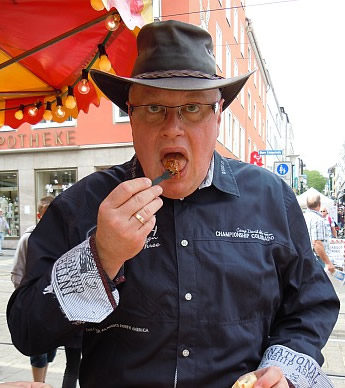
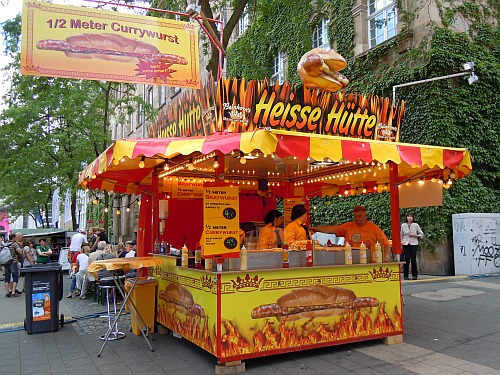
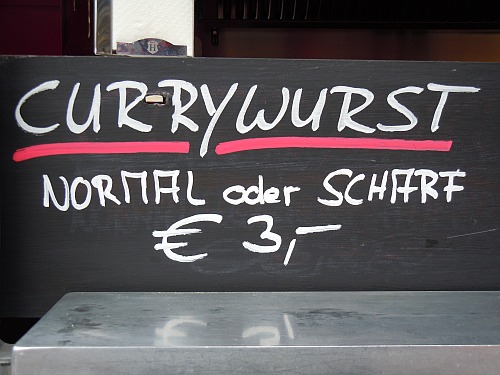
Despite its many riffs, currywurst is still just a simple, inexpensive take-away food, most often bought at a Schnellimbiss or Currywurstbude (fast-food stand) and eaten while standing up. (Even McDonald’s felt compelled to add “McCurry Wurst” to its menu in Germany.) Currywurst traditionally comes in an oval-shaped white cardboard bowl, along with a little wooden or plastic fork and a small white paper napkin for blotting up the messy drips of sauce—although some eat-in restaurants serve their sausages on a plate.

Currywurst connoisseurs are well known for their unswerving loyalty to a particular currywurst stand, disdaining all others as unworthy of their patronage. Claiming your favorite currywurst stand as the “best” can quickly get you into a heated discussion at a German bar.

Eaten by everyone from proletarians to high-level politicians, currywurst is particularly popular in its hometown of Berlin, where 70 million of these saucy sausages are sold every year. Many critics consider the currywurst at Konnopke’s Imbiss (two locations in Berlin) to be the best classic version in the city. A few years ago, two other stands, Curry 66 and Curry & Chili, entered the scene, both claiming to serve the hot-spiciest currywurst in Berlin, the sauces made with such tongue tinglers as habanero peppers and Black Death bottled hot sauce. And Curry 36 in Berlin bottles its own original curry ketchup for customers to take home, in case they get a craving for currywurst in the middle of the night.

Hamburg is another hotbed of currywurst consumption, with 72 million eaten annually in the Elbe port city, famous historically as a gateway for spices imported into Germany. Hamburg also claims to be the original home of currywurst, an assertion roundly rejected by Berliners.

Other popular places for eating currywurst in Germany include Scharfrichter, a restaurant that specializes in hot-spicy currywurst with sauces rated on a heat scale of 1 to 10. Curry 24 in Dresden advertises “the hottest currywurst in the city,” with a clever illustration on the menu showing a red sausage “rocket” with seven “burn levels” of rocket fuel. The owner uses different liquid chile pepper concentrates to fuel his rocket sauces—and sells over 250,000 of these mouth-flaming currywursts every year.

HUMBLE FARE
Who would have ever thought this humble fare could inspire not only cooks, inventors and museum curators, but also singers, writers and artists? Currywurst is featured regularly on a German television series, and in 2009 it was the subject of a cartoon contest on the Internet. Currywurst has its own page on Facebook, and you can listen to “The Currywurst Song” on both Facebook and YouTube. But you might get a bigger kick out of watching some of the currywurst eating contests posted online—that is, if you get turned on by red-faced men with bulging tongues, tears streaming down their cheeks, stuffing themselves with German sausages.

About the writer
Sharon Hudgins is an award-winning writer with four books and more than 700 articles published worldwide. Her food and travel writing has appeared in National Geographic Traveler, Saveur, Gastronomica, German Life, Russian Life, The World and I, Chile Pepper, Fiery Foods & Barbecue, major newspapers in the United States, and periodicals in Germany, Russia, and the Czech Republic. For several years she was the food columnist for The Stars and Stripes newspaper in Europe, and since 1997 has been the food columnist for German Life magazine in the United States. A former editor of Chile Pepper magazine, she has also worked as a cookbook editor, photographer, filmmaker, university professor, and lecturer on international tours offered by National Geographic Expeditions, Lindblad, Road Scholar, and Silversea Cruises.

Sharon Hudgins has lived in nine countries of Europe and Asia and traveled in 50 countries across the globe. Her European experience includes living in Germany for 15 years, as well as in several European capitals and small towns from northern Scotland to southern Spain to the Greek island of Crete. She is the author of an award-winning cookbook about the regional cuisines of Spain, and her personal memoir, The Other Side of Russia: A Slice of Life in Siberia and the Russian Far East, won two national awards for travel and food writing.