By Don Heimburger
Photos by the author
Grabbing a “taste” of Germany today doesn’t mean just visiting its Medieval castles like Neuschwanstein or Wartburg Castle, or visiting its thousands of half-timbered buildings such as you’ll find in Wernigerode, Bamberg and Cochem, or being one of the millions who take pictures of the famous Cologne Cathedral.
A “taste” of Germany in 2018 takes on a special meaning: this year Germany’s National Tourist Board officially unlocks its treasure chest of culinary delights as part of its promotion of the country, and there are many appetizing foods to be enjoyed, and 16 federal states in which to enjoy them.
With eight straight years of record growth in tourism, Germany is primed for more tourists in the year ahead who can also appreciate this country’s flavorful foods. In 2017, a total of 83.9 million overnight stays by foreign visitors in establishments with at least 10 beds were recorded, according to Petra Hedorfer, chief executive officer of the German National Tourist Board (GNTB).
The German Tourist Board is trying to get travelers’ attention by saying “Attention foodies: Germany is now open for tasting.” And there are many towns and regions in which to conduct this culinary research, as well as numerous restaurants, wineries, breweries and farms that are eager to show visitors what Germany has to offer.
HANNOVER CURRYWURST
In Hannover you can stop in at an interesting restaurant called the Ständige Vertretung at Friedrichswall 10. The “StäV” as it is named, is not just any cafe, but a political reading book … where the history of political happenings and famous German politicians from past decades can be found on the walls and in photos. But go also for the famous “explosive” currywurst offerings. There’s the German Chancellor Filet “Schröder Art,” the Bundestag Filet, and the Chancellor Tarte, all part of the currywurst menu. All come with spicy sauce.
THE ARISTOCRAT OF VEGETABLES
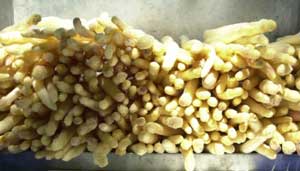
At Fritz Bormann’s 25-acre asparagus farm near Nienburg in Lower Saxony northeast of Hannover, vast fields of white asparagus (Spargel) covered by large plastic tarps, sit waiting for harvest. In early spring, workers pour into the fine sand-like fields, armed with long, sharp cutting tools and a bucket to pluck the revered savory asparagus stalks from underneath the heaped mounds of dirt.
The “white gold” is then cleaned, graded and quickly delivered to farmstands and markets where it is snapped up by eager eaters. Combined with a hollandaise sauce or hot melted butter, and perhaps a plate of potatoes and pork or ham, the pale, long-stemmed vegetables are a nationwide sensation.
Germany sets aside about 62,000 acres for growing asparagus every year, and it’s estimated the country consumes up to 125,000 tons of it, but some of that is grown in other nearby countries. And nearly every restaurant in the asparagus-growing regions feature Spargel specials on their lunch and dinner menus. The picking season ends promptly on June 24 every year.
If you’re lucky, you can even meet one of the local Spargel queens, like the 2017/2018 queen, Nicole Cybin from Nienburg, or visit the local asparagus museum, part of which is housed in an original 1663 building. The museum displays, among other things, old tools which were once used for harvesting asparagus, dishes and serving plates with asparagus themes painted on them and even molds in the shape of a bunch of asparagus.
ASPARAGUS ROUTE
There’s even an Asparagus Route (Spargelstrasse) which begins in the town of Schwetzingen (it also claims the title of “Asparagus Capital of the World”). When you walk through the city, look for the statue of the Spargelfrau (literally means asparagus woman). The town holds an annual Spargelfest and in 2018 celebrates 350 years as a major Spargel grower.
While you are in Nienburg, be sure to stroll around this fascinating 1,000-year-old village and find the 16th century half-timbered Rathaus built in 1533, as well as the same period St. Martins Church. There are also medieval mansions, other carefully restored half-timbered homes, and a large town center with wide streets. The castle and town of Nienburg were once the residence of the Counts of Hoya, and their tombs can be found in St. Martins Church.
You can also visit the Dobberschuetz Fishery & Smokehouse alongside the banks of the Weser River which flows through the town and get the catch of the day. Eels are their speciality. Get there on a Saturday and enjoy their Saturday fisherman breakfast.
No sleepy little village, Nienberg today has as many as 100 trains a week stop there.
OTHER GERMAN CULINERY DELIGHTS
At the sprawling Rotkäppchen winery in Freyburg, Sekt or sparkling wine is produced, with brothers Moritz and Julius Kloss and a friend establishing a wine store and producing Rotkäppchen champagne as early as 1856. The first 6,000 bottles were bottled in an apartment in the back of the house of the Kloss family.
In the large historic Rotkäppchen building in Freyburg, select grapes are used to make various cuvees, and the brand today is the most successful in Germany, and also holds a 30% international market share. This Sekt takes its name from the unique red cap on its bottles.
Every year the company sponsors a Jungweinprobe, where last years wines are sampled in the courtyard of the Rotkäppchen winery. It’s always a popular and crowded affair with everyone allowed to pour their own glass of wine from a staggering selection. Here, too, you can meet the local Wine Queen, and ask her which cuvees she prefers. In 2017/2018 the reigning queen was Juliana Beer, 22. Not just a queen in name only, she enjoys the aged wines, and can explain the nuances of wine growing and wine-making.
The Rotkäppchen winery boasts one of the largest storage barrels in Germany (from 1856) which can hold 160,000 bottles of wine. And you can also enjoy a great German meal as you sit near the giant wooden barrel and try to figure out how they made such an elaborate wooden vessel.
WEINGUT PAWIS IS A STANDOUT
Also in Freyburg, Weingut Pawis is a standout winery housed in a renovated stone building. As a 10-year-old boy, Bernard Pawis didn’t have much luck with a hoe in his father’s vineyard. But when he learned the wine profession in Radebeul years later, he was on his way to gaining national recognition with his wine production.
Taking over from his father in 1998, he constructed a new wine cellar and later rebuilt an old horse stable into a modern, welcoming and innovative winery with 30 acres of vineyards.
The family produces a number of wine varieties, including Müller-Thurgau, Silvaner, Riesling, Bacchus, Kerner, Pinot Blanc and Pinot Gris, Portuguese, Dornfelder, Pinot Noir and Regent.
Their unique operating philosophy includes sustainable economics, conscious handling of nature, respecting the soil and the vine as their most important commodity, and they work according to environmentally friendly cultivation methods.
The innovative Pawises offer wine tastings, art exhibitions, guided vineyard tours, champagne receptions, a Christmas market, and even a lookout tower on the historic estate.
BLUEBERRY HEAVEN
At Bickbeernhof, you’ll find just about every conceivable way to serve blueberries that you can think of. Owner Sylke Herse has already done the planting, growing, and the packaging for you, and draws upwards of 1,000 visitors a day to her blueberry world in Landesbergen. “Very busy, very organized. Long wait lines at peak times, but worth it. Big juicy blueberries. Every year a must!” are the typical comments from customers.
Blueberry fields are located right behind the processing plant and company store, and there is a wide variety of blueberry-made products offered in the gift shop including blueberry wines, jams, juices, books about blueberries and much more. In their restaurant, customers can order salads with blueberry dressing, blueberry marmalade blueberry pudding, blueberry smoothies and many other blueberry delicacies.
BORN FAMILY VINEYARD
Motorcycle-riding Jochen Born and the small Born Family Weingut in Höhnstedt, located near the famous Luther Walking Trail, produces a variety of wines from its mostly “vertical” vineyards lining the slopes of the area hills. The hills around Höhnstedt contain a lot of limestone, and help from the sun, the wind and the rain make it an ideal place to grow grapes. Jochen is an amicable host and willing to tell his guests about the intricacies of his wine brands and its production in his compact and cozy tasting room adjacent to the wine gift shop.
SCHLOSS WACKENBARTH
Schloss Wackenbarth in Radebeul, is a well-situated, picturesque winery, and one of the oldest sparkling wine producers in Europe. On the well-manicured grounds is a Mediterranean-style palace erected by Augustus the Strong. Since the 18th century Schloss Wackerbarth has attracted hundreds of thousands of visitors because of the charming setting, and of course the delicious wines.
Tours through the winery and grounds are conducted, and many social events, including weddings and banquets, take place on the grounds each year. Interestingly, the federal state of Saxony owns the winery. The winery calls itself an ambassador for the state of Saxony, and indeed it has the stature and appeal of something regal.
While every year Germany is certain to attract millions of visitors for its culture, history, sights and its uniqueness, 2018 calls out for a visit for all of the above, and especially its many and varied succulent, edible delights.
Guten appetit!
For more information go to www.germany.travel.com or www.germany.travel/culinary-germany




 European Traveler