By Danielle Pruger Photos courtesy Giraffe Childcare and Early Learning
Europe is famous for its decadent chocolate and many countries are known for their tasty treats. However, chocolate was originally only enjoyed in Central America where cacao beans grew. The Olmec Indians were the first to harvest the cacao beans and 1,000 years later the Mayans were the first to bring the cacao tree from the rain forest onto plantations in modern day Mexico and Guatemala. It wasn’t until 1530 that chocolate was introduced to the European population by Hernan Cortes, who added cane sugar to “xocaltl,” a traditional chocolate drink, to make it more appealing to Spanish royalty and aristocracy. From there many new chocolate concoctions were created throughout Europe, such as Pralines and chocolate milk and many other treats we enjoy today.
For more information visit the timeline created by Giraffe Childcare and Early Learning that covers more than 4,000 years of chocolate’s history: Chocolate History Timeline
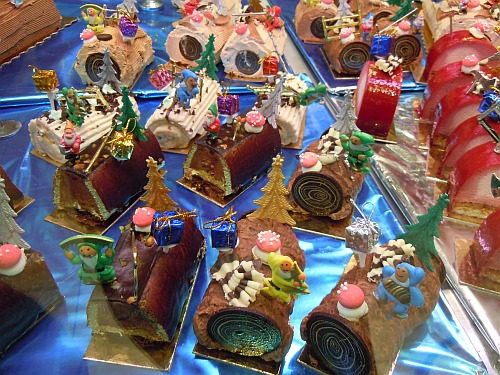
Parisian bakeries sell many versions of the traditional Buche de Noel (Yule Log) Christmas cake.
Paris is a great city to visit any time of the year—for fine foods, outstanding museums, and romantic walks along the Seine in the pink glow that often suffuses the city at twilight.
Many tourists want to see Paris in the spring. Remember the song, “April in Paris”? Or the movie of that name, with Ray Bolger and Doris Day? And who could forget Gene Kelly dancing among the blossoms with Leslie Caron in An American in Paris? But did you know that Paris is also a wonderful place to spend the winter holidays?
WINTER ROMANCE Paris in winter has something for everyone. Open-air and indoor Christmas markets throughout the city. Nativity scenes and sacred music concerts in historic churches. Menorahs and special Hanukkah foods in the Jewish delis and bakeries. Strings of sparkling lights across the grand boulevards. Outdoor ice-skating rinks decorated with Christmas trees. Children’s noses pressed against the glass of department store windows animated with fanciful displays. Cheerful families toting wrapped packages in the subway. Smiling vendors at the food stalls. Even friendly waiters in the restaurants.
More than a dozen colorful Christmas markets brighten up the city, some open for only a few days in December, others lasting six weeks or longer, from the start of Advent (the fourth Sunday before Christmas) through Epiphany (Three Kings Day on January 6). Some Christmas markets specialize in products from a particular part of France, such as Alsace, whereas others feature handmade crafts by local artisans. Paris’s newest food fair, Noël Gourmand, is also held in December, at the Carrousel du Louvre, a glitzy underground shopping mall in the heart of the city. There you can taste French regional products such as artisanal cheeses from the Basque region, wines from the Loire, meats from the Ardennes, and sweets from Provence. And no Christmas market anywhere in Paris would be complete without roasted chestnuts, chewy nougat, and hot spiced wine.
CHRISTMAS DINNER If you want to enjoy a special meal at a restaurant on Christmas Eve, make reservations early. Many restaurants are closed on the evening of December 24, and even more are shut on Christmas Day. A fun alternative is to pick up some good wine, cheese, bread, and a traditional French Christmas cake, a bûche de Noël (Yule log), to take back to your hotel for a private holiday picnic in your room. Then head to one of the gorgeous gothic churches for a memorable midnight service by candlelight.
You can feast even more lavishly if you rent an apartment through Airbnb or one of the other agencies that offer apartments in Paris year round. Have fun (and save money) by purchasing foods and wines at little local grocery stores and big open-air markets, then bring them back to your apartment for a cozy dinner at home. Even if you don’t want to cook, you can buy excellent prepared foods such as pâtés, cheeses, rotisserie chickens, cooked seafood, Burgundy beef stew, Spanish paella, North African couscous, fresh breads, and luscious French pastries at the delis, department stores, bakeries, and pastry shops all over Paris. Wine shops will also recommend the best vintages to accompany your store-bought meal. And if you don’t feel like lugging all that food back to your apartment, some stores will even deliver groceries and wines free of charge or for a small fee.
RING IN THE NEW YEAR New Year’s Eve on December 31 is the time to party at a restaurant, with friends and strangers, until the early hours of the morning. Many Parisian restaurants offer a special Réveillon dinner, a fixed-price, multi-course, New Year’s Eve meal with champagne. Some smaller places charge as little as €50 per person (with wine extra), or you can splurge at the high-end eateries for several hundred euros apiece. Wherever you choose to eat, reservations are a must.
On a recent New Year’s Eve, my husband and I celebrated at Restaurant Polidor, a relic of France’s culinary heritage. Polidor still serves the same kind of simple, old-fashioned, very affordable comfort food like you could find in little Paris bistros half a century ago. Nothing trendy or minimalist-modern here—just small wooden tables covered with red-and-white checked paper tablecloths, bentwood chairs set close together, dark wood wainscoting, big mirrors on the wall, and plenty of nostalgia atmosphere. Filmgoers will recognize Polidor as the place in Woody Allen’s film, Midnight in Paris, where Gil Pender meets Ernest Hemingway back in the 1920s. And indeed, Polidor has been feeding the famous and the not-so-famous ever since it was established in 1845.
If you’re a cat lover and missing your own felines when you’re away from home, you can even celebrate New Year’s Eve in the company of 16 rescue cats at the cozy Cafe des Chats Bastille, one of Paris’s two cat cafes, where the furry friends roam free among the tables. And wherever you choose to party, you don’t have to worry about drinking that extra glass of champagne and staying out really late. From 6 p.m. on New Year’s Eve until 5 a.m. the next day, the Paris subway runs continually overnight, and it’s even free of charge.
GIFTS OF THE MAGI Finally, finish up your Parisian holiday with a special treat on January 6, Three Kings Day. In all the pastry shop windows you’ll see round, flat pastries with a gold paper crown on top. These are galettes des Rois, the traditional King’s Cakes of northern France. A small porcelain or plastic prize is baked inside the cake, which is made from layers of puff pastry often with a frangipane filling. Whoever gets the slice with the prize inside is crowned “king for a day.” At some Three Kings Day parties, the prize-winner also has to buy drinks for everyone around the table.
So let Paris wish you not only a bon appetit, but also a Joyeux Noël (Merry Christmas), a Bonne Année (Happy New Year), and a Bonne Fête des Rois (Happy Three Kings Day) on your next trip to France!
Swiss cuisine combines influences from France, Northern Italy, Germany and Austria. And specialities vary greatly from region to region closely aligned with the language borders. Many local specialities have become firm favorites throughout Switzerland.
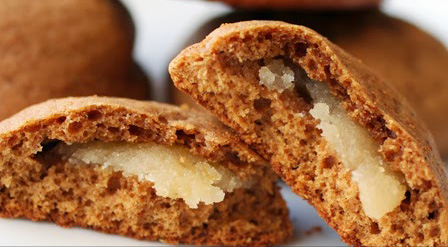
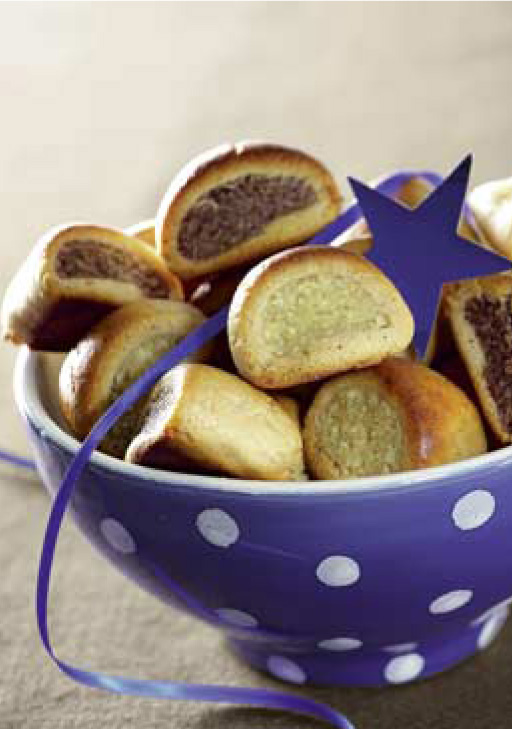
ST. GALLER & APPENZELLER BIBER St. Galler & Appenzeller Biber are two types of gingerbread with filling. One is from St. Gallen, the other from Appenzell. One is loaded with a hazelnut, the other with a white almond filling. But both are called “Biber” (beaver) or “Biberli” (little beaver) and have two layers of soft honey dough and one layer of yummy stuffing, so they might be totally different from the gingerbread you’ve had so far. No matter which one you try, they can be highly addictive.
BIBERLI WITH LEMONGRASS MARZIPAN Preparation time: approx. 50 minutes. Cooling time: approx. 13 hours. Baking time per baking sheet: approx. 8 minutes. Yield: 50 Biberli cookies
FOR DOUGH Mix in a bowl: 1 1/2 c. flour 1 teaspoon spice mix for Lebkuchen zest of 1/2 lime
Heat: 1/4 cup honey 2/3 cup powdered sugar 1 teaspoon water
Add sugar to flour with: 1 tablespoon milk 1 teaspoon baker’s salt (baker’s salt is ammonium bicarbonate and is available at pharmacies)
Knead into a soft, smooth dough and let rest for 12 hours in the refrigerator
FOR LEMONGRASS MARZIPAN Finely chop in a bowl: 2/3 cup peeled almonds 2–3 blades of Lemon grass (only the inside), cut in small pieces 1/4 cup white chocolate, broken up
Add and knead into a dense ball: 50 g Acacia honey ½ tablespoon lime juice
Shaping: Roll the dough with a little flour into a square shape (about 8 x 8″). Halve the squares lengthwise. Moisten edges with water. Halve the marzipan. Form 2 rolls (each about 12″ long, by 3/4″ diameter). Place 1 roll on the long side of the dough, form into a roll, cover and store in a cool place for 1 hour. Form a second roll. Cut the rolls diagonally into 1″ wide trapeze-shaped pieces. Place the Biberli on a baking sheet lined with parchment paper. Glaze with heavy cream.
Baking: Approx. 8 minutes in the center of the pre-heated oven, pre-heated to 400 degrees. Remove from oven and pull the parchment paper with the Biberli onto a wire cooling rack. Glaze once more with cream, let cool completely.
Storage: Biberli can be stored for approx. 1 week in a tin with a close fitting lid.
Alternate hazelnut-cinnamon filling: 2/3 cup hazelnuts, 1 teaspoon of cinnamon, 1/4 cup milk chocolate, broken into pieces; finely chop with a cutter. Add slightly less than 1/2 cup sweetened condensed milk and 1 tablespoon of water; knead until it forms a compact mass.



 European Traveler