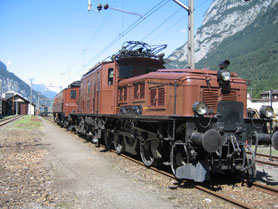
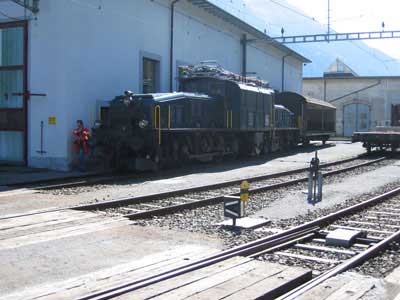
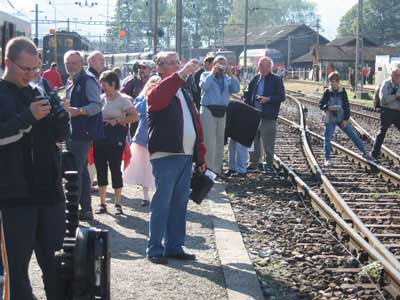
A giant electric Crocodile locomotive was on display September 8 and 9 in Erstfeld, Switzerland when 50,000 visitors showed up there and in Biasca to celebrate the 125th anniversary of the opening of the famous 15-mile-long Gotthard Tunnel. Heimburger’s European Traveler was at the giant party and recorded these photos. As many as seven steam engines and dozens of vintage pieces of equipment were available for viewing. There were also many interactive displays. For more information, go to www.sbbhistoric.ch.
By Marilyn Heimburger Photos by Don and Marilyn Heimburger
As spring approaches, thoughts of chocolate come to mind, just because we’re always looking for an excuse to eat chocolate! As the saying goes, “Chocolate–it’s not just for breakfast anymore!”
After a recent trip to Cologne, Germany, and after visiting the Cathedral and Roman ruins, I added a trip to the Chocolate Museum to my itinerary. You’ll learn all there is to know about this treat and have the opportunity to taste and see why the ancients called chocolate the “food of the gods.”
Opened on Halloween Day in 1993, the museum was the idea of Dr. Hans Imhoff, an entrepreneur who was the head of the Stollwerck Chocolate Company of Cologne. The three-story museum is located on the banks of the Rhine, within sight of the Cologne Cathedral.
Designed to look like a ship in the harbor, its modern glass and metal architecture surrounds the historic central customs office, which was built in the 1890’s. The museum welcomes an average of 1,700 visitors a day and about 650,000 per year.
3,000-YEAR-OLD HISTORY
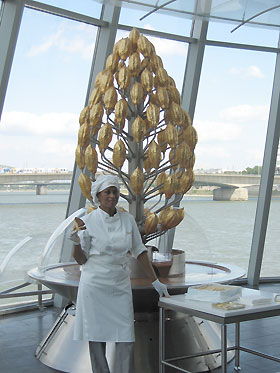
Visitors can see chocolate being made at the museum.
As you walk through the three-story museum, you’ll see exhibits covering the 3,000-year history of chocolate. Growing and harvesting raw cocoa is shown with photographs, harvesting tools and a full size log boat from Ghana. Next is a 100-square-meter tropical greenhouse containing real cocoa plants and more than 60 other rainforest species. You’ll learn that the flowers of the cocoa plant grow directly on the trunk of the tree, so that pollinating insects can find them more easily in the thick jungle!
Chocolate’s popularity began as a luxury drink. An extensive exhibit brings you through the pre-Columbian Olmec, Aztec and Mayan culture, where cocoa was the drink of the gods, and was sometimes used as currency, or “brown gold.”
Next you’ll see the beautiful porcelain and silver cups and pitchers that were crafted to serve this luxury item in 17th and 18th century Europe. The chocolate culture of the 19th and 20th centuries is depicted in a full-sized shop, with chocolate tins and boxes on display, as if you had stepped back in time.
Front and back of a Santa mold
Beautifully preserved chocolate vending machines and advertising posters give insight into the popularity of chocolate. A film room continuously shows old television ads for chocolate. Chocolate packaging from apparently any brand of chocolate that ever existed is on display. Even American brands of chocolate are represented, although Astrid Hage, press representative of the museum, admitted that it was difficult to find someone willing to eat the American-made chocolate in order to empty the packaging. She explained that the Europeans follow a different standard in their chocolate production, and that their formula produces a superior taste.
DECIDE FOR YOURSELF
You’ll have the chance to decide that for yourself in another part of the museum, where, thanks to the Lindt and Spruengli Company, a two-floor exhibit demonstrates the production of chocolate today. From the processing, roasting, grinding of the bean to the pouring of hollow molded chocolate figures and a truffle production line, this small-scale system makes about 400 kg of chocolate every day for visitors to see, smell and finally, to taste.
A nearly 10-foot tall chocolate fountain stands on the production floor, and a museum staff member stands ready to offer a waffle cookie dipped in the warm melted chocolate that pours from the spouts.
THERE’S MORE, TOO
Do you want more of the “food of the gods?” A gift shop offering chocolate, souvenirs and gifts is ready to serve you. The museum also has a restaurant with a view of the Rhine.
Admission fees are 6.50 EUR for adults. Children under six or visiting on their birthdays are free. All exhibit texts are in both German and English.
The museum is closed on Mondays. Check their web page for information on hours, tours and special events: www.schokoladenmuseum.de
Germany is famous for its rivers; they cut through beautiful landscapes from north to south, from east to west, from the sea to the mountains. The rivers have been the modes of mass transportation long before roads and today the Elbe, Rhine, Main, Moselle or Danube invite hundreds of thousands of tourists each year for river cruises. But you cannot only discover Germany’s rivers on a boat. Cycling paths follow them through ever changing landscapes, past old castles, romantic towns and buzzing cities.
The Elbe Cycling Path is one of the most attractive in Germany. It leads for 520 miles from Dresden in the southeast all the way to the North Sea. The route is split in several stages, all easily doable in a day, and you can choose between both sides of the river. Leading through fascinating landscapes from wetlands to hills, connecting UNESCO World Heritage Sites such as the city of Dresden, the Luther town of Wittenberg and the harbor city of Hamburg, there is plenty to discover along the way. The river has historic significance as part of the former West German-East German border and you can still see the transformation of this region in process. Along the way you will find plenty of bike-friendly hotels, hostels and camping grounds, and many package tours make this a very accessible route.
The Moselle Cycling Path in Germany’s west between the wine-growing region of the Elbling wine near Trier, a wine specialty of the Upper Moselle, and Koblenz invites you to a pleasurable bike tour. For 150 miles discover the 2,000-year-old history of the region, from old Roman ruins in Trier and Koblenz, to romantic wine villages such as Bernkastel or Cochem and great spas in Traben-Trabach. The trail is predominantly level, with an excellent network of cycle tracks and rural roads as well as old towpaths and accurate sign-posting, offer optimum conditions for the casual cyclist.
For 360 miles the Main River Cycling path leads from east to west through the northern Bavarian Region of Franconia and the State of Hesse to Frankfurt. Highlights along the way are the majestic Wagner town Bayreuth, the UNESCO World Heritage Site of Bamberg, known as Germany’s beer capital and for its Baroque architecture, the wine growing region around Wuerzburg and the buzzing financial metropolis of Frankfurt. Stop along the way in one of the many local breweries or vineyards and be enchanted by 1,000-year-old castles and cathedrals.
The second longest river in Europe, the Danube, springs unofficially in the park of the princely Fuerstenberg castle in Donaueschingen at the border of the Black Forest in southwestern Germany, contained in a magnificently decorated, circular fountain from the 18th Century. “Mother Bear” presides over the fountain and shows her “daughter,” the young Danube and all cyclists the way.
The Danube Cycling Path leads for 360 miles through the German states of Baden-Wuerttemberg and Bavaria from the Black Forest to Passau in the southeast. The cycling road is signposted and package tours with several itineraries from seven to 15 days are bookable. Highlights along the way are the Sigmaringen and Hohenzollern castles of the Hohenzollern dynasty that ruled Germany in Baden-Wuerttemberg. Also interesting are the cathedral and merchant town of Regensburg, with the largest core of undestroyed medieval houses in Germany, and the three-river city of Passau. Discover the Danube from its fast flowing beginnings until it grows into a wide and impressive river in Bavaria.
In terms of speed, comfort, travel connections and schedules, frequency and rail facilities, the countries served by Rail Europe offer travelers the best land transportation by almost any standards.
With Rail Europe’s newly-designed website now up and running, we interviewed both Frederick Buhr, vice president of eBusiness for Rail Europe and Samina Sabir, public relations manager for Rail Europe.
The European trains of today already seem miles ahead of what the U.S.– or most other countries — offer in terms of speed, comfort and on-time reliability. Would you agree with that assessment, and expound on the differences you see between European rails and those of other countries. The Swiss Federal Railways and French National Railroads are investing a great amount of public and private funds into a new hi-speed rail infrastructure which has resulted in a faster and more efficient form of train travel in Europe. Due to a high volume of travelers who use the European train network, there is a high frequency of train service that results in greater efficiency and punctuality. Train travel in Europe also allows people to seamlessly travel on multiple rail networks as European countries work together on public transportation. Rail Europe allows travelers to purchase train passes without restrictions that allows them to travel throughout the European continent.
If you could ride any European train for fun, which one would it be and why? The Chocolate Train in Switzerland. This involves a roundtrip panoramic train journey from Montreux in the Swiss Riviera to Gruyères, home of the Gruyères cheeses, and then onto the Nestle chocolate factory where chocolate sampling is included. The Chocolate Train is included in the price of a Swiss pass.
Name some important upcoming routes where you expect dramatic changes in terms of service, speed or new equipment. The TGV East in France now allows travelers to ride from Paris to the eastern regions of France faster and more conveniently than ever before. A route growing in popularity is the Paris/Reims journey–in just 45 minutes travelers are transported from the heart of Paris to the heart of the Champagne region.
The Spanish AVE train travels at speeds of 300 km/hour (186 mph) and covers the distance of 550 km (342 miles) between Madrid and Barcelona in less than 3 hours (travel time was previously 4 hours). New high-speed lines have also reduced travel times between Madrid and Valladolid; the journey, which previously took 2 hours, 30 minutes, now takes only 55 minutes. And what was a four-hour journey from Madrid to Málaga, now takes only 2 hours, 30 minutes. The city of Zaragoza is on the Madrid/Barcelona AVE line (1 hour, 18 minutes from Madrid, 1 hour, 29 minutes from Barcelona) and this is expected to be an emerging destination in Spain.
The Thalys train takes just 1 hour, 22 minutes to go from downtown Paris to Brussels, most of the journey made at 186 mph. By 2009, all Thalys tracks will be high-speed, and travel times Paris-Amsterdam (currently 4 hrs 11 min.) and Paris-Cologne (presently 3 hrs 50 min) will be cut to 3 hrs 9 min and 2 hrs 50 min, respectively. Up to 27 trains travel between Paris and Brussels in each direction daily, making the service convenient as well as fast.
In 10-15 years, how will the European rail travel scene have changed? At Rail Europe we believe that the developments in high-speed rail and the investments being made to continue to develop the rail networks of Europe will make Europe more easily and quickly accessible to all travelers. Day trips from the major cities to smaller towns and villages connected by train will become more popular.
European train travel also offers the time-saving benefit of bringing travelers right into the city center, eliminating the need for airport/city transfers. It is expected that this convenience, along with a growing awareness that trains are an eco-friendly way to travel, will continue to influence a shift from air traffic to rail.
What is the fastest train right now on Rail Europe tracks? The TGV in France runs at speeds of up to 200 mph and currently holds the world record for the fastest train.
For a first-time rail traveler in Europe, what can they expect when traveling on, say, an ICE train, the Eurostar and a regional train? All German Inter City Express (ICE) trains connect all the major German cities such as Frankfurt, Hamburg, Stuttgart, Munich, Cologne and Berlin. All trains feature comfortable amenities and cutting-edge services, including reclining seats with built-in tables and video screens, an integral audio system, notebook and laptop connections, as well as cellular-friendly zones that allow for undisturbed service.
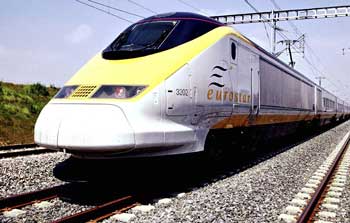
Eurostar takes you seamlessly from city center to city center within Belgium, France and the UK, as well as provides connecting services to more than 100 destinations. Business Premier class, which is the highest level of service, offers reclining seats and power outlets at each seat giving business passengers the freedom to work in comfortable surroundings. It also offers a choice of full service “at-seat” dining with champagne and wine and an “Express Breakfast” option. All 1st class cars for Leisure passengers offer comfortable seating, complimentary magazines/newspapers and the “at-seat” dining includes wine and hot and cold refreshments.
Regional trains are not high-speed trains and make more stops at more stations along the journey. At least one regional train journey is advisable, especially for the first time leisure traveler; it is a very real experience and has a certain air of romance to it. Buffet cars are available on most regional trains and offer sandwiches or hot and cold snacks.
Let’s say I wanted to fly to Frankfort and then travel by train to Passau and on to Vienna. What kind of travel times and service for this route would I find on your new website? You can choose a train which connects in Wein (Vienna) or choose the fastest train which is direct from Passau to Vienna – see example below:
TRAIN 21Fastest
10:33AM Passau Hbf, Germany
1:22PM Wien Westbahnhof, Austria
2 hr 49 min
I’ve heard there are a number of “Scenic Trains” available for shorter, fun excursions. Which ones are most popular and why? One very popular scenic train is The Glacier Express that connects the world-famous resorts of St. Moritz and Zermatt. Rail Europe offers a Glacier Express Tour which includes a Swiss Card with three transfers of rail travel, two nights accommodation in 3-star hotels (w/breakfast) and one night each in Zermatt and St. Moritz.
RAILTEAM AFFORDS ‘SEAMLESS’ TRAVEL
According to Buhr, Railteam (www.railteam.eu), a new venture, will make traveling on the European rail network easier and more seamless. Buhr says it will help “shrink Europe.”
It is a collaboration between Europe’s leading high-speed rail operators, currently DB (Germany), SNCF (France), Eurostar UK LTD (UK), NS Hispeed (Netherlands), ÖBB (Austria), SBB (Switzerland) and SNCB (Belgium), as well as their high-speed subsidiaries Thalys, Lyria and the DB/SNCF cooperation between France and Germany, with more train operators possibly joining in the future.
Access to the Railteam network is easy with interconnections at city center stations and Ffst local transfer services to and from departure points.
Unlike airports, when you travel with Railteam there are no lengthy boarding procedures, which means no lines. Swiftly on-board and settled in your reserved seat, travelers are able to work on their laptops, read, eat or relax.
Buhr also says that the European Union supplies large amounts of money to help the high-speed rail infrastructure budget for Europe, which allows more construction of new trackage and rail facilities throughout the continent.
Buhr is interested in hearing from passengers about how the new Rail Europe website works for them.
Fred Buhr, Vice President eBusiness, Rail Europe
Fred Buhr began his career with Rail Europe in 2000 to start up EuroVacations.com, the online one-stop shop for European vacation packages. In 2003 he became Rail Europe’s Director of Online Marketing, where he initiated the SEM and SEO strategies to grow market share. He currently holds the position of Vice President eBusiness and is in charge of eCommerce and online marketing. Fred was involved in leading a project dedicated to creating the newest version of the company’s website, RailEurope.com. He has extensive experience in the online travel industry and was responsible along with a business partner for creating one of the first full-service online agencies in Europe. Educated in Strasbourg, France, Fred also attended the Paris Business School where he earned a degree in International Business Relations.
Samina Sabir was educated in Ireland, and began her career in the retail/fashion industry. She joined Rail Europe in 1993, working in the Sales Department dealing specifically with Rail Europe National Accounts. In 2008 she became public relations manager for Rail Europ
The capital of the kingdom, yes kingdom, of Belgium–Brussels–is located pretty much in the center of Belgium, south of Antwerp. Brussels is a cosmopolitan city of more than 2 million people (total area) that loves food.
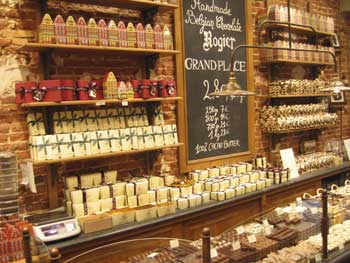
Known for its Grand-Place/Grote Markt with its filigree stonework, the city is fashionable, upscale and village-like all at the same time. Did I mention beer? It’s said Brussels offers 2,000 kinds of beer. Then there’s the food, and the chocolates.
Let’s take a tour through Brussels, using some of the internet sites available:
Both public and private transport are highly developed in the Brussels area, with a network of high-quality roads, airline routes and inland waterways. • Your arrival in Brussels–ways of entering the Brussels-Capital Region • Moving around Brussels–means of traveling, using public transport, on foot, by bicycle, by car, by motorbike, by air, etc. • Finding your way around Brussels–which are the best maps of the city available on the Net.
Brussels is served by Brussels Airport, located in the nearby Flemish municipality of Zaventem, and by the much smaller so-called Brussels South Charleroi Airport, located near Charleroi (Wallonia), some 50 km (30 mi) from Brussels. Brussels is also served by direct high-speed rail links to London by the Eurostar train via the Channel Tunnel (1hr 51 min); to Amsterdam; Paris and Cologne by the Thalys; and to Cologne and Frankfurt by the German ICE (Inter-City Express trains).
The Brussels metro dates back to 1976, but underground lines known as premetro have been serviced by tramways since 1968. A comprehensive bus and tram network also covers the city. Brussels also has its own port on the Willebroek Canal located in the northwest of the city.
An interticketing system means that a STIB/MIVB ticket holder can use the train or long-distance buses inside the city. The commuter services operated by De Lijn, TEC and SNCB/NMBS in the next few years will be augmented by a metropolitan RER rail network around Brussels.
Since 2003 Brussels has had a car-sharing service operated by the Bremen Company Cambio in partnership with STIB/MIVB and local ridesharing company taxi stop. In 2006 shared bicycles were also introduced.
Brussels contains more than 80 museums, including the Museum of Modern Art, and the Royal Museums of Fine Arts of Belgium. The museum has an extensive collection of various painters such as the Flemish painters such as Brueghel, Rogier van der Weyden, Robert Campin, Anthony van Dyck and Jacob Jordaens. Brussel’s museums cover areas such as art, technology, industry, science, folklore, literature, history and many other subjects, each presenting a different face of Brussels. They are astounding in the wealth of their collections and the new perspective they offer of cultures from all over the world.
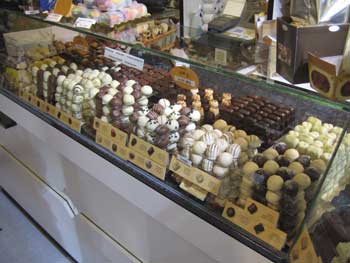
FOODS Brussels is known for its local waffles, its chocolate, its French fries and its numerous types of beers. The Brussels sprout was first cultivated in Brussels, hence the name.
Brussel’s gastronomic offerings include approximately 1,800 restaurants with very good food and atmosphere. Connoisseurs consider Belgian cuisine among the best in Europe. In addition to traditional restaurants, there is an overwhelming number of cafes and bistros and the usual range of international fast food chains. The cafes are similar to bars that offer beers and small dishes. Also widespread are so-called brasseries that offer a large number of beers and typical national foods.
Belgian cuisine is characterized by the combination of French cuisine with more hearty Flemish recipes. Culinary specialties include Brussel’s waffles (Gaufres) and mussels (usually served with “Moules frites”–French fries). The city is a stronghold of chocolate and praline manufacturers, with traditional companies like Godiva, Neuhaus and Leonidas. In addition, the Belgian beer enjoys a good reputation—Hoegaarden, Leffe, Duvel, Jupiler, Stella Artois and Kriek (cherry beer) are all examples.
Brussels has become a significant center for international institutions, notably those of the European Union. The city also plays host to the headquarters of the North Atlantic Treaty Organization (NATO) which is based in the city, along with 1,000 other international organizations and 2,000 international corporations. Brussels is third in the number of international conferences it hosts and is one of the largest convention centers in the world. The presence of the EU and other international bodies means there are more ambassadors and journalists in Brussels than Washington D.C. International schools have also been established to serve this presence.








 European Traveler