York, UK: A Medieval City Ringed With Walls and Featuring Hidden Gems

By Don Heimburger
Photos by the author and courtesy York Tourism

While London plays a key role in tourism in the United Kingdom, there are other cities in the U.K. that, while perhaps not as large in size or offering as many attractions, still rank high on the thrill meter.

One of these is York, which is worth a couple of days to explore and get to know. It’s accessible from Manchester Airport, an international hub that sees hundreds of flights each day from around the world. By train from the airport, York is about an hour’s ride.

Let’s take a tour of the walled city of York.

“I was born in York and grew up there,” says actor Judi Dench, “so I have a great fondness for this remarkable city with its winding, cobbled streets and beautiful architecture.”

“The city has evolved over the years, with…a wealth of interesting shops and a vibrant cafe and evening culture,” she continues.

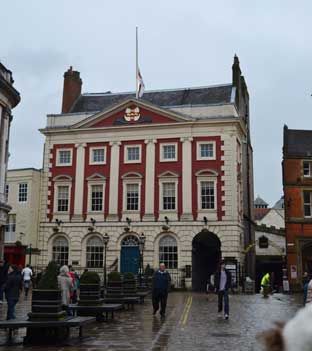
In the 18th century, York was seen by the monied class as an attractive alternative to London, and today many Georgian townhouses and buildings can be seen in the town because of this. At Fairfax House, for example, you can see what’s called the most distinguished 18th century townhouse in Britain.

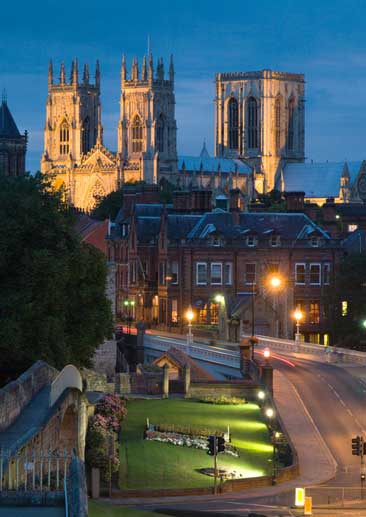
Likely the first thing to grab your attention in York is the Minster, renowned around the world as the largest medieval gothic cathedral in northern Europe. Taking 250 years to build, it dominates the city, with its central tower rising 200 feet skyward. “…That first glimpse of the magnificent Minster towering above the city will never cease to inspire and move me,” states Dench.

The cathedral, 500 feet in length and 100 feet wide, has the largest concentration of medieval stained glass in Britain. While there, you can also visit the undercroft, treasury and crypts. The church’s collections, open to the public, are a rich time capsule of the Minster’s history. The collection consists of silver, textiles, furnishings, monuments, stone and glass objects.

(left) Roman ruins underneath York’s business district

WALK THE WALLS
“Walking the walls” is a favorite thing for visitors to do. Since Roman times, these walls have helped defend the city, and now add interest as an attraction. Four main gatehouses, or bars—Monk, Bootham, Micklegate and Walmgate—were once used to extract tolls and act as defensive towers. There are a little more than two miles of walls around the city.

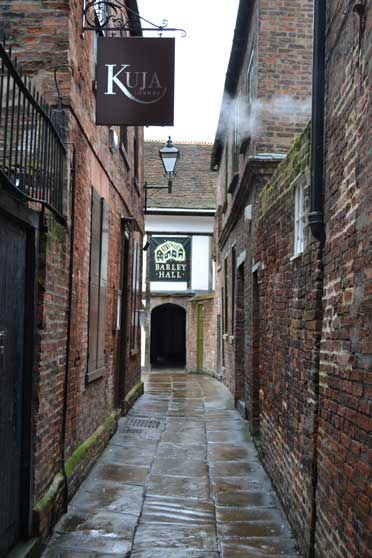
A odd thing about York are the snickelways and ginnels, or passages, some quite narrow and obscure. These short cuts conveniently connect sections of the town, and can save a lot of walking. After a day in York, I started using the snickelways like I was a resident.

The main shopping area is traffic-free, meaning the erratic streets are quiet and pleasant to stroll around, day and night. The medieval streets and buildings are beautifully preserved, especially 2,000-year-old Stonegate and Petergate streets, York’s main shopping arteries. These two streets were used by the Romans, leading to a massive Roman headquarters structure which is now occupied by the Minster.

SHAMBLES STREET
Visitors will enjoy reading the names of streets as they wind through the city. Mad Alice Lane, Grape Lane, Swinegate and Coffee Yard all can be found here, as can Shambles, a former street for butchers: you can still see the wide windowsills used by butchers to display their goods, and in some cases the meat hooks remain above the shop windows, as well.

If you like chocolate—and who doesn’t—York might surprise you. It’s been making the delicious treat now for 150 years, and was named Britain’s Home of Chocolate in 2012. It even has a Chocolate Trail that will take you into York’s Chocolate Story shop and museum, where you can mold and decorate your own chocolate bar, York’s Cocoa House where you can enjoy a cup of hot chocolate and Monk Bar Chocolatiers who hand make every blissful piece. Also, the York Kit Kat factory, one of the largest in the world, turns out six million chocolate bars every day.

The Treasurer’s House, which claims the most haunted cellar in York, is worth a visit to hear about royal visits, servant life and see four centuries of interiors and antiques. When the garden is open, you can also enjoy home-cooked meals here as well.

CLIFFORD’S TOWER
While most of York was the result of Roman and Viking construction, the original mound of Clifford’s Tower, with a timber structure at the top, was constructed by the Norman William the Conqueror in 1068 as a statement of his power over the region. The tower is 50 feet tall and 200 feet in diameter with four overlapping circles, resembling a four-leafed clover. The design pattern was unique in England and after being decimated by fire, wind and even water (the castle sunk into the moat causing the walls to crack in the 1350s) the castle’s jailer began demolishing the tower and selling the stone himself.

Clifford’s Tower

For those with a technical interest, the National Railway Museum near the railway station is a must, and it’s free. Here is the largest railway museum in the world, boasting a host of record-breakers and history makers, attracting 800,000 visitors annually.

National Railway Museum

It is home to a wide range of railway icons and literally millions of artifacts, from the opulent Royal trains to the record-breaking Mallard. Many of the museum’s collection of more than 300 locomotives and pieces of rolling stock are displayed in the Great Hall. Some of the featured pieces include the Flying Scotsman, famous for being the first steam engine to travel at 100 mph, and the collection of royal trains, including the royal carriages used by Queen Victoria to those used today by Queen Elizabeth II.

Permanent displays in the museum include “Palaces on Wheels.” Based in the Station Hall, this exhibition features royal saloons dating to the Victorian era, giving visitors a glimpse into the sumptuous bedrooms, dining rooms and day saloons that were palaces on wheels.

At York’s Art galley, you can view more than 600 years of British and European art, from 14th century Italian panels to 17th century Dutch masterpieces to Victorian narrative paintings.

Also, the Yorkshire Museum houses some of the finest collections of archaeological and geological treasures in Europe, from prehistoric to medieval times. You can also walk on a Roman mosaic floor or kneel at St. William’s medieval shrine while here. This museum features new, interactive galleries and audio-visual shows.

Yorkshire Museum objects

As the locals like to say, York has many “tucked-away” attractions, including museums, bars and restaurants, interesting shops, peculiar old signs, strange stone figures, gateways and medieval battlements.

York is a fun, history-filled city, with numerous attractions that will interest nearly every age group.

WHERE TO STAY IN YORK
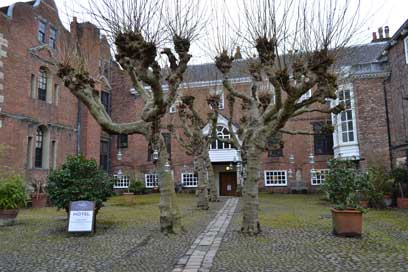
Grays Court in York near the Minster, is probably the oldest continuously occupied house in Britain, and as such, is a special place to stay, if you get the chance. It is built on the site of a Roman legionary fortress.

The staff is small and will likely remember your name after you’ve registered for the night. Grays Court is a family-owned and run country house with seven bedrooms, all filled with antique and contemporary furniture, and you’ll find the atmosphere around Grays Court quiet and friendly. A protected lawn and garden face the rear of the house, and the common areas invite you to wander throughout the house and get to know it.

Grays Court was once owned by the Duke of Somerset, Queen Jane Seymour’s brother, and was visited by King James 1st, James 2nd and the Duke of Cumberland. Sir Thomas Fairfax, Archbishop Robert Holgate and Archbishop Thomas Young have also lived here.

At one time the house was the original Treasurer’s House, commissioned by the first Norman Archbishop of York Minster, Thomas of Bayeux (1070-1100).

James I dined once at Grays Court with Edmond, Lord Sheffield, the Lord President of the North, and knighted eight nobleman in the house’s Long Gallery one evening.

Guests will find breakfast is served in a large open room with good views of the garden, and the wait staff is pleasant and accommodating. In the evening you can curl up on one of the large comfy sofas with a book and a glass of wine in the Long Gallery, or try the quiet Library to relax in.

Located on Chapter House Street, York. www.grayscourtyork.com.

For more information about the city of York, go to www.visityork.org.

Turkey’s Wild and Rugged Black Sea Coast

Turkey’s Wild and Rugged Black Sea Coast

Photos courtesy the Turkish Tourist and Culture Office of New York

Encompassing much of the country’s northern boundary and isolated by the rugged Kackar mountains, the narrow coastal Black Sea region of Turkey is well off the beaten path of many international travelers but treasured by those who discover its unique charms.

In addition to fascinating reminders of Turkey’s extraordinary history, the region is renowned for its magnificent coastline, scenic seaside and hilltop towns, World Heritage sites, lakes, national parks and some of the wildest natural landscapes in the country that draw intrepid trekkers, climbers and mountaineers from all over.
 
It should not be surprising that the Black Sea’s history was shaped by the nations that ruled the seas. Ancient Greece, the Roman Empire, the Byzantine Empire, Genoese, the Venetians and, until the early 20th century and afterwards Ottoman Empire, all put their cultural imprint on the region. They left behind castles overlooking the sea, churches, monasteries and mosques and distinctive architecture – much still intact or lovingly restored.

Today, visiting Turkey’s Black Sea by cruise ship (a number of lines based in North America offer itineraries that include one or two Turkish Black Sea ports) is one option, but for a more in-depth experience, travelers are advised to fly to Samsun or Trabzon, two of the larger towns, from Istanbul or Ankara, and rent a car or four-wheel drive vehicle. Comfortable and friendly accommodations are plentiful except in some of the more remote mountain villages. 
 
Though the coastal areas are blessed with moderate temperatures year-round, weather in the mountainous interior can be colder, therefore spring time is the most popular season for exploring the mountains.
 
Traveling from west to east through the Black Sea region, you might begin in Bolu. From coastal beaches to its famous multi-colored forests of oak, alder, pine, hazelnut and many more varieties of trees, visitors can virtually travel through all four seasons of the year within the course of a short drive. Yedigoller or Seven Lakes National Park is the centerpiece, but explorers will also discover hot springs, hiking and walking opportunities and, in winter, one of Turkey’s best ski centers.
 
As early as the 6th century BC, the coastal town of Amasra went by the name of Sesamus, and today offers a number of historic attractions, including 14th century Genoese forts, a Roman bridge, Byzantine city walls and historic mosques. Nearby, along the sea, the fishing villages of Cide and Abana are popular excursions, particularly known for their seaside restaurants.

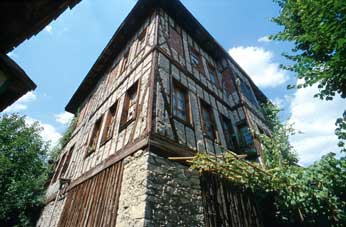
Just inland from Amasra is one of the region’s best known attractions: Safranbolu. Its beautifully preserved and restored buildings from the Ottoman Empire, including konaks, or mansions distinctively made of timber and stone, have earned the town a World Heritage Site designation. Other reasons to visit include the Koprulu Mehmet Pasa Mosque and the Kazdagi Mosque, Turkish baths, Shoemakers Street (the town once supplied the Turkish army with shoes) and the scenic Market Street.
 
Also inland is the town of Kastamonu, with its 12th century castle, ethnographic and archaeology museums, and famous handicrafts, including fabrics, tablecloths, woolens and fruit jams. The expansive pastures in the vicinity offer some of the best trail riding in Turkey, and nearby Ilgaz Mountain National Park is noted for its deer, foxes and bear as well as culinary traditions that include whole lamb cooked slowly in clay ovens.
 
Back on the Black Sea coast, the town of Samsun is where Mustafa Kemal Ataturk drew plans for what became the modern Turkish Republic; the hotel where he stayed became the Gazi Museum. Samsun also offers an Archaeological and Ethnologic Museum, with an impressive collection of antiquities, and not far away, at Bafra, are excavations dating back to the Hittite Iron Age civilization. The thermal springs of Havza, approximately 50 miles away, are another popular day trip.
 
Continuing eastward, Trabzon is the largest city in the region and a cruise port dating back to 7,000 B.C. It remains a major trading port, evolving from an early Greek colony to an important cultural center on the busy Black Sea. Under the Venetians, the town became an important feature of the famous Silk Route before the rule of Ottomans in 1461. Today visitors will find historic churches and mosques as well as other landmarks, including a villa belonging to Ataturk on the town’s periphery. Built by Maneul I in the 13th century, Ayasofia Church sits on top of a hill in the center of the city; the origins of the Church of Saint Eugenios, now the Yeni Cuma Mosque, are lost in time.
 
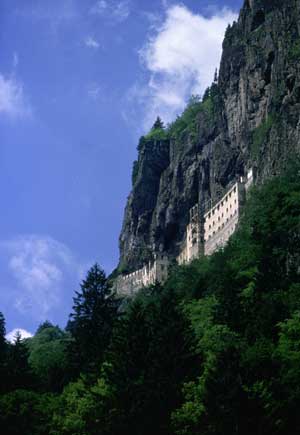
Just inland from Trabzon is the Sumela Monastery, a true treasure of the Black Sea region. Begun in the 4th century by the Greek monks, Barnabas and Sophronius, and built high into the cliffs of Mt. Mela, the monastery has been restored and rebuilt over the centuries.
 
Not far away, the alpine region of Zigana in the Kalkanli Mountains is renowned for its natural beauty and popular for day trips. The 3,200-feet high alpine lake at Uzungol is popular among campers, hikers and fishermen, who prize the lake’s trout. Even more rugged is the Yusufeli designated conservation area inland from the Georgian border. This remote area of lakes and historic Georgian and Armenian churches offers white water rafting as well as ecotours on the famous Coruh River.
 
Offering more cultural comforts is the nearby town of Artvin, which is famous throughout Turkey for its many festivals celebrating regional cultures and featuring music, food, costumes, dancing and other traditional celebrations. The most popular is the Bull Fighting Festival. Visitors will also find other picturesque rural villages in the area as well as the Karagol-Sahara National Park, which is noted for its forests and lakes.
 
Visitors to the region will also discover unique culinary traditions such as Black Sea cuisine, including the roots of the world-famous Turkish tea. Strongly influenced by geography and climate, mountains and sea, food featured in this region includes the black anchovy, or “hamsi,” corn served in endlessly interesting ways, pickled green beans, an abundance of other vegetables and Akcabat Kofte (meatballs). Sweet helva, made with corn, butter and local honey, is another local favorite, as are a great variety of Black Sea and river fish (including farm-raised trout), considered by many to be the tastiest in the world.
 
The Turkish tea industry is based in the town of Rize, where a moist, moderate climate provides perfect growing conditions. While green tea is exported all over the world, travelers should be prepared to enjoy the local favorite, the strong, smoky black variety that, traditionally served with sugar, is as much a social event as it is a beverage. But tea is not the only appeal of Rize and its surroundings. Not far away are the dramatic Kackar Mountains, with their waterfalls, highlands and peaks – magnets for hikers and climbers. Glacial lakes are adorned with yellow rhododendrons, found nowhere else in Turkey at these altitudes, and Mt. Kackar itself, one of the world’s ecological treasures, is home to bears, wolves, lynxes and mountain goats.
 
For more information on Turkey and its Black Sea region, contact the Turkish Culture and Tourist Offices in New York at (212) 687-2194; Washington, D.C. at (202) 612-6800; and Los Angeles at (323) 937-8066. Information is also available at www.tourismturkey.org.

Castles, Christmas Markets and Cruising

By Marilyn Heimburger
Photos by Don Heimburger

Taking a river cruise is always a good idea. A river cruise that includes both historic castles and colorful Christmas Markets along Germany’s Rhine River is the best idea ever. So on Thanksgiving Day I happily ignored Black Friday and escaped the pre-Christmas shopping frenzy of the USA to spend a week on the AmaKristina, cruising from Amsterdam to Basel, Switzerland. Romantic castles and Christmas Markets along the Rhine River ushered in the Christmas spirit for me this year.

The newest AMA ship, the AmaKristina

The AmaKristina is essentially a floating luxury hotel for 158 guests. Our roomy cabin had a queen-sized bed, private bathroom with shower and double sink, desk, large format Apple screen and keyboard for internet, TV, or movies. Built in 2017, the ship’s hallways and guest suites were filled with Gustav Klimt art prints, and seasonally decorated with lights, Christmas trees, wreaths, garlands, and gingerbread houses. We boarded in Amsterdam, unpacked, and had our first dinner on board. Open seating at each meal encourages mingling of guests.

AMSTERDAM ATTRACTIONS
Fortified with a sumptuous on-board breakfast buffet, including an omelet station and daily vitamin “shot,” we departed the ship for an informative canal cruise, a panoramic city bus tour of Amsterdam with an up-close look at a local working windmill, and free time for exploring. Although there were no Christmas markets in Amsterdam, there were plenty of opportunities for shopping near the central train station, and street entertainment in Dam Square: a saxophone player, giant bubble maker, dancing dinosaurs, and impromptu yoga. Just be sure to watch out for the numerous killer bicycles that demand the right-of-way.

The AmaKristina set sail from Amsterdam in the afternoon, and I had time to explore the ship’s main lounge and bar, massage and hair salon, fitness room, gift shop, and even a heated pool and giant chess set on the sun deck. A cruise overview presented by our cruise director, plus Christmas tree decorating and an evening classical music performance by the three talented string players known as “La Strada” kept passengers entertained. The cruise ships cleverly bring nightly entertainment on and off the ship when stopped at the locks on the river.

Onboard entertainment by La Strada

COLORFUL COLOGNE
After cruising all morning, we docked in Cologne, Germany, where shuttle buses brought us to our first Christmas Market in Cathedral Square. Although the earliest Christmas Markets in Germany date from the late Middle Ages, the one in the shadow of Cologne’s impressive Cathedral is a relative newcomer, opening in 1995. Under a dazzling canopy of thousands of tiny lights, 150 vendor huts with bright red awnings and brilliant multi-faceted stars displayed handicrafts, comfort foods, gifts of all types, decorations, wooden toys and much more.

Canopy of Christmas lights in Cologne’s Cathedral Square

Cologne Cathedral Square market

HOME OF THE ELVES
A few blocks away in the Altstadt and Heumarkt was an older and much larger Christmas Market called the “Heimat der Heinzel” or Home of the Elves. These were little creatures from a Cologne legend who used to do all the housework until they were annoyed by an inquisitive housewife, and disappeared. I loved this market. Aisles were arranged by theme, and the large wooden huts had Old World, wood-carved details, thick green garlands and costumed vendors. Little “Heinzelmännchen” rode in gondolas above an expansive ice rink. Each souvenir mug of Glühwein (the traditional hot mulled wine so popular at the Christmas Markets) had a different elf pictured on one side, and his particular work specialty described in verse on the other. Cologne boasted three additional smaller markets, but time was too short to visit all of them on this trip.

Home of the Elves’ Market in Cologne

CASTLE DAY ON THE RIVER
The morning cruise from Cologne to the next stop in Rüdesheim passed through the UNESCO World Heritage Rhine Gorge. What a treat to sit in the ship’s expansive lounge with panoramic windows, coffee in hand, gazing at vineyard- covered slopes, picturesque villages, historic castles, and the famous Lorelei Rock, with commentary by the cruise director. This romantic part of the trip alone is a highlight of any Rhine River cruise.

RÜDESHEIM’S CHRISTMAS MARKET OF THE NATIONS
After a gourmet lunch of traditional German specialties, we docked in Rüdesheim, where the “Christmas Market of the Nations” wound up and down the narrow streets of this wine town of about 7,000 citizens. Vendors from France sold mushrooms, lavender and cheese, Tunesia vendors brought wares made of olive wood, smoked salmon came from Norway, furs came from Finland and even the United States was represented with a local vendor offering homemade cookies, Dr. Pepper, Fanta, marshmallows, and Hershey’s chocolate. Christmas choir music piped throughout the market added to the festive atmosphere as shoppers strolled past inviting vendor stalls and village shops. A new discovery at this market was hot mulled Glühbier from Belgium.

(clockwise) Hot lunch in Rüdesheim; Fur from Finland at Rüdesheim’s Christmas Market of the Nations; “Hallo” from the gnomes in Rüdesheim; Placing a phone call to the Christkind in Speyer

Throughout the ship’s seven-day cruise, each day’s program offered passengers quiet, regular and active excursions. Rüdesheim excursions offered by the AMAKristina included wine tasting, a hike, bike or gondola tour through the vineyards. A late night, fun option was experiencing Rüdesheimer coffee – coffee set on fire with Asbach brandy and sugar, topped with whipped cream and chocolate flakes – at Eiscafe Engel on Rüdesheim’s famous Drosselgasse.

Rüdesheimer coffee
Atmospheric narrow Rüdesheim street

THE IMPERIAL CITY OF SPEYER
By noon the next day we docked in Mannheim and could choose a bus excursion to Heidelberg or to Speyer. Having visited Heidelberg several times already, we chose to see the 2,000-year-old Imperial city of Speyer. Here the Christmas Market extended down Maximilianstrasse from the UNESCO World Heritage Speyer Cathedral, the largest Romanesque cathedral in the world. Though smaller than the Cologne Christmas Markets, Speyer’s market had all the requisite comfort foods: Glühwein, grilled sausages, roasted almonds, and even waffles, potato soup and dumplings. Vendors offered wood handicrafts, colorful candles, jewelry, scarves, kitchen gadgets and unique cookie cutters. Especially for children were an ice rink, kiddie car rides and a telephone booth with direct access to the Christkind in Heaven!

Back onboard the AmaKristina we had a tea time treat of traditional Spekulatius cookies and Stollen, while we set sail for our next stop: Strasbourg and Le Petite Alsace in France.

INVITING STRASBOURG AND LE PETITE ALSACE
As with each stop on our route, AmaWaterways provided an energetic and knowledgable guide for a walking tour of the area on the way to the Christmas Markets. This morning we learned about the Alsace region, which changed hands between France and Germany four times in 75 years. The name “Alsace” derives from a German phrase meaning “seated on the Ill.” While our guide led us along the Ill River, past the beautiful half-timbered houses lining both sides, she explained that this charming area was historically the least desirable place to live. It had been the site of fortifications and a prison, the home of executioners and the location of the tanning trade, with its smelly byproducts. Today it is a photographic highlight of any trip.

CHRISTMAS MARKETS WITH A FRENCH TWIST
Christmas Markets first appeared in Strasbourg in 1570, making this German/French town the location of one of the oldest markets in Europe. Although much was similar to the Christmas Markets we saw in Germany, here the food vendors offered toasted baguettes topped with cheese as the warm comfort food, instead of the ubiquitous wursts in the German markets.

The traditional market was near the cathedral, with some vendor huts topped with storks, that famously nest in Strasbourg’s Parc de l’Orangerie. More than 300 vendor chalets filled the historic city center. Entertaining metal sculptures depicting different professions caught my eye, as did the detailed, intricately carved figures for nativity sets. A market area featuring Strasbourg’s service organizations surrounded a towering decorated Christmas tree and grassy area which was perfect for family photos. A small market in Gutenberg Square annually invites vendors from other countries: this year it welcomed Iceland.

Try some gingerbread in Gengenbach

GENGENBACH’S GIGANTIC ADVENT CALENDAR
We were back on the German side of the Rhine River by late afternoon, and on a shuttle bus from the AmaKristina to the beautiful village of Gengenbach. A guided tour down Engelgasse led to the Christmas Market which stretched down the main street from the town hall square.

Gengenbach Town Hall Advent Calendar

Gengenbach boasts the world’s largest Advent calendar in its neo-classical town hall, where each night one of its 24 windows is opened to reveal a picture by a famous artist. This year’s calendar featured paintings by Andy Warhol. We arrived just in time for the first night’s opening ceremony: a narrated short skit performed by children from the town. After browsing through the market’s matching vendor huts, with hot Glühwein in a mug depicting the town hall Advent calendar, we returned to the ship to be delightfully entertained by a French cabaret singer and her accordion accompanist.

LAST FULL DAY ONBOARD
Shuttle busses from the AmaKristina were the order of the day with options to Riquewihr, France, or to Freiburg and Breisach, Germany. Deciding to aim for German-speaking vendors, we took the second option, and explored the market in the heart of Freiburg’s beautiful old quarter. Traditional craft products, including glass blowing and colorful wooden toys were offered beneath the green and white lights that trimmed the roofs of the more than 130 vendor huts.

Time was too short to see all of the ceramics, candles, hand puppets, amber jewelry and Christmas decorations, but we enjoyed a quick wurst and Glühwein lunch before leaving for Breisach. Unfortunately this town’s tiny Christmas Market was not yet open for business, so after strolling down the pedestrian-only shopping zone, we walked back to the boat dock, to sail to Basel and enjoy the captain’s farewell dinner and our final evening on board.

Early the next morning, with our luggage packed with Christmas Market treasures, we left for home filled with Christmas spirit and with wonderful memories from this romantic river cruise of Christmas Markets and Castles on the Rhine.

TIPS AND FINAL NOTES
An AmaWaterways river cruise makes visiting so many sites along the Rhine extremely easy. You unpack only once in a roomy cabin. Meals are well-planned, complete and delicious, with perfect portions and special dietary options. Wine and beer are included with lunch and dinner. The fabulous coffee bar is open all the time. Special surprises delight passengers as well, such as serving a location’s specialty treats during afternoon tea time, recognizing St. Nicholas Tag by putting treats in passengers’ shoes left outside cabin doors, and providing hot towels and beverages upon re-boarding after cold excursions. The company will cheerfully arrange for your transfers to and from the cruise ship.

The cruise director is the key to having a wonderful time on any cruise, and this AmaWaterways trip had a great one. David Rosell was organized, energetic, accommodating and entertaining.

Most Christmas Markets are open from the beginning of Advent through Christmas, although some larger markets stay open longer, and some smaller ones have limited open hours. Bring euros – most small vendors don’t accept credit cards.

Pack warm layers of clothes, boots and umbrellas. The weather can be chilly and damp during November and December.

AmaWaterways provides a post-cruise option, if you want to extend your trip. This Christmas Market/Rhine River castle cruise offered an excursion to Lucerne and Zurich after disembarkation in Basel. For more AmaWaterways information and schedules, go to: www.amawaterways.com.

If you go: The Mövenpick Hotel Central in Amsterdam is a great place to stay before you board. This new, 4-star hotel is located within walking distance of the train station, the city center and the cruise ship loading docks. A sumptuous breakfast buffet is included with the room, and a knowledgable concierge team can help you plan your free time in Amsterdam before the cruise. For more information go to: www.movenpick.com/en/europe/netherlands/amsterdam.

Enjoying the Riverbanks of Burgundy

By Danielle Pruger
Photos courtesy Burgundy Tourism

Auxerre, France

Burgundy, France offers more than 600 miles of waterways, making it a perfect destination for sailors of all experience levels. There are many ways to enjoy the rivers of Burgundy – sailing, sightseeing, waterskiing and bicycling along the river are just to name a few.

FUN AND RELAXATION BY THE WATER
Visitors can relax on a sightseeing boat for a guided tour along the waters of the Burgundy Canal. The Seille, a river flowing between the French departments Tournus and Louhans, also offers cruising opportunities. Hotel barges are also a relaxing way to enjoy the Burgundy Canal.

The city of Clamecy and the medieval village of Cravant on the Nivernais Canal are great small towns to visit and explore. The little town of Semur-en-Auxois is few miles away from Burgundy and includes sights such as the Tour de l’Orle d’Or or the Collegiate Church of Notre-Dame. Large cities also have a lot to offer: the Dijon marina is a lively area with the Péniche Cancale, a boat converted into a floating gourmet bistro and cabaret that hosts concerts, exhibitions, dance performances and theatre.

Burgundy, the birthplace of pinot noir and chardonnay, is home to world-class vineyards that produce some of the most prestigious wines in the world. Visitors can taste some of the best wines of Burgundy at the cellars of the vineyards of Auxerrois, Tonnerrois, Maranges or Santenay.

WATER SPORTS
Water sports enthusiasts can choose other activities including water-skiing, sailing and rowing. The developed areas invite swimming in leisure centers in Auxerre or Decize. The tranquility of the waterway can be enjoyed by fishing on the region’s canals or lakes or by big game fishing on the Saône while accompanied by a qualified instructor.

OUTDOOR ACTIVITIES ALONG THE BANKS
The towpaths along the canals and rivers, open to cyclists, are perfect for biking. These paths are also great for enjoying a walk along the waterfront.

The region is full of marked trails so there are plenty of routes to choose from. The Tour of Burgundy by bike runs along the canals of Nivernais and Burgundy, as well as the Canal du Centre. These paths take visitors through the region’s most beautiful landscapes – across vineyards, groves and forests and pass by historic monuments and charming residences.

Pardone des mariniers in Saint-Jean de Losne

A region criss-crossed by waterways, every year Burgundy celebrates water with various events. Music, demonstrations, tournaments and tastings punctuate the shorelines all summer long. There are many events to choose from, including the Pardon des mariniers in Saint-Jean de Losne, the Fête du Flottage in Clamecy or the Halles en eaux in Decize.

For more info, go to Burgundy Tourism

Biking and Hiking Through Salzburg Lake District

By Danielle Pruger
Photos courtesy Austrian National Tourist Office

Lake Wolfgangsee

The Salzburg Lake District (Salzkammergut) is said to be one of the most charming regions in Austria: blue lakes, high mountains, green meadows and forests—a storybook landscape. The former emperor Franz Josef and his wife Sissi spent many holidays in this area and hence coined the term “Sommerfrische” (summer health resort).

Aristocracy was easily persuaded, and it was not long until half of Vienna passed the hot summer months in the “healthy” region of the Salzkammergut. The artist Gustav Klimt was yet another regular, spending time on the lakes and trying to capture this stunning natural scenery in his paintings. This area is also known as both a cycling and hiking paradise.

One way to experience this region is through self-guided tours through the company Bike Tours Direct. Trails are well-marked and well-maintained, and the terrain varies from flat lakeside trails to hilly meadows to outright mountains. The region is dotted with gorges, waterfalls and other natural wonders, but it’s also filled with culture and history—quaint villages, medieval towns and imperial villas where the Austrian emperors spent their summers.

The self-guided tour is seven nights long. Highlights of the tour include a bike tour of Lake Wolfgangsee, a train ride into Salzkammergut and a stay at the Hallstatt lake resort.

Although the tour is self-guided, van support is available for transfers and shuttles.

For more info, go to Bike Tours Direct