Castle-on-a-Lake in Northeastern Germany

Schweriner Schloss

By Tom Bross
Photos by the author

Travelers who like continental lake districts should set their sights on Mecklenburg-Lower Pomerania, Germany’s least densely populated federal state.

More than 1,000 lakes and ponds speckle the countryside terrain. Seven of those are right inside Schwerin’s municipal confines—plenty enough to give this Landeshaupstadt state capital (population 97,100) the appeal of curving shoreline pathways, footbridges, causeways, pleasure-boat docks and south-side Zippendorf’s sandy beach. To reach the city, take an InterCity Deutsche Bahn train from Hamburg, a 57-minute trip (check www.raileurope.com).

Get acquainted with the Schweriner See (biggest of the inner-city lakes) by way of a short Weisse Flotte cruise to Kaninchenwerder and Ziegelwerder, a pair of woodsy nature sanctuaries frequented by 100 species of birds. Even more central, crisscrossed by ferryboats, the oval-shaped Pfaffenteich features spouting fountains and a terrace café.

If this local water world doesn’t satisfy outdoor enthusiasts, you can hike-bike-paddle through the beechwood-forested Warnotal valley, 43 miles northbound toward coastal Rostock-Warnemünde via hidden-away riverside villages.
First though, one of Europe’s most flamboyantly spectacular castles, inspired by Grand Duke Friedrich Franz II, fairly shouts for attention. Its pentagonal bulk stands on a lake (the Burgsee), consciously imitating Château de Chambord in France’s Loire Valley. Rising from medieval fortress foundations on a mini-island accessed by ornamental bridges, ongoing construction and impulsive add-ons produced the neo-Renaissance, gilded-domed Schweriner Schloss, finally completed in 1857. End result, amidst terra-cotta trimmings: a splurge of pinnacles, belfries and 15 turrets. For dramatic impact, floodlights illuminate the ensemble during nighttime hours. Surely an extravagant setup for the state’s Landtag parliamentary offices.

PORTRAITS, PORCELAINS AND OLD MASTERS PAINTINGS
For visitors touring the premises, however, bureaucratic doings play second fiddle to the castle’s cultural finery. Not to be missed: galleries devoted to portraits covering 600 years of ancestral dukedom, plus important Mecklenburg landscape paintings. Also here: a lavish oak-paneled banquet hall, chapel and big-windowed orangerie. Inlaid-wood floor patterns and silk brocade wall hangings embellish the ducal throne room.

Watch for the Schloss museum’s displays of furniture, jewelry and weaponry, but especially its sizeable porcelain collection (Meissen, Sèvres, Fürstenberg). Relax in the rococo tea salon or stroll through the flowery Schlossgarten, accentuated by allegorical statues (www.schloss-schwerin.de).

Thanks to past acquisitions made by Mecklenburg Duke Christian Ludwig II and his son Friedrich, the state’s Staatliches Museum Kunstsammlung ranks high as an outstanding fine arts repository. Surrounded by linden groves on Werderstrasse’s northern edge of lakeside Alter Garten greenery, this cultural gem (built 1877-82) resembles a Grecian temple. Gallery-goers ponder Dutch-Flemish “Golden Age” materpieces (Rubens-Rembrandt-Hals-Breugel), but influential German works (Cranach the Elder-Caspar David Friedrich-Max Liebermann-Lovis Corinth) shouldn’t be ignored. Also prominent: Thomas Gainsborough’s full-length, 18th-century Queen Charlotte rendition and (surprise!) a comprehensive French array of dadaist-surrealist Marcel Duchamp canvases.

The Beaux-Arts Mecklenburgisches Staatstheater, another Alter Garten edifice, stages operatic-ballet-theatrical performances—and is “home hall” of the Mecklenburg Court Orchestra, established 448 years ago for eminence as Germany’s third-oldest symphony orchestra, after Dresden’s Staatskapelle and Leipzig’s Gewandhaus.

PANORAMIC VIEWS FROM THE CATHEDRAL TOWER
Schwerin’s cityscape emerged in remakably good shape from the economically skimpy GDR decades. So take in the architectural mix. Dom St. Maria und St. Johannes (on Bischofstrasse) exemplifies soaring early-Gothic north-German brick cathedrals. Climbing 219 spiral stairs to the tower rewards sightseers with terrific panoramics from a 320 foot altitude. Evocative tidbit: the 15th century golden cross crowning the steeple was salvaged from Wismar’s war-damaged (and, in 1990, GDR-dynamited) Marienkirche.

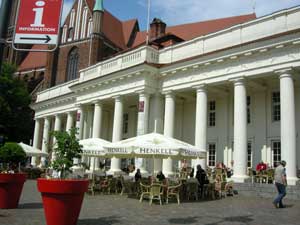
On the Marktplatz, you’ll see an unusual kind of Rathaus—basically Gothic but scrunched behind an English mock-Tudor façade. It stands near Schwerin’s 18th century Säulengebäude market hall, fronted by a dozen white Doric columns.
(right) Monument commemorating Henry the Lion, Duke of Saxony, founding father of Schwerin.

In 1707, a planned Schwerin Neustadt community named Schelfstadt came into existence. Narrow streets, clustered half-timbered Fachwerk houses, Baroque Nikolai Church and tidy kitchen gardens comprise a worthwhile visitor attraction. Same for this lakeside setting’s Freilichtmuseum Schwerin-Muess, recalling 18th-19th century rural folkways.

WHERE TO EAT, WHERE TO SLEEP
The Sorat organization converted a 1936 wheat warehouse into Speicher am Ziegelsee, where spacious guest rooms complement a 55-seat restaurant (www.speicher-hotel.de). Another Ziegelsee choice, Best Western’s Seehotel Frankenhorst, has boat dock, swimming pool and whirlpool-sauna amenities (www.seehotel.bestwestern.de).

Tops in town for deluxe ambience and Pffanteich vistas, Niederländischer Hof includes a wood-paneled library and mirrored restaurant (www.niederlaendischer-hof.de). Centrally situated Alt Schweriner Schankstuben is a budget category 16-room Gasthaus (www.alt-schweriner-schankstuben.de).

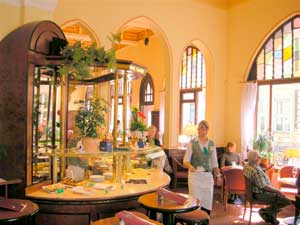
Among recommendable in-town dining options are upscale Weinhaus Uhle (www.weinhaus-uhle.de), beer-pouring Zum Stadtkrug Alstadt Brauhaus (www.altstadtbrauhaus.de), sophisticated Friedrichs, occupying a circa-1801 neoclassical mansion (www.restaurant-friedrichs.com) and ever popular Wallenstein, on a Schweriner See embankment, where patrons seated on the open-air pavilion are treated to views of the castle (www.restaurant-wallenstein.de). For a coffeehouse break, find elegant Café Prag, with sidewalk tables overlooking Schusterstrasse, and Röntgen on the Markplatz.

PLANNING YOUR TRIP
Tourist Information Schwerin (www.schwerin.com) is located longside the Rathaus. Or, go to the German National Tourist Office for answers (www.cometogermany.com).

Traveling Rail Europe’s ‘Little Lines’

German rail trains are fast and sleek.

By Don Heimburger
Photos by the author


One of my favorite things to do when planning a European trip by rail is to pull out my European rail route guide and investigate the towns and topography of the area through which I’ll be traveling.

Thus, when I recently organized a trip to Oberammergau, Germany from the Black Forest village of Villingen-Schwenningen, to visit the Passion Play theater and interview some of the play’s directors, I was delighted to see that I’d be changing trains at Pasing, a suburb of Munich, then heading south into the Alps. Pasing station is undergoing a major remodeling around the platform area, and it needs it. Hopefully by now the station is done and the passengers can more easily maneuver on the platform.

The schedule called for me to arrive Pasing at 11:20 a.m. on an Intercity Express from Ulm. Then a Regionalbahn train left at 11:39 a.m. for Murnau, which was slightly under an hour trip. At Murnau, I took the last leg of the trip to Oberammergau. End of story? Not quite, because the fun in travel is actually traveling, not going just from point A to point B.

WHAT THE FUN IS
The fun is waiting for the train, watching the other passengers and seeing what pulls up at the station when its your train. The fun is checking out the cars and seating arrangements, finding the diner and having a meal, or watching the scenery go by. And that’s where my research came in. I knew that the fun part of this trip—any train trip in Europe–is watching the scenery, and I was in for some spectacular scenery.

Not far out of Pasing I could tell the tracks were heading southwest, and towards the Alps. Actually, on a very clear day, you can see the Alps from Munich itself, but I hadn’t been able to see them when I flew in until the very last moment before we touched down. Now, however, it was a beautiful clear day, but it wasn’t until about Murnau that I could see the landscape starting to suggest something big was going to happen.

At Murnau the track split, with one line going to Garmisch-Partenkirchen and then onto Innsbruck: that would have been an awesome route to follow. The other line made a large loop, ending up in Oberammergau. Had the line been straight, the schedule for that segment of the trip would have been much less than the allotted 40 minutes. After Murnau, and a quick on-board lunch that I had packed, the track started to conform to the undulating hills.

Oberammergau Mayor Arno Nunn is in charge of the world-famous Passion Play 2010.
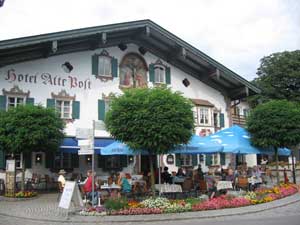
Sit back and relax with a cold beer under a tavern umbrella.

MOUNTAINS LOOM LARGER
We rolled further south, and there finally the mountains appeared and were growing bigger at every turn in the tracks. Our regional train, with a loud squeak for a horn, signaled for road crossings and little dirt paths that wound up into the foothills. Colorful mountain flowers along the way were welcoming enticements to follow the increasingly curvy path to my destination.

Small, interesting German villages, rich green forests, rolling meadows and the looming Alps were all reasons to continue the journey and discover what Oberammergau had in store. A word of caution: don’t step off at “Unterammergau” when you want to get off at Oberammergau. The town names, when you aren’t German and the conductor speaks fast, can be very similar!

At Obergrammergau the track abruptly ends at the station–there’s one track in–and it’s the same track out of the station. From there, you can walk into the center of town, or get a bus or cab. This little city, where the world-famous Passion Play is held every 10 years, is usually very active and touristy. But you feel like you’re in a “real” German town when you’re finally relaxing with a cold beer at a small tavern under the shade of an umbrella, and the Alps rise majestically above you. That’s living, that’s Germany, and trains will take you there. Next time, try the “small rail routes.”

For more information, go to www.raileurope.com and www.oberammergau.de or www.cometogermany.com.

Finding Luther in Wittenberg

500 years ago this reformer made history

By Don Heimburger
Photos by the author, Marilyn Heimburger and courtesy Pre-History Museum in Halle

Millions of visitors are expected to visit Wittenberg, Germany between now and 2017, when the 500th anniversary of the nailing of the 95 Theses by Martin Luther occurred.

The German state of Saxony-Anhalt is launching a giant campaign to publicize the anniversary and show off its Luther treasures to the world.

The kick-off event starts October 31 when the State Museum of Pre-History in Halle on the Saale River showcases numerous Luther archaeological artifacts that have recently been uncovered, mostly in Mansfeld, Luther’s childhood home, and Wittenberg at Luther House, where Luther taught.

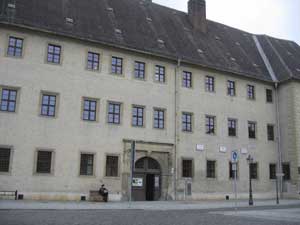
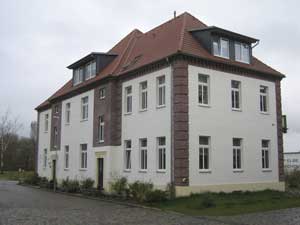
Luther House in Wittenberg

Entitled “Finding Luther—Archaeologists on the Reformer’s Trail,” the 4,000-square foot exhibit will be shown in the newly-restored Pre-History Museum.

“Except for his writings, the bulk of the reformer’s possessions got lost,” says Dr. Michael Schefzik, curator of the Museum. “On the other hand, the archaeological excavations in 2003 yielded hundreds of objects which certainly had belonged to the Luther family.”

LUTHER’S LIFE COMES INTO FOCUS

Only in the last several years, after research by various archaeologists, was it feasible to draw a picture of the life of the Luther family, especially in Mansfeld where the Luther family moved to in 1484, shortly after Luther was born.

“Historical truth and legends (about Luther) are almost inseparably intermingled with each other,” says Dr. Schefzik. Now, more is known and will be explained in this new exhibit.

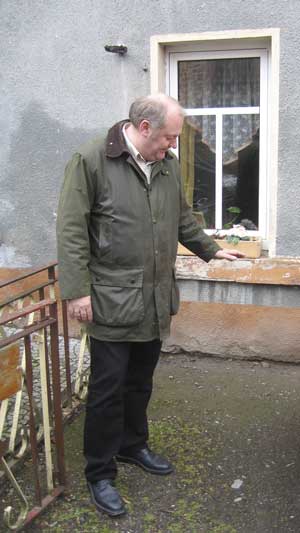
Dr. Schlenker indicates where first Luther artifacts were located in a parking area near Luther’s home

Some of the Luther exhibits visitors to the museum will find include:

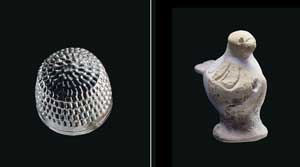
  • Luther’s childhood marbles? Archaeologists believe they found them—made of clay and probably heated over an open fire in the Lutherhaus in Mansfield.
  • Luther’s mother’s thimble (?) has been preserved and is beautifully made.
  • Heating stove tiles of several colors from Luther House in Wittenberg with pictures of Adam and Eve on them, as well as possibly Frederick the Wise, who befriended Luther.
  • Iron keys, padlocks, nails, large headdress pins, knives, belt buckles, chards of pottery, beads, garment accessories, jewelry, a beer tap, coins, fish and wild fowl bones and much more.

SURPRISES YET TO COME

In addition, the museum has a few exhibit surprises that only visitors there will get to see. Many more Luther objects, such as goblets and beakers, are on loan from other museums and estates that will be shown in the exhibit. Luther received the vessels from wealthy patrons and gave them to selected friends.

Don and Marilyn Heimburger with Wittenberg Mayor Eckhard Naumann

The new Luther finds have attracted National Geographic, which plans a comprehensive report on the news, as well as many German newspapers and other news agencies.

While in Wittenberg (Home of the Reformation), which you could make your home base for a few days as you tour the various surrounding Luther sights, you’ll want to see the Town and Castle churches, the Luther House, a UNESCO World Cultural heritage site, the Philipp Melanchthon house, the Market Square with the town hall built between 1523 and 1535, the Lucas Cranach houses (he owned several), and some of the town’s museums. The town, first documented in 1180, has a great many historical buildings.

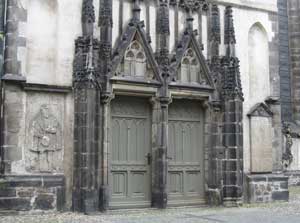
The Castle Church, with an 288-foot-high tower, was once the magnificent castle of the electors of Saxony, built between 1489 and 1525 for Frederick the Wise. It also became the university church, and it was here that Martin Luther nailed his 95 Theses to the door. Today a black bronze door (installed in 1858) has replaced the original one. The door commemorates October 31, 1517 when Luther nailed his theses “on the power of indulgences” to the door.

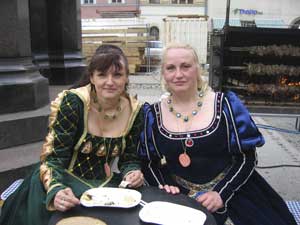
Medieval ladies add to Wittenberg’s Festival
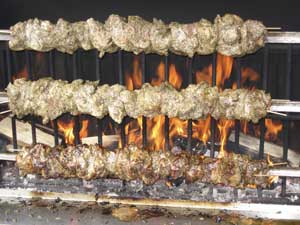
Meat sizzles on an open fire at Wittenberg town festival
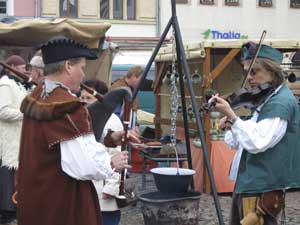
Musicians at Wittenberg festival

OLDEST CHURCH WORTH A VISIT

Wittenberg’s oldest church is the Town Church, the Town and Parish Church of St. Mary, set in the central square. The pulpit, at which Luther preached, can actually be found now at the Luther House. If you go, note the series of epitaphs by Lucas Cranach the Younger around the altar. They are from around 1560.

Other Wittenberg highlights include:

  • The multi-colored turreted high school designed by Friedensreich Hundertwasser
  • The Piesteritz residential housing complex on the west part of town, with some housing built as early as 1916, used to house factory workers
  • Museum of Town History, a collection of thousands of old historic Wittenberg documents and artifacts

For fun, visit the historical printing workshop in town and see how printing used to be done at the time Luther translated the Bible into German. You can even purchase a few humorous Luther quotes which have been printed at the shop.

WITTENBERG FESTIVALS

Hundertwasser School

Every year on the second weekend in June, thousands gather in the streets of this town for Luther’s Wedding, a town festival that includes medieval merrymaking with processions, strolling musicians and entertainers.

July and August brings the Wittenberg Summer of Culture which includes theater shows, courtyard concerts, a wine festival and “ErlebnisNacht” which features unexpected happenings at unexpected times in unexpected places in the old quarter.

Several hotels worth looking into are the Alte Canzley Hotel and Restaurant (www.alte-canzley.de), the Goldener Adler (www.goldeneradler-wittenberg.de) and the Luther-Hotel Wittenberg (www.luther-hotel-wittenberg.de). All are very close to all the attractions and the old town.

A newer hotel, across the Elbe River, is the Bruckenkopf Hotel, owned by the Schult family. Renate and Gehard Schult have invested heavily in the renovation of this sprawling military complex once used by the Kaiser’s Army and Napolean’s Army. There are 24 rooms in the brick fortress portion of the complex. The staff is friendly, and there is no noise except an occasional duck splashing in the nearby pond. The complex also provides rooms and cabins for boaters and bikers, tenters and motorhomes (www.marina-camp-elbe.de).

If you like good German food, a number of restaurants downtown can accommodate you. Nearly all hotels offer good food in their restaurants, but a favorite of the locals is the Schwarzer Baer, which is connected to a hotel (naturally) and Luther used to come in there to eat and drink, and it’s said he even slept there.

Wittenberg is best reached from Berlin’s Tegel Airport, and frequent ICE, ICE night and IC and EC trains stops in Wittenberg. For more Wittenberg information, go to www.wittenberg.de (e-mail: info@wittenberg-information.de). For individual town tours, contact English-speaking guides Bettina Brett at bettina.brett@arcor.de or Astrid Muehlmann at astrid.muehlmann@web.de. Both are veteran guides and are well-known locally.

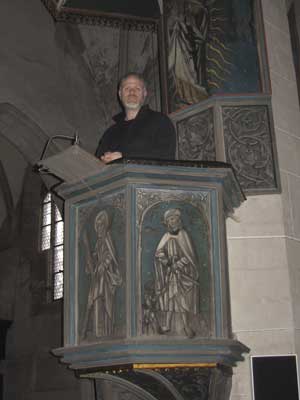
Reverend Scott Moore in the pulpit at Eisleben Church, where Luther was baptized.
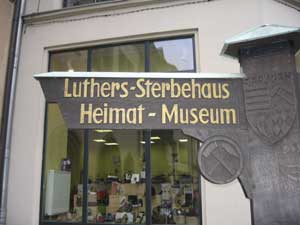
Luther Museum in Eisleben.

OTHER NEARBY CITIES

If you’re in Wittenberg, you really should take the time to visit some other nearby Luther sights and towns. They include the town of Eisleben, nestled in the hill country of the Mansfeld basin. It’s here that Luther was born (November 10, 1483) and baptized the next day in the Church of St. Peter and Paul. His home has been turned into a very interesting museum that documents his early childhood and youth and gives an insight into the spiritual environment in which Luther was raised.

On the hill overlooking Mansfeld, you can visit the Mansfeld Castle where Luther preached. In town is his parent’s large home, where they are now uncovering many Luther family artifacts.

In Torgau, the political center of the Reformation, you can visit the Hartenfels Palace Chapel, consecrated by Luther on October 5, 1544. It is regarded as the first church to be built as a Protestant church.

Luther studied theology and sciences in Erfurt between 1501-1505. In 1505 he requested acceptance into the Erfurt monastery, home to the Augustinian monks, an order known for its scholarship. In 1507 Luther was ordained as a priest

Regensburg: City of Wurst and 1,200 Historic Buildings

By Marilyn Heimburger
Photos by the author and Don Heimburger

The UNESCO World Heritage city of Regensburg, Germany, 90 minutes north of Munich, is more than 2,000 years old, and many of its buildings serve as a testament to its long history.

There’s plenty of reminders of this town’s heritage: located on the Danube, many tour ships dock here and unload visitors for a peek into this German treasure.

Even Mozart liked the city: Regensburg’s hospitality was commended as early as 1790 by Mozart who enjoyed “a sumptuous meal along with divine music” and praised the good wine.

Numerous Roman buildings, such as the Porto Praetorius–an old Roman town gate–can still be seen today. It was preserved because the Bishop’s beer garden was located on the site. An underground museum at Neupfarrplatz displays the history of the Romans and the Jewish community there until 1519.

NEUPFARRPLATZ IN JEWISH QUARTER
At the Neupfarrplatz, houses were built in the Jewish quarter over the old Roman fortress in the 8th century. These were destroyed in 1519 when the Jews were blamed for a downturn in the economy and were driven out.

In 1995 an excavation of the area was begun, and the ruins of the Jewish quarter were found, in addition to the Roman ruins.

Found in the excavation and on display in the underground museum were a second or third century statue of the Roman god Mercury; from the 15th century a statue of Aaron (Mose’s brother); and from 1520 an icon of the Virgin Mary. The museum is called Document Neupfarrplatz; if you walk down a flight of stairs, you can view a video showing the excavation finds. www.regensburg.de.

The city began as a Roman fortification (Castra Regina) in 179 AD by Roman Emperor Marcus Aurelius because it was the northernmost point on the Danube. When the Roman Empire fell, the Romans retreated. The fortress built there was not destroyed, and Bavarians then occupied it. It was the first capital of Bavaria; believe it or not, Munich is 1000 years younger!

Not much was damaged in the town during World War II as there wasn’t much industry in Regensburg, so there was nothing to bomb. Thus, the old buildings were preserved.

‘ITALY’S NORTHERNMOST CITY’
Rich merchants gained wealth from importing goods from far away lands. They built large homes with tall towers (a show of strength and wealth) after the style in Italy. Many of these are still standing in Regensburg; nearly 20 are still well preserved. The town is often called “Italy’s northernmost city” because of this.

One of the big Regensburg attractions is The Old Stone Bridge, built on 16 huge arches, which has been in continuous use for more than 800 years. Built between 1135 and 1146, the Stone Bridge enjoys the status of being a unique masterpiece of medieval engineering. It was for many centuries the only stone bridge spanning the Danube between Ulm and Vienna. It was not only a technological masterpiece of engineering, but of strategic importance in terms of transport and, as a result, of great commercial value.

Another town attraction is the Old Town Hall, where Roman Emperors used to summon princes, bishops and ambassadors to discuss the affairs of state. The Imperial Diet Chamber still contains the same furniture, including the benches that gave rise to the German expression “to put something on the long bench” (meaning to postpone it indefinitely).

‘HISTORIC LUNCH’
For a quick and tasty lunch, sit down near the Danube and enjoy hot, juicy sausages with kraut and bread in the “Historische Wurstkuchl,” the world’s oldest sausage kitchen. You can actually see them frying the sausages on the grill through a door that leads into the small kitchen. http://www.wurstkuchl.de

Regensburg is a city of churches. Focal points of early Christianity, its ecclesiastical buildings are majestic and typify early Christian architecture. Most famous is St. Peter’s Cathedral, inspired by the French Gothic style and built in the 13th century.

At waterside, Schifffahrt Klinger offers boat trips to many different sights such as the Walhalla, the German Hall of Fame containing busts of famous German personalities.

Regensburg`s remarkable buildings and towers offer an unspoiled look into the past; the wars of the 19th and 20th centuries left this Danubian community virtually unscathed.

The Regensburg Tourism Office is located at the old Rathaus, Rathausplatz 3, D-93047 in Regensburg. Fax is +49 941-507-1919 or e-mail to tourismus@regensburg.de.

For more information about Germany go to www.cometogermany.com.

Great German Beers

by Sharon Hudgins

Fifteen years of living in Germany convinced me that I was in beer-drinker’s heaven. Actually, I think it took only 15 minutes of intimate contact with my first mug of the local brew to convert me into a lifelong lover of “the national drink of Germany.”

I also discovered that Germans take their beer seriously. In 1516 the Dukes of Bavaria issued an edict in the city of Ingolstadt specifying that only water, barley and hops could be used in the brewing of beer.

Known as the Reinheitsgebot, or Purity Law, it was later amended to include processed yeasts (instead of wild yeasts from the air) and wheat (the only grain allowed besides barley). Still in effect, this early food safety law protects the integrity of German beers and insures the quality of the product. And today, German brewers of “organic beers” even go a step further, using only grains and hops that haven’t been treated with chemical pesticides and artificial fertilizers.

TWELVE HUNDRED BREWERIES
Germany boasts more breweries than anywhere else on the globe—1,282 throughout the country, nearly half of them concentrated in the southern state of Bavaria. And Germans happily consume most of the output, quaffing 115 liters (more than 30 gallons) per person annually, while exporting only 13% of the tasty brew to the rest of us.

Beer brewing is a controlled, scientific process, developed over centuries of experimentation. And German brewers are masters of the art. Germany claims the world’s oldest brewery—Brauerei Weihenstephan, in Bavaria, where beer has been brewed on that site since 1040. It’s also home to the world’s oldest monastic brewery—Klosterbrauerei Weltenburg, in Bavaria—dating from 1050, and the oldest wheat beer brewery, established in the Bavarian town of Kelheim, in 1607.

STYLISH BREWS
Large or small, old or new, secular or monastic, German breweries now produce more than 5,000 different beers in a variety of colors, tastes and strengths. Each of these beers belongs to a specific category, or style, determined by the way it’s made. But whatever the particular style, all German beers are either top-fermented (an older method in which the yeast rises to the top during heated fermentation) or bottom-fermented (a process perfected in the 19th century in which the yeast sinks to the bottom during a cooler fermentation). Today, the majority of German beers are of the bottom-fermented type.

Many of these beers are also categorized as lagers, which means that they have been lagered, or stored, in wooden barrels or steel tanks to mature over a period of time in a cool place such as a cellar, cave or under refrigeration.

Alcohol content is another way of classifying beers. Beer described as Schankbier is lightest in alcohol, with 2% to 3% alcohol by weight. Most German beers fall into the Vollbier category, with an alcohol content of 3.5% to 4.5% by weight. Stronger beers, such as Bocks and Double Bocks, with 5% or more alcohol, are called Starkbiere.

Germans also produce a few alcohol-free beers, as well as a type called Mälzbier, with little or no alcohol and a sweet, malty flavor, made from malt extract.

Sure, you can enjoy drinking German beers even if you don’t know much about them. But it’s a lot more fun if you know what to order when given a choice between a Helles or a Dunkles, a Rauchbier or a Weissbier.

Germany produces several classic styles of beer, which also have variations within each style. Bottom-fermented styles include:

* Hell / Helles – “Light-colored beer,” a common style of pale-colored, full-bodied lager, most often a Bavarian brew.

* Pilsener – A premium-quality pale lager with a distinctive flavor of hops and a dry finish; brewed throughout Germany but particularly associated with the northern part of the country, especially the city of Hamburg.

* Export – A light-colored but stronger lager, typically from the city of Dortmund, one of the largest producers of beer in Europe.

* Bock – Stronger in alcohol, traditionally brewed in the spring, especially in the cities of Einbeck and Munich.

* Doppelbock – “Double Bock,” an even stronger beer, traditionally dark in color but sometimes pale, made for wintertime, particularly in Munich and Kulmbach. Double Bock beers with names ending in “-ator” are especially strong in alcohol (Kulminator, Triumphator, Celebrator, and others).

* Märzenbier – “March beer,” a medium-strong, malty-tasting, amber-red beer traditionally drunk at Oktoberfest. In the past, before refrigeration, March was the last month that beer could be brewed before summer, and the beer had to be strong enough to remain in storage during the warmer months without spoiling. The last March beer in the barrels was drunk in September and Oktober as the next brewing season was about to begin.

* Dunkel / Dunkles – “Dark beer,” brewed in several locations but especially in Bavaria.

* Rauchbier – “Smoky beer,” a dark beer with a distinctly smoky taste, brewed in the city of Bamberg; sometimes described as the beer equivalent of single-malt Scotch whisky because of its smoky character.

Top-fermented German beer styles include:

* Altbier – “Old-style beer,” copper-colored and with a distinct taste of hops, brewed in the city of Düsseldorf.

* Kölsch – Pale, golden, light-bodied beer. By law, only beers brewed in the north German city of Köln (Cologne) may be labeled Kölsch.

* Weizenbier or Weissbier – “Wheat beer,” so called because it’s brewed from a combination of wheat and barley (instead of barley alone); also known as “white beer” because of the light-colored yeast that floats on the top during the brewing process. Most wheat beers are pale golden to light amber in color, although a dark type is produced, too. “Hefeweizen” beer is a richly flavored, cloudy looking, unfiltered wheat beer with the yeast sediment floating in the brew. Wheat beers are especially popular as summer drinks, often served at a slightly cooler temperature than other German beers and sometimes garnished with a slice of lemon. Wheat beers are made in many parts of Germany, but are especially associated with Bavaria in the south and Berlin and Bremen in the north.

SPECIALTY BEERS
In addition to the classic beer styles, German brewers produce a variety of specialty beers for holidays, festivals and other important occasions. Other beers are local types made only by a single brewery and seldom available beyond that locale.

Special beer types include heavy Bock beers brewed for the Lenten season; Oktoberfestbier for Germany’s most famous beer bash, in Munich; and Weihnachtsbier, or “Christmas beer” for the Christmas and New Year season.

Unique Steinbier (stone beer) is a top-fermented brown beer whose smoky flavor comes from stones heated over a beechwood fire, then added to the liquid at two different stages during the brewing process. A very strong beer known as Eisbock (ice beer) is produced by freezing Double Bock beer, then removing the ice that forms in it, leaving a brew with an even higher proportion of alcohol.

FLAVORINGS AHEAD
Germans also occasionally add flavorings other than hops to their beers. Under an exemption from the Beer Purity Law, top-fermented Gose, a spicy-tasting, deep-amber-colored beer from Leipzig, is flavored during the brewing process with coriander and salt. Berlin’s refreshing, low-alcohol Berlinerweisse white beer—sometimes called “the champagne of beers”—is often served with a splash of raspberry syrup, which sweetens the beer and tints it rosy-red, or with Waldmeister Sirop made with woodruff, a natural herbal additive, which colors the beer green.

A brewer in Abensburg even concocted a Spargelweissbier (asparagus white beer) for a special dinner during the Spargel (asparagus) season in Germany. And special beers are also brewed for the annual Tag des Deutschen Bieres, “German Beer Day,” on April 23, when Germans celebrate the establishment of that Beer Purity Law (Reinheitsgebot) enacted nearly 500 years ago.

BEER HALLS AND BEER GARDENS
“Wherever you travel in Germany, you’re never far from a glass of good beer.”

Although the state of Bavaria—and especially the region of Franconia—has the largest number of breweries per square mile, beer direct from the barrel (vom Fass, or Fassbier) or in bottles (Flaschenbier) is available at almost every place that serves food, from snack bars to the most upscale restaurants.

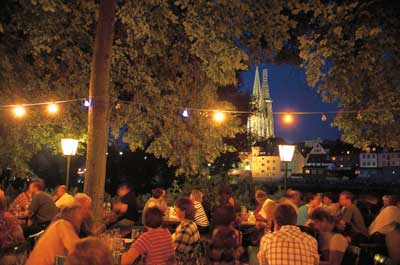
Some of the best places to taste barrel-fresh beers are the big beer halls owned by major breweries, especially those in Munich; at any Brauerei-Gasthaus (brewery with a restaurant attached) in many parts of Germany; historic monastic breweries such as Kloster Andechs in the scenic Bavarian Alps; open-air beer gardens shaded by spreading chestnut trees; friendly little family-owned inns throughout the country; and at the hundreds of festivals held every year in Germany, from local fests in tiny villages to the world-famous 16-day Oktoberfest in Munich.

BEER TANKARDS
German beer is drunk from a wide variety of containers. Beer tankards and mugs are an art form in themselves, made from glass, ceramics, wood, pewter, and even leather and ivory in earlier times. (Several German museums display fascinating collections of colorful, intricately crafted, beer mugs.) And certain beers are traditionally served in specially shaped glasses: Dortmund’s Altbier in short cylindrical glasses; Kölsch from Köln in tall, narrow, cylindrical glasses called Stange; Bavarian wheat beers in tall glasses, narrow at the bottom and wide at the top, that show off the beer’s carbonation; and Berlinerweisse wheat beer in large, heavy, bowl-shaped stemmed goblets like schooners or oversized Champagne coûpes.

But be forewarned: When you order “ein Bier, bitte” (“a beer, please”) at a Munich beer hall or Bavarian beer garden, your beer is likely to be served in a heavy glass or stoneware Masskrug, a mug containing a whopping one liter (just over a quart) of foamy beer. No, it’s not a pitcher for the whole table—so don’t ask for extra glasses. That one liter is entirely for you! If you want a smaller beer, ask for “ein Halbe,” meaning a half liter.

In other parts of Germany, however, “ein Bier” or “ein grosses Bier” (“a large beer”) is .5 liter or only .4 liter, and “ein kleines Bier” (“a small beer”) will be half of that, .25 liter or .2 liter (barely enough to quench your thirst, in my humble opinion).

CHOWING DOWN
“Beer is even considered one of the basic food groups in Germany.”

“Made from the same ingredients as bread—grain, water and yeast—beer is known as “flüssige Brot” (“liquid bread”). And like bread, German beer is an excellent accompaniment to many foods. Connoisseurs match beers with foods in the same way that wine lovers pair reds, whites, and rosés with different dishes: heavy dark beers with roasted meats, Bavarian Helles beer with thinly sliced white radishes, Kölsch with blood sausages and raw onions and elegant pale Pilseners with lighter fare.

Guzzling and gastronomy go hand-in-hand in Germany. At beer halls, beer gardens, and festivals you’ll find a variety of foods traditionally consumed with German beers: roast pork with sauerkraut, smoked ham, grilled sausages, rotisserie chicken, braised pork knuckles, smoked fish, potato pancakes, goulash soup, red cabbage, rye bread, sliced cheeses and cheese spreads, soft yeasty pretzels and German potato salad. There are distinct regional differences, too. Typical beer cuisine in Bavaria is different from what you’ll taste in Hamburg or Dortmund. Beer also shows up as an ingredient in many German dishes, from soups to sauces to desserts. Would you believe Prussian hot beer soup or Mälzbier ice cream?

As you drink your way through a meal in a German beer hall, brew pub or beer garden, whenever the waiter brings you another beer he often keeps tab by penning a mark for each beer on the coaster under your glass. These colorful cardboard coasters—many with the logo of the brewery or tavern—are nice little souvenirs to bring back from your trip to Germany. The waiters don’t mind if you take a couple of them from the table (after all, beer coasters are advertisements for the brew), and they’re lightweight to pack in your luggage.

Zum Wohl (Here’s to you!) and Prosit! (Bottoms up!)

ET EXTRA
For more information about Germany’s tasty beers, go to:

www.beerhunter.com
www.germanbeerinstitute.com
www.germannews.com/bier
www.bavarian-beer.de
www.franconianbeerguide.com
www.europeanbeerguide.net