Chill Out With Cool Summer Soups

Photos courtesy World Soups

By Sharon Hudgins

Now that global warming seems to be raising temperatures in Europe, you can beat the heat on your next summer trip by eating cold soup. That’s right. If the thought of eating a chilled soup leaves you cold, think again. Chilled soups have been popular in Europe for centuries, from Scandinavia in the north to Spain in the south. Why not try them yourself?

Some of these soups are made with fruits and berries, often combined with milk products. Others are based on vegetables and meat stocks, sometimes spiked with wine. They can be cooked or uncooked, thick or thin, smooth or chunky, sweet or savory, plain or garnished.

Most cold soups are eaten at the start of a meal, but in elaborate dinners they are sometimes served as palate cleansers between courses. In various parts of Europe, chilled soups are also eaten for breakfast, for snacks, as a main dish of a light meal and even for dessert. Some cold soups are considered solely summer fare, whereas others are served year round.

The next time you travel in Europe, look for these classic chilled soups, some of which are regional or national specialties.

SCANDINAVIA
The Scandinavians have a large repertoire of colorful cold soups made from fruits and berries (fresh or dried, bottled or frozen). The bounty of summer’s harvest turns up in many Scandinavian soup bowls: apples, cherries, apricots, plums, peaches and pears; blueberries, cranberries, raspberries, lingonberries, strawberries, blackberries, gooseberries, currants and raisins; and even other ingredients such as rhubarb and rosehips. Often these are combined with buttermilk, soured milk, yoghurt or sour cream, with a little lemon juice, sugar and cinnamon added, too.

Uncooked cold soups of this type are made simply by mixing the fruits and berries with the liquid and other flavorings, which are mashed together or puréed in a blender or food processor (much like a fruit smoothie). Cooked cold soups start with heating the ingredients together, then thickening them with flour, potato starch, cornstarch, arrowroot, sago, tapioca, semolina, ground rice or beaten eggs, before the soup is chilled for serving. Often these cold soups are garnished with a dollop of whipped cream or with heavy cream poured over the top.

The Danes make a cold buttermilk soup, which can be cooked or uncooked, seasoned with sugar and lemon juice and thickened with eggs or ground rice. Sometimes this pale-colored soup is poured over crumbled oatcakes in a bowl, topped with whipped cream and served at the end of a meal.

Surely the most famous Danish cold soup is rødgrød—literally “red groats”—a kind of thin pudding made from red fruits and berries (cherries, red raspberries, strawberries, red currants) cooked together, lightly thickened, then served cold, garnished with milk or cream. Occasionally blueberries, blackberries and black currants are added, which give the mixture a deeper, darker color. Considered a “national dish” of Denmark, this chilled pudding-soup is actually very popular throughout the Nordic countries, where you’ll find it on the table for breakfast, served as a soup before the meat course of the day’s main meal, or eaten as a summer dessert.

GERMANY & AUSTRIA
Rote Grütze is the German version of this same dish. It’s considered a specialty from the northern part of Germany, particularly the region of Schleswig-Holstein (near Denmark), where it’s known as Rodgrütt. You’ll now find Rote Grütze served throughout Germany, especially in the summer, from hotel breakfast buffets to the dessert menus of fancy restaurants, from beer halls to local festivals—the ruby-red mélange is topped with vanilla sauce, whipped cream or vanilla ice cream.

In the German language, cold soups in general are called Kaltschalen (“cold bowls”). Germans and Austrians both enjoy a variety of cold fruit-and-berry soups, at the beginning or end of a meal, as much as their northern neighbors do. Germans also make a chilled beer soup with currants and grated pumpernickel bread, seasoned with lemon, sugar, cinnamon and cloves, and garnished with pumpernickel croutons or little airy egg-white dumplings; cold spiced red or white wine soup, adorned with crunchy almond macaroons; a refreshing buttermilk soup embellished with stewed fruit or whipped cream; and a pale-green sorrel soup containing dill, sour cream, diced cucumbers and chopped hard-boiled eggs, served with an ice cube in each bowl.

The Austrians have their own versions of cold wine soups, such as lemon soup with sugar, egg yolks and white wine, sprinkled with a dusting of ground cloves, and a rich beef consommé (clarified meat stock) spiked with dry white wine, with a thin slice of orange and some finely chopped parsley floating on top. Austrian cold tomato soup combines white wine with a purée of tomatoes and onions cooked in beef stock, spiced with garlic and paprika, and with finely chopped cucumbers stirred into the soup just before serving.

The Austrians also like lightly gelled cold consommés enhanced with chilled green grapes, diced ham and minced herbs (parsley, chives, chervil, tarragon). And the unusual Austrian Kalte Paradeissuppe (Cold Paradise Soup) consists of chilled cantaloupe, cucumber and melon balls in a shallow soup plate surrounded by a cold purée of tomatoes and sour cream with strips of cooked ham, decorated with chopped parsley and mint—a combination worthy of being labeled “Baroque.”

POLAND, UKRAINE & BELARUS
Cold soups are as prevalent in Eastern Europe as in the central and northern parts of the continent. Poland in particular has a rich heritage of chilled soups based on a variety of fruits, berries and vegetables mixed with meat stocks, dairy products and pickled or fermented foods that give a slightly sour taste to some of these soups.

Sweet soups include pear and buttermilk with cloves and lemon rind, as well as soups made of strawberries, gooseberries, blueberries, apples and plums, sometimes partnered with rhubarb, scented with cinnamon or vanilla and garnished with fried bread croutons or little puff-pastry pellets. The Poles also make Zupa Nic (Nothing Soup), a sweet, ice-cold, custardy concoction, with frothy egg-white dumplings, much like the French dessert, Oeufs à la Neige (Snow Eggs).

Polish cold savory soups are often based on cooked or raw vegetables mixed with a sour liquid. In addition to several cold versions of barszcz (borshch) made with red beets and garnished with sour cream, the Poles make beet and buttermilk soup poured over hard-boiled egg slices; buttermilk and pickle brine soup; cold cucumber soup with soured milk, dill pickles, and hard-boiled egg quarters; and a creamy green cold soup of soured milk and buttermilk with sorrel, dill pickles, green onions, parsley, chives, dill weed, garlic and hard-boiled eggs.

Borshch, served hot or cold, is the national dish of Ukraine, where you’ll find as many versions as cooks who prepare it. Usually based on beets, which give it a bright red color, borshch can also contain potatoes, onions, carrots, cabbage, peppers, cucumbers, radishes, dill, garlic, meat stock, buttermilk or sour cream, pickle brine or sauerkraut juice, hard-boiled eggs, chopped beef or ham and even crayfish or shrimp. You name it, and the Ukrainians are likely to throw it into the soup pot. And in the summer they’ll often serve it chilled.

Sweetened fruit soups are popular in Ukraine and Belarus, too. On hot summer days, a light meal in these countries might consist of a bowl of cold fruit soup or chilled borshch, accompanied by a fresh vegetable salad or a fruit compote.

HUNGARY & ROMANIA
Hungarians love cold fruit soups. You’ll find chilled cherry soup on many Hungarian restaurant menus—a pretty pink soup made with tart Morello cherries, flavored with red or white wine, sugar, cinnamon and lemon, with a dash of sour cream or a dollop of whipped cream as a final flourish. Cold raspberry and strawberry soups are also popular, as is the simple but elegant fruit soup composed of puréed peaches and peach seeds, sugar, sparkling wine and Hungarian Riesling wine. Hungarian chilled vegetable soups include beet soups similar to Slavic borshch and a creamy yellow squash soup seasoned with dill.

Romanian fruit and berry soups range from apple, apricot, cherry and plum, to gooseberry and red currant. Some are sweet and creamy, garnished with puffs of sweet meringue and sliced nuts. Others are slightly sour, from lemon juice or soured milk products, and some even contain chopped or slivered smoked meats. The Romanians also make a cold vegetable soup containing cucumbers, carrots, onions, celeriac, veal stock, sour cream and dill.

FRANCE
Surely the most famous “French” cold soup is Vichyssoise—the classic potato and leek cream soup—which was actually created in New York by a French chef, Louis Diat, in the early 20th century. But the French can claim plenty of cold soups on their home soil, from seafood bisques to Crème Cyrano Froid, a cold chicken soup thickened with eggs and seasoned with mustard, tarragon and cayenne pepper, along with pieces of finely diced chicken or ham, all lightened by whipped cream folded into the mixture.

Other cold and creamy French soups include such flavors as broccoli, asparagus, cucumber with tarragon or mint, tomato with garlic and dill, carrot with cayenne, pumpkin with ginger and nutmeg, and green pea with diced chicken or turkey. These are often served in a bowl placed on a bed of crushed ice to keep the soup chilled while you eat.

In summer the French have a penchant for chilled consommés with pieces of cooked meats or vegetables suspended in the slightly gelatinous stock. They also make a lovely cold sorrel soup seasoned with garlic and lemon juice, mixed with heavy cream, chopped hard-boiled eggs, and thin slices of cucumber, then poured over diced black bread for serving.

SPAIN
Gazpacho is the king of cold soups in Spain. A regional specialty from Andalucía, in southern Spain, gazpacho can now be found on tourist menus all over the country, especially in the summer. The most common kind of gazpacho is a reddish-colored purée of tomatoes, cucumbers, onions, bell peppers, white bread, garlic, olive oil and wine vinegar. Served at the beginning of a meal, this type of gazpacho is often garnished with fried croutons and diced raw onions, cucumbers and peppers.

Before tomatoes and peppers arrived in Spain from the Western hemisphere 500 years ago, Andalucían gazpacho was simple peasant fare, made with the cheapest ingredients—only bread, water, salt, garlic, olive oil and vinegar or lemon juice—mashed together in a wooden bowl and eaten as the midday meal by farm workers in the fields. Today you’ll find many kinds of gazpachos in Spain: red, white, green and yellow, thick or thin, containing a wide range of ingredients from fruits and nuts to eggs, fish, meat and milk.

Salmorejo is a version of red, tomato-based gazpacho from Córdoba, where chopped hard-boiled eggs, canned tuna and strips of Spanish serrano ham are added to the cold mélange. Córdoban cooks also concoct a chilled white gazpacho made with almonds and sometimes pine nuts. Granada and Málaga both claim ajo blanco, a smooth white garlic and almond gazpacho garnished with green grapes. And Spanish gazpachuelo frio is another chilled white soup, prepared from thick homemade mayonnaise whisked with plenty of ice water before chopped red tomatoes and black olives are stirred in.

SOUTHERN & SOUTHEASTERN EUROPE
Given the torrid summers in southern Europe, it’s surprising that Italy, Greece and parts of the Balkans don’t have a tradition of many chilled soups in their regional or national cuisines. The Italians do have a minestrone freddo alla milanese, a rice and vegetable soup from Milan, garnished with basil leaves and grated cheese. But even that soup is eaten only at room temperature, not chilled.

Greeks cool off with tzatziki soupa, cold cucumber and yoghurt soup blended with lemon juice, olive oil, garlic and fresh mint. And around Thessaloniki, Greeks eat a sweet cherry soup made with dry white wine, heavy cream, cherry liqueur and cinnamon—much like the fruit soups favored in many northern European countries.

Tarator is a classic Bulgarian cold cucumber-and-yoghurt soup, very similar to the version eaten in Greece. But Bulgarian tarator is enriched with a paste of pounded walnuts, garlic, salt and olive oil swirled into it, often with chopped walnuts or dill sprinkled over the top. Bulgarians make other chilled soups from yoghurt combined with zucchini, sorrel, mushrooms and fresh herbs (especially dill). Cold tomato soups can sometimes be found in the Balkans, too. And on Christmas Eve the Bulgarians even serve a cold soup made of sauerkraut and sauerkraut juice, chopped leeks, onions and paprika, accompanied by a bowl of grilled hot peppers!
Paprika: Hungary’s ‘Red Gold’

By Sharon Hudgins
Photos by the author

Many people travel to Hungary for the architectural treasures, historical sites, and cultural life of Budapest, the cosmopolitan capital. Some venture farther into the wine country of Tokaj and Lake Balaton. Others float down the Danube on leisurely boat cruises.

But I go for the food.

And what would Hungarian food be without paprika, the red spice so characteristic of Hungarian cooking?

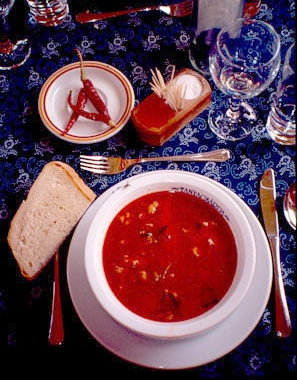
Paprika is an essential ingredient in Hungarian goulash

PAPRIKA PAST

Although many Hungarian dishes use paprika as an ingredient, this colorful, flavorful spice is actually a relative newcomer to Hungarian cuisine. Pepper cultivation was established in Hungary during the Turkish occupation of that country in the 16th and 17th centuries. But it wasn’t until the late 18th century that paprika gained widespread acceptance as a spice in Hungarian foods. Formerly found only in peasant dishes, it gradually entered the culinary repertoire of the gentry and the nobility, dispersing throughout all levels of society so thoroughly that today it would be hard to imagine Hungarian cooking without paprika.

PICK A PEPPER

Many different kinds of peppers are cultivated in Hungary, including those grown specifically to be dried and ground into paprika. These include several kinds of long red peppers commonly used for making the milder paprikas, and small round red “cherry peppers” used for some of the hotter varieties of the spice.

After being picked, the peppers are left to rest for two to three weeks, to let their flavor and color develop even further. Then they’re washed, dried, and ground into a powder. Paprika is now such an important cash crop that the locals even call it “Red Gold.”

Before the Industrial Revolution, farmers would string all their ripe peppers by hand, hang them up in a protected place to dry, and then complete the drying process in large earthenware ovens. The dried peppers were crushed underfoot, then ground into a fine powder by hand, using a huge mortar with a large pestle. Water mills, windmills and steam engines eventually replaced the hand method for grinding paprika. And today modern automatic machines wash, dry, crush, sort and grind the peppers all in one continuous process.

PAPRIKA PLACES

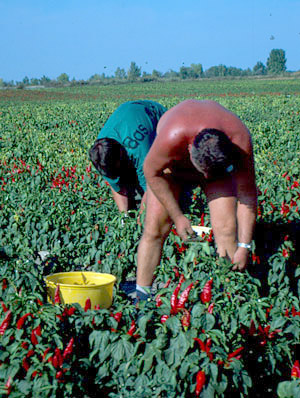
Much of Hungary’s paprika comes from the fields and factories around the small town of Kalocsa, near the Danube River, and the larger industrial city of Szeged, on the Tisza River, both located on the country’s Southern Great Plain. These two centers of paprika production have just the right combination of soil characteristics, temperature, rainfall and sunshine necessary to cultivate the pepper plants successfully. Harvesting starts at the end of the first week in September and lasts for about a month, depending on weather conditions.

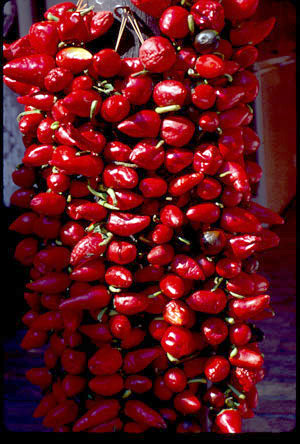
For three to four weeks every autumn, more than 8,000 acres of fields around Kalocsa are filled with farm workers picking bright red peppers and stacking them in small wooden crates or big plastic mesh bags. In the town itself, strings of shiny red peppers hang from balconies, porches, and eaves, like colorful ribbons on a peasant girl’s costume. And on some of the houses, long cylindrical mesh bags full of peppers are suspended from the eaves like giant sausages.

During September the entire town, its population swelled by busloads of tourists, celebrates the pepper harvest with a paprika festival called “Kalocsa Paprika Days,” featuring exhibitions of food products, a variety of sports competitions and a cooking contest (with paprika as an ingredient, of course). The highlight of the festival is the Paprika Harvest Parade, complete with local bands and colorful folk-dancing groups, followed that evening by a Paprika Harvest Ball.

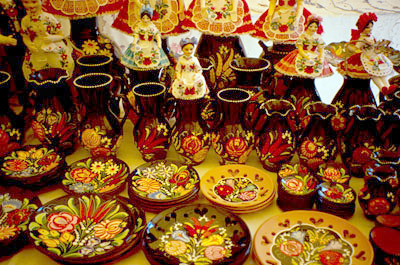
Regardless of the time of year, however, the visitor is never far removed from paprika in Kalocsa. In addition to its pepper fields and commercial paprika factories, Kalocsa has a Paprika Street and a Paprika Museum. Strings of dried peppers festoon store windows and roadside stands. Souvenir shops are filled with folk-art gifts adorned with images of bright red peppers, including hand-painted eggs, decorated dishware and embroidered linens. And walls of houses and restaurants are painted with murals depicting traditional floral motifs, often with red peppers incorporated into the design. A sleepy little town that was once just an agricultural center has become a tourist mecca, especially at harvest time, attracting travelers from all over Europe and beyond.

The much larger city of Szeged also has a paprika museum, as well as a pepper-and-paprika festival in early September.

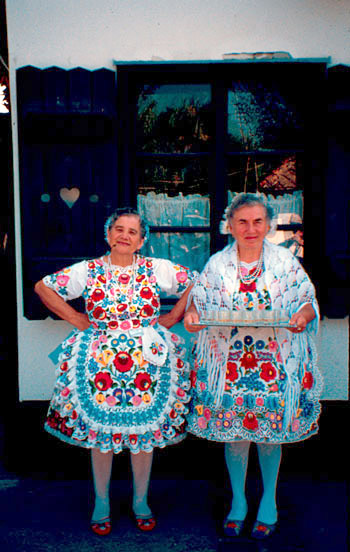
Hungarian women in traditional folk costumes from Kalocsa

TYPES OF HUNGARIAN PAPRIKA

The Hungarians produce a range of paprikas from mild to very hot—although the milder versions are used most often in Hungarian dishes. Contrary to popular belief, the brightest red paprika powders are the mildest and sweetest in taste, whereas the pale-red and light-brown colored paprikas are usually the hottest.

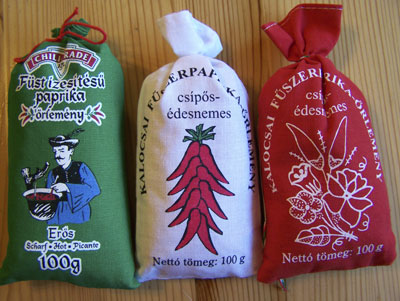
Heat levels range from édes (sweet, mild) to félédes (semi-sweet, medium-hot) to erös (hot). Füszer on the package just means “spice,” and orlemeny means “powder.” What’s important is the type of paprika you choose.

  • Különleges (Special): The brightest red paprika of all, with a good aroma and very mild, sweet flavor.
  • Édesnemes (Noble Sweet): Bright red in color but with only a mildly spicy flavor. Most of the paprika exported to the rest of the world is this type.
  • Csípmentes Csemege (Delicate): Mild-tasting, richly flavored, light- to bright-red paprika.
  • Csemege (Exquisite Delicate): Similar in color and aroma to “Delicate,” but with a slightly spicier taste.
  • Csípös Csmege (Pungent Exquisite Delicate): Similar in color and aroma to Delicate and Exquisite Delicate, but a bit spicier in flavor. One of the most popular of the hotter varieties of paprika in Hungary.
  • Félédes (Semi-Sweet): Medium-hot paprika.
  • Rozsa (Rose): Paler-red in color, with a strong aroma and hot-spicy taste.
  • Erös (Hot): The hottest variety, pale rust-red to light brownish-yellow in color.

PAPRIKA PACKAGING

Paprika is a popular souvenir to bring back from your trip to Hungary. The largest (and freshest) selection can be found at the Great Market Hall in Budapest. If you travel in the countryside, you’ll find paprika sold at many souvenir shops and roadside stands, too.

Kalocsa paprika is often packaged for retail sale in small cloth bags sometimes stamped with the image of a ripe pepper plant, or decorated with red, white and green ribbons, the colors of the Hungarian flag. Paprika also comes in less expensive, but still colorful, tin boxes and even cheaper cellophane or plastic bags.

In the United States, where Kalocsa paprika is less commonly available, you’re more likely to find tins of paprika from Szeged at gourmet stores and major supermarkets.

Paprika peppers are also made into bright-red pastes and packaged in cans, jars, and even tubes (like toothpaste).

Since all powdered paprikas lose color and flavor as they age, it’s best to purchase paprika that was harvested and milled during the past year. Keep it in your kitchen cabinet, away from heat and sunlight, and use it within a year after buying it.

COOKING WITH PAPRIKA

Hungarian souvenirs with pepper motifs on them

As the spice that defines many Hungarian dishes, paprika is often in combination with other traditional Hungarian ingredients such as lard, onions and sour cream. Hungarian cooks always have several kinds of paprika in their kitchens, in a whole range of hues and flavors.

Just remember that when cooking with paprika, you should always stir the spice into HOT fat, to dissolve the powder and release its full flavor and aroma. Then quickly stir in the meat or a liquid to lower the temperature, to keep the paprika from burning, or it will turn bitter and ruin the dish.

Once you’ve tasted true Hungarian paprika—and mastered the simple technique of cooking with it—you’ll never again think of paprika as just a pretty spice, good only for garnishing potato salad and devilled eggs.

As the Hungarians say, “Jó étvágyat kívánunk!” (“Enjoy your meal!”)

For more information:

www.budapest-tourist-guide.com/hungarian-paprika.html
www.budapest-tourist-guide.com/great-market-hall.html
www.1hungary.com/info/kalocsa/
www.countypress.hu/touristinfo/uk/kalocsa.htm
WWW.hungary.szegedhotels.com/visitorinfo.php

Corinthia Grand Hotel

By Don Heimburger
Photos by the author

In the sea of humanity which is Budapest, there is an oasis of calm and sophistication called the Corinthia Grand Hotel Royal.

Situated at Erzsebet krt 43-49 in the city center, this posh five-star hotel presents a grand facade, behind which lies 414 rooms, including 98 executive guestrooms on six floors, six junior suites, 22 one-bedroom deluxe suites and even 1-, 2- and 3-bedroom apartments.

From the Grand Ballroom, which features 72 tons of inlaid marble (a centerpiece of the hotel), to the plush lobby, to the quiet and well-staffed restaurant, this well-appointed hotel is tops.

As Rick Steves has suggested, a top hotel is where he likes to stay when in a Eastern European city because of the service, food and cleanliness. Certainly the Corinthia fits this category.

SIX-STORY ATRIUM
As guests enter, a sweeping six-story atrium tops out with a glass roof, and a broad statue-lined staircase soars upwards to the mezzanine. Light-colored columns, delicate trimmed railings, large flower arrangements and pleasant desk personnel add to the atmosphere.

interiors of Corinthia

Relaxing at the hotel isn’t hard. It offers a Royal Spa, the first of which opened in 1886, with all the latest spa facilities and treatments, plus its own 50-foot-long swimming pool, saunas, steam bath, jacuzzi, fitness room, mud/seaweed baths and more.

The rooms are nicely appointed, with laundry and dry cleaning services available, tea/coffee makers in the room, iron and ironing board, and room service is available. Elevators take guests to their floors. Terrycloth bathrobes are available for guests in the rooms.

room at the Corinthia

Languages spoken by the staff include English, Hungarian, German, French, Spanish and Italian. A concierge is available, as is a currency exchange, non-allergic pillows and a safe deposit box at the front desk. Parking is also available. There is a 24-hour security staff, complimentary access to WiFi wireless internet access, and internet access in rooms.

buffet

The breakfast buffet, one of the highlights of the morning, includes a variety of breads, croissants, muffins, coffee, champagne, hot and cold meats (bacon, sausage), eggs (scrambled and fried and made-to-order), fruits, pastries, cereals, juices, cheeses, baked beans, hash brown potatoes, pancakes, waffles, fresh vegetables, yogurts, and more. I came away fully satisfied with the morning breakfast. Service in the restaurant was always fast and friendly.

breakfast

The Corinthia features five restaurants/bars, a nightclub, a number of retail outlets and 26 apartments for long term stays.

Room rates at the Corinthia vary depending on the season, but one night in May 2009 would start at about $245 U.S.

The hotel first opened for the Millennium Exhibition in 1896, where Josephine Baker, Heinz Rühmann and many other celebrities stayed at the time. Over the years, many famous writers and artists have been guests at the hotel.

During the last renovation, the hotel had a $100 million facelift that virtually gutted the entire building, leaving a beautiful hotel in the central part of Budapest.

For more information, contact www.corinthiahotels.com or www.corinthia.hu. E-mail is budapest@corinthia.hu.

Great Goulashes!

Although goulash originated in Hungary, this popular dish later spread beyond its borders, first to the Austrian Empire, Germany, and the Balkans, and finally around the world.

Classic Hungarian goulash at a restaurant on Hungary’s Great Plain

By Sharon Hudgins
Photos by the author

Everyone loves a good goulash. But ask a dozen people what a goulash is—and you’ll get a dozen different answers: a soup, a stew, a meat dish served on a plate; brown, red, mild, hot-spicy; made with beef, pork, mutton, game, even vegetarian.

Although goulash originated in Hungary, this popular dish later spread beyond its borders, first to the Austrian Empire, Germany, and the Balkans, and finally around the world. That’s why there are so many versions of goulash today.

GOULASH ROOTS
Hungarian goulash traces its roots back to nomadic Magyar herdsmen in the ninth century. Shepherds cut meat into cubes and slowly stewed them in a heavy iron kettle over an open fire until the liquid evaporated. Then they spread the meat out in a single layer to further dry in the sun. This dried meat, an early convenience food, could be carried with them as they followed their flocks across the vast expanse of Hungary’s Great Plain. To reconstitute the meat they simply added water and heated it—sometimes with other ingredients, too—in a pot over a fire. If a lot of liquid was added, the dish was called goulash soup. With less liquid, it was simply goulash meat. In both cases it was eaten with spoons dipped into the communal cooking pot.

Goulash got its name from those early herdsmen, who were called gulyás in Hungarian. But goulash as we know it today did not develop until the end of the 18th century and beginning of the 19th, with the widespread cultivation of peppers in Hungary and the use of paprika as a popular spice. Originally it was considered peasant food, eaten primarily by country folk—farmers, shepherds, cowboys, and swineherds. With the rise of Hungarian nationalism in the second half of the 19th century, paprika-seasoned goulash moved from the campsites and farmhouses to the tables of middle class and wealthy city dwellers, to the menus of fashionable restaurants and eventually across the globe.

GOULASH VARIETIES
Goulash is now the Hungarian dish most widely known abroad. But in many parts of the world, dishes called “goulash” bear little resemblance to the gulyás that originated in Hungary and is eaten there today. In Hungary, gulyás is a meat dish halfway between a soup and a stew, made with small cubes of meat (usually beef), no more than 3/4-inch in size, and flavored with bacon or lard, onions and paprika. Gulyás is traditionally served in a bowl and eaten with a spoon.

Over time, Hungarian cooks also developed many variations on this theme, using such ingredients as garlic, tomatoes, mild banana peppers and hot cherry peppers, caraway seeds, root vegetables, cabbage, beans and tiny egg dumplings, as well as pork, mutton, venison and boar meat. Regional recipes abound, with each cook claiming his or her own version of goulash to be the best and most authentic.

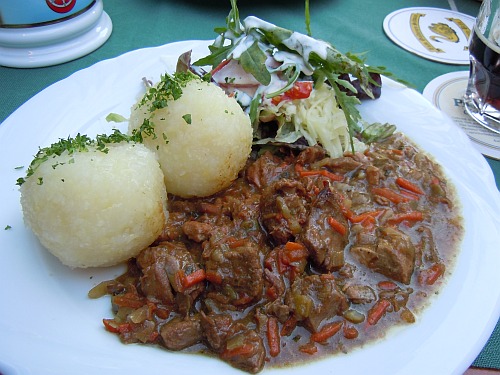
Germans adapted the basic Hungarian goulash recipe to their own tastes, producing the Gulaschsuppe (goulash soup) that is now so popular throughout Germany, where it’s traditionally served with a slice of rye bread and a mug of beer. Germans and Austrians also make a variety of thick, paprika-flavored meat stews called Gulasch, served on a plate and accompanied by boiled potatoes, egg noodles or dumplings. (The Hungarians, however, would call this kind of stew a pörkölt, not a goulash.) And Kesselgulasch (kettle goulash)—cooked outdoors in a pot suspended by an iron tripod over an open fire—is a Hungarian specialty that many Central Europeans now eat at their own backyard dinner parties and local festivals.

German “Beer Goulash” at brewery beer garden in Erfurt

As part of the former Austro-Hungarian Empire, the Austrians certainly love their own versions of Gulasch. There’s even a Cafe-Restaurant Gulaschmuseum in Vienna, where the menu lists more than a dozen varieties of goulash, including turkey or chicken-liver goulash with potatoes, bean goulash with paprika-seasoned sausage, veal goulash with little spinach dumplings, and even a dessert called Schokogulasch (chocolate goulash) containing cake, chocolate sauce and rum. In Prague I purchased a Czech cookbook devoted entirely to the subject of goulash—including versions identified as German, Austrian, Slovakian, Slovenian, Serbian, Bulgarian, even Chinese and Mexican! And recently in New Mexico I came across a Cajun goulash. What a mixture of geography and culinary cultures! From its humble beginnings on the plains of Hungary more than a thousand years ago, this simple peasant food has now become a truly global dish.

GOULASH-SPEAK
“Goulash” has also entered several languages as a word meaning more than just “a soup or stew.” In Hungary, “Goulash Communism” was a term for the Hungarians’ attempt in the late 1960s to create their own, more market-oriented, economic system distinct from the Soviet model. In Germany and Switzerland, a “goulash cannon” is military slang for a mobile field kitchen—a big, heavy, black, iron stewpot on wheels, with a cover on the top and a built-in firebox—which is also used for feeding crowds at festivals and other public events. And in the Czech Republic, political parties had a tradition of setting up their own “goulash cannons” in front of polling places at election time, where they dished out free goulash in a blatant attempt to influence voters’ choices on the ballot. As the Czechs said to each other when they headed to the polls to vote, “Have a good goulash!”