Beautiful Bratislava

Courtesy http://www.visit.bratislava.sk

By Leah Larkin
Photos by Don Heimburger (unless noted)

“I like the changes. The town looks much better now. It’s more comfortable,” says city guide Evo Cubrikova.

She was speaking about her hometown, Bratislava, the Slovak capital of 450,000 inhabitants that is spread out on two banks of Europe’s second longest river, the Danube.

Indeed, since Czechoslovakia overthrew communism in 1989 and Slovakia split from the Czech Republic in 1993, there have been major changes and improvements, not just in Bratislava, but throughout the country.

Yet, progress has been fastest in the capital where renovation, new construction and new wealth have made their mark. Most remnants of those gray, shabby communist days are long gone, replaced by freshly renovated historic buildings now painted in pretty pastels, swanky shops, trendy restaurants and bustling cafes.
Courtesy http://www.visit.bratislava.sk

LIVELY PLACE
It’s not Vienna, Prague or Budapest, but it’s a pleasant, lively place to visit. Many tourists in nearby Vienna (64 km/ 40 miles away) and Budapest (194 km/116 miles) make day trips by bus or boat to the city. The opposite is also true with Bratislava visitors heading to the Austrian and Hungarian capitals, also for day excursions.

“Bratislava is a great city break destination,” notes Alison White of the British tour agency Regent Holidays which sends many visitors to the city. “You can take the hydrofoil to Budapest or Vienna. Use it as a base to explore these cities that are more expensive.”

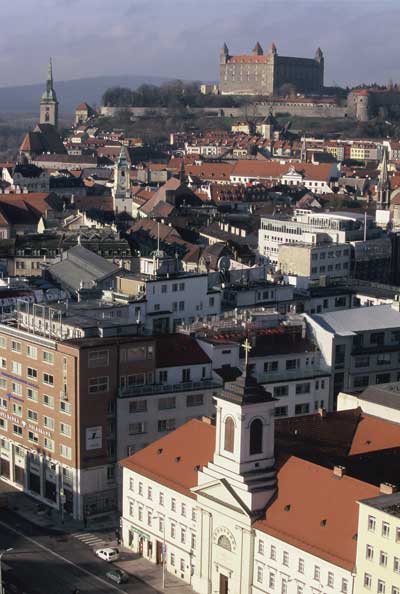
But don’t neglect Bratislava’s sights which are easy to explore on foot as the town is not that big. Towering over the city is its castle, a perfect place to begin a visit with magnificent views of the town and surroundings. Unfortunately the interior of the castle which houses the Slovak National Museum is closed for extensive renovation and will remain so for several years.

It’s still worth the trek. You can climb the outer walls and aim your camera for overall shots of the town. Across the river is Petrzalka, a suburb of bleak concrete highrises built in the communist era. One third of the city’s population live in these apartments, which are being restored. Because of their proximity to the inner city, they are now in demand, Cubrikova said.

The first written reference to the castle dates to 907, but the first inhabitants of the castle hill were Celts, then came the Slavs who built a fortress there. It was replaced by a palace of stone in the 10th century when Bratislava became part of the Hungarian kingdom. In the 15th century a Gothic castle was built, but all that changed in the 16th century when it was rebuilt in Renaissance style. Then along came Maria Theresa who had it converted into a rococo structure for her daughter.

MOST IMPORTANT TOWN
During Maria Theresa’s reign (1740-1780), Bratislava became the largest and most important town in the territory of present-day Slovakia and Hungary. The population exploded and many new palaces, monasteries, mansions and streets were built. But the glory began to fade when Maria Theresa’s son, Joseph II took over and the crown jewels were taken to Vienna in 1783 in an attempt to strengthen the union between Austria and Hungary.

The castle burned down in 1811 and remained a hulk of empty ruins until 1953 when renovation began, continuing until 1968. From far off, it looks like an upside down table -– four towers (legs) extending from the building, the table top.

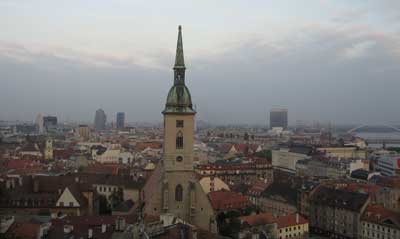
At the foot of the castle is the charming Old Town with labyrinthine streets and cobblestone squares. The prominent church at the edge of the Old Town, which was once part of the city’s walls, is St. Martin’s cathedral, a three-nave Gothic church dating to the beginning of the 14th century. Bratislava was the capital of the Kingdom of Hungary under the Habsburg monarchy from 1536 to 1783. Eleven Hungarian kings and eight royal wives were crowned in the cathedral.

Wandering through the narrow alleys of the Old Town behind the cathedral is reminiscent of Prague, with a Middle Ages ambience still in tact. You’ll undoubtedly come to Michael’s Gate, the only preserved gate of the medieval city fortifications. Its appearance changed through the centuries, but its 51-meter high tower still dominates.

Just down from the Gate is my favorite Bratislava discovery — Cokoládovna pod Michalon at Michalská 6, a chocolate café with what must be the world’s best hot chocolate — 44 different kinds, most with liqueurs. Dark, thick, sinfully delicious. I went for Indian hot chocolate, flavored with rum, cloves, cinnamon, orange peel and whipped cream –89 SKK (Slovak koruna).

Bratislava’s Old Town Hall took shape in the 15th century when several burgher houses were joined together. It, too, has been reconstructed throughout the centuries and now houses the city’s Municipal Museum. Under its tower is a unique and cozy cafe, Radnicka, which employs the disabled and is very popular. Crafts made by the disabled are also sold in the café.
CITY’S MAIN SQUARE
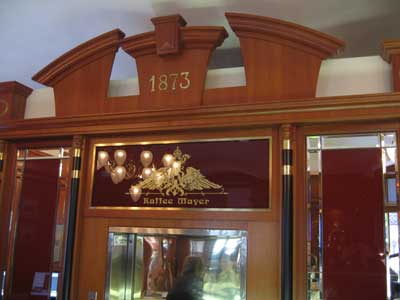
Walk through the passageway under the tower past the restaurant and enter the city’s main square, Hlavne Namestie, where architectural gems have been restored and now house embassies. There are also several cafes in the square including Maximilian’s, a pastry shop/café with a fountain flowing with liquid chocolate. Opposite is the Café Mayer, another noted café and pastry shop famous for “razky,” the city’s signature pastry, crescent shaped with a tiger pattern on the crust and a tasty filling of ground walnuts or poppy seeds.

Another attraction in this square is one of the town’s whimsical statues — a bronze of a Napoleonic soldier leaning over a bench. Tourists love to sit on the bench and pose next to the fellow, who was said to have been left behind by the French after they besieged the city in 1809.

More of these fun surprises are spread throughout the city, another favorite being a man peeping out of a manhole on the street. They say he’s looking up the ladies’ skirts.

On a more serious note is the Primatial Palace, an elegant, classical palace from the end of the 18th century which was the archbishop’s winter palace and now serves as the mayor’s office. Its lavishly-decorated rooms are used for official ceremonies. When none of these is taking place, you can visit and admire its Hall of Mirrors and series of six enormous, stunning English tapestries from the 17th century that illustrate the mythical legend of Hero and Leandros. According to Cubrikova, there are only three sets of tapestries in the world illustrating this legend, but only Bratislava’s set is complete.

The perfect place for a stroll is Hviezdoslavovo Namestie, a long mall-like boulevard with the Slovak National Theater on one end and a small square on the other end near the city’s famous New Bridge. Trees, fountains, a gazebo, cafes and restaurants, even the American Embassy, line the boulevard which is abuzz with people.

The restaurant of choice is the Slovenská Reštaurácia (www.slovrest.com), Hviezdoslavovo nám. 20, rich in old Slovak décor with a “Stroll Through Slovak Gastronomy” five-course menu for 790 SKK. From smoked trout, garlic soup with fried bread, goose liver in red wine sauce, a farmer’s platter and the finale, your choice of several types of homemade strudel, it’s a hearty feast. Get in the Slovak spirit and begin the meal with a shot of brandy. The restaurant serves many kinds, but silvovica (plum brandy) is the local staple. Slovakia makes excellent beer, the beverage of choice with this meal.

ONE-PYLON BRIDGE
After a meal like that, exercise is in order. Cross the bridge, a city symbol that was built in 1972 –- a futuristic suspension bridge with only one pylon. Ride the elevator to the top of the bridge tower where there is a viewing platform and the panorama “UFO” restaurant, so named because of its flying saucer shape. On the other side of the Danube is a lovely riverside park.

The UFO restaurant (www.u-f-o.sk/en/) is pricey with gourmet offerings — a six-course menu for 3,000 SKK. You can even have a tasting of Iranian caviar (6,800 SKK for 30 grams). I settled for a cappuccino, 70 SKK.

In the more affordable category, the Reštaurácia Monarch, Sedlárska 4, offers the Demänovská Valley Delicacy, a potato pancake filled with beef strips, tomatoes, green peppers, onions and mushrooms. Cost of the tasty concoction: 320 SKK. A large beer, 60 SKK.

Slovak crafts — wooden products, painted ceramics, cornhusk dolls — make the best souvenirs. Crystal is also a local favorite. I bought a pretty hand painted plate at Folk Art, Panská 2, for 450 SKK.

Recommended hotels in the city center include the four-star Hotel Devin (www.hoteldevin.sk) at Riecna 4; a new four-star boutique hotel, Marrols, (www.hotelmarrols.sk) at Tobrucká 4, and the reasonable and popular three-star Ibis Hotel (www.ibis-bratislava.sk), Zamocka 38.

For more information, check out visit.bratislava.sk/en/.

European Easter Egg Traditions

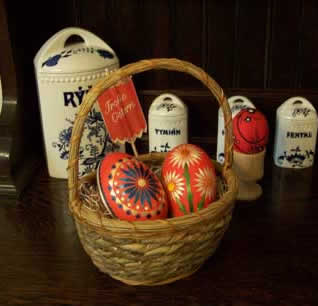
Goose and duck eggs from Poland, decorated with paint and colored straw.

By Sharon Hudgins
Photos by the author and courtesy German National Tourist Board

Europeans take their Easter egg traditions seriously.

From Scandinavia and Britain in the north to Italy and Greece in the south, from the Slavic countries to Germany, Romania and Hungary, eggs at Easter time are dyed in many colors, decorated with intricate designs, hung from tree branches, strung onto wires, buried in the ground, featured in games, exchanged among friends, baked into breads and taken to church to be blessed on Easter morning.

Easter egg tree at a Russian Orthodox church.

PRE-CHRISTIAN TRADITION
Although colored eggs are the most salient symbol of Easter today, their association with springtime reaches much farther into the past. Archeologists in Europe have uncovered egg-shaped artifacts with ornate designs made thousands of years before the Christian era.

Etched goose and duck eggs from the Czech Republic.

Folklorists say that decorated eggs were part of pagan spring festivals, for which eggs were painted in bright colors to symbolize blossoming plants. So it’s not surprising that the egg, representing the creation of new life, would also find a place in religious celebrations of the resurrection of Christ. The decorating of Easter eggs is a long-established folk art in many parts of Europe, still practiced today. During the 40-day Lenten fast preceding Easter, many Christians abstain from eating certain foods, including eggs. But the hens keep on laying. Some of these excess eggs are dyed a solid color: red is especially symbolic, representing drops of Christ’s blood as well as the regeneration of life.

Others are decorated with intricate floral or geometric motifs. Several countries and regions in Europe—Poland, Ukraine, Belarus, Moravia, Slovakia, Bohemia, Hungary, Slovenia, Romania, Germany, Austria—are well known for their production of beautifully decorated eggs, using age-old techniques and designs, many of which are unique to that particular place. The connoisseur of folk art eggs can tell at a glance whether an egg has come from the eastern or western part of the Czech Republic, from Slovakia, from northern Croatia or from central Austria.

Easter fountain in Ginsheim/Rhine near Mainz, Germany. Photo: Eric Eichberger

MAUNDY THURSDAY
In many parts of Europe, Maundy Thursday (the day before Good Friday) is the traditional day for decorating Easter eggs. Up through the 19th century, superstitions from earlier times survived in the belief that eggs laid on Maundy Thursday, Good Friday or Easter Sunday had magical powers: to prevent illness, to bring good luck, to act as an aphrodisiac, to ensure that the next baby will be a boy, to forestall an early death, to foretell the future. In some places, Easter eggs were fed to the livestock to protect the animals, or buried in the fields to help produce abundant crops. And Eastern European bee-keepers put a colored Easter egg under each hive to guarantee a good supply of honey.

A charming custom that dates from the 19th century is the making of an egg tree at Easter. Long branches of budding pussy willows or yellow forsythia are arranged in a vase, and eggs are hung on the branches like Christmas ornaments on an evergreen tree. Traditionally the eggs are hollow chicken or duck eggs, the whites and yolks first removed through pin holes before the eggshells are dyed and decorated, then a loop of ribbon or yarn pulled through the holes for suspending the eggs from the boughs. Sometimes brightly painted wooden eggs are also hung from the branches, along with little wooden birds. These egg trees are especially popular in Germany (where they’re known as Ostersträusse, Easter bouquets, or Osterbäume, Easter trees) and in several other parts of Central Europe, too.

Easter fountain in St. Wendel, in Germany’s Saarland region. Photo: Amt fuer Stadtmarketing, St. Wendel

OUTDOOR EASTER TREES
In some regions you’ll even see outdoor Easter trees, with real or plastic eggs suspended from the branches of live bushes or trees. In the Franconian Alps of northern Bavaria, the fountain or well in the center of many villages is decorated with garlands of evergreens, colorful streamers, fresh flowers and hundreds of painted eggs. For two weeks beginning on Good Friday, more than 200 of these traditional Osterbrunnen (Easter wells) are on display in Franconian towns.

In Europe today, Easter eggs are made from a wide variety of materials: natural egg shells—chicken, duck, goose—with the egg white and yolk blown out of the shell; uncooked eggs with their shells intact; hard-boiled eggs; edible substances such as sugar, chocolate and marzipan; precious metals, enameled metals, wood, wax, porcelain, onyx, marble, glass, cinnabar, cardboard and papier-mâché.

Decorations range from solid colors to painted, etched or batiked designs. Beads, lace, straw, colored paper and decals are also glued onto eggshells. The designs can be geometric, floral, symbolic—whatever suits the egg decorator’s fancy. And sizes extend from miniature jeweled eggs made with precious stones to the giant chocolate eggs, up to a meter tall, so beloved by Italian children.

An Easter egg tree decorated with eggs from many Central and Eastern European countries.

You can see hundreds of handcrafted eggs at the many Easter markets held in Europe during the spring. Prices range from just a few euros for simply painted hens’ eggs to several thousand euros for large exotic-bird eggs painted by internationally renowned artists. One of the most stunning eggs I saw at a Munich Ostereiermarkt (Easter egg market) was a huge ostrich egg acid-etched to look like lace. It was priced way beyond my budget, but I still came home with some lovely smaller samples of folk-art eggs by local artists. Now it’s time for me to find some pussy willow boughs and start decorating my own egg tree for the season.

Goose eggs from the Czech Republic, decorated with colored straw.

A SELECTION OF EUROPEAN EASTER EGG MARKETS

Germany
www.ostereier-maerkte.de/ (German only)
www.german-easter-holiday.com
www.voelkerkundemuseum.com

www.burgsatzvey.de/eng_index
www.volkskultur.sorben.com (German only)
www.ostereiermarkt.com (German Only)
www.ostern-in-deutschland.de (German only) 
www.stripes.com/

Austria
www.ostermarkt.co.at/
www.tyrol.tl/en/news_141
www.virtualvienna.net/

Czech Republic
www.pragueexperience.com
www.carnifest.com/
www.marys.cz/
www.jizni-morava.cz

Slovakia
www.goeasteurope.about.com

Poland
www.wieninternational.at

Hungary
www.budapesttimes.hu

Switzerland
www.swissinfo.ch

European Christmas Sweets

From Advent to Three Kings Day

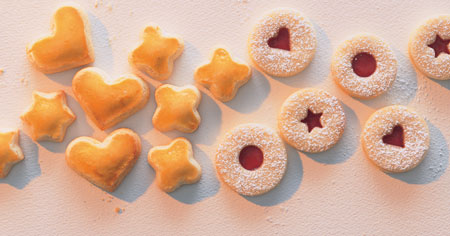
Two famous Swiss Christmas cookies: on the left are the Mailänderli, on the right, Spitzbuebli. Both will be devoured throughout Switzerland this season. Courtesy Swissmilk.ch/Ursula Beamish

by Sharon Hudgins

Christmas is my favorite holiday season in Europe. Advent, the period leading up to Christmas itself, begins on November 30 or on the fourth Sunday before Christmas, whichever comes first on the calendar. And in most places, the Christmas season doesn’t end until six weeks later, on January 6, known as Three Kings Day (or Epiphany).

Special foods are prepared and eaten at this time of year, some of them with roots in Europe’s pre-Christian past. During the cold, dark days leading up to the winter solstice (December 21 or 22) and Christmas (December 25), people have a natural craving for caloric cookies, cakes, and confections to tide them over until warmer, sunnier weather arrives. Yet not so long ago, Advent was a time of fasting for members of the Catholic Church, which forbade the consumption of butter, eggs, and other animal products during this holy period, in solemn preparation for the coming of the Christ Child.

Today, only a few people still deny themselves such temptations during the days leading up to Christmas. In many parts of northern Europe the annual Christmas baking binge begins as early as October, when home cooks make hundreds of cookies and dozens of cakes and puddings whose flavors are better if they “ripen” for several weeks before serving. Commercial bakers and confectioners hire extra help to produce thousands of holiday sweets for this most lucrative quarter of their business year. And colorful open-air Christmas markets in large cities and small towns sell the seasonal specialties of their own particular region.

Bakers in the British Isles start making their Christmas puddings several weeks or even months in advance of the special December day. Old-fashioned Christmas Plum Pudding—originally made with mutton, beefsteak, and fruits, including plums—has morphed in modern times into a dense, rich, dessert full of currants, raisins, and sultanas, with mixed fruit peel and candied cherries, steamed in a covered bowl and served with a brandy hard sauce made from sugar, butter, and brandy beaten together until fluffy. A sixpence coin is cooked inside the pudding, which supposedly brings good fortune to whoever finds it in his or her serving.

Also popular in Britain are a variety of fruit cakes, sometimes covered with a layer of marzipan and decorated with marzipan “fruits” and sprigs of holly—and small mince pies, their pasty cases filled with a fruity mincemeat mixture of apples, raisins, currants, sultanas, almonds, beef suet, brown sugar, and several spices. In earlier times, the oval shape of these mince pies was said to represent Christ’s crib, with the spices symbolizing the gifts from the East that the Three Kings brought to Bethlehem.

In Scotland, slices of densely textured Dundee Cake, filled with dried and candied fruits and decorated with almond halves on top, are served on “Boxing Day” (December 26). Buttery Scottish shortbread, taken with a dram of Scotch whisky, is traditional for the New Year. And in Ireland the holiday season is the time for loaves of fruit-and-nut-filled breads, as well as several kinds of round or oblong puddings made from wheat or potato doughs, sugar, spices, and dried fruits, wrapped in a cloth and boiled in a big cooking pot.

In the Scandinavian countries the Christmas season begins on St. Lucia’s Day (December 13), which is celebrated with coiled yeast buns colored with saffron. You’ll also find a number of yeast-raised Christmas breads (JulekakaJulekage) made with plenty of butter and eggs, filled with raisins, nuts, and candied fruits, and seasoned with cardamom. Norwegian Almond Ring Cake (Kransekake) is a tower of baked almond-paste rings, the largest on the bottom and the smallest on the top, fancily decorated with white icing. Crispy molasses-spice cookies called pepparkakor are popular throughout Scandinavia, where they’re made in many holiday shapes and sometimes hung as ornaments on the branches of a special “pepparkakor tree” made of wooden dowels. And a traditional Christmas Eve dessert is rice pudding, with a whole almond hidden inside. Whoever finds the almond will be married before the next Christmas (in Sweden) or will have a series of lucky adventures throughout the coming year (in Denmark).

The Netherlands, Belgium, and northern Germany are home to crispy brown Christmas cookies known as Speculaas or Spekulatius, the dough spiked with ginger or black pepper and pressed into special wooden molds that outline the cookies’ shapes and imprint designs on them. Cookies in the form of windmills and little sailor boys are especially popular. And throughout all of Germany, the Christmas season seems to bring out the best in home bakers, whose kitchens are filled with the aromas of sugar, yeast, spices, nuts, and candied fruits combined in myriad ways to produce some of Europe’s best-known holiday treats.

German gingerbread cookies (Lebkuchen) have been famous throughout Central Europe since the Middle Ages, especially those from the city of Nürnberg. The stiff dough made of rye or wheat flour, honey, almonds, hazelnuts, finely chopped candied fruit peel, and spices—ginger, cinnamon, nutmeg, cloves, allspice, cardamom, and coriander—is pressed into wooden molds that imprint intricate designs on the cookies. Other Lebkuchen cookies are made in simple shapes—circles, hearts, squares—and decorated with white or chocolate icing. No German Christmas season would be complete without plenty of Lebkuchen to nibble on during the entire six weeks from Advent to Epiphany.

Other traditional German Christmas sweets include flat, white, anise-flavored cookies (Springerle), made with pretty designs printed on them with wooden molds; spicy, round “pepper nuts” (Pfeffernüsse) containing ginger or black pepper; six-pointed “cinnamon stars” (Zimtsterne), redolent of that spice and covered with thick white icing; marzipan confections made of sweetened almond paste, shaped and colored to resemble tiny fruits, vegetables, animals, and other figures; Stollen, an oblong fruit-nut-raisin bread covered with a thick layer of confectioners’ sugar and said to represent the Christ Child in swaddling clothes; and Striezel, a braided bread whose three strands of dough symbolize the Holy Trinity.

Holiday treats very similar to these can be found throughout Switzerland, Austria, the Czech Republic, Slovakia, Poland, and Ukraine. Many Poles and Ukrainians also begin their Christmas Eve dinner with kutia, an ancient kind of pudding made with whole wheat grains boiled with honey, figs, dates, raisins, nuts, lemon peel, and poppy seeds. And they conclude the meal with a sweet compote containing twelve kinds of dried fruits, symbolizing the Twelve Apostles. In Hungary, poppy-seed rolls and cakes are popular at this time of year, harking back to the pre-Christian era when the tiny seeds were eaten as a fertility charm on the night of the winter solstice to ensure a bountiful harvest in the coming year.

Christmas traditions are a bit different in the Latin lands. In France, especially in the south, it’s customary to have thirteen desserts for the Christmas Eve dinner that follows Midnight Mass—including fruits, nuts, dates, marzipan, nougat, and always a “Jule log cake” (Bûche de Noël), a long cylindrical cake rolled up around a buttercream filling and decorated on the outside with chocolate icing swirled to look like tree bark, with marzipan “leaves” and meringue “mushrooms” attached to the log-shaped cake. The French end the Christmas season with the celebration of Three Kings Day (January 6), when they eat a special “kings’ cake” (galette des Rois), a round, somewhat flat, golden-colored cake made of puff pastry, often enriched with an almond-paste filling, which has a single bean or a porcelain or plastic good-luck charm baked into it. Whoever finds the charm in his or her piece of cake becomes king for the day and gets to wear the gold-foil crown that was perched atop the cake when it was served.

In Italy, bakers turn out a number of yeasty Christmas breads (pane di Natale), full of butter, eggs, nuts, raisins, and dried and candied fruits. Particularly popular throughout the country is panettone from Milan, a tall, delicate, dome-shaped yeast bread studded with raisins, almonds, and candied orange peel. The northern Italians like their own Alpine fruit bread (Zelten), another yeast-raised bread chock full of dates, sultanas, candied citron, almonds, walnuts, and pine nuts, scented with cinnamon and cloves. The Italian sweet tooth finds satisfaction in all the confections traditionally eaten during the Christmas season, too, including chewy almond nougat (torrone) and marzipan; candied orange halves, candied pumpkin slices, and candied whole chestnuts; and medieval panforte from Siena, a flat, dense, highly spiced, confection-like fruit-and-nut cake containing almonds, hazelnuts, walnuts, pine nuts, honey, candied fruit peel, cinnamon, cloves, white pepper, and coriander seeds. And on Three Kings Day the Italians eat puff pastries filled with apricot preserves, as well as a type of sweet focaccia (flat bread) with a single black bean baked inside for the lucky eater who finds it and gets to be “king for the day.”

The Christmas season in Spain is a time for consuming large quantities of the confections for which the country is famous: marzipan from Toledo, often formed in fanciful shapes and sometimes decorated with white icing and colorful candied fruits; almond nougat (turrón), the hard variety from Alicante and the soft version from Jijona, as well as numerous other types of turrón containing hazelnuts, pine nuts, coconut, and chocolate; candied chestnuts; sugar-coated almonds; candied fruits and dried dates; the rich chocolates for which Spain is gaining an international reputation; and “fig bread” (pan de higos), a thick, chewy confection of dried figs, hazelnuts, almonds, and sesame seeds, flavored with grated orange peel and anise liquor.

The special meal on Christmas Eve in Spain often concludes with a sweet soup made of ground almonds, walnuts, or chestnuts, sprinkled with cinnamon. But for children the main event of the holiday season is Three Kings Day, when they receive gifts from the Magi who carried presents to the baby Jesus. As in other Latin countries, the traditional sweet is Three Kings Cake (Roscón de Reyes), a ring-shaped cake studded with raisins, nuts, and candied fruit, and with a coin, a bean, or a small toy baked into it—the lucky charm for the finder, who then gets to wear a king’s paper crown for the rest of the day.

The holiday season in Greece is also a time for indulging in sweets: pencil-thin bread-dough fritters fried in olive oil and drizzled with honey; coiled flaky baklava filled with ground almonds and roasted chick peas; spice cookies made with cinnamon, cloves, and olive oil, then soaked in a sweet syrup; delicate ground-almond cookies (kourabiedes) covered with a thick coating of confectioners’ sugar and with a whole clove baked inside to symbolize the spices that the Three Kings brought to the Christ Child.

Many kinds of special Christmas breads (Christópsomo) are baked in Greece during this season, too. Depending on each family’s own traditions, the Christmas bread might contain walnuts, almonds, raisins, dried figs, lemon or orange zest, cinnamon, cloves, coriander seeds, black pepper, and aniseeds. The shapes of these breads vary according to family preferences, too, as do the decorations on top, which range from symbolic shapes made of dough to sugar glazes and garnishes of chopped candied fruits. After the midnight church service on Christmas Eve, the family and guests gather around the table to share the Christmas bread. The first piece is set aside for Christ, and the rest is distributed among the diners, one of whom will find a coin baked into the bread, bringing that person the blessing of good luck. And on New Year’s Eve, the Greeks share another special bread called Vasilópita (St. Basil’s Bread), a yeast bread flavored with aniseeds or mahlepi seeds, honey, olive oil, and grated orange zest, sprinkled on top with sesame seeds and often decorated with the number of the new year made out of dough. The head of the household breaks the bread at the last stroke of midnight, giving a piece to each person at the table—and whoever finds the coin baked inside will have good fortune throughout the year.

Gingerbread Galore!

By Sharon Hudgins
Photos by the author

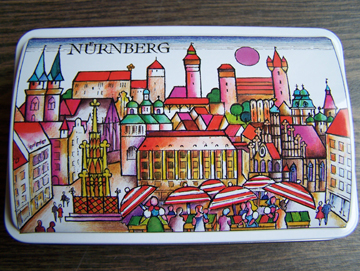
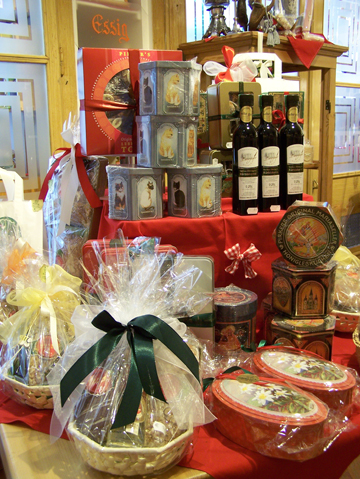
‘Tis the season when a young elf’s fancy turns to thoughts of gingerbread. Although these sweet-spicy cakes and cookies are popular year-round in many countries of Europe, they’re particularly associated with the winter holidays. Bakeries from Sweden to Slovakia to Switzerland turn out tons of commercial gingerbread products, often packaged in brightly colored wrappings and tin boxes. And home bakers dig through kitchen drawers and recipe files to find favorite cookie cutters and family recipes for their own Christmas gingerbreads.

Although flatcakes made with honey and spices were baked by the ancient Egyptians, Greeks, and Romans, the gingerbreads of northern Europe probably date only from the Middle Ages, when honey was still the main type of sweetener available locally, and exotic, expensive spices such as cinnamon, black pepper and ginger were increasingly being imported from faraway lands in the East. A taste for gingerbread eventually spread throughout Europe, with certain cities becoming known for their own particular types: Strasbourg and Dijon in France, Torun in Poland, Tula in Russia, Aachen and Nürnberg in Germany, Basel and St. Gallen in Switzerland.

MANY VARIETIES
Gingerbread recipes evolved over time and in diverse places. Various kinds of gingerbread were, and still are, made with different combinations of honey, sugar, flour, eggs, almonds, hazelnuts, walnuts, raisins, lemons, candied orange peel, candied citron, rosewater, rum, brandy, black pepper, ginger, cinnamon, nutmeg, cloves, allspice, cardamom, coriander, aniseed and saffron. Although these baked goods are often referred to as “gingerbread” in English, some of them don’t contain any ginger at all.

The variety of possible ingredients and textures causes some confusion about what “gingerbread” actually is. A cake, a cookie, or a loaf? Hard or soft? Thick or thin? Glazed or unglazed? Decorated with fancy frostings, or with fruits and nuts, or even with expensive gold leaf? At various times in its history, gingerbread has been all of these.

GERMAN GINGERBREAD
In the Middle Ages, the city of Nürnberg became one of the most famous places for making gingerbreads in Germany, where these seductive sweets have long been known as Lebkuchen (or sometimes Pfefferkuchen, when their spiciness comes from black pepper instead of ginger). Records show that Lebkuchen was being baked in Nürnberg as early as the 14th century. Traditionally, the stiff dough was pressed into highly detailed molds made of wood, metal, or terra cotta, which imprinted intricate designs on the Lebkuchen before it was removed from the molds and baked in a hot oven. Nürnberg Lebkuchen contained such costly ingredients, and was of such high quality, that it was accepted as payment for city taxes and given as gifts to nobles, princes, and heads of state.

Over time, as the prices of ingredients fell and the demand for Lebkuchen increased, faster production methods became necessary. The elaborate handmade molds were replaced by less detailed, often mass-produced, molds. Simpler decorations―such as nuts, candied fruit, and sugar frostings―were applied to the tops of many cookies. And the shapes were simplified, too, evolving into the basic human, animal, and geometric forms common today.

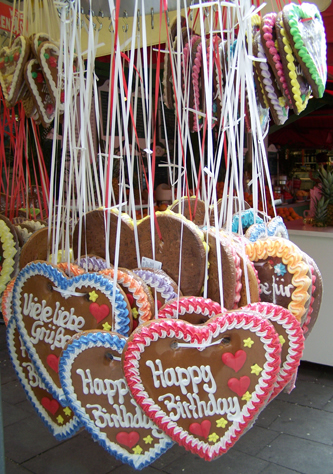
In the early 1800s, gingerbread houses became popular in Germany after the publication of the Grimm brothers’ fairy tale, Hansel and Gretel. And during the 19th century, ornately decorated Lebkuchen hearts also became the rage. Covered with fancy designs and romantic sayings made from colored icing, these large heart-shaped cookies were often exchanged between sweethearts. You can still buy them at almost every German festival and special market, including the Christmas markets held in many German cities throughout December.

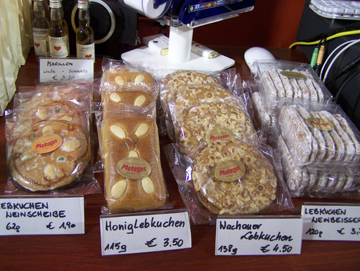
The Lebkuchen produced in Germany today comes in all sorts of sizes, shapes, flavors, colors and textures: rounds, rectangles, squares, hearts, stars, pretzel forms, St. Nicholas (for Christmas), lucky pigs (for New Year) and rabbits (for Easter). The Lebkuchen dough can be “white” (light colored) or different shades of brown. Some Lebkuchen are also covered with white or chocolate icing, and some are filled with marzipan or jam. Honey Lebkuchen is sweetened only (or primarily) with honey. Oblaten Lebkuchen are cookies with the dough mounded on top of a thin wafer before baking. And delicate, elegant Elisen Lebkuchen are made with at least 25% ground almonds, hazelnuts, or walnuts, and no more than 10% flour.

GINGERBREADS ACROSS EUROPE
You’ll also find similar spicy cookies of different shapes, colors and textures called Printen (in Aachen, Germany), Pfefferkuchen (in Pulsnitz, Germany), Spekulatius (in the German Rhineland), Leckerli (in Basel, Switzerland), Biberli (in the Appenzell region of Switzerland), speculaas Holland, speculoos in Belgium, pepperkaker in Norway, pepparkakor in Sweden, piperkakut in Finland, pebernǿdder in Denmark, pain d’épices in France, licitar in Croatia, mézeskalács in Hungary, perníky in the Czech Republic and Slovakia, pierniki in Poland and prianiki in Russia. Other towns and regions have their own specific names for the many varieties of gingerbreads produced there.

Europeans also use gingerbread cookies as ingredients in other dishes. You’ll find crumbled gingerbread used as a stuffing for pork and for pasta, as a thickener for sauces, a flavoring for soups, a crunchy texture in salad dressings, and a base for many puddings and desserts. There’s even a German-Italian “fusion” dessert called ” Nürnberger Tiramisu”! And for people who just can’t get enough of that sweet, spicy, Christmasy taste of gingerbread, the Belgians have recently invented a gingery, caramely speculoos spread, similar in texture to Nutella, made from crushed gingerbread cookies.

If I’ve whetted your appetite for these European gingerbreads, my best suggestion is to travel there and taste them for yourself. You can also mail order many of them from the websites listed below. Costard, the clown in Shakespeare’s play, “Love’s Labour’s Lost,” had the right idea when he said, “An’ I had but one penny in the world, thou shouldst have it to buy gingerbread.”

Nürnberg Lebkuchen information www.lebkuchen.nuernberg.de/englische_version/index.html

Lebkuchen-Schmidt, Nürnberg
ww2.lebkuchen-schmidt.com/eng_index.php

Metzger Lebkuchen, Vienna
www.lebkuchenmetzger.at/

Lebkuchen-Pirker, Mariazell, Austria
www.lebkuchen-pirker.at/home/index.php?&lang+eng

Kerner Lebkuchen, Mariazell, Austria
www.lebzelterei-kerner.at/index.htm

Lebkuchen-Gandl, St. Wolfgang, Austria
www.lebkuchen-gandl.com/

Appenzeller Biberli, Switzerland
www.baerli-biber.ch/

Basel Läckerli, Switzerland
www.laeckerli-huus.ch/

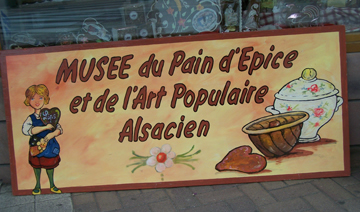
French-Alsatian Pain d’Épices
www.paindepices-lips.com
www.fortwenger.fr/

Alte Pfefferkuechlerei (small gingerbread museum in Weissenberg,Germany) www.museum.stadt-weissenberg.de/

Speculoos Spread
www.thenibble.com/zine/archives/speculoos-spread.asp

YouTube video about how to make decorated European gingerbread
www.youtube.com/watch?v=OVX5wiv_oMk

American online sources for ordering European gingerbreads
www.germandeli.com
www.germangrocery.com

Grand Hotel Kempinski

In a class all its own

By Ursula Vonplaten
Photo courtesy Hotel Kempsinski

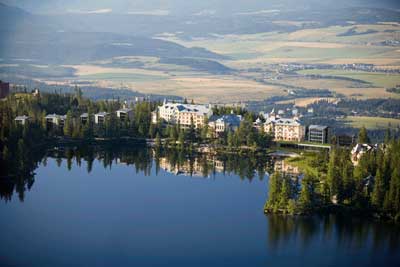
Slovakia’s first five star luxury hotel, the Grand Hotel Kempinski High Tatras, opened in May.

The hotel is located on the shores of an alpine lake, 4,400 feet above sea level in the spectacular High Tatras Mountains in Strbske Pleso. The mountains are the natural border between Poland and Slovakia, forming the central section of the Carpathian mountain range, where the air is said to be pure and medically beneficial.

The historic hotel, originally built in 1906, has been completely restored. The 98 spacious rooms and suites offer views either over the alpine lake, the mountains or the vast valley; some even feature private winter gardens.

The hotel provides international and Mediterranean cuisine in its all-day dining Grand Restaurant, focusing on local specialties, prepared by a team of international chefs.

For conferences, meetings and other occasions, the hotel has two ballrooms which can cater for up to 150 people. Apart from exploring the surrounding nature on foot or mountain bike, the area is ideal for cross-country and downhill skiing, horseback riding, or tours with horse carriages or snow scooters. Bungee jumping and paragliding, bear-watching expeditions and hot-air ballooning are also available and can all be arranged by the hotel’s concierge. For young guests, special amenities and services are available, including a professionally run Kids’ Club with many activities to keep children entertained while their parents relax.

The Wellness & Spa offers a variety of Thalgo and Terrake facial and body treatments. The facilities include several saunas, themed showers, a private VIP spa suite, seven treatment rooms and a vitamin bar. Indoor pools with views over the lake and mountains bring the natural environment into the spa.

From now through the end of June, guests can take advantage of a special opening rate of 160 EUR for a single and 180 EUR for double occupancy per night, including taxes, buffet breakfast and access to the wellness and spa area.

The Grand Hotel Kempinski High Tatras can be reached by road, rail or air. The nearest international airport is Poprad-Tatry; Kosice Airport is 93 miles away. Limousine transfers as well as helicopter pickups from Bratislava and Vienna are available.