INGREDIENTS l lb. of each: raisins, currants, golden raisins, breadcrumbs, brown sugar 8 oz. suet 4 oz. each: mixed peel, glace cherries chopped, almonds chopped 1 each: lemon – grate rind, orange – grate rind, carrot – grated, apple – grated 1 tbs. flour 1 tsp. mixed spice Pinch salt 6-8 eggs 10 oz. stout (bottle) or dark beer (Guiness is good) OR 5 ozs. each: brandy and milk
PREPARATION Mix dry ingredients first then mix with lightly beaten eggs & liquid. Grease the bottom of a bowl large enough to hold pudding and press mixture into it. Place wax paper over the top and then foil over that, crimping it around the edges to keep firm. Either cook for 2 hours in pressure cooker with about 2 inches water or put in pan with water on stove for 4 hours. Keep checking water in pan to prevent burning. Store well wrapped for as long as possible for better flavor. Some people make them one year to eat the next. Serve with hot custard, cream, or brandy sauce.
Why steam for so long? Christmas puddings are quite dense because of all the fruit, nuts, etc. they contain. Steaming is the best method of cooking because it allows a slow cooking which ensures a moist and palatable result (cakes being less dense can cook for less time and still remain moist, so baking is the best method). If you used a faster cooking method for a Christmas pudding you would get a crusty pudding. A pudding steamed for 2 hours, rather than 4, would probably still have some uncooked mixture in the center. So, while the cooking time obviously depends on the size of the pudding. (This is when it is cooked on the stove – not the pressure cooker) Related: Quick Christmas Pudding Recipe used by kind permission of Hazel Whyte
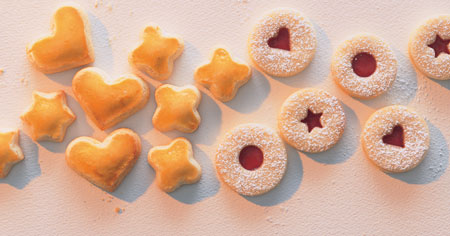
Two famous Swiss Christmas cookies: on the left are the Mailänderli, on the right, Spitzbuebli. Both will be devoured throughout Switzerland this season. Courtesy Swissmilk.ch/Ursula Beamish
by Sharon Hudgins
Christmas is my favorite holiday season in Europe. Advent, the period leading up to Christmas itself, begins on November 30 or on the fourth Sunday before Christmas, whichever comes first on the calendar. And in most places, the Christmas season doesn’t end until six weeks later, on January 6, known as Three Kings Day (or Epiphany).
Special foods are prepared and eaten at this time of year, some of them with roots in Europe’s pre-Christian past. During the cold, dark days leading up to the winter solstice (December 21 or 22) and Christmas (December 25), people have a natural craving for caloric cookies, cakes, and confections to tide them over until warmer, sunnier weather arrives. Yet not so long ago, Advent was a time of fasting for members of the Catholic Church, which forbade the consumption of butter, eggs, and other animal products during this holy period, in solemn preparation for the coming of the Christ Child.
Today, only a few people still deny themselves such temptations during the days leading up to Christmas. In many parts of northern Europe the annual Christmas baking binge begins as early as October, when home cooks make hundreds of cookies and dozens of cakes and puddings whose flavors are better if they “ripen” for several weeks before serving. Commercial bakers and confectioners hire extra help to produce thousands of holiday sweets for this most lucrative quarter of their business year. And colorful open-air Christmas markets in large cities and small towns sell the seasonal specialties of their own particular region.
Bakers in the British Isles start making their Christmas puddings several weeks or even months in advance of the special December day. Old-fashioned Christmas Plum Pudding—originally made with mutton, beefsteak, and fruits, including plums—has morphed in modern times into a dense, rich, dessert full of currants, raisins, and sultanas, with mixed fruit peel and candied cherries, steamed in a covered bowl and served with a brandy hard sauce made from sugar, butter, and brandy beaten together until fluffy. A sixpence coin is cooked inside the pudding, which supposedly brings good fortune to whoever finds it in his or her serving.
Also popular in Britain are a variety of fruit cakes, sometimes covered with a layer of marzipan and decorated with marzipan “fruits” and sprigs of holly—and small mince pies, their pasty cases filled with a fruity mincemeat mixture of apples, raisins, currants, sultanas, almonds, beef suet, brown sugar, and several spices. In earlier times, the oval shape of these mince pies was said to represent Christ’s crib, with the spices symbolizing the gifts from the East that the Three Kings brought to Bethlehem.
In Scotland, slices of densely textured Dundee Cake, filled with dried and candied fruits and decorated with almond halves on top, are served on “Boxing Day” (December 26). Buttery Scottish shortbread, taken with a dram of Scotch whisky, is traditional for the New Year. And in Ireland the holiday season is the time for loaves of fruit-and-nut-filled breads, as well as several kinds of round or oblong puddings made from wheat or potato doughs, sugar, spices, and dried fruits, wrapped in a cloth and boiled in a big cooking pot.
In the Scandinavian countries the Christmas season begins on St. Lucia’s Day (December 13), which is celebrated with coiled yeast buns colored with saffron. You’ll also find a number of yeast-raised Christmas breads (Julekaka, Julekage) made with plenty of butter and eggs, filled with raisins, nuts, and candied fruits, and seasoned with cardamom. Norwegian Almond Ring Cake (Kransekake) is a tower of baked almond-paste rings, the largest on the bottom and the smallest on the top, fancily decorated with white icing. Crispy molasses-spice cookies called pepparkakor are popular throughout Scandinavia, where they’re made in many holiday shapes and sometimes hung as ornaments on the branches of a special “pepparkakor tree” made of wooden dowels. And a traditional Christmas Eve dessert is rice pudding, with a whole almond hidden inside. Whoever finds the almond will be married before the next Christmas (in Sweden) or will have a series of lucky adventures throughout the coming year (in Denmark).
The Netherlands, Belgium, and northern Germany are home to crispy brown Christmas cookies known as Speculaas or Spekulatius, the dough spiked with ginger or black pepper and pressed into special wooden molds that outline the cookies’ shapes and imprint designs on them. Cookies in the form of windmills and little sailor boys are especially popular. And throughout all of Germany, the Christmas season seems to bring out the best in home bakers, whose kitchens are filled with the aromas of sugar, yeast, spices, nuts, and candied fruits combined in myriad ways to produce some of Europe’s best-known holiday treats.
German gingerbread cookies (Lebkuchen) have been famous throughout Central Europe since the Middle Ages, especially those from the city of Nürnberg. The stiff dough made of rye or wheat flour, honey, almonds, hazelnuts, finely chopped candied fruit peel, and spices—ginger, cinnamon, nutmeg, cloves, allspice, cardamom, and coriander—is pressed into wooden molds that imprint intricate designs on the cookies. Other Lebkuchen cookies are made in simple shapes—circles, hearts, squares—and decorated with white or chocolate icing. No German Christmas season would be complete without plenty of Lebkuchen to nibble on during the entire six weeks from Advent to Epiphany.
Other traditional German Christmas sweets include flat, white, anise-flavored cookies (Springerle), made with pretty designs printed on them with wooden molds; spicy, round “pepper nuts” (Pfeffernüsse) containing ginger or black pepper; six-pointed “cinnamon stars” (Zimtsterne), redolent of that spice and covered with thick white icing; marzipan confections made of sweetened almond paste, shaped and colored to resemble tiny fruits, vegetables, animals, and other figures; Stollen, an oblong fruit-nut-raisin bread covered with a thick layer of confectioners’ sugar and said to represent the Christ Child in swaddling clothes; and Striezel, a braided bread whose three strands of dough symbolize the Holy Trinity.
Holiday treats very similar to these can be found throughout Switzerland, Austria, the Czech Republic, Slovakia, Poland, and Ukraine. Many Poles and Ukrainians also begin their Christmas Eve dinner with kutia, an ancient kind of pudding made with whole wheat grains boiled with honey, figs, dates, raisins, nuts, lemon peel, and poppy seeds. And they conclude the meal with a sweet compote containing twelve kinds of dried fruits, symbolizing the Twelve Apostles. In Hungary, poppy-seed rolls and cakes are popular at this time of year, harking back to the pre-Christian era when the tiny seeds were eaten as a fertility charm on the night of the winter solstice to ensure a bountiful harvest in the coming year.
Christmas traditions are a bit different in the Latin lands. In France, especially in the south, it’s customary to have thirteen desserts for the Christmas Eve dinner that follows Midnight Mass—including fruits, nuts, dates, marzipan, nougat, and always a “Jule log cake” (Bûche de Noël), a long cylindrical cake rolled up around a buttercream filling and decorated on the outside with chocolate icing swirled to look like tree bark, with marzipan “leaves” and meringue “mushrooms” attached to the log-shaped cake. The French end the Christmas season with the celebration of Three Kings Day (January 6), when they eat a special “kings’ cake” (galette des Rois), a round, somewhat flat, golden-colored cake made of puff pastry, often enriched with an almond-paste filling, which has a single bean or a porcelain or plastic good-luck charm baked into it. Whoever finds the charm in his or her piece of cake becomes king for the day and gets to wear the gold-foil crown that was perched atop the cake when it was served.
In Italy, bakers turn out a number of yeasty Christmas breads (pane di Natale), full of butter, eggs, nuts, raisins, and dried and candied fruits. Particularly popular throughout the country is panettone from Milan, a tall, delicate, dome-shaped yeast bread studded with raisins, almonds, and candied orange peel. The northern Italians like their own Alpine fruit bread (Zelten), another yeast-raised bread chock full of dates, sultanas, candied citron, almonds, walnuts, and pine nuts, scented with cinnamon and cloves. The Italian sweet tooth finds satisfaction in all the confections traditionally eaten during the Christmas season, too, including chewy almond nougat (torrone) and marzipan; candied orange halves, candied pumpkin slices, and candied whole chestnuts; and medieval panforte from Siena, a flat, dense, highly spiced, confection-like fruit-and-nut cake containing almonds, hazelnuts, walnuts, pine nuts, honey, candied fruit peel, cinnamon, cloves, white pepper, and coriander seeds. And on Three Kings Day the Italians eat puff pastries filled with apricot preserves, as well as a type of sweet focaccia (flat bread) with a single black bean baked inside for the lucky eater who finds it and gets to be “king for the day.”
The Christmas season in Spain is a time for consuming large quantities of the confections for which the country is famous: marzipan from Toledo, often formed in fanciful shapes and sometimes decorated with white icing and colorful candied fruits; almond nougat (turrón), the hard variety from Alicante and the soft version from Jijona, as well as numerous other types of turrón containing hazelnuts, pine nuts, coconut, and chocolate; candied chestnuts; sugar-coated almonds; candied fruits and dried dates; the rich chocolates for which Spain is gaining an international reputation; and “fig bread” (pan de higos), a thick, chewy confection of dried figs, hazelnuts, almonds, and sesame seeds, flavored with grated orange peel and anise liquor.
The special meal on Christmas Eve in Spain often concludes with a sweet soup made of ground almonds, walnuts, or chestnuts, sprinkled with cinnamon. But for children the main event of the holiday season is Three Kings Day, when they receive gifts from the Magi who carried presents to the baby Jesus. As in other Latin countries, the traditional sweet is Three Kings Cake (Roscón de Reyes), a ring-shaped cake studded with raisins, nuts, and candied fruit, and with a coin, a bean, or a small toy baked into it—the lucky charm for the finder, who then gets to wear a king’s paper crown for the rest of the day.
The holiday season in Greece is also a time for indulging in sweets: pencil-thin bread-dough fritters fried in olive oil and drizzled with honey; coiled flaky baklava filled with ground almonds and roasted chick peas; spice cookies made with cinnamon, cloves, and olive oil, then soaked in a sweet syrup; delicate ground-almond cookies (kourabiedes) covered with a thick coating of confectioners’ sugar and with a whole clove baked inside to symbolize the spices that the Three Kings brought to the Christ Child.
Many kinds of special Christmas breads (Christópsomo) are baked in Greece during this season, too. Depending on each family’s own traditions, the Christmas bread might contain walnuts, almonds, raisins, dried figs, lemon or orange zest, cinnamon, cloves, coriander seeds, black pepper, and aniseeds. The shapes of these breads vary according to family preferences, too, as do the decorations on top, which range from symbolic shapes made of dough to sugar glazes and garnishes of chopped candied fruits. After the midnight church service on Christmas Eve, the family and guests gather around the table to share the Christmas bread. The first piece is set aside for Christ, and the rest is distributed among the diners, one of whom will find a coin baked into the bread, bringing that person the blessing of good luck. And on New Year’s Eve, the Greeks share another special bread called Vasilópita (St. Basil’s Bread), a yeast bread flavored with aniseeds or mahlepi seeds, honey, olive oil, and grated orange zest, sprinkled on top with sesame seeds and often decorated with the number of the new year made out of dough. The head of the household breaks the bread at the last stroke of midnight, giving a piece to each person at the table—and whoever finds the coin baked inside will have good fortune throughout the year.
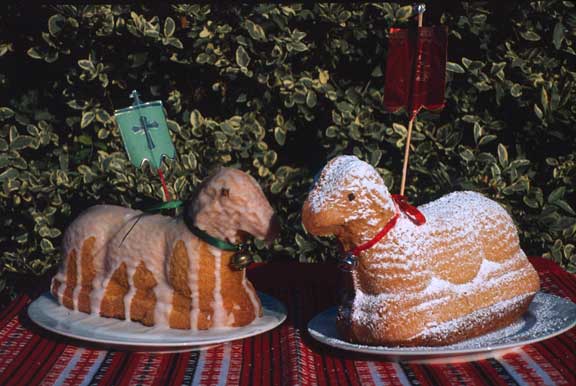
Lamb-shaped cakes and breads for Easter are made in the Alsace region of France, as well as in Germany, Austria and Eastern Europe. Photo by Sharon Hudgins
by Sharon Hudgins
When the Easter season approaches, European kitchens are filled with the yeasty aromas of freshly baked breads, as cooks all over the Continent prepare the special loaves and buns traditionally associated with this important religious holiday.
In the past, devout Christians observed a strict fast during Lent, the six or seven weeks before Easter, when they abstained from eating animal products of any kind: red meat, poultry, milk, butter, lard, cheese and eggs.
In some parts of Europe, even sugar, honey, olive oil, and certain kinds of fish were on the list of forbidden foods. When Easter finally arrived, people celebrated with a huge meal featuring dishes made from all the ingredients that had been prohibited during Lent. Even though few people follow such strict fasts today, the tradition of feasting on special foods at Easter is still an important part of many European cultures.
Rich, yeast-raised breads full of milk, butter and eggs are an essential element of the Easter meal in most European countries. Often the breads are made in symbolic shapes and elaborately decorated with sugar icing, candied fruits or colored eggs. Homemade or bakery bought, these breads represent a continuity of traditions from centuries past, including much earlier, pre-Christian times.
Different countries, regions and towns of Europe have their own characteristic breads baked especially for Easter. In some places, these special breads are taken to church to be blessed at the Easter midnight mass or the Easter Sunday morning service, before proudly being displayed on the festive dinner table at home. And in Russia and many Eastern European countries, the table also has a little three-dimensional lamb modeled out of butter, for spreading on the bread after it is cut.
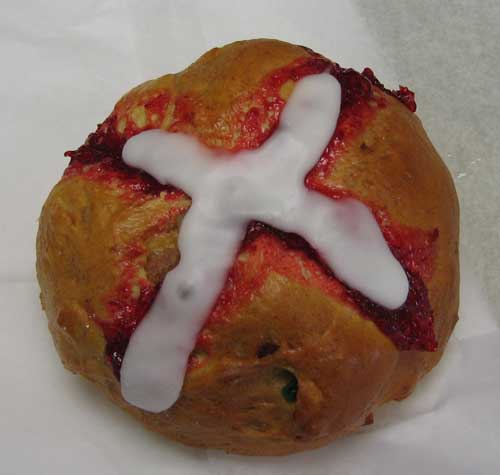
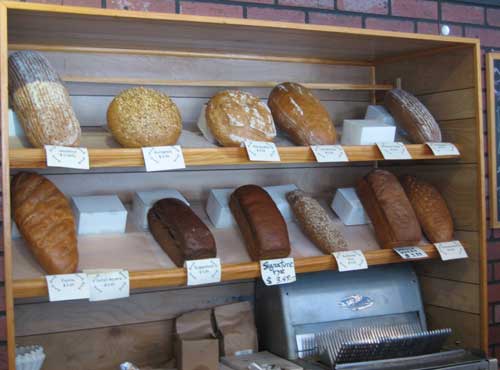
Hot cross buns are an Easter favorite.Breads of all kinds are offered at Easter-time; these were baked by Michael Mikusch at his Austrian bakery.
GERMANY AND CENTRAL EUROPE
Bakers in Germanic communities make Easter breads in a variety of shapes, secular and religious. Breads shaped like rabbits, lambs, baby chicks and fish are symbols of springtime, fertility and birth. Braided loaves—long and straight, round or wreath-shaped—are made with three strands of dough representing the Holy Trinity of Father, Son and Holy Spirit. Germans and Austrians make several versions of Osterzopf (Easter braid), Osterkranz (Easter wreath or crown), and Striezel (stacked braided bread), as well as Osternester (Easter nests) or Eier im Nest (Easter-egg nest) with white or colored hard-boiled eggs surrounded by the dough. The circular braided Osterkranz is also symbolic of Christ’s crown of thorns, and the red-dyed eggs decorating many Easter breads are said to represent Christ’s blood and resurrection—although the egg’s significance as a symbol of rebirth and regeneration actually dates further back in time to the pre-Christian era.
Other special Germanic Easter breads include the Osterfladen—a flat, rectangular bread with a sweet filling of apples, raisins and almonds—and several varieties of Osterbrot (Easter bread) flavored with raisins, currants, candied orange peel, grated lemon zest, anise and cardamom. The Osterkarpfen (Easter carp) is a bread shaped like a fish, glazed with white icing, and studded with sliced almonds to represent fish scales. Germans also make Osterkorbe breads formed like Easter baskets and rabbit-shaped Osterhasen breads, all of them holding real or candy eggs. And the Eiermännle (Little Egg Man) is a flat bread shaped like a boy or man, with an unshelled hard-boiled Easter egg baked in the center of his body or inside a basket that he carries on his back.
Lamb-shaped cakes and breads can be found at Easter-time from Alsace to Austria, from Germany to the Czech Republic, Poland, Slovakia and Hungary. Baked in three dimensional metal or pottery molds, these represent Christ as the sacrificed Lamb of God, although their origin can probably be traced to earlier, pre-Christian rites in which baked dough effigies of sacrificial animals were substituted for live animals. Lamb breads are made from the same kind of sweet, yeast-raised doughs used for Alsatian Kugelhopf, Austrian Gugelhupf,and Polish baba (or babka). The cake versions are made from a simple white cake batter, although both chocolate and marble (mixed chocolate and white) lamb cakes sometimes show up in the flocks of Easter lambs sitting in bakery windows at this time of year.
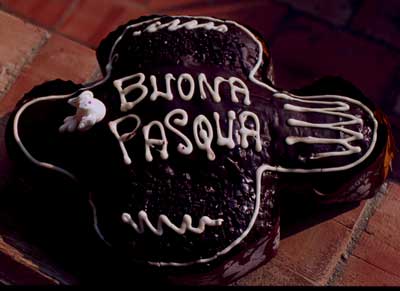
The simplest lamb breads and cakes are merely dusted with a coating of confectioners’ sugar or drizzled with a light glaze of sugar icing. More elaborate cakes are covered with fluffy white frosting, sometimes garnished with shredded coconut, or spread with chocolate icing decorated with white icing swirls. The eyes are made from raisins, whole cloves, or coffee beans, and a small silk ribbon, often with a tiny bell attached, is tied around the lamb’s neck. Many of these lambs also hold a colored foil banner bearing the emblem of a lamb or a cross—recalling similar banners carried by Christian crusaders to the Holy Land a thousand years ago.
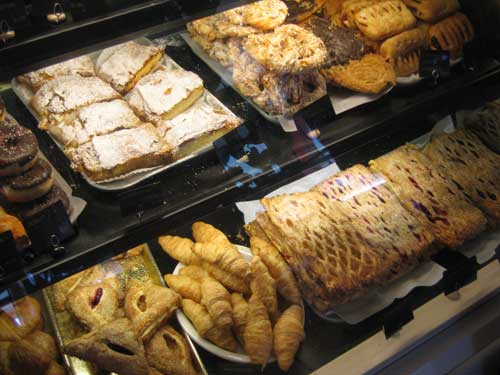
When you’re in Europe around Easter, look for the special Easter breads in local bakeries. You’ll likely be tempted by all the good pastries as well.This shop offers Austrian breads and pastries which are as good as they look.
ITALY
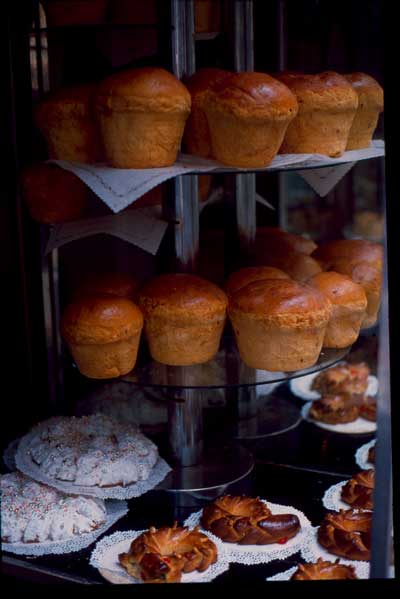
Italy offers a rich variety of regional Easter breads, including Genoa’s pane dolce (sweet bread) full of raisins, candied fruit peel and pine nuts; Umbria’s cylindrical, cheese-flavored crescia; Venice’s large fugassa di Pasqua buns; and Cesenatico’s ring-shaped ciambelle, seasoned with anise and lemon peel. In Sicily, the edible centerpiece of the Easter meal is a large yeast bread shaped like a crown, with colored hard-boiled eggs embedded in the top. In some parts of Italy an old custom is still followed when Easter breads are made: the shell of the first egg put into the dough is cracked on the head of a young boy—supposedly to keep bad luck at bay.
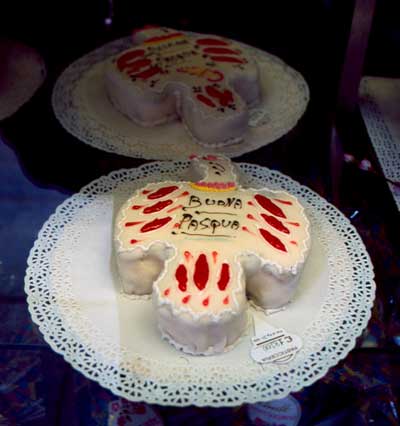
The Easter bread most popular throughout all of Italy is a specialty originally from Lombardy—the columba di Pasqua (or columba pasquale), a sweet yeast bread full of candied orange peel, raisins, and almonds, made in the shape of a dove. Some of the fancier columbe have pockets of orange- or champagne-flavored pastry cream inside. Others are made with swirls of light and dark (chocolate-flavored) dough, like marble cakes. The plainest ones are garnished with only a simple sugar glaze, but the more elegant columbe are elaborately decorated with almond paste, white or pastel icing, chocolate, nuts or sugar-paste flowers.
(bottom left and right) Italian Easter dove cakes (columbe di Pascua) are a symbol of springtime, the Holy Spirit, and peace.; Italian cheese-flavored crescia loaves for Easter, at a bakery in Umbria
GREECE
Maundy Thursday, three days before Easter, is the time when Greeks bake their holiday breads. Known as tsoureki or lambropsomo, these sweet, eggy breads are traditionally flavored with mahlepi, an unusual spice made from the finely-ground seeds of a type of cherry. Other Greek bakers add mastikha, pulverized crystals of sap from mastic shrubs that grow on the island of Chios. Cinnamon, nutmeg, cardamom and allspice can also go into the dough, as well as orange and lemon peel.
Greek Easter bread is made in different shapes from one region to another: a long braid, a braided wreath, a round loaf with bread-dough decorations on top in the form of leaves, flowers or a Byzantine cross. Each shape has its own symbolism. The three strands of braided dough represent the Holy Trinity. Wreaths and rings not only recall Christ’s crown of thorns but are also pre-Christian fertility symbols. Round shapes represent the life-giving sun, rebirth and resurrection. And no Greek Easter bread would be complete without one or more red-colored eggs—customarily dyed on Maundy Thursday—pressed into the top before baking.
SPAIN
The Spanish corona de Pascua (Easter crown) is another bread whose shape and symbolism is similar to Easter breads in many Mediterranean countries. Made from a sweet yeast-raised dough, the corona de Pascua is flavored with raisins, almonds, candied fruit peel, lemon and olive oil. Three strands of dough are first braided together, then formed into a ring. Whole, hard-boiled eggs are nestled into the top of the braid, usually one egg for each member of the family. Some people leave the eggshells white; others dye them red or a variety of spring colors.
Another Spanish Easter bread known as monja (nun) probably got its name from the nuns who traditionally baked breads, pastries and confections to sell from behind their convent walls. This orange-flavored bread—much like ones also found in Greece, Macedonia and Bulgaria—is round in shape, with a cross made of bread dough on top and four red-dyed eggs embedded at each point of the cross.
In the Castile region of Spain, Easter is celebrated with a large round loaf of bread in which shelled hard-boiled eggs, diced bacon,and chunks of Spanish sausages were imbedded in the dough before baking. And at Easter-time in some parts of Spain, godparents give their godchildren tortas de aceite, small savory buns made from yeast dough seasoned with orange, anise, and olive oil, with a single hard-boiled egg nestled in the center.
RUSSIA AND UKRAINE
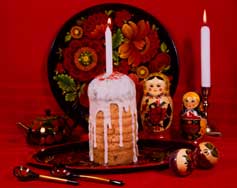
Since Easter is a springtime celebration of new life, it’s not surprising that many traditional Easter breads are made in the form of ancient fertility symbols. The most graphic of these are the tall, cylindrical breads with a puffy dome on top, whose phallic symbolism is unmistakable. Festive breads of this shape are made in both France and Italy, but the most famous is Russia’s kulich, a saffron-scented yeast bread flavored with raisins, almonds and candied fruit peel. The domes are frosted with white icing that dribbles down the sides in a further reinforcement of the fertility image. The kulichi can also be decorated with colored sugar sprinkles or candied fruits, and a long thin red candle is usually stuck into the top of the dome. On Easter, Russian Orthodox churches are often filled with these special breads, their candles lighted, awaiting blessing by the priest.
Velikodnia babka is the Ukrainian version of this tall, yeasty Easter bread, with raisins, almonds and candied peel kneaded into the dough. Another traditional Ukrainian Easter bread is velikodnia paska, made from a rich yeast dough containing plenty of butter, sugar, and eggs, and shaped into large rounds. The tops are fancily decorated with ornaments made out of dough, usually with a cross as the center motif surrounded by elaborate swirls, small birds, leaves,or flowers. Perekladnets is a special, colorful Easter treat, a kind of coffee-cake loaf made with lemon-scented yeast dough and three different layers of filling: chopped dried peaches or apricots with candied fruits; chopped figs, dates and walnuts; and chopped almonds with candied cherries.
Russian kulich, a tall cylindrical Easter bread often baked in a coffee can.
GREAT BRITAIN
Hot-cross buns are the most typical Easter bread in Great Britain. Baked on Good Friday, these round, slightly sweet buns often have chopped fruit peel and currants, raisins or sultanas in the dough. A cross is cut into the top of each bun before baking, or a strip of dough is used to make the form of a cross on top, to keep away evil on this sad day of remembering Christ’s crucifixion.
In some parts of Britain, a hot-cross bun is hung up in the house to keep away bad luck (fire, theft, illness) until Good Friday of the following year. Buns are also hung in the barns to protect the grain from rodents. As in the rest of Europe, these British hot-cross buns are an example of the powerful symbolism of breads baked for the Easter season.
Sweet juicy plums. Pungent goat cheeses. Briny black olives. Homemade pâtés studded with pistachios. Paper-thin slices of farmhouse cured ham. Multi-grain buns and rosemary-scented flatbreads. Chestnut honey and walnut tartes.
Are you hungry yet?
On my first trip to Europe many years ago, I became hooked on shopping for food at the colorful local markets. Not the sterile supermarkets or gargantuan hypermarkets of today, which, except for the package labels in different languages, could be anywhere in the developed world. The markets that captured my imagination—and still keep drawing me back—are the ones where fresh foods are sold by individual vendors hawking their wares from wooden stalls, customized vans, folding tables, or even blankets spread on the ground.
I go. I see. I buy. I eat.
TYPES OF MARKETS These food markets can be entirely outdoors, in the open air; or inside a cavernous covered market building; or in a combination of settings, with an indoor market surrounded by an open-air market that varies with the season. They can be permanent markets, operating year round at the same location, usually with the same vendors; or temporary events occurring only on specific days, once or twice a week, in a public square or country field, with local vendors as well as those who travel from one market to the next to sell their goods.
Some are truly farmers’ markets, where all the fruits, vegetables, meats and cheeses were grown, raised or processed by the people selling them. Others are outlets run by middlemen selling foods from a variety of suppliers, from small-time farmers to larger commercial companies. And some are a mixture of both.
London, Paris, Vienna, Madrid, Rome, and other major cities have many of these food markets located in neighborhoods throughout each metropolis. Smaller towns might have only one central market, whereas in a village there might be an open-air market only once a week, usually on Saturday. Check with the tourist office for the locations, dates and opening/closing times.
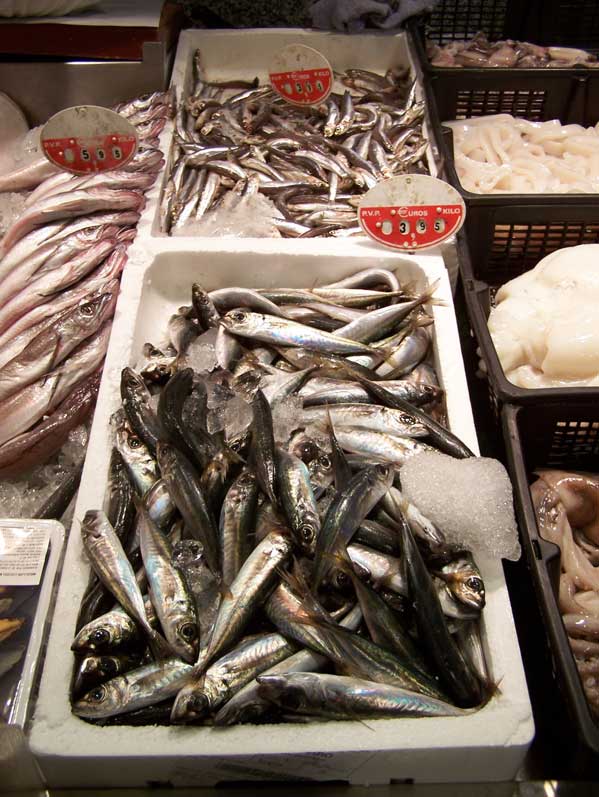
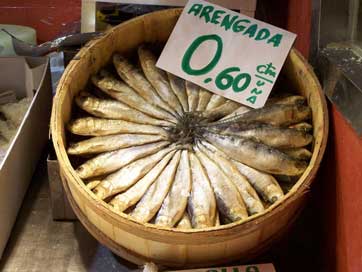
LOCAL SPECIALTIES, GLOBAL CHOICES At these markets you can see, smell and taste authentic local and regional specialties, some of them found nowhere else. In different regions of France, I’ve bought farmhouse cheeses made just down the road and jams preserved by the woman selling them. In Sicily and Greece, I’ve wandered through markets stocked with fish caught that morning in the nearby seas. At German markets I’ve left with my shopping bags filled with potatoes and apples grown in the surrounding fields, and with big loaves of rye bread still warm from the wood-fired oven in which they were baked.
A visit to a large metropolitan market can also be a lesson in globalization. In addition to local Catalan and regional Spanish food products, Barcelona’s big Boqueria covered market also sells hot sauces from the USA, moles from Mexico, and guavas from South America. At Munich’s central Viktualienmarkt, you’ll find not only Bavarian meats and cheeses but also chermimoyas from North Africa, hot chiles from Southeast Asia, and exotic tropical fruits from the Philippines.
Each season brings its own specialties to European markets: strawberries, cherries and asparagus in spring and early summer; raspberries and blueberries later in the summer; mushrooms, apples and pears in the autumn; and oranges, nuts, and root vegetables in winter. Of course markets have more fresh produce during harvest time from spring through early autumn. And on any day you’ll always find the best selection early in the morning, just after the market opens.
LOOK, DON’T TOUCH European markets are a great place to buy food for a picnic in your hotel room or in a park on a pretty day. Some even have a section with tables and chairs for public use, and German markets often include a beer garden on the premises, where you can bring your own food.
Tips: Always carry a shopping bag for your purchases. When you stop at a stand to buy fresh fruits or vegetables for your meal, don’t poke around in the produce and pick your own selection. At most markets, customers are expected to tell the vendor what they want, and the vendor chooses the best pieces, based on their ripeness and good condition, then weighs out the amount requested.
Don’t let your lack of the local language deter you from shopping in Europe’s food markets. Just point to the particular food you want and write the amount on a slip of paper: 100 grams (about one-fourth of a pound), 500 grams (close to a pound), 1 kilo (a bit over two pounds). Better yet, learn some basic numbers in that foreign language and let the product labels in the market teach you the names of the foods you want to eat. Soon you’ll be shopping like a European yourself.
A luxurious learning experience complete with a guide from London’s National Gallery
The Orient Express is launching a series of special vacation packages called “The Art of Travel,” including tours to Venice, Paris and within England. Travelers will learn about the lives of artists such as Canaletto, Bellini, Titian, Veronese, Monet, Rubens, Turner and Constable while seeing the places that inspired their work and visiting the places that house their work today, accompanied by an expert from London’s National Gallery.
All tours include at least one night at London’s Goring Hotel and begin at The National Gallery, where a specialist will give a guided introduction to selected masterpieces before the journey begins. Trips include:
THE VENICE OF CANALETTO: This seven-day tour will give travelers the opportunity to view Venice through Canaletto’s eyes. Travel from London aboard the Venice Simplon-Orient-Express through France, the snow-capped Alps and northern Italy. While in Venice, guests stay at the Hotel Cipriani and trace the footsteps of Canaletto, who is forever associated with magnificent Venetian views. Trips are limited to 20 people and depart on April 9, October 8 and October 22, 2011.
VENETIAN PAINTERS: This is a six-day tour that introduces the traveler to the great Venetian masters, from Giovanni Bellini and Titian to Veronese. Starting in London with a tour and dinner at the National Gallery, travelers will fly to Venice, where they will step back into the Italian Renaissance and explore great sights such as the Doge’s Palace, the Accademia and Ca’ Rezzonica with an expert from the National Gallery. The journey ends with a return to London on the Venice Simplon-Orient-Express. The trip is limited to 20 people and departs on April 30, 2011.
IMPRESSIONS OF PARIS: Also offered will be a series of five-day tours focusing on French Impressionism, where travelers will trace Claude Monet’s long, dynamic life and will learn about the birth of a new artistic movement, when painters first began painting in the open air to capture the effects of light. From London, guests board the Venice Simplon-Orient-Express and can marvel that two of the restored carriages aboard the Art Deco train were already carrying passengers when Monet was producing his last masterpieces. Departures are April 9, May 7, June 25, July 27, August 24, September 24 and October 22, 2011.
BRITISH PULLMAN: These tours combine the thrill of a steam-hauled luxury train, complemented by gourmet dining — brunch on the outbound journey and a three-course supper on the return — with delightful scenery and include visits to Bath’s finest art collections.
Collectors and Collecting: This trip is timed to coincide with the reopening of the Holburne Museum in May 2011 following a major restoration. After a guided tour of the museum, there will be a tour of “Beckford’s Bath,” including the eccentric William Beckford’s house and the grounds leading up to Beckford’s Tower. The trip will depart on June 28, 2011.
Thomas Gainsborough: This journey focuses on landscape paintings by notable British and European artists including Rubens, Turner and Constable. Highlights include the new exhibition “Gainsborough’s Landscapes: Themes and Variation,” at the Holburne Museum and a walking tour of artists’ Bath. This tour will depart on October 11, 2011.





 European Traveler