InterContinental Hotel at Frankfurt City Center

By Don Heimburger
Photos by the author

I haven’t been to perhaps more than six InterContinental hotels in my lifetime, but I have to admit that each one more than exceeded my expectations.

Many are oases in the middle of busy cities, with street noise and lots of hustle and bustle; yet, entering the lobby of the Frankfurt (Germany) hotel, I found myself already starting to relax.

The Frankfurt City Center hotel on Wilhelm-Leuschner Strasse, managed by Thomas Hilberath, who has a knack for pleasing his upscale guests, attracts a clientele with above average income. This includes many businessmen, but also leisure travelers, who come to Frankfurt to take in the sites. And when the annual Christmas Market begins in Advent, it’s just a 15 minute walk from the hotel to the Roemer Platz, where this popular event is held.

BUSY LOBBY
The lobby exudes a warm atmosphere and is a very busy place at 10 a.m., with professionals having discussions in the hotel’s lobby lounges. At the same time, bags await transfer to waiting cabs, and the hotel staff keeps busy helping guests find directions, check out and check in.

This 21-story hotel towers above the Main River and affords spectacular views of the city center as well as the Main. One of my night shots of the river from the top floor could probably win a prize.

The 770 rooms available are classed as standard, deluxe and suites, and a different range of services and room footage come with each type of room.

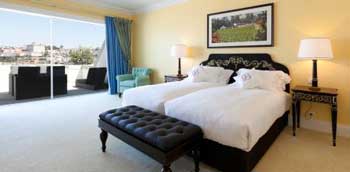
From my corner room I got a sweeping view of the skyscrapers from one set of windows and what was going on near the river on the other side of the room out the other windows.

Standard rooms of 280 square feet feature warm room colors and are equipped with high-speed internet connections. Bathrooms feature a black and cream and gold design. Bathrobes, hair dryers, in-room safe, coffee maker/tea-maker, mini-bar and iron/ironing board are featured in all standard rooms, as is a work desk, television with cable and satellite channels.

Deluxe rooms are on the 19th and 20th floors of the River Wing (the hotel has two wings, one across the street from the other), and measure about 540 square feet. There is turn-down service at night, complimentary morning newspaper and a separate check-in area at the front desk for these guests. Deluxe rooms also feature a separate sitting area, and the bathrooms are roomier and even more upscale with more features. A valet service is also available in Deluxe rooms.

The Panorama Suites feature an elegant living room, a more luxurious bedroom, a whirlpool and even a complimentary meeting room.

24-HOUR FITNESS ROOM
Strolling around the hotel, you’ll find a 24-hour health-fitness center on the ground floor, which is complimentary; massages, manicures and facials can be arranged. The business center offers high speed internet and wireless LAN in public areas such as the hotel lobby.

On the 21st floor is the Club InterContinental Lounge for guests of this floor. The bar on the first floor, which takes its name from the German stock market index, DAX, and Frankfurt’s skyscraper-inspired nickname, DAXx Mainhattan’s Bar, is located just off the lobby and stays open until 1 a.m.

Two restaurants offer guests modern cuisine as well as Italian specialties. Signatures Veranda Restaurant features a fusion of haute cuisine from across Europe, with a menu to suit every palate featuring varying themes. Regional dishes, steak, or fish are available and served in the private dining room, summer terrace or veranda, depending on the weather. The dining room is also where breakfast is served.

Breakfast is a hearty meal, with juice, eggs, scrambled or to order, sausages, bacon, potatoes, toast, tomatoes, beans, breads, jams and jellies, cold cuts, cereals, coffee and even champagne, plus plenty more for those who need to carb up for a long day. The wait staff is pleasant and courteous.

Leons Italian Restaurant, inside the hotel, is where you can enjoy a long, leisurely meal in the ambiance of a 1920s-style Italian cafe. Popular classics include pasta, pizza and meat and fish dishes, and a cold glass of beer or wine tops off the meal. The large bar area and live piano music lure young professionals, who often stop by for drinks after work.

Trip Advisor customer comments about the hotel include these two: “Excellent, quick check-in. Room may have been small, but it was clean and comfortable, along with nice large towels. Breakfast was very good with great coffee. Very close to the train station and a beautiful walk along the river to the Christmas market. “

A second comment was, “The staff (was) quick to complete the check-in formalities. The travel desk is also very informative. Breakfast is good and location is very close to main station.”

I’d stay at the InterContinental again. Good location next to the busy train station and to the main part of busy “Mainhattan,” good food and service, and a competitive price add up to what I’d call a hotel with staying power.

For more information, go to www.frankfurt.intercontinental.com or www.intercontinental.com.

Le Meridien Parkhotel

Prime location in the center of Frankfurt’s bustling downtown

By Don Heimburger
Photos by the author

This German 297-room hotel is more than 100 years old, having been built in 1905 as a palace with 77 rooms and suites, designed in the Art Nouveau style.

There are also 220 guest rooms in the newer wing which are highlighted by clean lines and modern design. At night, the hotel’s welcoming exterior sign, in lights and in a script style of writing, gives the hotel’s entrance a unique flair.

Located within easy walking distance of the main Frankfurt train station, the hotel is convenient for leisure as well as business travelers, as the main Frankfurt Trade Fair Center is only five minutes away. The museum district is also close by.

NEAR IDYLLIC PARK AREA
The hotel is located on the quiet and idyllic Wiesenhuttenplatz, and in the summer months you can sit underneath the towering chestnut trees in the beer garden La Jardin and sip your favorite beverage.

Concierge

Marble lobby floors, dark wood paneling accents and plenty of room to maneuver luggage give the hotel’s entrance floor a graciousness and style. A cozy bar, the Morocco-style Casablanca with high-backed leather chairs, at one end of the lobby, beckons thirsty guests to come in for some relaxation. The sign over the bar’s door from the lobby side is a light-projected image. Just down the street is a lively bar/restaurant area should you want to mingle with the street crowd. The reception desk or concierge can direct you.

The Casablanca

As at many of the other hotels in the vicinity, there is a choice of room types, with varying degrees of comfort, space and amenities. There are 25 Classic rooms located in the historical palace portion of the hotel, with high ceilings and real Italian marble in the bathrooms. The average room size here is about 130 square feet.

Superior rooms, and there are 177 of them, are in the modern business wing of the hotel and offer 270 square feet of space. Modern in design, the rooms feature a television with a LCD and plasma screens (and a handy mirror on the other side of the screen), a safe and a complimentary bottle of mineral water.

Room1

Executive rooms— with about 322 square feet of space—are in the historical palace portion of the building and provide decor in the Art Nouveau style but with modern amenities. The Deluxe rooms, with 355 square feet of space, offer more room for a comfortable stay. There are also Junior Suites, with about 485 square feet of space— available with separate living and sleeping areas. These are in the Art Nouveau style, and offer classical elegance with very high ceilings, inviting color tones and bathrooms featuring Italian marble. The hotel also says you receive the “VIP” treatment when you book a room of this category.

Room2

INVITING BREAKFAST
Buffet-style breakfasts consist of smoked salmon, cold cuts and cheese, eggs to order, soft boiled eggs, dried cereals, yogurt, juices and coffee, fresh cut fruits, apples, oranges, bananas, jams and jellies, a variety of breads and pastries, plus more.

Le Parc

The spacious, modern Restaurant La Parc off the lobby, with Sven Frambach as chef, offers a mix of both traditional classics and newer dishes. Using fresh ingredients, seasonal accents and Frambach’s expertise, each dish is “a little piece of art.” The menu is a la carte, with monthly specials, and culinary events are planned throughout the year. As an example, pumpkin was recently featured through the first week of November, then goose was the specialty of the house.

Restaurant

The restaurant is open between 6:30 a.m. and 11 p.m. There is also a business lunch buffet that alternates specialties from time to time. Every Friday starting at 6:30 p.m. there’s a special Laurent’s dinner buffet, inspired by French cuisine and accompanied by piano music. The price also includes a glass of Laurent-Perrier champagne, a carafe of the red or white house wine and mineral water.

The White Stone Lounge wellness center in the hotel offers saunas, herbal steam rooms, massages, cosmetic treatments, manicures and pedicures and exotic applications such as lotus petal facials and body peelings. A gym is also open daily between 5 a.m. and midnight.

Having come to the hotel from the main train station, and it was raining heavily, I was glad to see the Le Meridien such a short walk from the station. The reception clerk offered a friendly greeting, and quickly I was off to my room.

Convenient location, personable employees and some historic atmosphere make for a good mix at the Le Meridien.

For more information, go to www.lemeridienparkhotelfrankfurt.com or www.lemeridien.com.
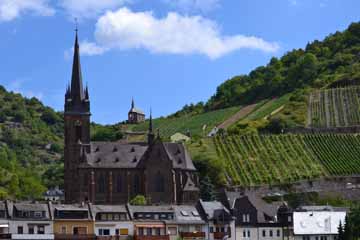
Steigenberger’s Parkhotel: This Hotel Enjoys 114 Years of Fame and Fortune

By Don Heimburger
Photos by the author

Steigenberger’s elegant five-star Parkhotel in Dusseldorf, Germany—located adjunct to a park—is an oasis in the middle of a popular shopping complex and entertainment strip of the Königsallee.

The prestigious hotel has just completed a multi-million dollar renovation of its entire first floor, kitchen area and more than 90 rooms and suites.

STROLL ALONG THE RIVER
The hotel is located at the heart of a number of cultural and entertainment venues which are easily walkable, such as the Opera House, the Old Town, and the Rhine River is just a 10 minute walk away. There you can stroll along the river, regarded as one of the most beautiful of esplanades. Planned by Niklaus Fritschi and built between 1990 and 1997, it “joins” the city to its river. It symbolizes Düsseldorfers’ Rhenish joie-de-vivre and particularly in summer is an expression of the city’s Mediterranean lifestyle.

The Rhine embankment promenade links the traditional Altstad (Old Town) to the modern MedienHafen and is lined by cafés and bars. Thus the Steigenberger Hotel enjoys a prominent position in the life of the city which guests can take full advantage of.

The hotel’s lobby is large and welcoming, with a large vase of eye-catching flowers, a glittering chandelier in the middle, colorful contemporary paintings on the walls and rich wood registration desks, backed on the walls by more rich wood panels. I immediately felt at home in this place, especially with the attentive, personable staff.

The Parkhotel’s 130 rooms, all with high ceilings, are comprised of superior single rooms, deluxe double rooms, grand deluxe rooms and deluxe suites, all neat as a pin, roomy and comfortable. Rooms feature a flat screen television, work desk, air conditioning and access to the spa. Larger rooms include even more amenities. In addition, the rooms are quiet and feature reading lamps on each side of the bed.

HOTEL IS CENTRALLY LOCATED
Rooms feature a flat screen television, work desk, air conditioning and access to the sauna and fitness area. The Hauptbahnhof is a few blocks away and guests can easily get there by cab from the hotel. The Dusseldorf trade fair building is about four miles away.

The hotel features six modular function rooms for meetings and conferences with air conditioning and state-of-the art facilities to enable users to make the most of modern multimedia.

Etoile Bar
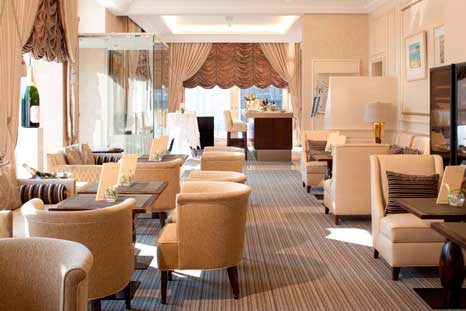
From mid-April the exclusive summer terrace of the hotel offers a chance to enjoy meals or drinks al fresco. Indoors, the dark wood-paneled Etoile Bar, where piano music can be enjoyed, is a good spot to sit a spell. There is also the Steigenberger Eck Lounge, a bistro and bar where one can have Champagne, tea or a drink, and seafood or other meal selections.

Artiste Restaurant

FINE DINING
At the fine dining restaurant Artiste, chef Christoph Kaiser provides a varied range of excellent foods and fine table wines. A super appetizer of Colby fish topped with avocado cream was followed by a thick, juicy steak, creamed white asparagus and delicious small potatoes. My wife had the asparagus and new boiled potatoes, but with a delicate, flaky salmon as the main dish. All vegetables are locally grown and personally selected by the chef.

The crème brûlée for dessert, as well as the citrus sponge cake garnished with colorful fruit was the perfect ending to a memorable dinner. The service was impeccable. Another hotel restaurant, the Menuett, is also available for breakfast and special events.

HISTORICAL, STUNNING BUILDING
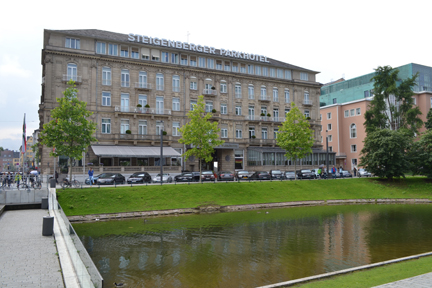
From the outside, the first impression of this hotel is of a magnificent, stunning building, in classical German architectural style. It’s history goes back a long way.

HISTORY
The hotel opened in 1902 in conjunction with the industry, trade and art exhibition in Düsseldorf. Soon after it opened aristocracy, famous industrialists and the traveling pubic frequented the hotel. As an example, in 1908 Crown Prince Wilhelm of Prussia and Crown Princess Cecilie visited there.

(left) In 1908, Crown Prince Wilhelm and Crown Princess Cecelie visited the hotel.

From 1936 to 1937 the hotel was reconditioned and modernized but was substantially damaged in 1944 during WWII air attacks, with the upper floors destroyed by fire. Between 1945 and 1951 the Steigenberger hotel was taken over by American and later British occupying forces. Later it served as the Mannesmann AG administrative building until 1953.

Today, English carpets and both modern and antique furniture evoke a synthesis of functionality and noble ambience in the hotel. The elegant interior was designed by architect Bergit Countess of Douglas. The valuable high class furniture imitates the style popular in 18th century’s France ruled by Louis XVI, evoking a sense of comfort and security through its warm wood colors and wooden materials.

In all, the Steigenberger Parkhotel is an island of calm in the midst of a bustling downtown city. Its interesting history and charm make it a prime Steigenberger property.

For more info, go to Steigenberger Hotels and Resorts or Steigenberger Parkhotel Duesseldorf.

Cruising Through Central Germany

By Marilyn Heimburger
Photos by Don Heimburger

Are you are looking for a vacation that combines relaxation, a bit of history, romantic castles, charming medieval villages, and excellent cuisine? This week-long river cruise on the Moselle, Rhine and Main rivers in Germany, offered by Avalon Waterways, may be the perfect choice for you.

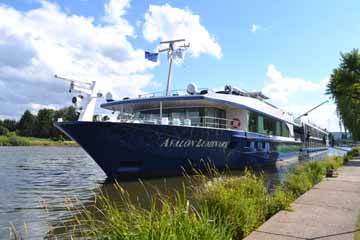
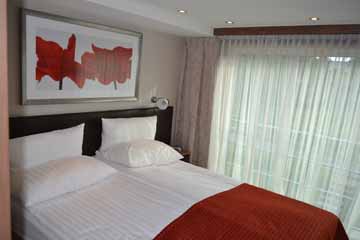
The MS Avalon Luminary, our ship for this cruise, was just recently added to Avalon’s fleet. Its 69 staterooms and suites are designed for efficiency, with plenty of space to stow personal items and luggage. Each room had a small bathroom with shower, comfortable memory foam mattress, a desk, lamp, mirror, fresh flowers, mini bar, and a safe for valuables. A television provided satellite programming and broadcast the view from a camera at the front of the ship. Floor-to-ceiling windows open to a private balcony in most rooms. It’s a luxury of river cruising to just unpack once and let the ship transport you with ease to each destination.

Another luxury on a cruise such as this is the excellent cuisine. The sumptuous breakfast buffet included breads, pastries and cereals, fruits, eggs, potatoes, sausages and bacon, and made-to-order entrees. The full lunch buffet served each day in the main dining room offered soups, salads, choice of main course and desserts. A lighter lunch option was also available in the lounge one deck above. Five-course dinners included an appetizer, choice of soups, salad, choice of meat, fish or vegetarian main course, and several dessert options. The well-trained staff served red, rose, or white wine or beer upon request.

BOARD IN LUXEMBOURG
Boarding the Luminary in Remich, Luxembourg, we were welcomed by cruise director Jean Loup Domart. Entertaining, energetic, and extremely organized, Jean excelled at keeping everything running smoothly.

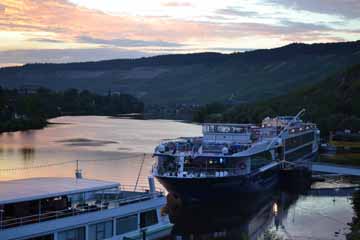
Although we set sail while dinner was being served, we missed none of the excitement, since the dining room was designed for maximum viewing, with panoramic windows on both sides. A sense of intimacy was provided with fresh orchids in lighted open rectangles dividing the large space without interrupting with the view. The lounge on the level directly above the dining room was also designed for watching Germany glide by in the most comfortable of settings.

Our first stop was Trier, Germany, which boasts amazingly intact structures from the Roman Empire, including imperial baths, an amphitheater, and Constantine’s reception hall, which now serves as a protestant church. Did you ever wonder why Roman ruins always seem to be discovered 6 feet underground? We learned from our local guide that after Roman towns were abandoned, local residents built homes by taking usable stones from the old Roman buildings. Over the course of 600 years, this practice left a 6-foot-deep base of rubble, upon which the medieval towns were built. Trier’s Porta Nigra (black gate) is black from wood fire smoke from Roman times, and was left standing because it was a site that attracted pilgrims, who brought money to the church.

As our trip continued down the Moselle, we passed vineyard after vineyard and peaceful patchwork slopes, dotted with small villages and church steeples. The southern facing slopes provide the perfect environment for catching warm sunlight needed to grow grapes for Germany’s famous Riesling wines. And the ship’s outdoor decks were perfect for relaxing with a cup of coffee or listening to birds along the shore as the ship glided quietly along.

BERNKASTEL-KUES WEINFEST
Our late afternoon arrival in Bernkastel-Kues allowed just enough time to explore the Old Town around the quaint market square. This town hosts the biggest Weinfest on the Moselle in September. One vineyard overlooking the town is the source of their “Doktor” wine. Legend has it that drinking some of the wine from this vineyard cured an archbishop of an ailment, so the wine became known as the “Doktor.”


Half-timbered buildings in Bernkastel

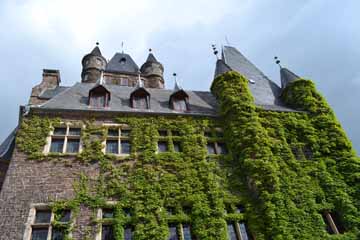
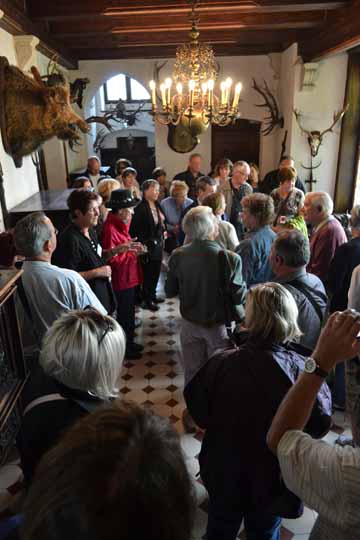
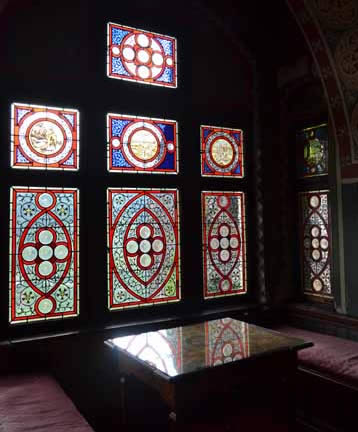
The next day brought us to the wine town of Cochem and a tour of Reichsburg Castle. The interior of the castle highlights not only only medieval artifacts, but Renaissance and Baroque furnishings selected by the 19th century restorers. The tour was informative and the view from the castle — spectacular.

 Passengers tour the castle

The Moselle joins the Rhine at Koblenz, an important center of trade during the Middle Ages. An imposing statue of Kaiser Wilhelm I mounted on a horse dominates the Deutches Eck (German Corner) where the two rivers meet. We arrived just before dinner, with enough time for a short walk into the square to see the many shops and restaurants. The fortress Ehrenbreitstein stands on the opposite bank of the river and provides a beautiful panoramic view of the area.

To begin our cruise down the Rhine Gorge (some say the most beautiful part of the Rhine) first thing in the morning, we docked overnight at Koblenz, and were entertained on board after dinner by a small ensemble of classical musicians.

THE MIDDLE RHINE
The next morning was filled with the history, legends and romance of the Middle Rhine. Cruise Director Jean Loup provided informative narration as the ship glided along, with passengers enjoying the view while relaxing on the sundeck. We learned that during the Middle Ages the Rhine River Gorge posed many hazards for travelers, and provided many opportunities for powerful kings to levy tolls for safe passage. They built castles and fortresses in the 12th and 13th centuries along the banks to collect tolls, make money, and enlarge territories.

Reichsburg Castle

The castles were usually built high on hills, close to a spring, and often on a curve with a view of the river. Stones for the castles were lifted with wheels and ropes, and the building projects provided work and security for locals, whose lifespan at the time was only about 40 years. Most castles were built with limestone, which was easier to work with than granite. Later palaces were built with marble, as techniques improved. To attack a fortress, enemies could try to break down a wall or door with a battering ram on wheels with a roof as protection from arrows shot from the castle. Or a catapult could throw fire over the castle walls. Castles residents used beehives, hot tar or hot water to fend off attackers. Some fortresses housed armies of 600.

In the town of Boppard we saw Sterrenberg and Liebenstein, known as the castles of the enemy brothers, and heard the legend: Two brothers both fell in love with their adopted sister. She wanted none of this, and entered a monastery in town to live as a nun. The brothers fought and finally built two castles next to each other with a wall in between.

The 430-foot-high Lorelei rock is located where the river narrows, creating treacherous currents dangerous to ships. The famous legend of the beautiful maiden who sat on the rock luring sailors to their destruction with her singing is commemorated with a bronze statue.

The town of Oberwesel, below Schoenburg Castle, still has many fortification walls and towers still standing. When the river water is low, travelers can see the “rocks of the seven virgins.” Legend has it that a lord with seven sons wanted to arrange marriages for them. The seven chosen virgins didn’t want to marry, and threw themselves into the Rhine, where, because they were so hardhearted, they turned to stone.
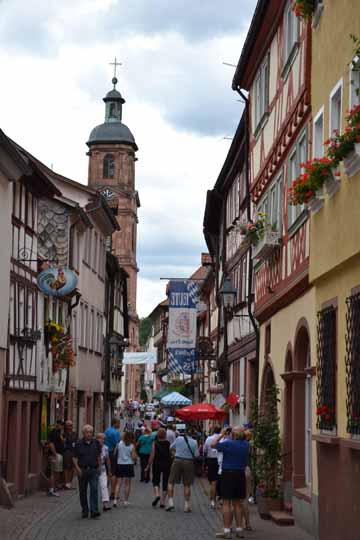
Pfalz Castle (whose gold lion was to symbolize strength and power) was built in the 16-17th century as a customs tollhouse on a little island in the middle of the river. Gutenfels Fortress was built on the bank opposite Oberwesel to protect the tollhouse.

Sooneck Castle, a toll-enforcing castle from the 11th century, also housed pirates. It is one of the oldest along the Rhine and is restored as a cafe.

In an attempt to preserve the beauty and tranquility of the shoreline, many of the houses along the shore are painted in soft pastels, often pale yellow, a color made popular by Maria Theresa. Train tunnel entrances on this stretch of the river are built to look like castles, in order to blend in with the style of the area.

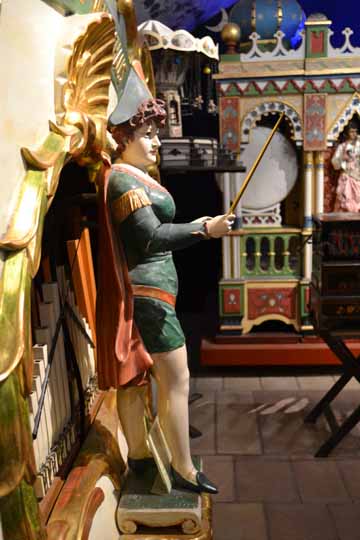
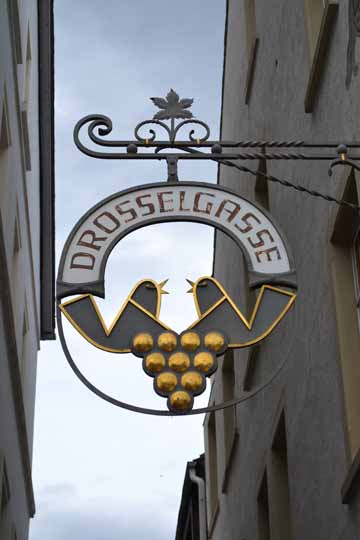
(left to right) Siegfried’s Mechanical Musical Instrument Museum; Drosselgasse, a lively street in Rudesheim.

DROSSELGASSE A FAVORITE
Our last stop on the Rhine River was in Rudesheim, where we enjoyed a guided tour of the Museum of Mechanical Musical Instruments (some imitating entire orchestras in one huge contraption!), and a local winery. Be sure to take time to explore the exciting main street, the Drosselgasse, with its many restaurants and shops.

Navigating the Main River is a slow process because of the many locks needed to raise or lower the ship along the route. So our ever resourceful cruise director kept passengers busy on board with an entertaining German lesson, and a cookie-baking demonstration by an “almost nun” from Miltenberg, our next port of call on the Main.

Miltenberg

Miltenberg was built against a hill at a curve in the river, a perfect place to collect tolls for the archbishop of Mainz. Many half-timbered houses are still preserved because the people here were too poor to tear them down and rebuild. If a floor sagged and sank, it was filled with sand and covered with another floor. In some recently renovated buildings, 30 centimeters of sand/wood layers were discovered beneath the floor. The original red “paint” on the houses was a mixture containing, among other things, oxblood and cattle dung, which provided the desired red color and also killed worms that might live in the wood. A unique naturally cool icehouse is located in the hill at the rear of the town.

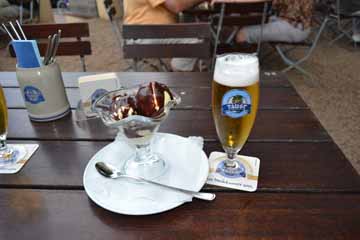
Cold beer and ice cream

While the ship slowly navigated through more locks, passengers rode by bus to Wurzburg, and met the ship when it finally docked after our tour. Wurzburg is the site of the Prince Bishop’s Residenz, which is one of the finest examples of a baroque palace, and also a UNESCO World Heritage Site. It was built to rival Versailles in France and the Schoenbrunn in Vienna. The unique mirrored room features the difficult technique of reverse painting. The famous ceiling fresco by Tiepolo miraculously survived bombing, and the original marble floor is still in the main reception hall. The “marble” pillars are actually a stone core with a ground marble coating so that colors could be controlled, a technique that was more expensive than using solid marble.

Wurzburg

WURZBURG AND X-RAYS
Wurzburg was also the home of Professor William Conrad Rundkin, winner of the Nobel Prize for the discovery of X-rays. Residents in Wurzburg are not x-rayed; they are “Rundkined.”

Bamberg

The terrain along the river from Wurzburg to Bamberg changes and becomes flatter, with fewer vineyards, more trees and shrubs, and more locks. This quiet time was perfect for relaxing with a book from the ship’s library, located in the small lounge at the rear of the ship. There passengers found English language books of all genres, games, and the most wonderful coffee machine which dispensed espresso drinks that rivaled any coffee shop. Iced tea, shortbread cookies and other snacks were available 24/7. The ship also had an exercise room with a treadmill, two types of exercycles and flat screen TV, and a small beauty salon.

Cruise ship surprises

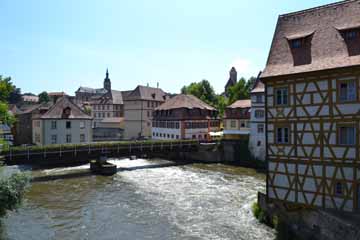
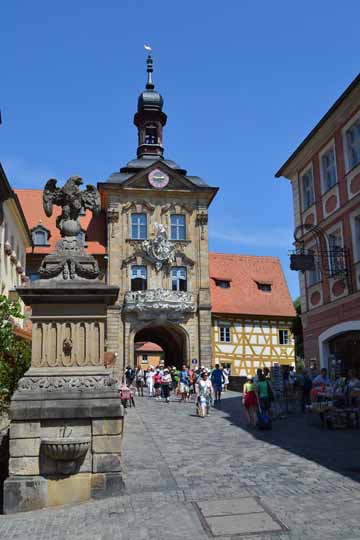
Busses again transported us to meet local tour guides in Bamberg, another UNESCO World Heritage Site. There we learned the local history of the cathedral, the Old Town Hall, which straddles the River Regnitz, had an opportunity to taste the local specialty, “Rauchbier” (smoked beer), and had time for browsing in the main pedestrian shopping area.

Our cruise ended the next morning upon arrival in Nuremberg, from which some passengers continued by bus to Prague, and others to charming Rothenburg ob der Tauber.

IF YOU GO..
Avalon Waterways, which has been in business for 80 years, has a number of different river cruises available in Europe. Their river cruise ships are small compared to ocean liners, which makes the service and trip more personal. They also have Europe’s youngest fleet of ships, with their fleet averaging just two years old, compared to seven years for other cruise companies.

There are full floor to ceiling sliding glass doors in 85% of the deluxe staterooms on Avalon’s fleet. Also, the Luminary had lots of space in the central passenger areas such as the dining room, lounge and library.

The Luminary offered five categories of rooms including Royal Deck suites; Royal Deck Category P; Sapphire Deck Forward, Category A; Sapphire Deck Aft, Category B; and Indigo Deck, Category E.

For more information, go to www.avalonwaterways.com or call 877-797-8791.

Leipzig on a Platter

This city is a multi-course meal for visitors

By Don Heimburger
Photos by Don Heimburger and Leipzig Tourism Office

If you were to spoon out Leipzig and put it on a plate, you’d discover a salad, a main meat course, vegetable course, a sorbet interlude and a delicious dessert.

I’d designate the salad course as the city’s unusual green belt at the Auenwald; the meat course is the art, architecture and music; the vegetable course Martin Luther and the Peaceful Revolution; the sorbet interlude is this town’s love of coffee; and the dessert is the city’s zest for living and its nightlife.

The city of Leipzig in central Germany, population 500,000, has a colorful history stretching back more than 800 years, and many events have shaped this former East German city. The city’s people and several major historical events have fashioned this town, and made it what it is.

SORBS FIRST SETTLED HERE

Sorbs first settled here in the 7th century, establishing a trading post known as Lipzk or “place near the lime trees.” After Leipzig was granted a town charter and market privileges around 1165, it quickly developed into an important center of commerce.

Maximilian I decided to award Leipzig imperial trade fair privileges in 1497, which helped turn the city into one of Europe’s leading trade fair centers, and it remains so today. Following the world’s first samples fair held in Leipzig in 1895, the city remained one of the global trading hubs until World War II put a hold on that.

Leipzig Zoo’s Gondowanaland

It’s hard to believe, but Leipzig has a floodplain forest that runs straight through its center, one of the largest of its kind in Europe. Consisting of eight square miles of trees, every year more trees are planted, and the green space is enlarged. A variety of protected plants and animals are found here, including a rare butterfly species.

This “salad area” or greenbelt is easy to spot on a roadmap, with a large green area running north to south through the city. Four streams also flow through the city. Another part of the city that has been “greened up” is the Leipzig Zoo, where tropical Gondowanaland just opened. This lush section of the zoo, larger than two football fields, allows visitors to come into close contact with the tropical rain forests of Africa, Asia and South America. It features 40 exotic animal species and approximately 500 different plant and animal species, and more than 17,000 plants started their journey in nursery gardens in Thailand, Malaysia and Florida to create this tropical environment.

The Alte Börse, built in 1678-87 by Christian Richter, was originally used as a trading floor for merchants.

MAIN COURSE: ART-ARCHITECTURE AND MUSIC
As Leipzigers are fond of saying, for the young and creative Leipzig is no longer an insider’s tip. Word has spread that the city’s working and living conditions are just right, and three universities with an artistic or cultural profile, as well as Leipzig University, constantly feed the pool of ideas. Leipzig is known for its vibrant arts, music and festival scene; this place not only appeals to artists and actors, but is also becoming a trendy destination for leisure travelers.

Leipzig’s dynamic art scene enjoys an excellent reputation worldwide. Interestingly, a former cotton mill, Spinnerei, in the trendy Plagwitz district, is home to a number of galleries and studios. Formerly the largest cotton mill in continental Europe, Spinnerei now has the highest density of galleries in Germany. In this old factory complex are 80 artists, 14 galleries and exhibition spaces which house creative professionals like architects, designers, craftspeople, retailers and printers.

Spinnerei Museum

Artist and professor Neo Rauch of the New Leipzig School, whose paintings combine his personal history with the politics of industrial alienation, reflects on the influence of social realism. Hollywood star Brad Pitt recently purchased one of his works.

The GRASSI Museum of Applied Art, with its world class collection, opened as Germany’s second museum of applied arts in 1874. It is considered one of Europe’s leading museums of arts and crafts. The high point of the year within the GRASSI museum’s special exhibition is a trade fair for applied art and design, an international forum of contemporary applied art and experimental design.

Then there’s another part of the Grassimesse, the Designers’ Open, which is a well-established independent design festival. An extensive program including lectures, workshops, movies and fashion shows complete the fair.

In 1996 the Leipzig Fair’s new exhibition complex opened, featuring trailblazing architecture, spacious avenues and the stunning Glass Hall at its core.

THE CITY OF MUSIC

If you go to Leipzig, a visit to St. Thomas’s Church is a must, since it is the home of the world-famous St. Thomas Boys Choir and where Johann Sebastian Bach was employed for 27 years as organist and choirmaster.

His grave can be seen in the chancel. Motets are performed every Friday and Saturday by the choir, and there are concerts in front of the statue of Bach outside in July and August. The Bach Museum is located opposite the church.

St. Thomas Boys Choir

Another regular musical highlight is the Sunday recitals at Mendelssohn House. Felix Mendelssohn-Bartholdy used to live in the building, which now contains the only museum dedicated to the composer.

There are two additional important centers of music in Leipzig: the Leipzig Opera House and the Gewandhaus Concert Hall.

The Gewandhaus Orchestra, dating back more than 250 years, regularly performs in both venues. The Opera House is the third oldest civilian music theater stage in Europe. And Schumann House is dedicated to the memory of Robert Schumann, one of the greatest composers of the 19th century Romantic era.

Bach concert at St. Thomas Church

Leipzig also hosts several music festivals, large and small, including the International Bach Festival, the A Capella Festival, the Leipzig Jazz Festival and the Mendelssohn Festival.

MARTIN LUTHER AND THE PEACEFUL REVOLUTION
Our vegetable course includes reformer Martin Luther, who was known to come to Leipzig to face the Catholic Church hierarchy to explain his ideas about Christianity and indulgences. Martin Luther, who lived in nearby Wittenberg, stayed in Leipzig on no less than 17 occasions. His most important visit was for his participation in the Leipzig Disputation, or series of debates, held in Pleissenburg Castle in the summer of 1519.

After Duke George died, the Reformation was introduced in Leipzig in 1539. On August 12, 1545 Luther inaugurated the former Dominican monastery church of St. Paul’s as a protestant university church.

St. Nicholas Church exterior

Leipzig was particularly significant in the rise of the Reformation movement, because Luther’s writings and numerous evangelical hymn books were distributed in large numbers from this city of printing shops and publishing houses. In Melchior Lotter’s printing shop alone, between 1517 and 1520, more than 40 works written by the great reformer were published.

In the Grafisches Viertel or Graphics Quarter of the city, the publishing industry flourishes. In 1912, 300 printers and nearly 1,000 publishing houses and specialized book shops, as well as 173 bookbinders, operated in Leipzig.

Leipzig is also known for helping overcome the GDR government. St. Nicholas Church—the oldest and biggest church in Leipzig—rose to fame in 1989 as the cradle of the Peaceful Revolution. Services for peace were and still are held there every Monday, and the following demonstrations at the end of the 1980s toppled the East German government, paving the way for German reunification. In the church, note the interior columns: they are designed to resemble palms.

St. Nicholas Church interior

A few other important sights to see in the city include:

  • The Monument to the Battle of the Nations—the tallest monument in Germany—was erected to commemorate those who fell during the Battle of the Nations (also known as the Battle of Leipzig) fought against Napoleon’s forces in October 1813.
  • In the Battle of the Nations, Austrians, Prussians, Russians and Swedes fought —500,000 soldiers in all— the biggest battle ever in world history, marking the decisive turning point in the war of liberation from Napoleonic rule.

(left to right) Battle of the Nations Monument; Porsche Leipzig Headquarters

The Mädler Passage, for centuries the city’s most exclusive arcade (one of 30 arcades in the city), is home to the famous Auerbachs Keller. Serving wine since 1525, this tavern/restaurant was immortalized in Faust by Johann Wolfgang Goethe, the father of German literature.

YOUR SORBET IS SERVED
The café-cum-restaurant Zum Arabischen Coffe Baum is one of Europe’s oldest coffee houses (dating from 1694) and it used to number composer Robert Schumann among its regulars. Today the coffee museum on the third floor of the building contains 500 exhibition items on the history of coffee, the Saxons’ “national drink.”

Zum Coffe Baum
  • The Old City Hall, one of the finest Renaissance buildings in Germany, can be admired on the Market Square; it houses the Museum of City History. Inside is Katharina von Bora’s (Martin Luther’s wife) wedding ring and a pulpit in which Luther preached.

Town Hall Museum where a number of Martin Luther artifacts are exhibited.

NIGHTLIFE ABOUNDS
If you happen to be a night person, there is plenty to do in the evening, with all the city’s theaters, concert halls, variety shows and casinos. There are several dining and nightlife districts as well, such as Drallewatsch, Schauspielviertel, Südmeile, Münzgasse, Gohlis and Plagwitz. And when you arrive in one of the many clubs or bars, you’ll learn that often the term “closing time” is not in the vocabulary. There are 1,400 pubs and restaurants in this city, so dessert is not a problem.


And there you have it: a complete Leipzig meal with all the courses. Emperor Maximilan I knew something in 1497 when he granted the town imperial trade fair rights. He knew that one day Leipzig would be a multi-course city, and he was correct.

Auerbachs Keller Restaurant, located below the Mädlerpassage, is the best known and second oldest restaurant in Leipzig, described in Johann Wolfgang von Goethe’s play Faust I, as the first place Mephistopheles takes Faust on their travels. The restaurant owes much of its fame to Goethe, who frequented Auerbach’s Cellar as a student and called it his favorite wine bar.

For more information, go to www.leipzig.dewww.leipzig.travel, or www.germany.travel


Hotel Fuerstenhof
An upscale Leipzig tradition

Not far from the main train station in Leipzig is the Hotel Fuerstenhof, a five-star gem with marble, gold-rimmed archways, high ceilings and soaring windows.

At one time a classic patrician’s palace, the 92-room air-conditioned hotel with 12 suites, features myrtle wood furniture, marble bathrooms and a friendly, dedicated staff. The staff is geared to making your stay a pleasant one, knowing your name when you come to the registration desk for questions, and providing service with a smile. I had more than a few special requests from the staff which were quickly and pleasantly taken care of.

There’s an indoor 7,000-square-foot pool area, equipped with saunas, fitness room, solarium, cosmetic and massage stations. Also, the hotel features a nice piano bar area with comfortable, plush seats, and tables, fine dining in the 18th-century style neo-classical Villers restaurant (with a choice of more than 200 wines), a complete breakfast area and a wine bar round out some of the amenities of this hotel.

The hotel was first mentioned in 1770 when Karl Eberhard Loehr, a banker, lived in the palatial home, built between 1770 and 1772. It was called the Loehr Haus. It opened as a hotel in 1889, and underwent a complete renovation and restoration in 1993. It is part of the Luxury Collection of Hotels, one of 62 worldwide luxury hotels. 

For more information, go to www.hotelfuerstenhofleipzig.com/en

Hotel Fuerstenhof