Antwerp’s Newest Museum: The Flip Side of Ellis Island

By Randy Mink

Everyone knows the story of the poor immigrants who arrived at Ellis Island in New York after a transatlantic journey from Europe. The “huddled masses yearning to breathe free” came by the millions in the late 19th and early 20th century, all with one dream—a better life in America. Their long voyage ended as they sailed into New York Harbor past the Statue of Liberty, a beacon of freedom and hope.

Many of us have visited the Ellis Island Immigration Museum and possibly even traced our ancestry there. But a new attraction in Antwerp, Belgium tells the flip side of the tale as it unfolded on the opposite shore of the ocean. In the actual brick warehouses where emigrants gathered to board, the Red Star Line Museum sheds light on the almost forgotten history of an American-owned shipping company that from 1873 to 1934 brought more than two million passengers from Antwerp to New York, Philadelphia, Boston and Halifax, most of them poor and oppressed peoples from Eastern Europe; about 25% were Jewish. Fewer than 200,000 were Belgians.

Among those dreamers was a Jewish family from a Russian town in what is now Belarus. The five-year-old son, Israel Isadore Baline, who traveled on Red Star Line’s Rijnland, went on to become a songwriter extraordinaire and changed his name to Irving Berlin. Had it not been for that voyage in 1893, “God Bless America” and “White Christmas” might not be part of the American songbook.

There were some rags-to-riches stories indeed, but it’s mostly the personal testimonies of ordinary folks that dominate the two exhibit floors of the Red Star Line Museum, located in Eilandje, a former dockyard district undergoing redevelopment. The museum is just a short walk from the Kattendijk Dock, where most European river cruise ships berth in Antwerp.

Curator Bram Beeleart confirms the museum is more about people than ships, emphasizing the importance of firsthand accounts of migrants before, during and after their transoceanic trips. “The overall theme we want to convey is that it’s about little people who imagined a better life for themselves on the other side of the ocean…little people who dreamed great things,” Beeleart says.

The fact that the museum occupies the original Red Star Line departure sheds on the Scheldt River’s Rijnkaai, or Rhine Quay, “adds power to the whole experience,” he says. The humble, decaying buildings had been empty since 2000; the oldest dates to 1894.

In putting together the museum’s exhibits, Beeleart and his team visited Ellis Island Immigration Museum and Hamburg’s Ballinstadt Emigration Museum, among others. Beyer Blinder Belle, the New York architecture firm that designed the Red Star Line Museum, also did the restoration work at Ellis Island.

The eight thematic areas abound with oversized photos and text (including excerpts from letters), artifacts, touchscreen computers, pullout drawers and audio and video stations. Visitors follow in the emigrant’s footsteps, starting at a Warsaw ticket agency similar to many such offices in Eastern Europe where passengers would have bought their Red Star Line tickets.

Next in the sequence is a train compartment for the trip to Antwerp, followed by glimpses of early 20th century Antwerp, procedures in the Red Star Line departure buildings, the deck of an ocean steamer, shipboard life, arrival at Ellis Island and a new future in the United States.

Prior to following the European emigrant’s path to the New World, visitors encounter a timeline of migration throughout human history and installations that spotlight “Six Star Witnesses,” including Red Star Line passengers Albert Einstein and Sonia Pressman Fuentes, the latter a renowned feminist who made the trip from Florida for the museum’s grand opening last fall.

The exhibit on 1910-1922 Antwerp, which features grainy film accompanied by sound effects like streetcars and the clip-clop of horses, describes how locals viewed the Eastern Europeans with curiosity and pity—exotic head scarves, weather-beaten faces and ragged appearance clearly set the migrants apart. Upon arrival in Antwerp, train passengers from small towns in Russia, Poland, Austria-Hungary and Germany were awed by the cathedral-like Central Station, still one of the city’s grandest sights and worth a look even if you’re not traveling by rail.

Before their 10-day ocean voyage, the rumpled travelers stayed in dingy, overcrowded migrant hotels and often were the target of crooks. But Basia Cohen, as a girl from Russia, had positive memories of her 1921 experience: “Antwerp was my favorite city of all. It was the first time I had ice cream. We used to hear about ice cream but we never even had seen it.”

Visitors also experience the anxiety that emigrants endured in the very building where they awaited the medical exams that resulted in 2 to 4% of ticket holders being rejected for the trip to America, as the line would be liable for repatriating anyone with a contagious disease. Everyone in third class had to take an hour-long shower using vinegar and other solutions; their clothes were fumigated and baggage was sterilized in large pressure boilers.

Once at sea, most of the emigrants wallowed in the bowels of the ship, where conditions were cramped. Those in third class, or steerage, slept on straw mattresses and had to scramble to stave off hunger. In the words of Golda Meir, a Russian immigrant who settled in Milwaukee and later became the prime minister of Israel: “It was not a pleasant trip. We spent the nights on sheetless beds and most of the days standing in line for food that was ladled out to us as though we were cattle.”

Passengers in deck chairs

Passengers in first- and second-class (pleasure travelers, businessmen, even an occasional emigrant), however, enjoyed fine dining, deck games and evening entertainment. Sometimes they would throw fruit or candy down to the children traveling in steerage. On display are dishes, silverware, ashtrays and cigarette lighters with the Red Star insignia, plus sample menus, wine lists and pictures of ballroom dancing. Ironically, songs played in the first- and second-class lounges in the 1920s and ’30s included ones written by a now-famous Irving Berlin, who had traveled in steerage three decades earlier.

From its earliest days the Red Star Line promoted its product in artistic brochures and posters, but concentrated more and more on the vacation market once the U.S. clamped down on immigration in the early 1920s. Actual printed materials and touchscreen displays show how the line marketed cruises to “discriminating travelers” who could “leave boredom behind and find solace in the sun” on a trip from New York to Havana, Nassau, and Bermuda. Its 2,500-passenger flagship, Belgenland II, touted a swimming pool and fake beach.

During Prohibition, Americans took “booze cruises” to Bermuda, and the line even did seven world cruises. Over the years Red Star operated 23 ships (all with “land” in the name—PennlandWesternlandLapland, etc.) and chartered other vessels. Unable to survive during the Great Depression, the company was finally liquidated in 1934. Its demise was a big blow to Antwerp, where “the pulse of the Red Star Line was felt in the very arteries of the city,” wrote one local newspaper reporter.

Exhibits on Ellis Island and tenement life in New York’s Lower East Side give way to the success stories, including the iconic example of composer/lyricist Berlin. A showpiece is one of Berlin’s composing pianos, on loan from his second daughter, Linda Emmet, who lives in Paris. Visitors are reminded of the many songs he penned, from “Alexander’s Ragtime Band” to “Puttin’ on the Ritz.”

A museum visit concludes with the stories of today’s immigrants in Antwerp and a chance to do online genealogical research of your own. Then climb or ride the elevator up the new concrete-and-steel observation tower, which mimics the chimney and bow of a Red Star Line ship. The open-air platform affords a panorama of quays along the Scheldt—the last scenes that passengers, on their way to an uncertain future, would have witnessed as Antwerp and the Old World slipped from view.

For anyone fascinated by maritime history and tales of human migration, the Red Star Line Museum is Antwerp’s star attraction. For information, visit redstarline.org.
The City of Beer and Fun: Munich; The City of Oktoberfest!

By Steve and Alison Ramsey

“Ozapft is!” exclaimed Munich’s Lord Mayor Christian Ude after opening the first keg of beer at noon on September 22, thus officially inaugurating the world famous German Octoberfest.

And following 16 days of beer, fun and Gemutlichkeit, the 2007 Munich Octoberfest closed its gates after 6.2 million people visited the biggest fair in the world.

This big city, with rural charm and friendly people, served 6.7 million glasses of beer, thousands of Hendl (chickens) and 104 oxen to the crowds that swarmed into the 14 large tents on the Octoberfest grounds right off of the Schwanthalerstrasse. As many as 10,000 people can be accommodated in some of the huge beer tents.

Alison Ramsey tasted and tested the beers at Octoberfest. A good reporter must get all the facts, and test all the flavors of beer before she files her report.

COLORFUL TENTS
The tents, which sometimes appear more like buildings, are highly colorful, and are decorated with painted murals, clouds and more to make them attractive to the visitors, some of which spend all day inside!

OctFest07

A special Octoberfest beer, brewed by Munich’s six major breweries, is served in the tents. The delicious draught is usually served with radishes, Obatzta (special cheese), sausages, roast chicken or grilled fish. And barbecue beef is a Wiesn specialty.

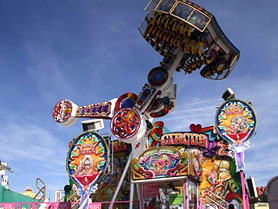
This year, as many as 80 different firms offered fair guests samplings of their foods, and more than 200 attractions greeted fair-goers as well, such as breathtaking rides like the Olympia Loop or the Power Tower, the Krinoline (merry-go-round), the Teufelsrad (Devil’s Wheel), the Toboggan and even a variety show.

OctFest11-13

HISTORY OF THE FAIR
The wedding of Crown Prince Ludwig–later King Ludwig I of Bavaria–and Princess Theresa of Saxony-Hildburghausen in 1810, started the fair when the royal couple invited the people of Munich to celebrate in the fields in front of the city gates. The fields were named “Theresienwiese” in honor of the princess, and locals later abbreviated the name to “Wiesn.”

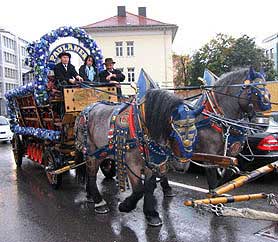
The annual Munich celebration starts off with a parade featuring festive carriages bearing the land-lords’ families, the horse-drawn drays of the Munich breweries, showmen’s coaches, waitresses on decorated floats and the beer tent bands. It’s quite a spectacle!

The following day the Munich Costume and Rifleman’s Parade features groups in traditional costumes, marching bands, troops of bandsmen and trumpeters, amateur and mountain riflemen. Performers of all kinds, decorated coaches and flower garlands are always main attractions of the parade. And the parade goes on even if the weather is bad!

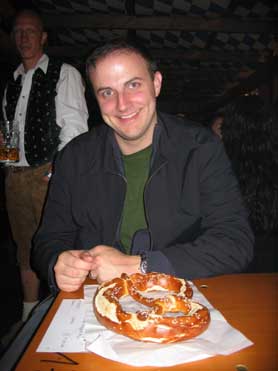
European Traveler’s Steve Ramsey tests one of the giant pretzels at the 2007 Munich Octoberfest. Got a beer to go with this?

ONE LAST WORD, AND A FAMOUS BREW
Of course, one of Munich’s famous trademarks is the 418-year-old Hofbrauhaus, where beer lovers gravitate throughout the year. It’s a fun establishment that holds up to 3,000 guests at the same time. The beer house even has its own beer, served, of course, at Octoberfest.

Stay tuned for more beer news. We had a great time in Munich, so it’s likely we’ll be back! Let’s see…when is next year’s fair?

OctFest09

Meissen Porcelain Celebrates 300 Years

Photos courtesy Germany Tourism

Founded in 1710, Meissen Porcelain is one of the world’s most successful luxury brands. It stands for the timeless connection between past and present, classic design and hand-made quality. This year Germany is celebrating the 300th anniversary of Meissen Porcelain with more than 40 special events and exhibitions.

Some of this year’s highlights included these exhibitions: Triumph of the Blue Swords at the Japanisches Palais in Dresden, focusing on the first 100 years of Meissen, showing masterpieces that are not usually displayed in public; All Nations are Welcome in the nearby town and modern factory of Meissen (January 23 – December 31); Philosopher’s Stone, a collection in the original workshop in Castle Albrechtsburg also in Meissen (May 8 – October 31); and The Fascination of Fragility with 500 pieces from Dresden’s state collection in the Ephraim Palace in Berlin.

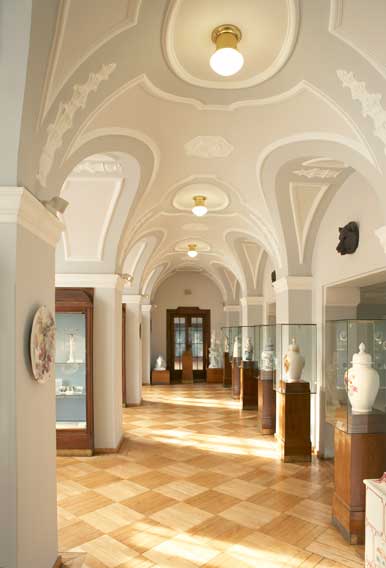
Porcelain in Meissen and Dresden is not only available to the public during this jubilee year. The Saxon nobelman Augustus the Strong’s permanent collection is housed in Dresden’s Zwinger Museum in the rooms beautifully restored by the New York designer Peter Marino. The modern production center, its connected museum in Meissen and the original factory in the Albrechtsburg, are only 45 minutes outside of Dresden and accessible by fast train to visitors throughout the year. You can dine on Meissen porcelain, participate in workshops, watch the production and, of course, buy the products.

Porcelain manufacturing and collection is a major attraction throughout Germany, with special routes, museums and production centers. Two porcelain routes link places of interest with the manufacturing of porcelain: Along the 340-mile-long route in the north-east of Bavaria visitors can discover famous factories, the European Industrial Museum of Porcelain, the Rosenthal Museum and the European Museum of Technical Ceramics.
www.porzellanstrasse.de

A second themed route in Thuringia features factories where porcelain is made and decorated and where visitors can visit factory outlets, demonstration workshops and several museums.
www.thueringerporzellanstrasse.de

Another highly acclaimed porcelain factory is based in Munich in the beautiful Nymphenburg Palace. For 260 years the Nymphenburg production center produced dinner services and figurines for the Bavarian kings. At the adjacent museum more than 1,000 pieces of Nymphenburg porcelain from different periods are exhibited. www.nymphenburg.com/us/nymphenburg

Couple Finds Marriage Bliss at 6,000 Feet

by Don Heimburger

Topping Out Wedding Destinations

Wedding “destinations” in the Germanic lands can sometimes be unusual.

Take, for instance, the June 2006 wedding of Swiss-born Hans and Birke Mebold of Rheinfelden, Switzerland.

“Our wedding was something special,” says Birke. “All this talk about the most beautiful day in your life…but it really was the case for us. The whole wedding took on a kind of momentum all its own.”

The Meholds first were officially married in a small church called Johanniterkapelle in Rheinfelden, home of Switzerland’s most popular beer, Feldschlosschen, and the town in which the couple both work.

Following the 11 a.m. ceremony, and a small reception, the couple was whisked away on Rheinfelden’s biggest fire truck with its blue lights flashing wildly. Both Feldwebel Hans and Birke are Rheinfelden fire brigade volunteers of 16 years and five years respectively, with Hans head of the town’s traffic regulations and security section.

HELICOPTER RIDE
Where the couple’s fire truck ride ended, their helicopter ride began, to the 2,100-foot-high resort town of Eptingen where  they met a bus full of 50 wedding guests of family and friends.

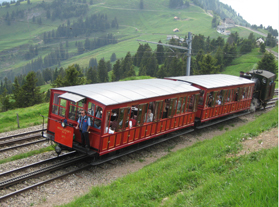
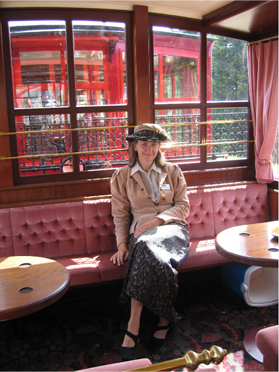
At Vitznau on Lake Lucerne, the group boarded a specially-reserved Mt. Rigi Railway steam locomotive and two-car cogwheel train consisting of No. 16, an 1923 oil-fired engine,  and the Belle Epoque, a stately parlor car built in 1873 and coach No.10, built in 1871. The crew assigned to the wedding train consisted of a driver, a fireman, a conductor and one hostess dressed in period costumes for each car.

As the steam train ascended up the side of steep 6,000-foot-high Mt. Rigi on a clear, warm spring day, the guests were served refreshments. The train passed quaint farms, pastures filled with grazing sheep and cows, and hiking trails.

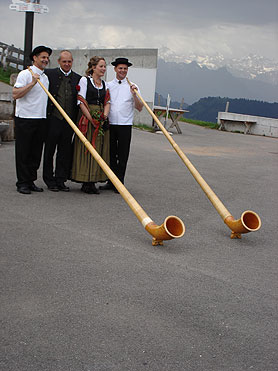
At Rigi Kulm, the group was welcomed by the alpine horns of Ruedi Imlig and his brother. Then a second wedding ceremony took place in the small chapel on the top of Rigi.

The wedding steam train for Hans and Birke Weber chugs up Mt. Rigi
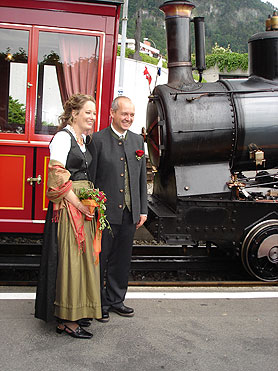
Bride Birke Weber steps out of her special railway car at the top of Mt. Rigi; her new husband, Hans, follows.
Train hostess Lucia Weber on the Belle Epoque, an 1873 salon car

DINNER AND DANCING AT THE TOP
The guests then enjoyed dinner and dancing at the Hotel Rigi Kulm. “The scenery at the top was so beautiful and the food was excellent,” says Birke. Afterward, dancing was provided by Gunter Pichler and his GP Music band.

“My great grand aunt had taken us to Mt. Rigi last year, and we were stricken by the incredible view from the top,” says Birke.”When we thought about a location for our wedding, it didn’t take long to decide to go to Mt. Rigi.” She admits the travel arrangements for buses, trains and helicopters were a bit daunting, however.

The happy couple and guests returned from the mountain after midnight on an electric cogwheel train, and later spent their honeymoon in Sweden. If this is what they planned for their wedding day, it sounds like this couple is never going to have a dull moment.

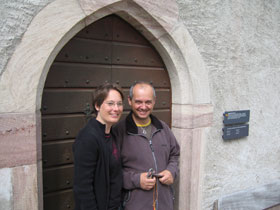
Hans and Birke Mebold, a year after their wedding, stand in front of the Rheinfelden, Switzerland church where they were married before their many relatives and friends. 

Noah’s Ark in the Netherlands

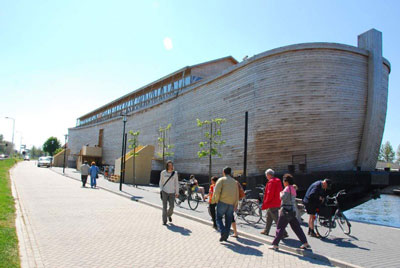
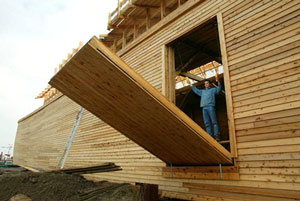
When the massive central door on the side of Noah’s Ark was opened, the first crowd of curious townsfolk was there to behold its wonder.

Of course, it’s only a replica of the biblical Ark, built by Dutch creationist Johan Huibers, as a testament to his faith in the literal truth of the Bible. The ark is 150 cubits long, 30 cubits high and 20 cubits wide. That’s two-thirds the length of a football field and as high as a three-story house.

LIFE-SIZE ANIMAL MODELS
Life-size models of giraffes, elephants, lions, crocodiles, zebras, bison and other animals greet visitors as they arrive in the main hold. A contractor by trade, Huibers built the ark of cedar and pine. Biblical scholars debate exactly what wood was used by Noah for construction.

Huibers did the work mostly with his own hands, using modern tools and with help from his son, Roy. Construction began in May of 2005. On the uncovered top deck — which was not quite ready for the opening– will come a petting zoo, with baby lambs and chickens, and goats and one camel.

Visitors on the first day were stunned. “It’s past comprehension,” said Mary Louise Starosciak, who happened to be bicycling by with her husband while on vacation when they saw the ark looming over the local landscape.

There is enough space near the keel for a 50-seat film theater where kids can watch a video that tells the story of Noah and the ark. Huibers says he hopes the project will renew interest in Christianity in the Netherlands, where church going has fallen dramatically in the past 50 years.