Wine Festivals Abound in Germany’s Historic Cities

From the first red wine produced along the Mosel River during Roman rule to the sweet Riesling for which the country is renowned, German wine is woven into the country’s culture and history.

Many member cities of the Historic Highlights of Germany are inviting travelers to experience this firsthand this fall with a series of wine-themed events, activities and offers.

In Mainz, more than 50 wine growers from throughout the region assemble during the first weekend in September for the annual Mainz Wine Market (photo at left). The event has craft stalls, rides, music and fireworks and, of course, dozens of wine stands. Wine-making goes back nearly 2,000 years in Trier, where several two-night packages feature special themes such as wine cultivation during Roman rule and a combination of World Heritage site visits and wine culture.

In Heidelberg, packages include the Heidelberg Wine and Chocolate Tasting with five wines from regional vineyards and five fine chocolates. Wine has long been central to life in Koblenz, located at the confluence of the Rhine and Mosel Rivers, where the “Wine Village” welcomes visitors to enjoy a glass of wine in the quiet setting of half-timbered houses.

Würzburg, situated on the Main River, is home to several wine estates, where visitors can enjoy tours and wine-tastings—including the Juliusspital, whose 400-year old, 800-foot long wine cellar makes it one of the oldest and largest German wineries.

Historic Highlights of Germany suggests two “Dream Routes” that focus on wine. Click on “Dream Routes” on our site at: www.historicgermany.com

Prague to Goslar

This train ride features Eurocity, Intercity and Regional trains

By Don Heimburger
Photos by the author

My travel plans had taken me to Prague, and I wanted to visit the medieval town of Goslar, Germany near the Harz Mountains. I had time to get there, and opted for a seven hour train ride so I could relax, unwind and see the scenery. Besides, trains are magic, and it’s much more fun to see the countryside from a train than it is from 30,000 feet up in the clouds.

Leaving my Prague hotel early morning, I take a short tram ride to a subway, and 15 minutes later walk up into the light of day where Prague’s Holesovice train station awaits me.

My particular concern is that I can’t read a word of Czech: Nada. Rien. Nichts.

FINDING MY TRAIN
Waiting in line at the station to check the status of seating on my Eurocity train leaving at 6:40 a.m.—that’s correct a.m.—a man darts in front of me. I can’t even say “excuse me” in Czech. And I can’t get much information that I can understand from the railway clerk, who sends me to another office down the corridor.

But I eventually learn that EC 178 (Eurocity) to Berlin is on time, that I likely won’t need a reservation in addition to my first class ticket, and that I’ll need to wait a few more minutes before I go out onto the platform. Once I make it to the platform, people stream out a few minutes before the train is due in, and once the train is stopped, they all board relatively fast. You have to in Europe, or the train leaves without you.

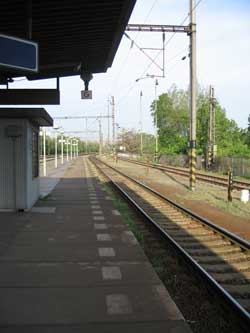
Praha-Holesovice station

I noted that the departure/arrival screen in the station–-not a large board like in most major European cities–was very small, and that there wasn’t room for more than several train listings at a time; perhaps not many intercity trains come and go from Prague.

ON BOARD
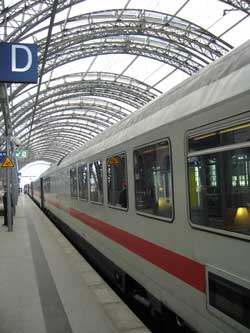
The car I sit in features good, comfortable seats–there are two first class cars, and I’m next to the on-board restaurant car. At my first class seat, tables fold down from the seat in front (like on an airplane), the chairs are adjustable, the windows are large in width and height, there are foot rests, and there’s luggage space above the seat. I could cross my legs and not block traffic as I sat in the aisle seat.

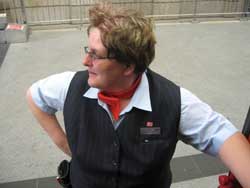
Conductor waits for passengers to board

As the train pushed through Prague and into the countryside, I could tell me were accelerating, and the engineer was using his electric locomotive to give us “the juice.” I suspect we were doing at least 100 mph at times.

When meal time came—enough of the menu was in English, with the help of some of the German I know—that I didn’t starve.

There were plenty of beverages available from coffee, lattes and espresso, to tea, wine and beer. Or you could order a Pepsi Cola. Other foods available included croissants, cheeses, sandwiches, soups and a vegetarian plate.

Dresden was the first stop once the train crossed the border into Germany.

CHANGE IN BERLIN
At the new Berlin train station, I had 18 minutes to hoof it to track 13 from track 7 (on a different level of the station)…and the conductor told me and the schedule in my hand called for me to change levels in the station. From there I boarded an ICE train (Intercity Express) for Braunschweig, Germany and with a 26-minute wait there, I had plenty of time. From there a Regionalbahn train took me to Goslar, arriving at 2:08 p.m., right on time.

A big part of the trip is its predictability; you can nearly always count on Rail Europe trains to do what they say they’re going to do. And it’s fun riding, and watching the little towns, the historic castles and rivers fly by outside your window.

For more information and to get your ticket for an overseas train ride, go to www.raileurope.com.

Let the journey begin.

The Dazzling Las Fallas Festival

The winning falla, which cost more than 1.2 million to construct.

By Darryl Newman
Photos by the author or as noted

Valencia is probably best known as the birthplace of Valencia oranges and paella, but from March 15-19, you might think Spain’s third largest city was the birthplace of pyromania mixed with pageantry and celebrations. It’s the festival of Las Fallas, and it’s billed as one of Europe’s most spectacular events.

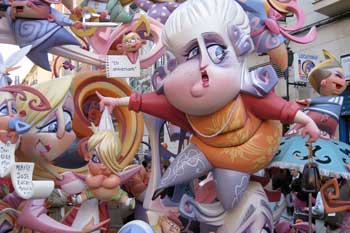
Fallas means “fires,” but is also the word to describe wooden-framed monuments that are placed in squares and key intersections throughout the city. The fallas depict current events, politicians and celebrities, and usually have a satirical tone. On the last night of the festival, the cremà takes place, the burning of all of the fallas, except the winning one.

Winning children’s falla

HISTORY OF FALLAS
Why the burning? Over past centuries, carpenters cleaned out their shops by making bonfires of wood scraps. It coincided with St. Joseph’s Day, the patron saint of carpenters, on March 19. The wood scraps took on doll-like shapes and then became effigies reflecting whatever face was griping the neighborhood. Today the fallas still poke fun but appear as elaborate polystyrene (styrofoam) painted works of art that can tower as high as a six-story building and cost more than $1 million to construct.

MASCLETÀ
At 2 o’clock from March 1-19, there’s the daily pyrotechnic mascletà in the always-packed City Hall Square. For 10 minutes, about 250 pounds of gunpowder explode in a rhythmic cadence of deafening blasts. Different sound artists shoot off a concoction of giant firecrackers, thunderous smoke bombs and screaming rockets to wow the crowds.

The city hall falla turns into an inferno during the crema.

STREET FESTIVAL
Valencia’s Old Town, the largest in Europe, is the ideal place to stroll around looking at the hundreds of captivating fallas (pack comfortable shoes). To accommodate the over one-half million visitors to this coastal city, 700 streets are closed to traffic. Down any street, you may see a 100-member falla commission with women, children and men in 18th century ornate Valencian dress being followed by their lively marching band. The streets are also filled with other kinds of sound. Random firecrackers can be heard everywhere and don’t be surprised to see toddlers, yes toddlers, taking part in the fun.

On a food note, you might see paella being cooked over hot coals in the street. To quell any hunger, temporary food stands are also set up everywhere, serving hot buñuelos de calabaza con chocolate (hot pumpkin donuts with hot chocolate as thick as pudding). For a refreshing drink, you can try the local horchata from the tiger nut legume. It has a pear-like texture and a thirst-quenching sweetness.

Neighbors gather to cook paella in the street.

BULLFIGHTS
As with any good festival in Spain, there’s always a crowd at the Plaza de Toros (bullring). For nine days, the best bullfighters in Spain descend on Valencia. This year, two young superstars, José Tomás and Sebastián Castella, were on the billing among many other talented bullfighters.

It’s said that Spain hasn’t seen a bullfighter like Tomás in decades. He excites the crowd with his poise and fearless entanglement with the bull. Many of his passes let the bull in so close that it actually grazes him. Somehow, Tomás makes what is arguably a cruel sport seem like a graceful and courageous ballet with death.

Superstar bullfighter Jose Tomas

FLOWER OFFERING
Amid the celebrations, there is a solemn aspect of Fallas as well. It is the procession of 105,000 Valencians from the edges of the Old Town to a 40-foot-high statue of Our Lady of the Forsaken, Valencia’s patron saint. Women carry bouquets of white, red or pink carnations that are offered to the Virgin. For two days, the flowers are placed in between wooden slats to fill in the pattern of her super-sized robe. The women become so emotional at seeing the Virgin that many are overwhelmed with tears.

NIT DE FOC
Every night there are fireworks leading up to the 1:30 am Nit de Foc (Night of Fire), the biggest fireworks show of the festival. Thousands walk across the bridges of the city to the Paseo de la Alameda to get a clear view of possibly the world’s noisiest and most colorful 22-minute extravaganza of fireworks. The sky is so bright with fireworks at the finale that it appears as if it is daylight.

CREMÀ
The last night is the cremà with 766 fallas burning throughout the city. At 1 am, the huge falla at the City Hall Square is the last to burn. It is doused with gasoline and packed with fireworks and loud explosives before the immolation. Within minutes it goes up in scorching flames. It’s a sad ending to the festival, but the burning is said to take away the past year’s negativity in order to make room for a new season.

The next morning, the streets are all clean and a calm takes over the city. It seems as if Valencia just simply turned over a fresh new page.

HOW TO GET THERE
Valencia is relatively easy to get to from the US. First, get yourself on a flight to Madrid, Spain’s capital. From Madrid, it’s a quick 40-minute connecting flight to Valencia. Iberia, the national airline of Spain, partners with American.

WHERE TO STAY
Valencia has over 100 hotels to choose from. I stayed at the Hotel Astoria Palace. It is the emblematic hotel of Valencia, ideally situated in the heart of Old Town and a few short minutes walk to the City Hall Square, cathedral and restaurant/shopping areas. Its central location is key for all the main events at Las Fallas.

The hotel itself has a long history of impressive guests from famous Spanish actors to bullfighters. Despite its 204 rooms, it has the elegant charm of a smaller hotel; it was recently renovated with a modern lobby and dining areas as well as with a spacious, high-ceiling bar. The rooms are classic Spain with rich wood furnishings.

During Fallas, the charismatic director Juan Torregrosa was present in the lobby and throughout the hotel to greet guests. He speaks English having had lived with a family in Arkansas for two years.

Vinatea, the hotel’s restaurant, features an extensive menu including a dozen unique rice and paella dishes. Its modern white setting with purple flourishes is the perfect place to dine and to try a bottle of wine from their extensive bodega.

WHERE TO EAT
If seafood is your thing, Civera, near the train station, is a must. You won’t believe their selection of shrimp and lobster in tanks to the scallops and dozens of different kinds of shellfish on display. All of their seafood is either from the bordering Mediterranean or Cantabrian seas. You can try the biggest oysters you’ll ever see — about the size of your fist. If you haven’t tried grilled sepia (local form of calamari) with olive oil, you’re in for a treat.

For a classic Valencian restaurant complete with paella and other typical rice dishes, try La Riuà. It’s one of the oldest establishments in the city with walls decorated with colorful and fascinating plates.

For artistic and mouth-watering tapas or pintxos, there’s Sagardi, a Basque tavern-like setting with an upstairs restaurant for dining including juicy T-bone steaks and popular fish like hake and cod.

WHERE TO START
Here are some key websites for Fallas and Valencia if you want to join in on the fun:
www.fallasfromvalencia.com
www.turisvalencia.es
www.spain.info

Gateway to Connemara

By Susan O’Brien
Photos by the author

The early part of the 21st century has changed Ireland in many ways both good and bad. A building boom (now gone bust in the world-wide recession) had Irish-style mini-mansions going up throughout the beautiful and rugged western part of this once-impoverished country. Many immigrants were returning home to take advantage of the employment opportunities created by the famed “Celtic Tiger” economy.

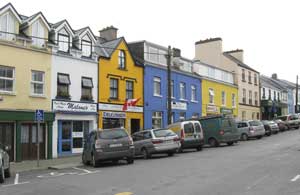
But if you are a visitor looking for a place that still holds the bucolic charm for which Ireland is famous, Clifden in County Galway is a perfect base for exploring beautiful Connemara. This little Irish village is perfectly situated between bustling Galway City and the rolling countryside of western Ireland, which is justly famous for its rugged, desolate beauty.

Kylemore Abbey, Connemara

One of the newest towns in Ireland, Clifden was founded at the beginning of the 19th century by John D’Arcy, who hoped the town would bring prosperity to the poverty-stricken area. Today the village is much as it was built more than 100 years ago, but as a hub for tourists exploring the surrounding countryside, it is home to numerous restaurants, shops, B&Bs and hotels.

Clifden is a logical and pleasant home base or jumping-off point for anyone wishing to explore Connemara and its beautiful coastline, quaint villages and rugged mountains. It is also a convenient hour’s drive into Galway City, with its more cosmopolitan nightlife and shopping scene.

To check out accommodations, restaurants and things to do in Clifden, go to www.clifdenchamber.ie. For information on the region, go to www.connemara.ie or discoverireland.com.

Travel With Kids

Photos courtesy Travel with Kids

ET: How many times have you taken your kids along with you on a foreign trip, and where?
 
The kids have been traveling with us since before they could walk (they are 10 and eight now), so on many, many trips to places like the British Isles, France, Italy, Greece, Peru, Costa Rica, Alaska, Florida, Mexico and the Caribbean.

ET: At what age do you feel it’s worthwhile for children to be taken on an overseas trip to Europe? Please explain your reasoning.
 
I think each age has its own benefits and drawbacks.  When they are babies they are easy to travel with (before they can walk) and babies seem to open up a whole new door with the locals…you will meet other parents and talk about universal issues and be introduced to a whole different world than a typical traveler…people love babies! The drawback is babies come with a lot of gear and long overseas flights can be tough with a crier.  Toddlers are fun to travel with because you see things entirely differently. They are fascinated by everything and leave nothing unexplored.  What we might see as a famous monument a toddler might see as a cool worm inching its way across a stone surface.  It gives perspective to things and adds a playfulness you might not get with older kids. However, toddlers can be unpredictable, and you still have to deal with added gear and schedules.  My favorite is school-age kids.  They still see things differently: our boys spent a good 20 minutes watching an ant carrying a toothpick across the Parthenon last summer, but they are more able to comprehend the historical and cultural significance of destinations.  They are learning about the places in school and they bring that with them as well. Plus, they don’t have as much stuff, and are able to carry their own bags and they actually want to spend time with their parents still.  The drawback is that they are in school, so homework has to become a part of their trip as well.  Pre-teens and teens, depending on what stage they are in, can still be excited by exotic destinations, especially if you put an adventurous spin on it (i.e., zip lining through the Amazon, hiking the Inca Trail), but they are harder to impress and a mopey teenager can put a damper on the vacation for everyone.  But, don’t let this stop you, as they will appreciate it later, and it gives them a global view on life that many kids their age don’t have.

ET: Language differences may or may not be a big barrier to children on a trip to Europe when accompanied by their parents, especially when the children are younger. At what age do you recommend children study the language before they travel overseas, and how might they best learn a language, say, when they’re going over for only a week or two?  
I always encourage travelers of every age to learn at least a few words in the country they are visiting.  Saying “s’il vous plaît” in Paris will get you a much warmer reception than instantly assuming everyone knows English.  And its fun for kids to practice the language with local kids.  It is by no means necessary. There are very few places on earth that you can’t find at least one person who speaks English. However, if you plan on getting far off the beaten path, I would suggest a phrase book.  There are lots of smart phone applications available as well now.  We usually download one of those and practice a few key phrases in the weeks before the trip and while we are on long plane or train rides.

ET: Are there some things that are vitally important to take with you when you take younger kids along, that you may not find in Europe?
 
For the most part, you can find anything in Europe that you will need supply-wise.  If there is a specialty item that is unique to your child, you may want to bring that…for example, a certain diaper rash cream for kids with sensitive skin, or a formula that your child needs.  Also, any prescription medications.  But don’t be afraid to try local things as well. Europe has lots of independent companies producing natural kids’ items that you can’t find in the States.

ET: What about the added expense by taking kids with you to Europe? Does it cost a lot extra to travel around, lodge and feed them?
 
Airline tickets are the main extra expense.  Big hotels will be able to accommodate most small families in a regular room without additional expense. Booking a condo/apartment helps save on lodging costs and gives extra room for the while family to spread out. Plus, the kitchen can help save money on eating out. We usually do breakfast and sometimes lunch or dinner in the condo, but we like to eat out as well to get a feel for the local cuisine. 

ET: Food. What do you suggest about finding “kid foods”– good, nutritious food at reasonable prices when overseas?
 
Go where the locals go. You don’t need to spend a lot to taste the local cuisine.  The kids love street stalls. too. Just make sure to ask for guidance from locals to avoid getting sick. Crepe stands in Paris, panini cafes in Italy, pasty shops in England…all these foods let you get a taste of real local foods at a fraction of the cost of a sit-down restaurant.

ET: Can you recommend some special “kid-friendly” hotels in Europe, or cities or attractions that seem to especially cater to kids?
 
It’s not always the cities you would think that are exciting for kids.  There doesn’t have to be an amusement park to interest kids.  Our kids were fascinated by Venice, a city many people would not think of taking kids to.  They loved taking the boats up and down the canals and wandering the tiny streets.  Big cities are fun for kids, too.  Paris and London are on the top of our kids’ destinations list.  They love riding the tube and double decker buses and visiting big time attractions like the Eiffel Tower.  Really anything can be interesting to kids if you prep them for it.  Learn about a destination before you go.  The kids learned about gladiators and Rome before we went to Italy, and it really came to life in Roman ruins all over Europe.  They had a blast pretending to be gladiators in colosseums from Wales to Rome.  Walks Inside Rome had a great tour with history on a kid’s level and a visit to Gladiator School…the kids learned from “real gladiators” how to fight with swords and defend against wild animals. Very fun! Many attractions have kid versions of audio tours, scavenger hunts, or something to engage kids. Just ask. If they don’t, you can always make your own. When the kids were younger (ages 5 and 7) we visited the Louvre. I was worried about keeping them interested, so I printed out pictures of some of the more famous exhibits and sent them on an art treasure hunt.  They had a blast, and even enlisted the security guards to help them, and we enjoyed extra time at the museum.
 
As far as hotels go, apartment rentals are always great with kids.  The apartments are often in local neighborhoods, so you get a better feel for local life.  We rented apartments from Frenchy Rentals in Paris, a villa in Tuscany from Italy Perfect and apartments in Rome from Parker Villas.  When we are staying in a hotel, we try to stay in family-owned, smaller hotels.  These are usually located in the more culturally rich or historically significant parts of town.  A lot of it is also about location.  We don’t want to have to take a 20 minute taxi everytime we want to go into the old part of town. We like to be where the action is.

ET: Teenage tensions can be a problem. How do you handle this on a long European trip?
 
Lots of luck.  Just kidding. Teenagers are a different breed, and since I don’t have any yet, I can’t give too much advice here.  What I have noticed with my niece and nephews is that when they are out of their element (like you are in a foreign culture), some of that attitude fades away.  I went on a trip to New York with my 15-year-old niece last year, and we had a blast.  I asked for her input on everything we did, and I think that helped a lot. Let the kids (of all ages) help plan what you are doing. That helps them feel invested in the trip ahead of time and keeps them engaged while you are on the road.

ET: What foreign trips/areas might you not want to take your kids on and why?
 
I don’t think there are any areas I would say don’t take kids accept for areas I would not go myself because of dangers or violence.  I guess there are some third world countries for which I would want to edit the itinerary. It would be very hard for the kids to comprehend such abject poverty. I might also stay away from long trips in which passengers are contained and there are no breaks. Kids who are cooped up and bored for long periods of time can get irritating fast.
 
Many people ask if I am scared to travel because of coverage they see on television. Fortunately, I have never felt any hostility from locals stemming from my being an American. In fact, quite the opposite.  I have always been welcomed with open arms.  When we traveled through the Middle East I was not sure what to expect, but everyone was very warm and welcoming.  What you see in the news is not always how it is in real life. I would be cautious, of course, as things can happen when you travel, just as they could at home.  Be aware of what is going on around you, ask the locals for perspective and trust your instincts.

ET: What do you suggest on a European trip if the parents want to occasionally go out alone in the evening and the kids need to go to bed. Who watches the kids? 
 
Many hotels offer babysitting service. I have never used them as I would not feel comfortable leaving my kids with a stranger.  However, I hear stories from other people who did this, and it turned out just fine.  I would say that for me, the point of a family vacation is to spend time with your kids.  At some point, they won’t want to hang around with us anymore, so I try to cash in on all the time I can with them now.  Schedules are a bit more flexible when we travel. So, the kids stay up later which is just fine as the town squares in the evening are packed with families strolling and kids playing. It’s a time where we really get to know the locals, and the kids love it!

ET: What do you think is the most important thing to remember when going to Europe with your kids?
 
Take time to absorb it all.  Often times when we travel (and I am just as guilty of it as anyone else), we pack in as much as we can.  There’s so many wonderful things to see and do in Europe. And we end up moving so fast that we don’t take time to just sit and soak it all in.  Sitting in the town square, watching life go by, is a great tradition in southern European countries, and it’s a great time to reflect and just spend time with your kids…time bonding and re-connecting with one another, which is really what it’s all about anyway.

Find out more about Travel with Kids:
Facebook: www.facebook.com/pages/Travel-With-Kids/107216306811
Twitter: twitter.com/Travel_WithKids
YouTube: www.youtube.com/travelwithkids
Travel With Kids Blog: travelingkids.blogspot.com
Janson Media:ttp: www.janson.com/dvdcatalog/

Travel With Kids takes viewers on an educational journey through each destination visited, presenting history and culture in an innovative way, as well as showing the kid-friendly things to do and see. Whether planning a trip, or just wanting to learn more about a destination, Travel With Kids will entertain the whole family. For more information on Travel With Kids, or to purchase a DVD visit www.TravelWithKids.tv