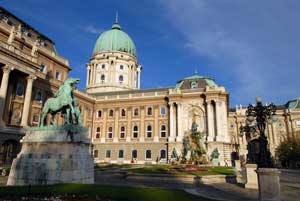
Budapest: Cultural Continental Capital

High-domed and in 19th-century neoclassical style, Budapest’s Royal Palace dominates high ground on the Buda side of the river. The complex includes the Hungarian National Gallery.

By Tom Bross
Photos courtesy Budapest Tourism

For a memorable trip combining two culturally rich continental capitals, start in Vienna by immersing yourself in music, fine-arts museums and some of that city’s famous Kaffeehäuser coffee houses.

DAY ONE
At the Vienna’s Westbahnhof, board an ÖBB Austrian Railways EuroCity train (www.oebb.at) headed for Budapest. The journey takes slightly more than three hours, covering 135 miles/217 km. by way of low-level Danube valley terrain. While approaching Hungary’s capital, you’re treated to urban riverbend panoramics meriting their UNESCO World Heritage eminence (as of 2002).

As they cross a high railroad bridge, passengers get wide-angle overviews of the two-part metropolitan layout. Hilly Buda, topped by the Castle District, looms above the river’s west bank. On the opposite side—with the enormous neo-Gothic Hungarian Parliament building as a focal point—flat Pest sprawls toward its parks, squares and buzzing commercial areas. (Regarding multinational Danube terminology, what’s called the Donau back in Vienna flows downstream to become the Duna here). Disembarkation at skylit, 19th-century-ornate Keleti station means you’ve arrived at Baross Square in the heart of Pest. Keleti’s completion in 1867 came when the Austro-Hungarian Empire had maximum geopolitical clout. That explains the two cities’ long-time kinship.


Several upscale hotels are in the station’s immediate vicinity such as the five-star Le Meridien, splendidly converted from a limestone police headquarters, with its 218 rooms (www.lemeridien.com). The comparably cosmopolitan Kempinski Corvinius opened in 2005 (www.keminski-budapest.com). Not as central, but walkably close to colonnaded Heroe’s Square and vast City Park, the Corinthia Grand Hotel Royal dates from Hungary’s 1896 Magyar Millenium and comes complete with deluxe spa amenities (www.corinthiahotels.com). Less pricey, more intimate and decorated with contemporary panache, the four-star, 57-room Atrium Hotel (www.atriumhotelbudapest.com) opened recently on a quiet side street located three blocks south of Keleti.

If Buda’s Old World atmospherics are more to your liking, check into the family-run, 27-room Hotel Victoria (www.victoria.hu), nicely situated for Duna vistas. The newer, four-star Novotel Blue Danube (www.novotel-bud-danube.hu) is another riverfront “recommendable.” A slick, Americanized Hilton (www.budapest.hilton.hu) was added to Buda’s skyline 30 years ago.

The Chain Bridge, one of the city’s beautiful Art Nouveau landmarks.

If you’re exploring Pest at midday, take a lunch break at Mühesz, providing an international menu and Budapest-brewed Dreher beer. Choose this indoor/outdoor restaurant for its location on sophisticated Andrássy Avenue—another UNESCO World Heritage Site, lined with imposing mansions and public buildings. Among them: 1884’s State Opera House, matching its Viennese counterpart for grandiose architecture and lavish interiors (Bertalan Székely’s murals on the foyer’s vaulted ceiling, for instance, and flamboyant Károly Lotz frescoes above the main hall).

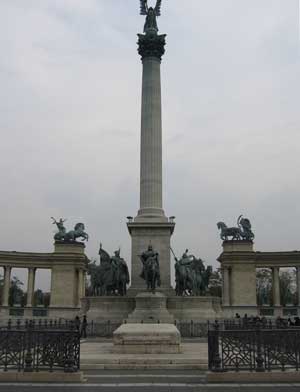
Wrought-iron railings seen on this Parisan-infuenced boulevard frame stairways descending to continental Europe’s earliest subway line, the M-l metro, inaugurated in 1896 to coincide with millennium celebrations. So, sure enough, Andrássy Avenue extends straight ahead toward the Millennium Monument on Heroes’ Square—marble-paved open space.

From there, tree-shaded walkways curve into City Park’s ponds, botanical gardens, Budapest’s zoo and the Széchenyi Spa Baths, Europe’s biggest such complex, fed by thermal springs discovered 150 years ago. Backtracking to the square, make at least a quick tour of the Museum of Fine Arts before closing time at 5 p.m. (Tuesday-Sunday). Collections include Raphael’s The Esterházy Madonna and a Dürer self-portrait, plus paintings by Rembrandt, Tiepolo, El Greco, Picasso and Pieter Bruegel the Elder’s 1556 masterpiece: St. John the Baptist’s Sermon.

For tonight’s meal, choose Belmondo, virtually next door to the Opera House. Singing waiters entertain in this two-level dining salon, where fish and vegetarian courses are on the menu, augmented by an extensive wine list. Here’s your chance to taste-test classic Hungarian beef goulash, served spicey-hot and traditionally accompanied by tarhonya noodles.

Sidewalk cafés line both sides of Pest’s trendy Andrássy Avenue, one of Budapest’s UNESCO World Heritage Sites.


DAY TWO
Make the most of a full day in Pest. No need for a hasty breakfast, because English-language tours of Kossuth Square’s Parliament complex don’t commence until 10 a.m. The crown and coronation regalia of St. Stephen (Hungary’s revered national patron) glimmer in display cases. In nearby St. Stephen’s Basilica, admire jewel-encrusted reliquaries, mosaics and paintings. Then climb to the dome’s 315-ft./96-meter observatory for all-around city-and-river views.

In a museum-going mood? Pest has dozens—ranging from ethnography to agriculture, geology to photography, railroading to contemporary art and natural history. The memorabilia-filled Béla Bartök Memorial House (Csalán Utca 29) was the 20th-century composer’s residence. Bold Art Nouveau design makes the Museum of Applied Arts a visual standout, with aqua and gold Zsolnay ceramics covering the dome and roof in dazzling patterns. Also compelling: north-side Budapest’s Jewish Quarter and its Byzantine-Moorish, twin-turreted Great Synagogue (Dohány Utca 2), consecrated in 1859.

Ponder two lunchtime possibilities. The circa-1897 Central Market Hall (more of those multicolored Zsolnay rooftop zigzags)—jam-packed with stalls purveying produce, breads, meats and cheeses—includes an upstairs niche where drinks, sandwiches and sugar-sprinkled, paprika-seasoned palacsinta pancakes can be ordered. Or, similar vintage but classier ambience: Gerbreaud, the quintessential mid-European pastry shop/coffee house/tea room/casual restaurant, facing Vörösmarty Square’s sculpted stone fountain.

Shopping, people-watching, café-relaxing. Accomplish all three by exploring a popular pedestrian corridor, located two blocks in from Pest’s riverfront. Namely: Váci Utca, hemmed in by neoclassical, Bauhaus and radical new postmodern buildings.

When nightfall approaches, floodlights click on, illuminating the historic Chain Bridge (1849) and Baroque buildings flanking Pest’s riversides. Your cue for a boat ride, therefore time to settle into Spoon, a sociable onboard restaurant. Follow dinner with drinks in the lounge, ideally big-windowed for watching the city lights while cruising the Duna.

DAY THREE
Ride a funicular railway up a 48-degree slope to reach the Buda heights, locale of the Royal Palace. Amidst courtyards, gardens and ornamental gateways, attractions inside this neoclassical include the Hungarian National Gallery, Budapest History Museum and Hungary’s National Library (containing more than two million books).

Beneath the ramparts, rows of Gothic and Baroque housefronts overhang tangles of gaslit streets laid out in the Middle Ages, now loaded with souvenir shops. (You’ll notice pockmarked walls, hit by bullets fired during the 18-day Hungarian Revolution in autumn 1956—Budapest’s heroic populace vs. Soviet troops and tanks). For lunch, find a sidewalk table at Walzer, a chatty little café near Holy Trinity Square. Then stroll upward to the picturesque Fishermen’s Bastion, an arcaded pavilion dating from 1895. A longer walk gets you to Statue Park, hilltop dumping ground for 41 gigantic Communist-era statues, ripped from citywide perches after “comrade” bureaucrats and Russian Red Army soldiers finally departed in 1991.

Guitar-strumming in a 15th-century palm court complements tonight’s candlelit dinner at Alabábardos, within sight of central Buda’s tall-steepled Mátyás Church. Enjoy continental cuisine along with fine Hungarian and Austrian wines.

DEPARTURE
A Hungarian National Railroad line connects Pest’s Nyugati station (a decade “younger” than Keleti) with domestic and international terminals at Ferihegy Airport (BUD), 10 miles/16 km. southeast of town. The transfer takes merely half an hour.

Beginner’s Budapest

By Don Heimburger
Photos by the author

The Eastern European capitals are becoming “closer” to visit each year with better airline routes, and in some cases, reasonably-priced tickets. It’s really not correct to call them “Eastern,” a friend of mine said, because if you look at a map of Europe, they are still close to the “West.” Consider perhaps cities in Belarus, the Ukraine and Romania as “Eastern,” he suggests.

So Budapest, a recent destination of mine and the capital of Hungary, was not particularly hard to reach, after I determined that a Rail Europe train ticket was the most economical form of transportation from Munich. It was, however, a 7 hour and 22-minute train ride from the Bavarian capital, but with trains being an easy and relatively inexpensive form of European travel, I opted for that.

FIRST IMPRESSION
My first impression of this city of about 2 million people (it’s much larger than Prague), came as I departed the train and walked among hundreds of train travelers to the door of the massive train station, where I met hundreds more people on the streets. The city seemed vibrant, active and alive. It also seemed like I should have studied the Hungarian culture a bit more before I arrived, just to ground myself better in what I was about to see.

Divided by the Danube, the city is really two cities in one—hilly Buda in which is located Castle Hill—and Pest, located on the east side, and flat. The most prominent building on the river is the Parliament Building, closed when I was there because of a national holiday. In fact, the whole area was roped off by the police.

Photo by Marilyn Heimburger

My overriding concern about going to Hungary was the language: I didn’t know a word of Hungarian, and I found it hard to pronounce words. I did learn that “Utca” meant “street,” “Hid” meant “bridge,” and “Furdo” meant ”bath.” I also found as I went along that I didn’t necessarily need to know any words in Hungarian. Most of the shopkeepers, hotel personnel and tourist guides knew enough English so that I could communicate well enough.

City trams in Budapest

GUIDEBOOK HELPS
I’d suggest picking up a guidebook at a local travel store before arrival, and then arranging for a city tour of the highlights before attempting to proceed on your own. The reason for the city tour is that because of the size of the city, you’ll not likely be able to find all the attractions yourself, or want to walk to them yourself.

The tour (www.cityrama.hu), will take several hours, but you will have seen the crème of the attractions of the city. If you plan to stay a few days, the Budapest Card provides free services or discounts at more than 100 places, from public transportation and museums, to thermal baths and restaurants.

The three-hour Cityrama “City Tour” costs 28 euro and includes free taxi pickup at your hotel. The tour starts at the Chain Bridge, which is especially beautiful at night; a romantic walk along the river near the Chain Bridge is memorable. The Parliament Building, built in 1896 for the city’s millennium celebration, features a unique Neo-Gothic design, and reminds one of its counterpart in London. At one time a large red communist star was anchored from the tallest spire. Guided tours are available in the portion of the building which was vacated by the House of Lords.

Behind the Parliament is Kossuth Ter, filled with monuments such as the one to Lajos Kossuth who led an uprising in 1848. The Museum of Ethography (focusing on folk art and country life) in the old Supreme Court Building houses artifacts from the pre-WWI days in Hungary.

Shops, theaters, cafes and more line the Andrassy Ut as the road connects the City Park where you’ll find the zoo with its playful buildings, the famous Szechenyi Baths with several different pools to soak in, the Vajdahunyad Castle (a replica of the famous castle in Transylvania), the Museum of Fine Arts, the Palace of Art and Heroes’ Square. At the baths, you’ll soak in water containing calcium-magnesium-hydrogen carbondate and sulphate-cloride.

I spent quite of bit of time in this area of the city, and would have spent more if the weather had cooperated. Heroes’ Square is where you’ll meet the most “historic” Hungarians in statue form; the very large open area has as its backdrop the imposing Millennium Monument. In the adjacent City Park is where the famous Gundel Restaurant is located (see sidebar). During the 19th century, citizens used to ride their horses in this place and take along a picnic lunch. In the winter, the lake is frozen, so ice skating is a popular past time.

In the other direction, the House of Terror, former headquarters of the Nazi-sponsored Gestapo and secret police, Budapest Opera House, with its neo-Renaissance architecture, fits well with the similarly-elegant neighborhood on Andrássy Avenue. Hungary’s greatest architect, Miklós Ybl, designed the building for the Millennium celebrations. Construction started in 1875 and the building was finished in 1884. Ybl oversaw the work himself with painstaking care. Hundreds of statues and paintings decorate the building both inside and out.

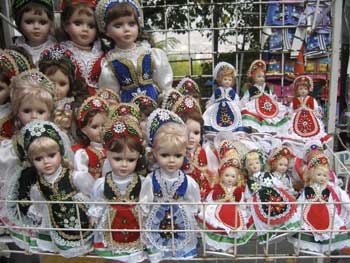
Another attraction in Pest is the Great Market Hall, a multi-level cavernous structure at the end of Vaci Utca, which should take care of most of your food needs if you’re looking for fresh meats, bakery goods, fruits or vegetables or paprika, and it will also satisfy your need for Hungarian souvenirs. This is a good place to hang out for a couple of hours and find lunch at one of the many fast food stalls,

At Buda Hill, you can walk up the hill (about 30 minutes), or take the chairlift to the top of Janos Hill (1,729 feet). The Erzsebet Lookout tower offers a panorama overview of the city below. The area is divided between the “royal” section and the civilian section, with Matthias Church and Fisherman’s Bastion highlights of the civilian section. Streets that lead away from Trinity Square are dotted with Baroque-style buildings and mansions that hide Gothic ruins.

For a rest and refreshment, try ice cream or a pastry at the Ruszmurm Cafe or sit for a while at Kapisztran Square and listen to the bells of the Magdalena Tower. Be sure to see the Royal Place complex. Once the home of lords and royals, it is now the home to museums.

There are more than 200 museums in Budapest, some of which include the Hungarian National Museum, the Budapest History Museum, the Hungarian National Gallery, Museum of Fine Arts, the Museum of Military History and the Ludwig Museum.

An interesting aspect of Budapest that many may not know about are the caves in the area. Monaco is the only other city that can boast a dripstone cave—Budapest has several open to the public: there’s the Palvogy, the Szemlo and Matthias Hill caves (qualified climbers only).

City park on Margaret Island

More highlights:

  • New York Cafe—The most ornate cafe of 320 that operated in the years preceding WWI, and it has remained the most elegant since. Gilded columns, reliefs and shining mirrors evoke the aesthetics of the early 1900s.
  • The square-shaped chocolate cake named after Jancsi Rigo, a gypsy musician, and its original creator Joseph Dobos, is a caramel-covered cake you’ll want to try while you’re in town.
  • Margaret Island, in the middle of the Danube, is a large, lovely park where you can escape the hustle and bustle of the city.

What have I left out? Actually quite a bit, but once there you’ll have plenty to do and see. Hungary’s capital is the hub of political, artistic and social energy. It’s full of history and grandeur, big bridges and wide boulevards. With impressive treasures and friendly people, Budapest is a spot you’ll not want to miss.

Prague to Goslar

This train ride features Eurocity, Intercity and Regional trains

By Don Heimburger
Photos by the author

My travel plans had taken me to Prague, and I wanted to visit the medieval town of Goslar, Germany near the Harz Mountains. I had time to get there, and opted for a seven hour train ride so I could relax, unwind and see the scenery. Besides, trains are magic, and it’s much more fun to see the countryside from a train than it is from 30,000 feet up in the clouds.

Leaving my Prague hotel early morning, I take a short tram ride to a subway, and 15 minutes later walk up into the light of day where Prague’s Holesovice train station awaits me.

My particular concern is that I can’t read a word of Czech: Nada. Rien. Nichts.

FINDING MY TRAIN
Waiting in line at the station to check the status of seating on my Eurocity train leaving at 6:40 a.m.—that’s correct a.m.—a man darts in front of me. I can’t even say “excuse me” in Czech. And I can’t get much information that I can understand from the railway clerk, who sends me to another office down the corridor.

But I eventually learn that EC 178 (Eurocity) to Berlin is on time, that I likely won’t need a reservation in addition to my first class ticket, and that I’ll need to wait a few more minutes before I go out onto the platform. Once I make it to the platform, people stream out a few minutes before the train is due in, and once the train is stopped, they all board relatively fast. You have to in Europe, or the train leaves without you.

Praha-Holesovice station

I noted that the departure/arrival screen in the station–-not a large board like in most major European cities–was very small, and that there wasn’t room for more than several train listings at a time; perhaps not many intercity trains come and go from Prague.

ON BOARD
The car I sit in features good, comfortable seats–there are two first class cars, and I’m next to the on-board restaurant car. At my first class seat, tables fold down from the seat in front (like on an airplane), the chairs are adjustable, the windows are large in width and height, there are foot rests, and there’s luggage space above the seat. I could cross my legs and not block traffic as I sat in the aisle seat.

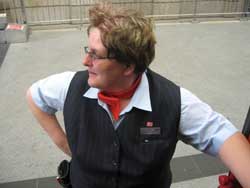
Conductor waits for passengers to board

As the train pushed through Prague and into the countryside, I could tell me were accelerating, and the engineer was using his electric locomotive to give us “the juice.” I suspect we were doing at least 100 mph at times.

When meal time came—enough of the menu was in English, with the help of some of the German I know—that I didn’t starve.

There were plenty of beverages available from coffee, lattes and espresso, to tea, wine and beer. Or you could order a Pepsi Cola. Other foods available included croissants, cheeses, sandwiches, soups and a vegetarian plate.

Dresden was the first stop once the train crossed the border into Germany.

CHANGE IN BERLIN
At the new Berlin train station, I had 18 minutes to hoof it to track 13 from track 7 (on a different level of the station)…and the conductor told me and the schedule in my hand called for me to change levels in the station. From there I boarded an ICE train (Intercity Express) for Braunschweig, Germany and with a 26-minute wait there, I had plenty of time. From there a Regionalbahn train took me to Goslar, arriving at 2:08 p.m., right on time.

A big part of the trip is its predictability; you can nearly always count on Rail Europe trains to do what they say they’re going to do. And it’s fun riding, and watching the little towns, the historic castles and rivers fly by outside your window.

For more information and to get your ticket for an overseas train ride, go to www.raileurope.com.

Let the journey begin.

The Dazzling Las Fallas Festival

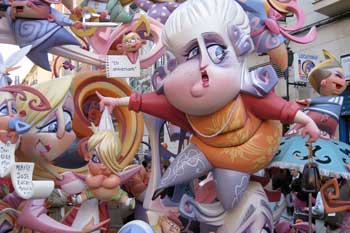
The winning falla, which cost more than 1.2 million to construct.

By Darryl Newman
Photos by the author or as noted

Valencia is probably best known as the birthplace of Valencia oranges and paella, but from March 15-19, you might think Spain’s third largest city was the birthplace of pyromania mixed with pageantry and celebrations. It’s the festival of Las Fallas, and it’s billed as one of Europe’s most spectacular events.

Fallas means “fires,” but is also the word to describe wooden-framed monuments that are placed in squares and key intersections throughout the city. The fallas depict current events, politicians and celebrities, and usually have a satirical tone. On the last night of the festival, the cremà takes place, the burning of all of the fallas, except the winning one.

Winning children’s falla

HISTORY OF FALLAS
Why the burning? Over past centuries, carpenters cleaned out their shops by making bonfires of wood scraps. It coincided with St. Joseph’s Day, the patron saint of carpenters, on March 19. The wood scraps took on doll-like shapes and then became effigies reflecting whatever face was griping the neighborhood. Today the fallas still poke fun but appear as elaborate polystyrene (styrofoam) painted works of art that can tower as high as a six-story building and cost more than $1 million to construct.

MASCLETÀ
At 2 o’clock from March 1-19, there’s the daily pyrotechnic mascletà in the always-packed City Hall Square. For 10 minutes, about 250 pounds of gunpowder explode in a rhythmic cadence of deafening blasts. Different sound artists shoot off a concoction of giant firecrackers, thunderous smoke bombs and screaming rockets to wow the crowds.

The city hall falla turns into an inferno during the crema.

STREET FESTIVAL
Valencia’s Old Town, the largest in Europe, is the ideal place to stroll around looking at the hundreds of captivating fallas (pack comfortable shoes). To accommodate the over one-half million visitors to this coastal city, 700 streets are closed to traffic. Down any street, you may see a 100-member falla commission with women, children and men in 18th century ornate Valencian dress being followed by their lively marching band. The streets are also filled with other kinds of sound. Random firecrackers can be heard everywhere and don’t be surprised to see toddlers, yes toddlers, taking part in the fun.

On a food note, you might see paella being cooked over hot coals in the street. To quell any hunger, temporary food stands are also set up everywhere, serving hot buñuelos de calabaza con chocolate (hot pumpkin donuts with hot chocolate as thick as pudding). For a refreshing drink, you can try the local horchata from the tiger nut legume. It has a pear-like texture and a thirst-quenching sweetness.

Neighbors gather to cook paella in the street.

BULLFIGHTS
As with any good festival in Spain, there’s always a crowd at the Plaza de Toros (bullring). For nine days, the best bullfighters in Spain descend on Valencia. This year, two young superstars, José Tomás and Sebastián Castella, were on the billing among many other talented bullfighters.

It’s said that Spain hasn’t seen a bullfighter like Tomás in decades. He excites the crowd with his poise and fearless entanglement with the bull. Many of his passes let the bull in so close that it actually grazes him. Somehow, Tomás makes what is arguably a cruel sport seem like a graceful and courageous ballet with death.

Superstar bullfighter Jose Tomas

FLOWER OFFERING
Amid the celebrations, there is a solemn aspect of Fallas as well. It is the procession of 105,000 Valencians from the edges of the Old Town to a 40-foot-high statue of Our Lady of the Forsaken, Valencia’s patron saint. Women carry bouquets of white, red or pink carnations that are offered to the Virgin. For two days, the flowers are placed in between wooden slats to fill in the pattern of her super-sized robe. The women become so emotional at seeing the Virgin that many are overwhelmed with tears.

NIT DE FOC
Every night there are fireworks leading up to the 1:30 am Nit de Foc (Night of Fire), the biggest fireworks show of the festival. Thousands walk across the bridges of the city to the Paseo de la Alameda to get a clear view of possibly the world’s noisiest and most colorful 22-minute extravaganza of fireworks. The sky is so bright with fireworks at the finale that it appears as if it is daylight.

CREMÀ
The last night is the cremà with 766 fallas burning throughout the city. At 1 am, the huge falla at the City Hall Square is the last to burn. It is doused with gasoline and packed with fireworks and loud explosives before the immolation. Within minutes it goes up in scorching flames. It’s a sad ending to the festival, but the burning is said to take away the past year’s negativity in order to make room for a new season.

The next morning, the streets are all clean and a calm takes over the city. It seems as if Valencia just simply turned over a fresh new page.

HOW TO GET THERE
Valencia is relatively easy to get to from the US. First, get yourself on a flight to Madrid, Spain’s capital. From Madrid, it’s a quick 40-minute connecting flight to Valencia. Iberia, the national airline of Spain, partners with American.

WHERE TO STAY
Valencia has over 100 hotels to choose from. I stayed at the Hotel Astoria Palace. It is the emblematic hotel of Valencia, ideally situated in the heart of Old Town and a few short minutes walk to the City Hall Square, cathedral and restaurant/shopping areas. Its central location is key for all the main events at Las Fallas.

The hotel itself has a long history of impressive guests from famous Spanish actors to bullfighters. Despite its 204 rooms, it has the elegant charm of a smaller hotel; it was recently renovated with a modern lobby and dining areas as well as with a spacious, high-ceiling bar. The rooms are classic Spain with rich wood furnishings.

During Fallas, the charismatic director Juan Torregrosa was present in the lobby and throughout the hotel to greet guests. He speaks English having had lived with a family in Arkansas for two years.

Vinatea, the hotel’s restaurant, features an extensive menu including a dozen unique rice and paella dishes. Its modern white setting with purple flourishes is the perfect place to dine and to try a bottle of wine from their extensive bodega.

WHERE TO EAT
If seafood is your thing, Civera, near the train station, is a must. You won’t believe their selection of shrimp and lobster in tanks to the scallops and dozens of different kinds of shellfish on display. All of their seafood is either from the bordering Mediterranean or Cantabrian seas. You can try the biggest oysters you’ll ever see — about the size of your fist. If you haven’t tried grilled sepia (local form of calamari) with olive oil, you’re in for a treat.

For a classic Valencian restaurant complete with paella and other typical rice dishes, try La Riuà. It’s one of the oldest establishments in the city with walls decorated with colorful and fascinating plates.

For artistic and mouth-watering tapas or pintxos, there’s Sagardi, a Basque tavern-like setting with an upstairs restaurant for dining including juicy T-bone steaks and popular fish like hake and cod.

WHERE TO START
Here are some key websites for Fallas and Valencia if you want to join in on the fun:
www.fallasfromvalencia.com
www.turisvalencia.es
www.spain.info

Munich to Budapest the ‘Rail’ Way

By Don Heimburger
Photos by the author

As I usually do, before making reservations for any European trip, I study a map to see where I’d like to go. Sometimes I am not aware of towns or attractions near where I’m traveling to, so a map can help identify those in short order.

The European map came in handy again recently when I booked a flight between Chicago and Munich, the first of what was to be a two-part air journey between Chicago and Budapest. When I discovered the Munich to Budapest air fare would be about as much as the Chicago to Munich fare ($746.00), I quickly gave second thoughts to how I would travel there. And who wouldn’t.

I didn’t want to drive through three countries (Germany-Austria-Hungary) because of gas prices, and my unfamiliarity with the laws and the roads. A bus would take too long, but a train, despite a journey of some seven hours, 22 minutes, would be economical and fun. And I had not ridden those rails before. In fact, Hungary was an altogether new adventure for me.

Munich’s Hauptbahnhof

RAIL COST WAS NOMINAL
A check at www.raileurope.com‘s new website quickly showed that a one-way trip to Budapest’s Keleti Station would cost only $171 U.S. dollars 2nd class ($269.00 first class), and once on board I could sleep or relax from my Atlantic crossing. With the new Rail Europe website, all I had to do was key in my departure and arrival cities, and up popped the cost for the date I wished to travel.

I would arrive Munich via Lufthansa at 5:55 a.m. and have plenty of time to travel on the S Bahn (covered by my Rail Europe ticket) from Munich Airport to the main Munich train station (Hauptbahnhof) to catch Train #63 at 9:27 a.m. to Budapest.

The flight over was uneventful, and the plane landed a few minutes early. Not having been in Germany since the spring, I was craving a croissant made the way the Germans make it, so I waited at an airport restaurant, indulging in coffee and croissants, until 7 a.m. and a Deutsche Bahn office opened to have my train ticket validated (you must validate tickets purchased in the U.S. prior to boarding a train in Europe).

I made a small deposit to reserve an assigned seat in first-class just to be sure. If the agent tells you the route can become crowded with passengers, paying a little extra for a reserved first-class seat can save you from transferring to second class if all the first class seats are taken.

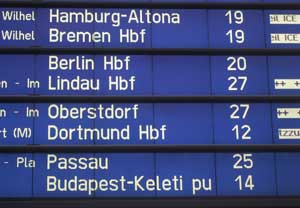
LARGE MUNICH STATION DEPARTURE BOARD
The large train departure board in Munich’s station is fascinating to watch, as new train numbers with boarding tracks pop up every few minutes, and people rush to that platform to board. My train’s notice appears on the board, I see my train roll into the station, and I board car #262 and settle into a comfortable, high-backed leather seat. The train, headed by an electric locomotive, the locomotive of choice in Europe, grabbed onto our string of passenger cars and eased us out of the station on time. Nothing new there—Europe’s trains are almost always on time.

Outside of Munich proper, I look out the window and guess we’re traveling between 95 and 100 miles per hour. I’m likely accurate on this, as European trains can move. A short time later the conductor confirms the train speed at 160 kilometers or 100 miles an hour. One reason trains can travel so fast is that the European track system is much stronger and can hold up much better at high speed. European rail lines have been investing heavily in their train tracks and facilities for years and years, and this is the payoff.

After a while, I note that the heat in the car is a bit excessive, but the conductor enters the car soon enough and announces the heat will be adjusted; it was. By 10 a.m. a porter with a trolley of beer, sandwiches, candy, rolls and chips arrives in the car to ward off any hunger pangs of the passengers.

As we near Salzburg, I can start seeing the snowed-covered Alps that I’ve come to be fond of; I see the Festung on the top of the hill in Salzburg, but only for a moment as the train rolls on. We’ve changed conductors since entering Austria. By the time we arrive at Linz the train is 8 minutes late, and continues to be behind schedule for a while.

Dining in the Speisewagen

TRAIN IS NEARLY FULL
Looking around at the seats and the various cars, I found that 90% of the train was full, and all but about 10 first-class seats had been reserved. If the seat is reserved in the first-class section, a small stub will be attached to the seat with the person’s name on it as well as their boarding and departure stations.

Walking up through the train to the Bord Restaurant, I found it not crowded, and serving Hungarian-style food, including goulash and Hungarian beers. The service was fast and the price was very reasonable.

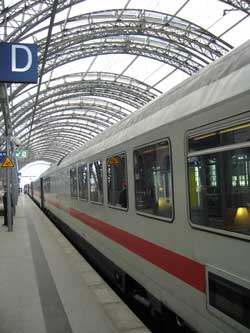
We roll through St. Polten 10 minutes late, and by Vienna we are 17 minutes late and running into fog. I don’t remember if we arrived late in Budapest, but we were nearly on time nevertheless. The Budapest train station was massive, with a large arching trainshed, similar to many large city trainsheds in Europe.

The trip was as advertised, it allowed me to catch up on my sleep from the flight over, and it allowed me to get into the “European mood” for my travels for the next two weeks. I also saved a lot of money. And in this current rough economy, that’s a good thing.