“Ozapft is!” exclaimed Munich’s Lord Mayor Christian Ude after opening the first keg of beer at noon on September 22, thus officially inaugurating the world famous German Octoberfest.
And following 16 days of beer, fun and Gemutlichkeit, the 2007 Munich Octoberfest closed its gates after 6.2 million people visited the biggest fair in the world.
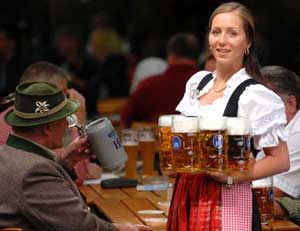
This big city, with rural charm and friendly people, served 6.7 million glasses of beer, thousands of Hendl (chickens) and 104 oxen to the crowds that swarmed into the 14 large tents on the Octoberfest grounds right off of the Schwanthalerstrasse. As many as 10,000 people can be accommodated in some of the huge beer tents.
Alison Ramsey tasted and tested the beers at Octoberfest. A good reporter must get all the facts, and test all the flavors of beer before she files her report.
COLORFUL TENTS The tents, which sometimes appear more like buildings, are highly colorful, and are decorated with painted murals, clouds and more to make them attractive to the visitors, some of which spend all day inside!
A special Octoberfest beer, brewed by Munich’s six major breweries, is served in the tents. The delicious draught is usually served with radishes, Obatzta (special cheese), sausages, roast chicken or grilled fish. And barbecue beef is a Wiesn specialty.
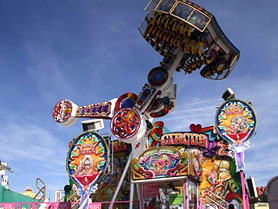
This year, as many as 80 different firms offered fair guests samplings of their foods, and more than 200 attractions greeted fair-goers as well, such as breathtaking rides like the Olympia Loop or the Power Tower, the Krinoline (merry-go-round), the Teufelsrad (Devil’s Wheel), the Toboggan and even a variety show.
HISTORY OF THE FAIR The wedding of Crown Prince Ludwig–later King Ludwig I of Bavaria–and Princess Theresa of Saxony-Hildburghausen in 1810, started the fair when the royal couple invited the people of Munich to celebrate in the fields in front of the city gates. The fields were named “Theresienwiese” in honor of the princess, and locals later abbreviated the name to “Wiesn.”
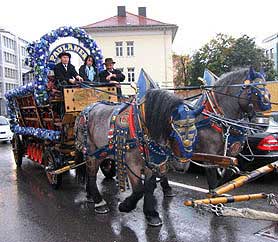
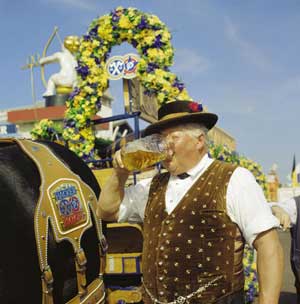
The annual Munich celebration starts off with a parade featuring festive carriages bearing the land-lords’ families, the horse-drawn drays of the Munich breweries, showmen’s coaches, waitresses on decorated floats and the beer tent bands. It’s quite a spectacle!
The following day the Munich Costume and Rifleman’s Parade features groups in traditional costumes, marching bands, troops of bandsmen and trumpeters, amateur and mountain riflemen. Performers of all kinds, decorated coaches and flower garlands are always main attractions of the parade. And the parade goes on even if the weather is bad!
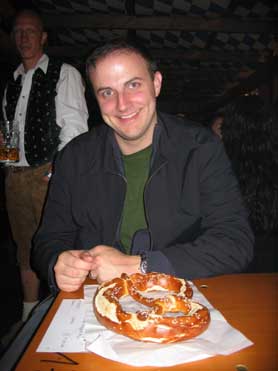
European Traveler’s Steve Ramsey tests one of the giant pretzels at the 2007 Munich Octoberfest. Got a beer to go with this?
ONE LAST WORD, AND A FAMOUS BREW Of course, one of Munich’s famous trademarks is the 418-year-old Hofbrauhaus, where beer lovers gravitate throughout the year. It’s a fun establishment that holds up to 3,000 guests at the same time. The beer house even has its own beer, served, of course, at Octoberfest.
Stay tuned for more beer news. We had a great time in Munich, so it’s likely we’ll be back! Let’s see…when is next year’s fair?
By Marilyn Heimburger Photos by Don Heimburger and courtesy Munich Tourist Office
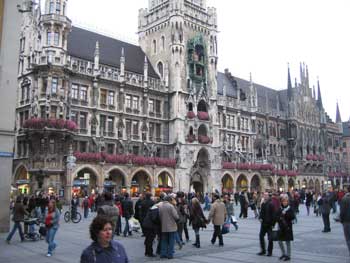
I have always liked Munich. Actually, it’s more than just liking the city. I feel moved by its vibrant life, its stimulating nature and its friendly people. Apparently many more feel the way I do, since it is Germany’s most-visited city.
Last year, during Munich’s 850th birthday, the city of 1.3 million hosted the following:
City Foundation Festival in June in the heart of the city, featuring traditional Bavarian culture and international folk culture. A highlight of the fest was a Gaufest, or regional festival, of the many associations for folk culture where dancing and costumes from the Isargau region were prominent. As many as 10,000 participants were involved in this. A group of 100 rafters from the Oberland region showed how to build a raft. Dance masters showed how to learn the “Munich-Francaise” dance.
In July, the Old Town Ring, which was free from automobile traffic, served as the center for a celebration of theater, music, dance, games and sports on many stages. Scenes from peasant life in Munich with markets, street theater and beer gardens were staged. There also was music from international bands and more.
In August, the three-day Isar Bridges Festival, centered around the Cornelius, Ludwig and Maximilian bridges, highlighted the Isar River (which flows through the city) as the city’s life-giving artery. There was music under the bridge, dancing along its banks, glittering lights on the water, and with this came Munich’s famous culinary delights. An action theater group, which encouraged audience participation, also presented skits. There were also night-time water and laser shows
Additional highlights included the world premier of a work commissioned from composer Victoria Borisova-Ollas especially for the 850th anniversary. In June the Cuvillies Theater, one of German’s most elegant Rococo theaters, reopened after a spectacular renovation. In the newly re-designed St. Jakobs-Platz, many of the local museums and community organizations held programs of music ranging from classical to klezmer (a musical genre), dancing and creative street theater, exhibitions, tours and more.
Many of Munich museums featured exhibits of famous Munich artists, writers and Munich’s cultural heritage.
As Munich’s Lord Mayor Christian Ude said, “(Munich’s) celebrating its 850th foundation day…is nothing exceptional. What is remarkable is the city’s rapid growth from a monastery on a hill to a European metropolis with over a million inhabitants and a high-tech hub.”
As Ude says, the city is special because of its enduring and much-praised flair as a place with a zest for life.
The settlement of Munichen was originally granted the right to market goods and mint coins in June of 1158. In 1214 it was granted status as a town, and in 1255 it became the seat of the Wittelsbach dynasty. Under Kind Ludwig I, many famous buildings were erected, making Munich a major cultural center, and in 1918 the Free State of Bavaria was formed.
For travelers, the city offers 355 hotels and pensions with 45,500 hotel beds available. In 2006, 4.4. million tourists booked nearly nine million overnight stays, with 47% of them from overseas, with the USA bringing in the most, followed by Italy, Great Britain, Austria and Switzerland.
The city boasts three universities and eight colleges, 60 theaters and an opera house, 45 major museums, three symphony orchestras—and it hosts the famous 16-day Octoberfest beginning on the Saturday two weeks before October.
Favorites for visitors to see in Munich include:
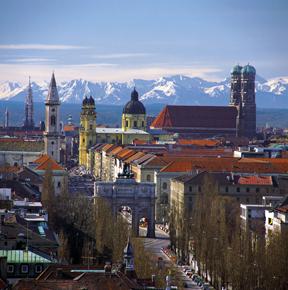
The city’s twin onion-domed towers of the Frauenkirche, Church of our Lady, Frauenplatz 1, is the city’s best-known landmark.
Marienplatz and the glockenspiel on the Marienplatz in the city center displays the mechanical dancers in the tower of the Rathaus (Town Hall) at 11 a.m. and noon (and 5 p.m. in the summer).
Schloss Nymphenburg is the impressive Baroque palace built as the summer residence for the Bavarian Electors. Today the main building houses a museum.
The Viktualienmarkt is Munich’s oldest market, originally begun as a farmer’s market and now a favorite place for a wide range of produce, Bavarian specialties and more.
The Hofbrauhaus deserves a visit, as its one of Munich’s best-known restaurant-breweries at Am Platz 9. Great dining is available, or just casual drinking and listening to oom-pah music. For information on the Hofbrauhaus, visit www.hofbraeuhaus.de.
There are many churches to visit, including the Asamkirche built by the Asam brothers in the 18th century with its spectacular interior at Sendlinger Strasse 62; Church of the Sacred Heart, a cubed-shaped structure with an innovative facade at Romanstrasse 6; and Saint Peter’s, Munich’s oldest parish at Rindermarkt 1.
The Deutsches Museum at Museumsinsel 1 houses sailboats, windmills, space probes, robots, ships, trains, planes and much more. Allot a whole day for this attraction.
Octoberfest Museum, at Sterneckerstrasse 2, will tell you all about the history of beer including how it started as a drink at monasteries, and all about the city’s famous Octoberfest celebration.
The expanded BMW Museum is a must-see if you are fascinated with automobiles and engineering. Tours are available.
Munich is waiting to wow you.
IF YOU GO… You can arrive at Munich’s Airport, which is like a city within itself. Flights from numerous major hubs arrive and depart from here daily. Train is another good option if you are coming from another European city.
If you’ll be in town for at least a day, pick up the City Tour Card (one- and three-day tickets are available), which is good not only for all public transportation, but also includes discounts of up to 50% on more than 30 attractions such as sights, bike rentals, museums, theaters and restaurants. www.citytourcard.com.
A close-in, convenient four-star hotel is the Platzl Hotel at Sparkassenstrasse 10. It is located near the Hofbrauhaus and is within a a couple of minutes walk of the Marienplatz. Visit www.platzl.de.
Guided tours of Munich are available. Visit www.muenchen.de for more information. The tourism office is located in the Rathaus, first floor, at Marienplatz.
Pinkel! The word is strange enough, but I recently learned how these six little letters can stir a whole region to party the day away in true Germanic style.
I thought I knew roughly what to expect in terms of German traditions and festivities. I was familiar, of course, with festivals like Oktoberfest and Weihnachtsmarkt, and with traditional victuals like cabbage and wurst. But little did I know I had yet to discover one of Bremen, Germany’s most unique traditions–one centered on green cabbage, a mysterious meat product called Pinkel, and plenty of alcoholic spirits.
It’s called “Kohlfahrt” (translation— “cabbage tour”) and recently I was told what this festival was all about.
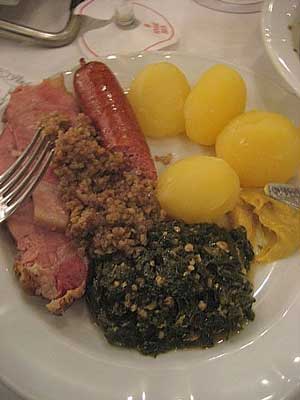
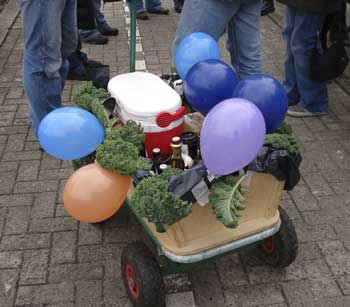
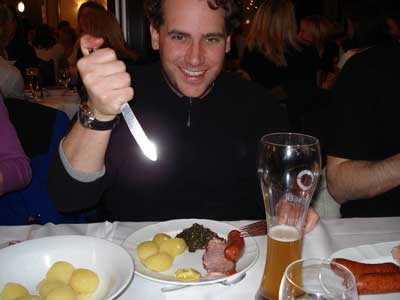
Kohlfart is a tradition practiced only in Northwest Germany, and is a beloved annual ritual in the Bremen area. The idea is that a group of friends or colleagues assemble on a Saturday afternoon in January or February, load up a “Bollerwagen” with an assortment of schnapps, whiskeys and beer, and amble through the countryside playing wacky party games and replenishing liquor at every opportunity. The event is organized months in advance by the group’s Kohlkoenig and Kohlkoenigin— the cabbage king and queen. After a couple hours of walking, when the participants’ bladders are full and their stomachs growling, the group descends on a pub or restaurant to enjoy the culmination of the day’s festivities–a meal of Kohl und Pinkel (the Kohl is green cabbage and Pinkel is something along the lines of bacon, oats, lard and spices packed together). And then they dance the night away—literally. I never knew the Germans loved to dance so much, especially to cheesy ’80’s cover bands. Although I will admit I hit the dance floor for several numbers (who can resist the Abba and AC/DC tribute?).
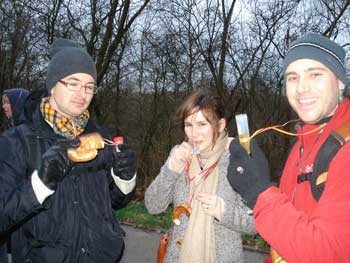
I didn’t know much about Kohlfahrt going into it, but once our group was assembled, and we were handed pretzels (sustenance is crucial) and plastic scientific sample vials to wear around our necks (it really is a cheap and logical way to hold liquor), I knew we were in for some surprises. It only got more interesting when our first two games tested who could maneuver a spoon down their shirt and pants the fastest, and who could throw a teabag the farthest using only their teeth.
Kohlfahrt was definitely worth experiencing for the sheer fun and folly of it all. But it’s a serious business here in Bremen, as evidenced by the multiple Kohlfahrt parties we passed on the road, some of which sported Bollerwagens decked out with flashing lights and loud speakers. The restaurant resembled more of a banquet hall, with about 100 long tables full of rosy-cheeked Kohlfahrters, swaying arm in arm and singing along to “Que Sera, Sera.” It’s experiences like these that remind me how different some things are here than in the States. Germans have no open container law to contend with and are perfectly free (and encouraged, in this case) to walk around toting shot-glass necklaces, singing songs, and pulling a wagon full of alcohol.
Although my observation is that even during the public inebriation and silliness of Kohlfahrt, Germans still manage to act fairly civilized. But civilized or not, it was obvious that everyone was having what seemed like the best Kohlfahrt ever. Until next year, that is…
In 2012, Munich and Upper Bavaria are celebrating an old Bavarian tradition. The 200th anniversary of the edict which permitted beer brewers to sell retail quantities of their own beer in their beer cellars from June until September and to serve beer and bread to their guests will be celebrated this year. The city and the breweries of Munich will offer numerous events in local beer gardens.
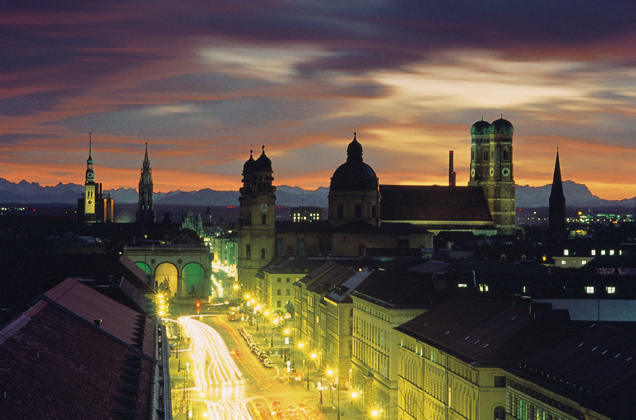
MUNICH – THE WORLD CITY OF BEER Big city, high-tech atmosphere mixed with rural charm, art treasures and traditional customs create a very special “Munich mix” which has helped the capital of Bavaria to achieve world renown. But what adds the final touch to the city’s popularity is the drink associated with Munich throughout the world: beer.
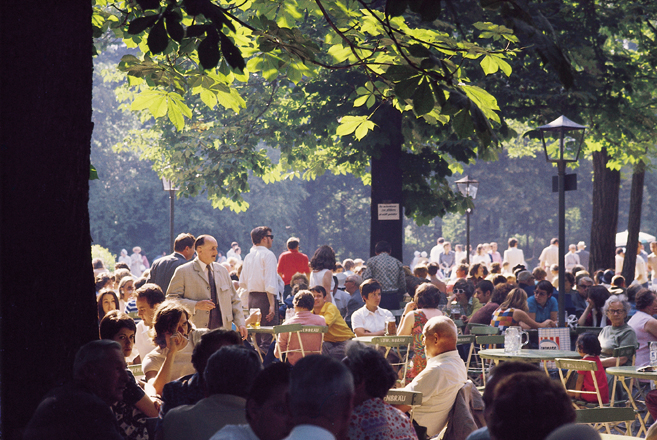
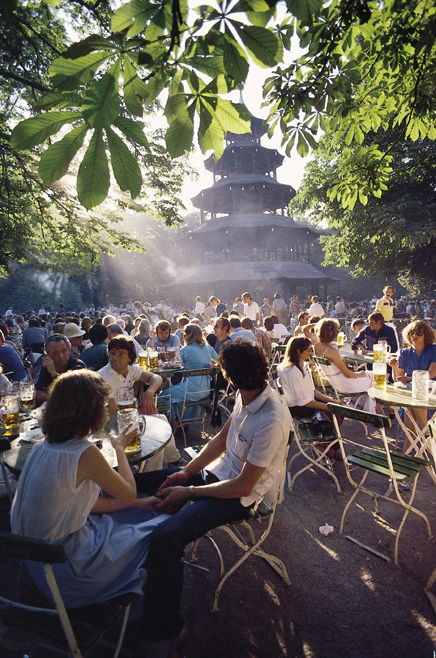
BEER GARDEN ETIQUETTE Bavarian beer gardens fulfill an important social function, as they have always been considered to be a popular meeting point for a wide spectrum of the populace. Visitors should not hesitate to take a seat and start up a conversation with their neighbors at the table. Munich’s beer gardens and the beer gardens in Upper Bavaria are the epitome of Bavarian Gemütlichkeit – the uniquely Bavarian atmosphere of good living, warmth and comfort. And it’s been that way for 200 years.
BRING YOUR OWN FOOD Bring your own food! A special element of visiting a traditional beer garden in Munich is the fact that guests can bring their own food with them. A perfect Brotzeit, as a beer garden picnic is known, might contain the following: Obazda (a delicious and very Bavarian soft cheese dip), Emmental cheese, radishes, freshly-baked pretzels, butter and salt and pepper. A table cloth is also important (preferably a cotton red and white check), as are wooden boards to eat from, a sharp knife, cutlery and napkins.
But those who come unprepared don’t have to miss out on a Bavarian Brotzeit. Most beer gardens offer a range of typical treats, such as Wurstsalat (finely sliced sausage, dressed with vinaigrette and onions), Leberkäse (Bavarian meat loaf) or Steckerlfisch (barbecued whole fish, normally mackerel).
In a Bavarian beer garden, self-service is the rule, unless it is clear that tables have been readied for service. Typical beer garden drinks, such as beer or Radler (a mix of beer and lemonade or lemon soda), are generally only served in one liter steins. Alcohol-free drinks, such as Spezi (a mixture of cola and orange soda) or Apfelschorle (a mixture of apple juice and mineral water), are normally served in half-liters.
The most important rule when toasting with others at your table is to do it as often as possible, so creating a sense of community and giving you the chance to make contact with your new friends. But don’t forget to look your drinking partners in the eye as you touch steins.
The reason horse chestnut trees can be found in every “real” Bavarian beer garden is a matter of history. According to a decree from the 16th century, brewing beer was banned in the summer months, due to the increased danger of fire. Therefore, beer that was brewed in spring for summer was made with a higher alcohol content to help preserve it. In order to keep the beer cool, beer cellars were constructed close to the breweries, but because Munich has a high groundwater level, deep cellars were out of the question, meaning that those that could be built had to be protected from the sun. And that is why trees which provide a lot of shade, such as horse chestnut trees, were planted above them.
BIER UND OKTOBERFEST MUSEUM, BEER TOURS & MORE Munich is the capital of beer – with six breweries, the Hofbräuhaus and the Oktoberfest. Interested in the story of beer? How German beer effected the monasteries and the purity law? Why is the quality of Munich’s beer so unique? Did you know that Oktoberfest was established as the national festival for the wedding of King Ludwig I with Princess Therese of Saxe-Hildburghausen? Visit the Bier und Oktoberfest Museum for the answer to these questions and a lot more.
Since the Middle Ages, the English university town of Oxford has been attracting scholars hungry for knowledge. Today it also draws hordes of tourists hungry to see its Gothic colleges, top-notch museums, colorful gardens, lively student hangouts and cozy pubs.
We all know that sightseeing is a strenuous activity that boosts your appetite. And Oxford offers plenty of places for filling empty stomachs as well as hungry minds. In this historic “city of dreaming spires,” you’ll find something to suit every taste, from traditional English pork pies to sushi rolls, from falafel sandwiches to chocolate fudge, from goat cheese pizza to the best of British cuisine.
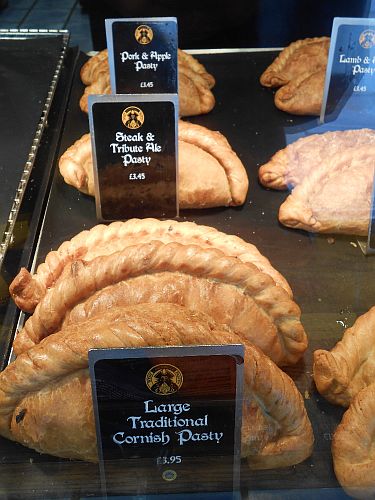
Classic Cornish pasties at West Cornish Pasty Company on Cornmarket Street
FAST FOOD In a town full of students, there’s no dearth of fast-food joints. Skip the inevitable McDonald’s and KFC, and head for the simple eateries offering more typical British fare. The West Cornish Pasty Company on Cornmarket Street sells very good versions of these traditional English turnovers with a selection of savory fillings. Many other takeout places, including supermarkets, offer fresh sandwiches stuffed with prawns, sliced cucumbers or egg salad, perfect for a picnic on a hot summer day. And food trucks parked around the edges of the central city cater to eaters on the go, selling a variety of takeaway dishes from India, Pakistan and the Middle East, as well as British standards such as “toad-in-the-hole” (succulent sausages baked inside Yorkshire pudding batter).
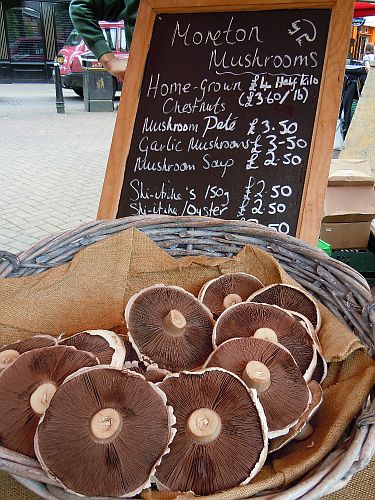
Mushroom stand at the weekly Oxford open-air market
OXFORD COVERED MARKET Opened in 1774, Oxford’s venerable covered market is one of the city’s most popular tourist attractions. In addition to its fruit, vegetable, meat, fish and cheese stores, it includes several little shops selling cooked foods to nibble on site or take away. Choose from an eclectic group of eateries: a “Brazilian Cheeseball” stand, a “Sooshe” bar, Nash’s Oxford Bakery, David John’s traditional butchery and meat pie shop. An especially popular place is Pieminister, which offers several kinds of freshly made, double-crust, meat or vegetable pies served with “mash” (mashed potatoes), “groovy” (gravy) and “minty mushy peas” (just what they sound like).
Traditional English pie with gravy at Pieminister in the Oxford Covered Market
PUB GRUB Oxford’s historic pubs are famous as much for their denizens as for their beer. You can quaff a pint of British bitter or English ale in the same spots where Thomas Hardy, Lewis Carroll, J. R. R. Tolkien, C. S. Lewis, Graham Greene, the fictional Detective Inspector Morse and many other Oxford luminaries wet their whistles. Pubs also serve food, sometimes the best bargains for a full (and filling) meal in Oxford. Typical dishes include fish-and-chips (battered-and-fried fish filets with French fried potatoes), Scotch eggs (hard-boiled eggs surrounded by sausage meat and deep fried), “Ploughman’s Lunch” (thick wedges of cheese and a slice of ham served with apple slices, sweet pickle relish, bread and butter) and “jacket potatoes” (aka baked whole potatoes, in their skins) with a choice of toppings: Cheddar or blue cheese, pork and beans, sautéed mushrooms, even meaty (or vegan beany) chili.
Traditional English ale at an Oxford pub
(left to right) Food shop inside Oxford Covered Market; Cottage loaves for sale at the weekly Oxford open-air market; The Bear, one of Oxford’s famous traditional old pubs
Purchase a guide to Oxford’s pubs at the Visitor Information Center on Broad Street or at many bookstores. You can also buy a postcard depicting 36 classic pubs for an “Oxford Heritage Pub Crawl.” My own favorite pubs include The Bear, The White Horse Inn, The Rose and Crown, The Lamb and Flag, The Eagle and Child and The Head of the River.
Head of the River, a favorite Oxford pub with a large beer garden
TEA & SWEETS You can’t visit England without having afternoon tea—a civilized sit-down with a pot of freshly brewed tea, finger sandwiches and baked goods (such as scones with jam and clotted cream, and a selection of scrumptious cakes). Several cafes advertise afternoon tea with a sign in their front windows. Some upscale restaurants also serve formal “teas” between 3:00 and 5:00 p.m. For an elegant experience in the grand old English manner (with prices to match), “take tea” in the drawing room of the Macdonald Randolph Hotel across from the Ashmolean Museum.
If you just need to satisfy your sweet tooth, stop in at Nash’s Bakery in the Covered Market for traditional British pastries, or head for the Fudge Kitchen on Broad Street, which sells more than 20 different flavors of fudge made fresh daily.
Handmade fudge at the Fudge Kitchen on Broad Street
RESTAURANTS Oxford has a wide range of full-service restaurants to fit any budget. Local foodies especially like Brasserie Blanc, on Walton Street, owned by one of the most respected chefs in Britain, Raymond Blanc; Jamie’s Italian, on George Street, one of a chain owned by another famous chef, Jamie Oliver; Gee’s, an Oxford landmark on Banbury Road; The Old Parsonage, on Banbury Road; and Magdalen Arms, a “gastropub” on Iffley Road. Look for fixed-price lunches of two or three courses for approximately £12 to £17 per person. Some restaurants also offer the same deal for “early supper” between 5:30 and 7:00 p.m.
Luncheon appetizer at Gee’s Restaurant on Banbury Road
Oxford has no lack of Asian restaurants, from Indian to Chinese, Japanese, Thai and “Asian fusion.” Popular Asian eateries include My Sichuan, Shanghai 30’s, Majliss, Saffron, Chiang Mai Kitchen and Wagamama.
And for your big splurge, drive out to Raymond Blanc’s Le Manoir aux Quat’ Saisons in Great Milton, just seven miles east of Oxford. This fine restaurant has garnered two Michelin stars and won many other culinary accolades. You’ll be tempted to stay overnight at the historic manor house, too. Just be sure to make reservations well in advance, for both the hotel and restaurant. Dining there is an experience you’ll never forget.
● Travel tip: The Oxford Visitors’ Guide, a handy booklet that costs only £1 at the Oxford Visitor Information Centre (15/16 Broad Street), contains a short history of the town, a map, a brief description of the colleges and their opening times, Top 10 Things to Do, a self-guided walking tour, and vignettes of Oxford’s most famous characters. Also pick up a free copy of the Oxford Restaurant Guide booklet.











 European Traveler