Highclere Castle is the True Home of Downton Abbey

Photos courtesy VisitBritain

The third season of the television series Downton Abbey premieres on January 6. Finally, fans of the series will find out whether the will-they-won’t-they relationship between Lady Mary and Matthew will end in happiness, not to mention the fate of Mr. Bates. You’ll also meet Lady Grantham’s mother, played by legendary actress Shirley MacLaine.

Watching the show makes you wish you were having afternoon tea in the beautiful garden of a magnificent stately home. Thousands of fans are visiting the real Downton Abbey, Highclere Castle, as well as the other stunning locations from the series.
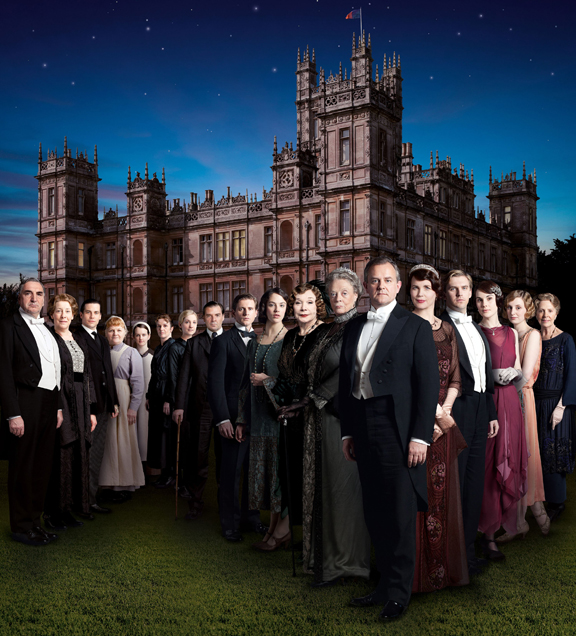
Cast of Downton Abbey

HIGHCLERE CASTLE
Highclere Castle in Berkshire (southeast England) is the real castle that plays the role of Downton Abbey, fictional home to the Earl of Grantham, his glamorous wife, daughters and a host of servants. The Victorian castle is set amidst 1,000 acres of parkland that is as beautiful as it looks on screen. The actual residents are the Earl and Countess of Carnarvon, whose family have lived on the site since 1679. Downton Abbey author, Julian Fellowes, is a longstanding friend of the family and had Highclere in mind as the home of the Granthams while writing the series.

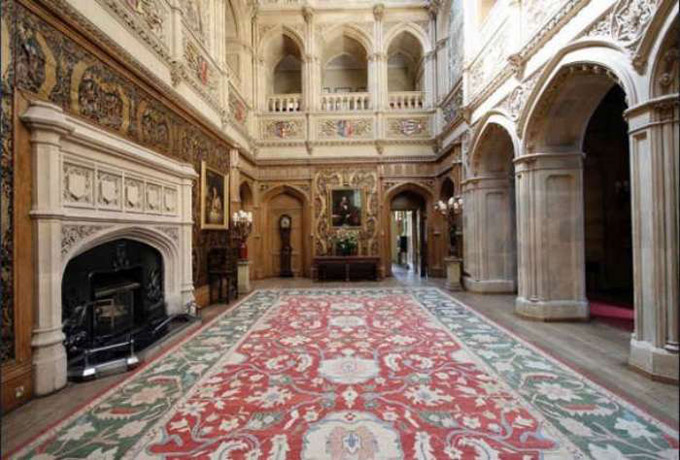
Make a trip this spring when the castle is open to visitors and truly step into Downton life: sip tea at the cafe, stroll the garden pensively just like Lady Mary, Edith or Sybil and admire the sumptuous rooms, many of which are used during filming. Highclere is located about 1 1/2 hours away from London by train.

For diehard fans who want to sleep in the same room as their Downton heroes (albeit without them there), book a room at The Carnarvon Arms, a grade-II former coachhouse nearby Highclere Castle. As it’s only a short distance from Highclere, during filming, The Carnarvon is occupied by the Downton cast, and has recently undergone restoration by British celebrity chef Marco Pierre White to become a luxury country inn hideaway. What could be better than guaranteed delicious pub grub, a traditional British inn experience and the possibility that you may catch a glimpse of Dan Stevens (Matthew) or Jim Carter (Carson) at the bar?

THE COTSWOLDS
The Cotswolds, in southwest England, have been designated as an area of outstanding natural beauty, and are quintessential England at its loveliest. The area is north of Highclere and can be reached in less than two hours from London. In series two, it was the site of scandal when Lady Sybil eloped with the family chauffeur, Branson. The pair went to Swinbrook in the Oxfordshire Cotswolds, a pretty village where time seems to have stood still, and filmed at the Swan Inn. This beautiful boutique inn makes for an idyllic base from which to explore the area.

Downton Abbey
Cotswolds Village

Also in the Cotswolds is the picturesque village of Bampton, where many of the exterior scenes in of Downton Village and Crawley House are filmed. Bampton library and church were used for exterior shots of Downton Cottage Hospital. Stop off at the shingle-roofed Bampton Coffee House for an English cream tea or lunch at the Vineyard at Stockcross, an elegant hotel with a great restaurant and an impressive wine cellar. Maggie Smith, Downton’s resident Dame, is rumored to have stayed here during filming.

LINCOLN CASTLE
Did he or didn’t he? Season three sees character John Bates locked up in York prison for the murder of his former wife. On closer inspection, it is actually Lincoln Castle, situated a couple of hours south of York, is used as the prison. In addition to its Downton fame, Lincoln Castle is also home to the Lincoln Magna Carta, which dates to 1215, as well as the Charter of the Forest, a 1217 document that made sure England’s forests weren’t taken over by the aristocracy. History buffs will be pleased to learn that Lincoln Castle is the only place in the world where you can witness the two documents together.

For more info, go to www.visitbritain.com

Visit These Famous British Locations Made Popular in Film and TV

Photos courtesy Visit Britain

PULTENEY BRIDGE WEIR
The stunning weir beneath Bath’s Georgian Pulteney Bridge plays the part of the River Seine in the film version of Les Misérables. Pay Bath a visit and see it for yourself (but don’t jump in, like they do in the film!)

St. John’s Church

ST. JOHN’S CHURCH
London’s St John’s Church in Smith Square was used in Atonement for the wedding scene. It’s a fine example of English baroque architecture and is a venue for concerts and recitals.

TEMPLE CHURCH
Built by the Knights Templar in the 12th century, this historic church exudes mystery. It has a circular nave based on the Church of the Holy Sepulchre in Jerusalem and was used as a location in The Da Vinci Code.

Inverness

INVERNESS
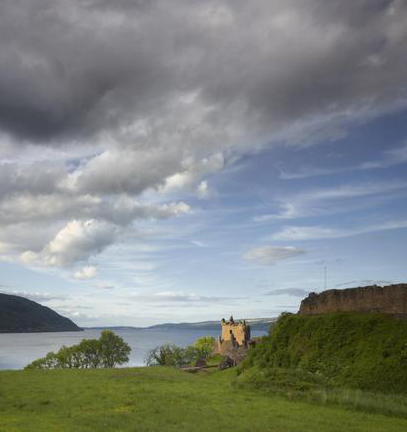
Inverness is a gateway to the Highlands and so makes a great base for exploring the surrounding countryside, historic battlefields and beautiful lochs. The Highland capital is friendly, welcoming, full of history and compact enough for wandering around by foot. Scenes for the TV drama Outlander were shot in and around the city.

MOMO
Probably London’s most famous Moroccan restaurant, Momo is a glamourous spot to enjoy fine North African dishes. You might also recognize it as one of the locations in the UK film Bridget Jones’s Diary.

Rye

RYE
One of East-Sussex’s most popular locations, Rye is a half-timbered medieval town full of unique shops and plenty of atmosphere. A great place to get a taste of traditional English life and to enjoy a good pub lunch or fish and chips overlooking the town quay.

OLD WARDOUR CASTLE
Built in the 14th century as a luxury house, Old Wardour Castle slowly became a fashionably romantic ruin. It’s a beautiful place to spend a day, and you might even recognize it as one of the locations used in Robin Hood: Prince of Thieves.

Inveraray Castle

INVERARAY CASTLE
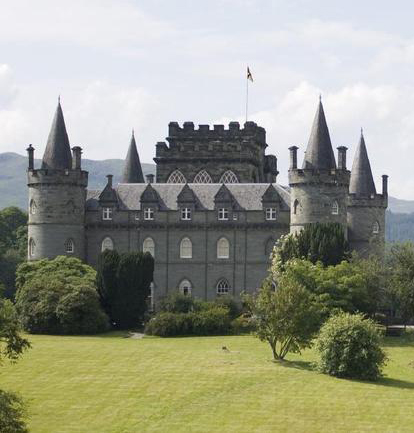
This magnificent stately home on the shores of Loch Fyne boasts tremendous views across the Scottish countryside. You might recognize its fairy-tale turrets from the Christmas 2012 episode of Downton Abbey when the Crawleys holiday in Scotland.

BROMPTON CEMETERY
One of Britain’s Royal Parks is also a historic cemetery. Expect an atmospheric array of spectacular tombs and more than a few famous names. Look for Brompton in a suitably Gothic scene from the 2009 film Sherlock Holmes.

MI6 (THE SECRET INTELLIGENCE SERVICE)
The HQ of MI6 (the Secret Intelligence Service) is off limits to visitors but you can get a great view of this imposing structure from the river. Take a speedboat tour with Thames RIB for fascinating anecdotes about Ian Fleming, the British Secret Service, and of course, James Bond himself.

For more info, go to www.visitbritain.com/en

I’ll Have What Phil’s Having

 A humorous culinary road trip on PBS

By Don Heimburger

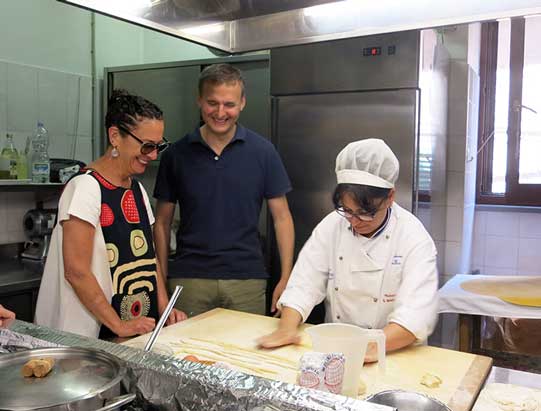
I didn’t know travel and culinary adventures could be so entertaining until I happen to watch my first episode of Phil Rosenthal’s “I’ll Have What Phil’s Having.” First I was drawn in by the name of the show which I heard about on my Chicago PBS station, and I thought, “Who has a television series name like this?”…but I was even more curious— “What does it mean?” I thought and thought, but couldn’t figure it out.

Then I happen to just be sitting down in the family room after supper and one of Phil’s episodes came on….it was his Barcelona program. It started with a flashback photo of Phil as a small kid…he was wrinkling up his nose at something in the photo. “Meat was a punishment,” he remembers from his childhood.

But today, Rosenthal, an Emmy award winner and a very funny guy, is visiting one of Spain’s — and the world’s — hippest spots, Barcelona. In this city, food is taken very seriously, with people in Barcelona planning supper while eating lunch, and when they plan a day trip, their most important concern is where they are going to eat. Just “grabbing a bite” is not an option here. In Barcelona eating comes first, and you have to think about it.

“The world can be a beautiful, delicious and friendly place when we travel and eat food together,” announces Phil as he begins his Barcelona food experience. Since Barcelona is located beside the Mediterranean, seafood abounds, with the long Catalan coast sheltering more than 30 fishing ports, and fish is a supreme passion with local gourmets.

Rosenthal, the creator of the TV hit “Everybody Loves Raymond,” is a passionate foodie who makes friends fast and warms up to excellent dishes even faster. “I’m Phil Rosenthal, and I’m here to say come on, you can have what I’m having.” His one-hour shows (I’ve also seen his Paris and Italy episodes), which focus on international culinary exploration, tend to grab you after just the first three or four minutes, as he investigates, samples, pokes and smells — and samples again — the culinary delights he discovers.

In Barcelona, he quips, “They start at 8 at night and they go from bar to bar eating tapas, and they’ll have three or four small plates, and then they go to the next bar— ‘Oh, we’ve got to try these small plates’ — until they’re full, which is around midnight, and then….dinner.”

Rosenthal apologizes on a late food outing that he might not make it through the evening: “They (the Barcelonians), love life. This is going to be a little difficult for me, because usually I’m in bed by 9,” he admits.

On a rooftop with new-found friends celebrating the Feast of San Juan, Phil savors a taste of grilled sausage and beef, talks to partygoers and his hosts, and generally adapts to his surroundings, shooting firecrackers off the roof when one comes sailing at him. “The only thing we can do,” he slyly suggests, “is retaliate” as he sends off a bright rocket into the sky, thus joining the aerial melee.

Following the party, he recovers the next morning just in time for breakfast, visiting the Boqueria Market where he discovers all varieties of fresh fish, fruits and vegetables; he ends up helping a market restauranteur and his brothers with the cooking, but says because of the tiny booth, “If my family worked here, we wouldn’t last five minutes.”

To add a bit of culture to the show, Phil drops in on two of Antoni Gaudi’s structures in the city, the 1882 Sagrada Familia church he started (when finished in 2028 it will be the tallest church in the world), and an apartment building—Çasa Mila— with an unusually distinctive roof.

With the mantra, “Why stop when you’re full?” Phil continues his Barcelona eating binge, devouring octopus, mullet, friend schrimp and eel, grouper and asparagus. Keeping in touch with his parents by Skype when overseas, he asks if they’d like to know what he’s been eating. At nearly the same time, his father responds, “Not really,” while his mother shouts, “Go ahead.”

Sitting down to the table at the restaurant Tickets, Rosenthal literally “hops for joy” when eating a plateful of tomato mozzarella. His last stop in town is at Vila Viniteca, where he puts on a humorous display of “jamon” slicing, devouring half of what he slices. As he leaves the store with a ham strapped to his bicycle—and says goodbye to Barcelona—he concludes that the city will give him memories for the rest of his life, and the jamon will last only about a week to a week and a half.

I can’t wait for the rest of the series — I do think I’ll have what Phil is having, and I’ll enjoy it.

THE SHOW: The PBS series features six one-hour episodes exploring a variety of foods and cultures as seen from Rosenthal’s perspective. Host Rosenthal explores culinary capitals of the world and dines on regional specialties, all the while pushing the boundaries of his palate – and the viewers’ – in his funny, unforgettable travels. In his search for the best of a city’s specialty, or one of its most unusual cuisines, Rosenthal entertains the audience while making connections all over the world.

PHIL SAYS: “My mother was not a fantastic cook; our oven had a setting for ‘shoe.’ But I’ve always loved family, food, travel and humor. That’s how I connect with people. I’m not your typical adventurer. So, I’m hoping folks will look at a nebbish like me exploring the world and trying new things and say, ‘If that guy can go outside maybe I can, too.’”

You can find out more about the show and stream episodes at: www.pbs.org/wgbh/what-phils-having/

Meet Art Wolfe

I’ve always been enthusiastic about the work I do.

Art Wolfe

ET: Of the many European countries, which country or countries do you like to photograph the most – and why?

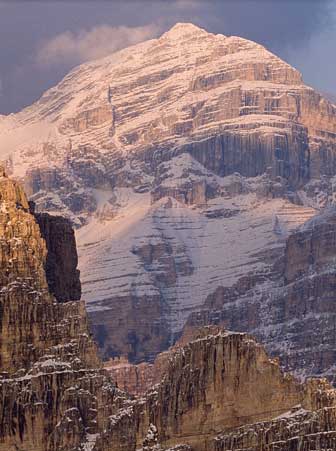
AW: I’ve traveled to Europe a number of times over the years. In fact, my first overseas trip was to England, and 28 days later I wound up in Greece. It was very early on, and one could argue I wasn’t much of a photographer, although I thought I was at the time. Italy definitely has been one of my favorite places to go, not only for the antiquity but for the stunning scenery: the craggy Dolomites in the north, and the south’s rumbling volcanoes of Mt. Etna and Stromboli. These have yielded great opportunities and photographs over the years; I love Italy!

Equally strong for me has been France; photographing in the French Alps, in and around the Rhone River delta and up into Provence has resulted in some of my most delightful photos over the years. Iceland surely is not to be missed―its young landscape is different every time I visit.

There are huge gaps in my coverage of Europe; I dream of the day I can travel through Spain. My long-time photo assistant is from Romania, though I have yet to get to central and eastern Europe. All these places draw my attention, and it’s just a matter of time before I get there.

ET: If you were to recommend to someone to photograph the European landscape, where would you “send” them and why?

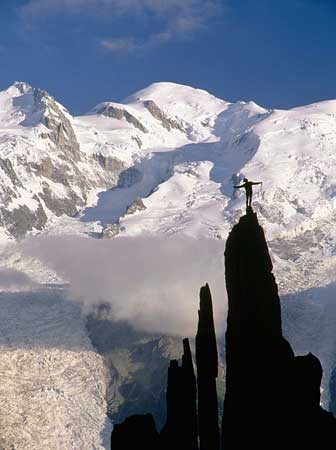
AW: Certainly it’s hard to beat the Alps, both French and Swiss. One of the striking things about the Alps is their verticality; they are very accessible initially but many of the peaks are among the most difficult peaks to climb on earth. One of my best locations has been Lac Blanc just above the ski town of Chamonix, France. I can’t overstate how stunningly beautiful Lac Blanc is as it reflects the extraordinary Chamonix Needles and Mont Blanc rising beyond.

I just love the Italian landscape, too. I love the whimsical ways the Italian farmers in Tuscany and Umbria have separated their fields by rows of cypress and pine. In addition, the rural landscapes of northern Scotland and the Isle of Skye are quite simply stunning; I have been there in the spring, when the forests around the icy, deep lochs are green and studded with bluebells. It is quite enchanting.

ET: Can you remember the first time you realized that maybe you were an “above average” photographer? How did your parents’ commercial artist business help you in your life’s work?

AW: My background initially was drawing and painting from early childhood all the way through graduating from the University of Washington, earning a degree in Fine Arts and Art Education. As far as realizing I was an above average photographer, it’s hard for me to just state that unequivocally; I would address it by saying I always realized I had an above average drive and focus. I’m rapidly approaching year 60 in my life, and the drive has not diminished. I’ve always been enthusiastic about the work that I do and sharing it with others.

Very early on I knew that whatever I wanted to do I could do it. My parents were commercial artists, and I watched my dad run his own small business. It was ingrained in me that I could do this as well. Children very often follow in the footsteps of their parents. Thankfully, my parents allowed me to pursue whatever I wanted. They had nothing but encouragement toward the arts, and in retrospect that was a blessing.

ET: You always seem to have so much fun and enthusiasm when you are photographing. Can you explain how this is?

AW: I think fun and enthusiasm is part and parcel to anyone’s occupation or passion. It’s rare in life for people to truly find their passion, especially when it’s their occupation. I feel blessed. I feel that I was destined to be a storyteller through the photographic medium, and I don’t take that lightly.

I sacrifice a lot being a photographer; I don’t have a family, I don’t have vacations, I don’t have a lot of things that people take for granted. But what I do have is a highly refined passion that gives me a deep sense of fulfillment. I can’t help but be enthusiastic and can’t help but having fun. I have a very impish sense of humor, a very free spirit about the work that I do and that just transfers to my photos. My enthusiasm is infectious; I am able to photograph people without trepidation. I have a very light spirit when I’m working around wild animals, I don’t stress about them, and they pick up on that energy so it’s a very positive experience. I wholly believe it enables me to get close to my subjects.

ET: Bad weather conditions typically thwart photography efforts. What do you think?

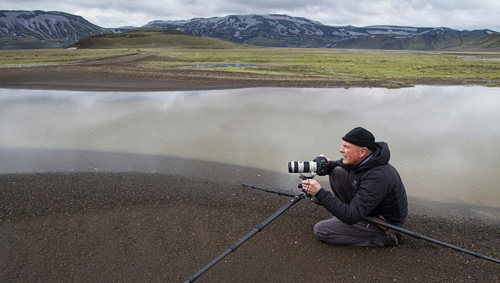
AW: My belief is bad weather often makes a shot. Whether it’s high winds, blowing snow or soaking rain, I get out there as long as I can protect myself and my camera. Weather makes for painterly effects: wind can be transferred into long impressionistic exposures where that sense of contrast between blurred motion and sharp focus subjects is often the difference between a mediocre photo and a great photo. So I look at bad weather conditions as the time to bundle up and get out the door!

ET: What is your advice for someone wanting to become a better than average photographer? What does it take to do this?

AW: No restraints! Just do it! There is an amazing amount of education being offered free through the internet. And some of the world’s best photographers offer amazing trips and workshops. I’d take advantage of that. Just jump in and immerse yourself into the world of photography and you will learn quickly.

ET: How do you determine where to go when you’re going to film your next show and how long does it take to arrange each edition of your show?

AW: My location choices for “Art Wolfe’s Travels to the Edge” were based on 30 years of knowledge about the world. After months of research and arrangements, each episode took an average of two weeks to film. The post production process added another couple months. It is a long process to get from idea to actual broadcast.

ET: Where did the name “Travels to the Edge” come from? (It’s a great line!)

AW: “Travels to the Edge” is based on my book Edge of the Earth, Corner of the Sky. It seemed like I traveled to the edges of the earth to photograph for that book. For the show name, my staff and I threw out words and started mixing and matching and ultimately settled upon “Travels to the Edge.” I thank you for the compliment and I agree, it’s a great line!