Regensburg: City of Wurst and 1,200 Historic Buildings

By Marilyn Heimburger
Photos by the author and Don Heimburger

The UNESCO World Heritage city of Regensburg, Germany, 90 minutes north of Munich, is more than 2,000 years old, and many of its buildings serve as a testament to its long history.

There’s plenty of reminders of this town’s heritage: located on the Danube, many tour ships dock here and unload visitors for a peek into this German treasure.

Even Mozart liked the city: Regensburg’s hospitality was commended as early as 1790 by Mozart who enjoyed “a sumptuous meal along with divine music” and praised the good wine.

Numerous Roman buildings, such as the Porto Praetorius–an old Roman town gate–can still be seen today. It was preserved because the Bishop’s beer garden was located on the site. An underground museum at Neupfarrplatz displays the history of the Romans and the Jewish community there until 1519.

NEUPFARRPLATZ IN JEWISH QUARTER
At the Neupfarrplatz, houses were built in the Jewish quarter over the old Roman fortress in the 8th century. These were destroyed in 1519 when the Jews were blamed for a downturn in the economy and were driven out.

In 1995 an excavation of the area was begun, and the ruins of the Jewish quarter were found, in addition to the Roman ruins.

Found in the excavation and on display in the underground museum were a second or third century statue of the Roman god Mercury; from the 15th century a statue of Aaron (Mose’s brother); and from 1520 an icon of the Virgin Mary. The museum is called Document Neupfarrplatz; if you walk down a flight of stairs, you can view a video showing the excavation finds. www.regensburg.de.

The city began as a Roman fortification (Castra Regina) in 179 AD by Roman Emperor Marcus Aurelius because it was the northernmost point on the Danube. When the Roman Empire fell, the Romans retreated. The fortress built there was not destroyed, and Bavarians then occupied it. It was the first capital of Bavaria; believe it or not, Munich is 1000 years younger!

Not much was damaged in the town during World War II as there wasn’t much industry in Regensburg, so there was nothing to bomb. Thus, the old buildings were preserved.

‘ITALY’S NORTHERNMOST CITY’
Rich merchants gained wealth from importing goods from far away lands. They built large homes with tall towers (a show of strength and wealth) after the style in Italy. Many of these are still standing in Regensburg; nearly 20 are still well preserved. The town is often called “Italy’s northernmost city” because of this.

One of the big Regensburg attractions is The Old Stone Bridge, built on 16 huge arches, which has been in continuous use for more than 800 years. Built between 1135 and 1146, the Stone Bridge enjoys the status of being a unique masterpiece of medieval engineering. It was for many centuries the only stone bridge spanning the Danube between Ulm and Vienna. It was not only a technological masterpiece of engineering, but of strategic importance in terms of transport and, as a result, of great commercial value.

Another town attraction is the Old Town Hall, where Roman Emperors used to summon princes, bishops and ambassadors to discuss the affairs of state. The Imperial Diet Chamber still contains the same furniture, including the benches that gave rise to the German expression “to put something on the long bench” (meaning to postpone it indefinitely).

‘HISTORIC LUNCH’
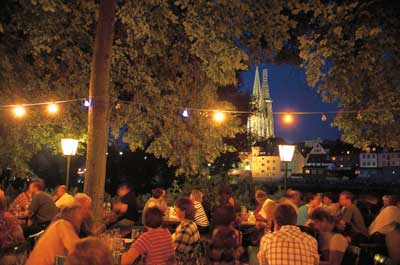
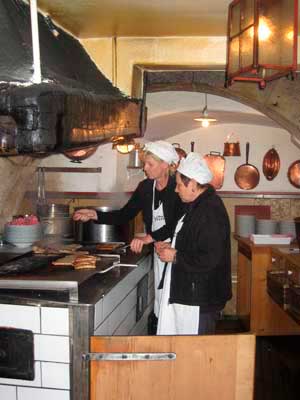
For a quick and tasty lunch, sit down near the Danube and enjoy hot, juicy sausages with kraut and bread in the “Historische Wurstkuchl,” the world’s oldest sausage kitchen. You can actually see them frying the sausages on the grill through a door that leads into the small kitchen. http://www.wurstkuchl.de

Regensburg is a city of churches. Focal points of early Christianity, its ecclesiastical buildings are majestic and typify early Christian architecture. Most famous is St. Peter’s Cathedral, inspired by the French Gothic style and built in the 13th century.
At waterside, Schifffahrt Klinger offers boat trips to many different sights such as the Walhalla, the German Hall of Fame containing busts of famous German personalities.

Regensburg`s remarkable buildings and towers offer an unspoiled look into the past; the wars of the 19th and 20th centuries left this Danubian community virtually unscathed.

The Regensburg Tourism Office is located at the old Rathaus, Rathausplatz 3, D-93047 in Regensburg. Fax is +49 941-507-1919 or e-mail to tourismus@regensburg.de.

For more information about Germany go to www.cometogermany.com.
Oberammergau’s Passion Play and RUHR.2010 lead the way

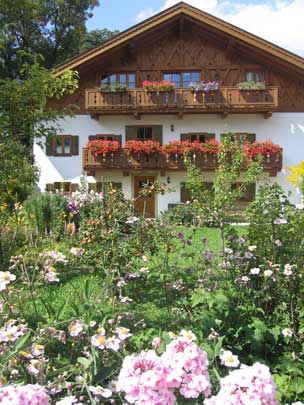
Colorful Oberammergau is home of the Passion Play in 2010.

Photos by Don Heimburger

With anniversaries and unique events all year long, 2010 is shaping up to be a year of variety and diversity in Germany.

From modern to traditional, the festivals and anniversaries offer something for every taste: the RUHR.2010 European Capital of Culture, the decennial Passion Play performance, Robert Schumann’s 200th birthday, the 300th anniversary of the renown Meissen Porcelain, the 175th birthday of the German Railway and last but not least, the 200th year of the world’s most famous beer festival, the Oktoberfest in Munich.

Essen and the Ruhr Region in western Germany will be voted the “European Cultural Capital 2010.” For the first time in this European competition the cultural capital is not an individual city, but a whole region with Essen as the standard bearer. 

The Ruhr region is Germany’s highest populated area and especially exciting for its post-industrial transformation. Discover this region on the move with its cutting edge museums and art installations within the existing walls of former coal mines and factories. The exciting project RUHR.2010 celebrates those changes with fascinating exhibitions, events and workshops starting in January.  www.ruhr2010.de 

For the 41st time, the Bavarian village of Oberammergau will celebrate the Passion Play in 2010. This event has taken place every 20 years since its first enactment in 1633. More than 2,000 Oberammergauers, actors, singers, instrumentalists and stage technicians, bring to life the last days of Christ in approximately six hours of playing time. More than 500,000 visitors from all over the world and tens of thousands of Americans will be part of this unique religious event from May 15 to October 3. www.passionsspiele2010.de 

Only one year after Mendelssohn, Leipzig celebrates another one of its famous citizens: the 200th birthday of Robert Schumann. Many concerts will be dedicated to his works, featuring solo concertos, symphonies, piano works and song-cycles. 

Without Schumann, 20th century music would be quite different. The fusion of radical subjectivity and mastery of form, and his characteristic modernity and individuality, has inspired and influenced many composers who came after him. A highlight of the Schumann Year is the anniversary concert in the Leipziger Gewandhaus on June 3 and 4, but also Baden-Baden, Bonn, Bremen, Dresden, Duesseldorf, Frankfurt, Heidelberg, Stuttgart and Zwickau will celebrate the composer with special concerts and exhibitions.  www.schumann-portal.de (German only) 

Oberammergau Mayor Arno Nunn

The history of European porcelain began with the discovery of hard porcelain and the subsequent founding of the Meissen porcelain workshop in 1710 near Dresden. In 2010 the Meissen porcelain workshop will celebrate the third centenary of its founding. Visitors can tour the factory and the museums as well as participate in workshops. 

The anniversary will be celebrated with several world class porcelain exhibitions in Meissen and Dresden. In the Meissen workshop the yearlong project “All Nations are Welcome” shows outstanding pieces of Meissen Porcelain that reflect the influence of different cultures and epochs during the workshop’s 300-year history. 

Within the walls of Albrechtsburg Castle in Meissen, where the first European porcelain workshop was founded in 1710, a special exhibition takes you deep into the beginnings of the Meissen porcelain (May 8 – October 31). Another highlight will be the exhibition in the Japanese Palais in Dresden, showing famous works from the first 100 years of the Meissen workshop (May – August). http://friedrich.meissen.com 

The world’s most famous beer festival, the Oktoberfest in Munich, celebrates its 200th anniversary from September to October 2010. It took place the first time in 1810 as a festival honoring the marriage of Crown Prince Ludwig (later King Ludwig I) and Princess Therese of Saxe-Hildburghausen. The festival grounds Theresienwiesen were named after her. The Oktoberfest, or “Wiesn” as it is called in Bavaria, started out as a horse race. A parade was added in the following years, and at the end of the 19th century, local brewers opened their beer tents. Today it is an enormous festival, attracting millions of visitors from all over the world every year with Bavarian music, food and, of course, beer.  www.oktoberfest.de 

In Nuremberg, 175 years ago, the first German train, the steam-driven “Adler” (eagle) started off towards the neighboring city of Fuerth. To celebrate this milestone in Germany’s history, the city will host several events throughout 2010: During the “Blue Night” (May 15th), artists will stage spectacular projections and actions to kick off the Railway Year, the past will be brought to life again with major locomotive and vehicle parades planned by German Rail and a comprehensive jubilee exhibition in the Deutsche Bahn Museum will focus on 175 years of railway history (dates to be determined). www.nuernberg.de 

Cathedrals in Germany: Masterpieces Inside and Out

View of the Aachen Cathedral from Katschhof Square

Photos courtesy German National Tourist Office

Cathedrals, monasteries, walled fortresses and abbeys are a distinct part of Germany’s culture and landscape. Every town, city and countryside has a beautiful church or abbey, including many masterpieces.

Aachen’s cathedral, the Church of St. Mary, was founded as Charlemagne’s chapel and is where 30 kings were crowned. The immensely beautiful Romanesque cathedral of Speyer, only one hour south of Frankfurt, became the burial place for the Salian emperors, and its size is on par with the Cologne Cathedral. The Cologne Cathedral is Germany’s most visited tourism site and was at one time the biggest building in the world. Its high Gothic style is pronounced and the Dom is home to sacred relics and precious artwork. In Hildesheim, 45 minutes outside of Hannover, St. Mary’s Cathedral and St. Michael’s Church are outstanding examples of Romanesque architecture.

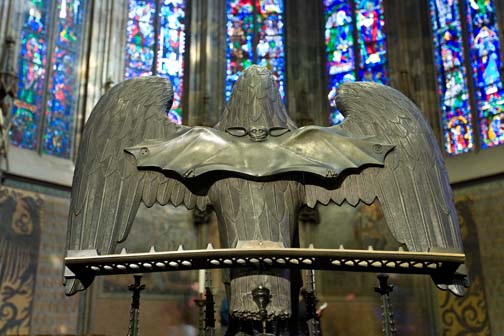
Sculpture inside Aachen Cathedral

AACHEN CATHEDRAL
The Church of St. Mary, originally built as the chapel of Charlemagne’s imperial palace in Aachen in 786 AD, was part of the emperor’s dream of creating a “new Rome.” With this building he laid the foundations of one of the most important architectural monuments in Europe. The cathedral’s appearance reflects more than 1,000 years of history. Charlemagne’s palatine chapel forms the core of the cathedral. The single-nave chancel was consecrated on the 600th anniversary of his death and the bold architecture of the “glass house” is as impressive today as it was then.

During the 600 years from 936 to 1531, 30 German kings were crowned in Aachen Cathedral. Today, the cathedral has lost nothing of the splendor of centuries past. The first ensemble of historical and architectural importance in Germany to be inscribed on the UNESCO World Heritage list in 1978, this is a building of outstanding significance.

SPEYER CATHEDRAL
The magnificent Romanesque imperial cathedral in Speyer is the town’s best-known and most prominent landmark. Built by emperors, the cathedral was a symbol of their power and served as their final resting place. Construction began around 1030 under the Salian Emperor Conrad II and the church was consecrated in 1061. Speyer’s imperial cathedral, laid out in the form of a Latin cross, is one of Germany’s largest and most important Romanesque buildings. The Salian emperors chose it to be their burial site.

Its huge triple-naved vaulted basilica is the central element of a design that greatly influenced Romanesque architecture in the 11th and 12th centuries. The hallmarks of the cathedral are the balanced distribution of its dimensions to the east and the west and the symmetrical layout of the structure, consisting of a nave and transept with four towers on the corners.

COLOGNE CATHEDRAL
Building first began in 1248 on what eventually became one of the finest ecclesiastical edifices in the world, and the epitome of high-Gothic cathedral architecture in its purest possible form. The scale of Cologne Cathedral is evident from its two mighty towers. Completed in 1880, they dominate both the city and the surrounding region. At the time of its completion in the 19th century, the cathedral was the biggest building in the world.

The design of the west side was truly groundbreaking. It has the largest exterior surface of any church in the world, said to be around 23,000 square feet, and is flanked by two huge towers, each rising to a height of 515 feet. The cathedral houses a wealth of important art treasures, including colorful stained glass windows that bathe the church interior in a mysterious light; the Ottonian Gero Cross (around 980 AD), the oldest large-scale sculpture in the western world; the shrine housing the relics of the Three Kings (1190-1225), an outstanding example of Rhenish goldwork; the altar of the patron saints of Cologne by Stefan Lochner (around 1450), a masterpiece of the Cologne school.

Cologne Cathedral by the Rhine
Cologne Cathedral detail
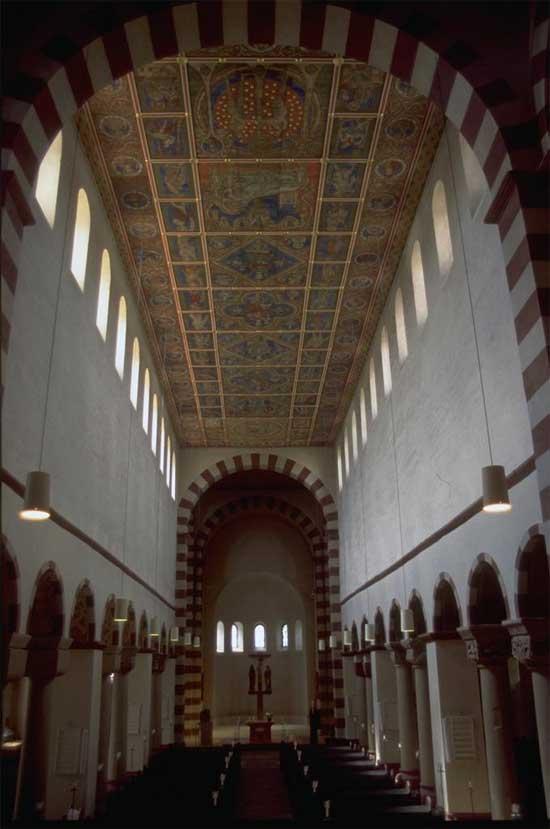
Hildesheim Cathedral interior

ST. MARY’S CATHEDRAL AND ST. MICHAEL’S CHURCH IN HILDESHEIM
St. Mary’s Cathedral and St. Michael’s Church are outstanding examples of early-Romanesque architecture. Both World Heritage churches exemplify the skill of Bishop Bernward (993 to 1022) and contain exceptional artworks.

The main attraction in St. Michael’s Church is the painted 13th century wooden ceiling depicting the Tree of Jesse. Germany’s only flat church ceiling, it is a fascinating example of monumental Romanesque painting. The spectacular cathedral treasure, Column of Christ and Bernward doors are characteristic of the Bernwardian period. The cathedral is being renovated for the anniversary of the diocese in 2015 and is closed until August 2014. Many of its treasures, including the huge bronze castings, can instead be seen at different places around Hildesheim until 2014.

The Column of Christ featuring scenes from the Old and New Testaments is on loan to St. Michael’s Church. The pair of two 16-ft. Bernward doors were cast in one piece—an achievement never mastered before—and are currently displayed at the Roemer and Pelizaeus Museum in Hildesheim.

For more info, go to www.friederisiko.de

Spend St. Valentine’s Day in Dublin

If a short break is on your agenda for St. Valentine’s Day, perhaps you need a push from the man himself — St. Valentine. Wouldn’t you know it? The Irish actually have relics (some of the remains) of the patron saint of lovers.

You need to head to Dublin for this. The St. Valentine’s Shrine is in Whitefriar Carmelite Church, Aungier Street, a few minutes walk from Grafton Street, St. Stephen’s Green and the famous Temple Bar, the center of Dublin’s shopping, culture and craic in the Irish capital.

If you can, visit St. Valentine’s Shrine on February 14 itself—the saint’s actual feast day, and the origin of the annual celebration of love, although it’s still a place of pilgrimage for those celebrating love at any time.

You can do a lot in Dublin on a long weekend. In Europe’s friendliest city; you can talk to anyone. It’s said the city is as intimate as a pub. But it’s probably better not to over-prepare for Dublin, or anywhere in Ireland. Be ready to go with the flow, build in one or two key activities and expect the locals to throw a surprise or two your way.

Dublin hotels and restaurants will be pulling out the stops to create a traditional romantic atmosphere on Valentine’s night, so candle-lit dinners will be the norm. Flowers are no problem either— Smithfield Flower Market — and one Dublin temple to the art of all things— chocolate— is actually not far from St. Valentines’ Shrine. Chocolatier Cocoa Atelier on Drury Street oozes handmade Irish chocolate deliciousness.

Finally, the all-important card.The Emerald Isle’s charm is more along the style of literary son Sheridan: “Won’t you come into the garden? My roses should like to meet you.”

Ireland is a land that reaches deep into the heart, lifts spirits and stirs you to your very core.

For more information, go to: www.discoverireland.comwww.galwayonline.com and www.visitdublin.com

The Melk Abbey: A 900-Year-Old Masterpiece

By Don Heimburger
Photos by Don and Marilyn Heimburger

Situated on a hill overlooking the small village of Melk, Austria, is the Melk Abbey, a Benedictine monastery with twin church towers that reach for the heavens.

The imposing Baroque abbey, high above the Danube, has two wings that project around the chapel, curving towards one another and connected by a balcony, framing the inset of the church. The builders succeeded in combining the natural surroundings with the structure.

Designed by Jacob Prandtauer and built between 1702 and 1736, the abbey monks provide pastoral care (the monastery oversees 23 parishes), and schooling (with 900 students). The theme of the abbey is “Ut In Omnibus Glorificetur Deus” (so that God is glorified in everything).

Visitors to the abbey can walk up steep steps to the entrance (walking through the small village of Melk) or drive up or take a taxi to the entrance. An abbey museum is located in the former Imperial Rooms and contains the exhibition “The Path from Yesterday to Today” which tells the story of the 900-year history. Beyond the museum, the must-see Marble Hall and library are two highlights of the structure.

In Marble Hall, Paul Troger’s beautiful frescoes (1731) adorn the ceiling; it is this room that was used as a guest room and dining hall for festive occasions, mostly for the imperial court. From the balcony, a grand view of the surrounding rivers, and town and fields is available.

Hundreds of inlaid bookshelves line the library room, which features similarly-bound books. A Paul Troger ceiling fresco is a counterpoint to the painting in the Marble Hall. On the upper floor of the library are two reading rooms, reached by a spiral staircase. The library contains 1,800 works, the oldest of which is a transcription of works by Venerable Bede from the early 9th century. Two-thirds of the manuscripts are from the reform period of the 15th century.

Gold, orange, ocher, gray and green combine to form a warm color accord in the church. In 1701 the church was completely rebuilt, and is now recognized as one of the most significant structures of the Baroque era. In its full light, its grandeur can take one’s breath away. The interior of the church has been shaped by the hand of Italian architect Antonio Beduzzi, with other artists actually doing the work.

Besides the abbey itself, there is also Abbey Park and the Baroque Garden Pavilion, and the abbey restaurant.

The whole Melk Abbey package is at least a two-hour visit, but to soak in everything, three hours seems more appropriate. Once there, you will undoubtedly want to stay longer.

The Melk Abbey is open all year. Admission is charged, with a reduction when other area attractions are combined. Guided tours are also available at the ticket office. The abbey is wheelchair accessible. For more information, go to www.stiftmelk.at or email kultur.tourismus@stiftmek.at