Amsterdam Mövenpick Hotel Is Restful Haven in Busy City

By Don Heimburger
Photos by the author

Situated in the bustling heart of cosmopolitan Amsterdam, a city of some 800,000-plus residents, sits a friendly, welcoming beacon for travelers.

The Mövenpick Hotel Amsterdam in the City Center is a 20-floor, 408-room haven of rest and quiet, which has been devotedly serving its guests in the Swiss tradition since 2006. The hotel’s rooms include 20 junior suites and an Ambassador Suite, as well.

With spectacular views of the Eastern Docklands area of the city, and sitting on the banks of the River IJ, the Mövenpick offers Executive rooms on the 19th and 20th floors, which includes access to the Executive Lounge, complete with its own espresso machine.

The hotel, one of the taller structures in the city, is easily seen with its large, bold red letters announcing its presence within sight of the busy Amsterdam Centraal train station, and close to the many river cruise docks that attract thousands of visitors to the city every year.

Overlooking the bay called the IJ and North Sea Canal, the hotel plays guest to many of the river cruises that begin or terminate there. Amsterdam is the second largest Netherlands port after Rotterdam, and the third largest cruise port in Europe, with as many as 140 sea cruise ships and 1,500 river cruise ships docking annually.

Such river cruise lines as AMA Waterways, Viking, Avalon, Uniworld and Tauck use the nearby harbors for docking, thus the river cruise traffic is significant, especially in the summer when the river ship sailings are in full swing. Also, ocean cruise lines such as Holland America, Regent, Royal Caribbean and Carnival frequent the port.

CONVENIENCE FACTORS OF MÖVENPICK AMSTERDAM
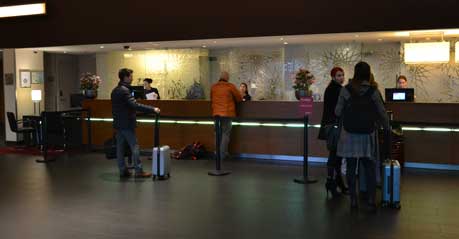
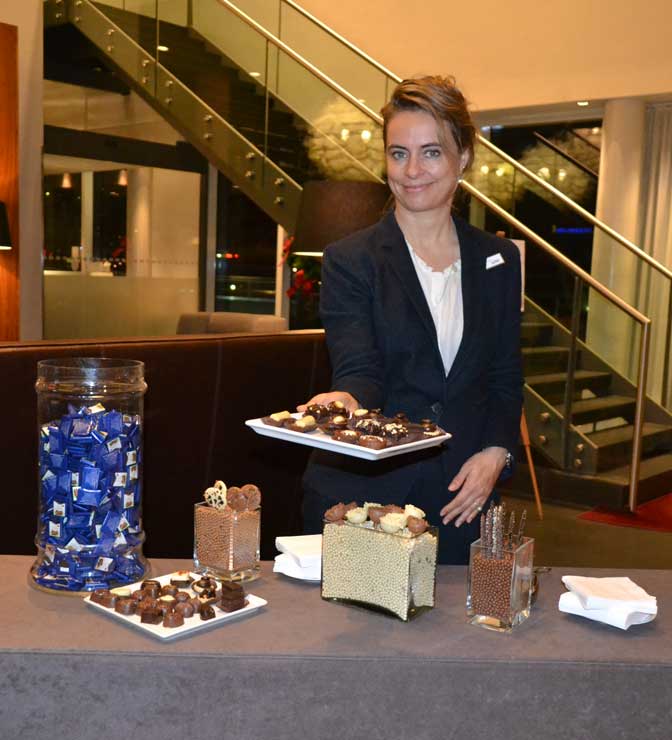
Not surprisingly, many of the Mövenpick guests choose to stay at the hotel right before and after their cruises, both for the convenient location and the many amenities that are offered to guests. As an example, you might be offered some of the delicious Mövenpick chocolates in the spacious lobby when you arrive. Or you might want to use the business center where you can check on your plane flight status or print out your boarding pass.
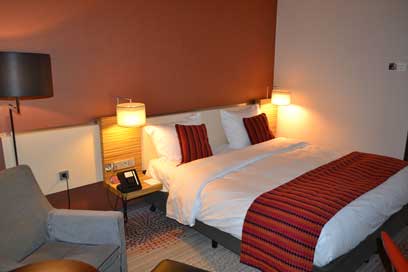
Other hotel amenities include air conditioning, coffeemakers, daily maid service, iron and ironing boards in many rooms, hairdryers, mini-bars in some rooms, all rooms are non-smoking rooms, telephone, voicemail, refrigerator, safe, ATM on site, cable/satellite television and internet access (high-speed wireless for an additional fee, or is complimentary on the executive levels).

The hotel also offers babysitting/child care services, complimentary pickup and drop-off transportation to the central train station, the services of a concierge, crib/rollaway beds, a currency exchange, gift shop, laundry/dry cleaning service, paid onsite parking, room service, wheelchair access to common/public areas and a multi-lingual staff.
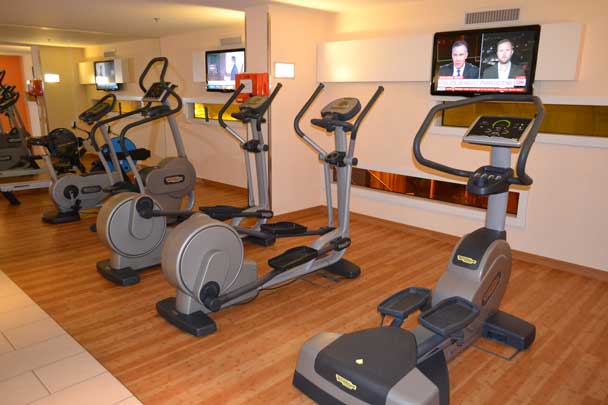
In addition, there is a lifestyle studio with cardio vascular equipment, a bio-sauna, Finnish sauna, a foot spa and a relaxation area, and massages are available.

Many business travelers also use the hotel because of its convenience next to the train station and the easy connections to busy Schiphol Airport, which is 11 miles away. The nearby Amsterdam train station with its 15 tracks serves more than 162,000 passengers each day. The hotel’s frequent shuttle service to and from the station allows guests to make easy transfers for local and international trains and also for quick train transfer to the airport.

EXECUTIVE LEVEL PRIVILEGES
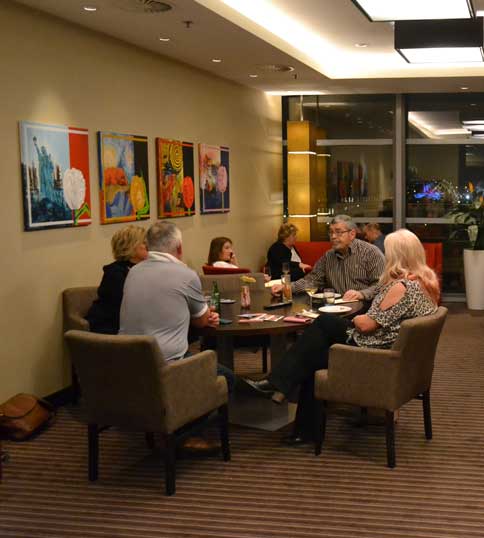
Guests staying on the Executive level of the hotel have access to a private lounge area on the second floor stocked with bottled soft drinks, juices and water, along with various snacks which are refilled during the day. At night between 5 and 7 p.m., the lounge features a happy hour complete with complimentary alcoholic beverages and snacks. The special second floor lounge looks out onto the harbor area of the canal, and features large windows, comfortable chairs and roomy tables.
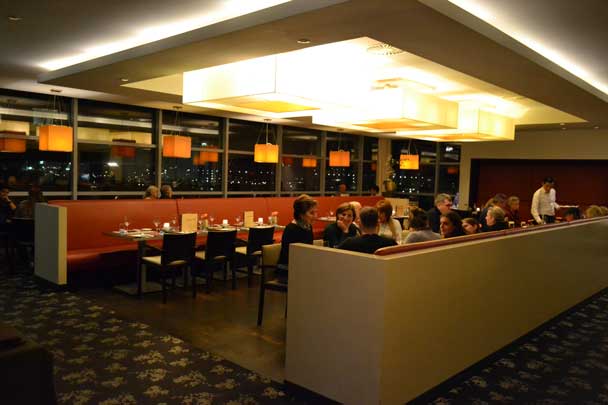
Hotel guests can enjoy meals all day in the Silk Road Restaurant which presents creative international cuisine for up to 220 guests at a time. The restaurant is located on the second floor with a view of the River IJ. Executive Chef Jamie Sharatt and his team prepare all dishes in an open kitchen with live cooking, including a selection of starters, main dishes, drinks and desserts.

From starters like home-made roasted tomato soup or fresh Caesar salad, to Linguine Alfredo and sliced veal (Zürich style), or various varieties of sumptuous steaks, to desserts such as Mövenpick ice cream creations, cheese cake or a cheese platter, the Silk Restaurant is worth a visit. The hotel also has a wide selection of Mövenpick wines to chose from when dining.

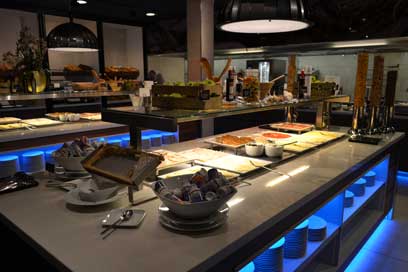
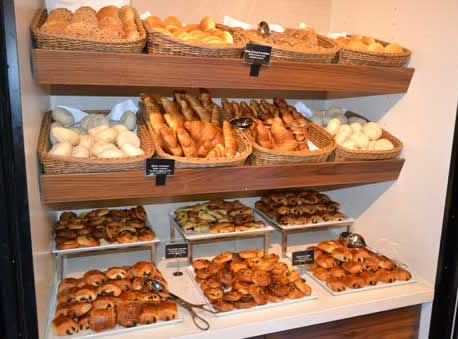
The large, multi-menu breakfast is a feast to behold. I am not sure I have ever seen such a wide variety of foods available at any first-class European hotel as here at the Mövenpick.

From any kind of egg creations, and several meat selections including fish and bacon, to about a dozen kinds of breads, rolls and croissants, to a wide variety of delicious fresh and dried fruits, yogurts and juices, the enticing breakfast buffet offers guests an overwhelming selection of foods. I enjoyed the freshly-baked, golden-toasted croissants with various jams and jellies, baked beans, grilled tomatoes, and cereals. Cold menu items include a choice of cut meats and cheese selections. Breakfast begins at 6:30 a.m. every day at the Mövenpick. Guests may special order breakfast omelets or eggs.
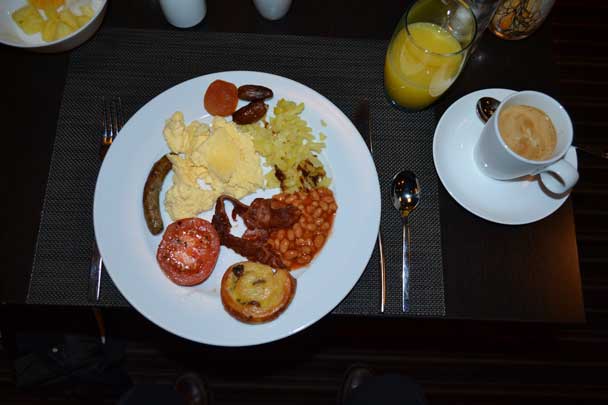
SILK BAR OFFERS ITS OWN CREATIONS
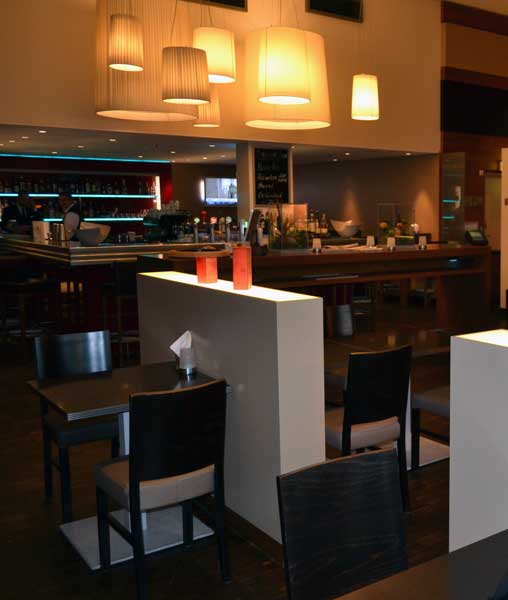
The smart Silk Bar is known for its extensive cocktail menu, and features a changing bar menu every day. It even offers its own original cocktail menu, and has a large whisky selection. Patrons can also enjoy a light lunch here, a quick snack, or a cup of Mövenpick coffee.

Helpful concierges are on duty in the lobby to assist Mövenpick guests locate points of interest in the city for sightseeing, modes of transportation, obtaining tickets for plays and museums, guided city tours and other questions that require a knowledgable answer. Looking for one of the city attractions—one of the smallest houses in the city—the hotel concierge quickly pulled out a city map and pointed out how to get there. I noticed later that he was the concierge supervisor, and his photo was on the cover of the printed, four-color map he handed me.

Because of all the city canals, one thing many visitors want to do is take a canal cruise. All you have to do is step out the front door of the hotel and you can embark on one of the many flat-bottomed canal boat tours offered in the city.

The hotel is also one of the most eco-friendly hotels in the city. The hotel uses heat and cold from the outside to help set room temperatures, and the hotel only uses fair trade linen.The hotel is Green-Globe Gold certified.
The Mövenpick, in keeping with the thousands of Amsterdam residents, supports guests who wish to do as the Dutch do, and ride their way through the city on two wheels. The hotel recommends Amsterbike which offers bike rentals, bike delivery, professional cycling tours, skip-the-line tours, as well as combination deals with boat tours, and walking tours in and around Amsterdam. The hotel offers a bike rental service on site.

Also, right next door to the hotel is the Muziekgebouw, a large concert and recital hall, and the most important stage in the Netherlands for contemporary music, offering more than 250 concerts annually.

For business travelers and business meetings, the hotel offers 12 state of the art “flexible” meeting rooms with such names as the Matterhorn, the Zurich, the Paris and the Dubai room.

In our opinion the outstanding Amsterdam Mövenpick in the city center rates a very high four stars, and is definitely passionate about serving its guests.

IF YOU GO….
The hotel is located at Piet Heinkade 111, 1019BR Amsterdam. Phone is +31 (0) 20 519 1200, or email the hotel at hotel.amsterdam@movenpick.com. The hotel’s general manager is Albert Rouwendal.
Prague’s Beer Taverns — A Czech Tradition

By Sharon Hudgins
Photos by the author

Many people consider Czech beer to be the best in the world. The Czechs think so, too: they’re the biggest consumers of beer on the planet, drinking an average of 161 liters (42.5 gallons) per person annually (about 30% more than their beer-loving neighbors next door in Germany).

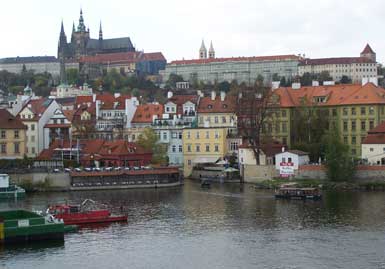
Prague is famous for both its architecture and its beer.

The Czechs prefer to drink their beer on tap, in local taverns, fresh from the barrel, not from bottles or cans. “Cans are for sauerkraut,” they say. Another Czech saying emphasizes the importance of the taverns: “The brewmaster brews the beer, the innkeeper makes it great.”

Prague’s oldest tavern, U Fleku, was founded in 1499.

BEER TAVERNS IN PRAGUE
Prague, the capital of the Czech Republic, has long been known for its beer taverns, some of which date from the Middle Ages. They’ve always been the haunts of workers and students, as well as those writers, artists and revolutionaries who preferred the classless camaraderie of the humble taverns to the social and intellectual pretensions of the city’s more elegant coffeehouses.

Before the Velvet Revolution of 1989, some of the beer taverns in Communist-era Prague were known as places where tourists (and spies) from the West could rendezvous with people from the Soviet Union and Eastern Europe, who were allowed to travel to Czechoslovakia but could not go to Western Europe or the United States. Of course those same taverns also attracted agents of Czechoslovakia’s secret police, who spied on the “suspects” from East and West meeting over mugs of beer in the smoke-filled rooms. Back then, some of Prague’s public taverns seemed like settings for a John le Carré novel.

After 1989, in the new capitalistic Czech Republic, some of those beer taverns cleaned up their grungy interiors but kept their traditional ambience. Others went completely glitzy-modern. A few old, defunct brewery taverns were brought back to life, and new microbrew pubs opened, too.

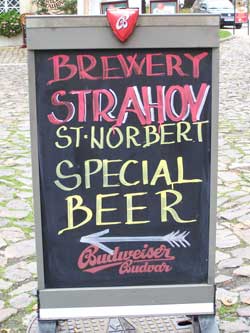
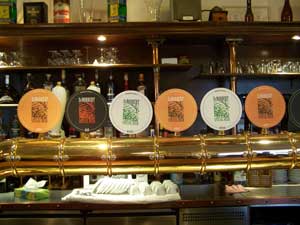
(left to right) Sign for the St. Norbert brewery in the Strahov district of Prague;
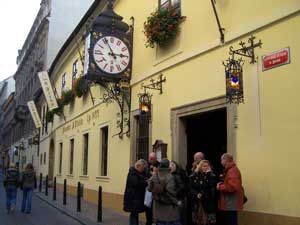
Entrance to the St. Norbert brewery;
Interior of the St. Norbert brewery, with a display of the different beers on tap.

Today Prague, a metropolis of 1.2 million people, has hundreds of beer taverns, from well-known hangouts in the central part of the city to little neighborhood pubs patronized only by locals. Prague’s classic beer taverns are also good places to eat, offering traditional Czech dishes like grandmother used to make, at reasonable prices that won’t break your budget.

U FLEKŮ
Prague’s oldest, best known, and most touristy tavern is U Fleků (At Flek’s Place), which dates back to 1499. Today, U Fleků’s famous strong dark beer is still brewed on the premises, attracting hordes of beer-lovers from around the globe.

The building’s rather plain exterior is distinguished only by the large gilded ironwork clock, the tavern’s symbol, on the front. Inside you’ll find several “Old World” rooms with dark wood paneling, vaulted ceilings, stained-glass windows, and beams painted with barley and hops motifs. Part of the building surrounds two open-air courtyards used as beer gardens in warm weather.

The food is decent and moderately priced. The multilingual menu includes roast duck with sauerkraut and dumplings, beef with sour cream sauce and bread dumplings, goulash with bacon dumplings, smoked pork with sauerkraut and potato dumplings.

Pork with sauerkraut and dumplings or sliced braised beef with bread dumplings and sour cream sauce are specialties at U Dvou Kocek.

U Fleků seats a total of 1,200 people in its various dining areas, and it’s often packed in peak periods. In tourist season, go there in mid-morning or mid-afternoon if you want to find a seat. The tavern also features live music, an “Old Prague cabaret” in the evenings, and a brewery museum for serious students of the suds.

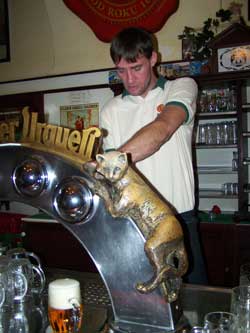
Drawing Pilsner Urquell beer from the tap at U Dvou Koček.

U MEDVÍDKŮ
U Medvídků (At the Little Bears) is an old historic tavern, recently renovated, where beer has been served since 1466. Today’s tavern retains the vaulted ceilings of the original structure in several rooms and features an open-air beer garden, too.

The wood-paneled restaurant has an extensive, multilingual menu of Central European dishes, including a game menu (in autumn) of venison, wild sheep, wild duck and pheasant accompanied by red cabbage, potatoes and dumplings. Many of the hot and cold appetizers are portioned large enough to make a light meal in themselves: try the “Medvědí tlapky,” the tavern’s own version of “devil’s toast” with a piquant meat mixture on top; or four slices of fried rye bread with house-made beer-cheese spread. The “Čertovo kolo” (“devil’s wheel”), is a delicious plate-size potato pancake topped with a spicy mixture of meat and vegetables.

The tavern serves Budvar (original Budweiser) beer on tap, as well as semi-dark Oldgott and very strong X-Beer from the new microbrewery upstairs, the smallest brewery in Prague, established in 2005. There’s also a cabaret section, a small museum, and a shop selling several kinds of beer and beer paraphernalia.

U RUDOLFINA
Many locals consider U Rudolfina, near the Rudofinum concert hall, to have the best Pilsner Urquell beer in Prague. They also consider it to be a “real” Czech beer tavern, which hasn’t made any concession to the rampant tourism that has overtaken central Prague during the past two decades. Most of the people drinking there are Czechs.

Czechs enjoying their beer at U Rudolfina.

Beyond the nondescript exterior, just inside the front door you’ll find a small, simple, wood-paneled room with a small bar. Downstairs is a larger area, just as plain in decor, and as smoky and noisy as the little room upstairs. Way in the back is a separate dining room set aside for non-smokers.

In addition to the excellent beer, U Rudofina serves some of the best beer-tavern food in town. Start with a basket of “topinky,” slices of dark rye bread fried on both sides, sprinkled with salt, and accompanied by whole cloves of garlic for you to rub on the bread, as much or as little as you like; or a plate of “beer cheese,” a mound of soft cheese with mustard and chopped onions on the side, which you mash together with your fork and spread on fresh bread. The main dishes emphasize meat—beef, pork, sausages, chicken—and are very well prepared, large portioned and reasonably priced.

Reservations are recommended because this is such a popular place—and well worth visiting for an authentic, no frills, Prague beer tavern experience.

Typical sign for a Prague beer tavern and restaurant. Many signs are in English to attract foreign customers.

RECOMMENDED PRAGUE BEER TAVERNS
U Fleků, Křemencová 11, Prague 1, www.ufleku.cz. Open daily 9 a.m. to 11 p.m.

U Medvídků, Na Perštýné 7, Prague 1, www.umedvidku.cz. Open 11:30 a.m. to 11 p.m.

U Rudolfina, Křížovnická 10, Prague 1. Open 11 a.m. to 11 p.m.

For current reviews and ratings of more than 60 Prague beer taverns, see www.praguepubs.co.uk.

The Cult of Currywurst

By Sharon Hudgins
Photos by the author

This multi-cultural fast food has overcome its humble origins to obtain cult status in Germany, even rating its own museum.

What could be more German than currywurst: chunks of sausage slathered with a sauce based on the same ingredients as Anglo-American tomato ketchup spiced with English Worcestershire sauce, Hungarian paprika and Indian-inspired curry powder (by way of Britain), served with French fries on the side?

Some German cooks even add another multicultural twist: spiking the sauce with Caribbean and South American peppers, as a challenge to macho munchers competing for the top-dog spot in their local currywurst “Hall of Fame.”

From its humble origin as a street food in the country’s war-torn capital, currywurst has risen to culinary cult status in Germany, even rating its own museum. That’s right: a museum devoted entirely to currywurst opened in Berlin in 2009, on the dish’s 60th birthday, with exhibits on everything you always wanted to know about currywurst (but didn’t know you wanted to ask).

SUCCESS STORY
Currywurst was invented in Berlin in 1949, when a woman named Herta Heuwer supposedly acquired some English curry powder (and maybe also Worcestershire sauce) from soldiers stationed in the British sector of the occupied city. Experimenting in her home kitchen, she concocted a tomato-based sauce as a topping for cooked sausages, which she sold at a street stand to construction workers rebuilding the rubble-strewn metropolis.

Heuwer’s currywurst was such a success that she was able to open a small restaurant in the red light district, which soon became a popular hangout for celebrities. In 1951, early in her career as the queen of currywurst, she also patented the secret recipe for her seductive sauce, which she called “Chillup,” its name a contraction of “chili” and “ketchup.”

Currywurst went on to take the country by storm. All over Germany street stands, festival stalls, food trucks and even restaurants now sell their own versions of this simple dish. More than 800 million currywursts are consumed annually in Germany—that’s nearly 10 sauce-covered sausages for every man, woman, child and foreign tourist in the whole country.

VARIETY SPICES LIFE
Currywurst sausages, sauces and sides vary widely, not only from one region of Germany to another, but also from one vendor to the next, even in the same neighborhood.

The recipe for Herta Heuwer’s original Berliner currywurst sauce remains a secret, although many cooks have tried to replicate it. Some street vendors and restaurant chefs take pride in making their own signature sauce from scratch, refusing to reveal their personal recipes. Others take the easy way out by merely adding spices to bottled ketchup. And big companies such as Heinz and Knorr market a variety of “Curry Ketchups” in Germany. Just squeeze the bottle and squirt.

Most sauce recipes include curry powder and paprika, along with other seasonings such as vinegar, sugar, garlic and onion. The sausages are first simmered in water, broth or beer, then finished on a griddle or grill, or pan-fried in a skillet. Usually they’re cut crosswise into pieces before being covered with sauce. German engineers even invented a commercial cutter to slice the sausages in one whack, quickly and uniformly. (Cutting 800 million by hand just wouldn’t be efficient.)

An exhibit at Berlin’s Currywurst Museum showcases several varieties of this favorite German fast food. The original West Berlin version is considered the classic currywurst: a thick sausage (usually Bockwurst, sometimes Knockwurst) cut crosswise into chunks, topped with a red tomato-based sauce, garnished with curry powder and served with a bread roll. The East German version uses skinless sausages, supposedly invented out of necessity when sausage skins were scarce in the early era of post-war rationing. In the Rhineland, bratwurst is favored, doused with a thinner dark-red sauce (with the curry mixed in but not sprinkled on top) and served with French fries on the side.

A “Manta plate” consists of currywurst and French fries, with ketchup and mayonnaise dolloped on the spuds. (In Cologne and Düsseldorf the same combo goes by another name, whereas in Hannover it’s called “the Chancellor’s plate.”) And a “taxi plate” is a caloric triumph of multiculturalism: currywurst with French fries, barbecue sauce, and mayonnaise, plus Greek gyros (thin slices of spit-roasted meat) and tzatziki (yoghurt-cucumber-garlic sauce).

There’s even a “Luxus” version (“for those very special moments in life”), a prime example of Berlin ironic humor: a whole sausage with a piece of gold leaf draped over the top, surrounded by a pool of currywurst sauce on a white china plate and accompanied by a glass of Sekt (German sparkling wine). And at Aqua, the Michelin 3-star restaurant in the Ritz-Carlton Hotel in Wolfsburg, I was served a cute little dessert amuse-bouche consisting of marzipan “sausages” wedged between macaroon “buns,” garnished with red strawberry sauce and sprinkled with cinnamon—the ultimate currywurst haute dog.

STAND UP FOR YOUR SAUSAGE
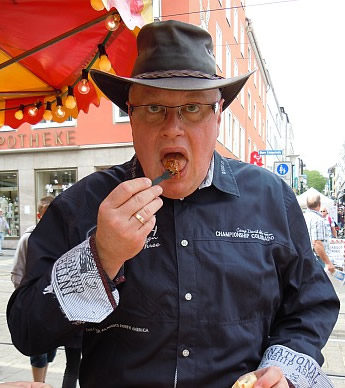
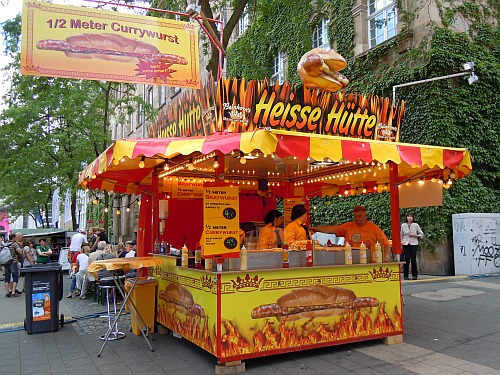
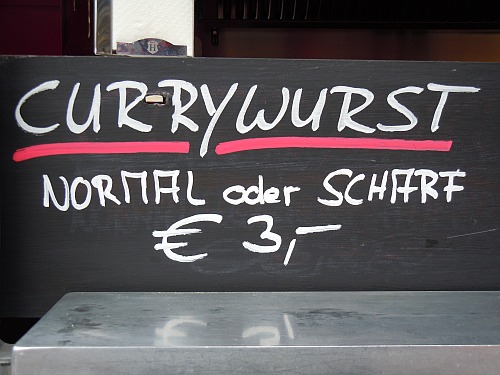
Despite its many riffs, currywurst is still just a simple, inexpensive take-away food, most often bought at a Schnellimbiss or Currywurstbude (fast-food stand) and eaten while standing up. (Even McDonald’s felt compelled to add “McCurry Wurst” to its menu in Germany.) Currywurst traditionally comes in an oval-shaped white cardboard bowl, along with a little wooden or plastic fork and a small white paper napkin for blotting up the messy drips of sauce—although some eat-in restaurants serve their sausages on a plate.

Currywurst connoisseurs are well known for their unswerving loyalty to a particular currywurst stand, disdaining all others as unworthy of their patronage. Claiming your favorite currywurst stand as the “best” can quickly get you into a heated discussion at a German bar.

Eaten by everyone from proletarians to high-level politicians, currywurst is particularly popular in its hometown of Berlin, where 70 million of these saucy sausages are sold every year. Many critics consider the currywurst at Konnopke’s Imbiss (two locations in Berlin) to be the best classic version in the city. A few years ago, two other stands, Curry 66 and Curry & Chili, entered the scene, both claiming to serve the hot-spiciest currywurst in Berlin, the sauces made with such tongue tinglers as habanero peppers and Black Death bottled hot sauce. And Curry 36 in Berlin bottles its own original curry ketchup for customers to take home, in case they get a craving for currywurst in the middle of the night.

Hamburg is another hotbed of currywurst consumption, with 72 million eaten annually in the Elbe port city, famous historically as a gateway for spices imported into Germany. Hamburg also claims to be the original home of currywurst, an assertion roundly rejected by Berliners.

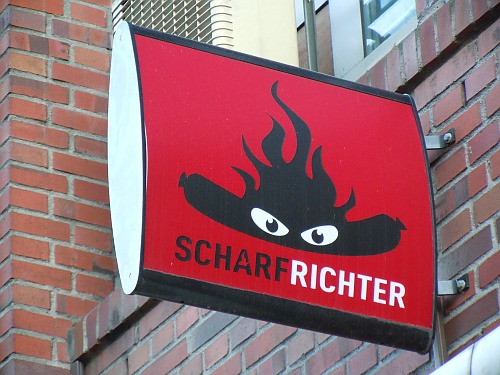
Other popular places for eating currywurst in Germany include Scharfrichter, a restaurant that specializes in hot-spicy currywurst with sauces rated on a heat scale of 1 to 10. Curry 24 in Dresden advertises “the hottest currywurst in the city,” with a clever illustration on the menu showing a red sausage “rocket” with seven “burn levels” of rocket fuel. The owner uses different liquid chile pepper concentrates to fuel his rocket sauces—and sells over 250,000 of these mouth-flaming currywursts every year.

HUMBLE FARE
Who would have ever thought this humble fare could inspire not only cooks, inventors and museum curators, but also singers, writers and artists? Currywurst is featured regularly on a German television series, and in 2009 it was the subject of a cartoon contest on the Internet. Currywurst has its own page on Facebook, and you can listen to “The Currywurst Song” on both Facebook and YouTube. But you might get a bigger kick out of watching some of the currywurst eating contests posted online—that is, if you get turned on by red-faced men with bulging tongues, tears streaming down their cheeks, stuffing themselves with German sausages.

About the writer
Sharon Hudgins is an award-winning writer with four books and more than 700 articles published worldwide. Her food and travel writing has appeared in National Geographic Traveler, Saveur, Gastronomica, German Life, Russian Life, The World and I, Chile Pepper, Fiery Foods & Barbecue, major newspapers in the United States, and periodicals in Germany, Russia, and the Czech Republic. For several years she was the food columnist for The Stars and Stripes newspaper in Europe, and since 1997 has been the food columnist for German Life magazine in the United States. A former editor of Chile Pepper magazine, she has also worked as a cookbook editor, photographer, filmmaker, university professor, and lecturer on international tours offered by National Geographic Expeditions, Lindblad, Road Scholar, and Silversea Cruises.

Sharon Hudgins has lived in nine countries of Europe and Asia and traveled in 50 countries across the globe. Her European experience includes living in Germany for 15 years, as well as in several European capitals and small towns from northern Scotland to southern Spain to the Greek island of Crete. She is the author of an award-winning cookbook about the regional cuisines of Spain, and her personal memoir, The Other Side of Russia: A Slice of Life in Siberia and the Russian Far East, won two national awards for travel and food writing.

Cruising Canals in France with “Panache”

By Marilyn Heimburger
Photos by Don Heimburger

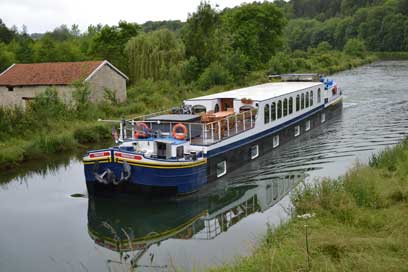
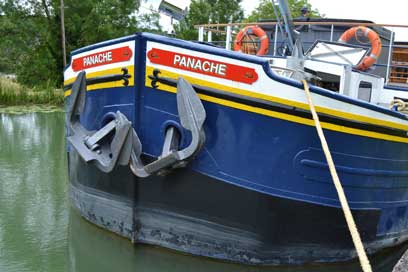
The word “panache” means style, energy, verve — and it’s also an apt name for a luxury hotel barge from European Waterways that cruises the canals of France.

Why cruise on a canal? Why are the canals there at all? Of France’s more than 5,000 miles of inland waterways, half consist of a vast network of canals, some built as early as the 17th century, to connect France’s rivers and provide a freight transportation route from the English Channel and the Atlantic Ocean to the Mediterranean. Narrow locks raised and lowered the barges over land elevations between the riverbeds. When trucks and railroads provided a cheaper and faster means of freight transport beginning in the 1970’s, the idea of redesigning commercial freight barges for passengers was born.

LUXURY ACCOMMODATIONS
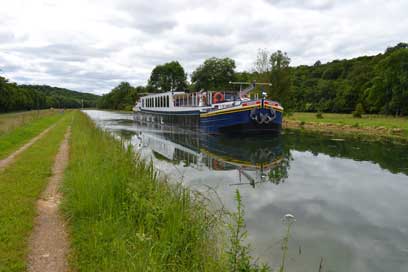
Our home during the six-day cruise on the Canal de la Marne au Rhin of Lorraine in eastern France was the 129-foot Panache, built in 1959 as a commercial freight barge and converted to a luxury hotel barge in 1998.

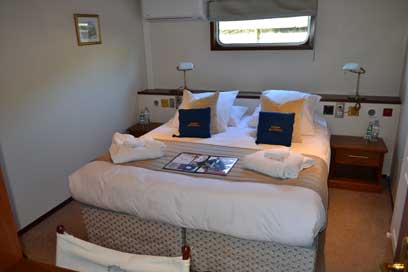
Rooms are below deck.

The six person crew — captain, pilot, deckhand, chef, hostess and housekeeper — greeted us on the sun deck with a Champagne toast and three appealing appetizers, and led us to our air-conditioned suite, with a queen-sized bed, private bathroom, plenty of storage space, desk, bedside tables, lamps and a television for watching onboard DVDs. Six roomy suites on the lower deck accommodate up to 12 passengers.

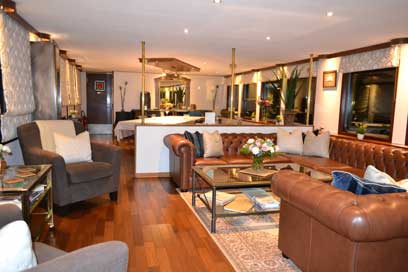
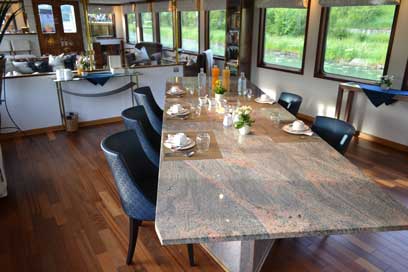
The main deck held the dining area with a gorgeous granite table that seats 12, a lounge area with a sectional leather sofa and coffee table for relaxing and reading, a fully stocked open bar, books and games, all surrounded by panoramic windows so guests can watch rural France glide by.

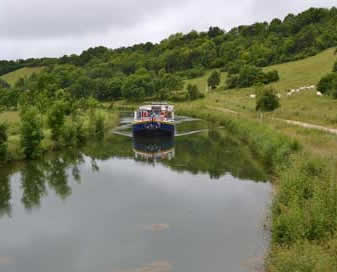
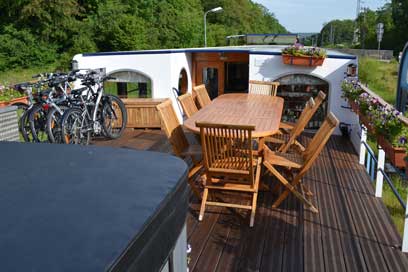
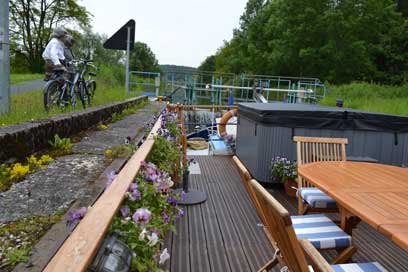
Another large table and folding chairs and a hot tub were on the sun deck, along with a supply of bicycles for guests to ride on the paved towpath that runs alongside the canal.

GOURMET MEALS
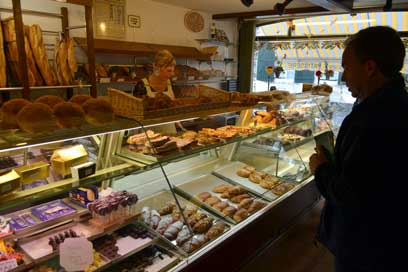
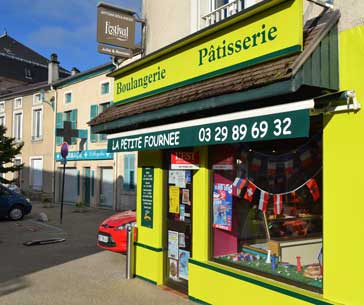
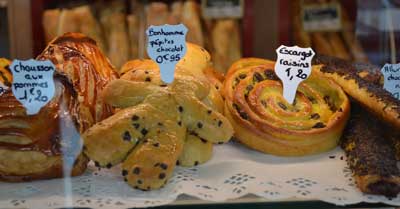
Each morning a continental breakfast of fresh fruit, juices, cheese and meats, coffee and fresh breads and pastries awaited us in the dining area. A made-to-order hot dish, such as scrambled eggs with smoked salmon, French toast, or an egg-in-ramekin creation, was also offered. By the second morning we were invited to accompany the captain on his early morning visit to the local patisserie to help select the freshly baked French pastries, croissants and baguettes for the day.

Going for fresh bread and pastries in the morning.

Both red and white wines were served with lunch menus that included mussels, a pesto and mozzarella tart, slices of smoked duck, carrot soup, mullet fish, chicken with wild mushrooms, sea bream, and fresh salads and cheese.

Each day ended with a four course, candlelit dinner in true French style. Red and white wines were presented to accompany each course:

  • Appetizers such as goat cheese and sun-dried tomato tart; crab, avocado and mango stack; chicken livers with shallots and capers; or seared scallops in cauliflower puree with crisps and chive oil.
  • Entrees including filet mignon wrapped in parma ham, rack of lamb, pork loin with dauphinois potatoes, beef filet with seared foie gras.
  • A cheese course with two or three selections meticulously paired with complementary dried fruits, jam or nuts.
  • And a dessert course – ah, the dessert course – banana souffle with double chocolate glace, chocolate mousse with iced amaretto, a fresh, citrusy lemon tart, a ramekin of molten chocolate lava with vanilla ice cream, and a strawberries and cream confection with crumbled merengue called the Eton mess.

One meal not prepared on board by Chef Todd was a special dinner at the intimate Table la Viktor in nearby Lucy on our second-to-last evening of the trip. With Captain Arnault as our genial host, we ordered local French cuisine – appetizers, entrees and desserts – from the menu, paired with appropriate wines, of course! It was a delicious dinner in an intimate setting.

EXCURSIONS ON LAND
The shady towpath alongside the canal immediately tempted us to take advantage of bicycles available for guests. The crew gave us bicycle helmets and readied the bikes for off-loading as we approached one of the many, many locks. Just as the deck reached ground level, we stepped out with our “wheels,” and rode off, easily out-pacing the barge (whose maximum cruising speed on the canals is 3 mph) past flower and vegetable gardens, through a small town and a playground filled with children, eventually meeting the barge at another lock to re-board.

The crew somehow managed to hopscotch two multi-passenger vans from dock to dock each day, so that a vehicle was always available for excursions and errands. Hence the early morning trips to the patisserie for fresh pastries, and the crew’s ability to shop for fresh local ingredients for our gourmet meals.

During the first afternoon we enjoyed an excursion to the Domaine Trepo Leriguier family-owned Champagne house for a private tour and tasting.

The next day featured a trip to the town of Vaucouleurs and the Musee de Jeanne d’Arc. The museum is filled with statues and paintings from artist’s imaginings of how Joan of Arc might have looked. There was even a pristine framed WWI poster with her image, asking for support for the war effort. We also sat in the Castle Chapel where she prayed before departing with an escort in 1429 to request an army from Charles VII to fight the English in France.

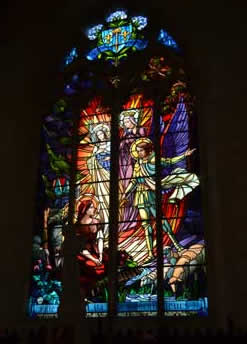
(left to right) Joan of Arc Castle Chapel; Joan of Arc statue in Vaucouleurs; Armored head; Stained glass windows in Castle Chapel

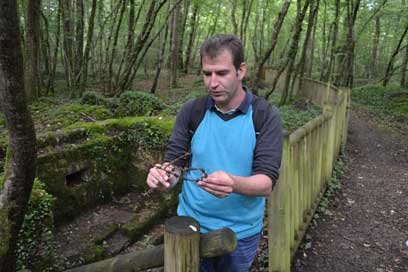
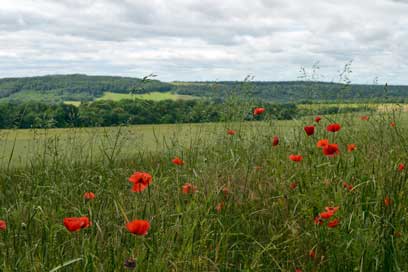
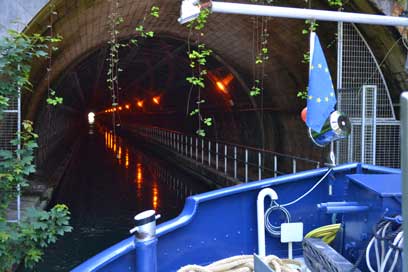
One morning, while the barge traveled through a three-mile tunnel, we drove to the town of St. Mihiel and had an excellent, informative tour guide show us the WWI trenches preserved nearby. Since it had recently rained, he easily found German and French bullets, barbed wire and shell remnants washed up in the mud. The majestic hilltop World War I Montsec American Monument dominates the landscape, and commemorates, among other things, the four-day battle in September 1918 when the American army liberated the St. Mihiel Salient.

Viewing the trenches of WWI; A U.S.-led WWI attack occurred in the strategically important Saint-Mihiel Salient, a triangular area of land between Verdun and Nancy occupied by the German army.

Our second-to-the-last day of cruising brought us to the town of Toul. A tour of the cathedral was followed by a private wine tasting at Domaine Lelievre. In addition to offering several of their wines, our hosts served us a traditional Lorraine meat filled pastry called Pate Lorraine.

Bertrand Trepo of Domaine Treop Leriguier offers tours of his Champagne vineyards. Domaine Lelievre in Lucey is a family-owned winery producing floral AOC Côtes wines.

By now we had switched from the canal to the Moselle River (where cruising speed increased somewhat) and our last stop was in Nancy, the ancient capital of Lorraine. We walked from the dock through beautiful gardens to the immense Saint Stanislas Square, which is surrounded by ornate gold and wrought iron and gates and stately buildings, and then used English language audio guides for a tour of the old town. A visit to the covered market and a stroll through the high end shopping district showed Nancy to be a popular stop for locals and tourists alike.

Saint Stanislaw Square; Porte de la Craffe in Nancy, built in the 14th century.

ENERGETIC CREW
The Panache lived up to its stylish name in accommodations and gourmet food, but every trip is only as good as its crew. Their energy and attitude were first class every day.

Chef Todd from England left an office job to study and follow his passion for cooking, and surprised us each day with menus derived from local ingredients, all with a perpetual smile on his face that revealed how much he loved his job.

Pilot Andre skillfully guided the barge through locks and tunnels with literally 2” of clearance on each side. He was phenomenal.

Hostesses Gabi and Kim enthusiastically presented wine selections, tempted us to try new cheese courses, delighted us with napkin folding and table-settings, and put fresh towels in our rooms every time we turned around.

Deckhand Anteo energetically did whatever needed to be done…from securing the barge inside each of the many locks, to off-loading bicycles, to painting scrapes on the boat when the pilot didn’t quite make it unscathed through the locks, to entertaining us with his guitar on the sun deck after hours.

Our unflappable captain Arnault, mini-bus chauffeur, evictor of spiders from air-conditioning units, tour leader, and story teller, met every challenge with tenacity and good humor, insuring that satisfaction was guaranteed on the cruise.

Consider a luxury hotel barge trip for a relaxing, comfortable week of gourmet meals and informative excursions while gliding through the backwaters of France. You won’t be disappointed.

Note: The itinerary for our cruise from Tronville-en-Barrois to Nancy was unique in the European Waterways system because a damaged lock prevented the barge from navigating its originally planned route.

For more information on this luxury hotel barge excursion, contact European Waterways:
USA 1-877-879-8808
Canada 1-877-574-3404
Email: sales@GoBarging.com
website: www.GoBarging.com