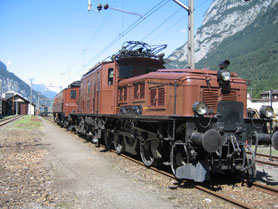
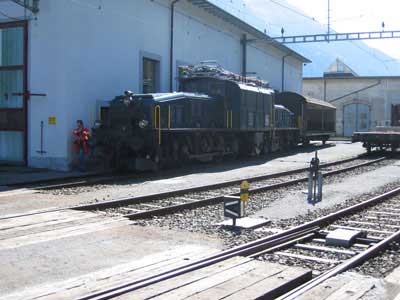
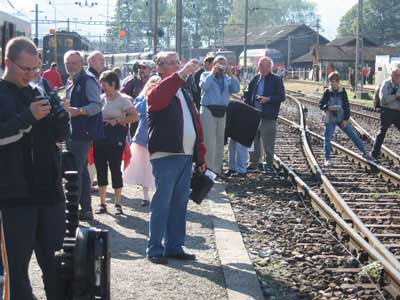
A giant electric Crocodile locomotive was on display September 8 and 9 in Erstfeld, Switzerland when 50,000 visitors showed up there and in Biasca to celebrate the 125th anniversary of the opening of the famous 15-mile-long Gotthard Tunnel. Heimburger’s European Traveler was at the giant party and recorded these photos. As many as seven steam engines and dozens of vintage pieces of equipment were available for viewing. There were also many interactive displays. For more information, go to www.sbbhistoric.ch.
From the first red wine produced along the Mosel River during Roman rule to the sweet Riesling for which the country is renowned, German wine is woven into the country’s culture and history.
Many member cities of the Historic Highlights of Germany are inviting travelers to experience this firsthand this fall with a series of wine-themed events, activities and offers.
In Mainz, more than 50 wine growers from throughout the region assemble during the first weekend in September for the annual Mainz Wine Market (photo at left). The event has craft stalls, rides, music and fireworks and, of course, dozens of wine stands. Wine-making goes back nearly 2,000 years in Trier, where several two-night packages feature special themes such as wine cultivation during Roman rule and a combination of World Heritage site visits and wine culture.
In Heidelberg, packages include the Heidelberg Wine and Chocolate Tasting with five wines from regional vineyards and five fine chocolates. Wine has long been central to life in Koblenz, located at the confluence of the Rhine and Mosel Rivers, where the “Wine Village” welcomes visitors to enjoy a glass of wine in the quiet setting of half-timbered houses.
Würzburg, situated on the Main River, is home to several wine estates, where visitors can enjoy tours and wine-tastings—including the Juliusspital, whose 400-year old, 800-foot long wine cellar makes it one of the oldest and largest German wineries.
Historic Highlights of Germany suggests two “Dream Routes” that focus on wine. Click on “Dream Routes” on our site at: www.historicgermany.com
By Don Heimburger Photos by the author, Marilyn Heimburger and courtesy Pre-History Museum in Halle
Millions of visitors are expected to visit Wittenberg, Germany between now and 2017, when the 500th anniversary of the nailing of the 95 Theses by Martin Luther occurred.
The German state of Saxony-Anhalt is launching a giant campaign to publicize the anniversary and show off its Luther treasures to the world.
The kick-off event starts October 31 when the State Museum of Pre-History in Halle on the Saale River showcases numerous Luther archaeological artifacts that have recently been uncovered, mostly in Mansfeld, Luther’s childhood home, and Wittenberg at Luther House, where Luther taught.
Luther House in Wittenberg
Entitled “Finding Luther—Archaeologists on the Reformer’s Trail,” the 4,000-square foot exhibit will be shown in the newly-restored Pre-History Museum.
“Except for his writings, the bulk of the reformer’s possessions got lost,” says Dr. Michael Schefzik, curator of the Museum. “On the other hand, the archaeological excavations in 2003 yielded hundreds of objects which certainly had belonged to the Luther family.”
LUTHER’S LIFE COMES INTO FOCUS
Only in the last several years, after research by various archaeologists, was it feasible to draw a picture of the life of the Luther family, especially in Mansfeld where the Luther family moved to in 1484, shortly after Luther was born.
“Historical truth and legends (about Luther) are almost inseparably intermingled with each other,” says Dr. Schefzik. Now, more is known and will be explained in this new exhibit.
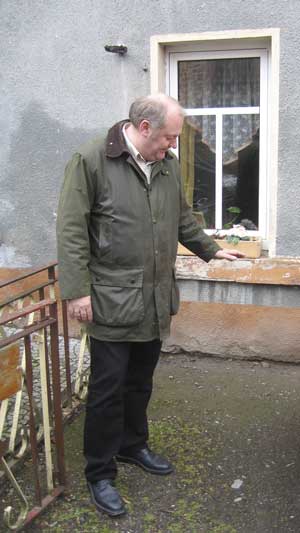
Dr. Schlenker indicates where first Luther artifacts were located in a parking area near Luther’s home
Some of the Luther exhibits visitors to the museum will find include:
Luther’s childhood marbles? Archaeologists believe they found them—made of clay and probably heated over an open fire in the Lutherhaus in Mansfield.
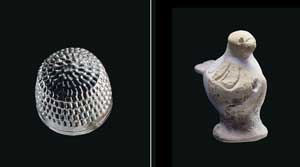
Luther’s mother’s thimble (?) has been preserved and is beautifully made.
Heating stove tiles of several colors from Luther House in Wittenberg with pictures of Adam and Eve on them, as well as possibly Frederick the Wise, who befriended Luther.
Iron keys, padlocks, nails, large headdress pins, knives, belt buckles, chards of pottery, beads, garment accessories, jewelry, a beer tap, coins, fish and wild fowl bones and much more.
SURPRISES YET TO COME
In addition, the museum has a few exhibit surprises that only visitors there will get to see. Many more Luther objects, such as goblets and beakers, are on loan from other museums and estates that will be shown in the exhibit. Luther received the vessels from wealthy patrons and gave them to selected friends.
Don and Marilyn Heimburger with Wittenberg Mayor Eckhard Naumann
The new Luther finds have attracted National Geographic, which plans a comprehensive report on the news, as well as many German newspapers and other news agencies.
While in Wittenberg (Home of the Reformation), which you could make your home base for a few days as you tour the various surrounding Luther sights, you’ll want to see the Town and Castle churches, the Luther House, a UNESCO World Cultural heritage site, the Philipp Melanchthon house, the Market Square with the town hall built between 1523 and 1535, the Lucas Cranach houses (he owned several), and some of the town’s museums. The town, first documented in 1180, has a great many historical buildings.
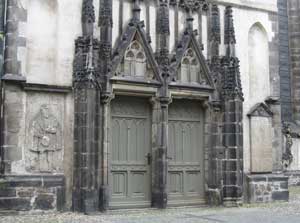
The Castle Church, with an 288-foot-high tower, was once the magnificent castle of the electors of Saxony, built between 1489 and 1525 for Frederick the Wise. It also became the university church, and it was here that Martin Luther nailed his 95 Theses to the door. Today a black bronze door (installed in 1858) has replaced the original one. The door commemorates October 31, 1517 when Luther nailed his theses “on the power of indulgences” to the door.
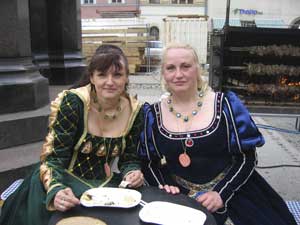
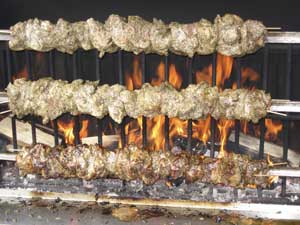
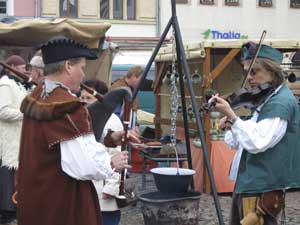
Medieval ladies add to Wittenberg’s FestivalMeat sizzles on an open fire at Wittenberg town festivalMusicians at Wittenberg festival
OLDEST CHURCH WORTH A VISIT
Wittenberg’s oldest church is the Town Church, the Town and Parish Church of St. Mary, set in the central square. The pulpit, at which Luther preached, can actually be found now at the Luther House. If you go, note the series of epitaphs by Lucas Cranach the Younger around the altar. They are from around 1560.
Other Wittenberg highlights include:
The multi-colored turreted high school designed by Friedensreich Hundertwasser
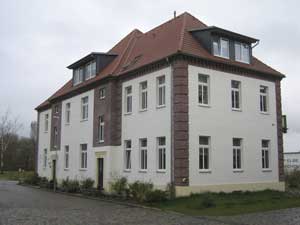
The Piesteritz residential housing complex on the west part of town, with some housing built as early as 1916, used to house factory workers
Museum of Town History, a collection of thousands of old historic Wittenberg documents and artifacts
For fun, visit the historical printing workshop in town and see how printing used to be done at the time Luther translated the Bible into German. You can even purchase a few humorous Luther quotes which have been printed at the shop.
WITTENBERG FESTIVALS
Hundertwasser School
Every year on the second weekend in June, thousands gather in the streets of this town for Luther’s Wedding, a town festival that includes medieval merrymaking with processions, strolling musicians and entertainers.
July and August brings the Wittenberg Summer of Culture which includes theater shows, courtyard concerts, a wine festival and “ErlebnisNacht” which features unexpected happenings at unexpected times in unexpected places in the old quarter.
A newer hotel, across the Elbe River, is the Bruckenkopf Hotel, owned by the Schult family. Renate and Gehard Schult have invested heavily in the renovation of this sprawling military complex once used by the Kaiser’s Army and Napolean’s Army. There are 24 rooms in the brick fortress portion of the complex. The staff is friendly, and there is no noise except an occasional duck splashing in the nearby pond. The complex also provides rooms and cabins for boaters and bikers, tenters and motorhomes (www.marina-camp-elbe.de).
If you like good German food, a number of restaurants downtown can accommodate you. Nearly all hotels offer good food in their restaurants, but a favorite of the locals is the Schwarzer Baer, which is connected to a hotel (naturally) and Luther used to come in there to eat and drink, and it’s said he even slept there.
Wittenberg is best reached from Berlin’s Tegel Airport, and frequent ICE, ICE night and IC and EC trains stops in Wittenberg. For more Wittenberg information, go to www.wittenberg.de (e-mail: info@wittenberg-information.de). For individual town tours, contact English-speaking guides Bettina Brett at bettina.brett@arcor.de or Astrid Muehlmann at astrid.muehlmann@web.de. Both are veteran guides and are well-known locally.
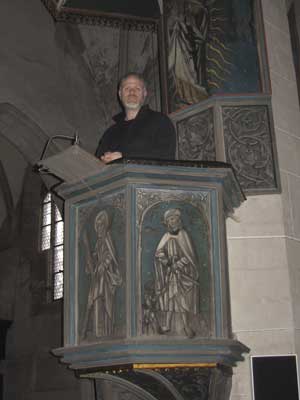
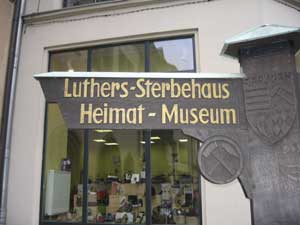
Reverend Scott Moore in the pulpit at Eisleben Church, where Luther was baptized.Luther Museum in Eisleben.
OTHER NEARBY CITIES
If you’re in Wittenberg, you really should take the time to visit some other nearby Luther sights and towns. They include the town of Eisleben, nestled in the hill country of the Mansfeld basin. It’s here that Luther was born (November 10, 1483) and baptized the next day in the Church of St. Peter and Paul. His home has been turned into a very interesting museum that documents his early childhood and youth and gives an insight into the spiritual environment in which Luther was raised.
On the hill overlooking Mansfeld, you can visit the Mansfeld Castle where Luther preached. In town is his parent’s large home, where they are now uncovering many Luther family artifacts.
In Torgau, the political center of the Reformation, you can visit the Hartenfels Palace Chapel, consecrated by Luther on October 5, 1544. It is regarded as the first church to be built as a Protestant church.
Luther studied theology and sciences in Erfurt between 1501-1505. In 1505 he requested acceptance into the Erfurt monastery, home to the Augustinian monks, an order known for its scholarship. In 1507 Luther was ordained as a priest
Perhaps surprisingly, Hamburg’s Weihnachtsmarkt at the Rathaus in the center of Hamburg is a relative newcomer to the world of Christmas Markets in Germany.
Several years ago the city fathers decided to look for a new concept for its holiday market, and found a creative partner in Bernhard Paul, director of Roncalli’s Circus. With its colorful circus-themed market stalls and entertainment, including a nostalgic carousel and historic fairground organ, the Christmas market at the Rathausmarkt opened for only its eighth year in 2007. In that short time, however, it has become one of the most popular markets in northern Germany, with nearly three million visitors each year.
LEBKUCHEN AND GLUHWEIN ABOUND
About 80 dealers from all over Germany gather to sell their handicrafts and food specialties. Shoppers enjoy the smell of roasted almonds, Lebkuchen and Gluhwein as they stroll through the rows of vendors, who are grouped according to their wares.
One row is filled with toys, including model trains. Handcrafters such as glassblowers, makers of hats or lanterns and amber jewelry are in another aisle. There is a food specialties area that includes cheese from Tirol, Christstollen from Dresden, Lebkuchen from Nurnberg and candy makers in action. Tired shoppers can enjoy genuine German refreshments indoors at the colorful Art Nouveau Viennese café at the market.
Three times each day Santa Claus, in his sleigh pulled by reindeer, flies high over the market to the sound of American Christmas carols –is that Bing Crosby I hear? Standing in a basket suspended under the moving sleigh is the Christkind (Christmas angel who delivers gifts to the children), waving at the crowd in the market below.
A city as large as Hamburg will, of course, have more than one Christmas market to attract visitors.
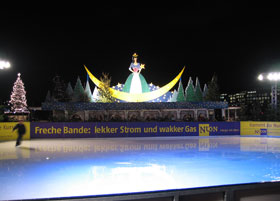
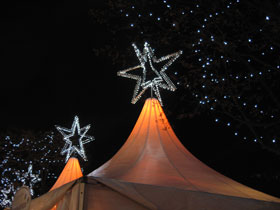
Of the 12—that’s correct, 12—Hamburg Christmas markets, one of the trendiest is Weihnachtsmarkt Jungfernstieg, which overlooks the beautiful Inner Alster Lake. White is the theme color of this market: white lights highlight the vendor booths, which are covered by soaring white roofs, and are topped with white star-lit peaks. Open for only its second season in 2007, this unique market boasts an ice-skating rink and an open-air lounge, which supplies warm blankets to customers. Shoppers can find clothes and jewelry along with traditional nutcrackers and food specialties.
MINIATUR WUNDERLAND
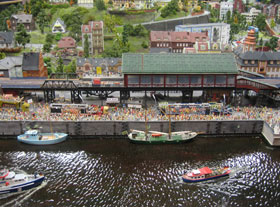
If rainy weather limits your time at the outdoor Christmas Markets, take advantage of some of the many attractions that Hamburg has to offer. Miniatur Wunderland is the world’s largest model railway and is housed next to the Elbe River in Hamburg’s warehouse district. The trains run on several different levels of the building, and a full-time paid staff monitors the miniature world.
Allow several hours to enjoy the more than 700 model trains, which run through scenery modeled after Germany, Austria, Switzerland, Scandinavia, and even the Western United States. See a circus in action, cars driving on highways and ships sailing the ocean. See fires break out and emergency trucks speed to the rescue. And then there are the trains—they are everywhere—and they are of every kind, all running as if they were on prototype railroads. And every half hour, daylight becomes nighttime inside this miniature HO scale world. There is an admission, and a nice gift shop.
It will be hard to pull kids away; perhaps dads won’t want to leave, either! Check out this fascinating world at www.miniatur-wunderland.de
BALLINSTADT EMIGRATION MUSEUM
Hamburg’s BallinStadt Museum offers an amazing and detailed look at the history of emigration to America via the port of Hamburg.
The museum is named after Albert Ballin, director of the HAPAG shipping company, who had a 30-building departure city built between 1901 and 1907 for emigrants. The museum is located on this site and housed in three reconstructed Housing Pavilions.
A model constructed beneath the floor and viewed from above through glass, shows the layout of the original departure city. Interactive exhibits tell the emigrants’ stories, and show what daily life was like as they awaited their journey to America. A family research center at the museum offers the opportunity to access Hamburg passenger lists from 1850 to 1934.
Easily reached by public transportation, the BallinStadt Museum shows how the Port of Hamburg became known as the emigrant’s gateway to the world. www.ballinstadt.de
If you’re ready for more shopping, and weather is still dampening the outdoor markets, try indoor shopping at the Europa Passage. Architect Hadi Teherani designed this structure with a glass ceiling and 21 arches, which connects five floors filled with 130 shops and restaurants. Located with a view of the Inner Alster, (one of Hamburg’s lakes), the mall offers modern, upscale shopping in light-filled arcades. www.europa-passage.de
For accommodations within walking distance from the Europa Passage, the Rathausmarkt, and the Christmas market Jungfernstieg, try the Hotel Atlantic Kempinski. First opened in 1909, this luxury hotel next to the Outer Alster served passengers awaiting their departure on ocean liners. Now it is a local landmark, recognized from afar by its white-lit rooftop globe and ladies emblem, which was used in the James Bond film “Tomorrow Never Dies.”
A sumptuous breakfast buffet and beautifully appointed lobby with tea service, offer the traveler warmth and welcome after a full day of rewarding Hamburg experiences. www.kempinski.atlantic.de
By Marilyn Heimburger Photos by Marilyn and Don Heimburger
When you think of Christmas markets in Germany, Nuremberg usually comes to mind first. It has a very long history and is considered the “queen” of the Christmas Markets.
The Christkindlmarkt of Nuremberg was first called “Kindelsmarkt” in an inscription on a wooden oval box dated 1628.
The main market square between the Schoener Brunnen (beautiful fountain) and the Frauenkirche (Church of Our Lady) is the site of this famous Christmas market. The 180 market stalls with their red and white-striped canvas roofs are arranged in rows and fill the area with the aromas and lights of the holiday season. The popular Christkindlmarkt has been called a “Little Town of Wood and Cloth.”
PRUNE MEN ARE SPECIALITY
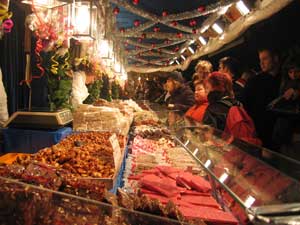
Vendors offer the beautiful craft wares and decorations found in many markets. But one special item you can find here are prune men: figures 6-8 inches tall with arms and legs made of dried prunes and heads made of walnuts.
An edible specialty of Nuremberg is its tiny sausages, which weigh exactly 23 grams and are about the size of a little finger. According to legend, they were made small enough to fit through the keyhole of a door, just in case someone was locked out of the city gate after curfew and needed something to eat!
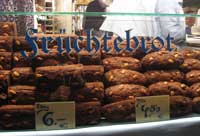
Another treat is Nuremberg’s famous Lebkuchen (gingerbread). Lebkuchen Schmidt ships its goods all over the world, and is available in beautifully decorated tins, even music boxes (www.lebkuchen-schmidt.com.)
Unique to the Nuremberg Christmas market is Christkind, who officially opens the market at 5:30 p.m. on the Friday before the first Sunday in Advent. The Christkind, or Christmas Angel, represents the Christ Child as the one who gives gifts on Christmas, as opposed to St. Nicholas, who delivers gifts into the waiting shoes of good children on December 6.
Every two years since 1969 a young girl is elected by a combination of popular vote and jury selection to represent the Christkind. Strict rules govern the age and height of a Christkind candidate. She must also be a good student, since her many appearances force her to miss school, and she must not be afraid of heights, because she must stand on a balcony near the top of the Church of Our Lady to deliver her market-opening pronouncement!
SPECIAL REQUIREMENTS
Nuremberg is understandably proud of its Christkindlmarkt. In order to protect the market’s reputation, war toys are banned, as are decorations of plastic firs, products displayed in cardboard boxes, and canned Christmas music.
A short walk away from the main market square is the Rathausplatz (Town Hall Square) where you can find 14 vendor stalls from Nuremberg’s partner cities offering their unique wares.
In addition to the Christkindlmarkt in Nuremberg’s main market square, a special Kinderweihnacht (Children’s Christmas Market) on the Hans-Sachs-Platz has entertained families since 1999. A 100-year-old steam Ferris wheel, a steam railway and a merry-go-round offer rides. Vendor stalls have lower counters to invite children to see and touch, decorate cookies and candles, and have pictures taken with Santa. Across from the children’s market is the Sternenhaus (Star House), which serves as headquarters for the Christkind and offers cultural programs for children.
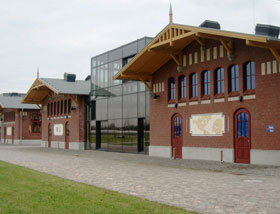
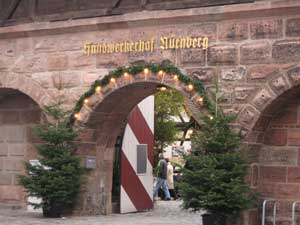
One very special market open all year round, but is especially magical during the Christmas season is the Handwerkerhof. Located across from the main train station, the stone and half-timbered structures look as old as the King’s tower and fortification walls that surround them. But the entire little town was built in 1971 as an additional attraction during the Albreacht Durer 500 anniversary celebration. It has remained a year-round attraction highlighting craftsmen who work with pewter, leather, glass, candles, precious metals, gingerbread and dolls.
You can watch bakers make Lebkuchen, shop for tin toys, wood and glass ornaments, have a mug of hot spiced wine, and then eat at the Bratwurstglocklein, a wonderful wood-paneled, low-ceilinged pub with waitresses dressed in traditional dirndls, and food served on pewter plates. Try the tiny sausages each of three ways: cooked with vinegar and onions, smoked and grilled. Served with potato salad, saurkraut and beer, it’s a tradional Nuremberger treat. The Handwerkerhof is open six days a week (seven days a week during Christkindlmarkt) from the middle of March through December 31 (www.handwerkerhof.de.)
Wonderful accommodations for your Christkindlmarkt visit can be found at the Maritim Nuernberg (www.maritim.de.) It is conveniently located just a short walk from the main train station, and across the street from the Handwerkerhof. Another short walk takes you to the main market square and the Christkindlmarkt in the shadow of the Schoener Brunnen.
One more suggestion: before leaving the main market square, look carefully at the Schoener Brunnen until you find the gold ring. Make a wish and turn the ring three times to make your wish come true. Perhaps you will wish to return to this beautiful market again next year!













 European Traveler