Winter and spring in Interlaken has fun to offer at the foot of the Eiger, Mönch and Jungfrau mountains. While superb sledge runs attract snow enthusiasts to the mountains, the region between the lakes has a wealth of cultural highlights in store.
INTERLAKEN CLASSICS The tradition-steeped concert series in the Interlaken Kursaal features the stars of tomorrow playing works by old masters. At Kleine Scheidegg, rock music greats share the stage with local music legends, and the many folklore clubs practice yodeling and alphorn sounds.
European Union Youth Orchestra
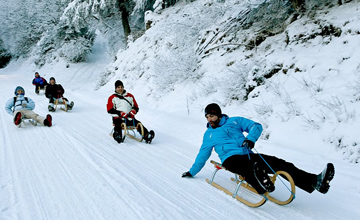
SLEDGING BY MOONLIGHT In Saxeten, after an uphill walk to Alp Nessleren near Wilderswil, guests are rewarded for the effort with a 2 1/2-mile-long sledging session. Culinary well-being is guaranteed with a stop for mulled wine, followed by a tasty fondue in traditional rustic surroundings at the end of the sledge run.
Sledging for snow enthusiasts
YODELING Swiss folklore clubs promote traditions yodeling and alphorn playing first hand. Yodeling choirs offer a unique blend of beautiful harmony and players create a powerful sound from a long wooden pipe, which echos through the valleys.
53RD INTERLAKEN CLASSICS You can meet tomorrow’s classic stars at the 53rd Interlaken Classics Festival from March 24 – April 8. The festival has grown into a summit meeting for younger and already internationally-acclaimed musicians. The consistent staging of this podium for young artists is based on close cooperation with Europe’s best youth orchestras, namely the Gustav Mahler Youth Orchestra and the European Union Youth Orchestra.
SnowpenAir Concert on April 6 is the highest-altitude open-air concert. This breathtaking setting on snow at 1 1/4 miles above sea level attracts thousands of concert visitors who will enjoy top acts such as Roxette and OneRepublic, the founding father of Swiss dialect rock Hanery Amman and promising young talent MC Juli.
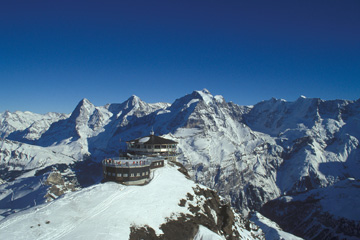
Schilthorn Summit near Interlaken, Switzerland offers panoramic views.
“Ozapft is!” exclaimed Munich’s Lord Mayor Christian Ude after opening the first keg of beer at noon on September 22, thus officially inaugurating the world famous German Octoberfest.
And following 16 days of beer, fun and Gemutlichkeit, the 2007 Munich Octoberfest closed its gates after 6.2 million people visited the biggest fair in the world.
This big city, with rural charm and friendly people, served 6.7 million glasses of beer, thousands of Hendl (chickens) and 104 oxen to the crowds that swarmed into the 14 large tents on the Octoberfest grounds right off of the Schwanthalerstrasse. As many as 10,000 people can be accommodated in some of the huge beer tents.
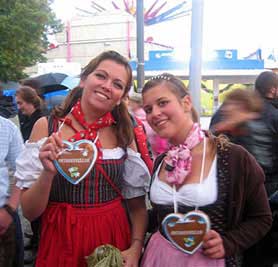
Alison Ramsey tasted and tested the beers at Octoberfest. A good reporter must get all the facts, and test all the flavors of beer before she files her report.
COLORFUL TENTS The tents, which sometimes appear more like buildings, are highly colorful, and are decorated with painted murals, clouds and more to make them attractive to the visitors, some of which spend all day inside!
A special Octoberfest beer, brewed by Munich’s six major breweries, is served in the tents. The delicious draught is usually served with radishes, Obatzta (special cheese), sausages, roast chicken or grilled fish. And barbecue beef is a Wiesn specialty.
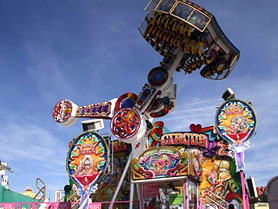
This year, as many as 80 different firms offered fair guests samplings of their foods, and more than 200 attractions greeted fair-goers as well, such as breathtaking rides like the Olympia Loop or the Power Tower, the Krinoline (merry-go-round), the Teufelsrad (Devil’s Wheel), the Toboggan and even a variety show.
HISTORY OF THE FAIR The wedding of Crown Prince Ludwig–later King Ludwig I of Bavaria–and Princess Theresa of Saxony-Hildburghausen in 1810, started the fair when the royal couple invited the people of Munich to celebrate in the fields in front of the city gates. The fields were named “Theresienwiese” in honor of the princess, and locals later abbreviated the name to “Wiesn.”
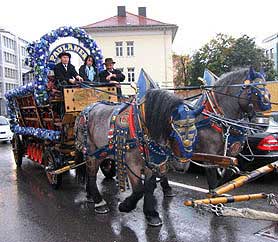
The annual Munich celebration starts off with a parade featuring festive carriages bearing the land-lords’ families, the horse-drawn drays of the Munich breweries, showmen’s coaches, waitresses on decorated floats and the beer tent bands. It’s quite a spectacle!
The following day the Munich Costume and Rifleman’s Parade features groups in traditional costumes, marching bands, troops of bandsmen and trumpeters, amateur and mountain riflemen. Performers of all kinds, decorated coaches and flower garlands are always main attractions of the parade. And the parade goes on even if the weather is bad!
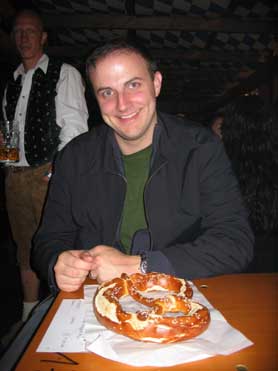
European Traveler’s Steve Ramsey tests one of the giant pretzels at the 2007 Munich Octoberfest. Got a beer to go with this?
ONE LAST WORD, AND A FAMOUS BREW Of course, one of Munich’s famous trademarks is the 418-year-old Hofbrauhaus, where beer lovers gravitate throughout the year. It’s a fun establishment that holds up to 3,000 guests at the same time. The beer house even has its own beer, served, of course, at Octoberfest.
Stay tuned for more beer news. We had a great time in Munich, so it’s likely we’ll be back! Let’s see…when is next year’s fair?
Wedding “destinations” in the Germanic lands can sometimes be unusual.
Take, for instance, the June 2006 wedding of Swiss-born Hans and Birke Mebold of Rheinfelden, Switzerland.
“Our wedding was something special,” says Birke. “All this talk about the most beautiful day in your life…but it really was the case for us. The whole wedding took on a kind of momentum all its own.”
The Meholds first were officially married in a small church called Johanniterkapelle in Rheinfelden, home of Switzerland’s most popular beer, Feldschlosschen, and the town in which the couple both work.
Following the 11 a.m. ceremony, and a small reception, the couple was whisked away on Rheinfelden’s biggest fire truck with its blue lights flashing wildly. Both Feldwebel Hans and Birke are Rheinfelden fire brigade volunteers of 16 years and five years respectively, with Hans head of the town’s traffic regulations and security section.
HELICOPTER RIDE Where the couple’s fire truck ride ended, their helicopter ride began, to the 2,100-foot-high resort town of Eptingen where they met a bus full of 50 wedding guests of family and friends.
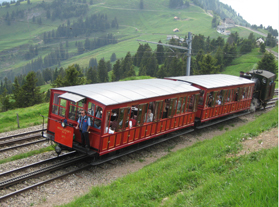
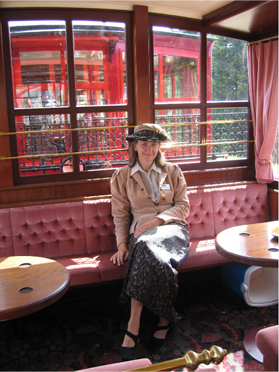
At Vitznau on Lake Lucerne, the group boarded a specially-reserved Mt. Rigi Railway steam locomotive and two-car cogwheel train consisting of No. 16, an 1923 oil-fired engine, and the BelleEpoque, a stately parlor car built in 1873 and coach No.10, built in 1871. The crew assigned to the wedding train consisted of a driver, a fireman, a conductor and one hostess dressed in period costumes for each car.
As the steam train ascended up the side of steep 6,000-foot-high Mt. Rigi on a clear, warm spring day, the guests were served refreshments. The train passed quaint farms, pastures filled with grazing sheep and cows, and hiking trails.
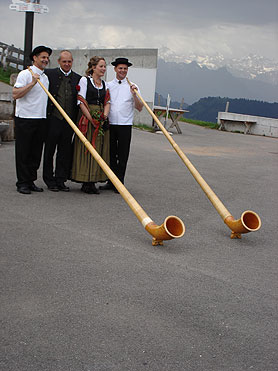
At Rigi Kulm, the group was welcomed by the alpine horns of Ruedi Imlig and his brother. Then a second wedding ceremony took place in the small chapel on the top of Rigi.
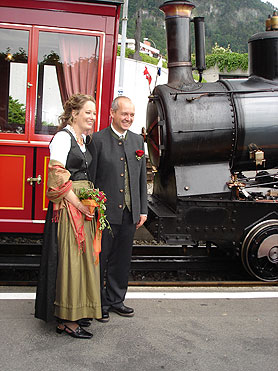
The wedding steam train for Hans and Birke Weber chugs up Mt. RigiBride Birke Weber steps out of her special railway car at the top of Mt. Rigi; her new husband, Hans, follows.Train hostess Lucia Weber on the Belle Epoque, an 1873 salon car
DINNER AND DANCING AT THE TOP The guests then enjoyed dinner and dancing at the Hotel Rigi Kulm. “The scenery at the top was so beautiful and the food was excellent,” says Birke. Afterward, dancing was provided by Gunter Pichler and his GP Music band.
“My great grand aunt had taken us to Mt. Rigi last year, and we were stricken by the incredible view from the top,” says Birke.”When we thought about a location for our wedding, it didn’t take long to decide to go to Mt. Rigi.” She admits the travel arrangements for buses, trains and helicopters were a bit daunting, however.
The happy couple and guests returned from the mountain after midnight on an electric cogwheel train, and later spent their honeymoon in Sweden. If this is what they planned for their wedding day, it sounds like this couple is never going to have a dull moment.
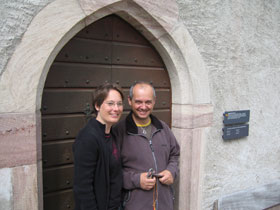
Hans and Birke Mebold, a year after their wedding, stand in front of the Rheinfelden, Switzerland church where they were married before their many relatives and friends.
The humble onion is the star of the show at the Onion Market held in Weimar, Germany every October. These are no ordinary onions lumped together in crates or sacks; these are onions arranged together in the traditional way and decorated with dried flowers of yellow, white or lilac. They come in all sizes, too—from tiny ones to whopping big ones.
MARKET FOR BEASTS AND ONIONS The market was first recorded in 1653 as a “market for beasts and onions” on what is today the Frauenplan, at a time when Weimar barely had a population of 5,000. There are many instances of the links between the German writer Goethe and the Market; he is said to have secured onion hearts to his desk, to have decorated his house with them, and to have praised the role of the onion in promoting good health.
In the 19th century, the market moved to today’s Schillerstrasse and developed into the major onion purchasing center for the whole of central Germany. Dealers came mainly from Heldrungen, 29 miles away, and that is still the case today.
In 1861 the market was extended to three days. In 1872 the city of Weimar passed an Onion Market Ordinance. Onions are offered as well as celery, radishes, garlic, leeks and marjoram, as well as other types of spices and vegetables. During the 20th century, world wars and inflation led to the decline of the market, and it was reduced to one day due to the limited produce available and high prices. It was not until the 1950s that the market began to pick up again, and by 1971 a record was set when 200,000 visitors attended.
ONION GARLAND The sale of the famous market souvenir, the onion garland, has grown to 70,000 pieces, and onions and other vegetables, fruits, spices and handicrafts began to make their mark. In 1990 the Onion Market again became a three-day event. The market has also grown in size in the interim and now occupies the whole of the historic inner city. The number of visitors is now 350,000 annually.
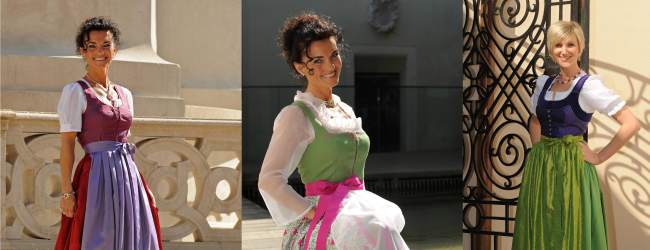
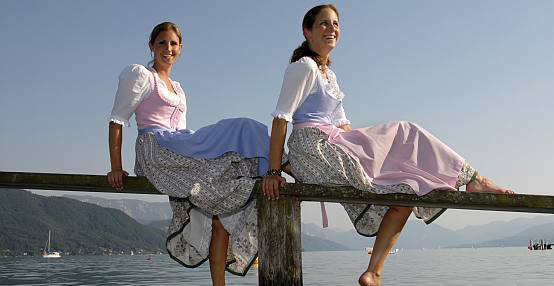
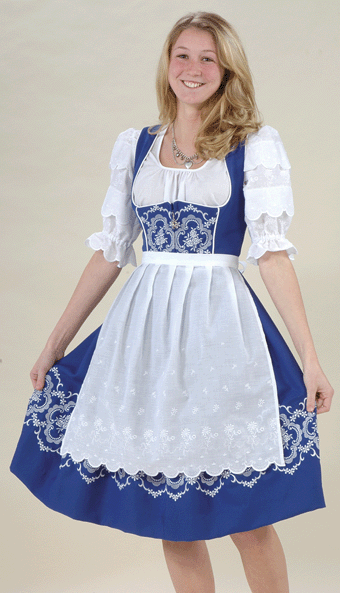
What is a Dirndl? If you have seen the movie “The Sound of Music,” you already know the basic elements that make up a Dirndl: skirt, bodice, apron and blouse. Simple, right? Far from it!
There is a veritable science to Dirndl cuts, fabric patterns, colors and embroidery.The main elements that make up a Dirndl are the wide skirt attached to a “Leiberl,” or fitted bodice, an apron (often with a hidden pocket) and a short Dirndl blouse.
The skirt usually starts at the waist or a little lower. You can choose between various lengths, depending on current fashion trends. The bodice used to be a separate item, but since the 1930s is sewn to the skirt. It comes in many different styles: with a high or low, round or square neckline, it is fastened with buttons, hooks, or ribbons.
An important element is the Dirndl blouse. It is generally very short (ends above the waist), with long, short or puffed sleeves. It can have many different necklines and is usually made of white cotton or linen. The Dirndl blouse accentuates the style of your Dirndl: Choose between delicately hand-embroidered pieces, blouses with extravagant ruffles and lace, or simple ones with straight sleeves.
Finally, there is the apron. Formerly worn to protect the dress underneath, it is now a purely decorative item. There are aprons for every-day wear and aprons for festive occasions which are usually of a more elegant fabric than the simple linen or cotton ones. Before you tie the knot—be sure to check on which side to place it—otherwise you might unwittingly send out the wrong message.
Different combinations of these elements make up the traditional Dirndl. There are different Dirndl styles for different occasions, even Dirndl styles that tell which region in Austria the wearer is from. With the recent “Dirndl Renaissance,” there are countless downright “unorthodox” styles that experiment with different fabrics, cross cultural references and punk elements.
If all these options seem daunting at first, remember: the most important thing is to have fun with the many different colors and patterns, and to choose a Dirndl that fits your personality.
FROM PEASANT GARB TO HIGH FASHION The Dirndl has evolved from its humble origins centuries past as the work garb of peasants to a modern-day fashion superstar. With its feminine silhouette, its versatility and simple elegance, the Dirndl is a fashion “evergreen.” But where does it come from, and how did it get so popular?
Allegedly, the short Dirndl blouse we know today was originally a long shirt. Way back when, the shirt was actually one of the “basics” in the contemporary wardrobe of the rural population. Women wore a bodice, or even just a tightly wound cloth as an undergarment for warmth and support. Aprons were tied around the shirt to protect it from stains and dust. When people came home from the fields, the apron was simply switched to a different one for house work, or one for festive occasions.
Eventually, for reasons of practicality and perhaps vanity, the shirt was sometimes worn underneath the bodice and so the Dirndl was born. For a long time it was the garb of women in the countryside, and different styles developed for different regions.
Finally, in the middle of the 19th century, Emperor Franz Joseph and his court used to vacation in the Salzburg Lake district. The emperor took to wearing Lederhosen during his hunting exhibitions there, and a fashion trend was born. Suddenly, the Dirndl was all the rage and the Viennese aristocracy wore Dirndls and Lederhosen during their stay in the country.
In the 1920s, the founders of the Salzburg Festival contributed to the popularity of the Dirndl by making it acceptable to wear during performances and society events. The Salzburger Dirndl manufacturer Lanz and the world-wide success of the operetta “Weisses Roessl” made the Dirndl an international hit.
Since then the Dirndl has conquered the international fashion world. In the last 10-15 years, the Dirndl and traditional costumes in general have experienced another huge surge in popularity, even outside of the regions in Austria where it has been an everyday item for generations.
WHERE TO BUY A DIRNDL? With so many different styles to choose from, where do you start your own quest for the perfect Dirndl? Where to find authentic, traditional styles, and which Dirndl designers are known for fun and tasteful modern versions?
The best place to buy your Dirndl, of course, is at the “source.” The “real” Maria von Trapp used to mainly wear Dirndls and ordered new outfits with her favorite Dirndl tailor whenever she went back to her native Salzburg. Today, with Dirndls and Lederhosen in high demand, there are enough Dirndl manufacturers and stores to make your head spin.










 European Traveler