B is for ‘Brusselicious’

By Don Heimburger
Photos by the author and courtesy Visitbelgium.com

What’s a 13-letter word that starts with a “B” and combines the capital city of Belgium with the concept of excellent food?

“Brusselicious” is the 2012 theme for Brussels’ Gourmet Year, and a fitting description of this city of 1.1 million that boasts no less than 19 Michelin stars among its dozens of top restaurants.

In 2006 Brussels was the capital of Fashion and Design, followed soon after in 2009 as the capital of the Comic Strip. Now it becomes the city of Culinary Delights, but locals and in-the-know visitors to this cosmopolitan city, with German, French and Flemish influences, enjoy their Brusselicious lunches and dinners every day of the year.

FRENCH FINESSE, GERMAN PORTIONS
The old saying is that the Belgians cook their food with the finesse of the French, but serve it in generous German-sized portions. Some specialties of Belgian cuisine include moules frites (mussels and fries), Waterzoo (fish or chicken stew), Stoemp potato (potatoes and vegetables mixed together), and Salade Liégeoise.

So what’s cooking in Brussels in 2012?

There’s a fairly long list, but it all begins with Brussels’ traditional menus, which start with fresh meats and produce, and are then honed with a top chef’s creativity and skill. In Brussels this is just the way they do it. After all, they have a reputation developed over the years, that they refined plate after plate.

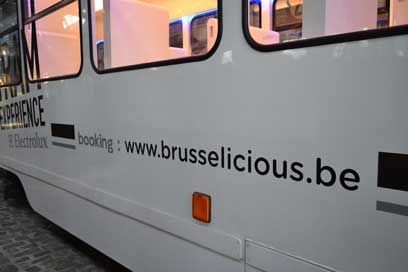
  • Brussels’ gastronomy will be on the move this year when a new designer tram will be introduced that will provide meals on board as guests roll around the city. Menus will be arranged by two-star chefs, and food will be served to 34 people on board the train during two-hour-long dinner parties. Departures start on Tuesdays and go through Sundays. This novel “meals on wheels” idea will appeal to the combination railfan and foodie.
  • As many as 35 giant artist’s reproductions will be introduced to the streets of Brussels during 2012 as well. Early in the year, artists were finalizing their creations in an old factory building called Carthago Delenda Est. Giant brussel sprouts, chocolate bars, mussels, pints of beer and giant cones of fries were masterfully being sawed, glued and screwed together to remind the city of its food heritage.
  • As many as eight themed dinners are being sponsored, from a Banquet des Miserables to mark 150 years of the finishing of Victor Hugo’s novel Les Miserables, to a Belgian Wine Growers Dinner, a Five Senses Dinner (sight, hearing, smell, taste, touch) and a Medieval Ommegang Banquet (Ommegang recreates a famous celebration of 1549 on the Grand Place in honor of Charles V and his son Philippe II).
  • The Bocuse D’Or Europe is the highly prestigious gastronomic competition held for 20 of the world’s top chefs this year in Brussels, who compete over a two-day period to claim top honors. The dozen best chefs then are entered into next year’s world finals in Lyon, France.
  • How about a Chocolate Week? With evening events, visits to chocolate workshops and a Chocolate’s Fair in town, what’s not to like?
  • A restaurant festival, publicized as the biggest gourmet event in Belgium, is coming to Brussels September 6-9. Imagine 100 restaurants and bars serving up their best dishes—with cooking on the spot—in a Brussels park.

TOP OF FOOD CHAIN
The 2012 culinary program doesn’t stop there, not for a city that loves to be at the top of the food chain. There’s a “Chipstands Festival” (you heard it correctly). So the city with some of the best frites (French fries) in the world will sponsor a competition and special events based on the fry. Would you like ketchup or mayo with that?

On a cooking platform 15 feet above the ground, Brussels’ star-studded top chefs will surprise and delight audiences with their “Dinner in the Sky” skills in the middle of the city. Also in August and September, the famed 650 tasty Belgian beers get their due during a weekend at the Grand’Place with tastings and more.

The city is also offering its own bottle of Brusselicious Beer, made by adding brown sugar to a bitter lambic. Lambic beer is produced by spontaneous fermentation: it is exposed to wild yeasts and bacteria that are said to be native to the Senne Valley, in which Brussels lies. It is this unusual process which gives the beer its distinctive flavor.

Other events are also planned, such as a Thai Food Festival, a Savoring Brussels Festival (dedicated to the flavors of fresh produce), and a Brussels Wine Weekend with open houses at some of the wine cellars and wine bars throughout the city.

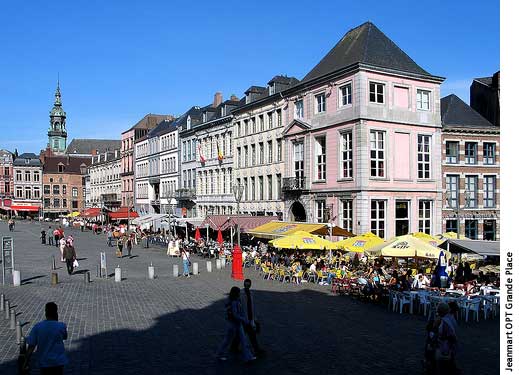
Brussels’ ornate Town Hall

BUSINESS, BUT RELAXED
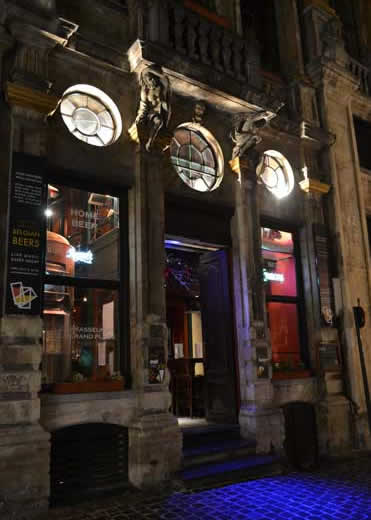
Brussels is, despite its European Parliament designation, a business center that appears to be relaxed at the same time. A tour of this multilingual city revolves around the Grand Place and its many gilded houses and the ornate town hall building (see it at night for a spectacular view).

Check out the Mont des Arts and its museums: the René Magritte Museum occupies the house in which the Belgian surrealist painter worked.  On the ground floor of the museum is the apartment where the painter lived and worked from 1930 to 1954;  exhibits of the artist are on two upper floors.

At the Belgian Comic Strip Center you can meet the comic strip character Tintin and his sidekicks, created by Belgian artist Georges Remi, who wrote under the pen name of Herge.

Walk to another part of the city and see the huge stone columns and a good view of the lower part of the city from the immense Palais de Justice, and visit the Atomium, with its gleaming spheres. It’s said to be “neither tower, nor pyramid, a little bit cubic, a little bit spherical, half-way between sculpture and architecture, a relic of the past with a determinedly futuristic look, museum and exhibition center; the Atomium is, at once, an object, a place, a space, a Utopia and the only symbol of its kind in the world which eludes any kind of classification.” The Atomium was the main pavilion and icon of the World’s Fair of Brussels in 1958.

If you’re in the market for shopping—or just window shopping—Brussels has it. Walk over to Avenue Louise and see its shopping arcade, or Boulevard de Waterloo, Rue de Namur or Avenue de la Toison d’Or for some upscale finds from classic to trendy.

Now back to Brusselicious food. One other very famous food delight is the Belgian waffle. I learned there are actually two types. One is the Belgian waffle, a light, fluffy waffle eaten with or without syrup and served at the more prestigious restaurants and hotels. Then there’s the thicker Liege waffle that is smaller, sweeter, heavier and more filling. You can find the heavier waffles served at stands everywhere in Brussels, usually with toppings such as whipped cream, strawberries, cherries, confectioner’s sugar, or chocolate spread.

If Belgium has a national cookie it is the Speculoos. Originally created for children to celebrate Saint Nicholas day on December 6, the treat is now widely popular and often found along with a cup of coffee in restaurants and bars as a side treat.

So add waffles and Speculoos to the large selection of foods that keep visitors going back to this vivacious gourmet city.

And to think, all this high cuisine started with the lowly Brussel sprout, from which the city gets its name. It just goes to show how inventive the Belgians are in the kitchen. They’ve taken the art of preparing and cooking food to new heights over the last few decades. Some would call that a Brusselicious endeavor. I’d say it was a call for dinner…in Brussels, of course.

For more information, go to www.visitbrussels.be or www.visitbelgium.com.

IF YOU GO…
Brussels has a number of interesting districts to visit.  The Brussels Card is valid for 72, 48 or 24 hours and allows you to visit 30 Brussels museums. It includes a public transport ticket and a full-color guidebook, as well as discounts at some tourist attractions and stores. Go to www.brusselscard.be.

The 2012 Michelin Guide shows the following Brussels restaurants have earned Michelin stars:

 2 STARS 
Sea Grill
Comme Chez Soi
Le Chalet de la Forêt (New addition)

1 STAR 
Alexandre
Jaloa (New addition)
La Truffe Noire
La Paix
Bruneau
San Daniele
Kamo
Senza Nome
Le Passage
Bon-Bon
Michel
Terborght
‘t Stoveke

Magnificent Marzipan

By Sharon Hudgins
Photos by the author

I’ve been in love marzipan ever since I first tasted it as a child. Back then, marzipan candy was a rare and expensive treat, often difficult to find in the United States. But when I later moved to Europe, I discovered a whole world of marzipan, enough to nourish my lifelong love affair with this seductive sweet.

I’ll admit it: I’ve never met a marzipan I didn’t like.

Marzipan is nothing more than a smooth paste of finely ground blanched sweet almonds mixed with sugar. Other ingredients are sometimes added, too, such as water, egg whites, sugar syrup, honey, almond extract, a small amount of bitter almonds, rosewater, orange blossom water and food colorings. But that description doesn’t do justice to the tantalizing taste of this tempting treat, nor to the many ways in which marzipan is used today by professional confectioners and home cooks.

On the grocery shelf, the difference between “almond paste” and “marzipan” is mainly the ratio of sugar to almonds, with marzipan containing more sugar. That ratio varies, depending on the individual producers and the various countries where this confection is made, some of which have laws regulating the proportion of each ingredient. The finest German marzipans contain two parts (or more) of ground almonds to one part of sugar. Others contain 50% almonds and 50% sugar. Danish Odense marzipan, the European brand marketed widely in the United States, has only 28% almonds. (Odense “Pure Almond Paste” contains 45% almonds.)

MARZIPAN MIGRATION
Culinary historians think that marzipan originally came to Europe from the Middle East, where almond trees and sugar cane have been grown since ancient times, and where there’s a long history of making sweets from almond paste. Even though the early Greeks and Phoenicians planted almond trees around the Mediterranean region, it was the Arabs who expanded the almond orchards, introduced sugar cane cultivation, and began producing marzipan in the areas of southern Europe they conquered and colonized between the 8th and 11th centuries. After Arab power waned in those parts of the Mediterranean, during the 11th to 15th centuries, the secrets of marzipan-making were preserved by nuns in Catholic convents, who produced these sinful sweets for sale to support themselves. That’s why former Arab-ruled lands such as Spain, Sicily, and Malta still have strong marzipan traditions today.

Historians surmise that marzipan spread to northern Europe from Venice and the eastern Mediterranean during the time of the Christian Crusades, from the 11th through 13th centuries. Certainly by the Middle Ages marzipan was known in France, England, and Germany, although in many places it was considered a costly medicine, sold only in pharmacies. It soon became a favored confection of the upper classes, whose cooks molded marzipan into elaborate and fantastic shapes for use as showy centerpieces or edible finales to medieval feasts.

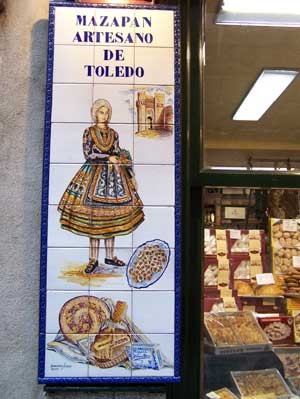
Sign for the Mazapan Artesano

MARZIPAN MANUFACTURE
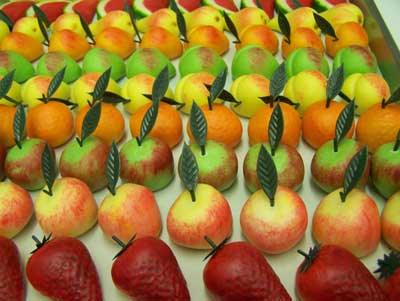
A traditional confection in Europe for several centuries, marzipan is made today by both artisan confectioners and big industrial plants. Centers of marzipan manufacture include Toledo, Spain; Palermo, Sicily; Budapest, Hungary; and Lübeck, Germany. Each has its own style of marzipan, with more or less sugar, baked or unbaked, and modeled into more shapes than you can imagine. At marzipan stores in Europe, I’ve seen this sweetened, colored almond paste formed into fruits, vegetables and flowers, from miniature to life-size; animals from penguins, polar bears and “good luck” pigs (for the New Year) to walruses, lions, hedgehogs and squirrels; Easter eggs and Easter rabbits; Santas and angels; fish and shellfish; lifelike sandwiches, cheeses and sausages; even modern marzipan cell phones and McDonald’s-like cardboard packets full of french fries.

Marzipan has other uses, too. Europeans fill chocolates with marzipan; wrap it around nuts, candied fruits and other sweet fillings; bake it inside cookies; and stuff dates, prunes, peaches and apples with it. They roll marzipan into thin sheets as a covering for fancy cakes and use it as ingredient in tortes and tartes, pies and pastries, sorbets and ice creams, even sweet dumplings, ravioli and roast pork. I once ate at a restaurant in Lübeck that featured “marzipan lasagna” for dessert, made with layers of white marzipan “pasta” and a red and green fondant filling.

MARZIPAN MUSEUMS
Several cities in Europe have marzipan museums, most of them attached to a confection company’s coffee shop, candy shop or factory store. The Niederegger Marzipan Salon, on the second floor of the Konditorei-Café Niederegger in Lübeck, Germany, has a display about the history of marzipan. But the actual shop on the ground floor is even more interesting, where you can buy more than 300 types of the company’s products, including whimsical edibles made out of marzipan and Niederegger’s irresistible Cuandolé marzipan liqueur.

Leu’s Marzipan-Land in Lübeck features a “Marzipan-Show” on Tuesdays, Wednesdays, and Thursdays. You’ll see all the stages in the manufacture of marzipan, as well as an unusual exhibition of large marzipan sculptures, before pigging out in the shop where you’ll be tempted to buy more marzipan than you should ever eat in one sitting.

Hungary boasts three marzipan museums, all owned by the Szabo confectionery company. My favorite is the Szabo Marzipan Museum in Szentendre, a pleasant (but now overly touristy) little artists’ village not far from Budapest. This small museum is chock full of displays of colored marzipan shaped into Disney characters, a Cinderella coach, a massive wedding cake, a cactus garden and even a detailed replica of the Hungarian parliament building. On the ground floor there’s a traditional confectionery kitchen where you can watch marzipan being made and a shop where you can buy goodies to go. Next door the Szabo café-and-pastry shop offers a wide variety of luscious Hungarian cakes, tortes, ice cream concoctions, marzipan candies, coffees and teas.

The smaller Szabo Marzipan Museum in Budapest features large marzipan sculptures of the Matthias Church, the Fishermen’s Bastion, and the Chain Bridge across the Danube (all local landmarks), a Chinese pagoda, several Harry Potter characters and other curiosities, some made from more than 100 pounds of marzipan. And there’s another Szabo Marzipan Museum in Pécs, also connected with one of their coffee-and-pastry shops.

In Sonseca, Spain, just south of historic Toledo, you can visit the interesting Delaviuda Marzipan Museum at the Delaviuda candy factory, which shows how Spain’s distinctive (and delicious) marzipan is made. And finally, Tallinn, the capital of Estonia, also has a couple of small marzipan museums in the Old Town. I just haven’t managed to eat my way that far north yet.

ADDRESSES AND WEBSITES:
Konditorei-Café Niederegger, Breit Strasse 89, Lübeck, Germany
www.niederegger.de/en/cafe_niederegger/marzipansalon/
marzipansalon.php

Leu’s Marzipan-Land, Drechlerstrasse 6, Lübeck, Germany
www.marzipanland.de/eng.html

Szabo Marzipan Museum, Hilton Budapest, Hungary
Szabo Marzipan Museum, Dumtsa Jeno St. 14, Szentendre, Hungary
Szabo Marzipan Museum, Apaca St. 1, Pécs, Hungary
www.szabomarcipan.hu/angol.html

Delaviuda Marzipan Museum, Calle Santa Maria 4, Sonseca, Spain www.delaviuda.com

Gingerbread Galore!

By Sharon Hudgins
Photos by the author

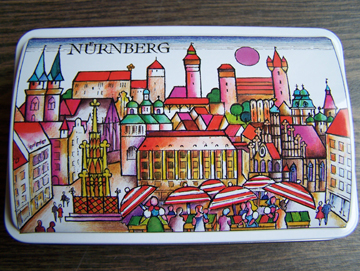
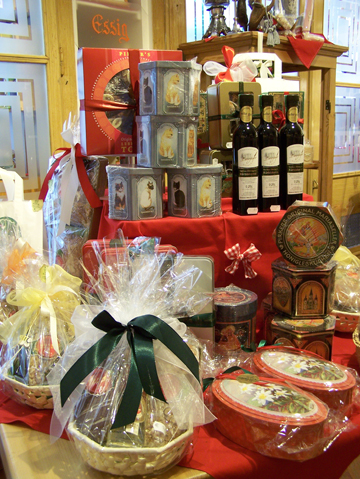
‘Tis the season when a young elf’s fancy turns to thoughts of gingerbread. Although these sweet-spicy cakes and cookies are popular year-round in many countries of Europe, they’re particularly associated with the winter holidays. Bakeries from Sweden to Slovakia to Switzerland turn out tons of commercial gingerbread products, often packaged in brightly colored wrappings and tin boxes. And home bakers dig through kitchen drawers and recipe files to find favorite cookie cutters and family recipes for their own Christmas gingerbreads.

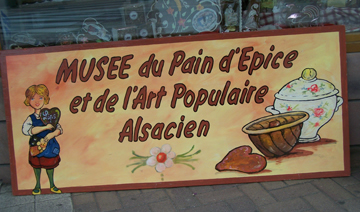
Although flatcakes made with honey and spices were baked by the ancient Egyptians, Greeks, and Romans, the gingerbreads of northern Europe probably date only from the Middle Ages, when honey was still the main type of sweetener available locally, and exotic, expensive spices such as cinnamon, black pepper and ginger were increasingly being imported from faraway lands in the East. A taste for gingerbread eventually spread throughout Europe, with certain cities becoming known for their own particular types: Strasbourg and Dijon in France, Torun in Poland, Tula in Russia, Aachen and Nürnberg in Germany, Basel and St. Gallen in Switzerland.

MANY VARIETIES
Gingerbread recipes evolved over time and in diverse places. Various kinds of gingerbread were, and still are, made with different combinations of honey, sugar, flour, eggs, almonds, hazelnuts, walnuts, raisins, lemons, candied orange peel, candied citron, rosewater, rum, brandy, black pepper, ginger, cinnamon, nutmeg, cloves, allspice, cardamom, coriander, aniseed and saffron. Although these baked goods are often referred to as “gingerbread” in English, some of them don’t contain any ginger at all.

The variety of possible ingredients and textures causes some confusion about what “gingerbread” actually is. A cake, a cookie, or a loaf? Hard or soft? Thick or thin? Glazed or unglazed? Decorated with fancy frostings, or with fruits and nuts, or even with expensive gold leaf? At various times in its history, gingerbread has been all of these.

GERMAN GINGERBREAD
In the Middle Ages, the city of Nürnberg became one of the most famous places for making gingerbreads in Germany, where these seductive sweets have long been known as Lebkuchen (or sometimes Pfefferkuchen, when their spiciness comes from black pepper instead of ginger). Records show that Lebkuchen was being baked in Nürnberg as early as the 14th century. Traditionally, the stiff dough was pressed into highly detailed molds made of wood, metal, or terra cotta, which imprinted intricate designs on the Lebkuchen before it was removed from the molds and baked in a hot oven. Nürnberg Lebkuchen contained such costly ingredients, and was of such high quality, that it was accepted as payment for city taxes and given as gifts to nobles, princes, and heads of state.

Over time, as the prices of ingredients fell and the demand for Lebkuchen increased, faster production methods became necessary. The elaborate handmade molds were replaced by less detailed, often mass-produced, molds. Simpler decorations―such as nuts, candied fruit, and sugar frostings―were applied to the tops of many cookies. And the shapes were simplified, too, evolving into the basic human, animal, and geometric forms common today.

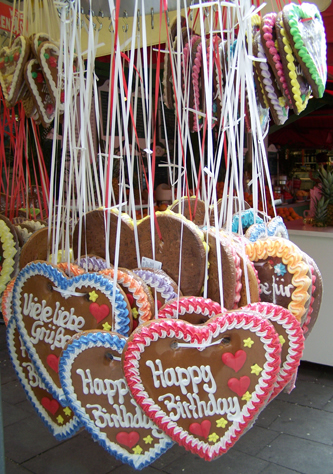
In the early 1800s, gingerbread houses became popular in Germany after the publication of the Grimm brothers’ fairy tale, Hansel and Gretel. And during the 19th century, ornately decorated Lebkuchen hearts also became the rage. Covered with fancy designs and romantic sayings made from colored icing, these large heart-shaped cookies were often exchanged between sweethearts. You can still buy them at almost every German festival and special market, including the Christmas markets held in many German cities throughout December.

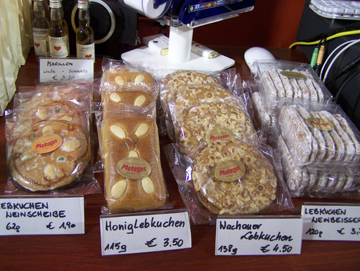
The Lebkuchen produced in Germany today comes in all sorts of sizes, shapes, flavors, colors and textures: rounds, rectangles, squares, hearts, stars, pretzel forms, St. Nicholas (for Christmas), lucky pigs (for New Year) and rabbits (for Easter). The Lebkuchen dough can be “white” (light colored) or different shades of brown. Some Lebkuchen are also covered with white or chocolate icing, and some are filled with marzipan or jam. Honey Lebkuchen is sweetened only (or primarily) with honey. Oblaten Lebkuchen are cookies with the dough mounded on top of a thin wafer before baking. And delicate, elegant Elisen Lebkuchen are made with at least 25% ground almonds, hazelnuts, or walnuts, and no more than 10% flour.

GINGERBREADS ACROSS EUROPE
You’ll also find similar spicy cookies of different shapes, colors and textures called Printen (in Aachen, Germany), Pfefferkuchen (in Pulsnitz, Germany), Spekulatius (in the German Rhineland), Leckerli (in Basel, Switzerland), Biberli (in the Appenzell region of Switzerland), speculaas Holland, speculoos in Belgium, pepperkaker in Norway, pepparkakor in Sweden, piperkakut in Finland, pebernǿdder in Denmark, pain d’épices in France, licitar in Croatia, mézeskalács in Hungary, perníky in the Czech Republic and Slovakia, pierniki in Poland and prianiki in Russia. Other towns and regions have their own specific names for the many varieties of gingerbreads produced there.

Europeans also use gingerbread cookies as ingredients in other dishes. You’ll find crumbled gingerbread used as a stuffing for pork and for pasta, as a thickener for sauces, a flavoring for soups, a crunchy texture in salad dressings, and a base for many puddings and desserts. There’s even a German-Italian “fusion” dessert called ” Nürnberger Tiramisu”! And for people who just can’t get enough of that sweet, spicy, Christmasy taste of gingerbread, the Belgians have recently invented a gingery, caramely speculoos spread, similar in texture to Nutella, made from crushed gingerbread cookies.

If I’ve whetted your appetite for these European gingerbreads, my best suggestion is to travel there and taste them for yourself. You can also mail order many of them from the websites listed below. Costard, the clown in Shakespeare’s play, “Love’s Labour’s Lost,” had the right idea when he said, “An’ I had but one penny in the world, thou shouldst have it to buy gingerbread.”

Nürnberg Lebkuchen information www.lebkuchen.nuernberg.de/englische_version/index.html

Lebkuchen-Schmidt, Nürnberg
ww2.lebkuchen-schmidt.com/eng_index.php

Metzger Lebkuchen, Vienna
www.lebkuchenmetzger.at/

Lebkuchen-Pirker, Mariazell, Austria
www.lebkuchen-pirker.at/home/index.php?&lang+eng

Kerner Lebkuchen, Mariazell, Austria
www.lebzelterei-kerner.at/index.htm

Lebkuchen-Gandl, St. Wolfgang, Austria
www.lebkuchen-gandl.com/

Appenzeller Biberli, Switzerland
www.baerli-biber.ch/

Basel Läckerli, Switzerland
www.laeckerli-huus.ch/

French-Alsatian Pain d’Épices
www.paindepices-lips.com
www.fortwenger.fr/

Alte Pfefferkuechlerei (small gingerbread museum in Weissenberg,Germany) www.museum.stadt-weissenberg.de/

Speculoos Spread
www.thenibble.com/zine/archives/speculoos-spread.asp

YouTube video about how to make decorated European gingerbread
www.youtube.com/watch?v=OVX5wiv_oMk

American online sources for ordering European gingerbreads
www.germandeli.com
www.germangrocery.com

Lamb Stew Hits the Spot in Ireland

Photos courtesy of Tourism Ireland

County Wicklow is famous for its sheep and wool, and the Wicklow Mountains have been renowned from the earliest times for the native breeds, which are of a distinct type, and have been on the mountains for centuries. The date of origin of the Wicklow Mountain sheep can only be approximated, but one thing is for sure, the Irish have many seasonal, regional and tasty recipes to take care of nature’s providence, including plenty for the less popular cuts.

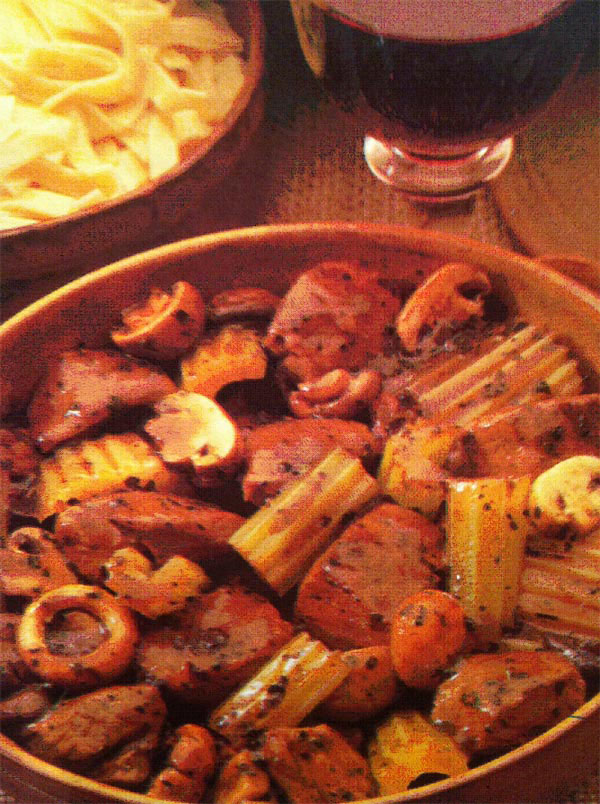
This recipe is a twist on the typical Irish lamb stew with a few additional flavors thrown in such as basil, oregano, celery, mushrooms and red wine. It comes from Wicklow Lady Fiona Teehan, whose mother is handed a gift of a whole sheep every year in return for some sheep-minding duties by her father. Fiona is manager of Pembroke Townhouse, a superb example of classic Georgian elegance in the heart of Dublin’s Ballsbridge area, just a 10-minute walk from the city center.

WICKLOW STEW
Serves 4
Ingredients:
3 tablesp sunflower oil
1 shoulder of Wicklow lamb, boned, trimmed of excess fat and cut into small cubes
3-4 sticks of celery, chopped into 1 inch lengths
1 onion, finely chopped
4 oz mushrooms, halved
1/2 c. red wine
1 c. vegetable stock
1 tablesp cornstarch
1 tablesp fresh basil, finely chopped (or 1 teasp dried basil)
1 tablesp fresh oregano, finely chopped (or 1 teasp dried oregano)
1 teasp grated lemon rind
Sea salt and freshly ground black pepper to taste
To garnish: freshly chopped herbs (some or all of basil / oregano / parsley)
To serve: mashed potato (or buttered noodles or boiled long grain rice to your preference)

Method
1. Heat half of the oil in a frying pan. When the oil is hot, add the lamb cubes and fry them, stirring frequently for about 10 minutes until they are well browned. Transfer the meat to a plate.
2. Heat the remaining oil in a casserole. Add the celery, onion and mushrooms and continue cooking over the heat until the onion is just soft.
3. Add the wine to the pan and boil well for two minutes.
4. Blend the stock together with the cornstarch and pour the mixture into the pan.
5. Add the basil, oregano, lemon rind. Season with the salt and pepper. Then, add back the cubed lamb. Mix well with the rest of the ingredients.
6. Cover with a lid or tinfoil, reduce the heat and simmer gently for 40-45 minutes or until the lamb is tender.
7. Sprinkle with a garnish of freshly chopped herbs (as above). Serve piping hot with mashed potato, (or buttered noodles or boiled long grain rice to your preference)

Optional: If you like garlic, add four cloves of minced Garlic with the onions.

To freeze: This dish freezes well. Cool quickly and pour into a freezer-proof container or bag. Label and freeze. Do not store in freezer for longer than two months.

For more info, go to Discover Ireland.

The Christmas Markets of Hamburg

Perhaps surprisingly, Hamburg’s Weihnachtsmarkt at the Rathaus in the center of Hamburg is a relative newcomer to the world of Christmas Markets in Germany.

Several years ago the city fathers decided to look for a new concept for its holiday market, and found a creative partner in Bernhard Paul, director of Roncalli’s Circus. With its colorful circus-themed market stalls and entertainment, including a nostalgic carousel and historic fairground organ, the Christmas market at the Rathausmarkt opened for only its eighth year in 2007. In that short time, however, it has become one of the most popular markets in northern Germany, with nearly three million visitors each year.

LEBKUCHEN AND GLUHWEIN ABOUND

About 80 dealers from all over Germany gather to sell their handicrafts and food specialties. Shoppers enjoy the smell of roasted almonds, Lebkuchen and Gluhwein as they stroll through the rows of vendors, who are grouped according to their wares.

One row is filled with toys, including model trains. Handcrafters such as glassblowers, makers of hats or lanterns and amber jewelry are in another aisle. There is a food specialties area that includes cheese from Tirol, Christstollen from Dresden, Lebkuchen from Nurnberg and candy makers in action. Tired shoppers can enjoy genuine German refreshments indoors at the colorful Art Nouveau Viennese café at the market.

Three times each day Santa Claus, in his sleigh pulled by reindeer, flies high over the market to the sound of American Christmas carols –is that Bing Crosby I hear? Standing in a basket suspended under the moving sleigh is the Christkind (Christmas angel who delivers gifts to the children), waving at the crowd in the market below.

A city as large as Hamburg will, of course, have more than one Christmas market to attract visitors.

Of the 12—that’s correct, 12—Hamburg Christmas markets, one of the trendiest is Weihnachtsmarkt Jungfernstieg, which overlooks the beautiful Inner Alster Lake. White is the theme color of this market:
white lights highlight the vendor booths, which are covered by soaring white roofs, and are topped with white star-lit peaks. Open for only its second season in 2007, this unique market boasts an ice-skating rink and an open-air lounge, which supplies warm blankets to customers. Shoppers can find clothes and jewelry along with traditional nutcrackers and food specialties.

MINIATUR WUNDERLAND

If rainy weather limits your time at the outdoor Christmas Markets, take advantage of some of the many attractions that Hamburg has to offer. Miniatur Wunderland is the world’s largest model railway and is housed next to the Elbe River in Hamburg’s warehouse district. The trains run on several different levels of the building, and a full-time paid staff monitors the miniature world.

Allow several hours to enjoy the more than 700 model trains, which run through scenery modeled after Germany, Austria, Switzerland, Scandinavia, and even the Western United States. See a circus in action, cars driving on highways and ships sailing the ocean. See fires break out and emergency trucks speed to the rescue. And then there are the trains—they are everywhere—and they are of every kind, all running as if they were on prototype railroads. And every half hour, daylight becomes nighttime inside this miniature HO scale world. There is an admission, and a nice gift shop.

It will be hard to pull kids away; perhaps dads won’t want to leave, either! Check out this fascinating world at www.miniatur-wunderland.de

BALLINSTADT EMIGRATION MUSEUM

Hamburg’s BallinStadt Museum offers an amazing and detailed look at the history of emigration to America via the port of Hamburg.

The museum is named after Albert Ballin, director of the HAPAG shipping company, who had a 30-building departure city built between 1901 and 1907 for emigrants. The museum is located on this site and housed in three reconstructed Housing Pavilions.

A model constructed beneath the floor and viewed from above through glass, shows the layout of the original departure city. Interactive exhibits tell the emigrants’ stories, and show what daily life was like as they awaited their journey to America. A family research center at the museum offers the opportunity to access Hamburg passenger lists from 1850 to 1934.

Easily reached by public transportation, the BallinStadt Museum shows how the Port of Hamburg became known as the emigrant’s gateway to the world. www.ballinstadt.de

If you’re ready for more shopping, and weather is still dampening the outdoor markets, try indoor shopping at the Europa Passage. Architect Hadi Teherani designed this structure with a glass ceiling and 21 arches, which connects five floors filled with 130 shops and restaurants. Located with a view of the Inner Alster, (one of Hamburg’s lakes), the mall offers modern, upscale shopping in light-filled arcades. www.europa-passage.de

For accommodations within walking distance from the Europa Passage, the Rathausmarkt, and the Christmas market Jungfernstieg, try the Hotel Atlantic Kempinski. First opened in 1909, this luxury hotel next to the Outer Alster served passengers awaiting their departure on ocean liners. Now it is a local landmark, recognized from afar by its white-lit rooftop globe and ladies emblem, which was used in the James Bond film “Tomorrow Never Dies.”

A sumptuous breakfast buffet and beautifully appointed lobby with tea service, offer the traveler warmth and welcome after a full day of rewarding Hamburg experiences.
www.kempinski.atlantic.de

For more information about Hamburg, visit their website at www.hamburg-tourism.de