Christmas Markets in Luther Country

Erfurt Christmas Market

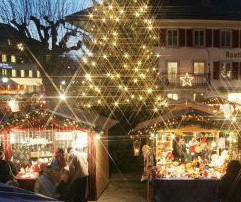
In Germany’s Luther Country, Advent means Christmas markets. The crisp winter air is filled with the smell of ginger and nutmeg, signaling the arrival of Stollen, a special Christmas cake, and Glühwein, mulled wine. Cobbled streets and squares, lined with half-timbered medieval houses, provide the backdrop for dozens of wooden stalls, selling wooden toys and Christmas decorations, handcrafted gifts and seasonal foods, such as Zimtsterne (cinnamon stars) and Lebkuchen (soft, spiced cookies).

Brass bands play and choirs sing carols, often written by Martin Luther himself. In fact, many Christmas traditions were supposedly instigated by the Protestant reformer 500 years ago. Legend insists one dark and starry night, Luther was touched by the beauty of the pine trees. On returning home, he cut down a tree, took it into his house and decorated it with candles. As well as the Christmas tree, Luther is credited with the idea of Christkind, the Christ child bringing presents. (Kris Kringle is still familiar in many U.S. homes). Concerned that Saint Nicholas, who delvered his gifts on December 6, was too popular, Luther came up with an alternative to “Santa Claus”: a golden angel, with wings and a crown.

Here are just some of Luther Country’s most authentic Christmas markets.

(clockwise) Christmas Stollen; Lebkuchen; Zimtsterne

ERFURT
November 27 – December 22
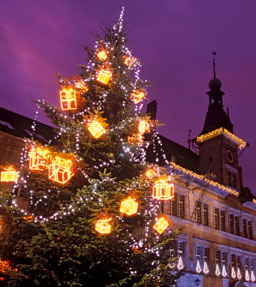
Although Erfurt’s 162nd Christmas Market spreads throughout the old town, the focus is on the Domplatz, the vast Cathedral Square. The 200 market booths sell everything from Thuringian bratwurst (Germany’s favorite grilled sausage) and Christmas cookies to handmade toys or traditional, handmade Christmas decorations. Children love the giant Ferris wheel,

the 90-foot-tall Christmas tree covered in candles, and the 40-foot-high wooden pyramid. Most of all, they love the nativity scene, set in a fairytale forest, complete with near life-sized, hand-carved figures. Gardeners should not miss the floral Christmas exhibition in the underground vaults of the cathedral.
Lutherstadt Wittenburg Christmas Market

LUTHERSTADT WITTENBERG
November 28 – December 23
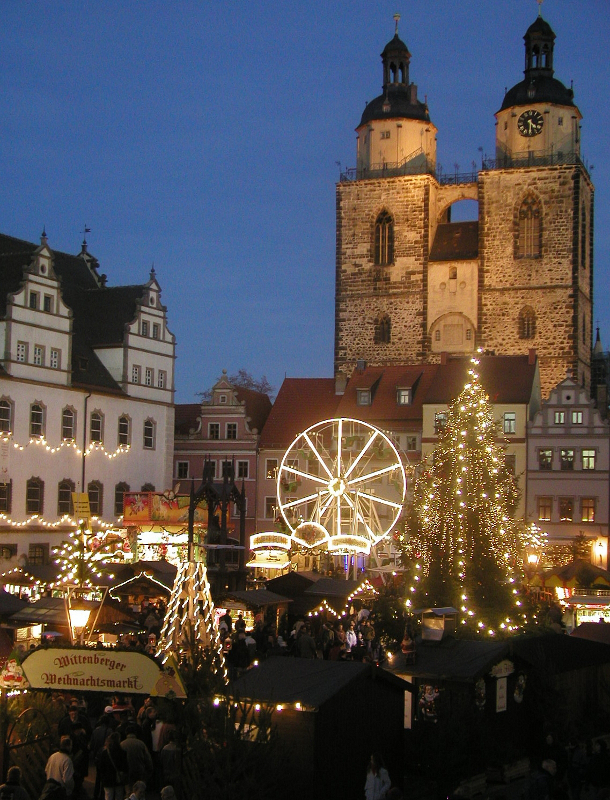
In the market square, a statue of Luther looks out across the Christmas market, with its stalls decorated with pine boughs, lights and Christmas ornaments. In the air is the scent of mulled wine and roasted almonds. Across the square is the Marienskirche (St. Mary’s Church), where Luther preached. Special are the town’s Adventshöfe, medieval courtyards, where local artists and craftsmen sell their wares. In the Cranach Courtyard, named for Luther’s great friend and painter Lucas Cranach, the weekend of December 8 and 9 features weavers and knitters, wood carvers and basket makers.

QUEDLINBURG
November 30 – December 23
With more than 1,300 half-timbered houses, Quedlinburg is one of Europe’s most romantic cities. And during the Christmas Market, strolling along the cobbled streets is like walking through history. One unique event is the “Advent in den Höfen” (December 1-2, 8-9, 15-16), when some 20 private courtyards open to sell special Christmas gifts, often handmade. Another highlight is the world’s largest Advent calendar! At 4:30 p.m. every afternoon for 24 days, children look out for the star that marks the house where the next scene in the Advent calendar will appear. When the door opens, fairytale characters appear and dance, sing or play for spectators.

WERNIGERODE
November 30 – December 22
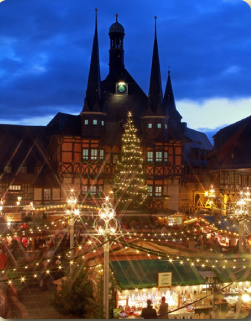
Dominated by its 12th-century castle, Wernigerode’s annual Christmas market has a fairy story backdrop: a 15th-century town hall, half-timbered houses and a 35-foot-tall Christmas tree. The stalls serve traditional food and drink, hand-made toys and ornaments for the home; evenings are filled with concerts of seasonal music. From December 15 to January 8, 2013, the Castle hosts its own special Winter Market. Children meet a fairy at 3 p.m. and receive presents from St. Nikolaus (Santa Claus) at 4 p.m. They also love to ride the Christmas train in a historic carriage, pulled by a steam engine through the snow-covered countryside.
Wernigerode Christmas Market

LAUSCHA
December 1-2 and 8-9
Each Christmas, this small town in a steep, wooded valley in the Thuringian Forest, plays a vital role in every American home. This is where the first glass Christmas tree ornaments were created in 1847. In 1880, F. W. Woolworth, the five-and-dime store pioneer, brought a batch of these glass balls to his store in Pennsylvania, and the rest is history. The tradition continues in Germany’s glassblowing capital, where you can watch artisans creating works of art at Lauscha’s Museum of Glass Art. At Lauscha’s annual Christmas “Kugelmarkt,” or glass bauble market, you can buy these handmade decorations in all shapes and colors.
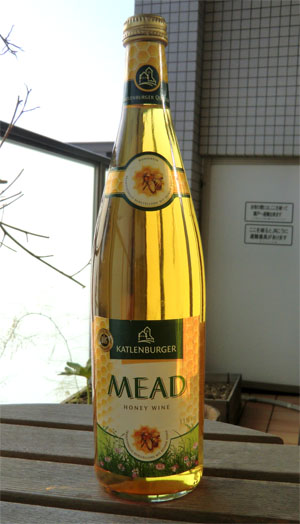
Mead honey wine

WARTBURG CASTLE, EISENACH
December 1-2, 8-9, 15-16
Wartburg Castle is where Martin Luther, the Protestant reformer, changed history when he translated the New Testament into German. And this UNESCO World Heritage Site just outside Eisenach is still a massively impressive fortress. At Christmas, however, a historic Christmas Market transforms the castle, with artists and street performers, craftsmen and knights. Meet candle makers and barrel makers, rope makers and lantern makers, minstrels and puppeteers. With cheerful booths and medieval decorations, this is a like a trip back in time. And the medieval food is delicious, from roast apples and honey to mead.
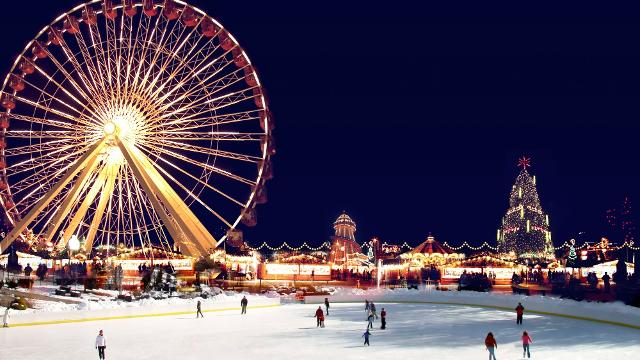
Christmas Activities in London’s Royal Parks

Angels Christmas and Yuletide Market

By Don Heimburger

This holiday season, Royal Parks in London are celebrating with special events in places including Richmond Park, Greenwich Park, Kensington Gardens and Hyde Park.

Diana's Walk

Visitors to the parks can partake in the festivities by choosing their own real Christmas tree, wander through four of the Royal Parks following the Diana Princess of Wales Memorial Walk, visit the deer enclosure in Greenwich Park, or take a timeless winter horse carriage ride.

While in London, take in the Winter Wonderland Hyde Park, where you can hear live music, go ice skating and visit the Angels Christmas and Yuletide Markets.

Ice skating

Couple Finds Marriage Bliss at 6,000 Feet

by Don Heimburger

Topping Out Wedding Destinations

Wedding “destinations” in the Germanic lands can sometimes be unusual.

Take, for instance, the June 2006 wedding of Swiss-born Hans and Birke Mebold of Rheinfelden, Switzerland.

“Our wedding was something special,” says Birke. “All this talk about the most beautiful day in your life…but it really was the case for us. The whole wedding took on a kind of momentum all its own.”

The Meholds first were officially married in a small church called Johanniterkapelle in Rheinfelden, home of Switzerland’s most popular beer, Feldschlosschen, and the town in which the couple both work.

Following the 11 a.m. ceremony, and a small reception, the couple was whisked away on Rheinfelden’s biggest fire truck with its blue lights flashing wildly. Both Feldwebel Hans and Birke are Rheinfelden fire brigade volunteers of 16 years and five years respectively, with Hans head of the town’s traffic regulations and security section.

HELICOPTER RIDE
Where the couple’s fire truck ride ended, their helicopter ride began, to the 2,100-foot-high resort town of Eptingen where  they met a bus full of 50 wedding guests of family and friends.

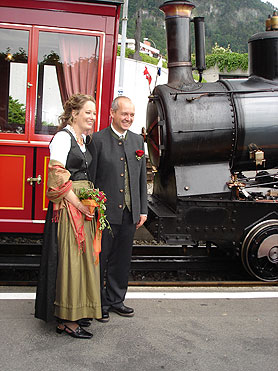
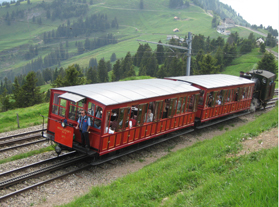
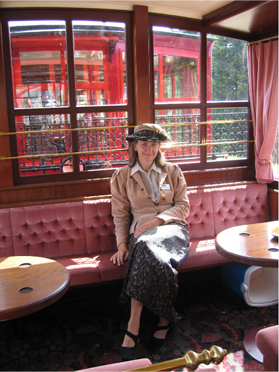
At Vitznau on Lake Lucerne, the group boarded a specially-reserved Mt. Rigi Railway steam locomotive and two-car cogwheel train consisting of No. 16, an 1923 oil-fired engine,  and the Belle Epoque, a stately parlor car built in 1873 and coach No.10, built in 1871. The crew assigned to the wedding train consisted of a driver, a fireman, a conductor and one hostess dressed in period costumes for each car.

As the steam train ascended up the side of steep 6,000-foot-high Mt. Rigi on a clear, warm spring day, the guests were served refreshments. The train passed quaint farms, pastures filled with grazing sheep and cows, and hiking trails.

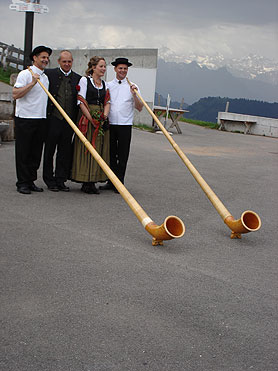
At Rigi Kulm, the group was welcomed by the alpine horns of Ruedi Imlig and his brother. Then a second wedding ceremony took place in the small chapel on the top of Rigi.

The wedding steam train for Hans and Birke Weber chugs up Mt. Rigi
Bride Birke Weber steps out of her special railway car at the top of Mt. Rigi; her new husband, Hans, follows.
Train hostess Lucia Weber on the Belle Epoque, an 1873 salon car

DINNER AND DANCING AT THE TOP
The guests then enjoyed dinner and dancing at the Hotel Rigi Kulm. “The scenery at the top was so beautiful and the food was excellent,” says Birke. Afterward, dancing was provided by Gunter Pichler and his GP Music band.

“My great grand aunt had taken us to Mt. Rigi last year, and we were stricken by the incredible view from the top,” says Birke.”When we thought about a location for our wedding, it didn’t take long to decide to go to Mt. Rigi.” She admits the travel arrangements for buses, trains and helicopters were a bit daunting, however.

The happy couple and guests returned from the mountain after midnight on an electric cogwheel train, and later spent their honeymoon in Sweden. If this is what they planned for their wedding day, it sounds like this couple is never going to have a dull moment.

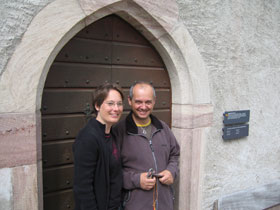
Hans and Birke Mebold, a year after their wedding, stand in front of the Rheinfelden, Switzerland church where they were married before their many relatives and friends. 

When in Austria, Look for Dirndls

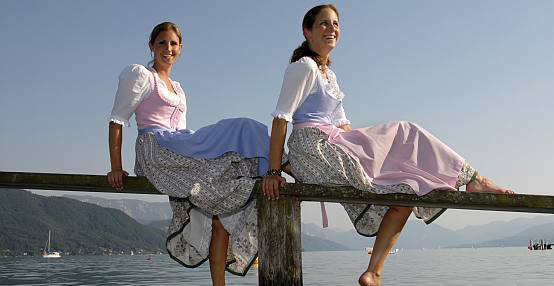
Photos courtesy Austrian Tourist Board

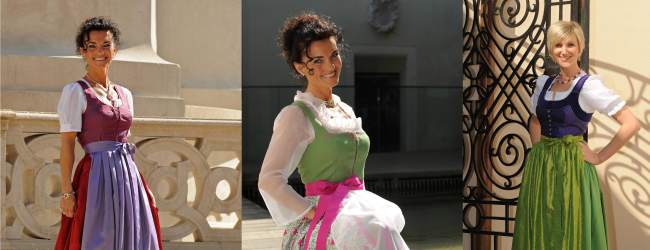
What is a Dirndl? If you have seen the movie “The Sound of Music,” you already know the basic elements that make up a Dirndl: skirt, bodice, apron and blouse. Simple, right? Far from it!

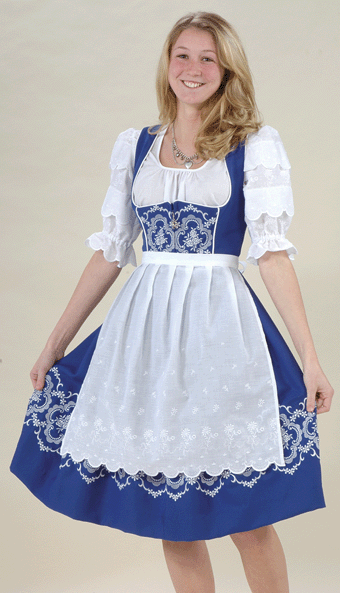
There is a veritable science to Dirndl cuts, fabric patterns, colors and embroidery.The main elements that make up a Dirndl are the wide skirt attached to a “Leiberl,” or fitted bodice, an apron (often with a hidden pocket) and a short Dirndl blouse.

The skirt usually starts at the waist or a little lower. You can choose between various lengths, depending on current fashion trends. The bodice used to be a separate item, but since the 1930s is sewn to the skirt. It comes in many different styles: with a high or low, round or square neckline, it is fastened with buttons, hooks, or ribbons.

An important element is the Dirndl blouse. It is generally very short (ends above the waist), with long, short or puffed sleeves. It can have many different necklines and is usually made of white cotton or linen. The Dirndl blouse accentuates the style of your Dirndl: Choose between delicately hand-embroidered pieces, blouses with extravagant ruffles and lace, or simple ones with straight sleeves.

Finally, there is the apron. Formerly worn to protect the dress underneath, it is now a purely decorative item. There are aprons for every-day wear and aprons for festive occasions which are usually of a more elegant fabric than the simple linen or cotton ones. Before you tie the knot—be sure to check on which side to place it—otherwise you might unwittingly send out the wrong message.

Different combinations of these elements make up the traditional Dirndl. There are different Dirndl styles for different occasions, even Dirndl styles that tell which region in Austria the wearer is from. With the recent “Dirndl Renaissance,” there are countless downright “unorthodox” styles that experiment with different fabrics, cross cultural references and punk elements.

If all these options seem daunting at first, remember: the most important thing is to have fun with the many different colors and patterns, and to choose a Dirndl that fits your personality.

FROM PEASANT GARB TO HIGH FASHION
The Dirndl has evolved from its humble origins centuries past as the work garb of peasants to a modern-day fashion superstar. With its feminine silhouette, its versatility and simple elegance, the Dirndl is a fashion “evergreen.” But where does it come from, and how did it get so popular?

Allegedly, the short Dirndl blouse we know today was originally a long shirt. Way back when, the shirt was actually one of the “basics” in the contemporary wardrobe of the rural population. Women wore a bodice, or even just a tightly wound cloth as an undergarment for warmth and support. Aprons were tied around the shirt to protect it from stains and dust. When people came home from the fields, the apron was simply switched to a different one for house work, or one for festive occasions.

Eventually, for reasons of practicality and perhaps vanity, the shirt was sometimes worn underneath the bodice and so the Dirndl was born. For a long time it was the garb of women in the countryside, and different styles developed for different regions.

Finally, in the middle of the 19th century, Emperor Franz Joseph and his court used to vacation in the Salzburg Lake district. The emperor took to wearing Lederhosen during his hunting exhibitions there, and a fashion trend was born. Suddenly, the Dirndl was all the rage and the Viennese aristocracy wore Dirndls and Lederhosen during their stay in the country.

Photo courtesy Ernst Licht German Imports

In the 1920s, the founders of the Salzburg Festival contributed to the popularity of the Dirndl by making it acceptable to wear during performances and society events. The Salzburger Dirndl manufacturer Lanz and the world-wide success of the operetta “Weisses Roessl” made the Dirndl an international hit.

Since then the Dirndl has conquered the international fashion world. In the last 10-15 years, the Dirndl and traditional costumes in general have experienced another huge surge in popularity, even outside of the regions in Austria where it has been an everyday item for generations.

WHERE TO BUY A DIRNDL?
With so many different styles to choose from, where do you start your own quest for the perfect Dirndl? Where to find authentic, traditional styles, and which Dirndl designers are known for fun and tasteful modern versions?

The best place to buy your Dirndl, of course, is at the “source.” The “real” Maria von Trapp used to mainly wear Dirndls and ordered new outfits with her favorite Dirndl tailor whenever she went back to her native Salzburg. Today, with Dirndls and Lederhosen in high demand, there are enough Dirndl manufacturers and stores to make your head spin.

For more info, go to www.austria.info/us

Get Your Swiss Christmas Fix

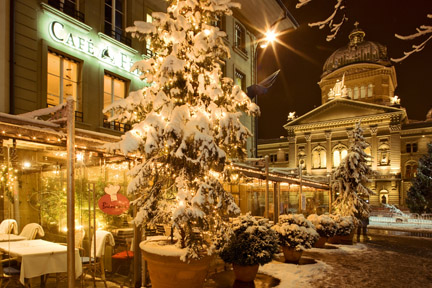
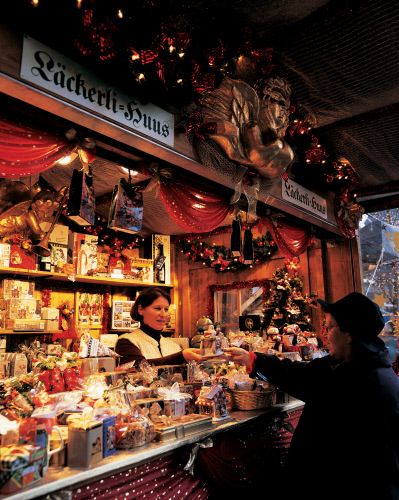
Photos courtesy Switzerland Tourism

Christmas is around the corner. In Switzerland, Christmas markets and events are as much a part of the holiday tradition as chocolates, cookie baking and family gatherings. Here is a sampling of festivities that vary in scope from the month-long markets in St. Gallen to weekend events in villages like Bad Ragaz, yet all share the basics: Christmas ornaments, gifts, local specialties, plenty of traditional Swiss atmosphere and snow.

Handmade products of Switzerland and local
treats bring visitors from around the globe.
Swiss Christmas Markets combine holiday festivities and historic locations.
Switzerland sparkles at Christmas.

For more info http://www.myswitzerland.com/en