Europe’s Fascinating Food Markets

By Sharon Hudgins
Photos by the author

Sweet juicy plums. Pungent goat cheeses. Briny black olives. Homemade pâtés studded with pistachios. Paper-thin slices of farmhouse cured ham. Multi-grain buns and rosemary-scented flatbreads. Chestnut honey and walnut tartes.

Are you hungry yet?

On my first trip to Europe many years ago, I became hooked on shopping for food at the colorful local markets. Not the sterile supermarkets or gargantuan hypermarkets of today, which, except for the package labels in different languages, could be anywhere in the developed world. The markets that captured my imagination—and still keep drawing me back—are the ones where fresh foods are sold by individual vendors hawking their wares from wooden stalls, customized vans, folding tables, or even blankets spread on the ground.

I go. I see. I buy. I eat.

TYPES OF MARKETS
These food markets can be entirely outdoors, in the open air; or inside a cavernous covered market building; or in a combination of settings, with an indoor market surrounded by an open-air market that varies with the season. They can be permanent markets, operating year round at the same location, usually with the same vendors; or temporary events occurring only on specific days, once or twice a week, in a public square or country field, with local vendors as well as those who travel from one market to the next to sell their goods.
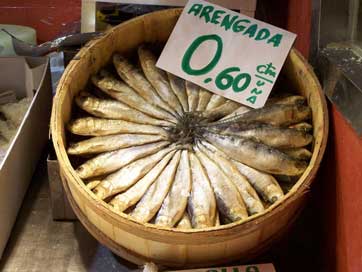
Some are truly farmers’ markets, where all the fruits, vegetables, meats and cheeses were grown, raised or processed by the people selling them. Others are outlets run by middlemen selling foods from a variety of suppliers, from small-time farmers to larger commercial companies. And some are a mixture of both.

London, Paris, Vienna, Madrid, Rome, and other major cities have many of these food markets located in neighborhoods throughout each metropolis. Smaller towns might have only one central market, whereas in a village there might be an open-air market only once a week, usually on Saturday. Check with the tourist office for the locations, dates and opening/closing times.

LOCAL SPECIALTIES, GLOBAL CHOICES
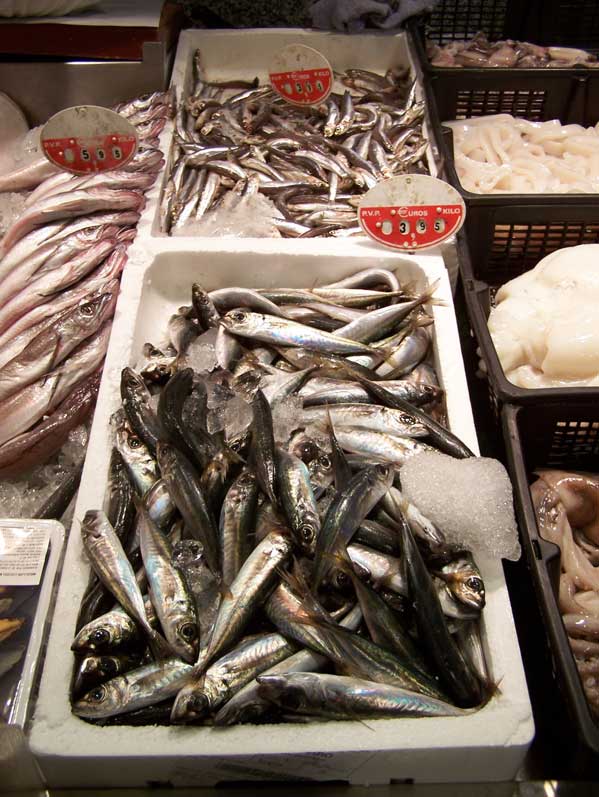
At these markets you can see, smell and taste authentic local and regional specialties, some of them found nowhere else. In different regions of France, I’ve bought farmhouse cheeses made just down the road and jams preserved by the woman selling them. In Sicily and Greece, I’ve wandered through markets stocked with fish caught that morning in the nearby seas. At German markets I’ve left with my shopping bags filled with potatoes and apples grown in the surrounding fields, and with big loaves of rye bread still warm from the wood-fired oven in which they were baked.

A visit to a large metropolitan market can also be a lesson in globalization. In addition to local Catalan and regional Spanish food products, Barcelona’s big Boqueria covered market also sells hot sauces from the USA, moles from Mexico, and guavas from South America. At Munich’s central Viktualienmarkt, you’ll find not only Bavarian meats and cheeses but also chermimoyas from North Africa, hot chiles from Southeast Asia, and exotic tropical fruits from the Philippines.

Each season brings its own specialties to European markets: strawberries, cherries and asparagus in spring and early summer; raspberries and blueberries later in the summer; mushrooms, apples and pears in the autumn; and oranges, nuts, and root vegetables in winter. Of course markets have more fresh produce during harvest time from spring through early autumn. And on any day you’ll always find the best selection early in the morning, just after the market opens.

LOOK, DON’T TOUCH
European markets are a great place to buy food for a picnic in your hotel room or in a park on a pretty day. Some even have a section with tables and chairs for public use, and German markets often include a beer garden on the premises, where you can bring your own food.

Tips: Always carry a shopping bag for your purchases. When you stop at a stand to buy fresh fruits or vegetables for your meal, don’t poke around in the produce and pick your own selection. At most markets, customers are expected to tell the vendor what they want, and the vendor chooses the best pieces, based on their ripeness and good condition, then weighs out the amount requested.

Don’t let your lack of the local language deter you from shopping in Europe’s food markets. Just point to the particular food you want and write the amount on a slip of paper: 100 grams (about one-fourth of a pound), 500 grams (close to a pound), 1 kilo (a bit over two pounds). Better yet, learn some basic numbers in that foreign language and let the product labels in the market teach you the names of the foods you want to eat. Soon you’ll be shopping like a European yourself.

LINKS TO FAVORITE FOOD MARKETS IN EUROPE
London Farmer’s Markets
Paris Food Markets
Rome Markets
Barcelona Food Markets
Madrid Markets
Berlin Markets
Munich Fresh Food Market
Hamburg Fish Market
Amsterdam’s Food and Antique Markets Guide
Guide to Seasonal Produce Markets of Brussels
Vienna Food and Farmer’s Markets
Guide to Vienna Food Markets
Budapest Markets
Athens Food and Flea Markets
Athens Farmer’s Markets

The Christmas Markets of Hamburg

Perhaps surprisingly, Hamburg’s Weihnachtsmarkt at the Rathaus in the center of Hamburg is a relative newcomer to the world of Christmas Markets in Germany.

Several years ago the city fathers decided to look for a new concept for its holiday market, and found a creative partner in Bernhard Paul, director of Roncalli’s Circus. With its colorful circus-themed market stalls and entertainment, including a nostalgic carousel and historic fairground organ, the Christmas market at the Rathausmarkt opened for only its eighth year in 2007. In that short time, however, it has become one of the most popular markets in northern Germany, with nearly three million visitors each year.

LEBKUCHEN AND GLUHWEIN ABOUND

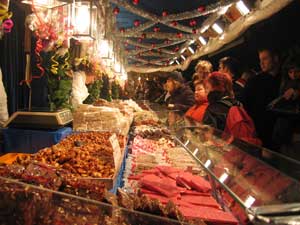
About 80 dealers from all over Germany gather to sell their handicrafts and food specialties. Shoppers enjoy the smell of roasted almonds, Lebkuchen and Gluhwein as they stroll through the rows of vendors, who are grouped according to their wares.

One row is filled with toys, including model trains. Handcrafters such as glassblowers, makers of hats or lanterns and amber jewelry are in another aisle. There is a food specialties area that includes cheese from Tirol, Christstollen from Dresden, Lebkuchen from Nurnberg and candy makers in action. Tired shoppers can enjoy genuine German refreshments indoors at the colorful Art Nouveau Viennese café at the market.

Three times each day Santa Claus, in his sleigh pulled by reindeer, flies high over the market to the sound of American Christmas carols –is that Bing Crosby I hear? Standing in a basket suspended under the moving sleigh is the Christkind (Christmas angel who delivers gifts to the children), waving at the crowd in the market below.

A city as large as Hamburg will, of course, have more than one Christmas market to attract visitors.

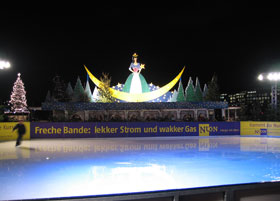
Of the 12—that’s correct, 12—Hamburg Christmas markets, one of the trendiest is Weihnachtsmarkt Jungfernstieg, which overlooks the beautiful Inner Alster Lake. White is the theme color of this market:
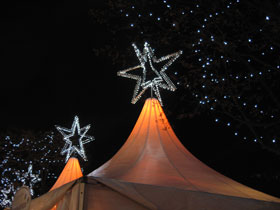
white lights highlight the vendor booths, which are covered by soaring white roofs, and are topped with white star-lit peaks. Open for only its second season in 2007, this unique market boasts an ice-skating rink and an open-air lounge, which supplies warm blankets to customers. Shoppers can find clothes and jewelry along with traditional nutcrackers and food specialties.

MINIATUR WUNDERLAND

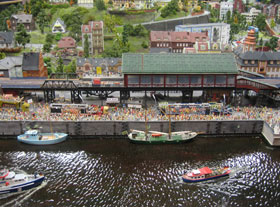
If rainy weather limits your time at the outdoor Christmas Markets, take advantage of some of the many attractions that Hamburg has to offer. Miniatur Wunderland is the world’s largest model railway and is housed next to the Elbe River in Hamburg’s warehouse district. The trains run on several different levels of the building, and a full-time paid staff monitors the miniature world.

Allow several hours to enjoy the more than 700 model trains, which run through scenery modeled after Germany, Austria, Switzerland, Scandinavia, and even the Western United States. See a circus in action, cars driving on highways and ships sailing the ocean. See fires break out and emergency trucks speed to the rescue. And then there are the trains—they are everywhere—and they are of every kind, all running as if they were on prototype railroads. And every half hour, daylight becomes nighttime inside this miniature HO scale world. There is an admission, and a nice gift shop.

It will be hard to pull kids away; perhaps dads won’t want to leave, either! Check out this fascinating world at www.miniatur-wunderland.de

BALLINSTADT EMIGRATION MUSEUM

Hamburg’s BallinStadt Museum offers an amazing and detailed look at the history of emigration to America via the port of Hamburg.

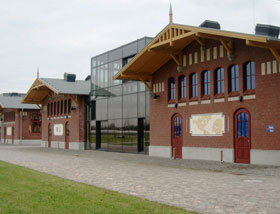
The museum is named after Albert Ballin, director of the HAPAG shipping company, who had a 30-building departure city built between 1901 and 1907 for emigrants. The museum is located on this site and housed in three reconstructed Housing Pavilions.

A model constructed beneath the floor and viewed from above through glass, shows the layout of the original departure city. Interactive exhibits tell the emigrants’ stories, and show what daily life was like as they awaited their journey to America. A family research center at the museum offers the opportunity to access Hamburg passenger lists from 1850 to 1934.

Easily reached by public transportation, the BallinStadt Museum shows how the Port of Hamburg became known as the emigrant’s gateway to the world. www.ballinstadt.de

If you’re ready for more shopping, and weather is still dampening the outdoor markets, try indoor shopping at the Europa Passage. Architect Hadi Teherani designed this structure with a glass ceiling and 21 arches, which connects five floors filled with 130 shops and restaurants. Located with a view of the Inner Alster, (one of Hamburg’s lakes), the mall offers modern, upscale shopping in light-filled arcades. www.europa-passage.de

For accommodations within walking distance from the Europa Passage, the Rathausmarkt, and the Christmas market Jungfernstieg, try the Hotel Atlantic Kempinski. First opened in 1909, this luxury hotel next to the Outer Alster served passengers awaiting their departure on ocean liners. Now it is a local landmark, recognized from afar by its white-lit rooftop globe and ladies emblem, which was used in the James Bond film “Tomorrow Never Dies.”

A sumptuous breakfast buffet and beautifully appointed lobby with tea service, offer the traveler warmth and welcome after a full day of rewarding Hamburg experiences.
www.kempinski.atlantic.de

For more information about Hamburg, visit their website at www.hamburg-tourism.de

Christkindlmarkt Nuremberg-Style

By Marilyn Heimburger
Photos by Marilyn and Don Heimburger

When you think of Christmas markets in Germany, Nuremberg usually comes to mind first. It has a very long history and is considered the “queen” of the Christmas Markets.

The Christkindlmarkt of Nuremberg was first called “Kindelsmarkt” in an inscription on a wooden oval box dated 1628.

The main market square between the Schoener Brunnen (beautiful fountain) and the Frauenkirche (Church of Our Lady) is the site of this famous Christmas market. The 180 market stalls with their red and white-striped canvas roofs are arranged in rows and fill the area with the aromas and lights of the holiday season. The popular Christkindlmarkt has been called a “Little Town of Wood and Cloth.”

PRUNE MEN ARE SPECIALITY

Vendors offer the beautiful craft wares and decorations found in many markets. But one special item you can find here are prune men: figures 6-8 inches tall with arms and legs made of dried prunes and heads made of walnuts.

An edible specialty of Nuremberg is its tiny sausages, which weigh exactly 23 grams and are about the size of a little finger. According to legend, they were made small enough to fit through the keyhole of a door, just in case someone was locked out of the city gate after curfew and needed something to eat!

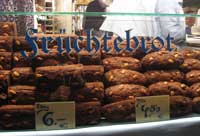
Another treat is Nuremberg’s famous Lebkuchen (gingerbread). Lebkuchen Schmidt ships its goods all over the world, and is available in beautifully decorated tins, even music boxes (www.lebkuchen-schmidt.com.)

Unique to the Nuremberg Christmas market is Christkind, who officially opens the market at 5:30 p.m. on the Friday before the first Sunday in Advent. The Christkind, or Christmas Angel, represents the Christ Child as the one who gives gifts on Christmas, as opposed to St. Nicholas, who delivers gifts into the waiting shoes of good children on December 6.

Every two years since 1969 a young girl is elected by a combination of popular vote and jury selection to represent the Christkind. Strict rules govern the age and height of a Christkind candidate. She must also be a good student, since her many appearances force her to miss school, and she must not be afraid of heights, because she must stand on a balcony near the top of the Church of Our Lady to deliver her market-opening pronouncement!

SPECIAL REQUIREMENTS

Nuremberg is understandably proud of its Christkindlmarkt. In order to protect the market’s reputation, war toys are banned, as are decorations of plastic firs, products displayed in cardboard boxes, and canned Christmas music.

A short walk away from the main market square is the Rathausplatz (Town Hall Square) where you can find 14 vendor stalls from Nuremberg’s partner cities offering their unique wares.

In addition to the Christkindlmarkt in Nuremberg’s main market square, a special Kinderweihnacht (Children’s Christmas Market) on the Hans-Sachs-Platz has entertained families since 1999. A 100-year-old steam Ferris wheel, a steam railway and a merry-go-round offer rides. Vendor stalls have lower counters to invite children to see and touch, decorate cookies and candles, and have pictures taken with Santa. Across from the children’s market is the Sternenhaus (Star House), which serves as headquarters for the Christkind and offers cultural programs for children.

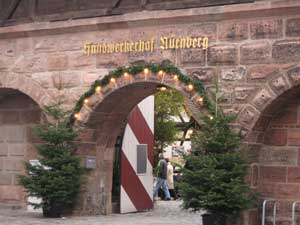
One very special market open all year round, but is especially magical during the Christmas season is the Handwerkerhof. Located across from the main train station, the stone and half-timbered structures look as old as the King’s tower and fortification walls that surround them. But the entire little town was built in 1971 as an additional attraction during the Albreacht Durer 500 anniversary celebration. It has remained a year-round attraction highlighting craftsmen who work with pewter, leather, glass, candles, precious metals, gingerbread and dolls.

You can watch bakers make Lebkuchen, shop for tin toys, wood and glass ornaments, have a mug of hot spiced wine, and then eat at the Bratwurstglocklein, a wonderful wood-paneled, low-ceilinged pub with waitresses dressed in traditional dirndls, and food served on pewter plates. Try the tiny sausages each of three ways: cooked with vinegar and onions, smoked and grilled. Served with potato salad, saurkraut and beer, it’s a tradional Nuremberger treat. The Handwerkerhof is open six days a week (seven days a week during Christkindlmarkt) from the middle of March through December 31 (www.handwerkerhof.de.)  

Wonderful accommodations for your Christkindlmarkt visit can be found at the Maritim Nuernberg (www.maritim.de.) It is conveniently located just a short walk from the main train station, and across the street from the Handwerkerhof. Another short walk takes you to the main market square and the Christkindlmarkt in the shadow of the Schoener Brunnen.

One more suggestion: before leaving the main market square, look carefully at the Schoener Brunnen until you find the gold ring. Make a wish and turn the ring three times to make your wish come true. Perhaps you will wish to return to this beautiful market again next year!

European Christmas Markets Celebrate the Season

Advent is the season in Europe when thousands of communities–large and small–set up Christmas trees, colorful lights and craft stalls in their central market square. For decades, Europeans have been getting together at these unique Christmas markets to share conversation, to enjoy a glass of hot mulled wine, or to find just the right specialty gift for a family member or friend.

European Traveler offers a quick glance at some of these fascinating markets, which normally last until Christmas Eve.

Belgium

Every town in French-speaking Wallonia hosts its own Christmas Market. The central square of Liège and the neighbouring Place du Marché stage one of Belgium’s largest Christmas Markets, attracting more than 1 million visitors with 190 wooden chalets full of tempting goodies, sweets and original hand crafted products and presents. If you’re in Brussels between November 27 and January 3, enjoy the Brussels Winter Wonderland featuring a Christmas Market with many stalls, a giant illuminated ferris wheel, street activities and a large skating rink. 


Switzerland

In Lucerne, a number of Christmas events take place, including the Christ Child Market at Railcity, the train station, between November 28 – December 21. Around 50 festively-decorated market stalls bring a  Christmas atmosphere feel to the station.

Every year between December 3-20 Lucerne’s Christmas Market takes place at the Franziskanerplatz. There are a large variety of stands with Christmas decorations, sweets, food and beverages.  The Christmas Tree Market usually starts one week before Christmas along the Schweizerhofquai. Then between December 17-20, 20 stands from 20 countries  present typical Christmas items from their homelands. There is always a stage featuring Christmas productions from all over the world. For more information, go to www.luzern.com/en/welcome.cfm?

Germany

Thuringia is primarily famous for its festive Christmas markets and especially the large selection of glass Christmas tree decorations. The Lauscha Ball Market (always held during two weekends in Advent) has the largest selection, but these traditional decorations are also available at other Thuringian Christmas markets.

In Frankfurt you are invited to the large, time-honored Christmas market where you can become acquainted with the market’s many culinary specialities and its traditions. You can join tour guides in ascending to the rooftop gallery of St. Nicholas Church, from where you’ll be able to enjoy a wonderful panoramic view of the entire market and the Frankfurt skyline. Next, join young and old for a nostalgic ride on a vintage carousel. Warm yourself with a hot cup of mulled wine at the end of the tour and take in the wonderful view of the market’s beautifully illuminated Christmas tree. The 1 1/2 hour tours include a carousel ride, hot mulled wine and special marzipan candy. Tours are available in English and German from the first day in Advent until Christmas.

Thanks to the Tourist Boards of Germany, Belgium, Austria and Switzerland for the photos in the report.

Christmas Markets in Luther Country

Erfurt Christmas Market

In Germany’s Luther Country, Advent means Christmas markets. The crisp winter air is filled with the smell of ginger and nutmeg, signaling the arrival of Stollen, a special Christmas cake, and Glühwein, mulled wine. Cobbled streets and squares, lined with half-timbered medieval houses, provide the backdrop for dozens of wooden stalls, selling wooden toys and Christmas decorations, handcrafted gifts and seasonal foods, such as Zimtsterne (cinnamon stars) and Lebkuchen (soft, spiced cookies).

Brass bands play and choirs sing carols, often written by Martin Luther himself. In fact, many Christmas traditions were supposedly instigated by the Protestant reformer 500 years ago. Legend insists one dark and starry night, Luther was touched by the beauty of the pine trees. On returning home, he cut down a tree, took it into his house and decorated it with candles. As well as the Christmas tree, Luther is credited with the idea of Christkind, the Christ child bringing presents. (Kris Kringle is still familiar in many U.S. homes). Concerned that Saint Nicholas, who delvered his gifts on December 6, was too popular, Luther came up with an alternative to “Santa Claus”: a golden angel, with wings and a crown.

Here are just some of Luther Country’s most authentic Christmas markets.

(clockwise) Christmas Stollen; Lebkuchen; Zimtsterne

ERFURT
November 27 – December 22
Although Erfurt’s 162nd Christmas Market spreads throughout the old town, the focus is on the Domplatz, the vast Cathedral Square. The 200 market booths sell everything from Thuringian bratwurst (Germany’s favorite grilled sausage) and Christmas cookies to handmade toys or traditional, handmade Christmas decorations. Children love the giant Ferris wheel,

the 90-foot-tall Christmas tree covered in candles, and the 40-foot-high wooden pyramid. Most of all, they love the nativity scene, set in a fairytale forest, complete with near life-sized, hand-carved figures. Gardeners should not miss the floral Christmas exhibition in the underground vaults of the cathedral.

Lutherstadt Wittenburg Christmas Market

LUTHERSTADT WITTENBERG
November 28 – December 23
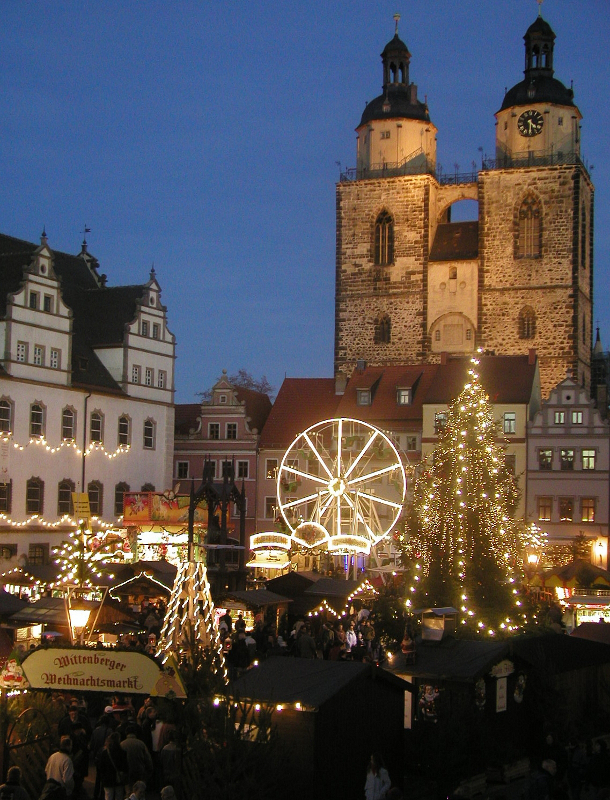
In the market square, a statue of Luther looks out across the Christmas market, with its stalls decorated with pine boughs, lights and Christmas ornaments. In the air is the scent of mulled wine and roasted almonds. Across the square is the Marienskirche (St. Mary’s Church), where Luther preached. Special are the town’s Adventshöfe, medieval courtyards, where local artists and craftsmen sell their wares. In the Cranach Courtyard, named for Luther’s great friend and painter Lucas Cranach, the weekend of December 8 and 9 features weavers and knitters, wood carvers and basket makers.

QUEDLINBURG
November 30 – December 23
With more than 1,300 half-timbered houses, Quedlinburg is one of Europe’s most romantic cities. And during the Christmas Market, strolling along the cobbled streets is like walking through history. One unique event is the “Advent in den Höfen” (December 1-2, 8-9, 15-16), when some 20 private courtyards open to sell special Christmas gifts, often handmade. Another highlight is the world’s largest Advent calendar! At 4:30 p.m. every afternoon for 24 days, children look out for the star that marks the house where the next scene in the Advent calendar will appear. When the door opens, fairytale characters appear and dance, sing or play for spectators.

WERNIGERODE
November 30 – December 22
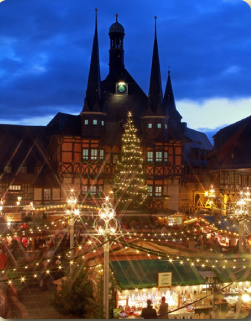
Dominated by its 12th-century castle, Wernigerode’s annual Christmas market has a fairy story backdrop: a 15th-century town hall, half-timbered houses and a 35-foot-tall Christmas tree. The stalls serve traditional food and drink, hand-made toys and ornaments for the home; evenings are filled with concerts of seasonal music. From December 15 to January 8, 2013, the Castle hosts its own special Winter Market. Children meet a fairy at 3 p.m. and receive presents from St. Nikolaus (Santa Claus) at 4 p.m. They also love to ride the Christmas train in a historic carriage, pulled by a steam engine through the snow-covered countryside.

Wernigerode Christmas Market

LAUSCHA
December 1-2 and 8-9
Each Christmas, this small town in a steep, wooded valley in the Thuringian Forest, plays a vital role in every American home. This is where the first glass Christmas tree ornaments were created in 1847. In 1880, F. W. Woolworth, the five-and-dime store pioneer, brought a batch of these glass balls to his store in Pennsylvania, and the rest is history. The tradition continues in Germany’s glassblowing capital, where you can watch artisans creating works of art at Lauscha’s Museum of Glass Art. At Lauscha’s annual Christmas “Kugelmarkt,” or glass bauble market, you can buy these handmade decorations in all shapes and colors.

Mead honey wine

WARTBURG CASTLE, EISENACH
December 1-2, 8-9, 15-16
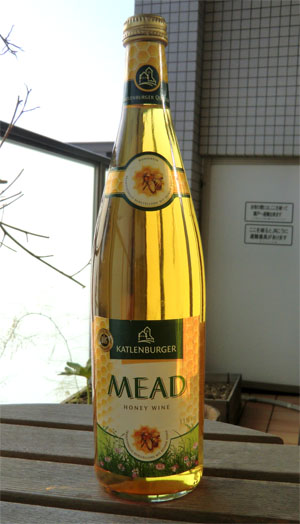
Wartburg Castle is where Martin Luther, the Protestant reformer, changed history when he translated the New Testament into German. And this UNESCO World Heritage Site just outside Eisenach is still a massively impressive fortress. At Christmas, however, a historic Christmas Market transforms the castle, with artists and street performers, craftsmen and knights. Meet candle makers and barrel makers, rope makers and lantern makers, minstrels and puppeteers. With cheerful booths and medieval decorations, this is a like a trip back in time. And the medieval food is delicious, from roast apples and honey to mead.