“Ozapft is!” exclaimed Munich’s Lord Mayor Christian Ude after opening the first keg of beer at noon on September 22, thus officially inaugurating the world famous German Octoberfest.
And following 16 days of beer, fun and Gemutlichkeit, the 2007 Munich Octoberfest closed its gates after 6.2 million people visited the biggest fair in the world.
This big city, with rural charm and friendly people, served 6.7 million glasses of beer, thousands of Hendl (chickens) and 104 oxen to the crowds that swarmed into the 14 large tents on the Octoberfest grounds right off of the Schwanthalerstrasse. As many as 10,000 people can be accommodated in some of the huge beer tents.
Alison Ramsey tasted and tested the beers at Octoberfest. A good reporter must get all the facts, and test all the flavors of beer before she files her report.
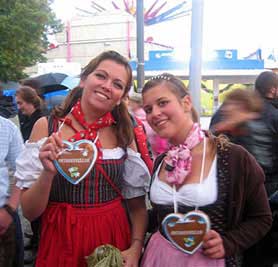
COLORFUL TENTS The tents, which sometimes appear more like buildings, are highly colorful, and are decorated with painted murals, clouds and more to make them attractive to the visitors, some of which spend all day inside!
A special Octoberfest beer, brewed by Munich’s six major breweries, is served in the tents. The delicious draught is usually served with radishes, Obatzta (special cheese), sausages, roast chicken or grilled fish. And barbecue beef is a Wiesn specialty.
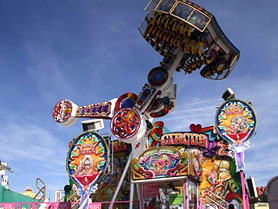
This year, as many as 80 different firms offered fair guests samplings of their foods, and more than 200 attractions greeted fair-goers as well, such as breathtaking rides like the Olympia Loop or the Power Tower, the Krinoline (merry-go-round), the Teufelsrad (Devil’s Wheel), the Toboggan and even a variety show.
HISTORY OF THE FAIR The wedding of Crown Prince Ludwig–later King Ludwig I of Bavaria–and Princess Theresa of Saxony-Hildburghausen in 1810, started the fair when the royal couple invited the people of Munich to celebrate in the fields in front of the city gates. The fields were named “Theresienwiese” in honor of the princess, and locals later abbreviated the name to “Wiesn.”
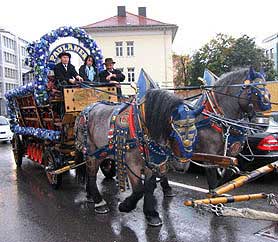
The annual Munich celebration starts off with a parade featuring festive carriages bearing the land-lords’ families, the horse-drawn drays of the Munich breweries, showmen’s coaches, waitresses on decorated floats and the beer tent bands. It’s quite a spectacle!
The following day the Munich Costume and Rifleman’s Parade features groups in traditional costumes, marching bands, troops of bandsmen and trumpeters, amateur and mountain riflemen. Performers of all kinds, decorated coaches and flower garlands are always main attractions of the parade. And the parade goes on even if the weather is bad!
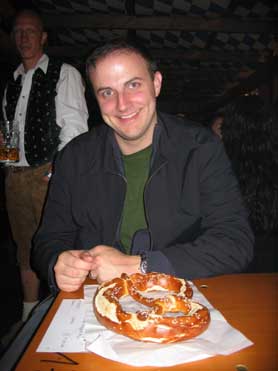
European Traveler’s Steve Ramsey tests one of the giant pretzels at the 2007 Munich Octoberfest. Got a beer to go with this?
ONE LAST WORD, AND A FAMOUS BREW Of course, one of Munich’s famous trademarks is the 418-year-old Hofbrauhaus, where beer lovers gravitate throughout the year. It’s a fun establishment that holds up to 3,000 guests at the same time. The beer house even has its own beer, served, of course, at Octoberfest.
Stay tuned for more beer news. We had a great time in Munich, so it’s likely we’ll be back! Let’s see…when is next year’s fair?
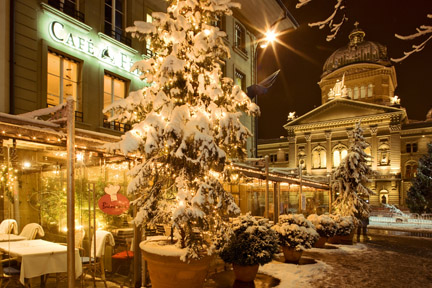
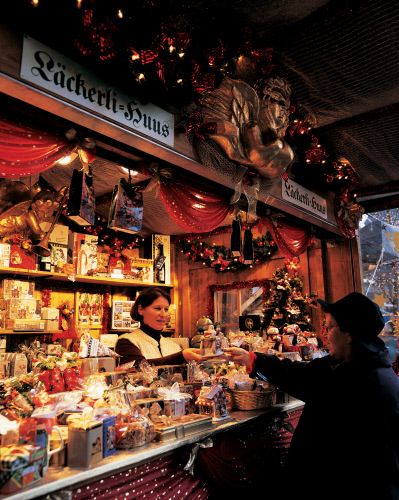
Christmas is around the corner. In Switzerland, Christmas markets and events are as much a part of the holiday tradition as chocolates, cookie baking and family gatherings. Here is a sampling of festivities that vary in scope from the month-long markets in St. Gallen to weekend events in villages like Bad Ragaz, yet all share the basics: Christmas ornaments, gifts, local specialties, plenty of traditional Swiss atmosphere and snow.
Handmade products of Switzerland and local treats bring visitors from around the globe.Swiss Christmas Markets combine holiday festivities and historic locations.Switzerland sparkles at Christmas.
Every year the magic of German Christmas Markets enchants millions of visitors. Crafts, culinary specialties like Gluhwein (mulled wine), baked apples and gingerbread biscuits (Lebkuchen) contribute to the traditional atmosphere.
Frankfurt (until Dec 22) Situated in the Roemerberg marketplace with St. Paul’s church as a backdrop, the Frankfurt Christmas Market is regarded as one of Germany’s most important. Organized events include the tower concert on the balcony of the Nikolai church, the Christmas Market of Frankfurt’s artists and the Frankfurt city peal of bells. Children can ride on multiple carousels, marvel at the gigantic Christmas tree and meet St. Nicholas on December 6. Guided tours of Frankfurt are also available. www.frankfurt.de
Mainz Christmas Market
Mainz (until Dec 23) The Mainz Christmas Market is set in the historic market square against the impressive backdrop of the 1,000-year-old cathedral of St. Martins. Highlights of the Christmas Market include the traditional fairy-tale performance in the city theater, the popular print shop of the Gutenberg museum and the 36-foot-high Christmas pyramid with its numerous figures and lights. Also, there is a wide choice of family programs at the Liebfrauenplatz. www.mainz.de
Wiesbaden (through Dec 23) “Twinkling Star Market” is the name of the Wiesbaden Christmas Market. Visitors enter the old castle square through four gates decorated with stars. Not to miss is the crèche with its life-sized wooden figures representing the Christmas story. www.wiesbaden.de/en
Wiesbaden Christmas Market
Aschaffenburg (through Dec 22) The Christmas Market is situated against the picturesque backdrop of the castle, with the Franconian Christmas crèche as its center. Also, during this festive season various other charming Christmas Markets can be found in the Aschaffenburg region. www.aschaffenburg.eu
Aschaffenburg Christmas Market
Bad Homburg (All advent weekends) One of the most beautiful Christmas markets in Germany is the romantic Christmas Market Bad Homburg at the Castle “Landgrafenschloss,” which is surrounded by an historical setting. Highlights include the traditional fairy-tale performances on the Kurtheater Bad Homburg. www.bad-homburg.de (German only)
Stuttgart Christmas Market
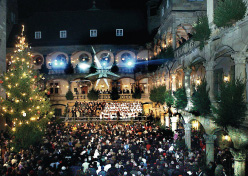
Stuttgart (through Dec 23) With its more than 280 decorated stands, is one of the oldest and largest Christmas markets in Europe. The Stuttgart Christmas Market is traditionally opened with a ceremonial concert in the inner courtyard of the Old Palace (Altes Schloss). Around the Altes Schloss, Schillerplatz, Kirchstrasse, Marktplatz and Hirschstrasse, small decorated wooden houses offer a range of Christmas items and gift ideas including Christmas tree decorations, crib figures, toys, woodcuts, puppets, lambskin shoes and candles. Culinary delights include hot chestnuts, German lebkuchen (gingerbread), roasted almonds, grilled sausages and mulled wine.www.stuttgart-tourist.de
Bremen Christmas Market
Bremen, on the River Weser close to the northern coast, puts a maritime twist on the classic Christmas market when the promenade along the river is transformed into Schlachte magic, a festive market offering historical, seasonal and maritime attractions. Another market with more than 160 beautifully decorated Christmas stalls are clustered in front of Bremen’s Church of Our Lady and the Roland Statue in the historical market square. www.bremen-tourism.de
Ruedesheim (through Dec 21) The Christmas market in Ruedesheim on the Rhine brings a festive feel to the romantic old town and its popular Drosselgasse Lane. More than 120 stands from 12 nations offer Christmas customs and traditions from around the world. Europe’s biggest Nativity scene can also be found in the market square. www.ruedesheim.de
Easter celebrations are among the oldest, most traditional and unique celebrations in Germany. A myriad of differing regional traditions, Easter markets and special celebrations start weeks before the four-day Easter weekend from April 5 to April 9. Many of the American Easter traditions, including egg decorating, Easter trees, Easter egg games and, of course, the chocolate Easter bunny, were brought to America by German immigrants.
In preparation for Easter, towns decorate their fountains and trees with eggs and wind crepe paper around the branches. On the Easter Eve, bonfires are lit celebrating the new and getting rid of the old. Easter markets throughout the country exhibit Easter eggs and spring-themed local arts and crafts in surroundings from historic cities and castles to landscape parks. The markets last either a few weeks or a weekend and are a favorite leisure time activity for locals and tourists alike.
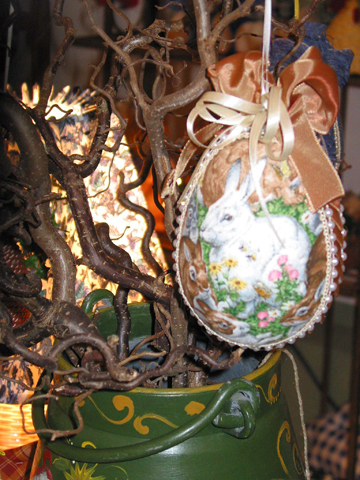
Easter decorations
EASTER MARKETS Being one of the oldest Easter markets in Germany, the Haeferles Market in Nuremberg in Franconia is the first major event of the spring season. With over 80 stalls in the middle of the historic city center, this market offers everything around the Easter holidays, from hand-painted eggs to wooden decorations (March 23 – April 9). Further to the north in the charming town of medieval Wolfenbuettel, about two hours from Frankfurt, the Easter market takes place in a royal surrounding. In the courtyard of the 18th century residence castle of the Guelphs in the city center, over 60 artists and craftsman from the region display their works on the weekend before Easter (March 31 – April 1). Then, on Easter Saturday a huge rabbit emerges from an enormous nest and distributes candy to the children.
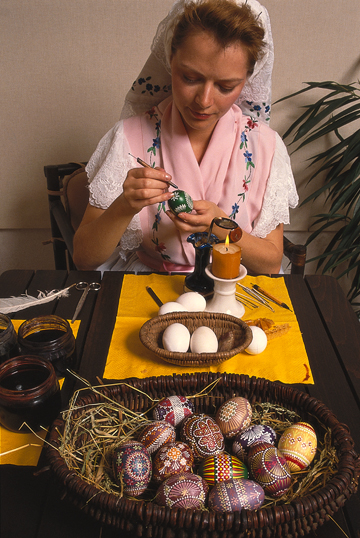
Lady in Sorbian costume handcrafts traditional Easter egg painting using wax-resist techniques.
EASTER DUCK RACE The festivities are closely followed by a duck race where the ducks are thrown into the river and race to the other side. One of the largest Easter Egg Fairs in Germany takes place in the beautiful landscape park Luisenpark in Mannheim from March 31 to April 4. The International Easter Egg Market at Mannheim’s Baumhainhalle hosts over 40 artists from Germany, Russia, France, Switzerland and Hungary.
St. Wendel fountain decorated for Easter
KREUZTRITT WALK PARADE A very special Easter culture exists in eastern Germany near the border with Poland. The Sorbs, a Slavic minority that has lived for generations in this area called Lusatia, celebrate Easter with a parade called the “Kreuztritt” (Cross Walk) on Easter Sunday. The men of the village dressed in traditional costumes of black jackets and top hats, ride horses in a circle from town to town announcing the resurrection of Christ. The Sorbs also are masters in the art of Easter egg painting. Sorbian artists from all over the region exhibit their skills during the Lenten season. The Egg Rolling and colorful Easter Market on Easter Sunday are wonderful highlights during the Easter weekend, April 7 and 8.
Explore the Christmas Markets with this easy river and rail adventure.
By Marilyn Heimburger Photos by Don Heimburger
As the weather turns colder and stores begin playing Christmas music to heighten anxiety about getting everything done before Christmas, I yearn to spend the Advent season once again in Germany’s beautiful Christkindlmarkts.
Not long ago, a friend also expressed her longing to visit the famous Christkindlmarkts in Germany and Austria during Advent, but didn’t know where to begin. Which ones should she see? How do you find accommodations in each town, and arrange transportation from market to market? The planning seemed too daunting, and she just never got started.
European Traveler discovered the perfect plan to make that dream come true: last Advent we took a nine-day Christmas market tour by river and rail that was easy and convenient. We experienced more than a dozen Christmas markets along the Danube River in Germany and Austria, with guided tours in towns along the way.
VIKING AEGIR The river portion of our “Advent along the Danube” trip was on the Viking Aegir, a 1-½-year-old Viking River Cruise ship which sailed from Budapest to Nuremberg. One of the best perks of a river cruise is that you unpack only once for the week. Meals are provided for you, and the ship delivers you from market to market, with local tour guides waiting when you dock, and activities onboard while you leisurely cruise from market to market. What could be easier?
On board the Viking Aegir, passengers relax in comfort with a beautiful view of Germany and Austria through panoramic floor to ceiling windows.
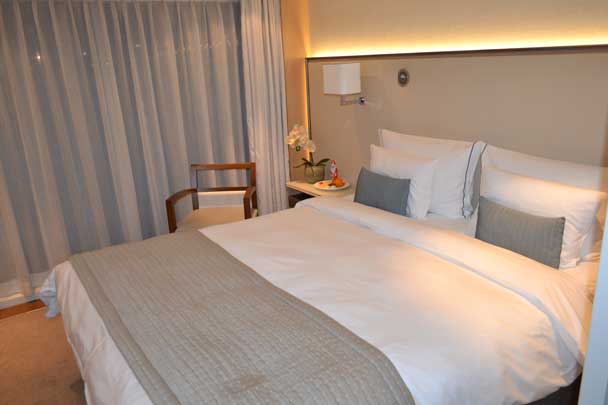
Although the cruise began in Budapest the day before, we chose to fly to Vienna and board the ship there. We moved into our spacious stateroom, complete with private bathroom with shower, drawers and closet for clothing, queen-sized bed, mini-fridge, TV and sliding glass doors on the balcony, offering a non-stop view along the Danube as Austria and Germany glided by.
Comfortable cabins await the passengers aboard the Viking Aegir cruise ship.
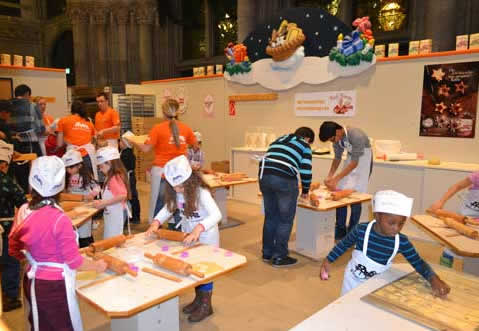
VIENNA’S MAGIC OF ADVENT Since the boat dock is some distance from the city center, Viking provides bus transportation to and from Vienna’s largest Christmas market, which glitters in the shadow of Vienna’s City Hall. Named “Wiener Adventzauber,” or “Vienna’s Magic of Advent,” it features hundreds of vendors in wooden huts offering local pastry, sausage and hot drink specialties, gifts, decorations, candles and accessories. There are pony rides, story reading on the Celestial Stage, appearances by the Viennese Christkind, and even arts and crafts and baking stations inside the Rathaus so children can make their own gifts and Christmas goodies.
Located inside Vienna’s Rathaus is a baking workshop, where children can make their own cookies.
Within walking distance of the Rathaus market are several other Christmas markets, smaller but with their own local focus and definitely worth a visit. Markets in other parts of Vienna are on Maria-Theresien-Platz, in the Old AKH, on Freyung, the Am Hof Advent Market, at Belvedere Palace, on Karlslatz, on Spittelberg, at Stephansplatz, on Riesenradplatz, and at the Schönbrunn Palace. To see all of them would take an extra day or two! We saved some of our market visits for after the cruise, when we returned to Vienna by rail for our flight back home.
Vienna has several smaller Christmas markets each with their own style and specialties, and each worth a visit.
The local food experiences aren’t limited to the Christmas markets. Upon our chilly return to the ship, we were met with Lebkuchen and hot mulled wine, and Vienna’s famous Sachertorte for dessert after the onboard dinner.
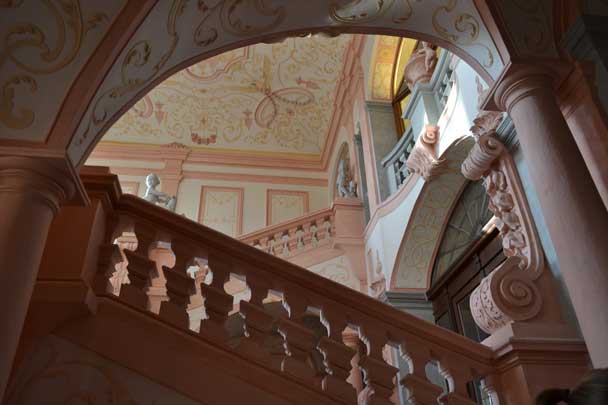
900-YEAR-OLD MELK ABBEY The small Christmas market at Melk, Austria, our next port of call, is only open on weekends, and unfortunately not during our visit. But we enjoyed a guided tour of the beautiful 900-year-old baroque Melk Abbey, and bought the famous local apricot liqueur.
A “Taste of Austria” luncheon aboard the Viking Aegir featured plenty of sausage and a Lederhosen-clad accordion player.
Leisurely travel on the Danube with its many locks means plenty of time for relaxing. To add to our Advent experience during that time, local culture is brought onboard: “A Taste of Austria” lunch included music by a Lederhosen-clad accordion player. A strudel-making demonstration showed that a tea towel was the trick to rolling the paper-thin dough around the apple/raisin/rum filling. As we neared the Bavarian town of Passau, a traditional Black Forest cake was the featured dessert after dinner.
(left to right) The Simon family bakers demonstrate the art of making gingerbread in Passau.; A beautiful Advent wreath is easy to make, as demonstrated in Passau.
ADVENT TRADITIONS IN PASSAU Our stop in Passau began a complete day of Advent tradition, all within easy walking distance from the boat dock. We learned the history and art of making Advent wreaths and the famous Simon family gingerbread, and were treated to a midday Advent organ concert at Passau’s St. Stephen’s Cathedral on the world’s largest cathedral organ. The main Passau Christmas market boasts a Bavarian flair with crafts and regional specialties, sausages, Glühwein and gingerbread.
Back on board our Viking ship we enjoyed tea time with plum cake, apple cake and other regional dessert specialties.
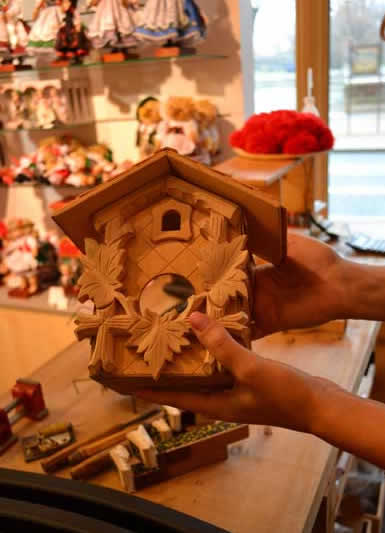
HISTORIC REGENSBURG The next day’s stop in Regensburg included a town tour with visits to the Hutkönig, a world famous hatmaker; a cuckoo clock-making demonstration; and the oldest sausage kitchen in Germany, which has been serving sausages for 900 years, since catering to the workers who built the adjacent Stone Bridge.
(left to right) A cuckoo clock-making demonstration was a tour option in Regensburg.; Regensburg’s famous Hutkönig had very special hats to offer.
ROMANTIC MARKET AT THE PALACE OF THURN AND TAXIS Regensburg’s main Christmas market spreads out near the cathedral, but another Regensburg highlight is the Romantic Christmas Market set in the courtyard and surrounding park of the Palace of Thurn and Taxis. Here the pathways are lit by torches, lanterns and lighted ropes wrapped around wooden fences, and there are hay bales for seating and open fires for warming stations. The bough-covered wooden stalls offer unique products obviously chosen for their quality and beauty. Although there is a fee of 6 -7 Euros to enter this private market, it was one of our favorites, and well worth the price.
The beautiful Romantic Christmas Market is on the grounds of the Palace of Thurn and Taxis in Regensburg.
After a full day in Regensburg, the local Advent experience continued on board as we were greeted with hot Glühwein and heart- and star-shaped Lebkuchen.
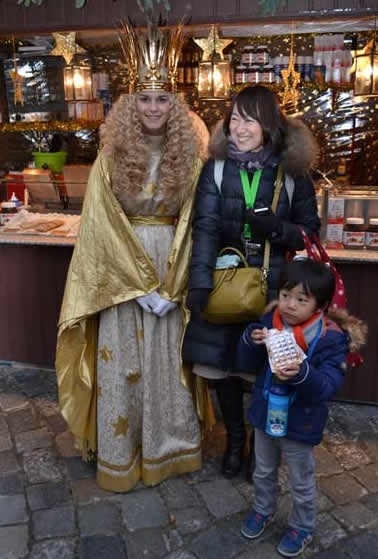
Red- and white-striped awnings decorate this Lebkuchen stall at Nuremberg’s historic Christkindlmarkt. The Christkind stands high on the balcony of the church on the left to open the market.
NUREMBERG’S CENTURIES-OLD CHRISTKINDLMARKT Our ship’s last stop was at Nuremberg, which boasts a 400-year-old Christmas market tradition. Once again, Viking provided bus transportation to and from the Christkindlmarkt on the Hauptmarkt square, since the boat dock is some distance away. Nearly 200 wooden stalls decorated with red- and white-striped awnings invite visitors from all over the world – more than two million each year – to sample the traditional gingerbread, sweets, sausages, potato pancakes and Glühwein, to buy their ornaments, candles, toys and prune men.
(left to right) The Children’s Christmas market in Nuremberg has rides and booths with hands-on activities for children, and appearances by Nuremberg’s Christkind.; Nuremberg’s unique Handwerkerhof is located at the distinctive Königtor within the historic city walls.
A few steps away is a children’s Christkindlmarkt with colorful rides, booths with hands-on activities, hot punch and Nuremberg’s beloved Christkind.
Don’t miss the nearby “Sister City” Christmas market featuring wares from Nuremberg’s sister cities around the world, and yet another Christmas market setting in Nuremberg’s distinctive Handwerkerhof, located at the Königstor within the historic city wall.
Though the river cruise part of our trip was over, and it was difficult to leave the cocoon of comfort we experienced on the ship, we had more markets to visit on our way back to Vienna.
INTER CITY EXPRESS SPEED AND COMFORT With a first class Eurail pass in hand, we boarded the fast Inter City Express (ICE) train from Nuremberg to Vienna. The Eurail pass, which we had to purchase in the U.S., allowed us to hop on and off the train for more Christmas market visits enroute to Vienna. Sitting in a six-seat “quiet room” directly behind the engineer gave us a clear view of the tracks ahead, a rail buff’s dream. The track generally followed the Danube, busy with barge traffic, with snow-covered mountains in the distance and large balls of mistletoe visible in the bare trees along the route.
Through the panoramic windows we watched the snow-covered forests and villages speed by, looking like gingerbread creations sprinkled with powdered sugar. We saw firewood meticulously piled high in covered sheds in preparation for the long cold winter, and churchyard cemeteries somehow decked out with colorful plants: lavender, heather – where does all the winter floral color come from?
MORE CHRISTKINDLMARKTS AT LINZ Soon we arrived at Linz, the location of our next Christmas market experience. We left our luggage in lockers at the train station and bought a ticket for the Linz City Express which took us through the town’s main shopping area to the Christkindlmarkt near the river on the Hauptplatz.
Nestled between the town’s centuries-old Baroque townhouses, this market featured wares by artists and artisans, with traditional hot drinks, Bratwürstlein and pastries. At the nearby Goldmann’s Bakery we sampled the town’s famous Linzer Torte. Lights above the stalls are designed to look like river waves, and a specially-designed light display above the river depicts angels blowing bubbles through a straw.
(left and bottom right) Vendors at the Schönbrunn Christmas Market offer painted pewter decorations and beautifully detailed figures for Nativity scenes.; Hot Glühwein in generous mugs, and stick-to-the-ribs comfort food hit the spot at the Schönbrunn Palace Christmas Market
Another short City Express ride delivered us to the Christmas market at the Folksgarten, which featured rides for children, stalls offering warm hats, scarves, decorations, and more hot drinks, pastries and comfort food.
Retrieving our luggage, we completed our train journey to Vienna, where one more very special Christmas Market beckoned.
SCHÖNBRUNN PALACE CHRISTMAS MARKET Vienna’s famous Schönbrunn Palace hosts its own large and very beautiful Christmas market. Situated on the grounds in front of the UNESCO World Heritage site, this unique market still has plenty of room to wander through the juried product stalls. Six food stands are centrally located, as is a towering lighted tree and a magnificently carved nativity scene. The Schönbrunn Market celebrates its 21st year in 2014, and has grown in size and popularity each year. This market easily sets a new standard with its attention to detail in set-up and design.
For those wondering how to experience the Christmas markets in Germany and Austria in comfort and convenience, this trip by river and rail is the answer.


















 European Traveler