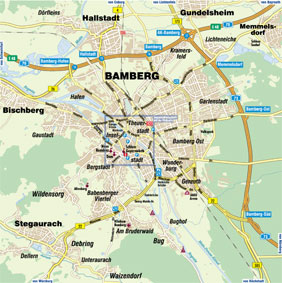
Bamberg, Germany, is a 1,000-year-old city of Episcopal and Imperial power, set on seven hills and located in the heart of Franconia in northern Bavaria.
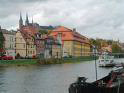
The city’s Old Town illustrates the development of a Middle Age city, and it escaped World War II almost unscathed. Set on the Regnitz River, more than 2,000 buildings are listed as UNESCO sites and form one of the largest Old Towns in Europe.
Things to see while there include the late Romanesque-early Gothic Imperial Cathedral, the Old Town Hall built right in the middle of the Regnitz River, the Baroque Palace Bottinger House and the Renaissance buildings of the Old Court.
There are also 15 museums in town, displaying a large variety of collections that document the wide cultural diversity of the city; at the Diocesan Museum, you can see the Blue Coat of Stars of Emperor Henry II. There are also numerous events and festivals–and, of course, there is that German favorite– beer. The town has 10 breweries which produce more than 50 differents beers, among them the famous “smoked beer.” There is also the Bamberg Brewery Trail, awarded special recognition in 2004.
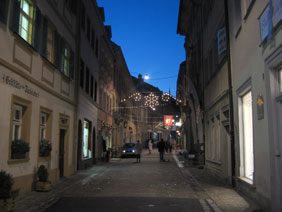
What else can you do in Bamberg? You could spend a whole day just walking the beautiful cobblestoned streets, taking in the various sights, and checking out the many restaurants, taverns and shops. The town is magical in the evenings.
There are also concerts by the Bamberg Symphony Orchestra, the magic festival called Bamberg Zaubert, an Antiques Week (runs between July and August), an Old Town fair called Sandkerwa–the biggest fair in town in August, the Calderon Festival which features outdoor theater, and the famous Nativity Trail during Advent which features 34 different Nativity scenes around town. These scenes are located in squares, churches, museums and other locations. Between May and October, you can take in an organ concert in the Imperial Cathedral every Saturday at noon; admission is free.
For train-goers, Bamberg can be reached by InterCity and InterCity Express trains, as well as others. The town of 70,000 inhabitants is 37 miles from the Nuremberg airport. Don Heimburger
By Marilyn Heimburger Photos by the author and Don Heimburger
The UNESCO World Heritage city of Regensburg, Germany, 90 minutes north of Munich, is more than 2,000 years old, and many of its buildings serve as a testament to its long history.
There’s plenty of reminders of this town’s heritage: located on the Danube, many tour ships dock here and unload visitors for a peek into this German treasure.
Even Mozart liked the city: Regensburg’s hospitality was commended as early as 1790 by Mozart who enjoyed “a sumptuous meal along with divine music” and praised the good wine.
Numerous Roman buildings, such as the Porto Praetorius–an old Roman town gate–can still be seen today. It was preserved because the Bishop’s beer garden was located on the site. An underground museum at Neupfarrplatz displays the history of the Romans and the Jewish community there until 1519.
NEUPFARRPLATZ IN JEWISH QUARTER At the Neupfarrplatz, houses were built in the Jewish quarter over the old Roman fortress in the 8th century. These were destroyed in 1519 when the Jews were blamed for a downturn in the economy and were driven out.
In 1995 an excavation of the area was begun, and the ruins of the Jewish quarter were found, in addition to the Roman ruins.
Found in the excavation and on display in the underground museum were a second or third century statue of the Roman god Mercury; from the 15th century a statue of Aaron (Mose’s brother); and from 1520 an icon of the Virgin Mary. The museum is called Document Neupfarrplatz; if you walk down a flight of stairs, you can view a video showing the excavation finds. www.regensburg.de.
The city began as a Roman fortification (Castra Regina) in 179 AD by Roman Emperor Marcus Aurelius because it was the northernmost point on the Danube. When the Roman Empire fell, the Romans retreated. The fortress built there was not destroyed, and Bavarians then occupied it. It was the first capital of Bavaria; believe it or not, Munich is 1000 years younger!
Not much was damaged in the town during World War II as there wasn’t much industry in Regensburg, so there was nothing to bomb. Thus, the old buildings were preserved.
‘ITALY’S NORTHERNMOST CITY’ Rich merchants gained wealth from importing goods from far away lands. They built large homes with tall towers (a show of strength and wealth) after the style in Italy. Many of these are still standing in Regensburg; nearly 20 are still well preserved. The town is often called “Italy’s northernmost city” because of this.
One of the big Regensburg attractions is The Old Stone Bridge, built on 16 huge arches, which has been in continuous use for more than 800 years. Built between 1135 and 1146, the Stone Bridge enjoys the status of being a unique masterpiece of medieval engineering. It was for many centuries the only stone bridge spanning the Danube between Ulm and Vienna. It was not only a technological masterpiece of engineering, but of strategic importance in terms of transport and, as a result, of great commercial value.
Another town attraction is the Old Town Hall, where Roman Emperors used to summon princes, bishops and ambassadors to discuss the affairs of state. The Imperial Diet Chamber still contains the same furniture, including the benches that gave rise to the German expression “to put something on the long bench” (meaning to postpone it indefinitely).
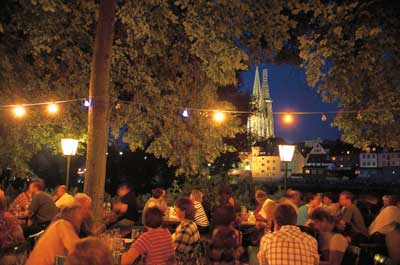
‘HISTORIC LUNCH’ For a quick and tasty lunch, sit down near the Danube and enjoy hot, juicy sausages with kraut and bread in the “Historische Wurstkuchl,” the world’s oldest sausage kitchen. You can actually see them frying the sausages on the grill through a door that leads into the small kitchen. http://www.wurstkuchl.de
Regensburg is a city of churches. Focal points of early Christianity, its ecclesiastical buildings are majestic and typify early Christian architecture. Most famous is St. Peter’s Cathedral, inspired by the French Gothic style and built in the 13th century.
At waterside, Schifffahrt Klinger offers boat trips to many different sights such as the Walhalla, the German Hall of Fame containing busts of famous German personalities.
Regensburg`s remarkable buildings and towers offer an unspoiled look into the past; the wars of the 19th and 20th centuries left this Danubian community virtually unscathed.
The Regensburg Tourism Office is located at the old Rathaus, Rathausplatz 3, D-93047 in Regensburg. Fax is +49 941-507-1919 or e-mail to tourismus@regensburg.de.
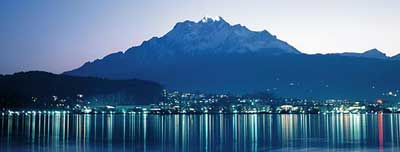
Approximately 200,000 spectators are expected to visit Lucerne, Switzerland for the 27th Swiss Yodeling Festival from June 26 to 29. More than 11,000 yodelers, flag throwers and alphorn players will participate in a number of contests along the shore of Lake Lucerne. A festival parade winds through the Haldenstrasse and across Lucerne’s “Seebrücke.”
PROGRAM EVENTS
Thursday, 26 June 2008
Two national finals: 13th Swiss Young Talents’ Yodeling Competition and the 15th Swiss Young Musicians’ Competition
Friday, 27 June 2008
Competitive events for yodeling, alphorn blowing and flag throwing
Festival happenings in the yodelers’ pubs and at yodelers’ stands
Saturday, 28 June 2008
Competitive events for yodeling, alphorn blowing and flag throwing
Festival happenings in the yodelers’ pubs and at yodellers’ stands
Sunday, 29 June 2008
Ceremonial presentation of the flag
Reception of festival veterans, ceremonial church service and official festival ceremony
Festival parade
Festival happenings in the yodelers’ pubs and at yodelers’ stands
Winter and spring in Interlaken has fun to offer at the foot of the Eiger, Mönch and Jungfrau mountains. While superb sledge runs attract snow enthusiasts to the mountains, the region between the lakes has a wealth of cultural highlights in store.
INTERLAKEN CLASSICS The tradition-steeped concert series in the Interlaken Kursaal features the stars of tomorrow playing works by old masters. At Kleine Scheidegg, rock music greats share the stage with local music legends, and the many folklore clubs practice yodeling and alphorn sounds.
European Union Youth Orchestra
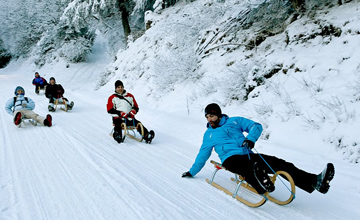
SLEDGING BY MOONLIGHT In Saxeten, after an uphill walk to Alp Nessleren near Wilderswil, guests are rewarded for the effort with a 2 1/2-mile-long sledging session. Culinary well-being is guaranteed with a stop for mulled wine, followed by a tasty fondue in traditional rustic surroundings at the end of the sledge run.
Sledging for snow enthusiasts
YODELING Swiss folklore clubs promote traditions yodeling and alphorn playing first hand. Yodeling choirs offer a unique blend of beautiful harmony and players create a powerful sound from a long wooden pipe, which echos through the valleys.
53RD INTERLAKEN CLASSICS You can meet tomorrow’s classic stars at the 53rd Interlaken Classics Festival from March 24 – April 8. The festival has grown into a summit meeting for younger and already internationally-acclaimed musicians. The consistent staging of this podium for young artists is based on close cooperation with Europe’s best youth orchestras, namely the Gustav Mahler Youth Orchestra and the European Union Youth Orchestra.
SnowpenAir Concert on April 6 is the highest-altitude open-air concert. This breathtaking setting on snow at 1 1/4 miles above sea level attracts thousands of concert visitors who will enjoy top acts such as Roxette and OneRepublic, the founding father of Swiss dialect rock Hanery Amman and promising young talent MC Juli.
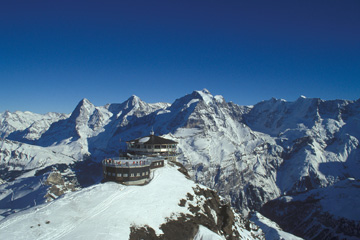
Schilthorn Summit near Interlaken, Switzerland offers panoramic views.
Flanders is a bucket-list destination for music lovers—big bands, unique scenes and tons of genres. With more than 280 festivals each year, there’s plenty to choose from.
Every summer millions of people gather in Flanders—a region full of history. You can enjoy live music in cities such as Antwerp, Ghent, Brugg and Boom as well as historical sites, exquisite food and shopping possibilities.
JAZZ MIDDELHEIM
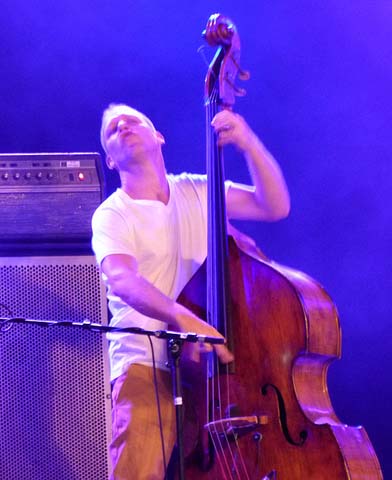
Jazz Middelheim, founded in the late 1960s, has become an iconic jazz festival. The festival grounds in Antwerp are within walking distance of the famous sculpture park. The green surroundings of the Park den Brandt with a high quality infrastructure, including a playground for children and gourmet catering, attract not only a vast jazz crowd but also families with children who love to linger in the park and enjoy the live music.
GHENT FESTIVALS After more than 160 years of existence, the Ghent Festivities have become one of the best festivals in Europe. Four international festivals take place there over a period of 10 days, with free music on 10 squares, children’s entertainment at various different locations in the city and hundreds of indoor and outdoor activities.
MAFESTIVAL One of the oldest classical music festivals with an international reputation takes place in Brugge. Daily concerts, competitions, workshops and lectures focus on the historical performance.
TOMORROWLAND Yesterday is History, Today is a Gift, Tomorrow is Mystery. What started out in 2005 as a one-day festival has grown into a three-day festival. Two weekends are being organized for the 10th anniversary of Tomorrowland in Boom. Tomorrowland is one of the largest festivals with 360,000 attendees. Tickets sell out in one day for this popular festival.











 European Traveler