Beautiful Bratislava

Courtesy http://www.visit.bratislava.sk

By Leah Larkin
Photos by Don Heimburger (unless noted)

“I like the changes. The town looks much better now. It’s more comfortable,” says city guide Evo Cubrikova.

She was speaking about her hometown, Bratislava, the Slovak capital of 450,000 inhabitants that is spread out on two banks of Europe’s second longest river, the Danube.

Indeed, since Czechoslovakia overthrew communism in 1989 and Slovakia split from the Czech Republic in 1993, there have been major changes and improvements, not just in Bratislava, but throughout the country.

Yet, progress has been fastest in the capital where renovation, new construction and new wealth have made their mark. Most remnants of those gray, shabby communist days are long gone, replaced by freshly renovated historic buildings now painted in pretty pastels, swanky shops, trendy restaurants and bustling cafes.
Courtesy http://www.visit.bratislava.sk

LIVELY PLACE
It’s not Vienna, Prague or Budapest, but it’s a pleasant, lively place to visit. Many tourists in nearby Vienna (64 km/ 40 miles away) and Budapest (194 km/116 miles) make day trips by bus or boat to the city. The opposite is also true with Bratislava visitors heading to the Austrian and Hungarian capitals, also for day excursions.

“Bratislava is a great city break destination,” notes Alison White of the British tour agency Regent Holidays which sends many visitors to the city. “You can take the hydrofoil to Budapest or Vienna. Use it as a base to explore these cities that are more expensive.”

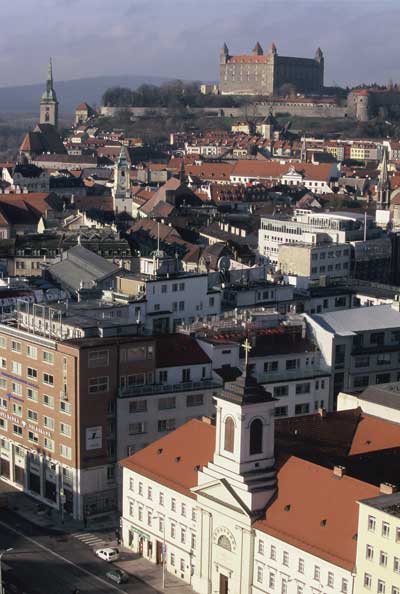
But don’t neglect Bratislava’s sights which are easy to explore on foot as the town is not that big. Towering over the city is its castle, a perfect place to begin a visit with magnificent views of the town and surroundings. Unfortunately the interior of the castle which houses the Slovak National Museum is closed for extensive renovation and will remain so for several years.

It’s still worth the trek. You can climb the outer walls and aim your camera for overall shots of the town. Across the river is Petrzalka, a suburb of bleak concrete highrises built in the communist era. One third of the city’s population live in these apartments, which are being restored. Because of their proximity to the inner city, they are now in demand, Cubrikova said.

The first written reference to the castle dates to 907, but the first inhabitants of the castle hill were Celts, then came the Slavs who built a fortress there. It was replaced by a palace of stone in the 10th century when Bratislava became part of the Hungarian kingdom. In the 15th century a Gothic castle was built, but all that changed in the 16th century when it was rebuilt in Renaissance style. Then along came Maria Theresa who had it converted into a rococo structure for her daughter.

MOST IMPORTANT TOWN
During Maria Theresa’s reign (1740-1780), Bratislava became the largest and most important town in the territory of present-day Slovakia and Hungary. The population exploded and many new palaces, monasteries, mansions and streets were built. But the glory began to fade when Maria Theresa’s son, Joseph II took over and the crown jewels were taken to Vienna in 1783 in an attempt to strengthen the union between Austria and Hungary.

The castle burned down in 1811 and remained a hulk of empty ruins until 1953 when renovation began, continuing until 1968. From far off, it looks like an upside down table -– four towers (legs) extending from the building, the table top.

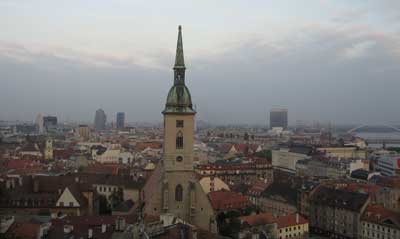
At the foot of the castle is the charming Old Town with labyrinthine streets and cobblestone squares. The prominent church at the edge of the Old Town, which was once part of the city’s walls, is St. Martin’s cathedral, a three-nave Gothic church dating to the beginning of the 14th century. Bratislava was the capital of the Kingdom of Hungary under the Habsburg monarchy from 1536 to 1783. Eleven Hungarian kings and eight royal wives were crowned in the cathedral.

Wandering through the narrow alleys of the Old Town behind the cathedral is reminiscent of Prague, with a Middle Ages ambience still in tact. You’ll undoubtedly come to Michael’s Gate, the only preserved gate of the medieval city fortifications. Its appearance changed through the centuries, but its 51-meter high tower still dominates.

Just down from the Gate is my favorite Bratislava discovery — Cokoládovna pod Michalon at Michalská 6, a chocolate café with what must be the world’s best hot chocolate — 44 different kinds, most with liqueurs. Dark, thick, sinfully delicious. I went for Indian hot chocolate, flavored with rum, cloves, cinnamon, orange peel and whipped cream –89 SKK (Slovak koruna).

Bratislava’s Old Town Hall took shape in the 15th century when several burgher houses were joined together. It, too, has been reconstructed throughout the centuries and now houses the city’s Municipal Museum. Under its tower is a unique and cozy cafe, Radnicka, which employs the disabled and is very popular. Crafts made by the disabled are also sold in the café.
CITY’S MAIN SQUARE
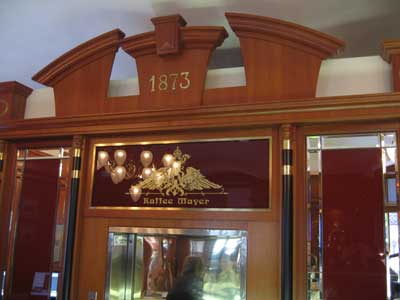
Walk through the passageway under the tower past the restaurant and enter the city’s main square, Hlavne Namestie, where architectural gems have been restored and now house embassies. There are also several cafes in the square including Maximilian’s, a pastry shop/café with a fountain flowing with liquid chocolate. Opposite is the Café Mayer, another noted café and pastry shop famous for “razky,” the city’s signature pastry, crescent shaped with a tiger pattern on the crust and a tasty filling of ground walnuts or poppy seeds.

Another attraction in this square is one of the town’s whimsical statues — a bronze of a Napoleonic soldier leaning over a bench. Tourists love to sit on the bench and pose next to the fellow, who was said to have been left behind by the French after they besieged the city in 1809.

More of these fun surprises are spread throughout the city, another favorite being a man peeping out of a manhole on the street. They say he’s looking up the ladies’ skirts.

On a more serious note is the Primatial Palace, an elegant, classical palace from the end of the 18th century which was the archbishop’s winter palace and now serves as the mayor’s office. Its lavishly-decorated rooms are used for official ceremonies. When none of these is taking place, you can visit and admire its Hall of Mirrors and series of six enormous, stunning English tapestries from the 17th century that illustrate the mythical legend of Hero and Leandros. According to Cubrikova, there are only three sets of tapestries in the world illustrating this legend, but only Bratislava’s set is complete.

The perfect place for a stroll is Hviezdoslavovo Namestie, a long mall-like boulevard with the Slovak National Theater on one end and a small square on the other end near the city’s famous New Bridge. Trees, fountains, a gazebo, cafes and restaurants, even the American Embassy, line the boulevard which is abuzz with people.

The restaurant of choice is the Slovenská Reštaurácia (www.slovrest.com), Hviezdoslavovo nám. 20, rich in old Slovak décor with a “Stroll Through Slovak Gastronomy” five-course menu for 790 SKK. From smoked trout, garlic soup with fried bread, goose liver in red wine sauce, a farmer’s platter and the finale, your choice of several types of homemade strudel, it’s a hearty feast. Get in the Slovak spirit and begin the meal with a shot of brandy. The restaurant serves many kinds, but silvovica (plum brandy) is the local staple. Slovakia makes excellent beer, the beverage of choice with this meal.

ONE-PYLON BRIDGE
After a meal like that, exercise is in order. Cross the bridge, a city symbol that was built in 1972 –- a futuristic suspension bridge with only one pylon. Ride the elevator to the top of the bridge tower where there is a viewing platform and the panorama “UFO” restaurant, so named because of its flying saucer shape. On the other side of the Danube is a lovely riverside park.

The UFO restaurant (www.u-f-o.sk/en/) is pricey with gourmet offerings — a six-course menu for 3,000 SKK. You can even have a tasting of Iranian caviar (6,800 SKK for 30 grams). I settled for a cappuccino, 70 SKK.

In the more affordable category, the Reštaurácia Monarch, Sedlárska 4, offers the Demänovská Valley Delicacy, a potato pancake filled with beef strips, tomatoes, green peppers, onions and mushrooms. Cost of the tasty concoction: 320 SKK. A large beer, 60 SKK.

Slovak crafts — wooden products, painted ceramics, cornhusk dolls — make the best souvenirs. Crystal is also a local favorite. I bought a pretty hand painted plate at Folk Art, Panská 2, for 450 SKK.

Recommended hotels in the city center include the four-star Hotel Devin (www.hoteldevin.sk) at Riecna 4; a new four-star boutique hotel, Marrols, (www.hotelmarrols.sk) at Tobrucká 4, and the reasonable and popular three-star Ibis Hotel (www.ibis-bratislava.sk), Zamocka 38.

For more information, check out visit.bratislava.sk/en/.
Gingerbread Galore!

By Sharon Hudgins
Photos by the author

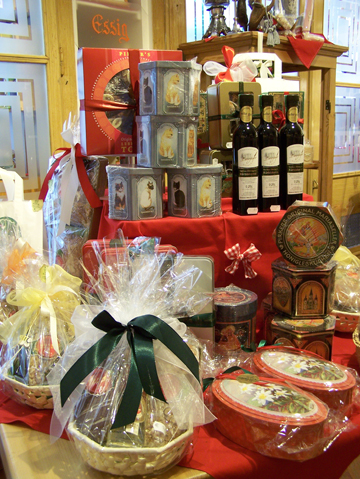
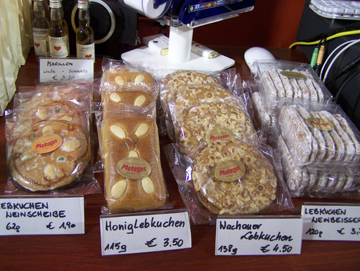
‘Tis the season when a young elf’s fancy turns to thoughts of gingerbread. Although these sweet-spicy cakes and cookies are popular year-round in many countries of Europe, they’re particularly associated with the winter holidays. Bakeries from Sweden to Slovakia to Switzerland turn out tons of commercial gingerbread products, often packaged in brightly colored wrappings and tin boxes. And home bakers dig through kitchen drawers and recipe files to find favorite cookie cutters and family recipes for their own Christmas gingerbreads.

Although flatcakes made with honey and spices were baked by the ancient Egyptians, Greeks, and Romans, the gingerbreads of northern Europe probably date only from the Middle Ages, when honey was still the main type of sweetener available locally, and exotic, expensive spices such as cinnamon, black pepper and ginger were increasingly being imported from faraway lands in the East. A taste for gingerbread eventually spread throughout Europe, with certain cities becoming known for their own particular types: Strasbourg and Dijon in France, Torun in Poland, Tula in Russia, Aachen and Nürnberg in Germany, Basel and St. Gallen in Switzerland.

MANY VARIETIES
Gingerbread recipes evolved over time and in diverse places. Various kinds of gingerbread were, and still are, made with different combinations of honey, sugar, flour, eggs, almonds, hazelnuts, walnuts, raisins, lemons, candied orange peel, candied citron, rosewater, rum, brandy, black pepper, ginger, cinnamon, nutmeg, cloves, allspice, cardamom, coriander, aniseed and saffron. Although these baked goods are often referred to as “gingerbread” in English, some of them don’t contain any ginger at all.

The variety of possible ingredients and textures causes some confusion about what “gingerbread” actually is. A cake, a cookie, or a loaf? Hard or soft? Thick or thin? Glazed or unglazed? Decorated with fancy frostings, or with fruits and nuts, or even with expensive gold leaf? At various times in its history, gingerbread has been all of these.

GERMAN GINGERBREAD
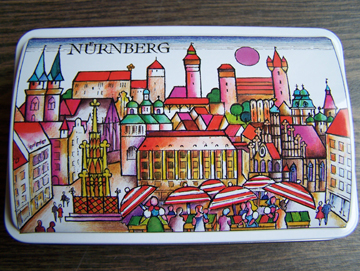
In the Middle Ages, the city of Nürnberg became one of the most famous places for making gingerbreads in Germany, where these seductive sweets have long been known as Lebkuchen (or sometimes Pfefferkuchen, when their spiciness comes from black pepper instead of ginger). Records show that Lebkuchen was being baked in Nürnberg as early as the 14th century. Traditionally, the stiff dough was pressed into highly detailed molds made of wood, metal, or terra cotta, which imprinted intricate designs on the Lebkuchen before it was removed from the molds and baked in a hot oven. Nürnberg Lebkuchen contained such costly ingredients, and was of such high quality, that it was accepted as payment for city taxes and given as gifts to nobles, princes, and heads of state.

Over time, as the prices of ingredients fell and the demand for Lebkuchen increased, faster production methods became necessary. The elaborate handmade molds were replaced by less detailed, often mass-produced, molds. Simpler decorations―such as nuts, candied fruit, and sugar frostings―were applied to the tops of many cookies. And the shapes were simplified, too, evolving into the basic human, animal, and geometric forms common today.

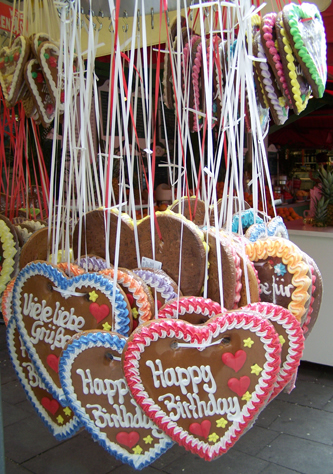
In the early 1800s, gingerbread houses became popular in Germany after the publication of the Grimm brothers’ fairy tale, Hansel and Gretel. And during the 19th century, ornately decorated Lebkuchen hearts also became the rage. Covered with fancy designs and romantic sayings made from colored icing, these large heart-shaped cookies were often exchanged between sweethearts. You can still buy them at almost every German festival and special market, including the Christmas markets held in many German cities throughout December.

The Lebkuchen produced in Germany today comes in all sorts of sizes, shapes, flavors, colors and textures: rounds, rectangles, squares, hearts, stars, pretzel forms, St. Nicholas (for Christmas), lucky pigs (for New Year) and rabbits (for Easter). The Lebkuchen dough can be “white” (light colored) or different shades of brown. Some Lebkuchen are also covered with white or chocolate icing, and some are filled with marzipan or jam. Honey Lebkuchen is sweetened only (or primarily) with honey. Oblaten Lebkuchen are cookies with the dough mounded on top of a thin wafer before baking. And delicate, elegant Elisen Lebkuchen are made with at least 25% ground almonds, hazelnuts, or walnuts, and no more than 10% flour.

GINGERBREADS ACROSS EUROPE
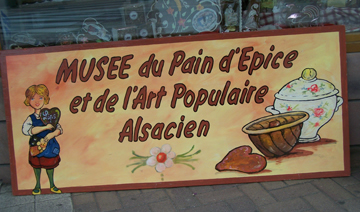
You’ll also find similar spicy cookies of different shapes, colors and textures called Printen (in Aachen, Germany), Pfefferkuchen (in Pulsnitz, Germany), Spekulatius (in the German Rhineland), Leckerli (in Basel, Switzerland), Biberli (in the Appenzell region of Switzerland), speculaas Holland, speculoos in Belgium, pepperkaker in Norway, pepparkakor in Sweden, piperkakut in Finland, pebernǿdder in Denmark, pain d’épices in France, licitar in Croatia, mézeskalács in Hungary, perníky in the Czech Republic and Slovakia, pierniki in Poland and prianiki in Russia. Other towns and regions have their own specific names for the many varieties of gingerbreads produced there.

Europeans also use gingerbread cookies as ingredients in other dishes. You’ll find crumbled gingerbread used as a stuffing for pork and for pasta, as a thickener for sauces, a flavoring for soups, a crunchy texture in salad dressings, and a base for many puddings and desserts. There’s even a German-Italian “fusion” dessert called ” Nürnberger Tiramisu”! And for people who just can’t get enough of that sweet, spicy, Christmasy taste of gingerbread, the Belgians have recently invented a gingery, caramely speculoos spread, similar in texture to Nutella, made from crushed gingerbread cookies.

If I’ve whetted your appetite for these European gingerbreads, my best suggestion is to travel there and taste them for yourself. You can also mail order many of them from the websites listed below. Costard, the clown in Shakespeare’s play, “Love’s Labour’s Lost,” had the right idea when he said, “An’ I had but one penny in the world, thou shouldst have it to buy gingerbread.”

Nürnberg Lebkuchen information www.lebkuchen.nuernberg.de/englische_version/index.html

Lebkuchen-Schmidt, Nürnberg
ww2.lebkuchen-schmidt.com/eng_index.php

Metzger Lebkuchen, Vienna
www.lebkuchenmetzger.at/

Lebkuchen-Pirker, Mariazell, Austria
www.lebkuchen-pirker.at/home/index.php?&lang+eng

Kerner Lebkuchen, Mariazell, Austria
www.lebzelterei-kerner.at/index.htm

Lebkuchen-Gandl, St. Wolfgang, Austria
www.lebkuchen-gandl.com/

Appenzeller Biberli, Switzerland
www.baerli-biber.ch/

Basel Läckerli, Switzerland
www.laeckerli-huus.ch/

French-Alsatian Pain d’Épices
www.paindepices-lips.com
www.fortwenger.fr/

Alte Pfefferkuechlerei (small gingerbread museum in Weissenberg,Germany) www.museum.stadt-weissenberg.de/

Speculoos Spread
www.thenibble.com/zine/archives/speculoos-spread.asp

YouTube video about how to make decorated European gingerbread
www.youtube.com/watch?v=OVX5wiv_oMk

American online sources for ordering European gingerbreads
www.germandeli.com
www.germangrocery.com

Grand Hotel Kempinski

In a class all its own

By Ursula Vonplaten
Photo courtesy Hotel Kempsinski

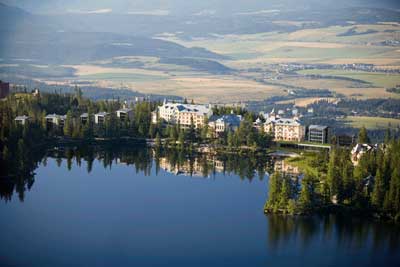
Slovakia’s first five star luxury hotel, the Grand Hotel Kempinski High Tatras, opened in May.

The hotel is located on the shores of an alpine lake, 4,400 feet above sea level in the spectacular High Tatras Mountains in Strbske Pleso. The mountains are the natural border between Poland and Slovakia, forming the central section of the Carpathian mountain range, where the air is said to be pure and medically beneficial.

The historic hotel, originally built in 1906, has been completely restored. The 98 spacious rooms and suites offer views either over the alpine lake, the mountains or the vast valley; some even feature private winter gardens.

The hotel provides international and Mediterranean cuisine in its all-day dining Grand Restaurant, focusing on local specialties, prepared by a team of international chefs.

For conferences, meetings and other occasions, the hotel has two ballrooms which can cater for up to 150 people. Apart from exploring the surrounding nature on foot or mountain bike, the area is ideal for cross-country and downhill skiing, horseback riding, or tours with horse carriages or snow scooters. Bungee jumping and paragliding, bear-watching expeditions and hot-air ballooning are also available and can all be arranged by the hotel’s concierge. For young guests, special amenities and services are available, including a professionally run Kids’ Club with many activities to keep children entertained while their parents relax.

The Wellness & Spa offers a variety of Thalgo and Terrake facial and body treatments. The facilities include several saunas, themed showers, a private VIP spa suite, seven treatment rooms and a vitamin bar. Indoor pools with views over the lake and mountains bring the natural environment into the spa.

From now through the end of June, guests can take advantage of a special opening rate of 160 EUR for a single and 180 EUR for double occupancy per night, including taxes, buffet breakfast and access to the wellness and spa area.

The Grand Hotel Kempinski High Tatras can be reached by road, rail or air. The nearest international airport is Poprad-Tatry; Kosice Airport is 93 miles away. Limousine transfers as well as helicopter pickups from Bratislava and Vienna are available.