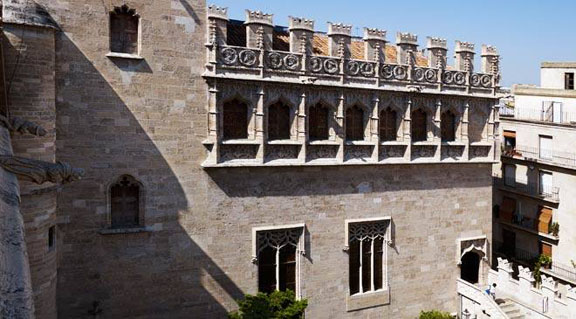
The Silk Exchange in Valencia, Spain is an exceptional example of a secular building in late Gothic style, which dramatically illustrates the power and wealth of one of the great Mediterranean mercantile cities. It is aesthetically unique because of its fine Gothic architecture combined with Renaissance decoration from the 15th century.
The majority of the Silk Exchange was built between 1482 and 1492 under master mason Pere Compte. The work was completed by a pupil of his after his death, which explains the presence of Renaissance elements.
Its similarity with old medieval castles is based on the fierce, fortress-like appearance of its stone walls. It comprises four parts: the Tower, the Sea Consulate Room, the Orange-tree Patio and the Room of Columns. The site covers more than 6,562 square feet indoors and out.
It is a typical representation of the commercial and financial past of the city of Valencia, and has been used for the same purpose for five centuries. Its original function was as a trading exchange for oil. It developed into the main maritime trading center and the silk exchange. At the present time it is still a major trading exchange, now dealing primarily in agricultural products.
By Danielle Pruger Photos courtesy of Castilla-León Regional Tourist Board
Castile-Léon Spain is highlighted in red.
Castile-Léon, an interior region of Spain, is known for its castles (Castile means “land of castles” in Spanish) and provides a look at ancient and medieval forms of architecture. Throughout the Middle Ages, Castile-Léon served as a frontier between Christians and Muslims from the 9th century to the 11th century, which created the initial motivation for building fortresses and castles. Later, the struggle between the various noble families and the royal family from the 12th century to the 15th century made it necessary to build new fortifications. The following six castles, open to the public, can be found in Castile-Léon.
AMPUDIA CASTLE The municipality of Ampudia is home to a 15th century castle which stands in the center of the village. This castle is well preserved and has been restored. Its sturdy enclosure is protected by four towers, and it has all of the traditional elements of medieval castles: battlements, ramparts, barbicans and a moat. Although it is privately owned, it is open to visitors, and its interior is home to a museum of art and antiquity.
PEÑAFIEL CASTLE The medieval castle in Peñafiel was built in the 11th century and stands on a rocky spur. The castle was rebuilt around the 14th and 15th centuries and has a peculiar shape because the outline of the walled enclosure conforms to the elongated silhouette of the ridge. This unusual shape has made it one of Spain’s most famous images; from a distance the castle resembles a boat run aground in the midst of a sea of pastures and wheat fields. This castle is also home to the Provincial Wine Museum.
ALCÁZAR FORTRESS The city of Segovia contains the Alcázar fortress, another one of Spain’s most emblematic images. This imposing Gothic building was built between the 14th and 15th centuries and was later transformed by Philip II in the 16th century into the Herrerrian style seen today. It was the residence of the Castilian and Spanish monarchs for two centuries; its location is on a gorge above the Eresma and Clamores rivers. The location, along with the appearance of the castle, is similar to the castles in fairytales, which evoke the images of princesses, knights, witches and dragons.
COCA CASTLE The Coca Castle, located in the municipality of Coca, is completely different from other castles; it was built in the Mudejar style of the 15th century using typical red brick. It has three walled enclosures, a moat with a drawbridge, a bailey (courtyard) and a splendid keep. The village of Coca is the descendant of the Celtic-Iberian city of Cauca, which was conquered by the Romans in 151 B.C.
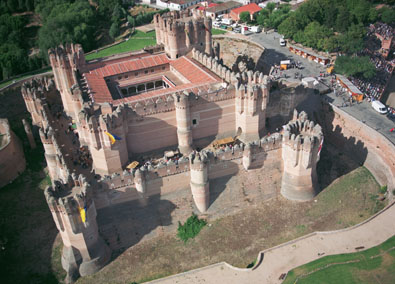
LA MOTA CASTLE La Mota Castle, also designed in the Mudejar style, is located in the town of Medina del Campo. It was built in the 15th century using concrete and red brick and has four enclosures protected by enormous walls, as well as a monumental keep. It was in the 15th century that Medina del Campo reached its maximum splendor: its fairs were the most important in all of Europe, and it is where bills, instead of coins, were first used as currency. This is also the place where Queen Isabella I of Castile, known as Isabella “la Católica,” died.
Zamora Castle
ZAMORA CASTLE The city of Zamora, located beside the Duero River, has a medieval castle that was built in the 12th century. This castle was restored in 2009, and the castle is surrounded by three walled enclosures dating from the same period, which encircle the historic center of town.
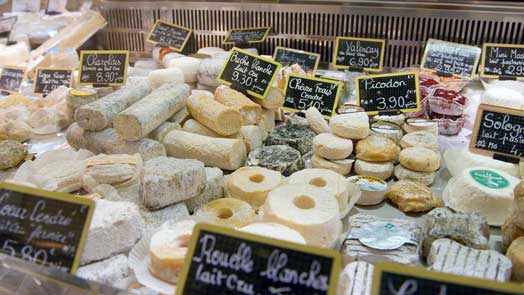
French Basque cheesemonger at the open-air market in St.-Jean-de-Lu
A special region with a proud history, a distinct language and a unique cuisine
By Sharon Hudgins Photos by the author
The Basque country of Europe is a region with a special ambiance all its own. Located in northern Spain and southwestern France, it’s a land of green meadows and high mountains, rugged coastlines and white beaches, wooded valleys and dry plains. Bordering on the Bay of Biscay, the Basque country straddles the Pyrenees Mountains and the coastal foothills along the frontier between France and Spain. It includes the Spanish provinces of Álava, Vizkaya, Gipuzkoa and, historically, parts of Navarra, as well as the western part of the French district of Pyrénées Atlantiques.
The Basques are proud of their regional identity and possess a spirit of independence that has often defined their history. An ancient people unrelated to other Europeans, they speak a unique language peppered with x’s, k’s and z’s. Theirs is also a land of contrasts, between rural and urban, past and present, rich and poor: the elegant boulevards of Biarritz and San Sebastián; the functional red-brick highrises and the soaring steel modernism of the Guggeheim Museum in Bilbao; the somber stone buildings of Vitoria and the picturesque fishing villages along the coast; the grimy industrial suburbs of major cities and the pastoral farmhouses of the interior, their walls, doors, and shutters painted white, red and green, the colors of the regional flag.
Passionate for politics and sports, the Basques are also very serious about food. Basque cuisine is famous on both sides of the border, and several Basque chefs have been among the leaders of Spain’s modernist cuisine movement. There are nearly 40 Michelin-starred restaurants in the French and Spanish Basque regions, with San Sebastián boasting a trio of restaurants awarded three Michelin stars (out of only seven 3-star restaurants in all of Spain). Known as the culinary capital of Spain, the city of San Sebastián has more Michelin stars per capita than anywhere else in the world.
The Basques like to cook, and they know how to eat well. Basque cooks of both sexes are renowned in Spain and abroad. Basque women are noted not only for the excellence of their home cooking, but also their success as restaurateurs. And Basque men, as accomplished restaurant chefs and members of local male gastronomic societies first organized in the nineteenth century, have been especially important in perpetuating and promoting Basque culinary traditions.
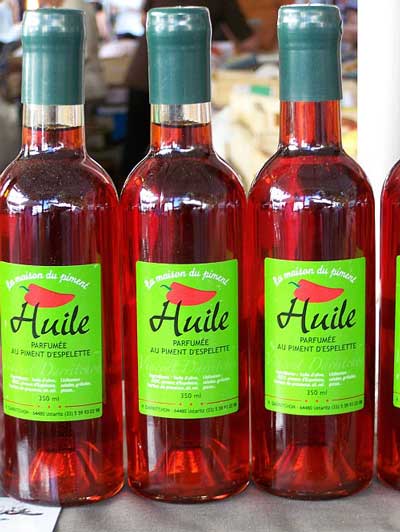
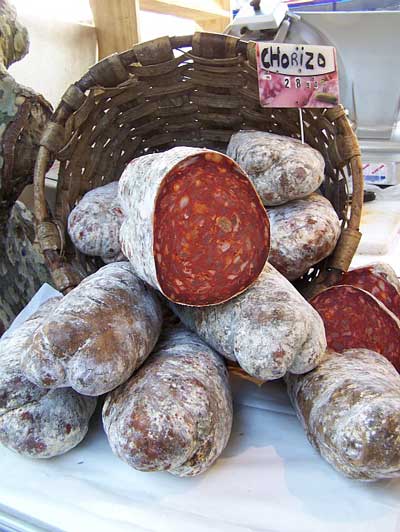
(left to right) Pork sausages flavored with paprika, in a Basque market; French Basque oil flavored with red peppers from Espelette
BASQUE FOOD PRODUCTS High quality ingredients form the basis of any notable cuisine. Fresh fish and shellfish are the mainstays of Basque cooking, caught in the Bay of Biscay and beyond, as well as in the mountain streams that flow to the sea: cod, hake, sardines, anchovies, herring, sole, sea bream, baby eels, tuna, bonito, bass, red mullet, octopus, squid, lobsters, crabs, clams, mussels, oysters, freshwater salmon and mountain trout.
The interior of the Basque country provides pork, beef, lamb and game, some of which is processed into cured meats like the famous the hams of Bayonne on the French side and the spicy sausages of the Spanish Basque land to the south. Basque dairy products are also of high quality, and the Basques use milk, butter and cream extensively in their cooking. Sheep’s milk goes into the production of several kinds of Basque cheeses made on both sides of the border, many of them matured in caves or huts high in the mountains. And the Basques are crazy about mushrooms. Every spring, summer and fall thousands of Basques head to the forests and meadows to pick the many varieties of wild mushrooms that suddenly pop up in secret places.
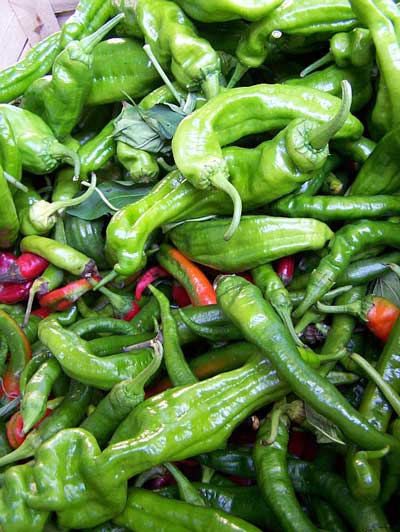
Market gardens grow the fresh produce so essential to many Basque regional dishes, including artichokes, asparagus, cabbages, leeks, onions and carrots. With the first Spanish voyages to the Western Hemisphere 500 years ago, tomatoes, potatoes, peppers, beans and cacao (later processed into chocolate) began returning in the holds of the ships and eventually became an important part of the Basque diet. Today several specific places in the Basque country are well known for the New World crops they grow: tomatoes in Deusto near Bilbao, potatoes in the province of Álava, many types of beans in Navarra and Gipuzkoa, and long green peppers from Gernika. Across the border in the French Basque country, paprika made from the bright red peppers grown around Espelette is the first and only spice in France to be awarded an AOC (controlled designation of origin) and APO (protected designation of origin) status.
Mild sweet peppers are a popular ingredient in Basque cuisine; peppers are a popular culinary motif in the Basque Country
Spanish Basque meals are often accompanied by excellent red wines from the Alavesa area of the famous Rioja wine region. A different type of Basque wine made near the Spanish coast is txakolí, which is light, slightly effervescent, and fruity but dry. Although the Basques produce white, red and rosé versions of txakolí, the whites are considered the best of these simple table wines, especially good with the fish dishes of the region. Reds are the predominant wines produced on the northern foothills of the Pyrenees in the wine region of Irouléguy, which is the only AOC-certified wine area within the Basque country of France.
Basque sparkling cider is another popular drink on the Spanish side of the border, served not only at home and in restaurants but also at sidrerías, combination cider mills and eating houses where the cider is tapped fresh from the barrels and served as an accompaniment to simple country-style meals.
TRADITIONAL BASQUE DISHES Fish and seafood dishes—grilled, baked, stewed, sautéed—are an important part of Basque cuisine. One of the most expensive dishes in Spain is the Basque dish of angulas, silvery-white baby eels (which cost up to 1,000 Euros per kilogram!) cooked in a small earthenware casserole containing very hot oil, a clove of garlic and a piece of dried red chile pepper. Much more reasonably priced are the rustic fish stews of this region, including classic marmitako, an oily-rich mélange of white-fleshed bonito and potatoes, usually cooked with tomatoes, garlic, and white wine in an iron pot. And although the Basques have an abundant and continuous supply of fresh fish from the sea, they also love bacalao, dried salt cod that has been split lengthwise, flattened out, heavily salted, and dried in the open air. Reconstituted in water before being prepared in innumerable ways, bacalao has been aptly described as mummified fish brought back to life by the cook.
In the Spanish Basque country, seafood is also paired with classic sauces whose colors reflect those of the Basque flag: red sauce (a la vizcaína, or Biscay-style) made with onions and dried sweet red peppers; green sauce (salsa verde) colored with parsley, peas, and asparagus; and a special kind of white sauce made by cooking the ingredients al pil-pil, in a shallow earthenware casserole set over a low flame, the casserole shaken, not stirred, until the gelatin released by the fish combines with the oil to produce a rich, unctuous sauce. The Basques also prepare baby squid in a thick, creamy, subtly flavored sauce tinted black by the squid’s own ink.
Another classic Basque dish is piparrada (Spanish) or piperade (French). Sweet red or green peppers, roasted and peeled, are sautéed in olive oil, butter, or lard, along with other ingredients such as tomatoes, garlic, onion, and ham. Often beaten eggs are swirled into this sauce just before serving, to make a kind of scrambled egg dish, or the sauce alone is served as an accompaniment to baked, grilled, or roasted meats.
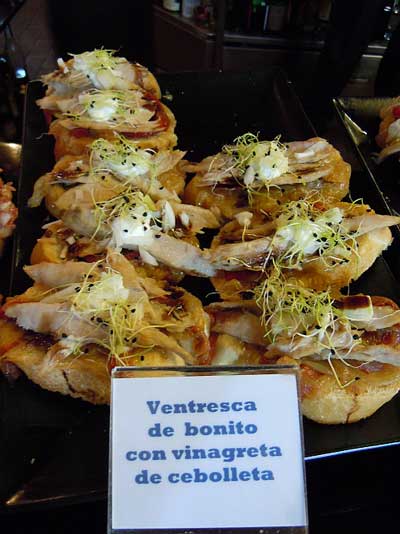
Pintxos are a particularly popular category of foods in northern Spain. The Basque version of Spanish tapas, these are bar snacks that range from traditional potato omelet slices, mayonnaise-bound potato salads, spicy sausages, and stuffed mussels, to more modern variations made from a thick slice of chewy white bread topped with two or three layers of tasty, colorful ingredients, all held together with a toothpick. Miniature masterpieces of the culinary art, these pretty little open-face sandwiches are enticingly displayed on the counter of each bar. No visit to the Spanish Basque country is complete without a poteo, a kind of civilized pub crawl, where you wander from one bar to the next, drinking a glass or two of local wine and tasting the designer pintxo specialties at each place.
But leave room for dessert. Traditional Spanish Basque specialties include leche frita (fried milk), thick custard squares dipped in beaten egg and flour, then fried until crisp; intzaursalsa, walnut cream soup made with crushed walnuts, toasted bread crumbs, milk, and sugar; mamiya, milk curds flavored with lemon and sugar; and colorful fruit compotes made with red wine and spices, such as zurracapote served on Christmas Eve. Spanish pastel vasco and French gateau basque are both classic Basque double-crust tarts filled with custard and sometimes jam. And if these old-fashioned desserts don’t appeal to your more modern palate, then spring for dinner at one of those Michelin-starred restaurants to taste (and marvel at) the futuristic sweets prepared by the Basque Country’s many highly acclaimed chefs.
By Danielle Pruger Photos courtesy Giraffe Childcare and Early Learning
Europe is famous for its decadent chocolate and many countries are known for their tasty treats. However, chocolate was originally only enjoyed in Central America where cacao beans grew. The Olmec Indians were the first to harvest the cacao beans and 1,000 years later the Mayans were the first to bring the cacao tree from the rain forest onto plantations in modern day Mexico and Guatemala. It wasn’t until 1530 that chocolate was introduced to the European population by Hernan Cortes, who added cane sugar to “xocaltl,” a traditional chocolate drink, to make it more appealing to Spanish royalty and aristocracy. From there many new chocolate concoctions were created throughout Europe, such as Pralines and chocolate milk and many other treats we enjoy today.
For more information visit the timeline created by Giraffe Childcare and Early Learning that covers more than 4,000 years of chocolate’s history: Chocolate History Timeline
I didn’t know travel and culinary adventures could be so entertaining until I happen to watch my first episode of Phil Rosenthal’s “I’ll Have What Phil’s Having.” First I was drawn in by the name of the show which I heard about on my Chicago PBS station, and I thought, “Who has a television series name like this?”…but I was even more curious— “What does it mean?” I thought and thought, but couldn’t figure it out.
Then I happen to just be sitting down in the family room after supper and one of Phil’s episodes came on….it was his Barcelona program. It started with a flashback photo of Phil as a small kid…he was wrinkling up his nose at something in the photo. “Meat was a punishment,” he remembers from his childhood.
But today, Rosenthal, an Emmy award winner and a very funny guy, is visiting one of Spain’s — and the world’s — hippest spots, Barcelona. In this city, food is taken very seriously, with people in Barcelona planning supper while eating lunch, and when they plan a day trip, their most important concern is where they are going to eat. Just “grabbing a bite” is not an option here. In Barcelona eating comes first, and you have to think about it.
“The world can be a beautiful, delicious and friendly place when we travel and eat food together,” announces Phil as he begins his Barcelona food experience. Since Barcelona is located beside the Mediterranean, seafood abounds, with the long Catalan coast sheltering more than 30 fishing ports, and fish is a supreme passion with local gourmets.
Rosenthal, the creator of the TV hit “Everybody Loves Raymond,” is a passionate foodie who makes friends fast and warms up to excellent dishes even faster. “I’m Phil Rosenthal, and I’m here to say come on, you can have what I’m having.” His one-hour shows (I’ve also seen his Paris and Italy episodes), which focus on international culinary exploration, tend to grab you after just the first three or four minutes, as he investigates, samples, pokes and smells — and samples again — the culinary delights he discovers.
In Barcelona, he quips, “They start at 8 at night and they go from bar to bar eating tapas, and they’ll have three or four small plates, and then they go to the next bar— ‘Oh, we’ve got to try these small plates’ — until they’re full, which is around midnight, and then….dinner.”
Rosenthal apologizes on a late food outing that he might not make it through the evening: “They (the Barcelonians), love life. This is going to be a little difficult for me, because usually I’m in bed by 9,” he admits.
On a rooftop with new-found friends celebrating the Feast of San Juan, Phil savors a taste of grilled sausage and beef, talks to partygoers and his hosts, and generally adapts to his surroundings, shooting firecrackers off the roof when one comes sailing at him. “The only thing we can do,” he slyly suggests, “is retaliate” as he sends off a bright rocket into the sky, thus joining the aerial melee.
Following the party, he recovers the next morning just in time for breakfast, visiting the Boqueria Market where he discovers all varieties of fresh fish, fruits and vegetables; he ends up helping a market restauranteur and his brothers with the cooking, but says because of the tiny booth, “If my family worked here, we wouldn’t last five minutes.”
To add a bit of culture to the show, Phil drops in on two of Antoni Gaudi’s structures in the city, the 1882 Sagrada Familia church he started (when finished in 2028 it will be the tallest church in the world), and an apartment building—Çasa Mila— with an unusually distinctive roof.
With the mantra, “Why stop when you’re full?” Phil continues his Barcelona eating binge, devouring octopus, mullet, friend schrimp and eel, grouper and asparagus. Keeping in touch with his parents by Skype when overseas, he asks if they’d like to know what he’s been eating. At nearly the same time, his father responds, “Not really,” while his mother shouts, “Go ahead.”
Sitting down to the table at the restaurant Tickets, Rosenthal literally “hops for joy” when eating a plateful of tomato mozzarella. His last stop in town is at Vila Viniteca, where he puts on a humorous display of “jamon” slicing, devouring half of what he slices. As he leaves the store with a ham strapped to his bicycle—and says goodbye to Barcelona—he concludes that the city will give him memories for the rest of his life, and the jamon will last only about a week to a week and a half.
I can’t wait for the rest of the series — I do think I’ll have what Phil is having, and I’ll enjoy it.
THE SHOW: The PBS series features six one-hour episodes exploring a variety of foods and cultures as seen from Rosenthal’s perspective. Host Rosenthal explores culinary capitals of the world and dines on regional specialties, all the while pushing the boundaries of his palate – and the viewers’ – in his funny, unforgettable travels. In his search for the best of a city’s specialty, or one of its most unusual cuisines, Rosenthal entertains the audience while making connections all over the world.
PHIL SAYS: “My mother was not a fantastic cook; our oven had a setting for ‘shoe.’ But I’ve always loved family, food, travel and humor. That’s how I connect with people. I’m not your typical adventurer. So, I’m hoping folks will look at a nebbish like me exploring the world and trying new things and say, ‘If that guy can go outside maybe I can, too.’”










 European Traveler