The Eastern European capitals are becoming “closer” to visit each year with better airline routes, and in some cases, reasonably-priced tickets. It’s really not correct to call them “Eastern,” a friend of mine said, because if you look at a map of Europe, they are still close to the “West.” Consider perhaps cities in Belarus, the Ukraine and Romania as “Eastern,” he suggests.
So Budapest, a recent destination of mine and the capital of Hungary, was not particularly hard to reach, after I determined that a Rail Europe train ticket was the most economical form of transportation from Munich. It was, however, a 7 hour and 22-minute train ride from the Bavarian capital, but with trains being an easy and relatively inexpensive form of European travel, I opted for that.
FIRST IMPRESSION My first impression of this city of about 2 million people (it’s much larger than Prague), came as I departed the train and walked among hundreds of train travelers to the door of the massive train station, where I met hundreds more people on the streets. The city seemed vibrant, active and alive. It also seemed like I should have studied the Hungarian culture a bit more before I arrived, just to ground myself better in what I was about to see.
Divided by the Danube, the city is really two cities in one—hilly Buda in which is located Castle Hill—and Pest, located on the east side, and flat. The most prominent building on the river is the Parliament Building, closed when I was there because of a national holiday. In fact, the whole area was roped off by the police.
Photo by Marilyn Heimburger
My overriding concern about going to Hungary was the language: I didn’t know a word of Hungarian, and I found it hard to pronounce words. I did learn that “Utca” meant “street,” “Hid” meant “bridge,” and “Furdo” meant ”bath.” I also found as I went along that I didn’t necessarily need to know any words in Hungarian. Most of the shopkeepers, hotel personnel and tourist guides knew enough English so that I could communicate well enough.
City trams in Budapest
GUIDEBOOK HELPS I’d suggest picking up a guidebook at a local travel store before arrival, and then arranging for a city tour of the highlights before attempting to proceed on your own. The reason for the city tour is that because of the size of the city, you’ll not likely be able to find all the attractions yourself, or want to walk to them yourself.
The tour (www.cityrama.hu), will take several hours, but you will have seen the crème of the attractions of the city. If you plan to stay a few days, the Budapest Card provides free services or discounts at more than 100 places, from public transportation and museums, to thermal baths and restaurants.
The three-hour Cityrama “City Tour” costs 28 euro and includes free taxi pickup at your hotel. The tour starts at the Chain Bridge, which is especially beautiful at night; a romantic walk along the river near the Chain Bridge is memorable. The Parliament Building, built in 1896 for the city’s millennium celebration, features a unique Neo-Gothic design, and reminds one of its counterpart in London. At one time a large red communist star was anchored from the tallest spire. Guided tours are available in the portion of the building which was vacated by the House of Lords.
Behind the Parliament is Kossuth Ter, filled with monuments such as the one to Lajos Kossuth who led an uprising in 1848. The Museum of Ethography (focusing on folk art and country life) in the old Supreme Court Building houses artifacts from the pre-WWI days in Hungary.
Shops, theaters, cafes and more line the Andrassy Ut as the road connects the City Park where you’ll find the zoo with its playful buildings, the famous Szechenyi Baths with several different pools to soak in, the Vajdahunyad Castle (a replica of the famous castle in Transylvania), the Museum of Fine Arts, the Palace of Art and Heroes’ Square. At the baths, you’ll soak in water containing calcium-magnesium-hydrogen carbondate and sulphate-cloride.
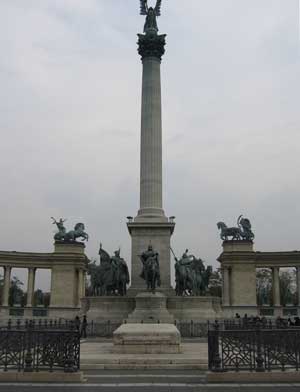
I spent quite of bit of time in this area of the city, and would have spent more if the weather had cooperated. Heroes’ Square is where you’ll meet the most “historic” Hungarians in statue form; the very large open area has as its backdrop the imposing Millennium Monument. In the adjacent City Park is where the famous Gundel Restaurant is located (see sidebar). During the 19th century, citizens used to ride their horses in this place and take along a picnic lunch. In the winter, the lake is frozen, so ice skating is a popular past time.
In the other direction, the House of Terror, former headquarters of the Nazi-sponsored Gestapo and secret police, Budapest Opera House, with its neo-Renaissance architecture, fits well with the similarly-elegant neighborhood on Andrássy Avenue. Hungary’s greatest architect, Miklós Ybl, designed the building for the Millennium celebrations. Construction started in 1875 and the building was finished in 1884. Ybl oversaw the work himself with painstaking care. Hundreds of statues and paintings decorate the building both inside and out.
Another attraction in Pest is the Great Market Hall, a multi-level cavernous structure at the end of Vaci Utca, which should take care of most of your food needs if you’re looking for fresh meats, bakery goods, fruits or vegetables or paprika, and it will also satisfy your need for Hungarian souvenirs. This is a good place to hang out for a couple of hours and find lunch at one of the many fast food stalls,
At Buda Hill, you can walk up the hill (about 30 minutes), or take the chairlift to the top of Janos Hill (1,729 feet). The Erzsebet Lookout tower offers a panorama overview of the city below. The area is divided between the “royal” section and the civilian section, with Matthias Church and Fisherman’s Bastion highlights of the civilian section. Streets that lead away from Trinity Square are dotted with Baroque-style buildings and mansions that hide Gothic ruins.
For a rest and refreshment, try ice cream or a pastry at the Ruszmurm Cafe or sit for a while at Kapisztran Square and listen to the bells of the Magdalena Tower. Be sure to see the Royal Place complex. Once the home of lords and royals, it is now the home to museums.
There are more than 200 museums in Budapest, some of which include the Hungarian National Museum, the Budapest History Museum, the Hungarian National Gallery, Museum of Fine Arts, the Museum of Military History and the Ludwig Museum.
An interesting aspect of Budapest that many may not know about are the caves in the area. Monaco is the only other city that can boast a dripstone cave—Budapest has several open to the public: there’s the Palvogy, the Szemlo and Matthias Hill caves (qualified climbers only).
City park on Margaret Island
More highlights:
New York Cafe—The most ornate cafe of 320 that operated in the years preceding WWI, and it has remained the most elegant since. Gilded columns, reliefs and shining mirrors evoke the aesthetics of the early 1900s.
The square-shaped chocolate cake named after Jancsi Rigo, a gypsy musician, and its original creator Joseph Dobos, is a caramel-covered cake you’ll want to try while you’re in town.
Margaret Island, in the middle of the Danube, is a large, lovely park where you can escape the hustle and bustle of the city.
What have I left out? Actually quite a bit, but once there you’ll have plenty to do and see. Hungary’s capital is the hub of political, artistic and social energy. It’s full of history and grandeur, big bridges and wide boulevards. With impressive treasures and friendly people, Budapest is a spot you’ll not want to miss.
As I usually do, before making reservations for any European trip, I study a map to see where I’d like to go. Sometimes I am not aware of towns or attractions near where I’m traveling to, so a map can help identify those in short order.
The European map came in handy again recently when I booked a flight between Chicago and Munich, the first of what was to be a two-part air journey between Chicago and Budapest. When I discovered the Munich to Budapest air fare would be about as much as the Chicago to Munich fare ($746.00), I quickly gave second thoughts to how I would travel there. And who wouldn’t.
I didn’t want to drive through three countries (Germany-Austria-Hungary) because of gas prices, and my unfamiliarity with the laws and the roads. A bus would take too long, but a train, despite a journey of some seven hours, 22 minutes, would be economical and fun. And I had not ridden those rails before. In fact, Hungary was an altogether new adventure for me.
Munich’s Hauptbahnhof
RAIL COST WAS NOMINAL A check at www.raileurope.com‘s new website quickly showed that a one-way trip to Budapest’s Keleti Station would cost only $171 U.S. dollars 2nd class ($269.00 first class), and once on board I could sleep or relax from my Atlantic crossing. With the new Rail Europe website, all I had to do was key in my departure and arrival cities, and up popped the cost for the date I wished to travel.
I would arrive Munich via Lufthansa at 5:55 a.m. and have plenty of time to travel on the S Bahn (covered by my Rail Europe ticket) from Munich Airport to the main Munich train station (Hauptbahnhof) to catch Train #63 at 9:27 a.m. to Budapest.
The flight over was uneventful, and the plane landed a few minutes early. Not having been in Germany since the spring, I was craving a croissant made the way the Germans make it, so I waited at an airport restaurant, indulging in coffee and croissants, until 7 a.m. and a Deutsche Bahn office opened to have my train ticket validated (you must validate tickets purchased in the U.S. prior to boarding a train in Europe).
I made a small deposit to reserve an assigned seat in first-class just to be sure. If the agent tells you the route can become crowded with passengers, paying a little extra for a reserved first-class seat can save you from transferring to second class if all the first class seats are taken.
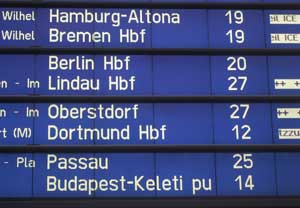
LARGE MUNICH STATION DEPARTURE BOARD The large train departure board in Munich’s station is fascinating to watch, as new train numbers with boarding tracks pop up every few minutes, and people rush to that platform to board. My train’s notice appears on the board, I see my train roll into the station, and I board car #262 and settle into a comfortable, high-backed leather seat. The train, headed by an electric locomotive, the locomotive of choice in Europe, grabbed onto our string of passenger cars and eased us out of the station on time. Nothing new there—Europe’s trains are almost always on time.
Outside of Munich proper, I look out the window and guess we’re traveling between 95 and 100 miles per hour. I’m likely accurate on this, as European trains can move. A short time later the conductor confirms the train speed at 160 kilometers or 100 miles an hour. One reason trains can travel so fast is that the European track system is much stronger and can hold up much better at high speed. European rail lines have been investing heavily in their train tracks and facilities for years and years, and this is the payoff.
After a while, I note that the heat in the car is a bit excessive, but the conductor enters the car soon enough and announces the heat will be adjusted; it was. By 10 a.m. a porter with a trolley of beer, sandwiches, candy, rolls and chips arrives in the car to ward off any hunger pangs of the passengers.
As we near Salzburg, I can start seeing the snowed-covered Alps that I’ve come to be fond of; I see the Festung on the top of the hill in Salzburg, but only for a moment as the train rolls on. We’ve changed conductors since entering Austria. By the time we arrive at Linz the train is 8 minutes late, and continues to be behind schedule for a while.
Dining in the Speisewagen
TRAIN IS NEARLY FULL Looking around at the seats and the various cars, I found that 90% of the train was full, and all but about 10 first-class seats had been reserved. If the seat is reserved in the first-class section, a small stub will be attached to the seat with the person’s name on it as well as their boarding and departure stations.
Walking up through the train to the Bord Restaurant, I found it not crowded, and serving Hungarian-style food, including goulash and Hungarian beers. The service was fast and the price was very reasonable.
We roll through St. Polten 10 minutes late, and by Vienna we are 17 minutes late and running into fog. I don’t remember if we arrived late in Budapest, but we were nearly on time nevertheless. The Budapest train station was massive, with a large arching trainshed, similar to many large city trainsheds in Europe.
The trip was as advertised, it allowed me to catch up on my sleep from the flight over, and it allowed me to get into the “European mood” for my travels for the next two weeks. I also saved a lot of money. And in this current rough economy, that’s a good thing.
One of my favorite things to do when planning a European trip by rail is to pull out my European rail route guide and investigate the towns and topography of the area through which I’ll be traveling.
Thus, when I recently organized a trip to Oberammergau, Germany from the Black Forest village of Villingen-Schwenningen, to visit the Passion Play theater and interview some of the play’s directors, I was delighted to see that I’d be changing trains at Pasing, a suburb of Munich, then heading south into the Alps. Pasing station is undergoing a major remodeling around the platform area, and it needs it. Hopefully by now the station is done and the passengers can more easily maneuver on the platform.
The schedule called for me to arrive Pasing at 11:20 a.m. on an Intercity Express from Ulm. Then a Regionalbahn train left at 11:39 a.m. for Murnau, which was slightly under an hour trip. At Murnau, I took the last leg of the trip to Oberammergau. End of story? Not quite, because the fun in travel is actually traveling, not going just from point A to point B.
WHAT THE FUN IS The fun is waiting for the train, watching the other passengers and seeing what pulls up at the station when its your train. The fun is checking out the cars and seating arrangements, finding the diner and having a meal, or watching the scenery go by. And that’s where my research came in. I knew that the fun part of this trip—any train trip in Europe–is watching the scenery, and I was in for some spectacular scenery.
Not far out of Pasing I could tell the tracks were heading southwest, and towards the Alps. Actually, on a very clear day, you can see the Alps from Munich itself, but I hadn’t been able to see them when I flew in until the very last moment before we touched down. Now, however, it was a beautiful clear day, but it wasn’t until about Murnau that I could see the landscape starting to suggest something big was going to happen.
At Murnau the track split, with one line going to Garmisch-Partenkirchen and then onto Innsbruck: that would have been an awesome route to follow. The other line made a large loop, ending up in Oberammergau. Had the line been straight, the schedule for that segment of the trip would have been much less than the allotted 40 minutes. After Murnau, and a quick on-board lunch that I had packed, the track started to conform to the undulating hills.
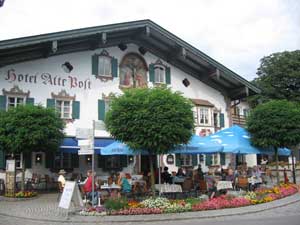
Oberammergau Mayor Arno Nunn is in charge of the world-famous Passion Play 2010.Sit back and relax with a cold beer under a tavern umbrella.
MOUNTAINS LOOM LARGER We rolled further south, and there finally the mountains appeared and were growing bigger at every turn in the tracks. Our regional train, with a loud squeak for a horn, signaled for road crossings and little dirt paths that wound up into the foothills. Colorful mountain flowers along the way were welcoming enticements to follow the increasingly curvy path to my destination.
Small, interesting German villages, rich green forests, rolling meadows and the looming Alps were all reasons to continue the journey and discover what Oberammergau had in store. A word of caution: don’t step off at “Unterammergau” when you want to get off at Oberammergau. The town names, when you aren’t German and the conductor speaks fast, can be very similar!
At Obergrammergau the track abruptly ends at the station–there’s one track in–and it’s the same track out of the station. From there, you can walk into the center of town, or get a bus or cab. This little city, where the world-famous Passion Play is held every 10 years, is usually very active and touristy. But you feel like you’re in a “real” German town when you’re finally relaxing with a cold beer at a small tavern under the shade of an umbrella, and the Alps rise majestically above you. That’s living, that’s Germany, and trains will take you there. Next time, try the “small rail routes.”
Photos courtesy Croatian National Tourist Office Home page photo by Mario Romulic & Drazen Stojcic
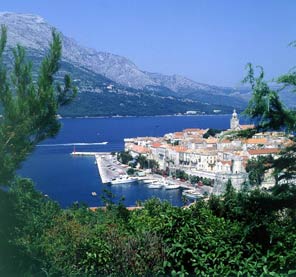
If you like to explore ancient history when you travel to Europe, the island of Korcula is your cup of tea.
The Croatian island of Korcula has been inhabited since prehistoric times, and traces of life from the past have been uncovered at many places on the island. The oldest finds were stone knives from the Neolithic age found on the islet of Badija near Korcula.
The richest discovery is the Neolithic site Vela spilja (Large Cave) at Vela Luka. Here, archaeologists have uncovered several layers of prehistoric life with fire sites, shards of ceramics and graves dating back 5,000 years before Christ.
Many Neolithic stone piles from this period—cult places and gravesites—have also been found over the entire island. The island was inhabited by the Greeks in the 6th century before Christ, first at Vela Luka.
Milan Babic
Later, on the other side of the island, in the area where Lumbarda is today, Greeks settled from the island of Vis (Issa), founding a separate settlement referred to in the inscription “PSEFIZMA” originating in the 3rd century before Christ, which was discovered at the end of the 19th century.
In the 1st century before Christ, the island, like the whole of Dalmatia, was conquered by the Romans, who called it Illyricum. In the 7th century A.D., the Slavs-Croats made their way to the Adriatic coast and formed their own state, which was first a principality and later became a kingdom, with the crowning of the first Croatian King Tomislav in 925. Korcula was also included within the borders of that state.
The Roman population fled from the Slavs to the islands of Brac, Hvar and Korcula, and after the situation settled, the majority returned to their original places of residence, while the rest assimilated with the settlers.
In 1,000 A.D., the Venetian Doge Petar II Orseolo took over the Dalmatian cities and islands, and thus Korcula also fell under Venetian rule. It was here on the nearby isle of Majsan that the Doge set up camp to lead the campaign against Korcula and Lastovo, which offered some resistance, but he quickly conquered both islands.
Following this, the rulers of Korcula changed frequently: the Venetians were replaced by the Zahumlje governors, then by the Austro-Hungarian kings, before the Venetians took over again, and from 1413 to 1420 the island was under the Dubrovnik Republic before again falling under Venetian rule in 1420, which lasted until 1797. When Napoleon brought down the Venetian Republic, Dalmatia was under Austrian rule for a short time before the French arrived.
From 1804 to 1805, Korcula was under French, then Russian rule, before the French again took control from 1897 to 1913. The English became rulers of the island to 1815, when the Vienna Congress set out the new borders of Europe.
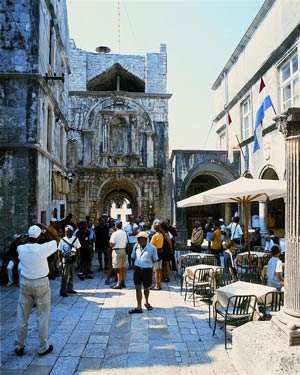
Today, Korcula is just a scenic three-hour drive or short ferry ride from Drubrovnik, and the island is known for producing some of Croatia’s finest wines and best olive oil. The southern coast offers many scenic drives with secluded beaches that are great for swimming. Korcula town’s ancient walled center has picturesque stone streets and round towers.
For more information about Korcula and other Croatian destinations, go to www.croatia.hr/en
With trendy Croatia one of the top travel destinations these days, I learned quickly that everyone wanted to go with me when I visited this small southeastern European country, tucked between Bosnia, Hungary and Slovenia.
Who wouldn’t want to go to the country that invented the sophisticated cravat, the forerunner of the modern tailored necktie and bow tie, or was now producing a truckload of good white wines, or was bounded by the romantic Danube? Although this land still bears the scars of the Bosnian War which affected the region between 1992 and 1995, the country is gradually moving on.
The warmth of the Croatian people, the abundant agricultural possibilities of the land, and the natural beauty of the country’s rocky mountains and green woodlands are only now being discovered, and touted in national tourist publications.
Some eye-opening travel gems await those who venture into the awakening interior.
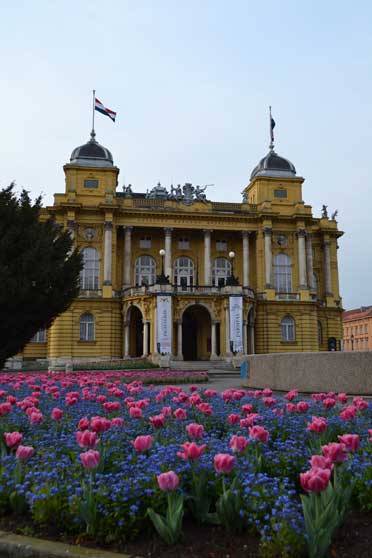
National Theater in Zagreb
CONTINENTAL CROATIA AND ZAGREB Croatia is shaped somewhat like a horseshoe, with one side extending 1,100 miles along the Dalmatian Coast, with seaside Dubrovnik at one end and Croatia’s third largest city, Rijeka, at the other. The entire country of 4.2 million people is only as large as West Virginia, or just 21,829 square miles.
While I wasn’t going to where most tourists journey—the coast and the Adriatic Sea— the interior of the country presented its own set of unique opportunities for exploration. I started my venture at the capital, leafy-green Zagreb, which sits on the historic and political threshold between Eastern and Western Europe.
Sitting on the Pannonian Plain as well as on the edge of the Dinaric Alps, this Hapsburg-inspired city has been inhabited for centuries by people coming from all over Europe, thus insuring a rich cultural heritage. It is the home of Croatia’s parliament, government and its president. It sits next to the lush, forested slopes of Mount Medvednica, often referred to by the name of its summit, Sljeme.
The city’s elegant facades, a horseshoe of green spaces—eight green squares created by Milan Lenuci in the 1880s— and a growing contemporary scene, are attracting the curious traveler; more may come soon as well, as Croatia and thus Zagreb are poised to join the European Union in 2013. Known as Vienna’s little sister, Zagreb is smallish—about one million residents—which makes it easy to walk around without a car, meet the populace, and indulge in the city’s cultural and historical attractions, and growing nightlife. I did a little of each.
Palace Hotel, Zagreb
FLIGHT TO ZAGREB My flight on Lufthansa from Frankfurt landed at Zagreb airport outside of town, where I hopped a cab to the Palace Hotel, located in an Art Nouveau palace in the center of the city. It was the first hotel in Zagreb, opened in 1907, across from a beautiful green park and where the likes of Orson Welles and actress Sophia Loren have stayed. I figured I was in good company.
Finished in elegant woods, the hotel’s lobby is inviting, and glass cases filled with historical artifacts give the visitor information about the history of this four-story gem. Zagreb was on the route of the famous King of Trains, the Orient Express, where Hercule Poirot solved his most famous case, where Alfred Hitchock’s The Lady Vanishes was staged, and on which James Bond rode from Istanbul to London in the movie From Russia With Love. Everyone loves a train with a good mystery, and Zagreb uses these connections to promote its mystique as a city. The train station is just a few blocks from the Palace Hotel, and an old black steam locomotive decorates the lawn on one side of the station.
Like all major cities, Zagreb is divided into areas, but the Upper Town (located on a hill) and the Lower Town, where streets are laid out in a simplistic and government-mandated style, are two that most visitors will learn quickly. You could cover the town’s main attractions in two days, but a third day will offer the best impression of the city.
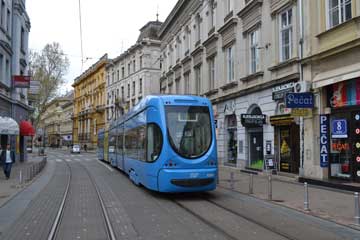
Zagreb’s main square, referred to as Jelacic plac, is a large, busy place with adjacent Ilica Street housing many shops. Croatians use the main square, just down from the hillside settlements of Kaptol and Gradec, to make connections with friends, to catch one of the many street trams pulsating here and there on tracks that run through the streets, or use the square’s large clock as their time-keeper. There are 37 clocks like this throughout the city, all maintained by the sixth generation watchmaker Lebarovic Dalibor, who has manufactured more than 200 public clocks in this country.
The main square, featuring a large statue of Croatian hero Ban Josip Jelacic, has been the commercial heart of the city since 1641. It is so large that fairs used to be held here; the buildings around the square date from the 19th century, and feature Biedermeier, Art Nouveau and post-modernism architectural styles.
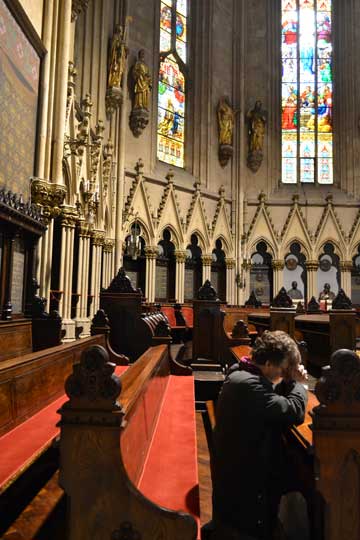
TWIN-SPIRED CATHEDRAL The city’s twin-spired landmark structure in the Kaptol neighborhood is the Cathedral of the Assumption of the Holy Virgin Mary, created by Hermann Bolle in the 19th century after an earthquake badly damaged the original church. In the 15th century it was the furthest outpost of Christianity. Beautiful marble side altars, statues and pulpit adorn the inside, as does the life-like tomb of Cardinal Alojzije Stepinac by Ivan Meštrović. You can’t miss it: it sits dead-center in front of the church near the choir.
While you’re there, notice the adjacent overpowering bishop’s palace with large turrets on the corners. The accompanying lawn features large colored Easter eggs during this season. Not far away, the fortified 13th century Lotrscak Tower in Upper Town, signals 12 o’clock by loud cannon fire and trailing white smoke, as it has every day since 1877. The bells of the stone tower used to summon residents back into the town gates at night before they closed. After watching this display of time-keeping, wander a few steps down the hill to the family-owned Pod grickim topom restaurant, where you’ll be treated to large portions of pork, beef and spaetzle while overlooking the city.
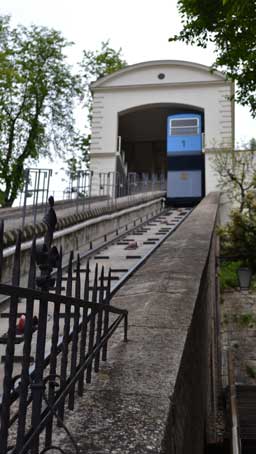
A funicular, the shortest in the world at 216 feet in length, takes you up to Upper Town in 55 seconds. Departing every 10 minutes, it accommodates 28 people each trip. Once powered by steam, the brilliant blue funicular pre-dates horse-drawn trams by a whole year.
At colorful St. Mark’s Church in St. Mark’s Square, you’re in the heart of Upper Town; the square used to be Gradec’s main market area. The 13th century Church of St. Mark’s is a Romanesque structure with Gothic arched ceilings and 15 Parler family statues that stand in the southern portal. The colorful roof is decorated with coats of arms of the triune Kingdom of Croatia, Dalmatia and Slavonia, as well as the city of Zagreb.
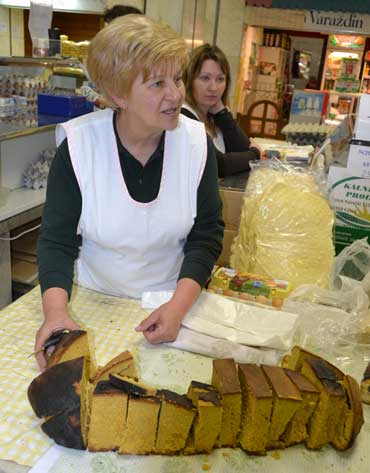
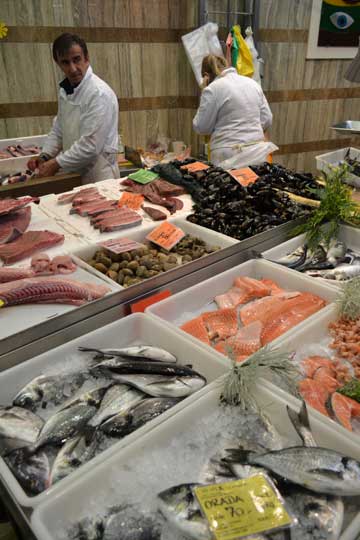
BUSTLING DOLAC MARKET The Dolac open-air market is a must-see, must-do free attraction. Close by the Cathedral, sun-ripened fruit, fresh fish including octopus trucked in from the coast overnight, colorful vegetables and hearty meats, nuts and fragrant spices are sold every day of the week. Known as the “belly of Zagreb,” the market dates from the early 1900s.
Croatia is a religious country, with about 77% of the residents Roman Catholic. The Upper Town is entered via the Kamenita vrata or the Stone Gate, which is the only city gate still remaining. It was built in the Middle Ages, and today acts as a Christian way station for anyone wanting to give thanks, or to make requests. The small chapel inside, dedicated to the Virgin Mary, patron saint of Zagreb, houses a painting of Mary miraculously saved from a fire in 1731. At all times of the day, this small chapel—complete with several wooden benches— attracts worshippers and the curious.
Stop by Zagreb’s oldest pharmacy on Kamenita ulica (Stone Street) where you’ll discover a two-story white building which has housed this business since 1355. And built along the former Medvescak Creek is Tkalca, Zagreb’s colorful downtown street where you’ll find a plethora of nightclubs, small boutiques, traditional shops and cafes. Stop by the Bulldog, an upscale downtown bar where the drinks flow until 3 a.m. from Wednesdays to Saturdays. The decor features aviation and nautical themes, with propeller-shaped ceiling fans, and there’s a mezzanine observation level. A bowl of shelled peanuts to accompany a cool drink doesn’t cost much, either.
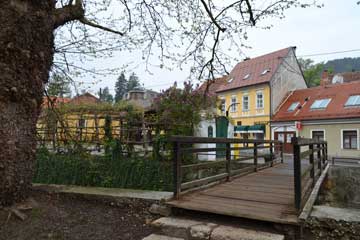
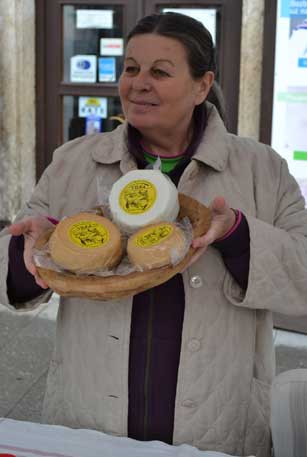
SAMOBOR If you’re heading into the countryside, Samobor is one of Croatia’s best-preserved villages. The light rain and mist which covered the surrounding hills and the Gradna River that flows through them, presented a magical Sunday morning welcome. Local villagers presented their farm-fresh cheeses and honey in the market square, and smiles and free samples were plentiful, as merchants waited until the packed-to-the-rooftop Catholic church let out.
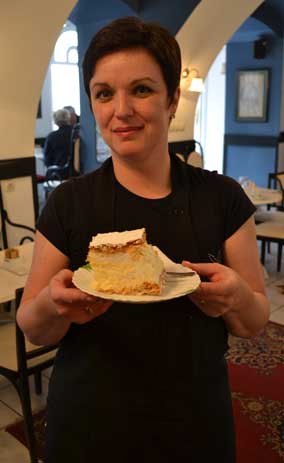
Many other locals were sitting in the Slasticarnica U Prolazu restaurant, having their Sunday coffee and Samoborska Kremsnita, a custard-colored 3 in.-high cream pastry square, a rich-flavored local tradition. Others were strolling down the path on the outskirts of town near the river, enjoying the budding of colorful flowers and trees, and soaking up the fresh fragrances of spring.
Samoborska Dremsnitz – a delicious dessert
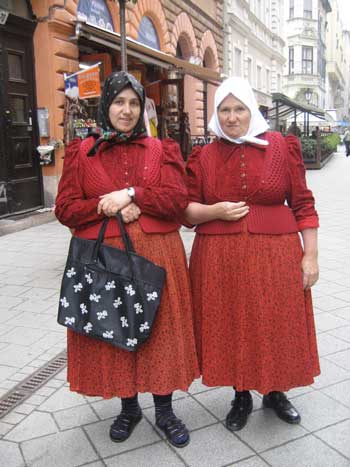
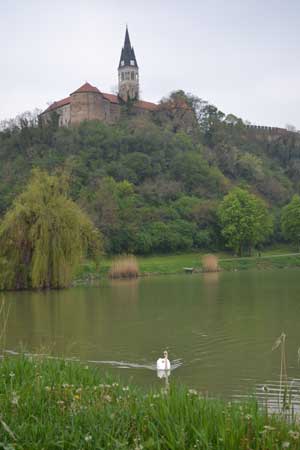
At the Town Museum, check out the intricately-woven folk costumes. Another option is a woodland stroll to the hillside park of Anindol that will take you to the ruins of Samobor’s 13th century castle, which you can see on the hill as you drive down the narrow road into town.
Samobor is also noted for Bermet, a local version of vermouth. This fortified wine, flavored with citrus fruits and aromatic herbs, goes well with crackers and the local Mustarda, a rich brown mustard with a fruity tang. Both the Bermet and Mustarda have been made for generations by the local Filipec family. A tour of their small facility and their shop, guarded by the family dog, will add extra interest to your visit.
Just west of Samobor are the Samobor Hills, a group of forested smooth-topped mountains which make great one-day hikes. The highest point is the 2,883-foot-high Samoborsko gorje, a two-hour walk from Soiceva kuca, a popular restaurant and recreation spot.
VARAZDIN If you have time to explore Croatia further, a trip to Varazdin near the Slovenian border is worthwhile. With its 18th century Baroque churches and the oldest rathaus in Europe, Varazdin is a jewel. First founded because of its Stari Grad, a well-preserved 16th century castle, the town today evokes “oohs” and “ahhs” as visitors discover the Baroque facades. On a clear, sunny day, the town is spectacular.
The city, in fact, was the capital of Croatia in 1756, but fire destroyed 50% of it 20 years later. This gave the city a chance to rebuild in Baroque style, and thus today Varazdin enjoys the benefits of tourism. The city first came to light in 1181 in a document sealed by King Bela III of Hungary. It was granted the right as a free royal city 33 years before Zagreb, the locals are fond of pointing out.
The Town Hall (Gradska Vijecnica) has been the seat of the city’s town council since 1513, making it one of the oldest buildings of its type in Europe. You can sit out in front of the hall on the main square to soak in the sun, or have a coffee, or watch the changing of the guard by soldiers in their tall, black-tasseled hats between May and September.
Zlatko Puntijar shows world’s smallest Croatian recipe book at Stari Puntijar Restaurant
The Cathedral of the Assumption with its magnificent interior became the seat of a diocese in 1997, and is noted as the first Baroque structure in town. Known for its acoustics, the cathedral is used during the Varazdin Baroque Evening Festival in September, where both domestic and foreign soloists and ensembles perform.
Take your camera with you to this picturesque town. The Varazdin countryside produces “Varazdin Sauerkraut” (sour cabbage), pumpkin seed oil, honey, goat and sheep cheeses, and fruit wines with a low alcohol content.
SLAVONIA BROD Stretching to the southeast of the country, Slavonski Brod, on the north bank of the Sara River, and bordering Bosnia, features the star-shaped Brodska Tvrdjava (Brod Fortress). With bastions and moats designed to protect against Ottoman soldiers, this huge embattlement could accommodate 4,000 soldiers. The local peasants built the fortress under a forced work program.
The town features the remains of a number of industries, including a large factory where Croatian steam locomotives were once manufactured. Past examples of the plant’s engines dot the factory entrance.
Memorial dedicated to Bosnian war victims
OSIJEK Moving further into the interior of Croatia and to the east, the city of Osijek is the largest town in Slavonia. Located on the Drava River, the town was founded by the Romans in the first century AD, and after a number of battles, Osijek became the administrative center of the rich agricultural region of Slavonia.
During the battle for independence, it came under siege for several months. A long promenade leads along the river to a large modern suspension bridge which connects Gornji Grad to Copacabana, the town beach.
Close by Osijek is Kopacki Rit Nature Park, a large tract of marshland with many varieties of birds. Located between the Drava and Danube rivers is part of a region called Baranja, with abundant fertile farming land.
For an excellent meal, stop at the cozy restaurant Kormoran, located in the park. Some foods are especially prepared in a large black caldron over an open wood fire, and served at your table. You won’t go away hungry.
CROATIA’S VINEYARDS If you enjoy wine, and touring vineyards, Croatia is “ripe” for the picking. Many of the wines I tasted—both reds and whites— were excellent. Croatia’s vineyards started around the 6th century B.C. in the coastal regions, and as far back as the 2nd century in the interior.
I especially liked the white wines such as Grasevina (pronounced: gra-she-vi-na), a wine cultivated in the countries along the Danube. Light and refreshing, it tastes different than Riesling, and can have slightly different flavors based on soil and sunlight. A bottle of Grasevina found its way home with me. Ice wines are also popular here, and are often awarded gold medals in competition. A 2009 Pinot Crni with 16.5% alcohol content also was a good wine, perfectly balanced.
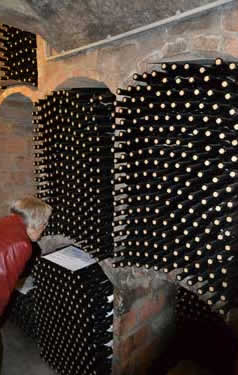
Many of the vineyards I visited offer richly decorated banquet halls, capable of serving complete multi-course meals for up to 100-150 people, along with a variety of wines from their cellars. Winery Kutjevo, with the oldest wine cellar in southeastern Europe (dating from 1232); Belje, the biggest; and Ilocki Podrumi at Principovac all offer a variety of excellent wines. You might find bottles from these vitners in the U.S., although not much is exported.
Croatia is making a solid effort to produce and distribute their many wine varieties, and Zagreb hosts an annual Wine Festival that’s a great wine-tasting opportunity and is packed with visitors.
I found continental Croatia refreshing because of its simplicity, its natural beauty, its tasty foods and wines and its unassuming people. I expect Croatia’s interior to be one of the “hot” travel destinations in the years ahead.
As they say in Croatia, “Zivjeli” — a toast to your good health!
For more information about travel to Croatia, go to: www.croatia.hr/en
















 European Traveler