The People and Places of Bruges

By Don Heimburger
Photos by the author

From the look of the crowds on the streets, it appears everyone has fallen in love with Bruges. And I visited in early April when there were fewer people visiting.

But that’s about the only negative thing you might be able to say about such a beautifully-preserved medieval city. It’s truly a must-see on any tour of Flanders, and you could easily spend several days visiting its wonders.

If Disney could have laid claim to Bruges, he would have: it’s that charming.

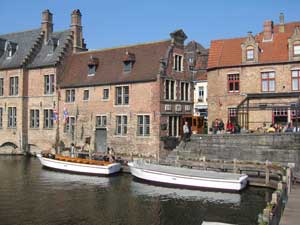
Bruges is easily walkable, but beware the cobblestone walks—make sure you have good walking shoes. Also, plenty of horse and buggies are for hire, or you can take a boat tour of the city or ride in a mini-bus.

UNESCO SITE
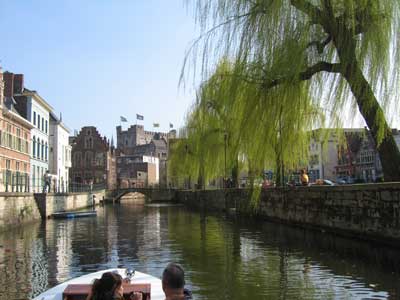
The whole of the city center is a historical landmark, designated by UNESCO as a World Heritage Site, and so it should be. It’s hard not to become enamored with Bruges, its twisting streets and alleyways, its network of canals, and its charm. It’s a complicated network of narrow passageways, brick buildings and waterways, but that’s what makes this city so fascinating. You’ll love it.

VISIT THE BEGUINAGE
In most cases, you’ll cross Minnewater Bridge to enter the Beguinage, founded in 1245. Now populated by nuns from the Order of Saint Benedict, you’ll see the beautiful courtyard garden, where yellow daffodils pop up in spring, the whitewashed house fronts that line the Beguinage, and the peaceful beauty of the area. A posted sign even asks visitors to be quiet and be beware of their surroundings.

THE BELFRY
In case of war—or fire, or anything—the belfry was where it was first noticed. The marketplace is still dominated by this high tower, and it looks out onto the bustling plaza where life comes together in Bruges. You can climb to the top of the belfry (it will cost you 366 steps), and get a good view of the town as well as the two statues in the square, one of Jan Breydel and one of Pieter de Conick, both heroes who resisted the French in 1302.

The Stadsschouwburg is the royal theater building dating from 1869 and is said to be Europe’s best preserved city theater. Behind the Gothic revival architecture is a palatial auditorium and an elegant foyer.

The Little Bear of Bruges, located in a niche in the Burghers Lodge at Poortersloge, a 15th century private club building, is an important city symbol. I tried finding it, to no avail, but perhaps you’ll have better luck. It’s worth a photograph.

Kempinski Dukes’ Palace, at Prinsenhof 8, now an excellent five-star luxury hotel, was a former 15th century Dukes of Burgundy castle, and features 93 rooms, including 22 palatial suites, of which six are historically listed. Each room contains original features from 1429, but they have been completely modernized with elegant furnishings and marble bathrooms, and the hotel offers the latest technology such as flat screen television and high speed internet. Even just a look from the outside at this hotel is impressive; it’s located at the end of a short street, and is easy to miss.

LAST REMAINING BREWERY
Bruges’ last remaining city brewery is De Halve Maan (The Half Moon), established in 1546; their specialty beer is called Brugse Zot, which refers to the nickname of the townspeople, conferred upon them by Maximilian of Austria. You can take a 45-minute tour of the brewery and museum; cost is 5.50 euros.

Churches are abundant and worthy of a look. There’s the Beguinage Church, the Episcopal Palace, the English Convent, Basilica of the Holy Blood, Church of the Holy Magdalena, the Military Chapel, Church of our Lady of the Pottery, and the Welcome Church of Our Lady (see the art collection inside including Michelangelo’s famous Madonna and Child, and the 15th and 16 century mausoleums of Mary of Burgundy and Charles the Bold). Saint James’ Church benefited from the Dukes of Burgundy and the many foreign merchants, and their gifts have left their glittering marks on the interior of this church. A guidebook, which you can pick up at the local tourism office in town or at the Bruges railway station, will sort out these churches and other points of interest for you. www.brugge.be/tourism

The Frietmuseum is all about the Belgian potato fry, located in the Saaihalle. Here you’ll learn all about the history of potatoes, and fries, and the condiments which are served with them. Kids will especially enjoy the fun things this museum offers, and you can even taste fries in the cellar of this medieval 14th century building.

WHAT ABOUT CHOCOLATE?
Belgian chocolates, and their history, are served up in good measure at the Chocolate Museum, a four-story compilation of everything chocolate. The museum explains chocolate started with the Mayans and Aztec civilizations in pre-Colombian Central America, and after adding sugar, was imported to Europe around 1500 AD. Chocolate as we know it became popular around 1800, and as they say, the rest is history. The museum is a must-see in Bruges at Wijnzakstraat 2.

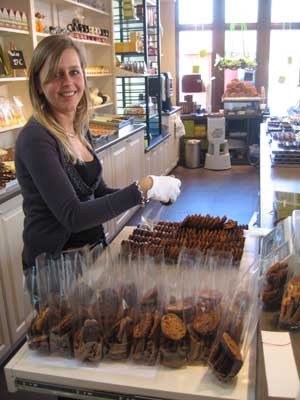
To taste more fine Belgian chocolate, you’ll want to check out The Chocolate Line at Simon Stevinplein 19. Master chocolatier Dominique Persoone, one of the owners, is a dynamic chef with advanced ideas on the making and blending of chocolates and other flavors. Chef Persoone blends chocolate with such tastes as cigars, fried onions and passion fruit. His shop is one of only three chocolate shops listed in the Michelin Guide, and the shop’s customers include such top-notch restaurants as Comme Chez Soi, Oud Sluis and Hof van Cleve. He even has a new book out where he travels through Mexico in search of the origins of cocoa, visiting Maya settlements and discovering the secret of the first chocolate drink and today’s Pozol. If you happen to get to meet Dominique, you will enjoy his demeanor and his chocolates.
www.thechocolateline.be

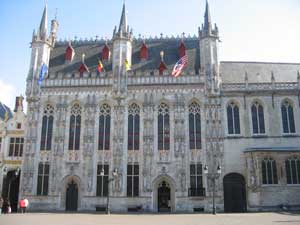
Bruges is also known for its many guild halls, which are scattered throughout the town. Bruges Town Hall, built between 1376 and 1420, is one of the oldest in the Low Countries. A ceremonial staircase leads from the entrance hall to the first floor, where visitors can view the Gothic Chamber. This former council chamber continues to play an important part in the life of the city. The wooden, polychrome ceiling is decorated with a profusion of late-medieval carvings. The murals illustrating Bruges’ past were added during the chamber’s restoration in the late 19th century.

Where to stay? There are dozens of hotels, youth hostels, apartments and bed and breakfasts to choose from. The Bruges Tourist Office can supply a booklet listing these.

Bruges is colorful, inviting and lively, and the food and beer there is some of the best in Europe. You couldn’t find a better combination of history, fun and food. For more information, go to www.visitflanders.us or www.brugge.be

Ghent: From Fallen Angels to Hard Candy to the Great Butcher’s Hall

By Don Heimburger
Photos by the author

From the year 1000 to about 1500, Ghent, Belgium, was said to be one of the most important cities in Europe. It was larger than London, and only Paris was larger in size.

The city was ruled by rich merchant families, from whence came its great wealth. Today, Ghent is still a town rich in history, color and great food and beer. It also helps visitors that as many as 120 new location signposts have been installed to guide tourists to the most important spots in town.

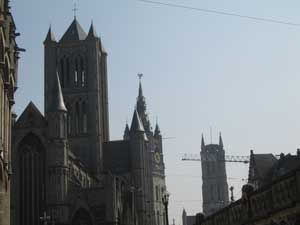
(left) The three towers of Ghent

Walking near the city center, you’re bound to discover features of the city that will amuse or interest you. Stolling along a street not far from Ghent’s impressive Castle of the Counts, I run across a small shop sign that reads, “The Fallen Angels.” The shop is devoted to old things. I like old things.


I hesitate to go in, perhaps not wanting to become one of those things the proprietor’s shingle suggests, but the more I study the front window, the more I determine it’s not only safe to walk in, but intriguing. Intriguing because of all the things that owner Isabelle Steel has gathered over the last 30 years or so for her re-sale shop.

“I started collecting things when I was 16 years old,” she explains. “My father was a painter,” she says, in helping to decipher how she came to appreciate colorful images.

PACKED WITH IMAGERY
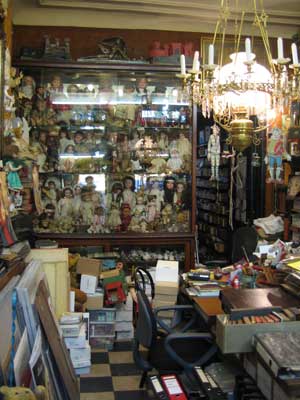
Her very small, quaint shop is packed with imagery in the old kitchen tins, the religious paintings, the thousands of postcards, the picture albums from as early as 1886, the old manufacturer catalogs, and the posters, dolls, toys and trains that pack the place.

Two floors of “fallen angels” material line the walls, the drawers, the flat surfaces of the shop. There is no more room for additional fallen angels. Every cabinet, every inch on the wall has been crammed with attention-getting merchandise.

A sign on the second floor, which is like a small mezzanine and a few steps up from the main floor, reads, “Not more than 3 persons on second floor.” If it could even hold that. Isabelle’s website reads, “For those who require a little bit of nostalgia, this is the place to visit. Here you will find old postcards, devotion cards, old dolls, bears, old toys, tin cookie jars, etc…”

A talkative, friendly person, Isabelle makes customers feel at home in her store, chatting up her goods and keeping an ear to customer conversation that would lead her to a big “fallen angels” find in the future. “A number of my buying customers have something to sell, as well,” she says.

Isabelle and her daughter Ganesha have shops next to each other. Isabelle’s shop has been open for 23 years, and her daughter’s re-sale shop about five years.

Both shops are located in de Jan Breydelstraat nr. 29-31, next to the Castle of the Counts and the Korenmarkt. The Design Museum of Ghent is also located on the same street. For more information, go to www.the-fallen-angels.com.

BELGIAN HARD CANDY ANYONE?
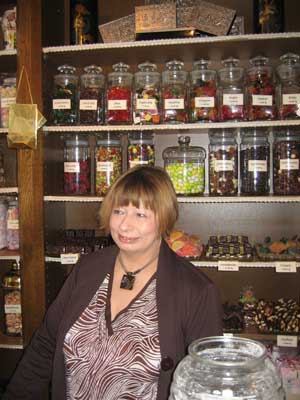
There’s more to Belgian confectionery than chocolate—delicious though it is. For traditional Flemish candy, visit Temmerman (Kraanlei 79)–about eight generations of family members have been making this hard candy. Most popular item is the “cuberdon,” or raspberry nose (red nose filled with sugar), but the tiny shop is stuffed with more than 600 other varieties of sweet stuff. Other goodies include wippers (butter caramel with vanilla sugar), mokken (biscuit with anise) and katrienspekken (hard candy treated with baked sugar).

Another speciality shop is Tierenteyn-Verlent (Groentenmarkt 3, www.tierenteyn-verlent.be), which sells natural mustard made to a centuries-old recipe, and therein lies a tale:  The first great evolution in making mustard took place in the region of Dijon where a farmer tried to crush the mustard seeds with a stone. This didn’t work because there was too much oil in the seeds that prevented the machine from working. He poured a bucket of water on the seeds and found out that mustard seeds had to be wet instead of dry to crush them.
 
This information was brought to Ghent by a soldier of Napoleon’s army who was discussing the mustard principle with an inhabitant of Ghent, Petrus Tierenteyn, who overheard this and decided to start making mustard himself. But instead of yellow seeds used in France, he used dark ones, like in most Germanic countries.
 
The shop was opened in 1790, and the first products they sold were herbs and groceries. In 1842 Petrus installed a steam-powered machine to give power to the mustard mill. From that time, the shop has been owned by the same family.
 

BUTCHER’S HALL
In Ghent’s medieval Groot Vleeshuis Butcher’s Hall (Groentenmarkt 7) next to the River Leie, large wooden beams on the interior of the roof show the strength of the building, and from these beams hang Ghent’s special Ganda hams…they look good enough to eat, and you can sample their ham and other specialties in this old hall. There is no fee to walk in, and the building is wheelchair accessible. The Butcher’s Hall is open Tuesday through Sunday from 10 a.m. to 6 p.m. The hall contains a restaurant called the Promotiecentrum voor Oost-Vlaamse Streekproducten where you can sample East Flemish dishes.

If you’re at Butcher’s Hall, you’re also at the heart of this city of 250,000, and during warm weather, many of the thousands of local university students gather around the Graslei and Korenlei, the old trading harbor, which is now filled with tour boats. In many scenes of Europe, this view along the river, showing many of the old trading houses of the free boatmen and the grain harvesters, is a classic. Another good viewing area of this scene is from St. Michael’s Bridge.

MORE TO SEE
Other top views of Ghent include the Castle of the Counts, an imposing fortress built in 1180. The Gravensteen (the Dutch name for the Castle of the Counts) was built by the counts of Flanders who had castles built in the principal cities of their rule. Because they had to maintain law and order, they moved continuously from city to city and thus had a castle in cities where they wanted to stay for a while. The castle in Ghent is the only one that survived the centuries more or less intact.

The Gravensteen was constructed by Fillips of Alsasse, who was the count of Flanders between 1157 and 1191. He took part in one of the crusades and died during the siege of Akko in the Holy Land. The opening in the form of a cross, above the main entrance gate, proves that he had taken part in a crusade when the castle was built. Next to the castle lies the Veerleplein (Veerle Square), the place where public executions took place.

Another attraction is St. Bavo’s Cathedral in the historic center, the oldest parish church. Astonishingly, it features 22 altars, and the rococo pulpit is a combination of beautiful marble and oak. At the Old Belfry, a dragon scans the horizon, and is perhaps one of the most impressive belfry towers in Flanders. Together with the St. Nicholas tower and the cathedral tower, it dominates the medieval center of the city. The architects were Jan van Aelst and Filips van Beergine. The tower was completed in 1338, when the bells were rung for King Edward II. At the top corners of the towers stone soldiers keep watch (they are copies and only one original is preserved elsewhere).

THE TOWN HALL
The Town Hall at Botermarkt 1 features a rather flamboyant style of Gothic architecture on one side, and a more reserved Renaissance style on the other side. Inside, the same form holds true, with many different styles from different years.

Other attractions in Ghent include the Castle of Gerald the Devil, a 13th century fortress which has been used as a knight’s house, an arsenal, a monastery, a school and a bishop’s seminary. In 1623 it was even a house for the mentally ill.

And if you have a bit more time, visit the House of Alijn, a former house of worship, the Carmelite Friary (which has been restored) and Church, and the Augustine Monastery, founded in 1296.

A new brewery just opened in Ghent as well, with European Traveler a guest on opening night, along with Ghent Mayor Daniel Termont. The Gruut Brewery at Grote Huidevettershoek 10, offers tastes of their delicious beer at the bar within the brewery confines. Mayor Termont is justifiably proud of finding space for the new establishment in his growing city.
www.gruut.be

Where to stay while in Ghent? I stayed at the very convenient Marriott Hotel at Korenlei 10, right in the heart of the historic center and next to the river. It’s next to all the attractions. The hotel features 138 rooms and 12 suites. The glass dome with the large bar-lounge Poppi serves as a cozy meeting place. The hotel’s restaurant is the Korenhuis.
www.marriottghent.com
info@marriottghent.com

Ghent is a city of surprises. Only Ghent residents may know about the “graffiti street,” but that’s another surprise in this city you won’t want to miss.

For more information, go to www.visitgent.be or www.visitflanders.us.

Magical Malta

This Mediterranean country, 58 miles south of Sicily, has everything but a high profile

By Susan MacCallum-Whitcomb

Samuel Taylor Coleridge… Lord Byron… Sir Walter Scott…they all found inspiration in Malta’s legendary landscapes. It was Winston Churchill, however, who summed the place up best when he dubbed it “the tiny rock of history and romance.” 

This three-island archipelago, covering only 122 square miles, certainly is tiny. Moreover, it reputedly has the world’s greatest concentration of historic sites. The romance quotient is remarkably high, too; though for centuries, most who came here couldn’t have cared less. 

St. John’s Cathedral, Valletta
Courtesy of Malta Tourism Authority/www.visitmalta.com

Malta’s strategic location was a far bigger attraction. Positioned midway between North Africa and the European mainland, it lured empire-builders from the ancient Phoenicians and Romans through to the imperial Brits, who prized Malta so much that they stayed for more than 150 years before pulling out in 1964. In their absence, moviemakers -– including those responsible for Gladiator and Troy -– moved in, drawn by a wealth of heritage sites, a camera-ready coastline and a reliably sunny climate. 

Of course, the same attributes that make Malta an ideal filming locale make it an ideal vacation destination as well. As an added bonus, Malta, unlike her more popular neighbors, has an English-speaking population (it’s one of the legacies of Britain’s colonial rule), which means you can roam at will without ever having to worry about language barriers, if you speak English.

KNIGHT FEVER

The logical starting point is the capital, Valletta. The fact that this small harbor city rates as a UNESCO World Heritage site is thanks to the crusading Knights of St. John. After being forced out of the Holy Land by “heathen hordes,” members of the elite order were offered these islands as a new home base in return for one Maltese falcon per year. Happily, the token rent left enough in their coffers to fund a building spree that lasted from 1530 to 1798. 

The results are visible in the Grand Master’s Palace, the opulent Manoel Theatre, Fort St. Elmo (a star-shaped citadel that was still fending off naval attacks in the 1940s), and the over-the-top auberges the knights called home. Even more evocative is their crowning achievement, St. John’s Co-Cathedral: a baroque extravaganza filled with such an abundance of gilt work, frescos, mosaics and paintings (among them Caravaggio’s massive “Beheading of St. John”) that it’s hard to find a bare surface. 

Because of the density of sites within Valletta, it is not uncommon to see tourists  charging brusquely down Republic Street –- from the city gate right to the sea –- frenetically ticking off sites in their guide book. But relaxing also has tangible rewards here. For instance, centuries of foreign occupation have made Malta a culinary crossroad. So you can get a combined course in history and anthropology by merely sitting down to dine! 

Interested in eating your way through the entire curriculum? Try breakfasting on Arab-inspired pastries at Caffe Cordina, Valletta’s landmark coffeehouse on Piazza Regina, then ciao-ing down at La Cave, a 16th-century wine cellar converted into an Italian-style lunch spot. Later, take a break for traditional English tea at Hotel Phoenicia’s Palm Court Lounge; and for dinner pull up a chair at Barracuda, a suburban seafood restaurant housed in a 17th- century mansion.

Traditional Maltese costumes
Courtesy of Malta Tourism Authority/www.visitmalta.com

THE FEMININE MYSTIQUE

While the Knights of St. John were Malta’s best known architects, they weren’t the first. That distinction goes to a Neolithic cult that spent more than a millennium building a mystery. Archeological evidence proves that they began work on a series of megalithic temples about 3800 B.C. It also shows that their efforts were dedicated to the Great Mother: a goddess rendered in clay as a voluptuous woman known simply as the “Fat Lady.” 

The rest remains an enigma because, inexplicably, the Fat Lady began to sing… By 2000 B.C. those who worshiped her had disappeared. As a result, we’ll likely never understand how a people who hadn’t discovered either metal tools or the wheel managed to construct sophisticated structures, complete with archways and corbelled ceilings, on such a colossal scale. Nonetheless, we may appreciate the fruits of their labors, each of which has its own claim to fame. 

On the country’s “big island” (itself named Malta), visitors marvel at the Tarxien Temples, the most richly-decorated of the megaliths; or the twin temples of Hagar Qim and Mnajdra, which are notable for their seaside location. The Hal-Saflieni Hypogeum, conversely, wins top marks for ingenuity: carved from solid rock with antler picks and stone axes, the site extends 36 feet below a suburban street near Valletta. The grand prize, though, goes to the Ggantija Temples on Gozo, a 30-minute ferry ride away. 

(left to right) Msida Church; Mdina Cathedral
Courtesy of Malta Tourism Authority/www.visitmalta.com

Predating Stonehenge and the Egyptian pyramids by 1,000 years, they qualify as the oldest freestanding structures on earth. Such antiquity is difficult to grasp (quite frankly, the centuries-old graffiti is sufficient to dazzle most people). Factor in the sheer size of the stones used in construction – some of which stand 20 feet high and weigh 50 tons – and it is almost possible to believe that the Ggantija Temples were, as their name implies, built by a giantess. 

MOTHER NATURE’S HANDIWORK

As if the mother lode of archeological sites wasn’t enough, Malta has a slew of natural attractions as well. The coastline is justifiably famous for geological oddities like the Azure Window, a towering stone arch encrusted with fossils. A lot of ink is also spent extolling Maltese beaches, particularly one on Rambla Bay where the mythological sorceress Calypso is said to have seduced Odysseus. But, truth be told, most are more like limestone shelves than sandy strands. So they seldom measure up to U.S standards.

The sunbather’s loss, however, is the diver’s gain because the rough terrain extends well beneath the waterline, creating seductive grottoes, dramatic drop-offs, and bizarre rock formations that beg to be explored. Conditions are optimal, too. The Mediterranean is clear here, with visibility up to 130 feet. Water temperatures rarely drop below 55° in winter, allowing for year-round diving. Plus there are dozens of outfitters happy to supply you with equipment or take you out on an organized dive. 

Non-divers can get a glimpse of what lies beneath by signing on for a glass-keeled boat cruise around St. Paul’s Bay, the spot where the apostle was shipwrecked in 60 A.D. Meanwhile, those content to be on the water rather than under it can rent whatever they need at local sports centers. Since all three Maltese islands have them (even Comino, which has no resident population!) getting hold of a kayak, windsurfer or sailing craft is never a problem. 

In this part of the world, though, the ultimate boating experience is also the oldest: namely crossing Valletta’s glorious Grand Harbour on a luzzu. These small, vividly-colored vessels have been plying local waters since the Phoenicians’ time and their prows are still painted with the god Osiris’ watchful eyes. Nowadays the luzzu serves as Malta’s unofficial national symbol. And nothing could be more appropriate in a tiny, waterbound land where myth and history remain inextricably bound.

WHERE TO STAY

Tourist zones around Sliema and St. Julian’s are crammed with upscale hotels. Hilton, Westin, Radisson: all the big names are represented. But for the optimal combination of amenities and location, it’s hard to beat Valletta’s Hotel Phoenicia. Although it is poised right at the city gates and has all the accoutrements of a grand hotel (think marble floors, plush upholstery and impeccable service), bargain hunters can snag double rooms there for as little as 90€ a night off season. Those who fantasize about lounging around a Mediterranean villa may prefer to book a vacation rental though Gozo Great Escapes. Heritage properties with private pools start at 595€ per week, so you can enjoy the high life without paying a high price. 

Spotlight on Lucerne

Lucerne, Switzerland is a great city for pedestrians. A walk around Lucerne, a city of only 57,500 people, is invigorating and beautiful, with the majestic Alps at your doorstep.

Founded as a small fishing village on Lake Lucerne (Vierwaldstattersee) the city (at 1,430 feet), is the focal point of the region, and the most populous city in central Switzerland.

The city is called “the essence of Switzerland” and the “Festival City” with numerous events such as the World Band Festival, Mozart Festival and the Lucerne Festival. There are numerous bridges in the city, with the Chapel Bridge the most famous, built  circa 1300 as part of the city’s fortifications.

The Musegg Wall with its nine towers was built in 1400 after the Battle of Sempach and today it is considered the longest and best preserved rampart walls in Switzerland.

A ride on the many beautiful lake steamers is a must to enjoy the surrounding countryside. Boats leave right from a dock downtown across from the train station (Bahnhof). While in Lucerne, walk through or stay at the 101-year-old historic Palace Hotel and ask for a lakeside room. 

While you are in Lucerne, stop by the Swiss Transport Museum (www.verkehrshaus.ch) and look at all the restored trains, planes, and other forms of transportation. If you have a full day each, also see Mt. Rigi (www.rigi.ch) and Mt. Pilatus (www.pilatus.ch), two spectacular mountains each obtainable by hiking or cog railway. You can take boats, trains or drive to the base of each mountain.

For more information on Lucerne, go to www.luzern.ch.

Venice: Queen of the Adriatic

by Kristi Nelson Cohen
Photos by author

One thousand five hundred years of recorded history, and the magic of Venice, Italy continues to captivate our hearts and please our artistic eye.

Venice was built on the water, and this love-hate relationship has challenged the city from her beginnings. She reaps the rewards of the sea (salt, fish, trade and now tourism) but suffer from this same sea lapping at her front steps, eroding the foundations of this architectural marvel. Venice is a beauty, simply fascinating and mysterious, she is the “Queen of the Adriatic!”

Venice was founded in 421, a result of residents of the Veneto (now, northern Italy) who were fleeing the wrath of the Goths. These Goths systematically looted and destroyed cities en route to Rome. The refuges set up villages in a marshy lagoon, on tiny uninhabited islands, where they were safe from invasion. This settlement became known as Venice.

BYZANTIUM LINKS

Due to its location on the sea, trade links with Byzantium were created, exporting salt, and importing exotic spices and fabrics from the Orient. Ships were able to dock right at the city’s front steps, and Venice began to grow in importance and wealth.

Although known as a trade center, Venetian merchants wanted to capitalize on the tourist traffic of Christian pilgrims traveling from Europe to Jerusalem. In 828 two brave merchants traveled to Alexandria, Egypt where they stole the body of Saint Mark, the evangelist. A massive cathedral dedicated to Saint Mark would be built, placing Venice on the map for Christians.

The first cathedral completed in 832, was built of wood, and, sadly, burned in 976. A second cathedral was built, and then torn down to make room for a third, massive, brick, marble and stone structure.

Construction on Saint Mark’s Basilica began in 1063 and was consecrated in 1094. This is the very cathedral whose intricate glass and gold mosaics, hand-carved stone pillars and impressive domes welcome visitors today.

Saint Mark’s Cathedral frames the western end of the Piazza San Marco. The Correr Museum (partially housed in the newest wing of the square called The Ala Napoleonica -built by Napoleon in the 18th century) stands on the eastern end of the square. Once completed, this building framed in the piazza.

DRAWING ROOM
After building his new wing, Napoleon Bonaparte said “Now, this is the most beautiful drawing room in all of Europe!” The Piazza is open to the sea on one portion of the Southside, adjacent to the Doge Palace, where two massive marble columns stand at the original entrance to the city.

These two columns were erected in 1172 but originally stood at Constantinople. Atop one column is a carved statue of a winged lion (the symbol for Saint Mark) and atop the other, is Saint Theodore with an alligator (Venice’s earlier Patron Saint.)

Today visitors to this magical city built on the water, arrive via the Ponte della Liberta, a two and a half mile long bridge from the mainland. The original bridge, built in 1846, accommodated train travelers only, but an auto bridge adjacent was completed in 1933.

When arriving in Venice by train, passengers disembark at the Santa Lucia Train Station, built in the mid 19th century and remodeled in the 1950’s. Don’t make the mistake of getting off the train at the Venice mainland station, as it is an expensive cab ride to Venezia.

BREATHTAKING VIEW
The train station’s front steps open up to a breathtaking view of the Grand Canal. The San Simeon Piccolo church (1718-1738) with its green copper dome, sits directly across the canal from the station. It is here, a visitor realizes, just how unique this city is, as you watch all the boats busily traversing the waterways.

There are Vaparettos (water buses) carrying visitors, locals and commuters around the city. There are trash boats, UPS boats, grocery delivery boats, personal boats and, yes, the famous graceful and elegant black gondolas with gondoliers sporting their time-honored black-and white-striped shirt and wide-brimmed straw hat.

All commerce and travel around Venice depends on these waterways. Venice is built of 117 tiny islands, connected by more than 400 walking bridges and more than 150 canals. There’s only one small area of Venice that is even connected by the Ponte della Liberta for auto traffic, parking and drop-off.

A visitor to Venice can explore the tiny streets boarder the small canals, without the distraction of noisy scooters and fast driving Italian automobiles. The city consists of a labyrinth of tiny streets and canals, and exploring these areas away from the primary tourist stops is calmingly quiet, romantic and simply enchanting.

THREE MILES WIDE
It’s safe to walk in Venice, and getting around is easier than you might think. Yes, you can get lost, but watch the street signs pointing to landmarks like the train station (Ferrovia), Saint Mark’s Cathedral or the Rialto Bridge, or even the Grand Canal, which will help you find your bearings. The entire city is less than three miles wide, and getting away from the most popular tourist sights will lead a visitor to explore this city’s numerous historic cathedrals, museums, parks and palaces.

The Vaparetto (water bus) is an excellent way to see the city. An all-day ticket (12 Euros) allows you on and off passage for a 24-hour period. Multiple day (3 and 7) or single excursion tickets are also available. There are Vaparetto stops all around the island and down the Grand Canal.

The Vaparetto routes also take passengers to the lagoon islands of Murano (known for Venetian glass) and Burano (known for its colorful houses and lace making). From the train station, take Line #1 or #82 for a leisurely two mile ride down the Grand Canal, as it snakes its way through the middle of Venice.

Lining the Grand Canal are impressive palaces, that offer a glimpse into life as it was from the Renaissance time to Casanova’s day. Remember, access to these palaces was primarily by water, so the highly-decorated front entrance was always along a canal, rather than the sidewalk in the rear.

PINEWOOD PILES
How could these early residents build such impressive structures on a swampy lagoon island? Pinewood piles were driven 25 feet into the solid clay ground before building work began. These pilings were closely packed, free from oxygen which inhibits decay.

Above the pilings came brick and then stone creating damp-proof foundations. Mortar on the exterior of buildings is a special Venetian style, which is porous enough for moisture to evaporate. (Keep in mind, the canal tides rise each day and canal boat traffic causes waves to lap onto these foundations.) Of course, there is decay, but it all adds to the beauty, history, the weathered Bettina.

Everything in Venice is worth a picture! A camera is a must to record your memories, but most importantly take, the time to stop at one of the many outdoor cafes, where you can sit in the sun, sip an espresso, listen to the water and immerse yourself in this historic time capsule. It’s a memory you will never forget! ET

Kristi Nelson Cohen is the owner and operator of Bella Italia Trips, leading guided tours to Italy. She has visited Venice numerous times.

WHERE TO STAY IN VENICE
Hotel Gardena 3 STARS
www.hotelgardenavenice.it

Phone: 39-041-220 5000
This hotel is conveniently located near Piazzale Roma (auto taxi and bus service for the airport). The hotel is only a 5 minute walk from the train station on a small and relatively quiet canal. This is a small hotel (14 rooms) with an exemplary staff.

Hotel Principe: 4 star
www.hotelprincipevenice.it
Phone: 39-0410220 4000
This hotel is conveniently located adjacent to the train station (to the left northeast) and this former palace hotel borders the Grand Canal. This is a larger hotel with numerous amenities and a full-service restaurant and piano bar.

Both of these hotels have easy access to Vaparetto or private water taxi service. To purchase multiple day Vaparetto tickets or the Venice Card, (combination Vaparetto and Museum admission) log onto www.venicecard.com.

To see a complete time table of rail schedules in and out of Venice: Venzia Santa Lucia, log onto www.raileurope.com.

For travel tips, packaged trips to Venice and photos, log onto www.bellaitaliatrips.com.