Mechelen, Belgium, about 15 miles north of Brussels, is a city of about 79,000 that features more than 300 monuments, eight historic Catholic churches and four UNESCO world heritage sights. You can reach the city by a short train ride from the main railway station in Brussels.
Mechelen is worth visiting not only because of its sights, but its people flourish because of a built-in determination and a friendliness that transcends nationalities. Maybe its because the Mecheleners have been perfecting humanity since 500 BC, when the first traces of human habitation of the area were discovered.
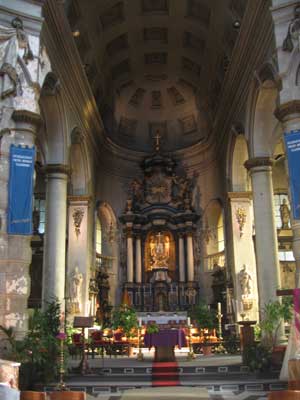
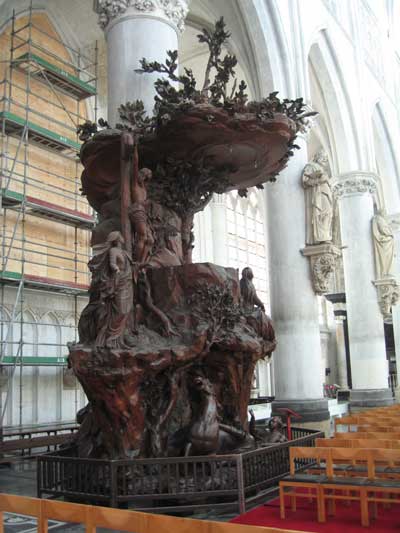
At one time, more than 100 firms in the city made furniture and word carvings, as evidenced by the many large and ornate church carvings seen here. Be sure to look for them as you discover this cobblestoned town, whose city center is only about a half mile across.
Some of the city’s sights include the early Gothic Brussels Gate, the last remnant of the medieval fortification constructed around the inner part of the city, built about 1300. At one time, all traffic entering and leaving had to pass through its limestone gates.
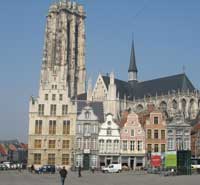
ST. RUMBOLD TOWER You can’t miss St. Rumbold Tower—it dominates the city skyline. If you have the time, conquer the 514 steps to the top of the tower to the skywalk for a great view of the area. Original plans for the tower were made when Mechelen was a rich and powerful commercial and political center, and thus the tower of St. Rumbold’s Cathedral was to become the highest tower in the Low Countries. Completed, it would have reached the dizzying height of 547 feet. Financial problems in the 16th century halted construction. The tower now reaches a height of 318 feet, still plenty tall.
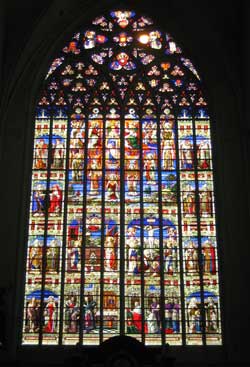
Inside the cathedral is a scale model of what the tower should have looked like had it been completed. Also inside the church are two of the largest stained glass windows in Europe. Jo Haazen and other guest carillonneurs present a carillon concert at the church every Monday evening from 8.30 p.m. to 9.30 p.m. These recitals are free.
A third highlight of the city is the Large Beguinage, where widows and unmarried women of class were invited to live together, submitting themselves to pledges of obedience and chastity. Parts of this community are still visible and are inter-woven into the city’s many old structures that line narrow streets in the center. Still in tact are the Beguines’ church, the infirmary, the house of the grand mistress and other structures.
(middle) One of the largest stained glass windows in Europe in Mechelen’s cathedral.
PALACE OF MARGARET OF AUSTRIA Another important site is the Palace of Margaret of Austria of the Court of Savoy. This was the first renaissance building in the Low Countries and perhaps outside of Italy. The facade features Margaret’s coat of arms, and between 1616 to 1795 it was the seat of the Great Council. Its interior garden area is a fine place to rest your feet for a while.
Another spot worth visiting is St. John’s Church, which is open to the public. A very fine wood carving on the interior is one of Ruben’s masterpieces, The Adoration of the Magi. The church furniture, paintings and statues date largely from the 17th and 18th centuries.
For a respite from walking or touring the city, find Windels at Iron Leen 48 (not far from the main railway station), the oldest cigar store in Belgium (from 1875) that continues to make fine cigars, and offers them in beautiful hand-made wooden boxes. The store, now being run by the fifth generation of Windels, also carries a good selection of whiskeys.
The Jef Denyn Royal Carillon School, at Frederik de Merodestraat 63, is a state-subsidized educational institute that offers a six-year program to obtain a laureate’s diploma. Even the Vienna Boys Choir visited the school during the last few years. When you realize Belgium is one of the carillon capitals of the world, this school makes sense, and attracts students from as many as a dozen different countries. The heaviest carillon in Belgium—there are five different carillons in town–is in one of the local church towers.
The Jef Denyn Royal Carillon School in Mechelen
The De Wit Royal Manufacturers of Tapestry, operating since 1889, is the only workshop in Flanders to retain this age-old tradition. Offering a complete range of tapestry services, the firm offers individual tours on Saturdays at 10:30 a.m. and group tours on other days. The De Wit is housed in a beautiful old Abbey at Schoutetraat 7, and plays a key role in many old and expensive tapestry restorations throughout Europe.
TIME FOR SOME CUCKOO Perhaps at lunch time you’ll want something unique and that is a local delicacy. Find a restaurant that serves the town’s famous Mechelse koekoek, or Mechelen cuckoo (chicken). This chicken, with black-gray feathers, is a feature on many local menus, and is often served with fresh vegetables or with a Mechelen beer sauce. You’ ll likely get a large side dish of round roasted potatoes to go with the chicken.
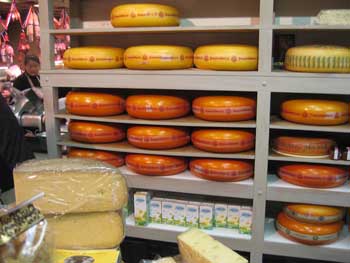
Delicious cheese lines the shelves in a Mechelen shop.
After lunch, stop in at one of the two local Gauthier chocolate shops (one is at Guldenstraat 2), and soak in the atmosphere. Store candies are hand-made, made from traditional Belgium customs, and follow a unique recipe, so you’ll likely leave with a bag full of something good to eat. The Gauthier family, with master chocolate maker Edouard Gauthier, has been making candy in town since 1964.
Round out your afternoon with a boat trip on the Inner Dyle River. A multilingual audio-guide tells you about the sights along the river banks. The departure is at the Jetty at Lamot/Haverwerf and costs €6 for adults.
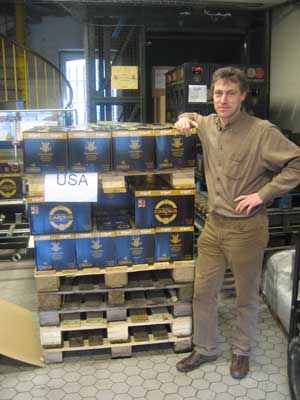
MUCH MORE TO SEE Many more Mechelen sights are available if you have the time, such as the Watchmaker’s Museum, the Jewish Museum of Deportation and Resistance, the Museum in City Hall (the old Rathaus), and the Het Anker Brewery Museum. At this small family brewery, best known for its local beers such as Gouden Carolus, you’ll get a feel for quality. The brewery also has its own restaurant and 22-room hotel.
Around the year 1500 more than 100 breweries operated in Mechelen, but like most things, the businesses and other important history of the city has faded over time. But this quaint Belgium town continues to re-count its traditions and rich past, and brings it forth today for all to enjoy.
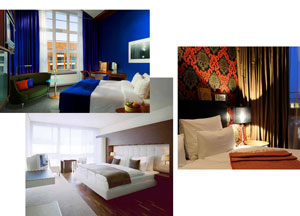
The cities belonging to Germany’s “Magic Cities” association, including Berlin, Cologne, Dresden, Duesseldorf, Frankfurt, Hamburg, Hannover, Leipzig, Munich and Stuttgart are centers of art, architecture, history and culture. Discover some of the newest additions of designer hotels that these cities offer:
In Berlin, the Soho House concept is being implemented for the first time in Germany. Stylish branches of this chain can already be found in London and New York. In the former “House of Unity” at the foot of Prenzlauer Berg, the hotel has 50 bedrooms. The luxurious fitness area, modern conference rooms and hotel with spacious apartments on the third and fourth floor will be open to all visitors. There will also be an exclusive area for club members only. Another highlight is planned on the second floor, where the office of the former State President of the GDR, Wilhelm Pieck, is being restored to its original condition.
Cologne
In Cologne, one hour from Frankfurt on the Rhine River, there is a new four-star hotel, Art’otel Cologne, in a prime location on the banks of the Rhine. Alongside the trapezoidal design and the colorful windows, the chief attraction of the hotel is the art-inspired interior design with a permanent exhibition of the works of the Korean artist SEO, a former master student of Georg Baselitz. The hotel has 218 rooms with a special twist: the glass walls partitioning the bath or shower rooms are colorfully painted with some of the best of SEO’s designs.
Duesseldorf lives up to its artistic reputation (Academy of Arts) with its own new designer hotels. The Stage 47 Hotel features a completely new, unique design. All 27 suites and rooms are named after famous artists. Their portraits adorn the walls of the individual rooms, creating a special atmosphere. British elegance combined with unpretentious comfort describe the Sir & Lady Astor hotels. Lovingly arranged details and charming decorations as well as discreet, attentive service give guests a feeling of a homecoming.
Dresden, the royal metropolis on the River Elbe in the eastern state of Saxony, has been restored to one of the most beautiful Baroque cities in Europe. Dresden offers beautiful architecture, world-class art and a variety of luxury hotels. A perfect example for the modern reinvention in the classic tradition is the QF Hotel, perfectly located near the Church of Our Lady in the heart of Dresden. The hotel, formerly the “Hotel Stadt Berlin,” has been known since 1804 as one of the best hotels in the city. The 96 rooms combine comfort and luxury with a clean and modern design.
Frankfurt, the financial metropolis in the middle of Germany, is not only the major airport hub, but also a fascinating city where great history meets modernity, world class contemporary art museums and galleries are placed alongside cultural giants such as Goethe. A new highlight of the hotel scene is the Roomers design hotel in the city center. This luxury hotel combines classic lines and innovative design in its 117 rooms.
Hamburg: The designer hotels in this port city combine themed interiors with the comforts and conveniences of the highest standard. Hamburg is also where you’ll find Germany’s highest-rated boutique hotel. The Side Hotel combines luxury and design with aplomb. This award-winning five-star establishment is characterized by a minimalist interior of dark wood and beige elements illuminated by unique lighting.
The George Hamburg holds an entirely different appeal as a four-star hotel with British charm. Rooms furnished in warm colors, an elegant library and an English Garden are all part of its homage to British style.
Hannover, in Germany’s north, has a long history as a royal seat of the English kings and queens, but also as a modern city that hosts many world-class conventions. A special place to overnight is the Sheraton Pelikan Hotel. Located in the former Pelikan factory, one of the most famous brands of fountain pens, the architects integrated the architecture of the old production facilities into the hotel design to create a distinctive loft atmosphere.
Leipzig
Leipzig, one of the most exciting cities in eastern Germany, invites visitors to stay in style in the newly-redesigned Pentahotel. The hotel was given a complete makeover in 2009 by Italian star designer Matteo Thun. The 356 new stylish and comfortable rooms have 32″ flat screen TVs, iPod or game consoles like Nintendo Wii, and other features catering to the needs of the modern and tech-savvy traveler.
Munich in southern Bavaria is known for its royal splendor. The new Louis Hotel that opened in September 2009 fits right in. The name Louis is intended as a reference to the appreciation of beauty as professed by King Ludwig II of Bavaria. Located in the heart of Munich, globetrotters will feel at home in the 72 rooms with carefully selected details and handcrafted furnishings. Natural stone and elegant tiling are reminiscent of the Parisian Metro and make the rooms an unforgettable experience.
Stuttgart
Stuttgart, home to the iconic car brands Mercedes and Porsche, now offers a very special experience for motorsports enthusiast. The V8 Hotel opened last fall and offers everything for high-octane car lovers. Individually designed rooms, antique and unique car models make this hotel a great experience. Its Bauhaus style combines function and comfort.
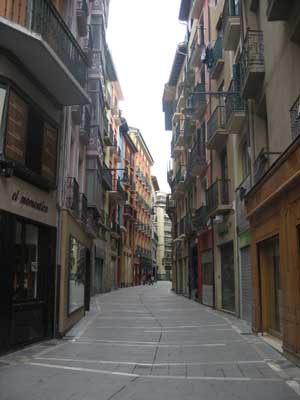
Since ancient Pamplona could not build outside of the city walls, expansion had to be up, resulting in tall, narrow buildings. During the Fiesta de San Fermin the bulls run here on Estafeta Street, where there is no excape for the runners except in the doorways of the buildings.
By Marilyn Heimburger Photos by Don and Marilyn Heimburger
Mention Pamplona, Spain, and most people will respond, “Oh, the running of the bulls!”
Although the Fiesta of San Fermin (July 6-14), made known internationally by Ernest Hemingway’s novel The Sun Also Rises, is Pamplona’s most familiar claim to fame, the city boasts many other reasons for tourists to visit, even when the bulls aren’t running.
Pamplona is the capital city of the region of Navarre, a beautiful and diverse area in northern Spain, bordering France along the Pyrenees Mountains. It is just one hour by air and a little more than three hours by train from Madrid. Barcelona is a three and a half hour train ride away.
WHERE TO START Once you’ve arrived and settled into your hotel (the city has one five-star, eight four-star and 20 three-star hotels) start your walking tour at the heart and soul of the city, the Plaza del Castillo.
This tree-lined square was named after the 14th century castle which used to be at one of its corners, and was the site of bullfights from the mid-14th century until 1844 when a bull ring was constructed. Now it has a bandstand in the center and is a popular place for leisure activities and for meeting friends. Cafes line the square, and the streets leading from the square are filled with tapas bars and small shops.
The Cafe Iruna, which looks out onto the Plaza del Castillo, was a favorite meeting place of Ernest Hemingway. It includes the Hemingway Bar, where a life-sized statue of Hemingway leans on the counter, awaiting your Kodak moment. This large cafe was the first location in Pamplona to install electric lights. With its mirrored walls and mirrored mosaic trim bordering the ceiling, the cafe demonstrated the new lights in 1888. Residents gathered inside with anticipation, and as the electric lights were turned on, they rushed in terror to the exits, suspecting witchcraft was responsible for the illumination. The cafe remains an everyday meeting place for the locals. A two-course meal with dessert and beverage costs 13 euros. Or just have coffee while you plan the rest of your route.
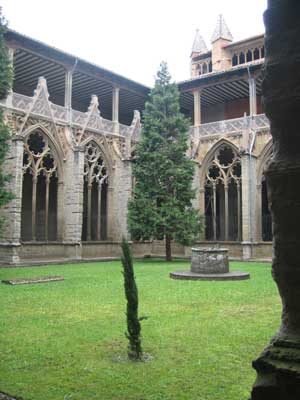
SEE THE PAST IN THE PRESENT Be sure to visit the Cathedral of Santa Maria, in what was the old Borough of La Navarreria. Look for the magnificent alabaster tomb of King Carlos III of Navarre and his wife Eleanor, the 16th century stained glass windows and the 13th-14th century Gothic cloister, which is considered one of the finest in Europe. When the church’s ancient Romanesque exterior collapsed, it was replaced during the 17th century with a Neo-Classical facade, hiding the French-Gothic interior. The figure of Mary in the main altar under the silver canopy has been nicknamed “Mary of the Adopted Child,” since the child in the sculpture is a replacement for the original, stolen during the 16th century. For that reason many families present their adopted children here.
If you visit during the spring, notice the blossom-filled chestnut trees that surround the cathedral. In the fall, pick up a fallen chestnut and put it in your pocket. Locals believe carrying the chestnut will protect you from aches and pains in your bones!
The fortified Church of San Cernin from the ancient borough of that same name also boasts a Gothic interior. The Pocico on the outside of the church marks the location of the well where San Cernin baptized the first Christians in Pamplona. Among those baptized was San Fermin, the son of a Roman general. He became a bishop and was eventually beheaded, giving some historic significance to the red scarves worn around one’s neck during the Fiesta of San Fermin.
The Church of San Nicolas, another fortified church from the 12th century, features a watchtower, a Gothic interior, and the largest Baroque organ in Pamplona.
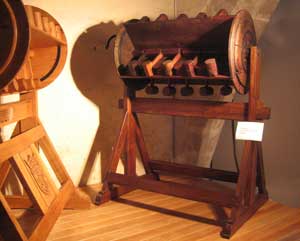
Gothic cloister of the Cathedral of Santa Maria.The racket made by turning the crank of this wooden noisemaker still serves as the “Call to worship” at the Cathedral when the bells are silenced from Good Friday until Easter morning.
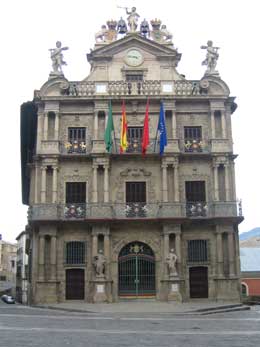
UNIQUE TOWN HALL The Town Hall with its remarkable Baroque facade was built between 1753 and 1759 to replace the old one from the 15th century, which was falling into ruin. The launch of a rocket from the upper floor balcony at noon on July 6th each year marks the official beginning of the Festival of San Fermin.
The Navarre History Museum is worth the two-euro cost of admission. A short walk from the Plaza del Castillo, the former 16th century hospital, houses art and archeological exhibits which are arranged from the Prehistoric and Roman ages in the basement through the 20th century on the fourth floor. Included in the collection are intricate Roman mosaics, a Spanish-Muslim casket from the Monastery of Leyere and a painting by Goya.
Pamplona’s town hall — a rocket launched from the upper floor balcony marks the beginning of the Fiesta de San Fermin.
WALK THE BULL ROUTE The route that the bulls run during the Sanfermines is much easier to see without dodging the bulls. Since medieval times the bulls have been driven through the streets to where the bullfights are held, first to the Plaza del Castillo and then to the bullring.
Follow the 1/2-mile route from the corral at the base of Santo Domingo Street to the niche in the wall holding a small statue of San Fermin. Here the runners pause and sing to San Fermin, asking for protection.
Continue up the street to the Town Hall Square, where the area is wider and runners have many places to escape. Make the 90-degree turn where the bulls often slip and fall, onto Estafeta Street, and look up at the second floor balcony of the Gran Hotel La Perla, from which Hemingway watched the action. Here the route is narrow and the only escape from the bulls is in the doorways of buildings.
At the end of the street the route slopes slightly downhill and narrows through wooden fences that funnel the bulls and runners into the bullring. During the few minutes that the bullrun lasts, all stoplights are kept at red to allow quick passage of emergency vehicles, should they be needed.
ONE MILLION VISITORS One million people come to Pamplona for the Sanfermines, which opens with a rocket blast from the balcony of the Town Hall at noon on July 6. The bulls run every morning at 8 am from July 7-14. Viewing space on private balconies lining the route can sell for 150 euros per tourist per day. Of the 6,000 runners, on average each year three people are gored, 80 injured and one dies about every 10 years. The runners are dressed in white with a red scarf around the neck, and carry a rolled-up newspaper to hold in front of the bull’s eyes, in case they get too close. A Sanfermines museum is being planned for 2012, so tourists can experience the July event throughout the year.
Pamplona’s Plaza de Toros (bullring) is the third largest in the world, after those in Mexico City and Madrid. The caretaker of the bullring lives year-round with his family in an adjoining house. This “concierge of the bull ring” takes great pride in keeping the building and grounds in beautiful condition, including the small chapel where the bullfighters kneel and pray before entering the ring. Tickets to the bullfights, held each day during the week of the Sanfermines, range from 400 euros in the shaded seats to 10 euros in the sun. Rumor has it that those in the sun usually have more fun partying than those watching the bullfight from the expensive seats. The money collected from ticket sales goes to charity, as does half of the meat from the bulls, which are butchered on site after the fights.
The chapel where bullfighters pray before entering the ring.
Outside of the bullring stands a statue of Ernest Hemingway, who made the Fiesta of San Fermin and the running of the bulls internationally famous. On the morning of July 6, the opening day of the Fiesta, a group of young people traditionally tie a huge red scarf around the statue’s neck, declaring that the festivities can now begin, since Hemingway has joined the party.
DRAMATIC STATUE The Encierro statue, which vividly depicts the excitement of the running of the bulls, is located a short walk from the Plaza del Castillo, in modern Pamplona. First erected with fewer figures, the statue was so well received that the artist was asked to add to it. The enlarged statue was completed in 2006. The artist put his own face on the figure in the front, about to be stepped on by the bull.
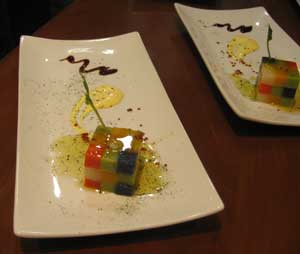
TASTY TAPAS Known here as “pinchos” (the Basque word for tapas) these tasty, unique small portions of seafood, vegetables, meat and pastries are served in bars on the streets that fan out from the Plaza del Castillo. Although pinchos are available all day, eating dinner late is the norm here, so after 9:30 p.m. wander in and out of the small bars and sample a variety of the offerings while standing at the bar with a glass of wine. Many of the recipes are award winners in local and national competitions. Look for the framed certificates proudly displayed on the walls. Baserri won first place for its vegetable Rubik’s cube. Bar Gaucho is also popular with the locals. An award-winning pincho in the “textures” category features slow-cooked salmon topped with a paper-thin loop of raw white asparagus.
Baserri’s award-winning pincho, the vegetable Rubik’s cube.
FINE DINING Pamplona and the region of Navarre boast three restaurants with a one-star Michelin rating. One of them is Rodero, located near the bullring and offering a creative tasting menu of an appetizer, three starters, two second courses and two desserts for around 60 euros.
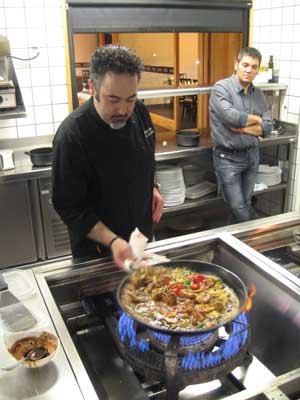
Relatively new to Pamplona is La Mar Salada, featuring chef Martin Iturri, who worked briefly in Chicago with the Lettuce Entertain You organization. His tasting menu, including two types of paella, a rice dish, is outstanding.
Chef Martin Iturri prepares paella.
A BIT OF HISTORY Originally a Vasconian settlement called Iruna (meaning “city”), Pamplona was named after Roman General Pompey, who founded the city in 75 BC, complete with drains, walls, moats, public baths, temples and houses. Remains of the Roman baths were recently found under the streets of the old quarter while upgrading the town’s infrastructure.
Occupied by Visigoths and Muslims between the 6th and 9th centuries, the Kingdom of Pamplona was founded in the 10th century by the city’s nobles. The city grew during the next two centuries primarily because of the steady stream of pilgrims trekking over the Pyrenees Mountains through Pamplona to the tomb of St. James at Santiago de Compostela. Travelers who decided to stay in Pamplona, and French traders and free artisans who came to provide services for the pilgrims, founded the Boroughs of San Cernin and San Nicolas. These two boroughs, along with the Borough of the Navarreria, which was inhabited by the locals, were each surrounded by walls, had its own fortified cathedral, and was governed separately.
In 1423 King Carlos III ordered walls between the boroughs to be removed, unified their outer walls, and built a city hall where the current 18th century city hall now stands. Pamplona became a fortress city with the construction of a Citadel and was a stronghold for defending Spain against France. The Citadel, considered the best example of Spanish renaissance military architecture, is now the site of beautiful parks and gardens. More than three miles of the medieval walls are still in beautiful condition, inviting a walk through historic gates, to ancient bastions and over bridges.
Expansion outside of the city walls didn’t begin until the end of the 19th century. Until then, growth within the walls meant not more but taller buildings, an unusual sight in Spanish cities, where 2-3 story structures are the norm. You can see these tall and colorful buildings in the old quarter along the streets that fan out from the Plaza del Castillo.
The symbol of a shell identifies the hostel where pilgrims can spend the night for six euros.A pilgrim from Canada with her credentials for walking the Way of St. James.
PILGRIMAGE PATH THROUGH PAMPLONA The Pilgrim’s Way to St. James (Camino de Santiago) has passed through Pamplona for centuries. According to legend, the body of St. James the Apostle was brought by boat to the “end of the western world,” after he was beheaded by in Jerusalem in 44 AD. It is said that his body arrived in the boat covered in scallop shells, and was buried in secret in Compostela, forgotten until re-discovered in 812. Compostela became an important pilgrimage site, with the number of pilgrims reaching its peak in the 12th century.
In the 1980’s interest in the Way to St. James rebounded. A total of 82,000 pilgrims are expected this year because the Feast of St. James (July 25) falls on a Sunday, an event which doesn’t happen again for 11 years. Pilgrims register their name, age, country of origin, and motivation for making the pilgrimage, and carry a credential, which is stamped each time they reach the next destination on their trek. Once spring begins, pilgrims can be seen throughout Pamplona, wearing hiking shoes, large backpacks, and carrying the symbolic scallop shell somewhere on their load. The pathway is marked with the shell symbol and yellow arrows. Hostels provide a place to sleep along the way for a few euros a night.
GREEN CITY Pamplona, with a population of 180,000, is very proud of its parks, which comprise more than 20% of the city. In fact, the city claims to be the greenest city in Spain, with almost 34 square yards of green space per resident.
An English-style garden (the largest park in the city) is built on the facing of the Citadel. The interior of the Citadel houses the Ciudadela Park. There you’ll find an open-air sculpture museum and military buildings housing art exhibitions. Taconera Park is on a bastion of the ancient walls, and contains a zoo (yes, a zoo) within the moat.
In addition to many other parks, including a Japanese garden, there is a 7-1/2-mile walking path along the Arga River with areas to picnic and fish. Most are easily accessible by foot from the old quarter, ready to explore and enjoy.
EXCURSIONS OUTSIDE OF PAMPLONA The region of Navarre offers diverse landscapes and opportunities for excursions outside of Pamplona, from the Pyrenees in the north to desert in the south.
The 13th century Romanesque Church of Saint Mary of Eunate is located southwest of Pamplona toward Estella, on the Pilgrim’s Way to St James. The origin of the peculiar octagonal stone building is unclear. Some legends connect it with the Templars, some as a shelter or hospital for 13th century pilgrims, many of whom appear to have been buried there. Some attribute to it the same mystical energies as that of Stonehenge and the pyramids. It continues to be a popular stop for pilgrims today.
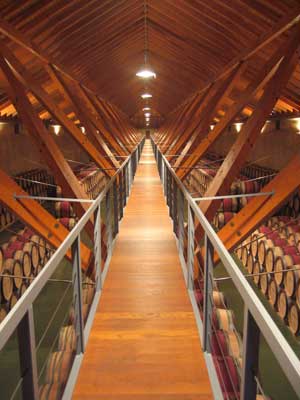
HOW ABOUT A WINERY TOUR? Navarre is known for its fine wines. The Arinzano Winery operated by the Chivite family has been awarded Pago status, which is the highest level of wine in Spain, an achievement shared with only four other estates in the country. The beautiful estate and winery lies along the Ega River, and is open for tours.
The Arinzano WineryChef Jose at Restaurante Principe de Viana serves vegetables harvested that morning from his market garden.
The area around Tudela, about 60 miles south of Pamplona, is known for its market gardens, producing excellent vegetables from the rich soils in the flood plain of the Ebro River. Visit Restaurante Principe de Viana in Murchante, where Chef Jose Aguado prepares vegetables harvested that morning from his family’s garden. A local specialty served only in April and May is menestra, a vegetable stew with asparagus, artichokes, lettuce hearts, peas, beans and chunks of ham.
Menestra, a vegetable stew served only in April and May, is a local specialty. Photo courtesy Restaurante Príncipe de Viana
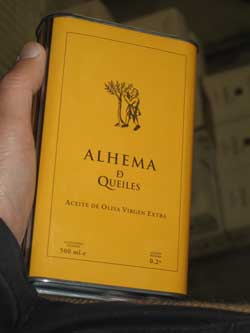
OIL FROM OLIVES It is a little known fact that Spain produces more olive oil than Italy. To find out how it’s done, visit Hacienda Queiles, an olive oil producer in the Tudela area, that prides itself on green technology and excellent quality. Its olive oil is sold in the United States at Dean and DeLuca, Williams Sonoma and Whole Foods. Tours are available for individuals, families, or groups; e-mail Juan.barral@haciendaqueiles.com
Olive oil from the Hacienda Queiles
WHERE TO STAY The city’s only five-star hotel is the historic Gran Hotel La Perla, ideally located in the heart of the old quarter on the Plaza del Castillo. Ernest Hemingway stayed here each time he returned to Pamplona. In fact, his room (which was number 217 until the hotel was extensively remodeled and renumbered to 201) is still as it was when he stayed in it. His balcony overlooks Estafeta Street, where he watched the running of the bulls without leaving his room. Only the bathroom has been enlarged and modernized. Other celebrities, including Orson Welles and violinist Pable Sarasate, also stayed here.
Owned by the same family for three centuries, the hotel’s renovated lobby of glass and stainless steel with white marble floors and stairways is punctuated with antiques from its earlier days: among them an original switchboard, mailbox, and the first elevator in Pamplona, which was still in use until 1991. The hotel also purchased some furnishings, including wooden chairs now in the hotel library, and original recipes (still used with some personal touches) in the hotel restaurant, La cocina de Alex Mugica, from Hemingway’s favorite restaurant when it closed.
Among Pamplona’s eight four-star hotels is the elegant Palacio Guendulain, built in the 18th century palace of the Viceroy of New Granada. Located a short walk from the Plaza del Castillo, it was the residence of the Guendulain family (now living in Madrid) for over two centuries until the end of 2008, and opened as a hotel in September 2009. It has 25 guest rooms, a lounge bar and facilities for meetings and events. Some of the guest rooms use furnishings original to the palace. The carriage on the hotel logo pays homage to the exquisite gilded carriage, also original to the palace, which is on display in the lobby.
Antique switchboard from earlier days at the Gran Hotel la Perla
SLEEP IN A PALACE The Royal Palace of Olite is a beautifully restored 15th century palace, part of which is now a Parador, or hotel. It was commissioned by Carlos III, the king of Navarre who unified Pamplona, and whose alabaster tomb lies in the Cathedral of Santa Maria. It was one of the most luxurious palaces in Europe in its day and contains a hanging garden designed for the king’s wife. Stay in the palace overnight, or for a delightful day trip from Pamplona, take a tour of the palace and the adjoining chapel of St. George, and eat your midday meal at the Parador restaurant.
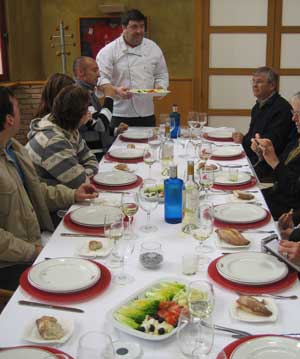
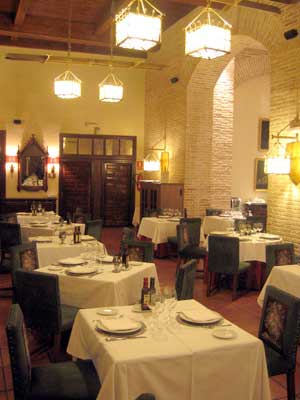
Restaurant at the Parador of Olite
LOCAL GUIDE For an English-speaking tour guide who can lead you through Pamplona with insight, humor and local anecdotes, contact Francisco Glaria with Novotur guias.
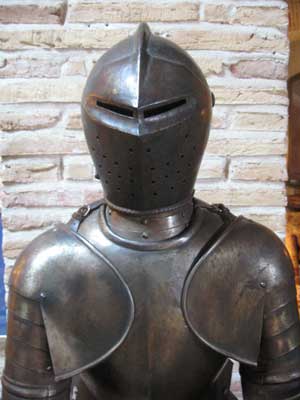
A knight in armor stands guard at the Parador of Olite.
TRAVELING THROUGH MADRID? If you stay overnight in Madrid at the beginning or end of your Pamplona adventure, stay at the Hotel Meninas, located a short walk from Madrid’s Royal Palace and the Madrid Opera House. The adjoining El Cafe de La Opera features professional opera singers who serve you and perform arias while you enjoy your meal.
Trains in Germany are fast, clean and on time. The comprehensive system that includes high speed trains, regional express trains, local trains, street cars and even buses, is so convenient that in the almost two dozen trips I’ve taken to Germany and bordering countries, I’ve never rented a car to get where I needed to be. But I have picked up some tips to make your train travel much easier.
For maximum flexibility in rail travel, a rail pass from Rail Europe is the way to go. Passes can be purchased for the number of days you need to travel over the course of a determined period of time. You must purchase your pass before leaving your country of origin.
On a recent two-week trip, which included a week-long river cruise in central Germany, I traveled by train before and after the boat trip. So my rail pass was for exactly five days of train travel (any days I chose) over the course of one month, starting on the day the pass is validated. Before boarding the train, fill in the date, have your passport with you on the train, and your ticket is valid for travel all day, on as many trains as you like. Some express trains may require an additional reservation fee; ask an agent if you’re unsure.
FIVE DAYS OF TRAIN TRAVEL After landing in Frankfurt, I used the first of my five days of train travel to go from the airport to the main Frankfurt train station. Trains leave from the airport to the Frankfurt Hauptbahnhof every few minutes. From the train station I could walk to my hotel. Since the main train stations of major European cities are usually in the historic town centers, you can usually walk to most of the “must see” historic destinations. The historical centre of Hamburg, which is North of Frankfurt, is situated between the Main Station and Gansemarkt and there’s a variety of hotels available if heading that route. Sometimes bicycles are also available for rent from Deutsch Bahn train stations.
The next morning I again filled in the date on my rail pass for the day’s travel, which included an S Bahn train to Mainz, a regional express train to Saarbrucken, a Regionalbahn train to Merzig, and finally, a bus to Remich, Luxembourg, where the river cruise began.
The following local trains are available in Germany:
RegionalExpress (RE) The RegionalExpress connects cities and offers travel in comfortable modern trains. It leaves at regular intervals and links local to long-distance trains. Regionalbahn (RB) The Regionalbahn offers a basic service from all local stations. It provides the connection between the regions and city centers. It also connects to the RegionalExpress. S Bahn The S Bahn services high-density areas, leaving in quick, regular intervals. Some S Bahn stations have access to longer distance regional trains, making travel within the city and between cities easier.
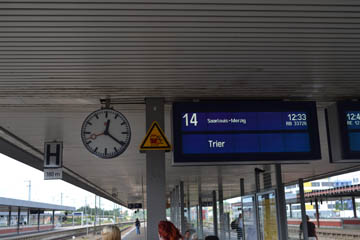
How do you find the right train? The very large train stations will have electronic signboards listing train destinations, the track (Gleis), and time of departure. If your train isn’t listed, wait a few minutes, and check again. The board is constantly updated as trains come and go. It will also list delays and cancellations. At smaller stations, a list of daily arrivals and departures is printed on signage on the platform. Go to the correct track number, and check the sign on the platform to make sure your destination is listed. Then keep an eye on the clock (there’s usually one on the platform at most midsize and major train stations) and watch your train arrive, usually right on time.
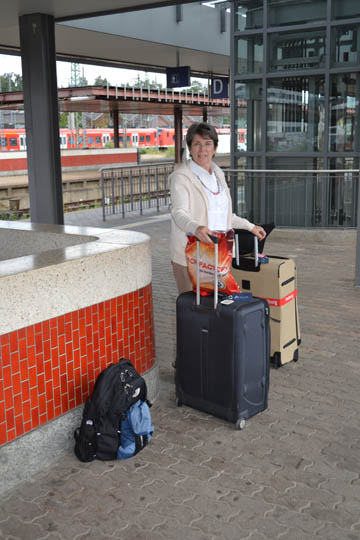
If your rail pass is for first class travel, as the train arrives, look for the cars with a number “1” on the side, indicating first class seating. While even second class sections are comfortable, first class is usually more luxurious, air-conditioned and roomier. Layover time at a station is often short, so it’s important to board quickly. You can move to the first class seating area once you’re on board, but it’s harder if you have a lot of bulky luggage.
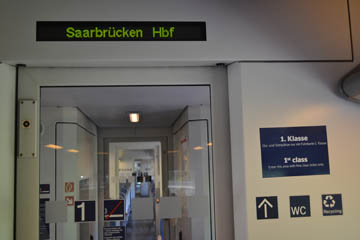
Look for the signs inside the train to learn your next stop.
MAKING CONNECTIONS When you’ve found a seat, look for the automated sign inside the car that indicates the next stop, and be ready to exit when your destination approaches. Not all trains have this, so having a pre-printed schedule in your hand prior to boarding is helpful. You can print these out from the Rail Europe website before you leave home. To find your next connection at the next station if you need to, check the station train board for the time and track number. If the layover is long enough, stop for a coffee or a snack, or get a sandwich and drink to enjoy on the train at one of the many food shops located in the larger train stations.
The last leg of my day’s travel was by bus to Remich, where the cruise ship was waiting. Since my pass was for travel in Germany only, it was not valid for the bus to Remich. However, the bus ticket was easily purchased from the driver after boarding. Bus stations are usually right next to the train stations, and schedules between trains and busses are coordinated for easy connections.
After disembarking the cruise at Nuremburg, I made my way to the main train station by cab, checked the large signboard, and found the track for my next destination: Dresden. Once again, I wrote the date for my third day of travel in the appropriate square on the rail pass before boarding. You must write in this date prior to each day’s trip.
This inter-regional express train, one-fifth of which was devoted to first class seating, had some cars designated to leave the train at Bayreuth. Look for the signs on the sides and front of each car to be sure the car you’re riding is going all the way to your destination, since some cars may be transferred to other towns en route.
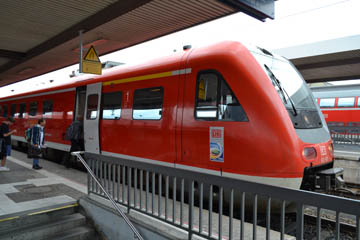
Even though this was a regional train, it traveled at upwards of 90 miles per hour, past farmland, forests, streams and rolling hills and through tunnels, often on super-elevated tracks, and in areas where double tracks allowed for quick, through traffic. The first-class seating area had a table at which I could comfortably eat the sandwiches I bought along. If you don’t have a chance to purchase food at the station, usually a snack cart on long-haul trains is wheeled through periodically, offering coffee, drinks and snacks.
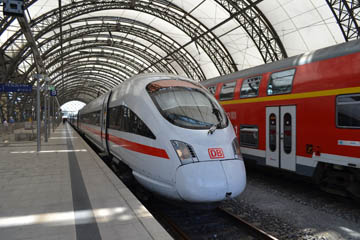
After four days in Dresden, I filled in the fourth travel date on my pass for the trip from Dresden to Frankfurt. In the Dresden Hauptbahnhof, I again bought food to eat on board while waiting for the signboard to list the train to Frankfurt. This trip would be on an ICE (InterCityExpress), one of the premier luxury trains on the Deutsch Bahn rail system. Once on the track platform, I looked for the chart listing the train equipment on this route. Waiting areas on the platform are designated “A”, “B”, “C” and “D”. Check this chart to find where the first class cars are in the train’s consist, and note where they line up in the ABCD waiting areas. You now know where the car you want will be as the train pulls into the station, allowing for quicker boarding.
RESERVATIONS MAY BE NEEED Reserving a seat is recommended on some heavily-traveled routes, even if you have a first class reservation. Making a reservation costs a small amount and is easily accomplished at a Deutsch Bahn service counter at main train stations. The lines move quickly, most agents speak English and will efficiently take care of your request.
With a reservation you are assigned a specific seat in a specific car. The seat will have a sign above it designating it as “reserved,” and is reserved solely for you. Sometimes seats are reserved for a segment of the route beginning at a station down the line, and these seats must also be kept free for the passenger who reserved them, even if they are empty for the first part of the trip. Sometimes reservations on busy routes fill up quickly, so decide early if you want to be sure to have a seat. I didn’t bother with reservations on another trip from Vienna to Venice once, and ended up clutching my first class ticket while sitting on my suitcase the entire way in the vestibule of the standing-room only car.
Since Dresden was the starting point for this train, the equipment was already at the station ready for boarding when I arrived. I had plenty of time to check the “consist” at the platform, and found the car number and seat that was on the reservation. While I came prepared with sandwiches and snacks, dining car menus in first class offer coffee, tea, soft drinks, beer, wine, hot and cold sandwiches, soup, salads and pastries, which can be ordered and brought to your seat or purchased in the dining car. The menu changes monthly.
The ICE train is truly an express train. Super-elevated tracks allow for fast curves and a smooth ride, often at speeds of 100 to 120 miles per hour. The only stops were at main train stations along the route. As the beautiful German countryside sped by, I could see Wartburg Castle near Eisenach, and noted the exact location where the border and guard towers had at one time divided Germany into East and West.
Upon arrival (right on time) in Frankfurt, I walked to the hotel, and enjoyed another evening of exploring the city center on foot. The next morning I filled in the last date on the rail pass for the trip from Frankfurt’s main train station to the airport. Train travel through central Germany was easy and actually fun. I enjoyed the ride, taking it easy, and leaving the driving to someone else. These iron rails can be such a delight!
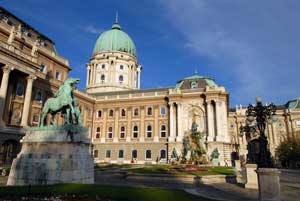
High-domed and in 19th-century neoclassical style, Budapest’s Royal Palace dominates high ground on the Buda side of the river. The complex includes the Hungarian National Gallery.
By Tom Bross Photos courtesy Budapest Tourism
For a memorable trip combining two culturally rich continental capitals, start in Vienna by immersing yourself in music, fine-arts museums and some of that city’s famous Kaffeehäuser coffee houses.
DAY ONE At the Vienna’s Westbahnhof, board an ÖBB Austrian Railways EuroCity train (www.oebb.at) headed for Budapest. The journey takes slightly more than three hours, covering 135 miles/217 km. by way of low-level Danube valley terrain. While approaching Hungary’s capital, you’re treated to urban riverbend panoramics meriting their UNESCO World Heritage eminence (as of 2002).
As they cross a high railroad bridge, passengers get wide-angle overviews of the two-part metropolitan layout. Hilly Buda, topped by the Castle District, looms above the river’s west bank. On the opposite side—with the enormous neo-Gothic Hungarian Parliament building as a focal point—flat Pest sprawls toward its parks, squares and buzzing commercial areas. (Regarding multinational Danube terminology, what’s called the Donau back in Vienna flows downstream to become the Duna here). Disembarkation at skylit, 19th-century-ornate Keleti station means you’ve arrived at Baross Square in the heart of Pest. Keleti’s completion in 1867 came when the Austro-Hungarian Empire had maximum geopolitical clout. That explains the two cities’ long-time kinship.
Several upscale hotels are in the station’s immediate vicinity such as the five-star Le Meridien, splendidly converted from a limestone police headquarters, with its 218 rooms (www.lemeridien.com). The comparably cosmopolitan Kempinski Corvinius opened in 2005 (www.keminski-budapest.com). Not as central, but walkably close to colonnaded Heroe’s Square and vast City Park, the Corinthia Grand Hotel Royal dates from Hungary’s 1896 Magyar Millenium and comes complete with deluxe spa amenities (www.corinthiahotels.com). Less pricey, more intimate and decorated with contemporary panache, the four-star, 57-room Atrium Hotel (www.atriumhotelbudapest.com) opened recently on a quiet side street located three blocks south of Keleti.
If Buda’s Old World atmospherics are more to your liking, check into the family-run, 27-room Hotel Victoria (www.victoria.hu), nicely situated for Duna vistas. The newer, four-star Novotel Blue Danube (www.novotel-bud-danube.hu) is another riverfront “recommendable.” A slick, Americanized Hilton (www.budapest.hilton.hu) was added to Buda’s skyline 30 years ago.
The Chain Bridge, one of the city’s beautiful Art Nouveau landmarks.
If you’re exploring Pest at midday, take a lunch break at Mühesz, providing an international menu and Budapest-brewed Dreher beer. Choose this indoor/outdoor restaurant for its location on sophisticated Andrássy Avenue—another UNESCO World Heritage Site, lined with imposing mansions and public buildings. Among them: 1884’s State Opera House, matching its Viennese counterpart for grandiose architecture and lavish interiors (Bertalan Székely’s murals on the foyer’s vaulted ceiling, for instance, and flamboyant Károly Lotz frescoes above the main hall).
Wrought-iron railings seen on this Parisan-infuenced boulevard frame stairways descending to continental Europe’s earliest subway line, the M-l metro, inaugurated in 1896 to coincide with millennium celebrations. So, sure enough, Andrássy Avenue extends straight ahead toward the Millennium Monument on Heroes’ Square—marble-paved open space.
From there, tree-shaded walkways curve into City Park’s ponds, botanical gardens, Budapest’s zoo and the Széchenyi Spa Baths, Europe’s biggest such complex, fed by thermal springs discovered 150 years ago. Backtracking to the square, make at least a quick tour of the Museum of Fine Arts before closing time at 5 p.m. (Tuesday-Sunday). Collections include Raphael’s The Esterházy Madonna and a Dürer self-portrait, plus paintings by Rembrandt, Tiepolo, El Greco, Picasso and Pieter Bruegel the Elder’s 1556 masterpiece: St. John the Baptist’s Sermon.
For tonight’s meal, choose Belmondo, virtually next door to the Opera House. Singing waiters entertain in this two-level dining salon, where fish and vegetarian courses are on the menu, augmented by an extensive wine list. Here’s your chance to taste-test classic Hungarian beef goulash, served spicey-hot and traditionally accompanied by tarhonya noodles.
Sidewalk cafés line both sides of Pest’s trendy Andrássy Avenue, one of Budapest’s UNESCO World Heritage Sites.
DAY TWO Make the most of a full day in Pest. No need for a hasty breakfast, because English-language tours of Kossuth Square’s Parliament complex don’t commence until 10 a.m. The crown and coronation regalia of St. Stephen (Hungary’s revered national patron) glimmer in display cases. In nearby St. Stephen’s Basilica, admire jewel-encrusted reliquaries, mosaics and paintings. Then climb to the dome’s 315-ft./96-meter observatory for all-around city-and-river views.
In a museum-going mood? Pest has dozens—ranging from ethnography to agriculture, geology to photography, railroading to contemporary art and natural history. The memorabilia-filled Béla Bartök Memorial House (Csalán Utca 29) was the 20th-century composer’s residence. Bold Art Nouveau design makes the Museum of Applied Arts a visual standout, with aqua and gold Zsolnay ceramics covering the dome and roof in dazzling patterns. Also compelling: north-side Budapest’s Jewish Quarter and its Byzantine-Moorish, twin-turreted Great Synagogue (Dohány Utca 2), consecrated in 1859.
Ponder two lunchtime possibilities. The circa-1897 Central Market Hall (more of those multicolored Zsolnay rooftop zigzags)—jam-packed with stalls purveying produce, breads, meats and cheeses—includes an upstairs niche where drinks, sandwiches and sugar-sprinkled, paprika-seasoned palacsinta pancakes can be ordered. Or, similar vintage but classier ambience: Gerbreaud, the quintessential mid-European pastry shop/coffee house/tea room/casual restaurant, facing Vörösmarty Square’s sculpted stone fountain.
Shopping, people-watching, café-relaxing. Accomplish all three by exploring a popular pedestrian corridor, located two blocks in from Pest’s riverfront. Namely: Váci Utca, hemmed in by neoclassical, Bauhaus and radical new postmodern buildings.
When nightfall approaches, floodlights click on, illuminating the historic Chain Bridge (1849) and Baroque buildings flanking Pest’s riversides. Your cue for a boat ride, therefore time to settle into Spoon, a sociable onboard restaurant. Follow dinner with drinks in the lounge, ideally big-windowed for watching the city lights while cruising the Duna.
DAY THREE Ride a funicular railway up a 48-degree slope to reach the Buda heights, locale of the Royal Palace. Amidst courtyards, gardens and ornamental gateways, attractions inside this neoclassical include the Hungarian National Gallery, Budapest History Museum and Hungary’s National Library (containing more than two million books).
Beneath the ramparts, rows of Gothic and Baroque housefronts overhang tangles of gaslit streets laid out in the Middle Ages, now loaded with souvenir shops. (You’ll notice pockmarked walls, hit by bullets fired during the 18-day Hungarian Revolution in autumn 1956—Budapest’s heroic populace vs. Soviet troops and tanks). For lunch, find a sidewalk table at Walzer, a chatty little café near Holy Trinity Square. Then stroll upward to the picturesque Fishermen’s Bastion, an arcaded pavilion dating from 1895. A longer walk gets you to Statue Park, hilltop dumping ground for 41 gigantic Communist-era statues, ripped from citywide perches after “comrade” bureaucrats and Russian Red Army soldiers finally departed in 1991.
Guitar-strumming in a 15th-century palm court complements tonight’s candlelit dinner at Alabábardos, within sight of central Buda’s tall-steepled Mátyás Church. Enjoy continental cuisine along with fine Hungarian and Austrian wines.
DEPARTURE A Hungarian National Railroad line connects Pest’s Nyugati station (a decade “younger” than Keleti) with domestic and international terminals at Ferihegy Airport (BUD), 10 miles/16 km. southeast of town. The transfer takes merely half an hour.














 European Traveler