Hiking the Wicklow Way in Ireland’s “Garden County” is an unforgettable experience.
Photos courtesy Tourism Ireland
The 79-mile trail stretching from the southern suburbs of Ireland’s capital, Dublin, through the mountains of County Wicklow and into neighbouring County Carlow is one of the most popular parts of Ireland’s network of long-distance walking trails.
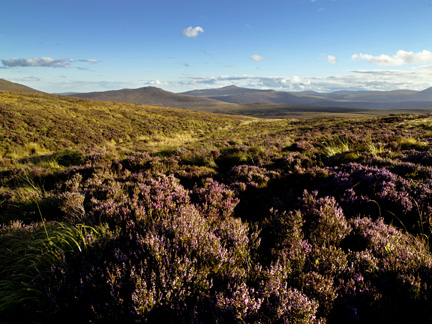
Wicklow Mountains
Starting at the outskirts of Dublin, walkers head southwest through the beautiful and varied Irish countryside encompassing rugged mountains, ice-age glacial valleys, upland lakes, mountain streams and pine forests. Along the way are scattered many remnants of Ireland’s long and colorful past, including the extensive remains of the early medieval monastic settlement at Glendalough.
As the walks are self-guided, walkers can proceed at their own pace, and take time to appreciate the spectacular views.
The Wicklow Way is one of 43 National Waymarked Trails in 25 counties in Ireland, offering a variety of hiking experiences against the backdrop of an endlessly stunning landscape.
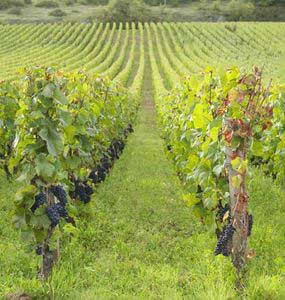
The wines of Burgundy are rich and varied, and are divided into regional appellations, village appellations, Premiers crus and Grands crus. The Appellation d’Origine Contrôlée (AOC) is your guarantee of the characteristics of the regional wines. Fall is a beautiful time to drive or bike through the wine routes.
The Côte de Nuits extends from the south of Dijon to Corgoloin and forms the northern section of the Grands Crus route. It is a prestigious hillside that is home to villages bearing the names of the greatest red wines in the world. Here you will find 24 of the 33 grands crus in Burgundy: Chambertin, Clos de Vougeot, Romanée-Conti and many more.
The Côte de Beaune follows on from the Côte de Nuits towards the south, from Ladoix-Serrigny to the hillside of the Maranges. This soil, blessed with the Chardonnay grape, is where the greatest dry white wines in the world are produced (Corton-Charlemagne and Montrachet, among others). Outside of the city of Beaune, which is the capital of Burgundy’s wine regions, the countryside becomes gentler as you approach Santenay and the département of Saône-et-Loire.
ROUTE OF THE GRANDS VINS DE BOURGOGNE – THE ROUTE THROUGH NATURE The route of the Grands Vins runs from Santenay to Saint-Gengoux-le-National, and is the extension of the route of the Grands Crus towards the south: more than 100 signposts connect around 40 towns via the vineyards of Maranges, the Couchois and the Côte Chalonnaise. This varied route combines villages with nature, and vineyards with wooded countryside, and is dotted with Romanesque churches and castles. You can discover it by car, but also along the water of the Canal du Centre, or by bike along the the many cycling routes.
ROUTE OF THE MÂCONNAIS-BEAUJOLAIS, THE SOUTHERN WINE-GROWING AREA This route in the south of Saône-et-Loire is the extension of all the wine routes from Dijon. The eight circuits enable you to break away from the main route and explore the most southerly vineyards in Burgundy in greater depth. The main route itself crosses the Mâcon wine-growing region in a straight line and finishes at Romanèche-Thorins (Saône-et-Loire) on the hillsides of the Beaujolais region.
ROUTE OF THE VINEYARDS OF THE YONNE ALONGSIDE THE RIVERS In the département of the Yonne, the vineyards have developed alongside rivers: the Jovinien and the Auxerrois in the Yonne Valley, the Chablisien in the Serein Valley, the Tonnerrois in the Armançon Valley, and the Vézelien in the Cure Valley. The wines of the Yonne are undergoing a renaissance and deserve to be discovered in all their diversity just as much as the highly famous Chablis.
ALONG THE LOIRE AROUND THE NIÈVRE The vineyards of the Nièvre, which extend along the right bank of the Loire, belong not to Burgundy but to the Centre-Loire, and have long suffered from a certain lack of recognition. Now another wine route enables visitors to discover all their charms, from the hillsides of Pouilly-sur-Loire, where the famous Pouilly-Fumé is produced, to the Coteaux du Giennois overlooking Cosne-Cours-sur-Loire. This route also takes in Sancerre on the other side of the river in the Cher.
By Don Heimburger Photos by the author and the Park Hotel Weggis
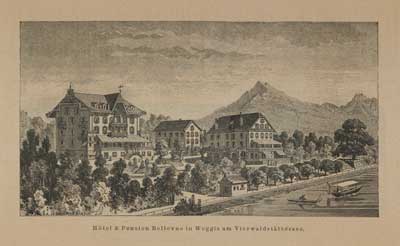
On the shores of beautiful, serene Lake Lucerne stands a tall, stately structure amid a lush garden of flowers and trees. I have passed it several times on a Lake Lucerne Navigation Company steam-powered paddlewheel boat, each time saying I would like to visit.
It is an intriguing complex of buildings, some hidden by the finely-appointed, trimmed mature greenery. At night, lights in the castle-like buildings, and outside on the grounds, twinkle a welcoming “hello.” The hotel is slightly elevated on the grounds, and thus it takes on an even more eloquent appearance.
The Park Hotel Weggis has been welcoming guests to Lake Lucerne since 1875.
This year, my time had come to finally “meet” this jewel on the lake. I made an appointment to visit the Park Hotel Weggis, located a 15-minute walk from downtown Weggis, Switzerland. A total of 50% of the clientele is from Switzerland, but I came all the way from the USA to visit, the hotel being that intriguing.
Weggis, home of the popular Rosenfest, a lavish July event in this town of 4,000, sits quietly and calmly on the shores of what author Mark Twain once said was the most beautiful spot on earth. While it may be bested by a few other spectacular sights around the globe, I have no doubt that most people would call Weggis a shining star when it comes to serenity and aesthetics.
The hotel looks out onto the lake and the Alps of central Switzerland, and thus this wish from Twain: “This is the charmingest place we have ever lived in for repose and restfulness, superb scenery whose beauty undergoes a perpetual change from one miracle to another, yet never runs short of fresh surprises and new inventions. We shall always come here for the summers if we can.” Twain lived for several summers in Weggis, traveling up to the nearby Rigi-Kulm, which is 6,000 feet above and to one side of the village. Three of the hotel’s rooms are called the Mark Twain suites.
With a warm breeze blowing across the lake, this area creates its own weather patterns which usually means warmer weather in the winter, and softer, gentler breezes during the summer. As a testament to this climate, palm trees and cactus grow alongside the beautiful roses the city is noted for.
BEACON ACROSS THE LAKE It’s in this peaceful setting that the 5 1/2-acre, five-star Park Hotel Weggis shines a beacon across the lake to everyone, that this is a place to rest and relax, to have some fun, to dine or just get away from it all for a while.
In fact, the hotel has been doing this for 135 years, as in 2010 it celebrates more than a century and a third of being hospitable in this unique place.
The annex portion of the hotel was built in 1899. The hotel, with just 53 rooms and suites in the main building and two adjacent structures, pampers its guests, offers several dining choices and is big on wellness. The hotel has seven categories of rooms, and underground tunnels allow guests to reach various parts of the complex without going outside. The hotel is 30 minutes by car from Lucerne, and 35 miles from Zurich.
The list of awards the hotel has garnered through the years includes its selection as one of the 10 best vacation hotels in Switzerland for the past eight years, and the Hotel of the Year Award by GaultMillau in 2001. Its spa and wine selections have also won awards.
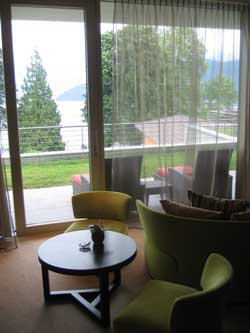
A total of 43 rooms in the main building were renovated between 2007 and 2010, and 10 more new “Adara” suites with generously-sized rooms were also added with large balconies, electric curtains, large Treca de Paris beds, Christian Fischbacher satin bed linens and bathrobes, Bose sounds systems and Panasonic flat televisions.
The rooms also incorporate B&B Italia and Promemoria Italian furniture, accessories from the Thony Collection, and fabrics from JAB and Carlucci di Chivasso. Each suite features its own wine cabinet with rarities such as Premier Grand Cru Classe from Bordeaux and Chateau d’Yquem.
The showers, in Foster, KOS Italia and Form-Laufen designs, match the green-clad marble walls with marble from the Greek island of Tinos in the Aegean Sea.
In the last 13 years, the Park Hotel has poured $100 million (Swiss francs) into refurbishing the property.The Denz family of Switzerland are the owners.
WELLNESS AREA OF HOTEL The hotel prides itself with its extensive Wellness area for those who like to be especially pampered. With many upscale hotels and resorts paying more attention to this part of a guest’s visit, this is becoming a more prominent feature of hotel services. Under the leadership of Brigitte Bunder, body, soul and spirit are soothed as her team immerses guests in a peaceful, stress-free world for a few hours. The Park Hotel offers a 49 foot x 20 foot open-air heated pool which overlooks Lake Lucerne, and also traditional Tibetan massages (four employees of the hotel are from Tibet). A wide range of other treatments are available, such as body scrubs, hair and beauty sessions, and hot herb applications.
In addition, there are six Spa cottages which offer guests seclusion and privacy. These cottages are available for beauty treatments, fitness exercises, massages and a range of different therapies. The cottages, equipped with whirlpools, sauna or steam baths, solariums, showers and waterbeds, can be rented individually. Designer furniture from Colombostile and Moroso are featured in these rooms. In the Wellness area there is also a library with a matchless view of the surrounding mountains.
One aspect of the hotel is its welcoming Japanese gardens located at the entrance of the grounds, which was the first public-opened Bonsai garden in Europe. Large Burgenstock limestone pieces, some weighing seven tons, make up the garden, along with a 100-year-old juniper tree and other plants. The trees in the garden were imported from Japan, and some have been shaped and cared for four generations.
A HIGH POINT: FOOD Food is always an attention-getter at a luxury hotel, and the Park offers three inviting venues for dining, including the Annex with Chef Renee Rischmeyer. Being ushered into the Annex sets the mood for the evening, with windows that look out onto the lake and the Alps, or you can also sit outside on the terrace. In this restaurant, traditional French culinary delights with Mediterranean and Asian influences are prepared using fresh local market seasonal products. The wine steward is Christian Bock, who was awarded the Best Swiss Sommelier in 2005/2006 and Master Sommelier in 2009. His job is to offer selections from 2,600 in-house wines, a daunting task. (The hotel’s vinothek offers wine for purchase for guests.) The Annex has been awarded 16 GaultMillau points and one Michelin star.
I found dining in the Annex was “an experience” as much as having a meal. The lake, the low lights, the glow from the room, and the wait staff service, made the evening memorable. Later did I realize there was soft music playing in the background, loud enough just for me to recognize it was there. It set just the right mood. My “parting shot” for the evening were the three delicious Swiss chocolates that were set before me; they did not last long.
Restaurant Sparks, with a capacity for 60 guests, is unique for its venue as much as its food. This high-ceiling room with a large chandelier, large windows and comfortable chairs, lifts your mood just walking in. Large scale Luciano Castelli paintings depicting the four seasons adorn the walls. In the Sparks, Chef Florian Gilges presents modern and light cuisine, combining art and design in his natural dishes, which has been awarded 14 GaultMillau-points. The Sparks is where breakfast is served every morning for hotel guests; there are 25 seats also available on the fresh-air veranda.
One evening in the Sparks I started off with baked goat cheese with Mediterranean vegetables, beef paillard with Carnaroli risotto and glazed Trevisano, a skewer of fillet of beef on potato salad with clear gazpacho, apple strudel and vanilla custard, and nectarine and honey cream mille feuille on tonka bean ice cream. With the meal I enjoyed a Valais, Switzerland white wine from 2008 and a Figuero tinto (2004) from Spain, both delicious.
For even more hotel food delights, guests can stroll over to The Grape a short distance away, where the speciality is California cuisine. There guests–many of them locals–are offered a wide selection of California wines from the Napa Valley, and food selections from California include juicy grilled steaks. For kids, a space has been set aside in the restaurant to play Nintendo games.
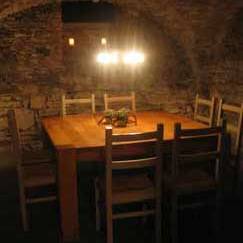
For a nightcap, the Lalique Caviar Bar is perfectly located in the hotel for a great view of the lake. Caviar–of course–malt whiskies and cigars are on the menu, along with the great view. If you want a drink outdoors, you can go down to the water’s edge where the cozy Beach Bar Lounge stays open until late hours. Last, for special dining occasions where you want to make an impression, you can book dinner in the smart vaulted wine cellar. For large gatherings such as weddings, receptions or banquets, the hotel features the Aquarius Hall with frosted glass panels, dark parquet floors and special lighting effects.
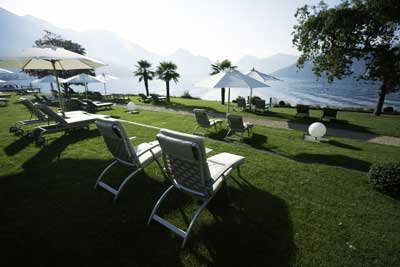
OTHER FEATURES At this hotel you can arrive by boat, as the hotel has its own boat moorings, as well as a private lakefront area, bathing beach and sunbathing lawn. Sitting outside next to the lake with a good book and a cool drink could very well be the thing to top off an afternoon.
For kids, there’s a billiard room, and the suites have their own kid’s rooms, as well as a play station area with television and Nintendo games. The hotel also hosts occasional entertainment for kids.
With its own boat moorings (the hotel owns three boats itself), a number of cruise scenarios come to mind including renting a boat for yourself and guests and have it pick you up from from the hotel dock, or you can bring your own boat and dock it at the hotel. Canoes, mountain bikes, fitness and exercise equipment is available, as is a 1959 Chevrolet Impala convertible, sometimes parked out in front of the entrance. Nearby is the Rigi Railway (access is via a cable car in Weggis), and the Mt. Pilatus Railway is also close by. Lucerne is just a short car ride or boat ride away.
According to deputy director Marc Eichenberger, who is new at the property, guests often arrive stressed from their daily routine, but leave relaxed. Eichenberger knows a bit about getting away from it all himself. He has taken professional classes at Cornell University in the States, and likes to vacation in Asia. Sometimes you’ll find him trekking (and sleeping in a tent) in the desert.
He holds meetings with his staff on a daily basis, discussing the “arrivals,” and weekly and monthly “theme” meetings and even twice a year “broad goal” meetings with the staff. A personable man, he has a sharp eye for detail, and walks from one part of the large property to the other with purpose.
He calls the hotel “a hideaway” for guests who can wander from their room, to a hotel restaurant, to the spa area or to the beach within minutes.
With upwards of 65% of the hotel’s business repeat customers, you know the property is doing something right. My trip complete, I hope to return to this jewel on the lake soon, but perhaps I’ll stay longer next time. One visit just isn’t enough.
IF YOU GO… The Park Hotel Weggis is rated five stars superior. It is located 225 miles from Munich. The hotel’s address is Hertensteinstrasse 34, CH-6353, Weggis. Telephone is +41 (0)41 392 05 05; e-mail is info@phw.ch. To see the hotel’s rates, rooms and facilities from their internet site, go to www.phw.ch. The latest award issued the hotel was 1st place in 2010 by the Blilanz news magazine for the best hotel day spa.
The hotel is part of the Swiss Deluxe Hotels and the Relais & Chateaux collections.
A luxurious learning experience complete with a guide from London’s National Gallery
The Orient Express is launching a series of special vacation packages called “The Art of Travel,” including tours to Venice, Paris and within England. Travelers will learn about the lives of artists such as Canaletto, Bellini, Titian, Veronese, Monet, Rubens, Turner and Constable while seeing the places that inspired their work and visiting the places that house their work today, accompanied by an expert from London’s National Gallery.
All tours include at least one night at London’s Goring Hotel and begin at The National Gallery, where a specialist will give a guided introduction to selected masterpieces before the journey begins. Trips include:
THE VENICE OF CANALETTO: This seven-day tour will give travelers the opportunity to view Venice through Canaletto’s eyes. Travel from London aboard the Venice Simplon-Orient-Express through France, the snow-capped Alps and northern Italy. While in Venice, guests stay at the Hotel Cipriani and trace the footsteps of Canaletto, who is forever associated with magnificent Venetian views. Trips are limited to 20 people and depart on April 9, October 8 and October 22, 2011.
VENETIAN PAINTERS: This is a six-day tour that introduces the traveler to the great Venetian masters, from Giovanni Bellini and Titian to Veronese. Starting in London with a tour and dinner at the National Gallery, travelers will fly to Venice, where they will step back into the Italian Renaissance and explore great sights such as the Doge’s Palace, the Accademia and Ca’ Rezzonica with an expert from the National Gallery. The journey ends with a return to London on the Venice Simplon-Orient-Express. The trip is limited to 20 people and departs on April 30, 2011.
IMPRESSIONS OF PARIS: Also offered will be a series of five-day tours focusing on French Impressionism, where travelers will trace Claude Monet’s long, dynamic life and will learn about the birth of a new artistic movement, when painters first began painting in the open air to capture the effects of light. From London, guests board the Venice Simplon-Orient-Express and can marvel that two of the restored carriages aboard the Art Deco train were already carrying passengers when Monet was producing his last masterpieces. Departures are April 9, May 7, June 25, July 27, August 24, September 24 and October 22, 2011.
BRITISH PULLMAN: These tours combine the thrill of a steam-hauled luxury train, complemented by gourmet dining — brunch on the outbound journey and a three-course supper on the return — with delightful scenery and include visits to Bath’s finest art collections.
Collectors and Collecting: This trip is timed to coincide with the reopening of the Holburne Museum in May 2011 following a major restoration. After a guided tour of the museum, there will be a tour of “Beckford’s Bath,” including the eccentric William Beckford’s house and the grounds leading up to Beckford’s Tower. The trip will depart on June 28, 2011.
Thomas Gainsborough: This journey focuses on landscape paintings by notable British and European artists including Rubens, Turner and Constable. Highlights include the new exhibition “Gainsborough’s Landscapes: Themes and Variation,” at the Holburne Museum and a walking tour of artists’ Bath. This tour will depart on October 11, 2011.
In Germany’s Luther Country, Advent means Christmas markets. The crisp winter air is filled with the smell of ginger and nutmeg, signaling the arrival of Stollen, a special Christmas cake, and Glühwein, mulled wine. Cobbled streets and squares, lined with half-timbered medieval houses, provide the backdrop for dozens of wooden stalls, selling wooden toys and Christmas decorations, handcrafted gifts and seasonal foods, such as Zimtsterne (cinnamon stars) and Lebkuchen (soft, spiced cookies).
Brass bands play and choirs sing carols, often written by Martin Luther himself. In fact, many Christmas traditions were supposedly instigated by the Protestant reformer 500 years ago. Legend insists one dark and starry night, Luther was touched by the beauty of the pine trees. On returning home, he cut down a tree, took it into his house and decorated it with candles. As well as the Christmas tree, Luther is credited with the idea of Christkind, the Christ child bringing presents. (Kris Kringle is still familiar in many U.S. homes). Concerned that Saint Nicholas, who delvered his gifts on December 6, was too popular, Luther came up with an alternative to “Santa Claus”: a golden angel, with wings and a crown.
Here are just some of Luther Country’s most authentic Christmas markets.
ERFURT November 27 – December 22 Although Erfurt’s 162nd Christmas Market spreads throughout the old town, the focus is on the Domplatz, the vast Cathedral Square. The 200 market booths sell everything from Thuringian bratwurst (Germany’s favorite grilled sausage) and Christmas cookies to handmade toys or traditional, handmade Christmas decorations. Children love the giant Ferris wheel,
the 90-foot-tall Christmas tree covered in candles, and the 40-foot-high wooden pyramid. Most of all, they love the nativity scene, set in a fairytale forest, complete with near life-sized, hand-carved figures. Gardeners should not miss the floral Christmas exhibition in the underground vaults of the cathedral.
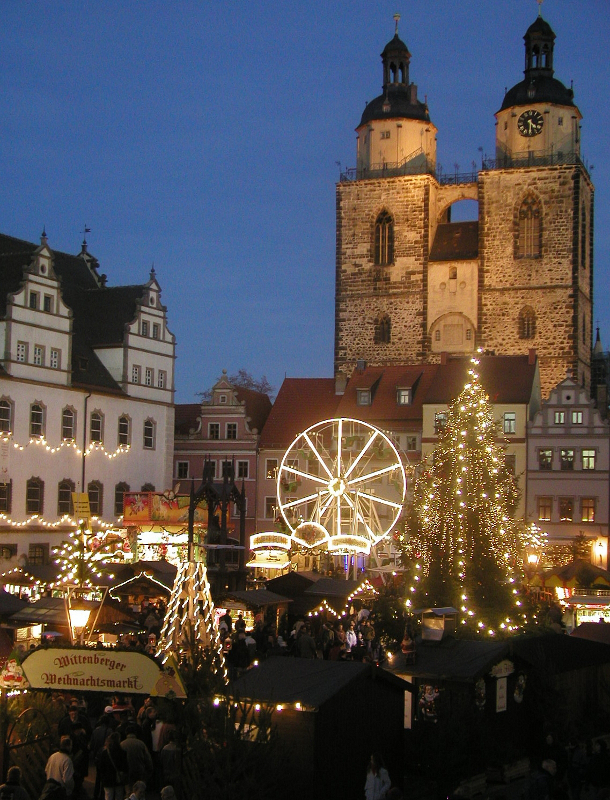
Lutherstadt Wittenburg Christmas Market
LUTHERSTADT WITTENBERG November 28 – December 23 In the market square, a statue of Luther looks out across the Christmas market, with its stalls decorated with pine boughs, lights and Christmas ornaments. In the air is the scent of mulled wine and roasted almonds. Across the square is the Marienskirche (St. Mary’s Church), where Luther preached. Special are the town’s Adventshöfe, medieval courtyards, where local artists and craftsmen sell their wares. In the Cranach Courtyard, named for Luther’s great friend and painter Lucas Cranach, the weekend of December 8 and 9 features weavers and knitters, wood carvers and basket makers.
QUEDLINBURG November 30 – December 23 With more than 1,300 half-timbered houses, Quedlinburg is one of Europe’s most romantic cities. And during the Christmas Market, strolling along the cobbled streets is like walking through history. One unique event is the “Advent in den Höfen” (December 1-2, 8-9, 15-16), when some 20 private courtyards open to sell special Christmas gifts, often handmade. Another highlight is the world’s largest Advent calendar! At 4:30 p.m. every afternoon for 24 days, children look out for the star that marks the house where the next scene in the Advent calendar will appear. When the door opens, fairytale characters appear and dance, sing or play for spectators.
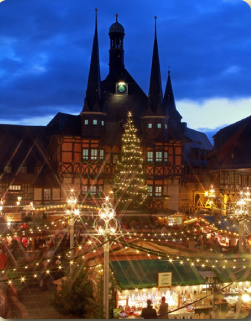
WERNIGERODE November 30 – December 22 Dominated by its 12th-century castle, Wernigerode’s annual Christmas market has a fairy story backdrop: a 15th-century town hall, half-timbered houses and a 35-foot-tall Christmas tree. The stalls serve traditional food and drink, hand-made toys and ornaments for the home; evenings are filled with concerts of seasonal music. From December 15 to January 8, 2013, the Castle hosts its own special Winter Market. Children meet a fairy at 3 p.m. and receive presents from St. Nikolaus (Santa Claus) at 4 p.m. They also love to ride the Christmas train in a historic carriage, pulled by a steam engine through the snow-covered countryside.
Wernigerode Christmas Market
LAUSCHA December 1-2 and 8-9 Each Christmas, this small town in a steep, wooded valley in the Thuringian Forest, plays a vital role in every American home. This is where the first glass Christmas tree ornaments were created in 1847. In 1880, F. W. Woolworth, the five-and-dime store pioneer, brought a batch of these glass balls to his store in Pennsylvania, and the rest is history. The tradition continues in Germany’s glassblowing capital, where you can watch artisans creating works of art at Lauscha’s Museum of Glass Art. At Lauscha’s annual Christmas “Kugelmarkt,” or glass bauble market, you can buy these handmade decorations in all shapes and colors.
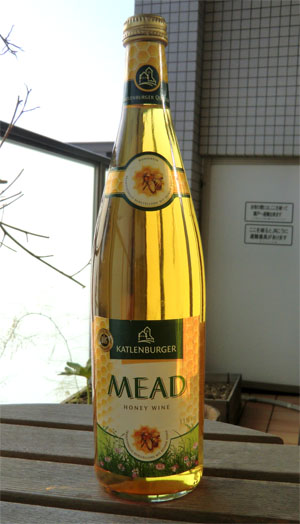
Mead honey wine
WARTBURG CASTLE, EISENACH December 1-2, 8-9, 15-16 Wartburg Castle is where Martin Luther, the Protestant reformer, changed history when he translated the New Testament into German. And this UNESCO World Heritage Site just outside Eisenach is still a massively impressive fortress. At Christmas, however, a historic Christmas Market transforms the castle, with artists and street performers, craftsmen and knights. Meet candle makers and barrel makers, rope makers and lantern makers, minstrels and puppeteers. With cheerful booths and medieval decorations, this is a like a trip back in time. And the medieval food is delicious, from roast apples and honey to mead.










 European Traveler