Perched on a wooded, sunny plateau above the Rhône Valley about halfway between Martigny and the Chateau de Chillon end of Lake Geneva, Villars offers activities that find the balance between recreation and relaxation.
Ever since the famous Orient Express arrived here, visitors to Villars have enjoyed the healthy air to be found on the natural balcony it rests on. At about 1,300 meters (4,225 feet) in the heart of the Vaud Alps, this idyllic setting has stunning views stretching from Lake Geneva to Mont Blanc.
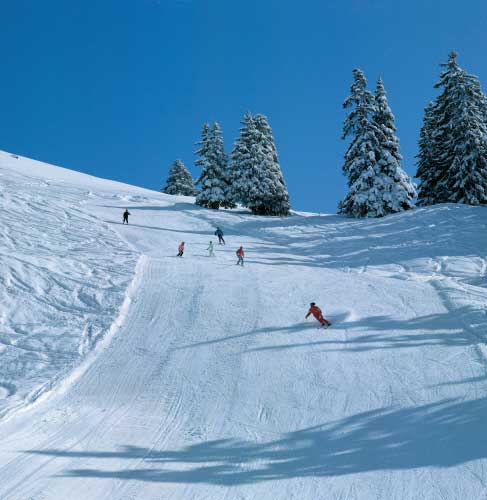
Winter sports fans can enjoy the wide range of attractions the area offers, including 125 kilometers (78 miles) of skiing terrain. In all, there are 52 runs which are 50 percent beginner, 42 percent intermediate and eight percent advanced. Sports enthusiasts wanting to be challenged can try the glacier at Les Diablerets, about 20 kilometers (13 miles) from Villars. There are four glaciers in the area available for heliskiing.
Those in search of relaxation can enjoy the facilities and wellness benefits of the thermal baths (Lavey-les-Bains). Children can enjoy the family programs that cater to adults and kids.
Wine festivals in August and September are spread throughout Germany’s 13 wine-producing regions. There is no better way to get to know Germany and its people than whiling away a few hours (or days) at local wine festivals. There is little doubt you will end up in discussion with the people at the next table or with the owner about the harvest or quality of the grapes, this year’s weather and local goings-on. And, before you know it, you have made some nice acquaintances, learned some German, soaked up the atmosphere and tried some wines that you might never find outside Germany.
More than 2,000 years ago, the Romans identified the mineral-rich terrain in Germany and laid the foundations of the vineyards that today cover more than 245,000 acres. Winding rivers, steep hillsides and medieval castle ruins characterize the various regions and their wine towns.
At the tip of the southern Black Forest in Germany’s southernmost wine region of Baden, Freiburg offers a taste of the academic pace of life in one of Germany’s oldest university towns. A direct high-speed rail connection from Frankfurt to Basel is available, as well as the local Black Forest Bahn, which offers views of the Black Forest hills and villages. A typical day is characterized by spending time at the open air market with all of the products from the local farmers and craftspeople, and then enjoying a glass of wine in the Weinhaus Alte Wache with a view of the marketplace activities. The Landmann Winery is particularly notable for its organic wines and the local wine festival from September 2 to September 9 is a particularly festive time. In November Freiburg hosts the Plaza Culinaria, a culinary trade fair with many local products from Freiburg’s partner cities.
Nestled between two of Germany’s most famous wine regions, where the Moselle and the Rhine come together, Koblenz stars as the host to the National Garden Show. In honor of the show, Koblenz opened a new winery at the Fortress Ehrenbreitstein, which boasts not only wines from the region, but also offers a history of the 2,000 years of wine-making in the Rhineland Pfalz. Koblenz has long been a stop for wine lovers. The well-known brand of Deinhard offers tastings of sparkling wine in the middle of the old city and the Weinbar Gerhards wine cellar and bar can be found nearby.
Deep in the Rhineland but still only a half hour from Frankfurt, Mainz is known as the Great Wine Capital, as it is the only German city belonging to this worldwide network. It’s easy to while away a few afternoon hours in Mainz’s wine market at the cathedral square. On Saturdays, local farmers bring in an endless stream of regional and seasonal foods and wines that you can try as well as buy in a friendly and relaxed atmosphere.
One particularly sweet time is August 25-28 and September 1-4, when the Mainz Wine Festival takes place. You can wend your way from stand to stand trying different wines, enjoy music and peruse the crafts for sale. Two tips: The new Hofgut Laubenheimer Hoehe winery, along with the Wine Institute created the Riesling Lounge, where rieslings from each of Germany’s 13 wine-producing regions are offered. An especially enjoyable stop is the Zum Beichtstuhl wine bar.
In the middle of Germany’s oldest wine territory, close to the steeps banks of the Moselle River and famous for its Roman gate and walls, Trier is where the Romans first planted their vines in Germany. The oldest winery is the Vereinigte Hospitien, where you can still see the wall of the original Roman storehouse. The wine producer Bischoefliche Weingueter can be found underground in the center of Trier; most tourists don’t realize as they walk through the pedestrian zone in the central city that a famous wine cellar lies beneath them. The Bar Weinsinnig is where you can get a sense of the region’s great variety, as the list of wines offered changes daily.
In the spa town of Wiesbaden, the Rheingau Wine Week in August kicks off a celebration smack in the middle of town on the Castle Square. Known for its ornate and elaborate casino, beautiful spa buildings and hotels, elegant streets and antique galleries, Wiesbaden is a prime starting point to explore the Rheingau. The State Winery of Hessen in Eberbach, a former Cistercian monastery, is one such example, and it is also worthwhile to take the tour and a tasting at Henkel, the famous producer of sparkling wine.
On the other side of Frankfurt is the baroque city of Wuerzburg in the heart of the Franconian wine region, where wine is bottled only in the famous bulbous bottles, called Bocksbeutel. The wines of Franconia are outstanding and one place to enjoy them is in Wuerzburg’s Residenz (castle). The wine cellar recently won an architectural prize for its renovation.
WINE FESTIVALS August 31 – September 9, 2011 Rheingau Wine Festival, Frankfurt More than 600 wines and sparkling wines from the Rheingau region will be tasted at 30 vintner stands. These range from the finest wines to light and zesty summer wines, with wines from alternative grape varieties being offered alongside the dominant Rheingau riesling. www.frankfurt-tourismus.de
September 1 – 5, 2011 Middle Moselle Wine Festival, Bernkastel Kues The “Middle Mosel Wine Festival” enjoys legendary fame. The fireworks, the winemakers’ procession, the artisan market and all of the happenings on the wine road and at the locales in Old Town as well as the large amusement park are the attractions featured at the Moselle region’s largest wine festival. More than 30 wine booths present famous riesling wines. www.bernkastel.de
September 2 -12, 2011 Vintners’ Festival, Bingen in Rhinehessen near Frankfurt There is something special about the wine in Bingen. Here the so-called ice wine was invented in the suburb of Dromersheim. It is no coincidence that the festival lasts 11 days, because so much time is needed to taste all the wines offered. www.bingen.de
September 24 – October 3, 2011 Red Wine Festival, Ingelheim, close to Mainz and Frankfurt There is virtually no other wine festival in the Rhine Hessen region which takes place in such an attractive setting, surrounded by vineyards, as the Ingelheim Red Wine Festival. Every year on the last weekend in September this popular wine festival is opened with the ceremonial crowning of the Red Wine Queen. www.ingelheim.de
Pinkel! The word is strange enough, but I recently learned how these six little letters can stir a whole region to party the day away in true Germanic style.
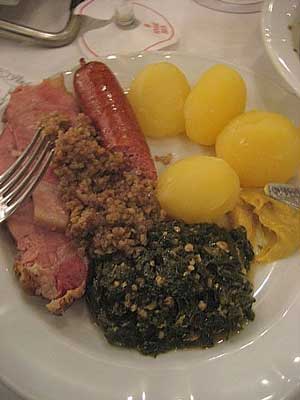
I thought I knew roughly what to expect in terms of German traditions and festivities. I was familiar, of course, with festivals like Oktoberfest and Weihnachtsmarkt, and with traditional victuals like cabbage and wurst. But little did I know I had yet to discover one of Bremen, Germany’s most unique traditions–one centered on green cabbage, a mysterious meat product called Pinkel, and plenty of alcoholic spirits.
It’s called “Kohlfahrt” (translation— “cabbage tour”) and recently I was told what this festival was all about.
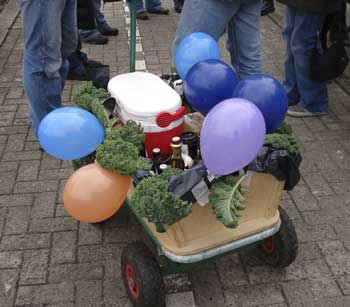
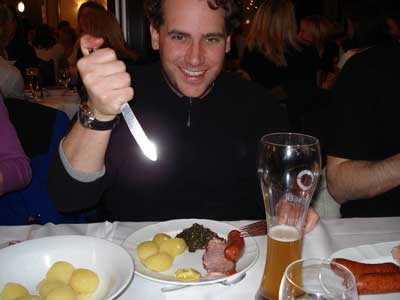
Kohlfart is a tradition practiced only in Northwest Germany, and is a beloved annual ritual in the Bremen area. The idea is that a group of friends or colleagues assemble on a Saturday afternoon in January or February, load up a “Bollerwagen” with an assortment of schnapps, whiskeys and beer, and amble through the countryside playing wacky party games and replenishing liquor at every opportunity. The event is organized months in advance by the group’s Kohlkoenig and Kohlkoenigin— the cabbage king and queen. After a couple hours of walking, when the participants’ bladders are full and their stomachs growling, the group descends on a pub or restaurant to enjoy the culmination of the day’s festivities–a meal of Kohl und Pinkel (the Kohl is green cabbage and Pinkel is something along the lines of bacon, oats, lard and spices packed together). And then they dance the night away—literally. I never knew the Germans loved to dance so much, especially to cheesy ’80’s cover bands. Although I will admit I hit the dance floor for several numbers (who can resist the Abba and AC/DC tribute?).
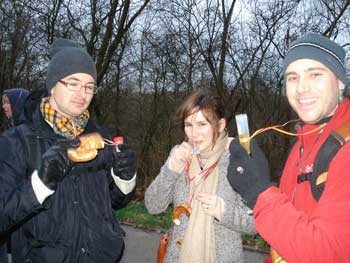
I didn’t know much about Kohlfahrt going into it, but once our group was assembled, and we were handed pretzels (sustenance is crucial) and plastic scientific sample vials to wear around our necks (it really is a cheap and logical way to hold liquor), I knew we were in for some surprises. It only got more interesting when our first two games tested who could maneuver a spoon down their shirt and pants the fastest, and who could throw a teabag the farthest using only their teeth.
Kohlfahrt was definitely worth experiencing for the sheer fun and folly of it all. But it’s a serious business here in Bremen, as evidenced by the multiple Kohlfahrt parties we passed on the road, some of which sported Bollerwagens decked out with flashing lights and loud speakers. The restaurant resembled more of a banquet hall, with about 100 long tables full of rosy-cheeked Kohlfahrters, swaying arm in arm and singing along to “Que Sera, Sera.” It’s experiences like these that remind me how different some things are here than in the States. Germans have no open container law to contend with and are perfectly free (and encouraged, in this case) to walk around toting shot-glass necklaces, singing songs, and pulling a wagon full of alcohol.
Although my observation is that even during the public inebriation and silliness of Kohlfahrt, Germans still manage to act fairly civilized. But civilized or not, it was obvious that everyone was having what seemed like the best Kohlfahrt ever. Until next year, that is…
By Don Heimburger Photos by Don and Marilyn Heimburger
Situated on a hill overlooking the small village of Melk, Austria, is the Melk Abbey, a Benedictine monastery with twin church towers that reach for the heavens.
The imposing Baroque abbey, high above the Danube, has two wings that project around the chapel, curving towards one another and connected by a balcony, framing the inset of the church. The builders succeeded in combining the natural surroundings with the structure.
Designed by Jacob Prandtauer and built between 1702 and 1736, the abbey monks provide pastoral care (the monastery oversees 23 parishes), and schooling (with 900 students). The theme of the abbey is “Ut In Omnibus Glorificetur Deus” (so that God is glorified in everything).
Visitors to the abbey can walk up steep steps to the entrance (walking through the small village of Melk) or drive up or take a taxi to the entrance. An abbey museum is located in the former Imperial Rooms and contains the exhibition “The Path from Yesterday to Today” which tells the story of the 900-year history. Beyond the museum, the must-see Marble Hall and library are two highlights of the structure.
In Marble Hall, Paul Troger’s beautiful frescoes (1731) adorn the ceiling; it is this room that was used as a guest room and dining hall for festive occasions, mostly for the imperial court. From the balcony, a grand view of the surrounding rivers, and town and fields is available.
Hundreds of inlaid bookshelves line the library room, which features similarly-bound books. A Paul Troger ceiling fresco is a counterpoint to the painting in the Marble Hall. On the upper floor of the library are two reading rooms, reached by a spiral staircase. The library contains 1,800 works, the oldest of which is a transcription of works by Venerable Bede from the early 9th century. Two-thirds of the manuscripts are from the reform period of the 15th century.
Gold, orange, ocher, gray and green combine to form a warm color accord in the church. In 1701 the church was completely rebuilt, and is now recognized as one of the most significant structures of the Baroque era. In its full light, its grandeur can take one’s breath away. The interior of the church has been shaped by the hand of Italian architect Antonio Beduzzi, with other artists actually doing the work.
Besides the abbey itself, there is also Abbey Park and the Baroque Garden Pavilion, and the abbey restaurant.
The whole Melk Abbey package is at least a two-hour visit, but to soak in everything, three hours seems more appropriate. Once there, you will undoubtedly want to stay longer.
The Melk Abbey is open all year. Admission is charged, with a reduction when other area attractions are combined. Guided tours are also available at the ticket office. The abbey is wheelchair accessible. For more information, go to www.stiftmelk.at or email kultur.tourismus@stiftmek.at
Lismore Castle is a unique destination ideal for family holidays, a special gathering of friends or even a romantic wedding. The layout of the castle means it can feel intimate with 8-12 guests yet spacious with up to 27 and there is room for many more in the Banqueting Hall for larger events. A dedicated staff is on hand to offer help on every aspect of your stay.
Originally built in 1185 by King John, Lismore Castle was owned in turn by Sir Walter Raleigh and Richard Boyle, First Earl of Cork, before passing to the Fourth Duke of Devonshire in 1753. The castle, located in the southern county of West Waterford, is designed in Gothic style and contains some of the finest examples of domestic Pugin furniture still in private hands. The gardens, laid out over eight acres within the 17th Century outer defensive walls, are believed to be the oldest in Ireland and retain much of their original Jacobean form. In recent years, the castle has been extensively restored and upgraded by successive Dukes but the historic charm remains intact. In addition, the West Wing has been renovated as a contemporary art gallery.
Continually cultivated gardens
FINE FOOD Fine food is the highlight of any guest’s stay; everything is made from scratch in the castle kitchens. Seasonal food is a must for Lismore Castle chefs, and the ever-expanding kitchen gardens offer a plentiful supply of home grown produce to provide accompaniments to locally sourced seafood, fish and meat.
Afternoon tea in the drawing room19th Century decor adorns the Dining Room
From hikes and hot air balloon rides in and over the nearby Knockmealdown Mountains to beachcombing and rock-pooling with botanists on White Bay Strand, to sea kayaking and surfing in Ardmore Bay, to cycle tours along the river and leisurely strolls along Lady Louisa’ Walk, Lismore and the surrounding area is paradise for lovers of the outdoors. Take part in the Sean Kelly Cycle Tour and pedal the hills and valleys where Ireland’s greatest cyclist’s bike once flashed over the cobbles or enjoy a day out at the Tramore Races Festival.
The Blackwater fishing season, an example of one of many festivals in the area, runs from February 1st to September 30th. Enjoy casual casting on a charming stretch of river beneath the castle walls or test your skills and on famed stretches nearby. The Kilkenny Arts Festival (renowned multi-arts festival) and Spraoi, a free urban festival in Waterford city are also within easy reach of Lismore.
Lismore Castle offers packages which include multi-night accommodation with breakfast, afternoon tea and dinner; private airport transfers and more.