Touring the Castles of Castile-Léon Spain

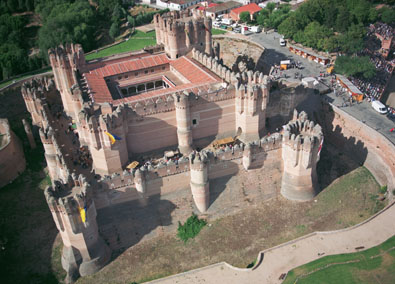
Coca Castle

By Danielle Pruger
Photos courtesy of Castilla-León Regional Tourist Board

Castile-Léon Spain is highlighted in red.

Castile-Léon, an interior region of Spain, is known for its castles (Castile means “land of castles” in Spanish) and provides a look at ancient and medieval forms of architecture. Throughout the Middle Ages, Castile-Léon served as a frontier between Christians and Muslims from the 9th century to the 11th century, which created the initial motivation for building fortresses and castles. Later, the struggle between the various noble families and the royal family from the 12th century to the 15th century made it necessary to build new fortifications. The following six castles, open to the public, can be found in Castile-Léon.

AMPUDIA CASTLE
The municipality of Ampudia is home to a 15th century castle which stands in the center of the village. This castle is well preserved and has been restored. Its sturdy enclosure is protected by four towers, and it has all of the traditional elements of medieval castles: battlements, ramparts, barbicans and a moat. Although it is privately owned, it is open to visitors, and its interior is home to a museum of art and antiquity.

PEÑAFIEL CASTLE
The medieval castle in Peñafiel was built in the 11th century and stands on a rocky spur. The castle was rebuilt around the 14th and 15th centuries and has a peculiar shape because the outline of the walled enclosure conforms to the elongated silhouette of the ridge. This unusual shape has made it one of Spain’s most famous images; from a distance the castle resembles a boat run aground in the midst of a sea of pastures and wheat fields. This castle is also home to the Provincial Wine Museum.

ALCÁZAR FORTRESS
The city of Segovia contains the Alcázar fortress, another one of Spain’s most emblematic images. This imposing Gothic building was built between the 14th and 15th centuries and was later transformed by Philip II in the 16th century into the Herrerrian style seen today. It was the residence of the Castilian and Spanish monarchs for two centuries; its location is on a gorge above the Eresma and Clamores rivers. The location, along with the appearance of the castle, is similar to the castles in fairytales, which evoke the images of princesses, knights, witches and dragons.

COCA CASTLE
The Coca Castle, located in the municipality of Coca, is completely different from other castles; it was built in the Mudejar style of the 15th century using typical red brick. It has three walled enclosures, a moat with a drawbridge, a bailey (courtyard) and a splendid keep. The village of Coca is the descendant of the Celtic-Iberian city of Cauca, which was conquered by the Romans in 151 B.C.

LA MOTA CASTLE
La Mota Castle, also designed in the Mudejar style, is located in the town of Medina del Campo. It was built in the 15th century using concrete and red brick and has four enclosures protected by enormous walls, as well as a monumental keep. It was in the 15th century that Medina del Campo reached its maximum splendor: its fairs were the most important in all of Europe, and it is where bills, instead of coins, were first used as currency. This is also the place where Queen Isabella I of Castile, known as Isabella “la Católica,” died.

Zamora Castle

ZAMORA CASTLE
The city of Zamora, located beside the Duero River, has a medieval castle that was built in the 12th century. This castle was restored in 2009, and the castle is surrounded by three walled enclosures dating from the same period, which encircle the historic center of town.

For more info, go to Spain is Culture

Austrian Ice Caves

Photos Courtesy Austrian Tourist Board

Austria is a magnificent country that offers plenty of tourist attractions. One popular attraction is located in Werfen, Austria which is home to “Eisriesenwelt,” German for “world of the ice giants.”

Eisriesenwelt was discovered in 1879 by a scientist named Anton Posselt and is located inside of the Tennengebirge section of the Alps. Prior to Posselt’s discovery in 1879, hunters and poachers knew of its existence, but had never entered the cave. Although Posselt only explored 1/8 of a mile inside the cave, he published a report of his discovery a year later. It wasn’t until 1921 that Eisriesenwelt saw a large increase in the number of visitors to the cave.

Lamps are distributed to visitors who explore these breathtaking caves for a 75 minute tour. Visitors experience Posselt Hall, which holds the Posselt Tower stalagmite; the Great Ice Embankment, a formation towering over 75 feet; and the Ice Organ, created by the stalactites in Hymir’s Castle. The ice formations are sometimes highlighted with magnesium lighting for an added effect.

The Eisriesenwelt caves are open from May 1 to October 26, and during peak season tours are held every six minutes.

For more info, go to: www.austria.info

Experience 24 Hours in Innsbruck

Innsbruck, Austria

Photos courtesy Innsbruck Tourism

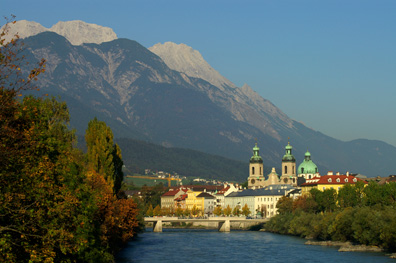
Innsbruck’s beautiful medieval Old Town, set against the backdrop of majestic peaks, is everything you picture a quintessential Alpine town to be. Yet its quaint appearance can be deceiving: a one-day tour will reveal a rich and varied side of Tirol’s capital underneath layers of ancient history and cherished tradition.

MORNING
Before you do anything else, purchase a 24-hour Innsbruck Card either at your hotel or at the Innsbruck Information Office in the Old Town. This grants you access to all museums, public transportation, one roundtrip on any of Innsbruck’s lifts and cable cars and guided tours. Armed with the card, you are now set to start your day with a tour of the historic city center. You’ll love the colorful medieval buildings, vaulted walkways and stuccoed facades.

Golden Roof

Innsbruck’s landmark, the Golden Roof, is famously covered with exactly 2,657 gilded tiles and overlooks the main square. In the 15th century, the Habsburg family ruled their empire from Innsbruck’s Hofburg Imperial Palace.

See the Imperial Apartments and exhibitions at the palace, then stop at the adjacent Hofkirche Court Church, where one of the most important cultural monuments in Tyrol is on display: 28 larger-than-life bronze figures surround the 16th century tomb of Emperor Maximilian I, representing his heroes of antiquity and his ancestors. The quaint alleys of the Old Town also house many small boutique stores offering handcrafted Tyrolean products that make for excellent souvenirs.

AFTERNOON
For lunch with a view, head past the Hofburg Imperial Palace to the Nordkettenbahnen Cable Cars. The funicular stations were designed by star-architect Zaha Hadid, and their sleek modern design contrasts beautifully with the surrounding landscape and historic architecture of the city.

Only 20 minutes later you’ll find yourself at 6,500 feet, near the top of the Nordkette Mountain range. Head to the restaurant at the Alpenlounge Seegrube and enjoy the breathtaking views over Innsbruck and the Austrian Alps. If you want to continue your mountain experience, head to the Innsbruck Alpine Zoo. Europe’s highest zoo features more than 2,000 animals including bears, wolves, eagles and many other species native to the region. To get there, simply take the Nordkettenbahnen back down the mountain and get off at the Alpenzoo Station. Otherwise, head straight back to the city in the early afternoon. It’s time to explore Innsbruck’s excellent shopping street, the Maria-Theresien-Strasse. Within view of the Golden Roof, the grand boulevard is located in a pedestrian area and—among many smaller shops and boutiques—houses two shopping centers: the ultra-modern Kaufhaus Tyrol designed by David Chipperfield and the Rathaus Galerien with boutique stores featuring well-known luxury brands. Don’t miss the Swarovski Flagship Store in the Old Town.

Maria Theresien

Another option for outdoor enthusiasts is to spend the afternoon taking part in Innsbruck’s fabulous summer hiking program. Visitors to Innsbruck and its 25 holiday villages can use the hiker’s bus with their Guest Card and explore the region with a free mountain guide. Even the equipment rental is free of charge with your Guest Card. Simply make a reservation through your hotel the day before.

EVENING
You don’t really know a destination until you have sampled its food. Tyrol is famous for its hearty fare, such as Tiroler Gröstl (meat, potatoes, and onions topped with a fried egg) and a large variety of sweet and savory dumplings. The famous Café Sacher, a traditional Viennese coffee house and restaurant, as well as the Ottoburg, the Weisses Rössl or the Goldener Adler in the Old Town all feature excellent authentic cuisine. After dinner, head to the newly-opened Adlers hotel, housed in one of the city’s tallest buildings and enjoy a cocktail on the rooftop terrace, ending the day with a stunning view of Innsbruck by night.

For more info, go to www.austria.info/us or www.innsbruck.info/en

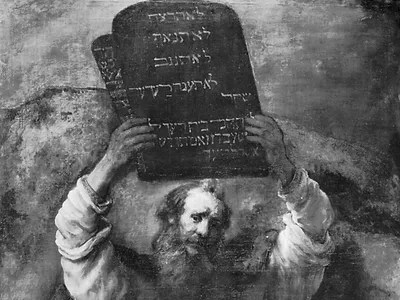
The 10 Commandments for Travelers

1. Thou shalt not expect to find things precisely as they are at home… for thou hast left home to find things different.

2. Thou shalt not be unhappy with schedule changes…for schedule changes are inevitable and part of great adventure.

3. Remember to take half as many clothes as thou thinkest and twice the money.

4. Thou shalt not let other travelers get on thy nerves…for thou art paying good money to enjoy thyself.

5. Thou shalt not judge an entire nation by one person with whom thou hast had a problem.

6. Thou shalt carry a passport at all times, for a person without a passport is a person without a country.

7. Thou shalt not look to assign blame when problems arise, for we are all in the boat together.

8. Thou shalt not worry, for he that worrieth hath no pleasure…and few things are fatal.

9. When in Spain and Portugal, do as the Spaniards and Portuguese do.

10. Remember that thou art a guest in other lands and he that treats his host with respect shalt be an honored guest.

Mark Waldron