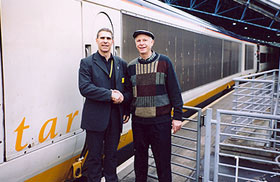
Don Heimburger and Eurostar Driver Detlef Hofmann shake hands prior to departure from Waterloo Station, London, when the train left from this station.
Nearly 22,000 travelers hop aboard a Eurostar train each day, and more than 75 million have traveled the Eurostar routes over the last decade.
That figure represents more rail passengers than all the airline passengers combined on both Eurostar routes out of London.
So what’s new with Eurostar for 2008?
NEW FOR 2008
For one, since November, 2007 Eurostar has moved to a new station, from Waterloo to St. Pancreas, reducing the rail journey between London and Paris by 20 minutes. (I loved Waterloo Station!) The travel time is now 2 hours and 15 minutes, and between London and Brussels it is only 1 hour and 51 minutes.
Also opened was Great Britian’s first high-speed line (called HS1) which carries the Eurostar exclusively. This allows travelers from London to Paris or Brussels to use the train for a one-day business or leisure trip. Every day the train runs 18 roundtrips between London and Paris and 10 between Brussels.
Eurostar trains feature 18 cars each, with car configurations changed depending on if the train is designated as a Business Premier train or a Leisure Select train. The train also runs to Lille, Eurodisney/Marne La Valle, Avignon (summer only), and Bourg St. Maurice (winter only).
TRAINS SEAT 766
Trains seat 766 persons, with special cars situated between cars 7 and 12, and standard class cars 1-5 and 14-18. There are always two bar cars, 6 and 13.
If you are a U.S. citizen, you will probably want to book your trip through Rail Europe, especially if you want to purchase a Eurail Pass that can include the Eurostar (and you can receive up to a 60% discount). Go to http://www.raileurope.com for the details.
In other European rail news, last summer the new French Railway TGV East train broke the world’s rail speed record, reaching a top speed on the trip of 357 miles per hour! A Rail Europe spokesman said, “This accomplishment is monumental for the SNCF and the rail community, and will have a positive impact on all who wish to travel east from Paris.”
The average speed, however, of the TGV East trains is 200 miles per hour. Each first class seat features its own electric power outlet, and broad seat cushions; first class passengers can book a taxi through the train conductor; and on-board messages are in French, German and English.
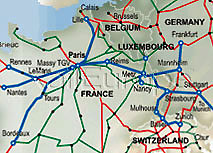
As an example of faster speeds on the TGV, here are new travel times posted by Rail Europe for travel between some stations:
Photos courtesy the Paris Convention and Visitor’s Bureau
Museum shops. Parisian museums present the opportunity to combine culture with shopping. After a visit, you can pick up the hottest new design object to take home; find a special work on architecture, science, or cinema; or choose the latest trendy image or object as a souvenir.
THEMATIC AND SPECIFIC SHOPS Museum shops offer works and objects of a high quality representative of those found in the exhibitions themselves. They often present the opportunity to find rare or very specialized objects, recordings, or books.
Close to the Jardin des Plantes, the bookshop of the Institut du Monde Arabe, designed by Jean Nouvel, has many precious items. Once through the entrance of this magnificent institution encased in moucharabiehs, the shop offers insight into Arab culture with high-quality exhibition catalogs and books on photography, architecture and craftsmanship.
Cinémathèque Française
In the Bercy district, the bookshop of the Cinémathèque Française is housed in a building designed by the architect Frank O. Gerhy. This bookshop for cinema buffs is situated on the mezzanine of the Cinèmathèque and is the main reference for cinema in Paris. Books about the history of cinema, experimental cinema and film music, as well as posters, and photos are for sale.
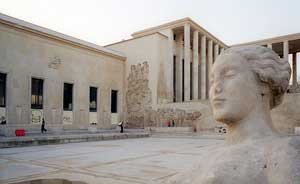
The bookshop at the Jeu de Paume, at the Place Concorde, is a landmark bookshop for all areas of photography, the visual arts and cinema, and has built a collection of more than 10,000 titles. The bookshop also operates a high-quality mail-order service for visitors abroad.
The huge bookshop Harmonia Mundi is located between the concert hall and the Musee de la Cita de la Musique, at the entrance to the Parc de la Villette, in north Paris. Lovers of classic, jazz and world music can choose from among the 9,000 CD and DVD references and benefit from the advice of professionals.
Linked to the Cité de l’Architecture et du Patrimoine, just across from the Eiffel Tower, the Moniteur Bookshop is entirely devoted to the subject of architecture and stocks works on architecture, town planning and heritage.
NATIONAL MUSEUMS The national museums in Paris also have their prestigious shops. The Musée du Louvre shops, in several locations at the Carrousel, sell elegant objects like reproductions of jewelery and sculpture from the museum’s collections, as well as a selection of monographs by artists, essays and art books.
The Musée d’Orsay, a former train station built for the World Fair of 1900, has a delightful shop inspired by the collections of the museum selling posters, table and home decor objects, and exhibition catalogs.
Finally, the Flammarion bookshop at Beaubourg, in the Centre Pompidou, offers exhibition catalogs, postcards and multimedia products as well as a large selection of publications on art and design.
Musee d’Orsay
CONTEMPORARY SHOPS Some museums boast highly-contemporary shops designed like a second exhibition area to extend the length of a visit and offer a sales area with a striking decor. The ultra-trendy Palais de Tokyo, powerhouse of the contemporary artistic avant-garde, close to the Eiffel Tower, asked the graffiti artist André, the creator of the character of Monsieur A., to design its Blackblock gift shop. The design of the shop was inspired by a gas station in the suburbs of Stockholm. Encircled by refrigerated glass windows with integrated pink lights, the shop displays rare objects and limited editions. The space is also regularly used for special events.
In another vein, Le Laboratoire has opened near the Louvre; it is an experimental venue at the crossroads of science and contemporary creation with a bookshop called Laboshop. A veritable bubble in white, the shop invites visitors to discover a variety of prototypes that have been devised and created by participants at the venue, and which it is possible to test or buy. Among the most astonishing, “the Whiff” is a process which enables you to eat by inhalation, while “the Bel-Air” is a filter that enables plants to filter the air. These unique objects are signed by Designer Mathieu Lehanneur, and scientist and founder of this unique place, David Edwards.
The mezzanine of the Centre Pompidou, a dynamic Parisian cultural institution, houses the Printemps du Design, a shop with a grey concrete floor and minimalist windows. It offers 3,000 types of objects around five themes: living, savoring, charming, communicating, getting around and playing. Eggcups, seats, cameras, jewelery, sweets and spinning tops catch the eye. Striking for its selection and display of objects, it offers design classics as well as the latest in contemporary creations.
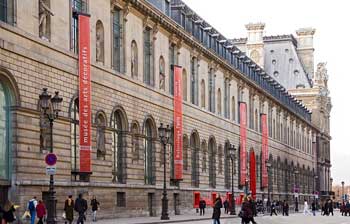
The 107 Rivoli is the sales area of the Musée des Arts Décoratifs, close to the Tuileries Gardens in the center of the capital. Specializing in specific areas of the decorative arts, fashion and design, the shop offers a rare selection of books, accessories, stationary, tableware and toys. For more up-to-date shopping, celebrities and designers are invited to suggest a selection of special objects for the duration of an exhibition or an event.
The new Galerie de l’Opéra is a gem of a shop situated within the prestigious Palais Garnier. A place to discover talents and trends in Europe, it specializes in the operatic and choreographic arts and is divided into four areas: multimedia library, art for children, memory, and performance, and is linked to the artistic program of the famous institution. Educational games, designer objects, books, technological or even signature and showcase objects already make this a cult address for the latest in museum shopping.
Galerie de l’Opéra
Palais de Tokyo
The prestigious Pinacothèque de Paris, situated opposite the Madeleine church, rounds off this tour of contemporary museum shops. Its shop showcases French and European designers who are not well-known to the general public, like the La Tonkinoise jewelery brand, for example. There is also a great selection of items for children: memory games, card games, wooden toys; and for adults, superb decorative objects and even luxury stationary.
For the curious and contemporary art buffs, there is the Merle Moqueur, situated in the north wing of the Halle Curial at the Centquatre, the city of Paris art establishment in northeast Paris. The shop features an epoxy floor, suspended acoustic cassettes and ramps with fluorescent lighting. Reference works for children and adults are offered in the different sections: general, youth and arts.
Also centered on contemporary creations, the bookshop of the Maison Rouge in Paris, Bookstorming, has wall decoration by the artist Jean-Michel Alberola. Books on art, monographic works, and critical essays, as well as many original works are on sale. Numerous events and encounters with artists and authors, like book signings, talks and video displays are featured regularly.
The bookshop of the Musée du Quai-Branly, situated on the Seine quayside near the Eiffel Tower, is devoted to art from outside Europe. This unique place offers a variety of ethnic objects while advocating the values of fair trade, for example with A-Typik and its Colombian jewelery, whose profits go to the reconstruction of schools in Colombia.
UNUSUAL SHOPS Reflecting the museums in which they are housed, this type of shop offers unusual and miscellaneous articles.
At the Musée de la Poste, the shop Correspondances offers a fine choice of objects linked to the role and history of the Post Office: original postcards, objects and ideas for gifts.
Below Sacré-Coeur in Montmartre, the Halle Saint-Pierre is an exhibition area showing unusual and popular primitive art. The bookshop of the Halle Saint-Pierre is as surprising as the museum. Built of iron and glass, it houses books on art and literature, often illustrated and covering all types of contemporary creation.
Not far from the Halle Saint-Pierre, in north Paris, the shop of the Musée de l’Érotisme caters to shopping with an aphrodisiac edge. On sale are books of modern art and erotic photographs, and old films and comic strips on the same theme.
There is also the bookshop of the Hôtel de Sully, located in a 17th-century mansion. This exceptional establishment presents national heritage treasures and heritage publications.
The shop of the Monnaie de Paris delights fans of coins, medals and jewelery.
The bookshop of the Musée de la Chasse et de la Nature, situated near City Hall, offers atypical shopping opportunities with very specialized literary and artistic publications on the subjects of nature and hunting.
For honing technical and scientific knowledge, the shop of the Musée des Arts et Métiers offers fine objects and books linked to the current exhibitions. Badges, fans, model aircraft, and literary works provide a close-up view of the fascinating world of technology.
Finally, in the Hôtel de Saint-Aigan, in the heart of the Marais, the bookshop of the Musée d’Art et d’Histoire du Judaïsme offers a selection of varied objects and books on religion, philosophy, history and ethnography, continually updated according to what’s at the museum.
Photos courtesy Paris Convention and Visitors Bureau
Designer hotels: everything started in Paris a few years ago with the trend toward boutique hotels.
The term is used for small capacity hotels with three or four stars, which offer clients a personalized and attentive welcome and a particularly refined and cozy decor.
Following the success of this type of hotel, certain hotels decided to take the concept further by entrusting their decor to interior designers and architects and providing their guests with a contemporary atmosphere: designer furniture, use of new materials, the latest technologies and contemporary works of art.
Some hotel groups have made this design orientation their speciality. This is the case for the Murano Hotels and Resorts, which owns the Murano Urban Resort Hotel and the Kube Rooms and Bars Hotel in Paris. The first, located between République and Bastille on the edge of the Marais, drew attention with its immaculate white design aesthetic, its bar lounge with colored seats, its lobby with a huge contemporary fireplace and its guest rooms which mix high-tech and state-of-the-art design. The second, located in the north of the capital, applies the same formula to the design of its guestrooms and offers an out-of-the-ordinary experience with its bar completely made of ice.
The Astotel group also offers 15 Parisian hotels where the designer touch captivates guests in search of a contemporary atmosphere. This is the case at Le 1223 Elysees, a hotel where beautiful materials (Swarovski crystal, marble, etc.) provide a contemporary feel, or at the Hotel Joyce, which combines the latest technology gadgets (iPod stations) with products answering to the needs of today’s travelers (a range of organic products), all in a contemporary decor that play on the codes of traditional hotel charm and character (outlines of bed heads and features of interior decor drawn on the bedroom walls).
The Relais de Paris group reinvents the classic Relais style with a contemporary, designer version. The BLC Design Hotel offers an immaculate white setting in the Charonne district. The 29 guest rooms all have a monochrome look, combining refined furniture with black and white photographs.
At the Standard Design Hotel, not far from the lively Bastille District, black and white begins in the reception areas. The young designers invited to decorate the hotel have created a contemporary, trendy place. The Color Design Hotel, between Bastille and the Gare de Lyon, lives up to its name and offers guests lively colors with special touches in the guest rooms and bathrooms. The vaulted breakfast room follows the same concept with a contrast provided by exposed stonework. Located in the picturesque Montmartre district, the Chat Noir Design Hotel plays the designer card while respecting the traditional Parisian style of this area. The decoration amusingly evokes the shadow plays that gave the Théâtre du Chat Noir its reputation, while offering refined white furniture complemented by warm orange and brick tones.
The wave of designer hotels can be found in all districts of Paris, each revealing a leading concept and specific style of decoration. Another example in the Latin Quarter is the Five Hotel. This hotel’s concept is the awakening of the five senses: smell with fragrances created just for the Five, touch with the use of sensual materials in the guestrooms and particularly the ultra-contemporary reinterpretation of Chinese lacquer, taste with a breakfast of the best Viennese pastries from the Monge bakery, sight with the fibre-optic lighting effects and luminous atmosphere of the bedrooms, and hearing appeased by the hotel’s silence.
In the same neighborhood, the Hotel Design de la Sorbonne has had a makeover and offers an upscale and elegant designer stay. Dark wallpaper, luxury fabrics and a contemporary photography exhibition on every level set the tone of the establishment.
The Hotel Le A, in the heart of the fashion district between the Champs-Élysées and the rue Saint Honore, mixes an ultra-designer look of the interior decor with a cozy feel in the reception areas designed to look like those of a private apartment, with a contemporary-style fireplace, comfortable couches, lounge with a library filled with art books, a bar under a 19th century glass roof and 25 sumptuous guestrooms where a refined sober style contrasts with bold contemporary drawings decorating the walls.
In a more understated style, design is also honored at the Hotel Arvor Saint-Georges, in the peaceful 9th arrondissement. The 30 guestrooms offer the tranquility of a contemporary and convivial private residence. In the 14th arrondissement, LeFabe Hotel stands out from the rest with its 17 guestrooms, each offering an original atmosphere. The names of the rooms (Mona Lisa, Orchidées, Together, etc.) are an indication of the designer decoration offered to guests. In the 16th arrondissement, Mon Hotel, a small establishment of 37 guestrooms a few steps from the Champs-Élysées, boasts luxury designer decor with the use of materials like leather, Alcantara fabric, and wood.
Paris appears to top the destination wish list on a first trip to France. But after that, the Dordogne area of southwestern France is an enticing destination known for history, culture, wine, gastronomy and relaxation.
The Dordogne, also known by its former name, the Perigord, is an hour’s drive east of Bordeaux. The Dordogne River runs east to west through its center, carving out a winding river valley scattered with more than 1,000 picturesque castles and chateaus. From vineyards in the west to pre-historic sites along the Vezere River tributary in the east, and fortified villages from the Hundred Years War, there is plenty to see.
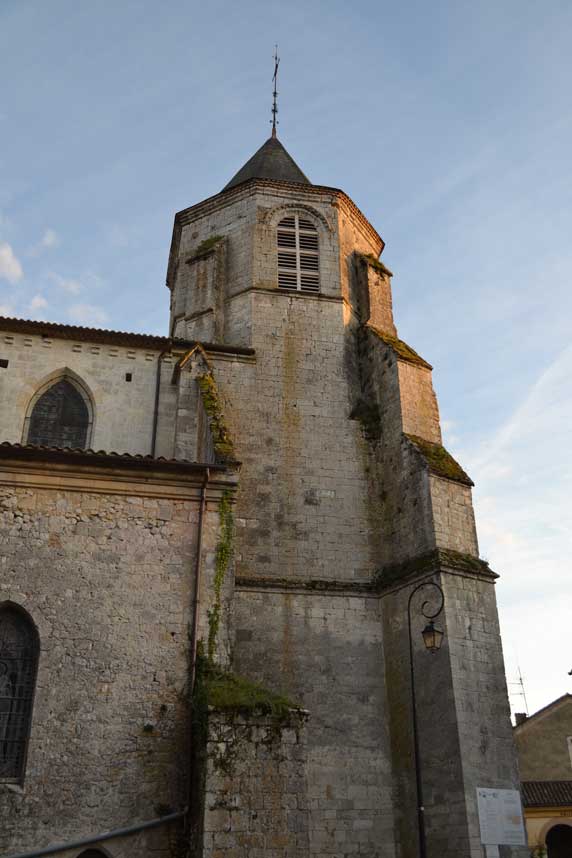
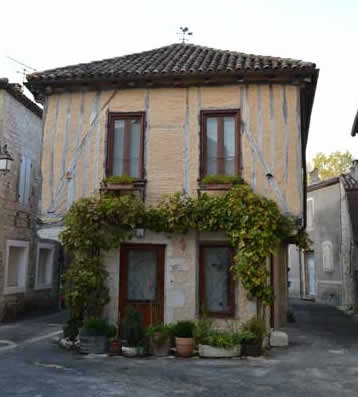
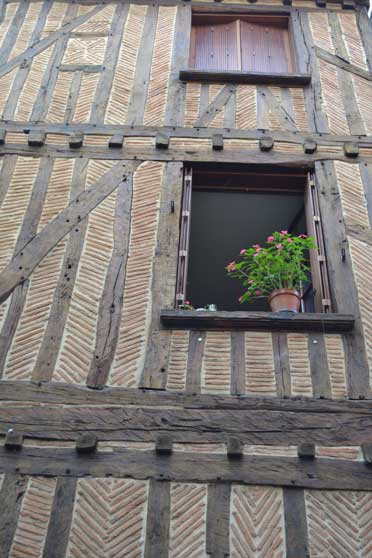
ISSIGEAC In the tiny medieval village of Issigeac a circular wall surrounds winding streets dominated by the octagonal bell tower of the 15th century Church of Saint Felicien. The 13th century stone buildings with Gothic arches and charming half-timbered houses with beautiful inlaid brick detail are lovingly preserved, not to attract tourists, but to be lived in and used by the less than 1,000 inhabitants. Look for the “Mushroom House,” built with an overhanging second story, to allow carts access to the narrow streets that surround it. An active market is held in the central square on Sunday mornings, but a stroll through the quiet town at dusk calms the spirit and prepares you for a relaxing dinner.
Church of Saint Felicien“Mushroom House”
La Bruceliere restaurant in Issigeac is family-run and serves gourmet local cuisine with regional wines. A pleasant surprise in rural France, it also offers five rooms for overnight accommodations. www.labruceliere.com
BERGERAC The historic town of Bergerac was founded with the castle built to manage river traffic on the Dordogne, and the 9th century bridge accommodating pilgrims on the road to Santiago de Compostela. In the old town, see the picturesque stone buildings constructed with local yellow stone, and the half-timbered houses on the Rue St. Clar. The National Tobacco Museum is housed in the 17th century Peyrarede House.
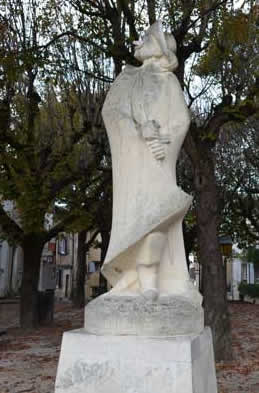
In the medieval town square, restored in the 1970’s, you’ll discover a stone statue of Cyrano de Bergerac – the comic/tragic hero made famous by Edmond Rostand’s 1897 fictional story about the brilliant and poetic swordsman with a very large nose, in love with the beautiful Roxane. The real-life Savinien de Cyrano, upon whom the fictional character was loosely based, was born in the 17th century near Paris. When he joined the Cadets of Gascony, he changed his name to Cyrano de Bergerac, after a family estate of that name. The town of Bergerac is nevertheless happy to adopt him as a symbol of boldness and generosity.
Unfortunately, Cyrano’s famous stone nose is routinely broken off by admiring fans. So a new colorful bronze Cyrano with a more permanent nose was erected in 2005 in the Place Pelissiere, in the shadow of the picturesque church of Saint-Jacques.
Stone Cyrano
In the 18th century flat-bottomed boats called Gabarre carried wine and wood for barrel-making from Bergerac’s riverfront to Bordeaux for export. Replica Gabarre today offer tours on the Dordogne in Bergerac and in the castle-rich area near La Roque-Gageac.
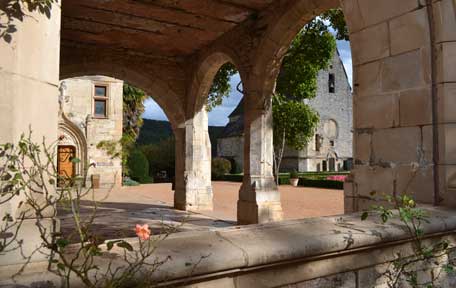
A peaceful courtyard is at the center of the Recollets Cloister, now home to Bergerac’s House of Wines. Here a Wine Journey exhibit explains the history and appellations of Bergerac wines. Visitors can also taste the local wines and visit with a winemaker from the Dordogne Wine Route.( www.vins-bergerac.fr/en/p/maison-des-vins-or-house-wines.) What is there to learn at the House of Wines?
The vineyards in the geographic area of Bergerac are classified into 13 appellations that are grouped into five different types:
Reds: Bergerac, Cotes de Bergerac, Montravel and Pecharmant Roses: Bergerac rose Dry Whites: Bergerac and Montravel Sweet Wines Monbazillac and Saussignac Dessert Wines: Cotes de Bergerace Blanc, Cotes de Montravel, Haut Montravel and Rosette
France’s system of appellations consists of a set of strict rules covering which grape types may be used in a particular wine, the areas in which the grapes can be grown, the maximum permitted yields, the pruning type and sometimes the harvesting techniques.
Particularly popular in the area is Monbazillac, a sweet white wine made from grapes harvested after they have begun to shrivel and develop “noble rot.” Each individual grape must be hand picked from the bunch at just the right time — a labor intensive, painstaking job.
Edouard de Saint-ExuperyChateau Tiregan
WINEGROWERS The vineyards of Bergerac cover almost 30,000 acres in 93 villages on both sides of the Dordogne. Although traditionally overshadowed by the more well-known wines of its neighbor Bordeaux, many of the Bergerac wines compete favorably with them, and at a lower cost.
Chateau Puy-Servain (www.puyservain.com) owners Daniel and Catherine Hecquet have nearly 120 acres of vineyards (the average for wine growers in the area is 50 acres) and export 60% of their wine.
The Chateau VARI estate in the town of Monbazillac is an organic vineyard. Their wine bar, la maison Vari, offers wine along with a simple, but delicious menu for a light lunch. www.chateau-vari.com
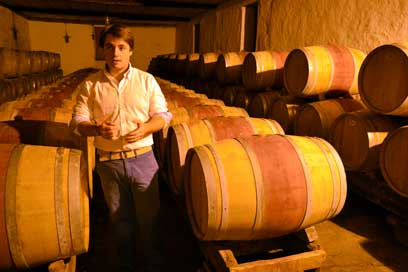
Winegrower Edouard de Saint-Exupery of the Chateau Tiregand in Creysse (whose famous literary relative wrote The Little Prince in 1943) welcomes visitors for free wine tastings or for a guided tour of the 17th century family estate, located just 10 minutes east of Bergerac. www.chateau-de-tiregand.com
PREHISTORIC SITES The valley of the Vezere River, which flows into the Dordogne, has been called the prehistoric capital of the world: the part of Europe that claims the longest period of continuous human habitation. Cro-Magnon man was discovered here in 1868 during excavation for the construction of the railroad. A national museum of prehistory is located in the cliffs above Les Eyzies-de-Tayac. www.musee-prehistoire-eyzies.fr
The valley boasts 147 prehistoric sites dating from the Paleolithic age, and 25 decorated caves, the most famous of which is the Lascaux Cave in Montignac. The site of 17,000-year-old paintings and engravings, it was discovered in 1940 and opened to the public for viewing. The paintings had survived beautifully for centuries in the stable and somewhat sterile environment. However, visitors unwittingly exposed the cave and drawings to destructive elements such as algae and carbon dioxide, which forced the closure of the cave for viewing in 1963.
Today visitors to the Dordogne can view an exact three-dimensional replica of largest two areas of the cave in Lascaux II, a remarkable achievement that took 10 years to construct. Since 2012, a traveling replica called Lascaux III will be on exhibit in museums around the world, starting with the Field Museum in Chicago, and continuing to Houston and Montreal, not to return to France until 2020. www.lascaux.culture.fr; www.semitour.com/site-touristique/lascaux-ii
Walking through the Grand Roc Caves in Les Eyzies de Tayac is like being inside an illuminated geode. Well-placed lighting showcases the incredibly delicate stalagmites, stalactites and crystallizations of this Unesco World Heritage site. www.les-grands-sites-du-perigord.com
A few steps away from the Grand Roc is Laugerie Basse showcasing two prehistoric rock shelters and displays of prehistoric mobile art.
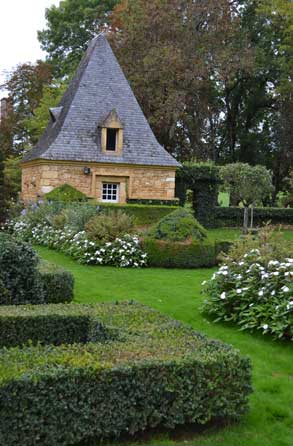
EYRIGNAC MANOR GARDEN Eyrignac Manor Garden is one of France’s most beautiful private gardens. Known for its topiary art, the gardens and manor have been in the same family for 500 years. Owner Patrick Sermadiras is often on hand to meet guests and share his design and gardening expertise. A well-written visitor’s guide and audio tour is available in English to lead you through the seven distinct gardens. An on-site restaurant offers a varied menu for a tasty lunch. www.eyrignac.com
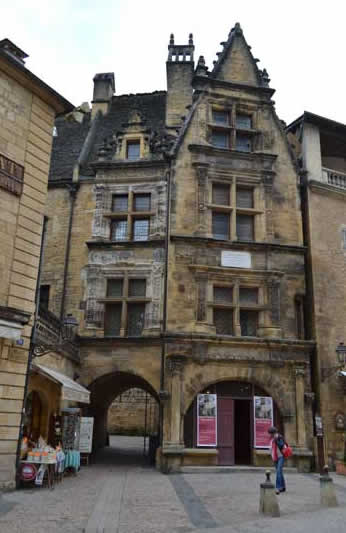
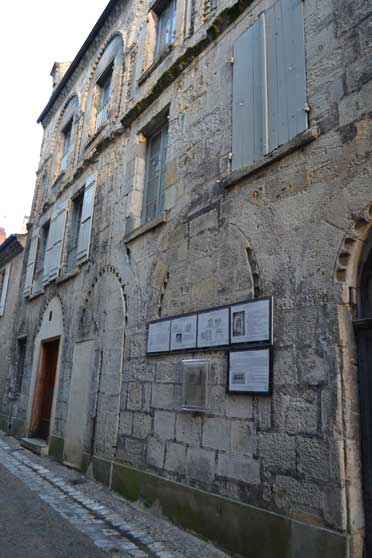
MEDIEVAL TOWN OF SARLAT A medieval jewel, Sarlat boasts one of the largest medieval urban areas in the world. Locals are especially proud to showcase the birth-house of political philosopher Etienne La Boetie as a gem of Italian Renaissance architecture. Throughout the town, note the roofs made of overlapping flat stones, the inexpensive, readily available roofing material of the time. These stones made the roofs extremely heavy, necessitating steep roof angles for stability. A little jarring, yet noteworthy nonetheless, are the huge metal doors that open into Sainte-Marie church, which now serves as a covered market. World famous architect Jean Nouvel, who was born near Sarlat, designed the doors to replace the destroyed apse. He also designed the glass elevator that bursts through the open roof of the bell tower, offering a spectacular panoramic view of the surrounding old town.
Boetie House
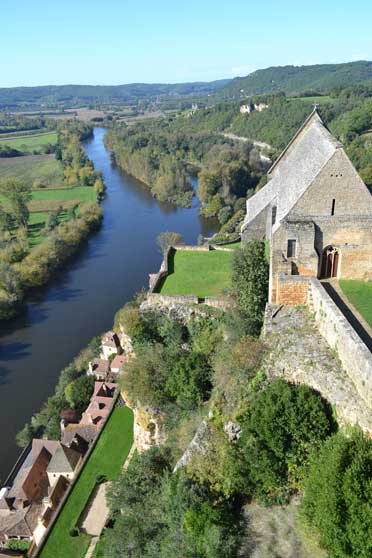
VILLAGE OF BEYNAC Bring your walking shoes and climb up the winding stone streets of the beautiful medieval village of Beynac. Your goal is the 12th century fortress at the top of the cliffs overlooking the Dordogne. From there, the view of the surrounding countryside, the town below, the winding Dordogne River and the Castelnaud Castle on the opposite riverbank is unforgettable. A walk through the restored castle is a living history lesson.
During the Hundred Years War, the Dordogne River was the border between France and England. Beynac Castle was French and Castelnaud was English. All along the Dordogne River struggles for supremacy meant the bastides (fortified towns built by either the French or the English during the 13th century to contain invasions) were shuffled back and forth between the two countries.
Beynac Castle and village served as the location for more than a dozen films, including Joan of Arc in 1999, Ever After in 1998 and Chocolat in 2000.
After climbing and touring Beynac Castle on the cliff, enjoy a meal at LaPetite Tonnelle, a quaint restaurant tucked against the cliff on the way down. Their menu offers homemade dishes with locally sourced gourmet food and regional wines, served on their patio with a beautiful view of the village or in their dining room, built right into the rock wall. www.restaurant-petite-tonnelle.fr
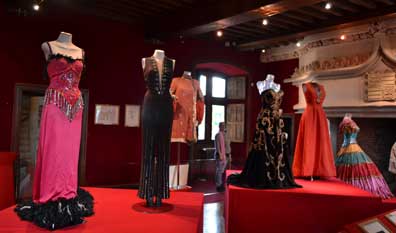
CHATEAU DES MILANDES On the other side of the river in the town of Castelnaud le Chapelle is the Chateau des Milandes, a beautiful 15th century castle, and the former home of musical entertainer Josephine Baker. Born in St. Louis, Missouri, Josephine’s popularity sky-rocketed during the 20’s in Paris when she appeared in the Revue Negre at the Theatre des Champs-Elysees. During her time at the Chateau de Milandes she adopted 12 multi-national children (her “Rainbow Tribe”) and became beloved by the locals because of her generosity and kindness, even working for the French Resistance during WWII. Poor financial planning caused the house and its contents to be put up for auction in 1968. Four families have owned the Chateau des Milandes since the auction. Current owner Angelique de Labarre has passionately collected items from Josephine’s past to fill the 14 rooms with original costumes, music, photos and furnishings. Beautiful gardens and a live birds-of-prey show on the grounds outside the castle complete an entertaining visit. www.milandes.com
PERIGUEUX Périgueux, located along the Isle River, is the largest town in the Perigord region, and its contemporary face makes finding the hidden medieval gems a little more difficult.
Périgueux began as two distinct towns. Easy to see are the historic remnants of the older one: Gallo-Roman town of Vesunna. The ruins of the inner sanctum of the temple for the goddess Vesunna and remnants of the ancient amphitheater stand near Jean Nouvel’s newly-designed Gallo-Roman Museum. The Romanesque gate of Porte Normande leads to what is left of the Barriere Castle and Romanesque-style house built in the Middle Ages on Roman foundations. The Saint-Etienne de la Cité Church was the cathedral of Périgueux until 1669, when that title was transferred to the Saint Front Cathedral in the second nearby settlement that comprises today’s Périgueux.
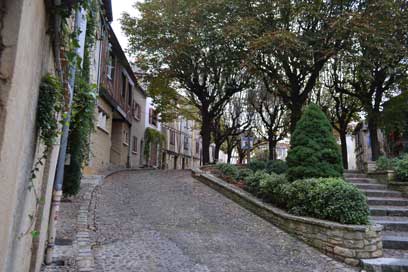
Streets of Périgueux
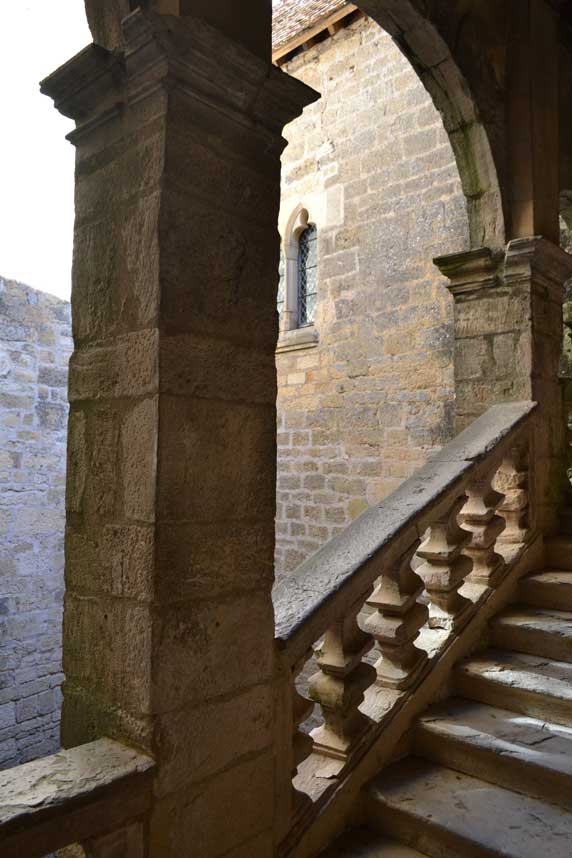
Further to the east, the more commercial city of Puy St. Front, the second “building block” in what is now Périgueux, developed in the 12th century. Look carefully down narrow streets of the old town for half-timbered houses, towers, walls with evidence of ancient arched windows and gateways, bricked-in and changed to fit the needs of the century. Beautiful ancient stone staircases still lie hidden in entryways of private houses, accessible to guides with keys.
Dominating the skyline is the Byzantine-style bell tower of the Saint Front Cathedral. The church is in the shape of a Greek cross, with five domes dating from the 12th Century. It was restored by Architect Paul Abdie between 1852 and 1895. His award winning design of the Sacre Coeur Basilica in Montmartre in Paris was inspired by the style of the Saint Front Cathedral.
ACCOMMODATIONS The Chateau des Vigiers in Monestier on the western edge of the Perigord is one of the few places in the area that can accommodate large groups. This luxury hotel, with a spa and a 27-hole golf course, offers 36 romantic rooms in a 16th century chateau and annex and 40 more in its contemporary, eco-friendly Relais des Vigiers. www.vigiers.com
For peaceful and luxurious accommodations five miles south of Bergerac, LaChartreuse du Bignac offers 12 rooms and a restaurant in a 1630 stone chateau with vaulted ceilings and exposed beams. Extensive grounds with terraces, a swimming pool and a park lead to a small lake. www.abignac.com
The recently renovated Hotel Les Glycines in les Eyzies de Tayac is centrally located near the Cro-Magnon museum and Grand Roc cave, and is a short drive to Lascoux cave. The hotel features beautiful romantic rooms, extensive gardens, a pool and a wonderful restaurant. Order the “Victoria pineapple” for dessert, aim your video camera, and watch the magic begin. The waiter pours warm rum/passion fruit syrup over a hollow chocolate ball until the surprise pineapple tidbits, pina colada and vanilla ice cream appear. Entertaining and delicious! www.les-glycines-dordogne.com
Vieux Logis in Tremolat is a lovely 4-star country inn, formerly a priory and then a farmstead, that is not to be missed. Rustic comfort in 14 rooms and nine apartments, with a one-star Michelin chef, gourmet restaurant, bistro, seminar rooms and lovely garden and terrace. Once there, you won’t want to leave. www.vieux-logis.com
NEED A GUIDE? For a professional travel guide in the Dordogne, European Traveler recommends Frances and Sandra Ho Tham Kouie.
They have more than 20 years of experience in tailor-made tours for English speaking travelers – either individuals or groups. Their knowledge of history and attention to detail will smooth your way to an enjoyable discovery of the Dordogne. www.voyages-france-impressions.com.
Crave chocolate? Do you salivate when someone utters those sweet syllables? Whether you call it chocolate (Spanish, Portuguese), xocolata (Catalan), chocolat (French), chocola (Dutch), Schokolade (German), Schoggi (Swiss-German), cioccolato (Italian), choklad (Swedish), sjokolade (Norwegian), czekolada (Polish), suklaa (Finnish) or okolaad (Estonian), it’s all the same: delicious!
As a woman at a Swiss chocolate factory told me, “You don’t need to know any other languages to talk about chocolate. Chocolate speaks for itself!”
FROM BEAN TO BAR The Olmecs, Mayans, and Aztecs were enjoying chocolate as a drink for centuries before Christopher Columbus bumped into the Western Hemishphere on his way to the spice-producing lands of the East. Both Columbus and Hernán Cortés are credited with bringing cacao beans (from which chocolate is made) back to Spain in the early 1500s, where the Spanish eventually figured out that the bitter beverage of Central America tasted a lot better with sugar, vanilla and spices such as cinnamon and cloves added to the brew.
Sweet, foamy, dark and thick, hot chocolate soon became a favorite drink of the Spanish nobility, and Spain monopolized the market for cacao beans for nearly a century. In the 1600s, the popularity of chocolate—still consumed only as a beverage—began to spread to other parts of Europe, including France, England, Austria and the Netherlands. By the early 1700s, chocolate-drinking establishments in London were already competing with the popular coffeehouses there.
It was the Europeans who turned a ceremonial drink of the Aztec aristocracy into the affordable chocolate products that we enjoy today: chocolate powder, chocolate candy, chocolate syrup, chocolate spread.
In 1828 a Dutchman named Coenraad van Houten developed a process for removing the natural fat (cocoa butter) from the cacao beans and turning the remaining solids into powder. By the mid-1800s, European chocolatiers had figured out how to combine sugar and cocoa butter with a paste of ground cacao beans to make bars of “eating chocolate.”
The British were also pioneers in the development of chocolate technology, but the Swiss were the leaders in the field. Cailler, the first brand of Swiss chocolates, was established in 1819. In 1875, Daniel Peter in Switzerland invented milk chocolate, soon to be marketed by Nestlé. Four years later, Rodolphe Lindt created the world’s first “melting chocolate” for use in pastry- and candy-making. And in 1913, Jules Séchaud introduced a process for manufacturing filled chocolates. By that time, the Swiss were already the largest producers of chocolate in the world.
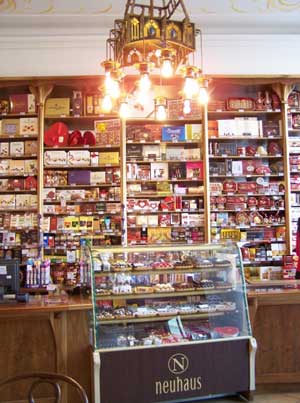
SWEET TOOTH Today, the Swiss, Belgians, and Germans lead the world in chocolate consumption, happily eating 24 to 26 pounds of chocolate per person every year. The British, Austrians, and Norwegians are close behind, consuming 18 to 22 pounds each. And what tourist traveling in Europe can resist those triangular Toblerone and purple-packaged Milka bars, square Ritter Sports, round Mozart Kugeln, gold-wrapped Ferrero Rochers, fancy French and Belgian handmade bon-bons, chocolate Santas at Christmas, chocolate bunnies and cream-filled eggs at Easter time?
When I told a Swiss hotelier that I was surprised to learn that the Swiss eat an average of 12 kilograms (over 26 pounds) of chocolate per person annually, she looked surprised, too. “So little?” she asked incredulously. “I eat 200 grams of chocolate every day. Let’s see, that’s…”—she stopped to calculate in her head—”3 pounds each week, which is about 150 pounds a year. And I’m such a happy person!”
CHOCOLATE TOURS Several countries in Europe have fascinating museums that focus on the history and process of making chocolate, from bean to bar. And many chocolate producers—from major multinational companies to small independent artisans—offer tours of their facilities, with a chocolate tasting included. The Swiss even have a Chocolate Train that takes you on a round trip from Montreux to visit the Cailler-Nestlé chocolate factory in Broc, as well as a cheese factory in Gruyères.
For more information on European chocolate museums and factory tours, check out the following sweet links:













 European Traveler