Chill Out With Cool Summer Soups

Photos courtesy World Soups

By Sharon Hudgins

Now that global warming seems to be raising temperatures in Europe, you can beat the heat on your next summer trip by eating cold soup. That’s right. If the thought of eating a chilled soup leaves you cold, think again. Chilled soups have been popular in Europe for centuries, from Scandinavia in the north to Spain in the south. Why not try them yourself?

Some of these soups are made with fruits and berries, often combined with milk products. Others are based on vegetables and meat stocks, sometimes spiked with wine. They can be cooked or uncooked, thick or thin, smooth or chunky, sweet or savory, plain or garnished.

Most cold soups are eaten at the start of a meal, but in elaborate dinners they are sometimes served as palate cleansers between courses. In various parts of Europe, chilled soups are also eaten for breakfast, for snacks, as a main dish of a light meal and even for dessert. Some cold soups are considered solely summer fare, whereas others are served year round.

The next time you travel in Europe, look for these classic chilled soups, some of which are regional or national specialties.

SCANDINAVIA
The Scandinavians have a large repertoire of colorful cold soups made from fruits and berries (fresh or dried, bottled or frozen). The bounty of summer’s harvest turns up in many Scandinavian soup bowls: apples, cherries, apricots, plums, peaches and pears; blueberries, cranberries, raspberries, lingonberries, strawberries, blackberries, gooseberries, currants and raisins; and even other ingredients such as rhubarb and rosehips. Often these are combined with buttermilk, soured milk, yoghurt or sour cream, with a little lemon juice, sugar and cinnamon added, too.

Uncooked cold soups of this type are made simply by mixing the fruits and berries with the liquid and other flavorings, which are mashed together or puréed in a blender or food processor (much like a fruit smoothie). Cooked cold soups start with heating the ingredients together, then thickening them with flour, potato starch, cornstarch, arrowroot, sago, tapioca, semolina, ground rice or beaten eggs, before the soup is chilled for serving. Often these cold soups are garnished with a dollop of whipped cream or with heavy cream poured over the top.

The Danes make a cold buttermilk soup, which can be cooked or uncooked, seasoned with sugar and lemon juice and thickened with eggs or ground rice. Sometimes this pale-colored soup is poured over crumbled oatcakes in a bowl, topped with whipped cream and served at the end of a meal.

Surely the most famous Danish cold soup is rødgrød—literally “red groats”—a kind of thin pudding made from red fruits and berries (cherries, red raspberries, strawberries, red currants) cooked together, lightly thickened, then served cold, garnished with milk or cream. Occasionally blueberries, blackberries and black currants are added, which give the mixture a deeper, darker color. Considered a “national dish” of Denmark, this chilled pudding-soup is actually very popular throughout the Nordic countries, where you’ll find it on the table for breakfast, served as a soup before the meat course of the day’s main meal, or eaten as a summer dessert.

GERMANY & AUSTRIA
Rote Grütze is the German version of this same dish. It’s considered a specialty from the northern part of Germany, particularly the region of Schleswig-Holstein (near Denmark), where it’s known as Rodgrütt. You’ll now find Rote Grütze served throughout Germany, especially in the summer, from hotel breakfast buffets to the dessert menus of fancy restaurants, from beer halls to local festivals—the ruby-red mélange is topped with vanilla sauce, whipped cream or vanilla ice cream.

In the German language, cold soups in general are called Kaltschalen (“cold bowls”). Germans and Austrians both enjoy a variety of cold fruit-and-berry soups, at the beginning or end of a meal, as much as their northern neighbors do. Germans also make a chilled beer soup with currants and grated pumpernickel bread, seasoned with lemon, sugar, cinnamon and cloves, and garnished with pumpernickel croutons or little airy egg-white dumplings; cold spiced red or white wine soup, adorned with crunchy almond macaroons; a refreshing buttermilk soup embellished with stewed fruit or whipped cream; and a pale-green sorrel soup containing dill, sour cream, diced cucumbers and chopped hard-boiled eggs, served with an ice cube in each bowl.

The Austrians have their own versions of cold wine soups, such as lemon soup with sugar, egg yolks and white wine, sprinkled with a dusting of ground cloves, and a rich beef consommé (clarified meat stock) spiked with dry white wine, with a thin slice of orange and some finely chopped parsley floating on top. Austrian cold tomato soup combines white wine with a purée of tomatoes and onions cooked in beef stock, spiced with garlic and paprika, and with finely chopped cucumbers stirred into the soup just before serving.

The Austrians also like lightly gelled cold consommés enhanced with chilled green grapes, diced ham and minced herbs (parsley, chives, chervil, tarragon). And the unusual Austrian Kalte Paradeissuppe (Cold Paradise Soup) consists of chilled cantaloupe, cucumber and melon balls in a shallow soup plate surrounded by a cold purée of tomatoes and sour cream with strips of cooked ham, decorated with chopped parsley and mint—a combination worthy of being labeled “Baroque.”

POLAND, UKRAINE & BELARUS
Cold soups are as prevalent in Eastern Europe as in the central and northern parts of the continent. Poland in particular has a rich heritage of chilled soups based on a variety of fruits, berries and vegetables mixed with meat stocks, dairy products and pickled or fermented foods that give a slightly sour taste to some of these soups.

Sweet soups include pear and buttermilk with cloves and lemon rind, as well as soups made of strawberries, gooseberries, blueberries, apples and plums, sometimes partnered with rhubarb, scented with cinnamon or vanilla and garnished with fried bread croutons or little puff-pastry pellets. The Poles also make Zupa Nic (Nothing Soup), a sweet, ice-cold, custardy concoction, with frothy egg-white dumplings, much like the French dessert, Oeufs à la Neige (Snow Eggs).

Polish cold savory soups are often based on cooked or raw vegetables mixed with a sour liquid. In addition to several cold versions of barszcz (borshch) made with red beets and garnished with sour cream, the Poles make beet and buttermilk soup poured over hard-boiled egg slices; buttermilk and pickle brine soup; cold cucumber soup with soured milk, dill pickles, and hard-boiled egg quarters; and a creamy green cold soup of soured milk and buttermilk with sorrel, dill pickles, green onions, parsley, chives, dill weed, garlic and hard-boiled eggs.

Borshch, served hot or cold, is the national dish of Ukraine, where you’ll find as many versions as cooks who prepare it. Usually based on beets, which give it a bright red color, borshch can also contain potatoes, onions, carrots, cabbage, peppers, cucumbers, radishes, dill, garlic, meat stock, buttermilk or sour cream, pickle brine or sauerkraut juice, hard-boiled eggs, chopped beef or ham and even crayfish or shrimp. You name it, and the Ukrainians are likely to throw it into the soup pot. And in the summer they’ll often serve it chilled.

Sweetened fruit soups are popular in Ukraine and Belarus, too. On hot summer days, a light meal in these countries might consist of a bowl of cold fruit soup or chilled borshch, accompanied by a fresh vegetable salad or a fruit compote.

HUNGARY & ROMANIA
Hungarians love cold fruit soups. You’ll find chilled cherry soup on many Hungarian restaurant menus—a pretty pink soup made with tart Morello cherries, flavored with red or white wine, sugar, cinnamon and lemon, with a dash of sour cream or a dollop of whipped cream as a final flourish. Cold raspberry and strawberry soups are also popular, as is the simple but elegant fruit soup composed of puréed peaches and peach seeds, sugar, sparkling wine and Hungarian Riesling wine. Hungarian chilled vegetable soups include beet soups similar to Slavic borshch and a creamy yellow squash soup seasoned with dill.

Romanian fruit and berry soups range from apple, apricot, cherry and plum, to gooseberry and red currant. Some are sweet and creamy, garnished with puffs of sweet meringue and sliced nuts. Others are slightly sour, from lemon juice or soured milk products, and some even contain chopped or slivered smoked meats. The Romanians also make a cold vegetable soup containing cucumbers, carrots, onions, celeriac, veal stock, sour cream and dill.

FRANCE
Surely the most famous “French” cold soup is Vichyssoise—the classic potato and leek cream soup—which was actually created in New York by a French chef, Louis Diat, in the early 20th century. But the French can claim plenty of cold soups on their home soil, from seafood bisques to Crème Cyrano Froid, a cold chicken soup thickened with eggs and seasoned with mustard, tarragon and cayenne pepper, along with pieces of finely diced chicken or ham, all lightened by whipped cream folded into the mixture.

Other cold and creamy French soups include such flavors as broccoli, asparagus, cucumber with tarragon or mint, tomato with garlic and dill, carrot with cayenne, pumpkin with ginger and nutmeg, and green pea with diced chicken or turkey. These are often served in a bowl placed on a bed of crushed ice to keep the soup chilled while you eat.

In summer the French have a penchant for chilled consommés with pieces of cooked meats or vegetables suspended in the slightly gelatinous stock. They also make a lovely cold sorrel soup seasoned with garlic and lemon juice, mixed with heavy cream, chopped hard-boiled eggs, and thin slices of cucumber, then poured over diced black bread for serving.

SPAIN
Gazpacho is the king of cold soups in Spain. A regional specialty from Andalucía, in southern Spain, gazpacho can now be found on tourist menus all over the country, especially in the summer. The most common kind of gazpacho is a reddish-colored purée of tomatoes, cucumbers, onions, bell peppers, white bread, garlic, olive oil and wine vinegar. Served at the beginning of a meal, this type of gazpacho is often garnished with fried croutons and diced raw onions, cucumbers and peppers.

Before tomatoes and peppers arrived in Spain from the Western hemisphere 500 years ago, Andalucían gazpacho was simple peasant fare, made with the cheapest ingredients—only bread, water, salt, garlic, olive oil and vinegar or lemon juice—mashed together in a wooden bowl and eaten as the midday meal by farm workers in the fields. Today you’ll find many kinds of gazpachos in Spain: red, white, green and yellow, thick or thin, containing a wide range of ingredients from fruits and nuts to eggs, fish, meat and milk.

Salmorejo is a version of red, tomato-based gazpacho from Córdoba, where chopped hard-boiled eggs, canned tuna and strips of Spanish serrano ham are added to the cold mélange. Córdoban cooks also concoct a chilled white gazpacho made with almonds and sometimes pine nuts. Granada and Málaga both claim ajo blanco, a smooth white garlic and almond gazpacho garnished with green grapes. And Spanish gazpachuelo frio is another chilled white soup, prepared from thick homemade mayonnaise whisked with plenty of ice water before chopped red tomatoes and black olives are stirred in.

SOUTHERN & SOUTHEASTERN EUROPE
Given the torrid summers in southern Europe, it’s surprising that Italy, Greece and parts of the Balkans don’t have a tradition of many chilled soups in their regional or national cuisines. The Italians do have a minestrone freddo alla milanese, a rice and vegetable soup from Milan, garnished with basil leaves and grated cheese. But even that soup is eaten only at room temperature, not chilled.

Greeks cool off with tzatziki soupa, cold cucumber and yoghurt soup blended with lemon juice, olive oil, garlic and fresh mint. And around Thessaloniki, Greeks eat a sweet cherry soup made with dry white wine, heavy cream, cherry liqueur and cinnamon—much like the fruit soups favored in many northern European countries.

Tarator is a classic Bulgarian cold cucumber-and-yoghurt soup, very similar to the version eaten in Greece. But Bulgarian tarator is enriched with a paste of pounded walnuts, garlic, salt and olive oil swirled into it, often with chopped walnuts or dill sprinkled over the top. Bulgarians make other chilled soups from yoghurt combined with zucchini, sorrel, mushrooms and fresh herbs (especially dill). Cold tomato soups can sometimes be found in the Balkans, too. And on Christmas Eve the Bulgarians even serve a cold soup made of sauerkraut and sauerkraut juice, chopped leeks, onions and paprika, accompanied by a bowl of grilled hot peppers!

Alsace: A Special Culinary Corner of France

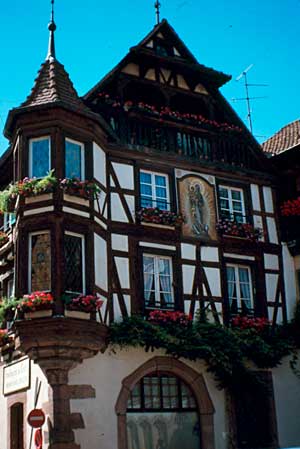
Typical half-timbered house in Kayserberg, on the Alsatian Wine Route

By Sharon Hudgins
Photos by the author

Quick: Which region of France has also belonged to Germany—and is a top culinary destination for travelers from all over the world?

If you answered “Alsace,” then immediately pass GO, collect $200 from the nearest ATM, and head for a memorable meal in one of the most famous culinary regions of the country.

Bonus: You can drink well there, too.

Alsace produces fine wines from Riesling, Sylvaner, Gewürztraminer, and other types of grapes, as well as clear, potent, aromatic distilled liquors (eaux-de-vie) from the many varieties of fruits and berries that grow in abundance in this northeastern corner of the country. Located along the Rhine River across from Germany and Switzerland, Alsace is also the main beer-producing region of France.

And all of these local beverages pair perfectly with a cuisine that anchors Alsace solidly on France’s gastronomic map.

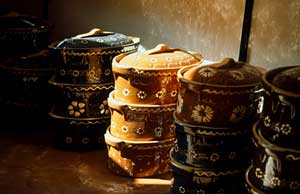
Traditional earthenware casseroles from the pottery village of Soufflenheim

TRADITION MEETS MODERNITY
Alsace has long been known for the high quality of its cooking, from home kitchens to cozy bistros and brasseries to some of the top-rated restaurants in France. Based on locally grown crops, farm-raised animals, and wild game from the forests and fields, traditional Alsatian cuisine reflects the rustic simplicity of rural life, influenced by next-door Germany (to which Alsace has belonged at different times in history), but with a decidedly French twist.

Modern Alsatian restaurant chefs have sought to reduce the butter, cream and lard so prevalent in past preparations, and to lighten the load of pork products and heavy casseroles that once characterized the cuisine. Some have even fallen for the fancy foams and deconstructed dishes of the latest food fads. But most of the region’s modern chefs remain true to their roots, using fresh, local ingredients in creative ways that still pay homage to the established traditions of Alsatian cooking.

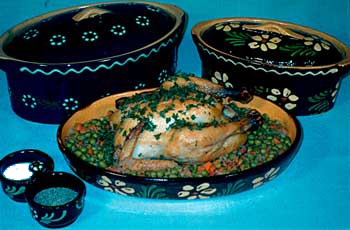
Poulet Grand-Mère (Grandmother’s-Style Chicken), cooked and served in traditional earthenware pottery from Soufflenheim

WHERE TO EAT
Modern Alsatian cuisine can be tasted at many of the region’s highly rated upscale restaurants (see list). For more traditional fare, look for smaller, family-run restaurants, bistros, bakeries and pastry shops. Some of the best of these are located along the Route des Vins d’Alsace (Alsatian Wine Route) between Marlenheim and Thann, in little villages of old half-timbered houses, their window boxes bursting with red geraniums in summer.

Many traditional restaurants serve their dishes in rustic handmade earthenware from the pottery town of Soufflenheim. And they pour excellent Alsatian white wines out of handmade blue-and-gray stoneware pitchers, from the pottery village of Betschdorf, into tall, thin, green-stemmed wine glasses set on tables covered with Alsatian-made linens. Dining in Alsace is a feast for both your palate and your eyes.

WHAT TO EAT
► Kugelhopf, a richly flavored, light-textured, yeast-raised cake studded with raisins and almonds, baked in a special fluted mold shaped like a Turk’s turban. Traditionally eaten for Sunday breakfast, accompanied by big cups of café au lait (coffee with milk). Also served in the afternoon with coffee or tea and sometimes after dinner as a dessert dressed up with sweet sauces and whipped cream.

► Choucroûte garnie, mild sauerkraut cooked in white wine, beer or cider and seasoned with juniper berries and black peppercorns. Considered a “national dish of Alsace,” the big mound of sauerkraut is served on a large platter and topped with a variety of meats—especially ham, bacon, sausages and other smoked pork products—along with cooked whole carrots and boiled potatoes. Traditionally served as the Sunday midday meal, but now available on many restaurant menus every day of the week.

► Bäckeoffe, a stick-to-your ribs casserole made with layers of sliced potatoes and leeks with two or three kinds of meats (beef, pork, lamb), cooked together in white wine inside an earthenware casserole hermetically sealed with a strip of bread dough. In earlier times, Bäckeoffe was assembled at home on Monday mornings, then taken to the local bakery to be cooked in the wood-fired oven while the housewives were busy doing their laundry by hand.

► Tarte flambée, the Alsatian answer to pizza, made from a very thin crust of bread dough topped with a layer of crème fraîche (slightly soured cream) or fromage blanc (fresh white cheese), thinly sliced onions, and small pieces of smoked bacon. Known in Alsatian dialect as Flammekueche, the best of these are baked in wood-fired ovens.

► Munster cheese, from the Alsatian town of Munster. When ripe, this cow’s milk cheese has a slightly creamy interior and a deliciously pungent aroma. Often served at the end of the meal, accompanied by slices of fresh fruits or garnished with a sprinkling of caraway, fennel or anise seeds.

► Fruit tarts, from rhubarb in spring to apple and pear in autumn. The Alsatians have a well deserved reputation as excellent bakers of breads, cakes, tarts and cookies. Their bakeries and pastry shops are among the most tempting in France.

Alsatian tourism: www.tourisme-alsace.com/
Alsatian Wine Route: www.france-for-visitors.com/alsace/vosges/route-du-vin.html

RESTAURANTS:
Strasbourg: www.buerehiesel.fr/
Strasbourg: www.anciennedouane.fr/
Illhaeusern: www.auberge-de-l-ill.com/V2/index.html
Lembach: www.au-cheval-blanc.fr/
Marlenheim: www.lecerf.com/
Natzwiller: www.hotel-aubergemetzger.com/
Bergheim: www.wistub-du-sommelier.com/

Paris Avec Famille

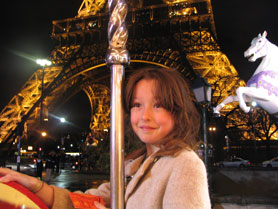
Sophie at the Eiffel Tower

By Susan MacCallum-Whitcomb
Photo by the author

Ahh, Paree! For most of us, the City of Light is synonymous with culture, cuisine and romance.

When you visit, you’re supposed to spend your time in world-class museums and Michelin-starred restaurants. You’re supposed to take intimate strolls by the River Seine. You’re not supposed to take your children. Right? Wrong.

In fact, Paris is extremely kid-friendly. Part of the reason is that the locals-–who tend to take their own enfants everywhere-–are so welcoming. But it is also because Paris itself seems reassuringly familiar to children.

Some discover the French capital as toddlers courtesy of Ludwig Bemelman’s Madeline books; other make vicarious visits with Eloise, the Aristocats, the Rugrats, even the ubiquitous Olsen Twins. Hence its big-ticket attractions already have a built-in appeal. Take Notre Dame Cathedral: 800-year old churches don’t normally top a child’s itinerary. But, as the setting for Disney’s Hunchback movies, this one is an exception to the rule. Since it is literally the center of the city–the place from which all distances are measured-–it also makes a fitting starting point for your family’s monumental adventure.

CAVERNOUS INTERIOR
After spinning around the cavernous interior and “reading” the stories in the stained-glass windows, older kids can drop a few euros to descend into the pre-Roman Crypte Archeologique or climb the towers for a close-up look at Quasimodo’s home turf.

Younger ones, meantime, may prefer to plop on a bench in adjacent Viviani Square. Thanks to the uncluttered view of Notre Dame it offers, they can amuse themselves by playing “spot the gargoyle” (one looks suspiciously like Disney’s Laverne) and feeding the world’s most gregarious pigeons.

Compared to the cathedral, the Eiffel Tower is a relative newcomer. Yet it’s a certifiable icon, and you’ll likely feel compelled to scale it. Of course, every other tourist in town will too. So to avoid the worst crowds, try arriving early on a weekday and taking the elevator straight to the third level. Tickets are steep (11.50€ /6.30€ for ages 3-11); but on a clear morning the vista is priceless. Alternately, bring the kids after dark to see the tower lit up like a super-sized Christmas tree. For the full effect, arrive on the hour (dust to 2 a.m. in summer) when 20,000 individual bulbs sparkle in a 10-minute display.

ARC DE TRIOMPHE
For those who’d rather look at the Eiffel Tower than be on it, the Arc de Triomphe is another option. Napoleon’s tribute to his troops might not seem like a natural choice for families: after all, it’s perched on the site where Paris’ 12 main avenues converge and is surrounded by an obscenely-busy traffic circle. Nevertheless, children routinely give it the “Coolest Tall Thing” award. That’s because it’s wide open at the top. Unlike the Eiffel Tower (which is enveloped in mesh) there is nothing creepy or cage-like to impede their view-–and the sight of Paris, laid out like a star below–is impossible to beat.

Once you’ve soaked it all in, it’s time to hit the city’s famed museums-–some of which are aimed squarely at families. One such venue is the Science and Industry Museum. Its interactive “Cité des Enfants” is undeniably inviting: five – to 12 year-olds, for instance, can program robots while younger siblings play Bob the Builder at a mini construction site. However, the rules can be off-putting. Registration is required, limited numbers of guests are admitted and visits are restricted to 90 minute sessions. Kids are also streamed by age. So depending on your family structure, the trip can be a logistical nightmare.

Luckily, though, there’s no need to stick to the kiddy category when it comes to Parisian museums. Musée Rodin is a case in point. The esteemed sculptor’s estate in the seventh arrondissement is an ideal place to introduce youngsters to fine art. Sure its walls hide orderly flowerbeds, ornamental pools and a grand 18th-century mansion. But don’t let the formality fool you. In the garden, kids are free to play among famous statues; and inside visitors as young as four can sign up for regularly-scheduled activities (including tours complete with games and drawing sessions) that are priced between €4.50 and €6. 

KID PLEASERS
Musée d’Orsay, on the Left Bank, and the Pompidou Centre’s t&L=2″ Musée National d’Art Moderne, on the Right, are kid-pleasers as well. The former has a dazzling Impressionist and Post-Impressionist collection (think works by Monet, Renoir, Van Gogh and Cézanne), while the latter focuses on Modern masters like Picasso and Matisse. Both have intriguing architecture, plus bright bold canvases that appeal to kids. But the fabled Louvre, with its exhaustive-–and exhausting!-–supply of religious and historical paintings will seem pretty staid by comparison.

If seeing Mona Lisa’s smile is high on your personal to-do list, consider taking turns with   another adult. When one of you dips in, the family can relax just outside on the expansive lawns of Jardin du Tuileries. It’s easy to while away hours there bouncing on tres chic trampolines, sailing toy bateaus, riding carousel horses or graduating to real ponies (à la carte activities that cost a couple of euros each). Many of the same simple pleasures can be enjoyed across the Seine in Jardin du Luxembourg: a sixth arrondissement park which also happens to house the city’s best-loved marionette theater.

JARDINS ARE BACKYARDS

The beauty of both spots is that they’re not merely tourist attractions. In a city of apartment dwellers, these jardins serve as a backyard for countless families. So lingering in them qualifies as an authentic cultural experience, especially on weekends or Wednesday afternoons when local children are out of school. If your offspring have a smattering of French they can strike up a conversation with their Parisian peers. If not, don’t worry: they’ll quickly learn that the language of child’s play is universal.

For playtime on a grander scale, you can take the gang 20 miles north to Parc Astérix (35€/ 25€ for ages 3-11). Inspired by France’s favorite cartoon hero, it features dozens of amusements ranging from a classic wooden roller coaster to an ultra-modern corkscrew model. Twenty miles east of the city, meanwhile, is Disneyland-Paris: a 2,225-acre resort that proves it really is “a small world after all.” Said to be Europe’s #1 tourist attraction, it consists of two parks-–a Magic Kingdom and Walt Disney Studios-–with one-day passes to each costing  46€  (38€ for ages 3-11). 

FUN ANYWAY
Since these resemble their U.S. counterparts and recreate many popular rides (“Dumbo’s Flight” and “Rock’n’Roller Coaster” among them), Disneyland-Paris is often dismissed as an unnecessary Americanism. Who, naysayers may ask, needs a kingdom built around a faux castle when the countryside is full of the genuine article? For that matter, who needs a movie park dedicated to a foreign director when Jean-Luc Godard and François Truffaut are native sons? Well, nobody does. But they’re fun anyway. Besides, a dose of Disney is a great antidote for kids suffering a temporary case of culture shock.

The truth is that no matter how well prepared you are, your children will feel slightly disoriented at times. Moreover, touring with them will always be an added responsibility. Yet there are upsides. Kids, literally and figuratively, look at things from a different angle. Hence being with them will reveal sites and scenes that are typically hidden from vacationers. All you have to do is slow down and savor the experience. Remember, parents don’t get bonus points for ticking off every attraction listed in their guidebook. The real reward comes from building a store of family memories that you all can share. ET

Take a Pass: Admission charges add up fast, so a  Paris Museum Pass is just the ticket for pennywise parents. Priced from €30 for a two-day version, it gives adults unlimited entry to more than 60 museums and monuments – including all of those mentioned above except for the Eiffel Tower. Children don’t need one because so many of the attractions are already free for guests under 18 (that’s a big plus when your traveling companions have short attention spans!). Better still, the whole family benefits since the pass also allows all of you to jump those lengthly lines.

ABOUT THE WRITER
Living up to her turn-of-the-millennium resolution, freelancer Susan MacCallum-Whitcomb jettisoned her professorial robes and traded teaching for full-time travel writing. In the years since, she has spent an inordinate amount of time doing research in Europe — much of it with her family in tow!  The results can be read in Fodor’s guidebooks (she’s contributed to six thus far) as well as Fodor’s online newsletter, and a host of Canadian magazines and newspapers. When not jaunting around the continent, Susan enjoys taking it easy in her sublime home base: Halifax, Nova Scotia.

Have a Very Good Trip…by Train

So, you want to show your wife or your date a very good time.

And you want to do it between Venice and Paris.

That can be arranged.

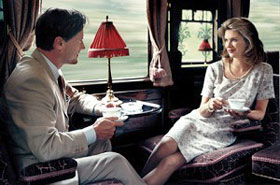
What is called the World’s Most Romantic Celebration consists of a train trip on the Orient-Express between Venice and Paris.

Here are the details. The trip is eight days and seven nights from $24,750: three nights in Venice; one night on the Venice Simplon-Orient-Express and three nights in Paris.

Departure dates, which are Sundays and Wednesdays, in 2008 are: March 30; April 6, 13, 20, 27; May 11, 14, 25;June 8, 11, 22, 29; July 20, 27; August 3, 10, 17, 24; September 10, 21, 24, 28; and October 12, 15.

The itinerary consists of:

Day 1 – Venice
Arrive in the romantic city of Venice and transfer by private water taxi boat to the Hotel Cipriani. A deluxe suite is reserved for three nights in the city of canals. 

Overnight in Venice.


Day 2 – Venice
A personally tailored guided tour of the city in the morning. In the afternoon, the private launch of Romilly, Lady McAlpine collects you from the hotel and takes you to her home for a visit and refreshments. 

Breakfast included. Overnight in Venice.

Day 3 – Venice
Explore the delights of La Serenissima before a final romantic evening, including a ride on a gondola before dinner, at one of Venice’s most exclusive restaurants. 

Breakfast and dinner included. Overnight in Venice.


Day 4 – On the Venice Simplon-Orient-Express
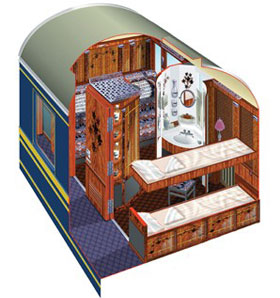
The train’s hostess completes check-in formalities for your journey on the Venice Simplon-Orient-Express train before your private transfer to the station. Board the train (cabin suite) for the overnight journey to Paris, enjoying superb cuisine and sparkling champagne. 

Breakfast, lunch and dinner included. Overnight on board.


Day 6 – Paris
After breakfast, a private car and driver takes you to the French countryside en route to Reims, capital of the Champagne region, where you have a private tasting before lunch at the two-star Michelin restaurant of Chateau Les Crayères, accompanied by fine wines and Prestige Champagne. After lunch, return to Paris. Breakfast and lunch included. Overnight in Paris.

Day 7 – Paris 
Time for final sightseeing or shopping in the boutiques and designer stores. In the evening a private car transfers you to Quai de Grenelle, where you board a luxurious private yacht. The vessel’s teak deck and sleek interiors allow you to relish the cozy atmosphere of a 1960s boat. Enjoy a glass of champagne as you cruise along the river Seine, before a romantic candlelit dinner served either on the outdoor deck or the inside cabin. A shower of roses completes the cruise before returning for a final night in Paris. Breakfast and dinner included. Overnight in Paris.

Day 8 – Paris
Your journey comes to an end. Breakfast included.  All aboard!

IF YOU GO…
Log onto www.orient-express.com for more details about the trip. Or, call (in the USA) 401-351-7518 or e-mail to: oesales.providence@orient-express.com. From France, call +33 1 55 62 18 00; from Germany, call +41 44 770 1407; from the Netherlands, call +31 35 6955111; and from the U.K., call +44 20 7805 5060

The ‘Champs-Elysees’ of Burgundy Wines

The wines of Burgundy are rich and varied, and are divided into regional appellations, village appellations, Premiers crus and Grands crus. The Appellation d’Origine Contrôlée (AOC) is your guarantee of the characteristics of the regional wines. Fall is a beautiful time to drive or bike through the wine routes.

The Côte de Nuits extends from the south of Dijon to Corgoloin and forms the northern section of the Grands Crus route. It is a prestigious hillside that is home to villages bearing the names of the greatest red wines in the world. Here you will find 24 of the 33 grands crus in Burgundy: Chambertin, Clos de Vougeot, Romanée-Conti and many more.

The Côte de Beaune follows on from the Côte de Nuits towards the south, from Ladoix-Serrigny to the hillside of the Maranges. This soil, blessed with the Chardonnay grape, is where the greatest dry white wines in the world are produced (Corton-Charlemagne and Montrachet, among others). Outside of the city of Beaune, which is the capital of Burgundy’s wine regions, the countryside becomes gentler as you approach Santenay and the département of Saône-et-Loire.

Burgundy hiker

ROUTE OF THE GRANDS VINS DE BOURGOGNE – THE ROUTE THROUGH NATURE
The route of the Grands Vins runs from Santenay to Saint-Gengoux-le-National, and is the extension of the route of the Grands Crus towards the south: more than 100 signposts connect around 40 towns via the vineyards of Maranges, the Couchois and the Côte Chalonnaise. This varied route combines villages with nature, and vineyards with wooded countryside, and is dotted with Romanesque churches and castles. You can discover it by car, but also along the water of the Canal du Centre, or by bike along the the many cycling routes.

ROUTE OF THE MÂCONNAIS-BEAUJOLAIS, THE SOUTHERN WINE-GROWING AREA
This route in the south of Saône-et-Loire is the extension of all the wine routes from Dijon. The eight circuits enable you to break away from the main route and explore the most southerly vineyards in Burgundy in greater depth. The main route itself crosses the Mâcon wine-growing region in a straight line and finishes at Romanèche-Thorins (Saône-et-Loire) on the hillsides of the Beaujolais region.

ROUTE OF THE VINEYARDS OF THE YONNE ALONGSIDE THE RIVERS
In the département of the Yonne, the vineyards have developed alongside rivers: the Jovinien and the Auxerrois in the Yonne Valley, the Chablisien in the Serein Valley, the Tonnerrois in the Armançon Valley, and the Vézelien in the Cure Valley. The wines of the Yonne are undergoing a renaissance and deserve to be discovered in all their diversity just as much as the highly famous Chablis.

ALONG THE LOIRE AROUND THE NIÈVRE
The vineyards of the Nièvre, which extend along the right bank of the Loire, belong not to Burgundy but to the Centre-Loire, and have long suffered from a certain lack of recognition. Now another wine route enables visitors to discover all their charms, from the hillsides of Pouilly-sur-Loire, where the famous Pouilly-Fumé is produced, to the Coteaux du Giennois overlooking Cosne-Cours-sur-Loire. This route also takes in Sancerre on the other side of the river in the Cher.

For more information on Burgundy, go to www.burgundy-tourism.com.