New Designer Hotels in Germany’s ‘Magic Cities’

Photos courtesy German National Tourist Office

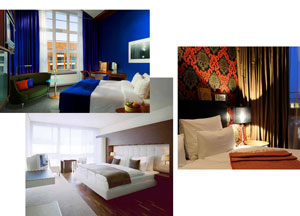
The cities belonging to Germany’s “Magic Cities” association, including Berlin, Cologne, Dresden, Duesseldorf, Frankfurt, Hamburg, Hannover, Leipzig, Munich and Stuttgart are centers of art, architecture, history and culture. Discover some of the newest additions of designer hotels that these cities offer:

In Berlin, the Soho House concept is being implemented for the first time in Germany. Stylish branches of this chain can already be found in London and New York. In the former “House of Unity” at the foot of Prenzlauer Berg, the hotel has 50 bedrooms. The luxurious fitness area, modern conference rooms and hotel with spacious apartments on the third and fourth floor will be open to all visitors. There will also be an exclusive area for club members only. Another highlight is planned on the second floor, where the office of the former State President of the GDR, Wilhelm Pieck, is being restored to its original condition.

Cologne

In Cologne, one hour from Frankfurt on the Rhine River, there is a new four-star hotel, Art’otel Cologne, in a prime location on the banks of the Rhine. Alongside the trapezoidal design and the colorful windows, the chief attraction of the hotel is the art-inspired interior design with a permanent exhibition of the works of the Korean artist SEO, a former master student of Georg Baselitz. The hotel has 218 rooms with a special twist: the glass walls partitioning the bath or shower rooms are colorfully painted with some of the best of SEO’s designs.

Duesseldorf lives up to its artistic reputation (Academy of Arts) with its own new designer hotels. The Stage 47 Hotel features a completely new, unique design. All 27 suites and rooms are named after famous artists. Their portraits adorn the walls of the individual rooms, creating a special atmosphere. British elegance combined with unpretentious comfort describe the Sir & Lady Astor hotels. Lovingly arranged details and charming decorations as well as discreet, attentive service give guests a feeling of a homecoming.

Dresden, the royal metropolis on the River Elbe in the eastern state of Saxony, has been restored to one of the most beautiful Baroque cities in Europe. Dresden offers beautiful architecture, world-class art and a variety of luxury hotels. A perfect example for the modern reinvention in the classic tradition is the QF Hotel, perfectly located near the Church of Our Lady in the heart of Dresden. The hotel, formerly the “Hotel Stadt Berlin,” has been known since 1804 as one of the best hotels in the city. The 96 rooms combine comfort and luxury with a clean and modern design.

Frankfurt, the financial metropolis in the middle of Germany, is not only the major airport hub, but also a fascinating city where great history meets modernity, world class contemporary art museums and galleries are placed alongside cultural giants such as Goethe. A new highlight of the hotel scene is the Roomers design hotel in the city center. This luxury hotel combines classic lines and innovative design in its 117 rooms.

Hamburg: The designer hotels in this port city combine themed interiors with the comforts and conveniences of the highest standard. Hamburg is also where you’ll find Germany’s highest-rated boutique hotel. The Side Hotel combines luxury and design with aplomb. This award-winning five-star establishment is characterized by a minimalist interior of dark wood and beige elements illuminated by unique lighting.

The George Hamburg holds an entirely different appeal as a four-star hotel with British charm. Rooms furnished in warm colors, an elegant library and an English Garden are all part of its homage to British style.

Hannover, in Germany’s north, has a long history as a royal seat of the English kings and queens, but also as a modern city that hosts many world-class conventions. A special place to overnight is the Sheraton Pelikan Hotel. Located in the former Pelikan factory, one of the most famous brands of fountain pens, the architects integrated the architecture of the old production facilities into the hotel design to create a distinctive loft atmosphere.
Leipzig

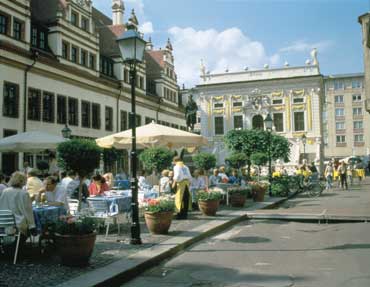
Leipzig, one of the most exciting cities in eastern Germany, invites visitors to stay in style in the newly-redesigned Pentahotel. The hotel was given a complete makeover in 2009 by Italian star designer Matteo Thun. The 356 new stylish and comfortable rooms have 32″ flat screen TVs, iPod or game consoles like Nintendo Wii, and other features catering to the needs of the modern and tech-savvy traveler.

Munich in southern Bavaria is known for its royal splendor. The new Louis Hotel that opened in September 2009 fits right in. The name Louis is intended as a reference to the appreciation of beauty as professed by King Ludwig II of Bavaria. Located in the heart of Munich, globetrotters will feel at home in the 72 rooms with carefully selected details and handcrafted furnishings. Natural stone and elegant tiling are reminiscent of the Parisian Metro and make the rooms an unforgettable experience.

Stuttgart

Stuttgart, home to the iconic car brands Mercedes and Porsche, now offers a very special experience for motorsports enthusiast. The V8 Hotel opened last fall and offers everything for high-octane car lovers. Individually designed rooms, antique and unique car models make this hotel a great experience. Its Bauhaus style combines function and comfort.
Central Germany’s Fast Trains

A Rail Europe ticket: your key to the country

By Marilyn Heimburger
Photos by Don Heimburger

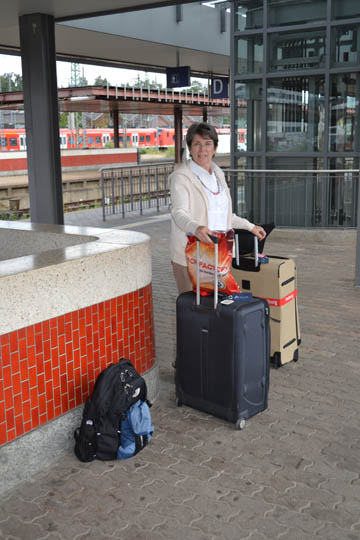
Trains in Germany are fast, clean and on time. The comprehensive system that includes high speed trains, regional express trains, local trains, street cars and even buses, is so convenient that in the almost two dozen trips I’ve taken to Germany and bordering countries, I’ve never rented a car to get where I needed to be. But I have picked up some tips to make your train travel much easier.

For maximum flexibility in rail travel, a rail pass from Rail Europe is the way to go. Passes can be purchased for the number of days you need to travel over the course of a determined period of time. You must purchase your pass before leaving your country of origin.

On a recent two-week trip, which included a week-long river cruise in central Germany, I traveled by train before and after the boat trip. So my rail pass was for exactly five days of train travel (any days I chose) over the course of one month, starting on the day the pass is validated. Before boarding the train, fill in the date, have your passport with you on the train, and your ticket is valid for travel all day, on as many trains as you like. Some express trains may require an additional reservation fee; ask an agent if you’re unsure.

FIVE DAYS OF TRAIN TRAVEL
After landing in Frankfurt, I used the first of my five days of train travel to go from the airport to the main Frankfurt train station. Trains leave from the airport to the Frankfurt Hauptbahnhof every few minutes. From the train station I could walk to my hotel. Since the main train stations of major European cities are usually in the historic town centers, you can usually walk to most of the “must see” historic destinations. The historical centre of Hamburg, which is North of Frankfurt, is situated between the Main Station and Gansemarkt and there’s a variety of hotels available if heading that route. Sometimes bicycles are also available for rent from Deutsch Bahn train stations.

The next morning I again filled in the date on my rail pass for the day’s travel, which included an S Bahn train to Mainz, a regional express train to Saarbrucken, a Regionalbahn train to Merzig, and finally, a bus to Remich, Luxembourg, where the river cruise began.

The following local trains are available in Germany:

RegionalExpress (RE)
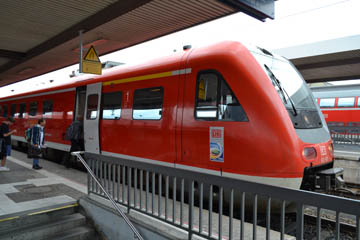
The RegionalExpress connects cities and offers travel in comfortable modern trains. It leaves at regular intervals and links local to long-distance trains.
Regionalbahn (RB)
The Regionalbahn offers a basic service from all local stations. It provides the connection between the regions and city centers. It also connects to the RegionalExpress.
S Bahn
The S Bahn services high-density areas, leaving in quick, regular intervals. Some S Bahn stations have access to longer distance regional trains, making travel within the city and between cities easier.

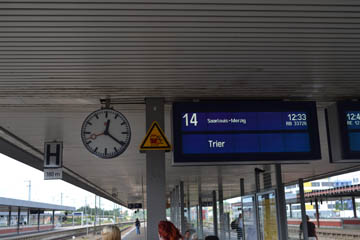
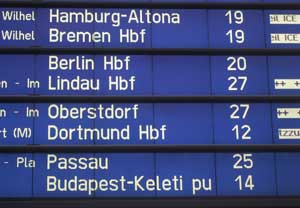
How do you find the right train? The very large train stations will have electronic signboards listing train destinations, the track (Gleis), and time of departure. If your train isn’t listed, wait a few minutes, and check again. The board is constantly updated as trains come and go. It will also list delays and cancellations. At smaller stations, a list of daily arrivals and departures is printed on signage on the platform. Go to the correct track number, and check the sign on the platform to make sure your destination is listed. Then keep an eye on the clock (there’s usually one on the platform at most midsize and major train stations) and watch your train arrive, usually right on time.

If your rail pass is for first class travel, as the train arrives, look for the cars with a number “1” on the side, indicating first class seating. While even second class sections are comfortable, first class is usually more luxurious, air-conditioned and roomier. Layover time at a station is often short, so it’s important to board quickly. You can move to the first class seating area once you’re on board, but it’s harder if you have a lot of bulky luggage.

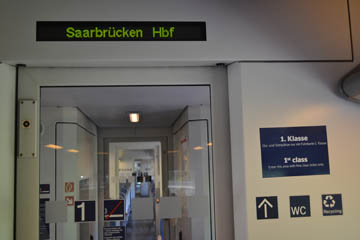
Look for the signs inside the train to learn your next stop.

MAKING CONNECTIONS
When you’ve found a seat, look for the automated sign inside the car that indicates the next stop, and be ready to exit when your destination approaches. Not all trains have this, so having a pre-printed schedule in your hand prior to boarding is helpful. You can print these out from the Rail Europe website before you leave home. To find your next connection at the next station if you need to, check the station train board for the time and track number. If the layover is long enough, stop for a coffee or a snack, or get a sandwich and drink to enjoy on the train at one of the many food shops located in the larger train stations.

The last leg of my day’s travel was by bus to Remich, where the cruise ship was waiting. Since my pass was for travel in Germany only, it was not valid for the bus to Remich. However, the bus ticket was easily purchased from the driver after boarding. Bus stations are usually right next to the train stations, and schedules between trains and busses are coordinated for easy connections.

After disembarking the cruise at Nuremburg, I made my way to the main train station by cab, checked the large signboard, and found the track for my next destination: Dresden. Once again, I wrote the date for my third day of travel in the appropriate square on the rail pass before boarding. You must write in this date prior to each day’s trip.

This inter-regional express train, one-fifth of which was devoted to first class seating, had some cars designated to leave the train at Bayreuth. Look for the signs on the sides and front of each car to be sure the car you’re riding is going all the way to your destination, since some cars may be transferred to other towns en route.

Even though this was a regional train, it traveled at upwards of 90 miles per hour, past farmland, forests, streams and rolling hills and through tunnels, often on super-elevated tracks, and in areas where double tracks allowed for quick, through traffic. The first-class seating area had a table at which I could comfortably eat the sandwiches I bought along. If you don’t have a chance to purchase food at the station, usually a snack cart on long-haul trains is wheeled through periodically, offering coffee, drinks and snacks.

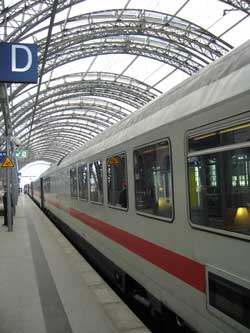
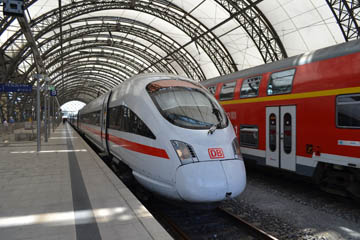
After four days in Dresden, I filled in the fourth travel date on my pass for the trip from Dresden to Frankfurt. In the Dresden Hauptbahnhof, I again bought food to eat on board while waiting for the signboard to list the train to Frankfurt. This trip would be on an ICE (InterCityExpress), one of the premier luxury trains on the Deutsch Bahn rail system. Once on the track platform, I looked for the chart listing the train equipment on this route. Waiting areas on the platform are designated “A”, “B”, “C” and “D”. Check this chart to find where the first class cars are in the train’s consist, and note where they line up in the ABCD waiting areas. You now know where the car you want will be as the train pulls into the station, allowing for quicker boarding.

RESERVATIONS MAY BE NEEED
Reserving a seat is recommended on some heavily-traveled routes, even if you have a first class reservation. Making a reservation costs a small amount and is easily accomplished at a Deutsch Bahn service counter at main train stations. The lines move quickly, most agents speak English and will efficiently take care of your request.

With a reservation you are assigned a specific seat in a specific car. The seat will have a sign above it designating it as “reserved,” and is reserved solely for you. Sometimes seats are reserved for a segment of the route beginning at a station down the line, and these seats must also be kept free for the passenger who reserved them, even if they are empty for the first part of the trip. Sometimes reservations on busy routes fill up quickly, so decide early if you want to be sure to have a seat. I didn’t bother with reservations on another trip from Vienna to Venice once, and ended up clutching my first class ticket while sitting on my suitcase the entire way in the vestibule of the standing-room only car.

Since Dresden was the starting point for this train, the equipment was already at the station ready for boarding when I arrived. I had plenty of time to check the “consist” at the platform, and found the car number and seat that was on the reservation. While I came prepared with sandwiches and snacks, dining car menus in first class offer coffee, tea, soft drinks, beer, wine, hot and cold sandwiches, soup, salads and pastries, which can be ordered and brought to your seat or purchased in the dining car. The menu changes monthly.

The ICE train is truly an express train. Super-elevated tracks allow for fast curves and a smooth ride, often at speeds of 100 to 120 miles per hour. The only stops were at main train stations along the route. As the beautiful German countryside sped by, I could see Wartburg Castle near Eisenach, and noted the exact location where the border and guard towers had at one time divided Germany into East and West.

Upon arrival (right on time) in Frankfurt, I walked to the hotel, and enjoyed another evening of exploring the city center on foot. The next morning I filled in the last date on the rail pass for the trip from Frankfurt’s main train station to the airport. Train travel through central Germany was easy and actually fun. I enjoyed the ride, taking it easy, and leaving the driving to someone else. These iron rails can be such a delight!

For more information, go to: www.raileurope.com or the DB website: www.bahn.com/i/view/USA/en/trains/index.shtml, but you will still need to purchase your ticket from Rail Europe before you go.

Wine Festivals Abound in Germany’s Historic Cities

From the first red wine produced along the Mosel River during Roman rule to the sweet Riesling for which the country is renowned, German wine is woven into the country’s culture and history.

Many member cities of the Historic Highlights of Germany are inviting travelers to experience this firsthand this fall with a series of wine-themed events, activities and offers.

In Mainz, more than 50 wine growers from throughout the region assemble during the first weekend in September for the annual Mainz Wine Market (photo at left). The event has craft stalls, rides, music and fireworks and, of course, dozens of wine stands. Wine-making goes back nearly 2,000 years in Trier, where several two-night packages feature special themes such as wine cultivation during Roman rule and a combination of World Heritage site visits and wine culture.

In Heidelberg, packages include the Heidelberg Wine and Chocolate Tasting with five wines from regional vineyards and five fine chocolates. Wine has long been central to life in Koblenz, located at the confluence of the Rhine and Mosel Rivers, where the “Wine Village” welcomes visitors to enjoy a glass of wine in the quiet setting of half-timbered houses.

Würzburg, situated on the Main River, is home to several wine estates, where visitors can enjoy tours and wine-tastings—including the Juliusspital, whose 400-year old, 800-foot long wine cellar makes it one of the oldest and largest German wineries.

Historic Highlights of Germany suggests two “Dream Routes” that focus on wine. Click on “Dream Routes” on our site at: www.historicgermany.com

Prague to Goslar

This train ride features Eurocity, Intercity and Regional trains

By Don Heimburger
Photos by the author

My travel plans had taken me to Prague, and I wanted to visit the medieval town of Goslar, Germany near the Harz Mountains. I had time to get there, and opted for a seven hour train ride so I could relax, unwind and see the scenery. Besides, trains are magic, and it’s much more fun to see the countryside from a train than it is from 30,000 feet up in the clouds.

Leaving my Prague hotel early morning, I take a short tram ride to a subway, and 15 minutes later walk up into the light of day where Prague’s Holesovice train station awaits me.

My particular concern is that I can’t read a word of Czech: Nada. Rien. Nichts.

FINDING MY TRAIN
Waiting in line at the station to check the status of seating on my Eurocity train leaving at 6:40 a.m.—that’s correct a.m.—a man darts in front of me. I can’t even say “excuse me” in Czech. And I can’t get much information that I can understand from the railway clerk, who sends me to another office down the corridor.

But I eventually learn that EC 178 (Eurocity) to Berlin is on time, that I likely won’t need a reservation in addition to my first class ticket, and that I’ll need to wait a few more minutes before I go out onto the platform. Once I make it to the platform, people stream out a few minutes before the train is due in, and once the train is stopped, they all board relatively fast. You have to in Europe, or the train leaves without you.

Praha-Holesovice station

I noted that the departure/arrival screen in the station–-not a large board like in most major European cities–was very small, and that there wasn’t room for more than several train listings at a time; perhaps not many intercity trains come and go from Prague.

ON BOARD
The car I sit in features good, comfortable seats–there are two first class cars, and I’m next to the on-board restaurant car. At my first class seat, tables fold down from the seat in front (like on an airplane), the chairs are adjustable, the windows are large in width and height, there are foot rests, and there’s luggage space above the seat. I could cross my legs and not block traffic as I sat in the aisle seat.

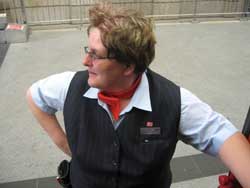
Conductor waits for passengers to board

As the train pushed through Prague and into the countryside, I could tell me were accelerating, and the engineer was using his electric locomotive to give us “the juice.” I suspect we were doing at least 100 mph at times.

When meal time came—enough of the menu was in English, with the help of some of the German I know—that I didn’t starve.

There were plenty of beverages available from coffee, lattes and espresso, to tea, wine and beer. Or you could order a Pepsi Cola. Other foods available included croissants, cheeses, sandwiches, soups and a vegetarian plate.

Dresden was the first stop once the train crossed the border into Germany.

CHANGE IN BERLIN
At the new Berlin train station, I had 18 minutes to hoof it to track 13 from track 7 (on a different level of the station)…and the conductor told me and the schedule in my hand called for me to change levels in the station. From there I boarded an ICE train (Intercity Express) for Braunschweig, Germany and with a 26-minute wait there, I had plenty of time. From there a Regionalbahn train took me to Goslar, arriving at 2:08 p.m., right on time.

A big part of the trip is its predictability; you can nearly always count on Rail Europe trains to do what they say they’re going to do. And it’s fun riding, and watching the little towns, the historic castles and rivers fly by outside your window.

For more information and to get your ticket for an overseas train ride, go to www.raileurope.com.

Let the journey begin.

Munich to Budapest the ‘Rail’ Way

By Don Heimburger
Photos by the author

As I usually do, before making reservations for any European trip, I study a map to see where I’d like to go. Sometimes I am not aware of towns or attractions near where I’m traveling to, so a map can help identify those in short order.

The European map came in handy again recently when I booked a flight between Chicago and Munich, the first of what was to be a two-part air journey between Chicago and Budapest. When I discovered the Munich to Budapest air fare would be about as much as the Chicago to Munich fare ($746.00), I quickly gave second thoughts to how I would travel there. And who wouldn’t.

I didn’t want to drive through three countries (Germany-Austria-Hungary) because of gas prices, and my unfamiliarity with the laws and the roads. A bus would take too long, but a train, despite a journey of some seven hours, 22 minutes, would be economical and fun. And I had not ridden those rails before. In fact, Hungary was an altogether new adventure for me.

Munich’s Hauptbahnhof

RAIL COST WAS NOMINAL
A check at www.raileurope.com‘s new website quickly showed that a one-way trip to Budapest’s Keleti Station would cost only $171 U.S. dollars 2nd class ($269.00 first class), and once on board I could sleep or relax from my Atlantic crossing. With the new Rail Europe website, all I had to do was key in my departure and arrival cities, and up popped the cost for the date I wished to travel.

I would arrive Munich via Lufthansa at 5:55 a.m. and have plenty of time to travel on the S Bahn (covered by my Rail Europe ticket) from Munich Airport to the main Munich train station (Hauptbahnhof) to catch Train #63 at 9:27 a.m. to Budapest.

The flight over was uneventful, and the plane landed a few minutes early. Not having been in Germany since the spring, I was craving a croissant made the way the Germans make it, so I waited at an airport restaurant, indulging in coffee and croissants, until 7 a.m. and a Deutsche Bahn office opened to have my train ticket validated (you must validate tickets purchased in the U.S. prior to boarding a train in Europe).

I made a small deposit to reserve an assigned seat in first-class just to be sure. If the agent tells you the route can become crowded with passengers, paying a little extra for a reserved first-class seat can save you from transferring to second class if all the first class seats are taken.

LARGE MUNICH STATION DEPARTURE BOARD
The large train departure board in Munich’s station is fascinating to watch, as new train numbers with boarding tracks pop up every few minutes, and people rush to that platform to board. My train’s notice appears on the board, I see my train roll into the station, and I board car #262 and settle into a comfortable, high-backed leather seat. The train, headed by an electric locomotive, the locomotive of choice in Europe, grabbed onto our string of passenger cars and eased us out of the station on time. Nothing new there—Europe’s trains are almost always on time.

Outside of Munich proper, I look out the window and guess we’re traveling between 95 and 100 miles per hour. I’m likely accurate on this, as European trains can move. A short time later the conductor confirms the train speed at 160 kilometers or 100 miles an hour. One reason trains can travel so fast is that the European track system is much stronger and can hold up much better at high speed. European rail lines have been investing heavily in their train tracks and facilities for years and years, and this is the payoff.

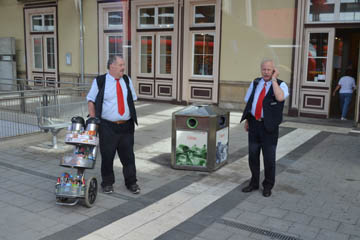
After a while, I note that the heat in the car is a bit excessive, but the conductor enters the car soon enough and announces the heat will be adjusted; it was. By 10 a.m. a porter with a trolley of beer, sandwiches, candy, rolls and chips arrives in the car to ward off any hunger pangs of the passengers.

As we near Salzburg, I can start seeing the snowed-covered Alps that I’ve come to be fond of; I see the Festung on the top of the hill in Salzburg, but only for a moment as the train rolls on. We’ve changed conductors since entering Austria. By the time we arrive at Linz the train is 8 minutes late, and continues to be behind schedule for a while.

Dining in the Speisewagen

TRAIN IS NEARLY FULL
Looking around at the seats and the various cars, I found that 90% of the train was full, and all but about 10 first-class seats had been reserved. If the seat is reserved in the first-class section, a small stub will be attached to the seat with the person’s name on it as well as their boarding and departure stations.

Walking up through the train to the Bord Restaurant, I found it not crowded, and serving Hungarian-style food, including goulash and Hungarian beers. The service was fast and the price was very reasonable.

We roll through St. Polten 10 minutes late, and by Vienna we are 17 minutes late and running into fog. I don’t remember if we arrived late in Budapest, but we were nearly on time nevertheless. The Budapest train station was massive, with a large arching trainshed, similar to many large city trainsheds in Europe.

The trip was as advertised, it allowed me to catch up on my sleep from the flight over, and it allowed me to get into the “European mood” for my travels for the next two weeks. I also saved a lot of money. And in this current rough economy, that’s a good thing.