Oberammergau’s Passion Play and RUHR.2010 lead the way

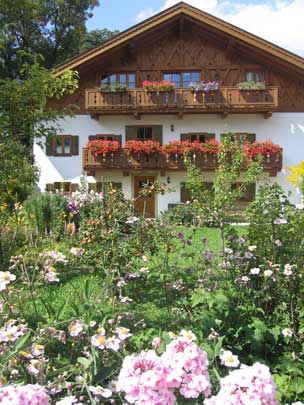
Colorful Oberammergau is home of the Passion Play in 2010.

Photos by Don Heimburger

With anniversaries and unique events all year long, 2010 is shaping up to be a year of variety and diversity in Germany.

From modern to traditional, the festivals and anniversaries offer something for every taste: the RUHR.2010 European Capital of Culture, the decennial Passion Play performance, Robert Schumann’s 200th birthday, the 300th anniversary of the renown Meissen Porcelain, the 175th birthday of the German Railway and last but not least, the 200th year of the world’s most famous beer festival, the Oktoberfest in Munich.

Essen and the Ruhr Region in western Germany will be voted the “European Cultural Capital 2010.” For the first time in this European competition the cultural capital is not an individual city, but a whole region with Essen as the standard bearer. 

The Ruhr region is Germany’s highest populated area and especially exciting for its post-industrial transformation. Discover this region on the move with its cutting edge museums and art installations within the existing walls of former coal mines and factories. The exciting project RUHR.2010 celebrates those changes with fascinating exhibitions, events and workshops starting in January.  www.ruhr2010.de 

For the 41st time, the Bavarian village of Oberammergau will celebrate the Passion Play in 2010. This event has taken place every 20 years since its first enactment in 1633. More than 2,000 Oberammergauers, actors, singers, instrumentalists and stage technicians, bring to life the last days of Christ in approximately six hours of playing time. More than 500,000 visitors from all over the world and tens of thousands of Americans will be part of this unique religious event from May 15 to October 3. www.passionsspiele2010.de 

Only one year after Mendelssohn, Leipzig celebrates another one of its famous citizens: the 200th birthday of Robert Schumann. Many concerts will be dedicated to his works, featuring solo concertos, symphonies, piano works and song-cycles. 

Without Schumann, 20th century music would be quite different. The fusion of radical subjectivity and mastery of form, and his characteristic modernity and individuality, has inspired and influenced many composers who came after him. A highlight of the Schumann Year is the anniversary concert in the Leipziger Gewandhaus on June 3 and 4, but also Baden-Baden, Bonn, Bremen, Dresden, Duesseldorf, Frankfurt, Heidelberg, Stuttgart and Zwickau will celebrate the composer with special concerts and exhibitions.  www.schumann-portal.de (German only) 

Oberammergau Mayor Arno Nunn

The history of European porcelain began with the discovery of hard porcelain and the subsequent founding of the Meissen porcelain workshop in 1710 near Dresden. In 2010 the Meissen porcelain workshop will celebrate the third centenary of its founding. Visitors can tour the factory and the museums as well as participate in workshops. 

The anniversary will be celebrated with several world class porcelain exhibitions in Meissen and Dresden. In the Meissen workshop the yearlong project “All Nations are Welcome” shows outstanding pieces of Meissen Porcelain that reflect the influence of different cultures and epochs during the workshop’s 300-year history. 

Within the walls of Albrechtsburg Castle in Meissen, where the first European porcelain workshop was founded in 1710, a special exhibition takes you deep into the beginnings of the Meissen porcelain (May 8 – October 31). Another highlight will be the exhibition in the Japanese Palais in Dresden, showing famous works from the first 100 years of the Meissen workshop (May – August). http://friedrich.meissen.com 

The world’s most famous beer festival, the Oktoberfest in Munich, celebrates its 200th anniversary from September to October 2010. It took place the first time in 1810 as a festival honoring the marriage of Crown Prince Ludwig (later King Ludwig I) and Princess Therese of Saxe-Hildburghausen. The festival grounds Theresienwiesen were named after her. The Oktoberfest, or “Wiesn” as it is called in Bavaria, started out as a horse race. A parade was added in the following years, and at the end of the 19th century, local brewers opened their beer tents. Today it is an enormous festival, attracting millions of visitors from all over the world every year with Bavarian music, food and, of course, beer.  www.oktoberfest.de 

In Nuremberg, 175 years ago, the first German train, the steam-driven “Adler” (eagle) started off towards the neighboring city of Fuerth. To celebrate this milestone in Germany’s history, the city will host several events throughout 2010: During the “Blue Night” (May 15th), artists will stage spectacular projections and actions to kick off the Railway Year, the past will be brought to life again with major locomotive and vehicle parades planned by German Rail and a comprehensive jubilee exhibition in the Deutsche Bahn Museum will focus on 175 years of railway history (dates to be determined). www.nuernberg.de 

European Christmas Markets Celebrate the Season

Advent is the season in Europe when thousands of communities–large and small–set up Christmas trees, colorful lights and craft stalls in their central market square. For decades, Europeans have been getting together at these unique Christmas markets to share conversation, to enjoy a glass of hot mulled wine, or to find just the right specialty gift for a family member or friend.

European Traveler offers a quick glance at some of these fascinating markets, which normally last until Christmas Eve.

Belgium

Every town in French-speaking Wallonia hosts its own Christmas Market. The central square of Liège and the neighbouring Place du Marché stage one of Belgium’s largest Christmas Markets, attracting more than 1 million visitors with 190 wooden chalets full of tempting goodies, sweets and original hand crafted products and presents. If you’re in Brussels between November 27 and January 3, enjoy the Brussels Winter Wonderland featuring a Christmas Market with many stalls, a giant illuminated ferris wheel, street activities and a large skating rink. 


Switzerland

In Lucerne, a number of Christmas events take place, including the Christ Child Market at Railcity, the train station, between November 28 – December 21. Around 50 festively-decorated market stalls bring a  Christmas atmosphere feel to the station.

Every year between December 3-20 Lucerne’s Christmas Market takes place at the Franziskanerplatz. There are a large variety of stands with Christmas decorations, sweets, food and beverages.  The Christmas Tree Market usually starts one week before Christmas along the Schweizerhofquai. Then between December 17-20, 20 stands from 20 countries  present typical Christmas items from their homelands. There is always a stage featuring Christmas productions from all over the world. For more information, go to www.luzern.com/en/welcome.cfm?

Germany

Thuringia is primarily famous for its festive Christmas markets and especially the large selection of glass Christmas tree decorations. The Lauscha Ball Market (always held during two weekends in Advent) has the largest selection, but these traditional decorations are also available at other Thuringian Christmas markets.

In Frankfurt you are invited to the large, time-honored Christmas market where you can become acquainted with the market’s many culinary specialities and its traditions. You can join tour guides in ascending to the rooftop gallery of St. Nicholas Church, from where you’ll be able to enjoy a wonderful panoramic view of the entire market and the Frankfurt skyline. Next, join young and old for a nostalgic ride on a vintage carousel. Warm yourself with a hot cup of mulled wine at the end of the tour and take in the wonderful view of the market’s beautifully illuminated Christmas tree. The 1 1/2 hour tours include a carousel ride, hot mulled wine and special marzipan candy. Tours are available in English and German from the first day in Advent until Christmas.

Thanks to the Tourist Boards of Germany, Belgium, Austria and Switzerland for the photos in the report.

Christmas Markets in Luther Country

Erfurt Christmas Market

In Germany’s Luther Country, Advent means Christmas markets. The crisp winter air is filled with the smell of ginger and nutmeg, signaling the arrival of Stollen, a special Christmas cake, and Glühwein, mulled wine. Cobbled streets and squares, lined with half-timbered medieval houses, provide the backdrop for dozens of wooden stalls, selling wooden toys and Christmas decorations, handcrafted gifts and seasonal foods, such as Zimtsterne (cinnamon stars) and Lebkuchen (soft, spiced cookies).

Brass bands play and choirs sing carols, often written by Martin Luther himself. In fact, many Christmas traditions were supposedly instigated by the Protestant reformer 500 years ago. Legend insists one dark and starry night, Luther was touched by the beauty of the pine trees. On returning home, he cut down a tree, took it into his house and decorated it with candles. As well as the Christmas tree, Luther is credited with the idea of Christkind, the Christ child bringing presents. (Kris Kringle is still familiar in many U.S. homes). Concerned that Saint Nicholas, who delvered his gifts on December 6, was too popular, Luther came up with an alternative to “Santa Claus”: a golden angel, with wings and a crown.

Here are just some of Luther Country’s most authentic Christmas markets.

(clockwise) Christmas Stollen; Lebkuchen; Zimtsterne

ERFURT
November 27 – December 22
Although Erfurt’s 162nd Christmas Market spreads throughout the old town, the focus is on the Domplatz, the vast Cathedral Square. The 200 market booths sell everything from Thuringian bratwurst (Germany’s favorite grilled sausage) and Christmas cookies to handmade toys or traditional, handmade Christmas decorations. Children love the giant Ferris wheel,

the 90-foot-tall Christmas tree covered in candles, and the 40-foot-high wooden pyramid. Most of all, they love the nativity scene, set in a fairytale forest, complete with near life-sized, hand-carved figures. Gardeners should not miss the floral Christmas exhibition in the underground vaults of the cathedral.

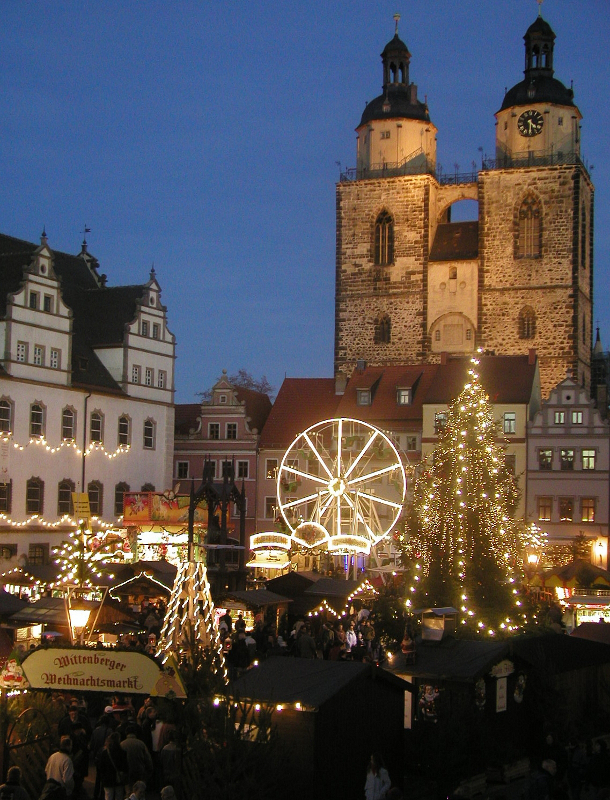
Lutherstadt Wittenburg Christmas Market

LUTHERSTADT WITTENBERG
November 28 – December 23
In the market square, a statue of Luther looks out across the Christmas market, with its stalls decorated with pine boughs, lights and Christmas ornaments. In the air is the scent of mulled wine and roasted almonds. Across the square is the Marienskirche (St. Mary’s Church), where Luther preached. Special are the town’s Adventshöfe, medieval courtyards, where local artists and craftsmen sell their wares. In the Cranach Courtyard, named for Luther’s great friend and painter Lucas Cranach, the weekend of December 8 and 9 features weavers and knitters, wood carvers and basket makers.

QUEDLINBURG
November 30 – December 23
With more than 1,300 half-timbered houses, Quedlinburg is one of Europe’s most romantic cities. And during the Christmas Market, strolling along the cobbled streets is like walking through history. One unique event is the “Advent in den Höfen” (December 1-2, 8-9, 15-16), when some 20 private courtyards open to sell special Christmas gifts, often handmade. Another highlight is the world’s largest Advent calendar! At 4:30 p.m. every afternoon for 24 days, children look out for the star that marks the house where the next scene in the Advent calendar will appear. When the door opens, fairytale characters appear and dance, sing or play for spectators.

WERNIGERODE
November 30 – December 22
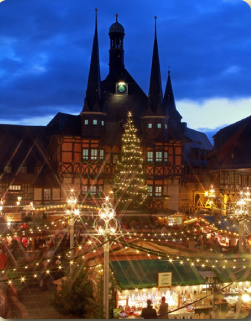
Dominated by its 12th-century castle, Wernigerode’s annual Christmas market has a fairy story backdrop: a 15th-century town hall, half-timbered houses and a 35-foot-tall Christmas tree. The stalls serve traditional food and drink, hand-made toys and ornaments for the home; evenings are filled with concerts of seasonal music. From December 15 to January 8, 2013, the Castle hosts its own special Winter Market. Children meet a fairy at 3 p.m. and receive presents from St. Nikolaus (Santa Claus) at 4 p.m. They also love to ride the Christmas train in a historic carriage, pulled by a steam engine through the snow-covered countryside.

Wernigerode Christmas Market

LAUSCHA
December 1-2 and 8-9
Each Christmas, this small town in a steep, wooded valley in the Thuringian Forest, plays a vital role in every American home. This is where the first glass Christmas tree ornaments were created in 1847. In 1880, F. W. Woolworth, the five-and-dime store pioneer, brought a batch of these glass balls to his store in Pennsylvania, and the rest is history. The tradition continues in Germany’s glassblowing capital, where you can watch artisans creating works of art at Lauscha’s Museum of Glass Art. At Lauscha’s annual Christmas “Kugelmarkt,” or glass bauble market, you can buy these handmade decorations in all shapes and colors.

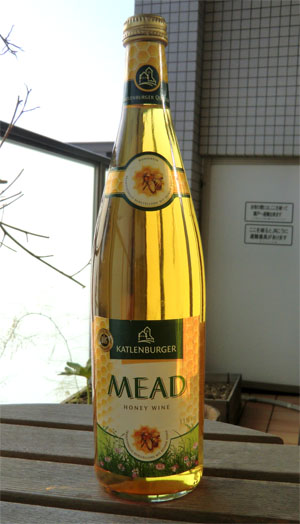
Mead honey wine

WARTBURG CASTLE, EISENACH
December 1-2, 8-9, 15-16
Wartburg Castle is where Martin Luther, the Protestant reformer, changed history when he translated the New Testament into German. And this UNESCO World Heritage Site just outside Eisenach is still a massively impressive fortress. At Christmas, however, a historic Christmas Market transforms the castle, with artists and street performers, craftsmen and knights. Meet candle makers and barrel makers, rope makers and lantern makers, minstrels and puppeteers. With cheerful booths and medieval decorations, this is a like a trip back in time. And the medieval food is delicious, from roast apples and honey to mead.

New Addition at the German Emigration Center

Photos courtesy of the German Emigration Center

View of new wing at the German Emigration Center (on right).

The Emigration Center at Bremerhaven, Germany, just added a new wing to the museum. Until now visitors ended their journey back in time through the staged and reconstructed rooms at the Ellis Island Receiving Station in New York; the journey now continues.

The new room “Office of the New World” is dedicated to the question: what did immigrants and the countries of immigration know about one another? Against the backdrop of a train station as a place of transit, the new staged and reconstructed room “Grand Central Terminal” shows the history of German immigrants in the U.S.A.

The original plan.

The new bridge connects the history of emigration with the history of immigration.

HISTORY OF IMMIGRATION IN THE NEW EXTENSION
On the first floor of the new building a mall with several commercial stores in the Federal Republic of Germany from 1973 has been reconstructed. Visitors trace the roots of immigrants: the shop windows display common, everyday objects together with the memorabilia of immigrant families, illustrating the stories of 15 immigration groups that came to Germany in the last 300 years. On the ground floor general information on immigration to Germany between 1685 and today can be found, as well as the family research area and the new “Roxy Cinema.” For more information, visit www.dah-bremerhaven.de/english.php

Cathedrals in Germany: Masterpieces Inside and Out

View of the Aachen Cathedral from Katschhof Square

Photos courtesy German National Tourist Office

Cathedrals, monasteries, walled fortresses and abbeys are a distinct part of Germany’s culture and landscape. Every town, city and countryside has a beautiful church or abbey, including many masterpieces.

Aachen’s cathedral, the Church of St. Mary, was founded as Charlemagne’s chapel and is where 30 kings were crowned. The immensely beautiful Romanesque cathedral of Speyer, only one hour south of Frankfurt, became the burial place for the Salian emperors, and its size is on par with the Cologne Cathedral. The Cologne Cathedral is Germany’s most visited tourism site and was at one time the biggest building in the world. Its high Gothic style is pronounced and the Dom is home to sacred relics and precious artwork. In Hildesheim, 45 minutes outside of Hannover, St. Mary’s Cathedral and St. Michael’s Church are outstanding examples of Romanesque architecture.

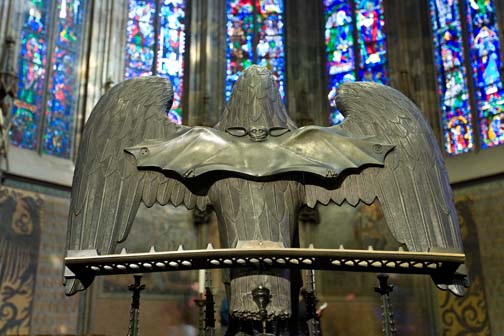
Sculpture inside Aachen Cathedral

AACHEN CATHEDRAL
The Church of St. Mary, originally built as the chapel of Charlemagne’s imperial palace in Aachen in 786 AD, was part of the emperor’s dream of creating a “new Rome.” With this building he laid the foundations of one of the most important architectural monuments in Europe. The cathedral’s appearance reflects more than 1,000 years of history. Charlemagne’s palatine chapel forms the core of the cathedral. The single-nave chancel was consecrated on the 600th anniversary of his death and the bold architecture of the “glass house” is as impressive today as it was then.

During the 600 years from 936 to 1531, 30 German kings were crowned in Aachen Cathedral. Today, the cathedral has lost nothing of the splendor of centuries past. The first ensemble of historical and architectural importance in Germany to be inscribed on the UNESCO World Heritage list in 1978, this is a building of outstanding significance.

SPEYER CATHEDRAL
The magnificent Romanesque imperial cathedral in Speyer is the town’s best-known and most prominent landmark. Built by emperors, the cathedral was a symbol of their power and served as their final resting place. Construction began around 1030 under the Salian Emperor Conrad II and the church was consecrated in 1061. Speyer’s imperial cathedral, laid out in the form of a Latin cross, is one of Germany’s largest and most important Romanesque buildings. The Salian emperors chose it to be their burial site.

Its huge triple-naved vaulted basilica is the central element of a design that greatly influenced Romanesque architecture in the 11th and 12th centuries. The hallmarks of the cathedral are the balanced distribution of its dimensions to the east and the west and the symmetrical layout of the structure, consisting of a nave and transept with four towers on the corners.

COLOGNE CATHEDRAL
Building first began in 1248 on what eventually became one of the finest ecclesiastical edifices in the world, and the epitome of high-Gothic cathedral architecture in its purest possible form. The scale of Cologne Cathedral is evident from its two mighty towers. Completed in 1880, they dominate both the city and the surrounding region. At the time of its completion in the 19th century, the cathedral was the biggest building in the world.

The design of the west side was truly groundbreaking. It has the largest exterior surface of any church in the world, said to be around 23,000 square feet, and is flanked by two huge towers, each rising to a height of 515 feet. The cathedral houses a wealth of important art treasures, including colorful stained glass windows that bathe the church interior in a mysterious light; the Ottonian Gero Cross (around 980 AD), the oldest large-scale sculpture in the western world; the shrine housing the relics of the Three Kings (1190-1225), an outstanding example of Rhenish goldwork; the altar of the patron saints of Cologne by Stefan Lochner (around 1450), a masterpiece of the Cologne school.

Cologne Cathedral by the Rhine
Cologne Cathedral detail
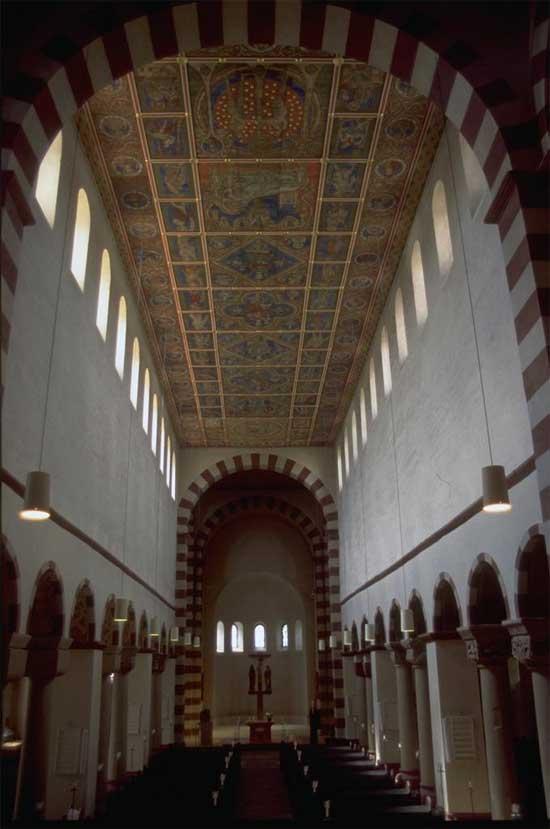
Hildesheim Cathedral interior

ST. MARY’S CATHEDRAL AND ST. MICHAEL’S CHURCH IN HILDESHEIM
St. Mary’s Cathedral and St. Michael’s Church are outstanding examples of early-Romanesque architecture. Both World Heritage churches exemplify the skill of Bishop Bernward (993 to 1022) and contain exceptional artworks.

The main attraction in St. Michael’s Church is the painted 13th century wooden ceiling depicting the Tree of Jesse. Germany’s only flat church ceiling, it is a fascinating example of monumental Romanesque painting. The spectacular cathedral treasure, Column of Christ and Bernward doors are characteristic of the Bernwardian period. The cathedral is being renovated for the anniversary of the diocese in 2015 and is closed until August 2014. Many of its treasures, including the huge bronze castings, can instead be seen at different places around Hildesheim until 2014.

The Column of Christ featuring scenes from the Old and New Testaments is on loan to St. Michael’s Church. The pair of two 16-ft. Bernward doors were cast in one piece—an achievement never mastered before—and are currently displayed at the Roemer and Pelizaeus Museum in Hildesheim.

For more info, go to www.friederisiko.de