PULTENEY BRIDGE WEIR The stunning weir beneath Bath’s Georgian Pulteney Bridge plays the part of the River Seine in the film version of Les Misérables. Pay Bath a visit and see it for yourself (but don’t jump in, like they do in the film!)
St. John’s Church
ST. JOHN’S CHURCH London’s St John’s Church in Smith Square was used in Atonement for the wedding scene. It’s a fine example of English baroque architecture and is a venue for concerts and recitals.
TEMPLE CHURCH Built by the Knights Templar in the 12th century, this historic church exudes mystery. It has a circular nave based on the Church of the Holy Sepulchre in Jerusalem and was used as a location in The Da Vinci Code.
Inverness
INVERNESS Inverness is a gateway to the Highlands and so makes a great base for exploring the surrounding countryside, historic battlefields and beautiful lochs. The Highland capital is friendly, welcoming, full of history and compact enough for wandering around by foot. Scenes for the TV drama Outlander were shot in and around the city.
MOMO Probably London’s most famous Moroccan restaurant, Momo is a glamourous spot to enjoy fine North African dishes. You might also recognize it as one of the locations in the UK film Bridget Jones’s Diary.
Rye
RYE One of East-Sussex’s most popular locations, Rye is a half-timbered medieval town full of unique shops and plenty of atmosphere. A great place to get a taste of traditional English life and to enjoy a good pub lunch or fish and chips overlooking the town quay.
OLD WARDOUR CASTLE Built in the 14th century as a luxury house, Old Wardour Castle slowly became a fashionably romantic ruin. It’s a beautiful place to spend a day, and you might even recognize it as one of the locations used in Robin Hood: Prince of Thieves.
Inveraray Castle
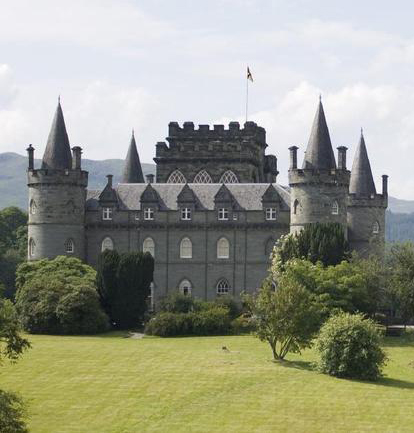
INVERARAY CASTLE This magnificent stately home on the shores of Loch Fyne boasts tremendous views across the Scottish countryside. You might recognize its fairy-tale turrets from the Christmas 2012 episode of Downton Abbey when the Crawleys holiday in Scotland.
BROMPTON CEMETERY One of Britain’s Royal Parks is also a historic cemetery. Expect an atmospheric array of spectacular tombs and more than a few famous names. Look for Brompton in a suitably Gothic scene from the 2009 film Sherlock Holmes.
MI6 (THE SECRET INTELLIGENCE SERVICE) The HQ of MI6 (the Secret Intelligence Service) is off limits to visitors but you can get a great view of this imposing structure from the river. Take a speedboat tour with Thames RIB for fascinating anecdotes about Ian Fleming, the British Secret Service, and of course, James Bond himself.
Since the Middle Ages, the English university town of Oxford has been attracting scholars hungry for knowledge. Today it also draws hordes of tourists hungry to see its Gothic colleges, top-notch museums, colorful gardens, lively student hangouts and cozy pubs.
We all know that sightseeing is a strenuous activity that boosts your appetite. And Oxford offers plenty of places for filling empty stomachs as well as hungry minds. In this historic “city of dreaming spires,” you’ll find something to suit every taste, from traditional English pork pies to sushi rolls, from falafel sandwiches to chocolate fudge, from goat cheese pizza to the best of British cuisine.
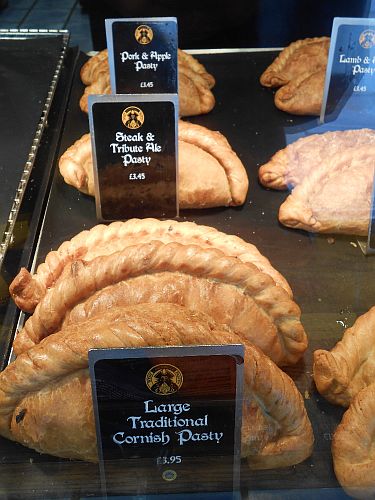
Classic Cornish pasties at West Cornish Pasty Company on Cornmarket Street
FAST FOOD In a town full of students, there’s no dearth of fast-food joints. Skip the inevitable McDonald’s and KFC, and head for the simple eateries offering more typical British fare. The West Cornish Pasty Company on Cornmarket Street sells very good versions of these traditional English turnovers with a selection of savory fillings. Many other takeout places, including supermarkets, offer fresh sandwiches stuffed with prawns, sliced cucumbers or egg salad, perfect for a picnic on a hot summer day. And food trucks parked around the edges of the central city cater to eaters on the go, selling a variety of takeaway dishes from India, Pakistan and the Middle East, as well as British standards such as “toad-in-the-hole” (succulent sausages baked inside Yorkshire pudding batter).
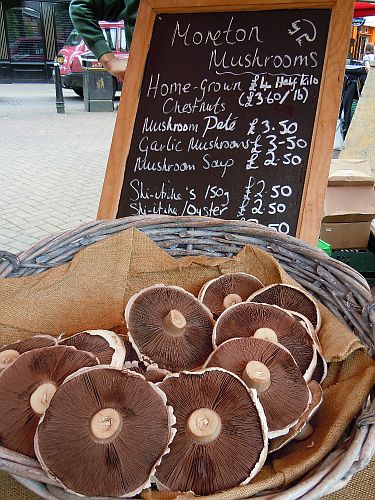
Mushroom stand at the weekly Oxford open-air market
OXFORD COVERED MARKET Opened in 1774, Oxford’s venerable covered market is one of the city’s most popular tourist attractions. In addition to its fruit, vegetable, meat, fish and cheese stores, it includes several little shops selling cooked foods to nibble on site or take away. Choose from an eclectic group of eateries: a “Brazilian Cheeseball” stand, a “Sooshe” bar, Nash’s Oxford Bakery, David John’s traditional butchery and meat pie shop. An especially popular place is Pieminister, which offers several kinds of freshly made, double-crust, meat or vegetable pies served with “mash” (mashed potatoes), “groovy” (gravy) and “minty mushy peas” (just what they sound like).
Traditional English pie with gravy at Pieminister in the Oxford Covered Market
PUB GRUB Oxford’s historic pubs are famous as much for their denizens as for their beer. You can quaff a pint of British bitter or English ale in the same spots where Thomas Hardy, Lewis Carroll, J. R. R. Tolkien, C. S. Lewis, Graham Greene, the fictional Detective Inspector Morse and many other Oxford luminaries wet their whistles. Pubs also serve food, sometimes the best bargains for a full (and filling) meal in Oxford. Typical dishes include fish-and-chips (battered-and-fried fish filets with French fried potatoes), Scotch eggs (hard-boiled eggs surrounded by sausage meat and deep fried), “Ploughman’s Lunch” (thick wedges of cheese and a slice of ham served with apple slices, sweet pickle relish, bread and butter) and “jacket potatoes” (aka baked whole potatoes, in their skins) with a choice of toppings: Cheddar or blue cheese, pork and beans, sautéed mushrooms, even meaty (or vegan beany) chili.
Traditional English ale at an Oxford pub
(left to right) Food shop inside Oxford Covered Market; Cottage loaves for sale at the weekly Oxford open-air market; The Bear, one of Oxford’s famous traditional old pubs
Purchase a guide to Oxford’s pubs at the Visitor Information Center on Broad Street or at many bookstores. You can also buy a postcard depicting 36 classic pubs for an “Oxford Heritage Pub Crawl.” My own favorite pubs include The Bear, The White Horse Inn, The Rose and Crown, The Lamb and Flag, The Eagle and Child and The Head of the River.
Head of the River, a favorite Oxford pub with a large beer garden
TEA & SWEETS You can’t visit England without having afternoon tea—a civilized sit-down with a pot of freshly brewed tea, finger sandwiches and baked goods (such as scones with jam and clotted cream, and a selection of scrumptious cakes). Several cafes advertise afternoon tea with a sign in their front windows. Some upscale restaurants also serve formal “teas” between 3:00 and 5:00 p.m. For an elegant experience in the grand old English manner (with prices to match), “take tea” in the drawing room of the Macdonald Randolph Hotel across from the Ashmolean Museum.
If you just need to satisfy your sweet tooth, stop in at Nash’s Bakery in the Covered Market for traditional British pastries, or head for the Fudge Kitchen on Broad Street, which sells more than 20 different flavors of fudge made fresh daily.
Handmade fudge at the Fudge Kitchen on Broad Street
RESTAURANTS Oxford has a wide range of full-service restaurants to fit any budget. Local foodies especially like Brasserie Blanc, on Walton Street, owned by one of the most respected chefs in Britain, Raymond Blanc; Jamie’s Italian, on George Street, one of a chain owned by another famous chef, Jamie Oliver; Gee’s, an Oxford landmark on Banbury Road; The Old Parsonage, on Banbury Road; and Magdalen Arms, a “gastropub” on Iffley Road. Look for fixed-price lunches of two or three courses for approximately £12 to £17 per person. Some restaurants also offer the same deal for “early supper” between 5:30 and 7:00 p.m.
Luncheon appetizer at Gee’s Restaurant on Banbury Road
Oxford has no lack of Asian restaurants, from Indian to Chinese, Japanese, Thai and “Asian fusion.” Popular Asian eateries include My Sichuan, Shanghai 30’s, Majliss, Saffron, Chiang Mai Kitchen and Wagamama.
And for your big splurge, drive out to Raymond Blanc’s Le Manoir aux Quat’ Saisons in Great Milton, just seven miles east of Oxford. This fine restaurant has garnered two Michelin stars and won many other culinary accolades. You’ll be tempted to stay overnight at the historic manor house, too. Just be sure to make reservations well in advance, for both the hotel and restaurant. Dining there is an experience you’ll never forget.
● Travel tip: The Oxford Visitors’ Guide, a handy booklet that costs only £1 at the Oxford Visitor Information Centre (15/16 Broad Street), contains a short history of the town, a map, a brief description of the colleges and their opening times, Top 10 Things to Do, a self-guided walking tour, and vignettes of Oxford’s most famous characters. Also pick up a free copy of the Oxford Restaurant Guide booklet.
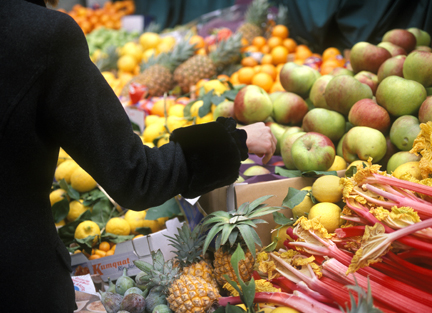
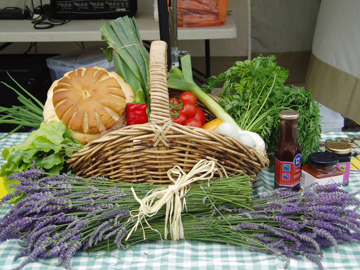
With summer approaching, it’s a good time to plan to visit the annual food and vegetable markets that pop up in the United Kingdom. Here are four of them that you might like to put on your “shopping list.”
Selection of colorful fruit, Borough Market, London, EnglandPecorino Favoloso, Borough Market, London, England.The farmers’ market in Winchester, England has a great variety of produce, organic vegetables and fruit.
From tea in a British buffet car, to luxury dining on the Trans-Siberian Express, eating on trains can be a true culinary adventure.
By Sharon Hudgins Photos by the author
I grew up riding trains across America just before the era of classic passenger service ended on the railroads and before Amtrak was a gleam in the government’s eye. Later I rode trains all over Europe from northern Scotland to central Italy, from the coast of France to the plains of Hungary. And in Russia I’ve logged nearly 40,000 miles on the legendary Trans-Siberian Railroad, crossing the continents of Europe and Asia between Moscow and Vladivostok several times.
That’s also a lot of dining on trains, snacking on railroad station platforms and eating at station buffets.
DINING ON BRITISH TRAINS I remember riding first class on British Rail across England and Scotland many years ago, when smartly uniformed stewards served tea in your private train compartment, first spreading a starched white cloth on the little table under the window, then pouring the hot brown brew from a silver-plated teapot into a porcelain cup (with milk added first or last depending on where you stand on that contentious issue). A small plate of sweet biscuits (cookies, in American English) always accompanied the tea. What a civilized way to spend a morning or afternoon, sipping tea, nibbling on biscuits, and watching the British countryside roll by outside the window.
Morning coffee and afternoon tea were included in the price of the ticket. But like many travelers on trains all over the world, I often chose to save money on meals by purchasing food from station vendors to eat on the train. Once in a while, however, I’d splurge on a meal in the dining car, luxuriating in the “white-tablecloth service” and the selection of foods that were so different from those I’d eaten on American trains.
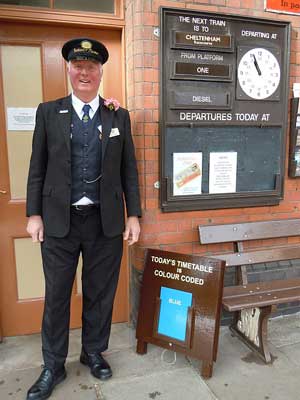
(left) Conductor on the Cheltenham Flyer, historic steam train of the Gloucestershire Warwickshire line of the British Great Western Railway.
Traditional English pork pie from the buffet aboard the Cheltenham Flyer
Alas, in 2011 contemporary trains in Britain did away with the last of their full-service dining cars, replacing them with airline-type meals served at the seats of first-class passengers and microwaved snacks sold in the buffet car for everyone else. But there’s hope for the future: In 2013 the First Great Western Railway re-introduced full-service “Pullman dining,” with fine wines and locally-sourced foods, on the UK’s only remaining regularly scheduled train with a real restaurant car. But, strangely, the dining services don’t operate on weekends or public holidays!
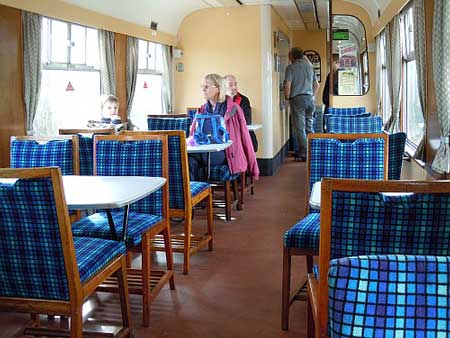
Restored 1950s-era buffet saloon car on the Cheltenham Flyer
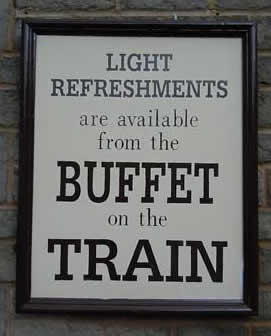
However, special tourist trains in Britain, including many historic trains, still provide a range of enjoyable culinary experiences. Recently I traveled through England’s lovely Cotswolds countryside on the historic Cheltenham Flyer, a 1930s-era steam train that chugs along the Gloucestershire Warwickshire branch of the Great Western Railway, which has been operating trains in western England since 1838. The train included a restored 1950s “buffet saloon car” whose menu offered Scotch eggs, pork pies, bacon rolls, homemade flapjacks and homemade cakes, along with a range of hot and cold drinks, alcoholic and non-. At certain times of the year, the historic trains running on these rails also offer special culinary tours, from Fish & Chips Specials to Ale & Steam Weekends (sampling 24 real English ales) to Luxury Pullman Style Dining Experiences with multi-course meals served on china plates, accompanied by wines poured into crystal glasses.
CONTINENTAL RAILROAD DINING The railroad dining experience on the European continent varies from country to country, type of train, and distance of travel. Some local trains have no dining facilities at all. Others have only a small snack bar or buffet, or vendors who come through the train with a cart stacked with packaged foods and canned drinks. Some have a full-service dining car, with a menu featuring multi-course meals and a selection of wines. If fine food and white-tablecloth dining are an important to you on a rail journey, then you need to seek out the trains that have a separate dining car and well rated menus.
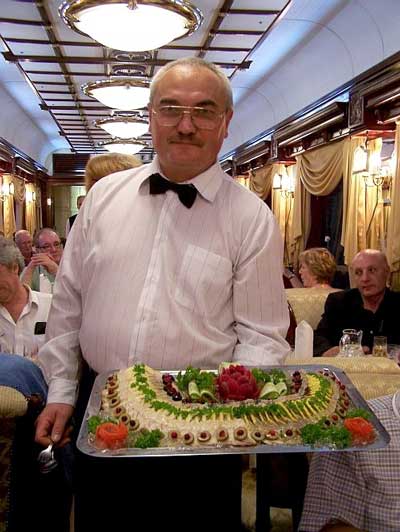
For the ultimate in Old World luxury train travel (and dining), book a journey on the Venice-Simplon Orient Express, a modern revival of that classic train, which operates several tours of different lengths between London and Istanbul. The trains also feature three beautifully restored dining cars from the 1920s, with haute cuisine to match. Wear period dress to dinner, and you’ll feel like you’ve stepped back in time into an Agatha Christie novel.
Who could resist the special Swiss Chocolate Train that takes you on a day trip to a cheese-making factory, Gruyères Castle, and the Cailler-Nestlé Chocolate Factory in Broc for cheese and chocolate tastings at those stops? Travel in a vintage Pullman Belle Epoque-era train car or in a sleek, ultramodern panoramic car with large windows for viewing the Swiss Alps, the vineyards surrounding Montreux and the medieval town of Gruyères along the route. Bring along a shopping bag and leave your calorie counter behind.
Don’t overlook the foods to be found inside train stations, too. If you don’t want to spend big bucks to travel on a luxury train but you still like to eat well, you’ll find plenty of choices at many of Europe’s train stations, particularly those in the larger cities. I’ve been especially impressed with the train station buffets and take-out selections at major Swiss, German and French stations, as well as those in capital cities such as Budapest and Madrid. But for the ultimate in elegant, nostalgic, train-station dining, don’t miss the beautifully restored Le Train Bleu (The Blue Train) restaurant in Paris’s Gare de Lyon—a Belle Epoque-style restaurant with a pricey French menu and a gorgeous decor to match.
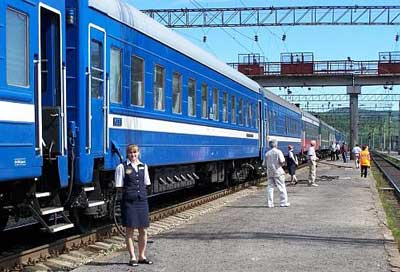
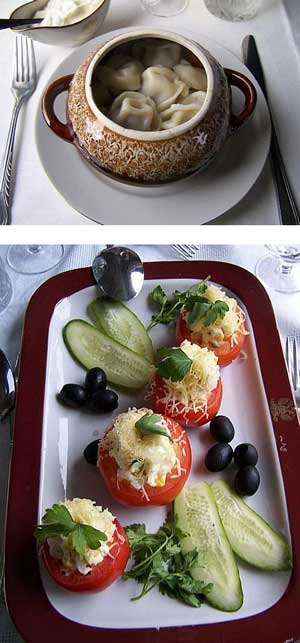
DINING ACROSS CONTINENTS Finally, for the travel adventure of a lifetime, board the British-owned, Russian-operated Golden Eagle Trans-Siberian Express whose route covers nearly 6,000 miles between Moscow and Vladivostok. Almost half that distance is on the European side of Russia, from Moscow to Kazan to the Ural Mountains. Each comfortable cabin on this luxury train has its own private bathroom. And three times a day, professional chefs in the a fully equipped kitchen car turn out freshly cooked meals featuring regional specialties, all served in an elegant dining car designed to evoke the Golden Age of train travel. During the 12-day journey across Europe and Asia, the menu is different at every meal except breakfast. On this longest train trip on earth, you’ll have plenty of time to enjoy the best of Russian cuisine and international wines while watching the fascinating changes of scenery outside the dining car windows.
So wherever you travel by train in Europe, enjoy the experience of dining on (and off) the diner. It’s a great way to taste a wide variety of regional foods and expand your culinary and geographic horizons at the same time.
I’ve always been enthusiastic about the work I do.
Art Wolfe
ET: Of the many European countries, which country or countries do you like to photograph the most – and why?
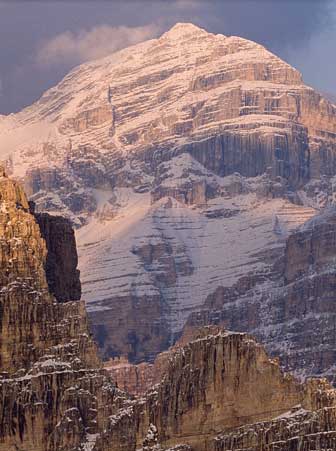
AW: I’ve traveled to Europe a number of times over the years. In fact, my first overseas trip was to England, and 28 days later I wound up in Greece. It was very early on, and one could argue I wasn’t much of a photographer, although I thought I was at the time. Italy definitely has been one of my favorite places to go, not only for the antiquity but for the stunning scenery: the craggy Dolomites in the north, and the south’s rumbling volcanoes of Mt. Etna and Stromboli. These have yielded great opportunities and photographs over the years; I love Italy!
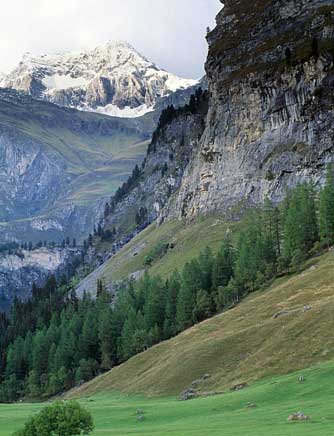
Equally strong for me has been France; photographing in the French Alps, in and around the Rhone River delta and up into Provence has resulted in some of my most delightful photos over the years. Iceland surely is not to be missed―its young landscape is different every time I visit.
There are huge gaps in my coverage of Europe; I dream of the day I can travel through Spain. My long-time photo assistant is from Romania, though I have yet to get to central and eastern Europe. All these places draw my attention, and it’s just a matter of time before I get there.
ET: If you were to recommend to someone to photograph the European landscape, where would you “send” them and why?
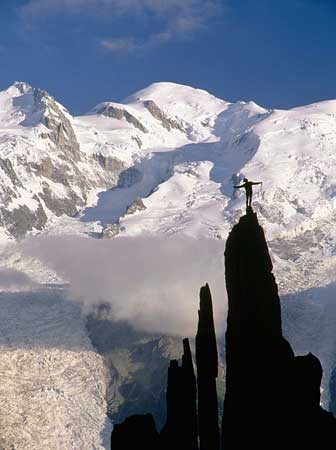
AW: Certainly it’s hard to beat the Alps, both French and Swiss. One of the striking things about the Alps is their verticality; they are very accessible initially but many of the peaks are among the most difficult peaks to climb on earth. One of my best locations has been Lac Blanc just above the ski town of Chamonix, France. I can’t overstate how stunningly beautiful Lac Blanc is as it reflects the extraordinary Chamonix Needles and Mont Blanc rising beyond.
I just love the Italian landscape, too. I love the whimsical ways the Italian farmers in Tuscany and Umbria have separated their fields by rows of cypress and pine. In addition, the rural landscapes of northern Scotland and the Isle of Skye are quite simply stunning; I have been there in the spring, when the forests around the icy, deep lochs are green and studded with bluebells. It is quite enchanting.
ET: Can you remember the first time you realized that maybe you were an “above average” photographer? How did your parents’ commercial artist business help you in your life’s work?
AW: My background initially was drawing and painting from early childhood all the way through graduating from the University of Washington, earning a degree in Fine Arts and Art Education. As far as realizing I was an above average photographer, it’s hard for me to just state that unequivocally; I would address it by saying I always realized I had an above average drive and focus. I’m rapidly approaching year 60 in my life, and the drive has not diminished. I’ve always been enthusiastic about the work that I do and sharing it with others.
Very early on I knew that whatever I wanted to do I could do it. My parents were commercial artists, and I watched my dad run his own small business. It was ingrained in me that I could do this as well. Children very often follow in the footsteps of their parents. Thankfully, my parents allowed me to pursue whatever I wanted. They had nothing but encouragement toward the arts, and in retrospect that was a blessing.
ET: You always seem to have so much fun and enthusiasm when you are photographing. Can you explain how this is?
AW: I think fun and enthusiasm is part and parcel to anyone’s occupation or passion. It’s rare in life for people to truly find their passion, especially when it’s their occupation. I feel blessed. I feel that I was destined to be a storyteller through the photographic medium, and I don’t take that lightly.
I sacrifice a lot being a photographer; I don’t have a family, I don’t have vacations, I don’t have a lot of things that people take for granted. But what I do have is a highly refined passion that gives me a deep sense of fulfillment. I can’t help but be enthusiastic and can’t help but having fun. I have a very impish sense of humor, a very free spirit about the work that I do and that just transfers to my photos. My enthusiasm is infectious; I am able to photograph people without trepidation. I have a very light spirit when I’m working around wild animals, I don’t stress about them, and they pick up on that energy so it’s a very positive experience. I wholly believe it enables me to get close to my subjects.
ET: Bad weather conditions typically thwart photography efforts. What do you think?
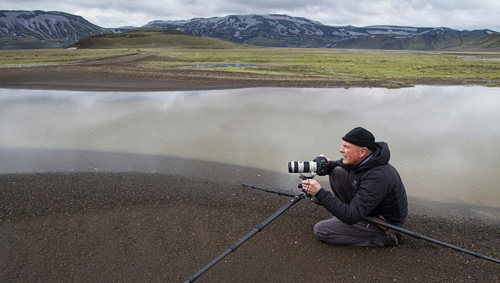
AW: My belief is bad weather often makes a shot. Whether it’s high winds, blowing snow or soaking rain, I get out there as long as I can protect myself and my camera. Weather makes for painterly effects: wind can be transferred into long impressionistic exposures where that sense of contrast between blurred motion and sharp focus subjects is often the difference between a mediocre photo and a great photo. So I look at bad weather conditions as the time to bundle up and get out the door!
ET: What is your advice for someone wanting to become a better than average photographer? What does it take to do this?
AW: No restraints! Just do it! There is an amazing amount of education being offered free through the internet. And some of the world’s best photographers offer amazing trips and workshops. I’d take advantage of that. Just jump in and immerse yourself into the world of photography and you will learn quickly.
ET: How do you determine where to go when you’re going to film your next show and how long does it take to arrange each edition of your show?
AW: My location choices for “Art Wolfe’s Travels to the Edge” were based on 30 years of knowledge about the world. After months of research and arrangements, each episode took an average of two weeks to film. The post production process added another couple months. It is a long process to get from idea to actual broadcast.
ET: Where did the name “Travels to the Edge” come from? (It’s a great line!)
AW: “Travels to the Edge” is based on my book Edge of the Earth, Corner of the Sky. It seemed like I traveled to the edges of the earth to photograph for that book. For the show name, my staff and I threw out words and started mixing and matching and ultimately settled upon “Travels to the Edge.” I thank you for the compliment and I agree, it’s a great line!













 European Traveler