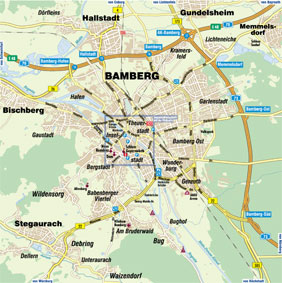
Bamberg, Germany, is a 1,000-year-old city of Episcopal and Imperial power, set on seven hills and located in the heart of Franconia in northern Bavaria.
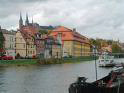
The city’s Old Town illustrates the development of a Middle Age city, and it escaped World War II almost unscathed. Set on the Regnitz River, more than 2,000 buildings are listed as UNESCO sites and form one of the largest Old Towns in Europe.
Things to see while there include the late Romanesque-early Gothic Imperial Cathedral, the Old Town Hall built right in the middle of the Regnitz River, the Baroque Palace Bottinger House and the Renaissance buildings of the Old Court.
There are also 15 museums in town, displaying a large variety of collections that document the wide cultural diversity of the city; at the Diocesan Museum, you can see the Blue Coat of Stars of Emperor Henry II. There are also numerous events and festivals–and, of course, there is that German favorite– beer. The town has 10 breweries which produce more than 50 differents beers, among them the famous “smoked beer.” There is also the Bamberg Brewery Trail, awarded special recognition in 2004.
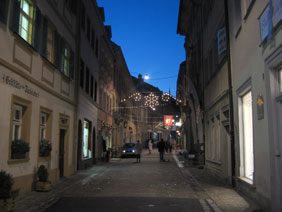
What else can you do in Bamberg? You could spend a whole day just walking the beautiful cobblestoned streets, taking in the various sights, and checking out the many restaurants, taverns and shops. The town is magical in the evenings.
There are also concerts by the Bamberg Symphony Orchestra, the magic festival called Bamberg Zaubert, an Antiques Week (runs between July and August), an Old Town fair called Sandkerwa–the biggest fair in town in August, the Calderon Festival which features outdoor theater, and the famous Nativity Trail during Advent which features 34 different Nativity scenes around town. These scenes are located in squares, churches, museums and other locations. Between May and October, you can take in an organ concert in the Imperial Cathedral every Saturday at noon; admission is free.
For train-goers, Bamberg can be reached by InterCity and InterCity Express trains, as well as others. The town of 70,000 inhabitants is 37 miles from the Nuremberg airport. Don Heimburger
By Susan O’Brien Photos courtesy Croatian National Tourist Board
Have you always wished you had been on the Riviera with Hemingway, Stein and Picasso in the 1920s? Although time travel is not (yet) possible, there’s a place on the Adriatic coast that claims to capture that golden era.
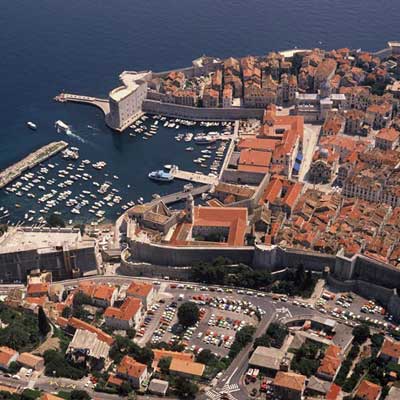
Dubrovnik has a proud history that goes back to Roman times, and its ancient center is so remarkably well-preserved it is on UNESCO’s list of World Heritage sites. It is Croatia’s southernmost city, enjoying a sunny Mediterranean climate and a spectacular mountain coastline dotted with more than 1,000 islands. It combines the charm of an ancient walled city with the amenities of a first-class Adriatic resort. It’s easy to see why the city has been known as “The Pearl of the Adriatic.”
The city was built on maritime trade, becoming a rival to Venice In the Middle Ages. Supported by its wealth and skilled diplomacy during the 15th and 16th centuries, Dubrovnik was one of the centers of development of the Croatian language and literature, home to many notable poets, playwrights, painters, mathematicians, physicists and other scholars.
GETTING THERE The easiest way to get to Dubrovnik is by air, although bus and ferry transportation are also possibilities. Croatia Airlines operates daily flights to and from Zagreb and select European cities. Planes land at Dubrovnik International Airport (Zracna Luka), located at Cilipi, 18km (11 miles) from the city center.
Buses are available from other Croatian cities, as are ferries from Bari, Italy and other coastal spots in Croatia.
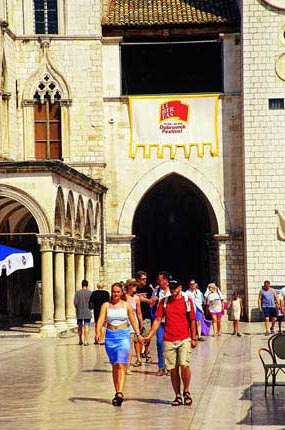
SIGHTS The walled Old Town is pedestrian-friendly, and most major sites are inside. The Stradun is the main street through the Old Town. The Romanesque cathedral, which dates from the 6th or 7th century, was badly damaged in the earthquake of 1667 and rebuilt in the Baroque style by Roman architects Andrea Buffalini and Paolo Andreotti. There are also Jesuit, Dominican and Franciscan monasteries, among many other architectural treasures.
DINING The basic style of Dubrovnik cuisine is Mediterranean. The emphasis is on olive oil, not butter. Polenta is a popular side dish and most dishes are liberally seasoned with parsley and garlic.
With strong historic links to Italy, it’s unsurprising that pasta and risotto is served in nearly every restaurant. Pizza is another favorite, usually toasted in wood-fired ovens.
The staple of traditional Dubrovnik cuisine is fish and seafood, expertly prepared but not necessarily local. The demand for best quality fish and shellfish far outstrips the supply, particularly in high season, and restaurants are often forced to buy frozen fish from afar.
NIGHTLIFE Dubrovnik hosts a lively nightlife scene and dozens of restaurants, all vying with each other for the attention of tourists. If you are used to the prices of Western Europe, this Eastern European city will seem like a comparative bargain.
Photos courtesy the Paris Convention and Visitor’s Bureau
Museum shops. Parisian museums present the opportunity to combine culture with shopping. After a visit, you can pick up the hottest new design object to take home; find a special work on architecture, science, or cinema; or choose the latest trendy image or object as a souvenir.
THEMATIC AND SPECIFIC SHOPS Museum shops offer works and objects of a high quality representative of those found in the exhibitions themselves. They often present the opportunity to find rare or very specialized objects, recordings, or books.
Close to the Jardin des Plantes, the bookshop of the Institut du Monde Arabe, designed by Jean Nouvel, has many precious items. Once through the entrance of this magnificent institution encased in moucharabiehs, the shop offers insight into Arab culture with high-quality exhibition catalogs and books on photography, architecture and craftsmanship.
Cinémathèque Française
In the Bercy district, the bookshop of the Cinémathèque Française is housed in a building designed by the architect Frank O. Gerhy. This bookshop for cinema buffs is situated on the mezzanine of the Cinèmathèque and is the main reference for cinema in Paris. Books about the history of cinema, experimental cinema and film music, as well as posters, and photos are for sale.
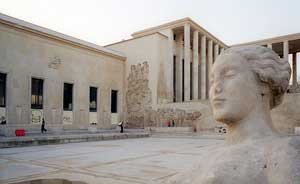
The bookshop at the Jeu de Paume, at the Place Concorde, is a landmark bookshop for all areas of photography, the visual arts and cinema, and has built a collection of more than 10,000 titles. The bookshop also operates a high-quality mail-order service for visitors abroad.
The huge bookshop Harmonia Mundi is located between the concert hall and the Musee de la Cita de la Musique, at the entrance to the Parc de la Villette, in north Paris. Lovers of classic, jazz and world music can choose from among the 9,000 CD and DVD references and benefit from the advice of professionals.
Linked to the Cité de l’Architecture et du Patrimoine, just across from the Eiffel Tower, the Moniteur Bookshop is entirely devoted to the subject of architecture and stocks works on architecture, town planning and heritage.
NATIONAL MUSEUMS The national museums in Paris also have their prestigious shops. The Musée du Louvre shops, in several locations at the Carrousel, sell elegant objects like reproductions of jewelery and sculpture from the museum’s collections, as well as a selection of monographs by artists, essays and art books.
The Musée d’Orsay, a former train station built for the World Fair of 1900, has a delightful shop inspired by the collections of the museum selling posters, table and home decor objects, and exhibition catalogs.
Finally, the Flammarion bookshop at Beaubourg, in the Centre Pompidou, offers exhibition catalogs, postcards and multimedia products as well as a large selection of publications on art and design.
Musee d’Orsay
CONTEMPORARY SHOPS Some museums boast highly-contemporary shops designed like a second exhibition area to extend the length of a visit and offer a sales area with a striking decor. The ultra-trendy Palais de Tokyo, powerhouse of the contemporary artistic avant-garde, close to the Eiffel Tower, asked the graffiti artist André, the creator of the character of Monsieur A., to design its Blackblock gift shop. The design of the shop was inspired by a gas station in the suburbs of Stockholm. Encircled by refrigerated glass windows with integrated pink lights, the shop displays rare objects and limited editions. The space is also regularly used for special events.
In another vein, Le Laboratoire has opened near the Louvre; it is an experimental venue at the crossroads of science and contemporary creation with a bookshop called Laboshop. A veritable bubble in white, the shop invites visitors to discover a variety of prototypes that have been devised and created by participants at the venue, and which it is possible to test or buy. Among the most astonishing, “the Whiff” is a process which enables you to eat by inhalation, while “the Bel-Air” is a filter that enables plants to filter the air. These unique objects are signed by Designer Mathieu Lehanneur, and scientist and founder of this unique place, David Edwards.
The mezzanine of the Centre Pompidou, a dynamic Parisian cultural institution, houses the Printemps du Design, a shop with a grey concrete floor and minimalist windows. It offers 3,000 types of objects around five themes: living, savoring, charming, communicating, getting around and playing. Eggcups, seats, cameras, jewelery, sweets and spinning tops catch the eye. Striking for its selection and display of objects, it offers design classics as well as the latest in contemporary creations.
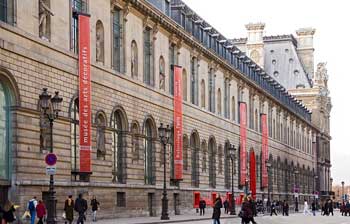
The 107 Rivoli is the sales area of the Musée des Arts Décoratifs, close to the Tuileries Gardens in the center of the capital. Specializing in specific areas of the decorative arts, fashion and design, the shop offers a rare selection of books, accessories, stationary, tableware and toys. For more up-to-date shopping, celebrities and designers are invited to suggest a selection of special objects for the duration of an exhibition or an event.
The new Galerie de l’Opéra is a gem of a shop situated within the prestigious Palais Garnier. A place to discover talents and trends in Europe, it specializes in the operatic and choreographic arts and is divided into four areas: multimedia library, art for children, memory, and performance, and is linked to the artistic program of the famous institution. Educational games, designer objects, books, technological or even signature and showcase objects already make this a cult address for the latest in museum shopping.
Galerie de l’Opéra
Palais de Tokyo
The prestigious Pinacothèque de Paris, situated opposite the Madeleine church, rounds off this tour of contemporary museum shops. Its shop showcases French and European designers who are not well-known to the general public, like the La Tonkinoise jewelery brand, for example. There is also a great selection of items for children: memory games, card games, wooden toys; and for adults, superb decorative objects and even luxury stationary.
For the curious and contemporary art buffs, there is the Merle Moqueur, situated in the north wing of the Halle Curial at the Centquatre, the city of Paris art establishment in northeast Paris. The shop features an epoxy floor, suspended acoustic cassettes and ramps with fluorescent lighting. Reference works for children and adults are offered in the different sections: general, youth and arts.
Also centered on contemporary creations, the bookshop of the Maison Rouge in Paris, Bookstorming, has wall decoration by the artist Jean-Michel Alberola. Books on art, monographic works, and critical essays, as well as many original works are on sale. Numerous events and encounters with artists and authors, like book signings, talks and video displays are featured regularly.
The bookshop of the Musée du Quai-Branly, situated on the Seine quayside near the Eiffel Tower, is devoted to art from outside Europe. This unique place offers a variety of ethnic objects while advocating the values of fair trade, for example with A-Typik and its Colombian jewelery, whose profits go to the reconstruction of schools in Colombia.
UNUSUAL SHOPS Reflecting the museums in which they are housed, this type of shop offers unusual and miscellaneous articles.
At the Musée de la Poste, the shop Correspondances offers a fine choice of objects linked to the role and history of the Post Office: original postcards, objects and ideas for gifts.
Below Sacré-Coeur in Montmartre, the Halle Saint-Pierre is an exhibition area showing unusual and popular primitive art. The bookshop of the Halle Saint-Pierre is as surprising as the museum. Built of iron and glass, it houses books on art and literature, often illustrated and covering all types of contemporary creation.
Not far from the Halle Saint-Pierre, in north Paris, the shop of the Musée de l’Érotisme caters to shopping with an aphrodisiac edge. On sale are books of modern art and erotic photographs, and old films and comic strips on the same theme.
There is also the bookshop of the Hôtel de Sully, located in a 17th-century mansion. This exceptional establishment presents national heritage treasures and heritage publications.
The shop of the Monnaie de Paris delights fans of coins, medals and jewelery.
The bookshop of the Musée de la Chasse et de la Nature, situated near City Hall, offers atypical shopping opportunities with very specialized literary and artistic publications on the subjects of nature and hunting.
For honing technical and scientific knowledge, the shop of the Musée des Arts et Métiers offers fine objects and books linked to the current exhibitions. Badges, fans, model aircraft, and literary works provide a close-up view of the fascinating world of technology.
Finally, in the Hôtel de Saint-Aigan, in the heart of the Marais, the bookshop of the Musée d’Art et d’Histoire du Judaïsme offers a selection of varied objects and books on religion, philosophy, history and ethnography, continually updated according to what’s at the museum.
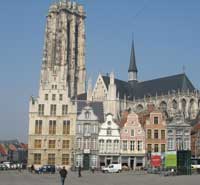
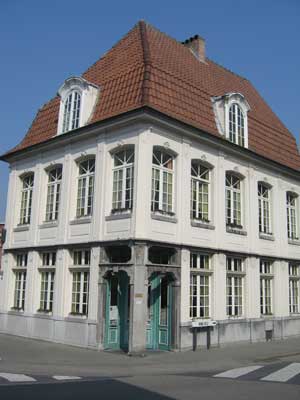
Mechelen, Belgium, about 15 miles north of Brussels, is a city of about 79,000 that features more than 300 monuments, eight historic Catholic churches and four UNESCO world heritage sights. You can reach the city by a short train ride from the main railway station in Brussels.
Mechelen is worth visiting not only because of its sights, but its people flourish because of a built-in determination and a friendliness that transcends nationalities. Maybe its because the Mecheleners have been perfecting humanity since 500 BC, when the first traces of human habitation of the area were discovered.
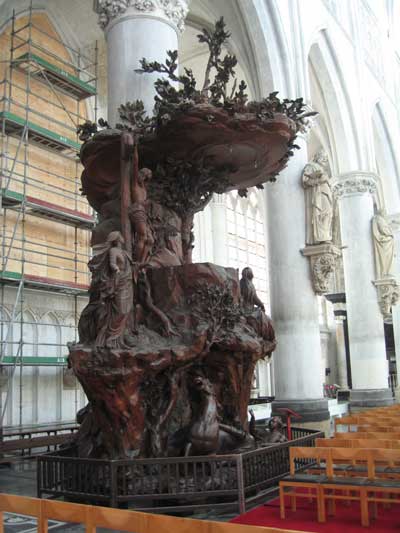
At one time, more than 100 firms in the city made furniture and word carvings, as evidenced by the many large and ornate church carvings seen here. Be sure to look for them as you discover this cobblestoned town, whose city center is only about a half mile across.
Some of the city’s sights include the early Gothic Brussels Gate, the last remnant of the medieval fortification constructed around the inner part of the city, built about 1300. At one time, all traffic entering and leaving had to pass through its limestone gates.
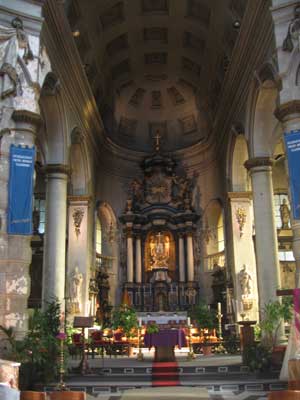
ST. RUMBOLD TOWER You can’t miss St. Rumbold Tower—it dominates the city skyline. If you have the time, conquer the 514 steps to the top of the tower to the skywalk for a great view of the area. Original plans for the tower were made when Mechelen was a rich and powerful commercial and political center, and thus the tower of St. Rumbold’s Cathedral was to become the highest tower in the Low Countries. Completed, it would have reached the dizzying height of 547 feet. Financial problems in the 16th century halted construction. The tower now reaches a height of 318 feet, still plenty tall.
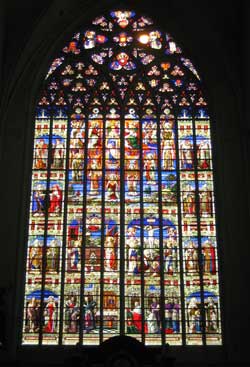
Inside the cathedral is a scale model of what the tower should have looked like had it been completed. Also inside the church are two of the largest stained glass windows in Europe. Jo Haazen and other guest carillonneurs present a carillon concert at the church every Monday evening from 8.30 p.m. to 9.30 p.m. These recitals are free.
A third highlight of the city is the Large Beguinage, where widows and unmarried women of class were invited to live together, submitting themselves to pledges of obedience and chastity. Parts of this community are still visible and are inter-woven into the city’s many old structures that line narrow streets in the center. Still in tact are the Beguines’ church, the infirmary, the house of the grand mistress and other structures.
(middle) One of the largest stained glass windows in Europe in Mechelen’s cathedral.
PALACE OF MARGARET OF AUSTRIA Another important site is the Palace of Margaret of Austria of the Court of Savoy. This was the first renaissance building in the Low Countries and perhaps outside of Italy. The facade features Margaret’s coat of arms, and between 1616 to 1795 it was the seat of the Great Council. Its interior garden area is a fine place to rest your feet for a while.
Another spot worth visiting is St. John’s Church, which is open to the public. A very fine wood carving on the interior is one of Ruben’s masterpieces, The Adoration of the Magi. The church furniture, paintings and statues date largely from the 17th and 18th centuries.
For a respite from walking or touring the city, find Windels at Iron Leen 48 (not far from the main railway station), the oldest cigar store in Belgium (from 1875) that continues to make fine cigars, and offers them in beautiful hand-made wooden boxes. The store, now being run by the fifth generation of Windels, also carries a good selection of whiskeys.
The Jef Denyn Royal Carillon School, at Frederik de Merodestraat 63, is a state-subsidized educational institute that offers a six-year program to obtain a laureate’s diploma. Even the Vienna Boys Choir visited the school during the last few years. When you realize Belgium is one of the carillon capitals of the world, this school makes sense, and attracts students from as many as a dozen different countries. The heaviest carillon in Belgium—there are five different carillons in town–is in one of the local church towers.
The Jef Denyn Royal Carillon School in Mechelen
The De Wit Royal Manufacturers of Tapestry, operating since 1889, is the only workshop in Flanders to retain this age-old tradition. Offering a complete range of tapestry services, the firm offers individual tours on Saturdays at 10:30 a.m. and group tours on other days. The De Wit is housed in a beautiful old Abbey at Schoutetraat 7, and plays a key role in many old and expensive tapestry restorations throughout Europe.
TIME FOR SOME CUCKOO Perhaps at lunch time you’ll want something unique and that is a local delicacy. Find a restaurant that serves the town’s famous Mechelse koekoek, or Mechelen cuckoo (chicken). This chicken, with black-gray feathers, is a feature on many local menus, and is often served with fresh vegetables or with a Mechelen beer sauce. You’ ll likely get a large side dish of round roasted potatoes to go with the chicken.
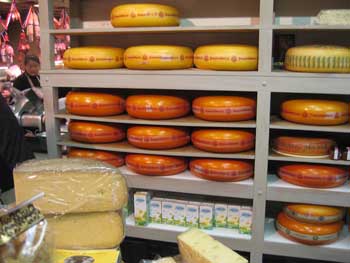
Delicious cheese lines the shelves in a Mechelen shop.
After lunch, stop in at one of the two local Gauthier chocolate shops (one is at Guldenstraat 2), and soak in the atmosphere. Store candies are hand-made, made from traditional Belgium customs, and follow a unique recipe, so you’ll likely leave with a bag full of something good to eat. The Gauthier family, with master chocolate maker Edouard Gauthier, has been making candy in town since 1964.
Round out your afternoon with a boat trip on the Inner Dyle River. A multilingual audio-guide tells you about the sights along the river banks. The departure is at the Jetty at Lamot/Haverwerf and costs €6 for adults.
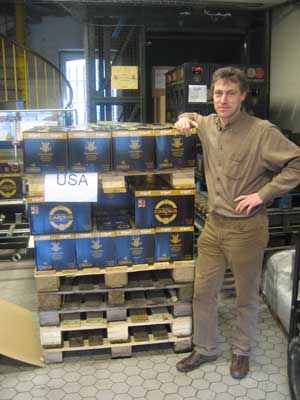
MUCH MORE TO SEE Many more Mechelen sights are available if you have the time, such as the Watchmaker’s Museum, the Jewish Museum of Deportation and Resistance, the Museum in City Hall (the old Rathaus), and the Het Anker Brewery Museum. At this small family brewery, best known for its local beers such as Gouden Carolus, you’ll get a feel for quality. The brewery also has its own restaurant and 22-room hotel.
Around the year 1500 more than 100 breweries operated in Mechelen, but like most things, the businesses and other important history of the city has faded over time. But this quaint Belgium town continues to re-count its traditions and rich past, and brings it forth today for all to enjoy.
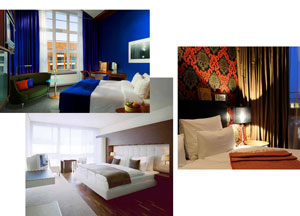
The cities belonging to Germany’s “Magic Cities” association, including Berlin, Cologne, Dresden, Duesseldorf, Frankfurt, Hamburg, Hannover, Leipzig, Munich and Stuttgart are centers of art, architecture, history and culture. Discover some of the newest additions of designer hotels that these cities offer:
In Berlin, the Soho House concept is being implemented for the first time in Germany. Stylish branches of this chain can already be found in London and New York. In the former “House of Unity” at the foot of Prenzlauer Berg, the hotel has 50 bedrooms. The luxurious fitness area, modern conference rooms and hotel with spacious apartments on the third and fourth floor will be open to all visitors. There will also be an exclusive area for club members only. Another highlight is planned on the second floor, where the office of the former State President of the GDR, Wilhelm Pieck, is being restored to its original condition.
Cologne
In Cologne, one hour from Frankfurt on the Rhine River, there is a new four-star hotel, Art’otel Cologne, in a prime location on the banks of the Rhine. Alongside the trapezoidal design and the colorful windows, the chief attraction of the hotel is the art-inspired interior design with a permanent exhibition of the works of the Korean artist SEO, a former master student of Georg Baselitz. The hotel has 218 rooms with a special twist: the glass walls partitioning the bath or shower rooms are colorfully painted with some of the best of SEO’s designs.
Duesseldorf lives up to its artistic reputation (Academy of Arts) with its own new designer hotels. The Stage 47 Hotel features a completely new, unique design. All 27 suites and rooms are named after famous artists. Their portraits adorn the walls of the individual rooms, creating a special atmosphere. British elegance combined with unpretentious comfort describe the Sir & Lady Astor hotels. Lovingly arranged details and charming decorations as well as discreet, attentive service give guests a feeling of a homecoming.
Dresden, the royal metropolis on the River Elbe in the eastern state of Saxony, has been restored to one of the most beautiful Baroque cities in Europe. Dresden offers beautiful architecture, world-class art and a variety of luxury hotels. A perfect example for the modern reinvention in the classic tradition is the QF Hotel, perfectly located near the Church of Our Lady in the heart of Dresden. The hotel, formerly the “Hotel Stadt Berlin,” has been known since 1804 as one of the best hotels in the city. The 96 rooms combine comfort and luxury with a clean and modern design.
Frankfurt, the financial metropolis in the middle of Germany, is not only the major airport hub, but also a fascinating city where great history meets modernity, world class contemporary art museums and galleries are placed alongside cultural giants such as Goethe. A new highlight of the hotel scene is the Roomers design hotel in the city center. This luxury hotel combines classic lines and innovative design in its 117 rooms.
Hamburg: The designer hotels in this port city combine themed interiors with the comforts and conveniences of the highest standard. Hamburg is also where you’ll find Germany’s highest-rated boutique hotel. The Side Hotel combines luxury and design with aplomb. This award-winning five-star establishment is characterized by a minimalist interior of dark wood and beige elements illuminated by unique lighting.
The George Hamburg holds an entirely different appeal as a four-star hotel with British charm. Rooms furnished in warm colors, an elegant library and an English Garden are all part of its homage to British style.
Hannover, in Germany’s north, has a long history as a royal seat of the English kings and queens, but also as a modern city that hosts many world-class conventions. A special place to overnight is the Sheraton Pelikan Hotel. Located in the former Pelikan factory, one of the most famous brands of fountain pens, the architects integrated the architecture of the old production facilities into the hotel design to create a distinctive loft atmosphere.
Leipzig
Leipzig, one of the most exciting cities in eastern Germany, invites visitors to stay in style in the newly-redesigned Pentahotel. The hotel was given a complete makeover in 2009 by Italian star designer Matteo Thun. The 356 new stylish and comfortable rooms have 32″ flat screen TVs, iPod or game consoles like Nintendo Wii, and other features catering to the needs of the modern and tech-savvy traveler.
Munich in southern Bavaria is known for its royal splendor. The new Louis Hotel that opened in September 2009 fits right in. The name Louis is intended as a reference to the appreciation of beauty as professed by King Ludwig II of Bavaria. Located in the heart of Munich, globetrotters will feel at home in the 72 rooms with carefully selected details and handcrafted furnishings. Natural stone and elegant tiling are reminiscent of the Parisian Metro and make the rooms an unforgettable experience.
Stuttgart
Stuttgart, home to the iconic car brands Mercedes and Porsche, now offers a very special experience for motorsports enthusiast. The V8 Hotel opened last fall and offers everything for high-octane car lovers. Individually designed rooms, antique and unique car models make this hotel a great experience. Its Bauhaus style combines function and comfort.