Traveling Rail Europe’s ‘Little Lines’

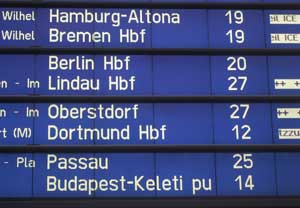
German rail trains are fast and sleek.

By Don Heimburger
Photos by the author


One of my favorite things to do when planning a European trip by rail is to pull out my European rail route guide and investigate the towns and topography of the area through which I’ll be traveling.

Thus, when I recently organized a trip to Oberammergau, Germany from the Black Forest village of Villingen-Schwenningen, to visit the Passion Play theater and interview some of the play’s directors, I was delighted to see that I’d be changing trains at Pasing, a suburb of Munich, then heading south into the Alps. Pasing station is undergoing a major remodeling around the platform area, and it needs it. Hopefully by now the station is done and the passengers can more easily maneuver on the platform.

The schedule called for me to arrive Pasing at 11:20 a.m. on an Intercity Express from Ulm. Then a Regionalbahn train left at 11:39 a.m. for Murnau, which was slightly under an hour trip. At Murnau, I took the last leg of the trip to Oberammergau. End of story? Not quite, because the fun in travel is actually traveling, not going just from point A to point B.

WHAT THE FUN IS
The fun is waiting for the train, watching the other passengers and seeing what pulls up at the station when its your train. The fun is checking out the cars and seating arrangements, finding the diner and having a meal, or watching the scenery go by. And that’s where my research came in. I knew that the fun part of this trip—any train trip in Europe–is watching the scenery, and I was in for some spectacular scenery.

Not far out of Pasing I could tell the tracks were heading southwest, and towards the Alps. Actually, on a very clear day, you can see the Alps from Munich itself, but I hadn’t been able to see them when I flew in until the very last moment before we touched down. Now, however, it was a beautiful clear day, but it wasn’t until about Murnau that I could see the landscape starting to suggest something big was going to happen.

At Murnau the track split, with one line going to Garmisch-Partenkirchen and then onto Innsbruck: that would have been an awesome route to follow. The other line made a large loop, ending up in Oberammergau. Had the line been straight, the schedule for that segment of the trip would have been much less than the allotted 40 minutes. After Murnau, and a quick on-board lunch that I had packed, the track started to conform to the undulating hills.

Oberammergau Mayor Arno Nunn is in charge of the world-famous Passion Play 2010.
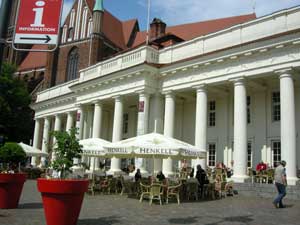
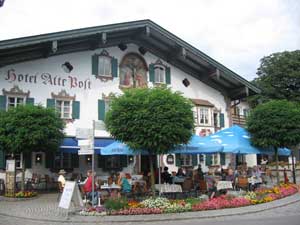
Sit back and relax with a cold beer under a tavern umbrella.

MOUNTAINS LOOM LARGER
We rolled further south, and there finally the mountains appeared and were growing bigger at every turn in the tracks. Our regional train, with a loud squeak for a horn, signaled for road crossings and little dirt paths that wound up into the foothills. Colorful mountain flowers along the way were welcoming enticements to follow the increasingly curvy path to my destination.

Small, interesting German villages, rich green forests, rolling meadows and the looming Alps were all reasons to continue the journey and discover what Oberammergau had in store. A word of caution: don’t step off at “Unterammergau” when you want to get off at Oberammergau. The town names, when you aren’t German and the conductor speaks fast, can be very similar!

At Obergrammergau the track abruptly ends at the station–there’s one track in–and it’s the same track out of the station. From there, you can walk into the center of town, or get a bus or cab. This little city, where the world-famous Passion Play is held every 10 years, is usually very active and touristy. But you feel like you’re in a “real” German town when you’re finally relaxing with a cold beer at a small tavern under the shade of an umbrella, and the Alps rise majestically above you. That’s living, that’s Germany, and trains will take you there. Next time, try the “small rail routes.”

For more information, go to www.raileurope.com and www.oberammergau.de or www.cometogermany.com.

Gateway to Connemara

By Susan O’Brien
Photos by the author

The early part of the 21st century has changed Ireland in many ways both good and bad. A building boom (now gone bust in the world-wide recession) had Irish-style mini-mansions going up throughout the beautiful and rugged western part of this once-impoverished country. Many immigrants were returning home to take advantage of the employment opportunities created by the famed “Celtic Tiger” economy.

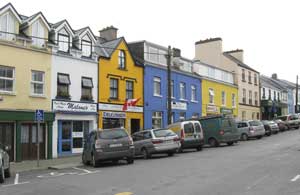
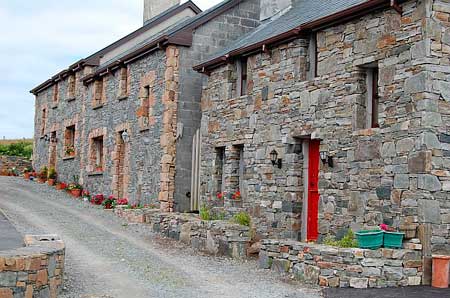
But if you are a visitor looking for a place that still holds the bucolic charm for which Ireland is famous, Clifden in County Galway is a perfect base for exploring beautiful Connemara. This little Irish village is perfectly situated between bustling Galway City and the rolling countryside of western Ireland, which is justly famous for its rugged, desolate beauty.

Kylemore Abbey, Connemara

One of the newest towns in Ireland, Clifden was founded at the beginning of the 19th century by John D’Arcy, who hoped the town would bring prosperity to the poverty-stricken area. Today the village is much as it was built more than 100 years ago, but as a hub for tourists exploring the surrounding countryside, it is home to numerous restaurants, shops, B&Bs and hotels.

Clifden is a logical and pleasant home base or jumping-off point for anyone wishing to explore Connemara and its beautiful coastline, quaint villages and rugged mountains. It is also a convenient hour’s drive into Galway City, with its more cosmopolitan nightlife and shopping scene.

To check out accommodations, restaurants and things to do in Clifden, go to www.clifdenchamber.ie. For information on the region, go to www.connemara.ie or discoverireland.com.

Discover the Island of Korcula

Photos courtesy Croatian National Tourist Office
Home page photo by Mario Romulic & Drazen Stojcic

If you like to explore ancient history when you travel to Europe, the island of Korcula is your cup of tea.

The Croatian island of Korcula has been inhabited since prehistoric times, and traces of life from the past have been uncovered at many places on the island. The oldest finds were stone knives from the Neolithic age found on the islet of Badija near Korcula.

The richest discovery is the Neolithic site Vela spilja (Large Cave) at Vela Luka. Here, archaeologists have uncovered several layers of prehistoric life with fire sites, shards of ceramics and graves dating back 5,000 years before Christ.

Many Neolithic stone piles from this period—cult places and gravesites—have also been found over the entire island. The island was inhabited by the Greeks in the 6th century before Christ, first at Vela Luka.

Milan Babic

Later, on the other side of the island, in the area where Lumbarda is today, Greeks settled from the island of Vis (Issa), founding a separate settlement referred to in the inscription “PSEFIZMA” originating in the 3rd century before Christ, which was discovered at the end of the 19th century.

In the 1st century before Christ, the island, like the whole of Dalmatia, was conquered by the Romans, who called it Illyricum. In the 7th century A.D., the Slavs-Croats made their way to the Adriatic coast and formed their own state, which was first a principality and later became a kingdom, with the crowning of the first Croatian King Tomislav in 925. Korcula was also included within the borders of that state.

The Roman population fled from the Slavs to the islands of Brac, Hvar and Korcula, and after the situation settled, the majority returned to their original places of residence, while the rest assimilated with the settlers.


In 1,000 A.D., the Venetian Doge Petar II Orseolo took over the Dalmatian cities and islands, and thus Korcula also fell under Venetian rule. It was here on the nearby isle of Majsan that the Doge set up camp to lead the campaign against Korcula and Lastovo, which offered some resistance, but he quickly conquered both islands.

Following this, the rulers of Korcula changed frequently: the Venetians were replaced by the Zahumlje governors, then by the Austro-Hungarian kings, before the Venetians took over again, and from 1413 to 1420 the island was under the Dubrovnik Republic before again falling under Venetian rule in 1420, which lasted until 1797. When Napoleon brought down the Venetian Republic, Dalmatia was under Austrian rule for a short time before the French arrived.

From 1804 to 1805, Korcula was under French, then Russian rule, before the French again took control from 1897 to 1913. The English became rulers of the island to 1815, when the Vienna Congress set out the new borders of Europe.

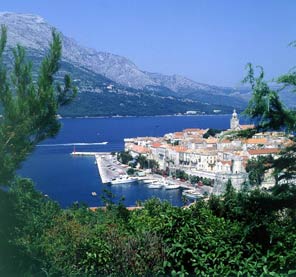
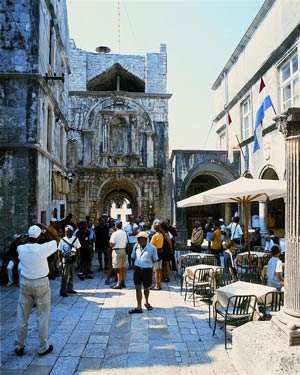
Today, Korcula is just a scenic three-hour drive or short ferry ride from Drubrovnik, and the island is known for producing some of Croatia’s finest wines and best olive oil. The southern coast offers many scenic drives with secluded beaches that are great for swimming. Korcula town’s ancient walled center has picturesque stone streets and round towers.

For more information about Korcula and other Croatian destinations, go to www.croatia.hr/en

Finding Luther in Wittenberg

500 years ago this reformer made history

By Don Heimburger
Photos by the author, Marilyn Heimburger and courtesy Pre-History Museum in Halle

Millions of visitors are expected to visit Wittenberg, Germany between now and 2017, when the 500th anniversary of the nailing of the 95 Theses by Martin Luther occurred.

The German state of Saxony-Anhalt is launching a giant campaign to publicize the anniversary and show off its Luther treasures to the world.

The kick-off event starts October 31 when the State Museum of Pre-History in Halle on the Saale River showcases numerous Luther archaeological artifacts that have recently been uncovered, mostly in Mansfeld, Luther’s childhood home, and Wittenberg at Luther House, where Luther taught.

Luther House in Wittenberg

Entitled “Finding Luther—Archaeologists on the Reformer’s Trail,” the 4,000-square foot exhibit will be shown in the newly-restored Pre-History Museum.

“Except for his writings, the bulk of the reformer’s possessions got lost,” says Dr. Michael Schefzik, curator of the Museum. “On the other hand, the archaeological excavations in 2003 yielded hundreds of objects which certainly had belonged to the Luther family.”

LUTHER’S LIFE COMES INTO FOCUS

Only in the last several years, after research by various archaeologists, was it feasible to draw a picture of the life of the Luther family, especially in Mansfeld where the Luther family moved to in 1484, shortly after Luther was born.

“Historical truth and legends (about Luther) are almost inseparably intermingled with each other,” says Dr. Schefzik. Now, more is known and will be explained in this new exhibit.

Dr. Schlenker indicates where first Luther artifacts were located in a parking area near Luther’s home

Some of the Luther exhibits visitors to the museum will find include:

  • Luther’s childhood marbles? Archaeologists believe they found them—made of clay and probably heated over an open fire in the Lutherhaus in Mansfield.
  • Luther’s mother’s thimble (?) has been preserved and is beautifully made.
  • Heating stove tiles of several colors from Luther House in Wittenberg with pictures of Adam and Eve on them, as well as possibly Frederick the Wise, who befriended Luther.
  • Iron keys, padlocks, nails, large headdress pins, knives, belt buckles, chards of pottery, beads, garment accessories, jewelry, a beer tap, coins, fish and wild fowl bones and much more.

SURPRISES YET TO COME

In addition, the museum has a few exhibit surprises that only visitors there will get to see. Many more Luther objects, such as goblets and beakers, are on loan from other museums and estates that will be shown in the exhibit. Luther received the vessels from wealthy patrons and gave them to selected friends.

Don and Marilyn Heimburger with Wittenberg Mayor Eckhard Naumann

The new Luther finds have attracted National Geographic, which plans a comprehensive report on the news, as well as many German newspapers and other news agencies.

While in Wittenberg (Home of the Reformation), which you could make your home base for a few days as you tour the various surrounding Luther sights, you’ll want to see the Town and Castle churches, the Luther House, a UNESCO World Cultural heritage site, the Philipp Melanchthon house, the Market Square with the town hall built between 1523 and 1535, the Lucas Cranach houses (he owned several), and some of the town’s museums. The town, first documented in 1180, has a great many historical buildings.

The Castle Church, with an 288-foot-high tower, was once the magnificent castle of the electors of Saxony, built between 1489 and 1525 for Frederick the Wise. It also became the university church, and it was here that Martin Luther nailed his 95 Theses to the door. Today a black bronze door (installed in 1858) has replaced the original one. The door commemorates October 31, 1517 when Luther nailed his theses “on the power of indulgences” to the door.

Medieval ladies add to Wittenberg’s Festival
Meat sizzles on an open fire at Wittenberg town festival
Musicians at Wittenberg festival

OLDEST CHURCH WORTH A VISIT

Wittenberg’s oldest church is the Town Church, the Town and Parish Church of St. Mary, set in the central square. The pulpit, at which Luther preached, can actually be found now at the Luther House. If you go, note the series of epitaphs by Lucas Cranach the Younger around the altar. They are from around 1560.

Other Wittenberg highlights include:

  • The multi-colored turreted high school designed by Friedensreich Hundertwasser
  • The Piesteritz residential housing complex on the west part of town, with some housing built as early as 1916, used to house factory workers
  • Museum of Town History, a collection of thousands of old historic Wittenberg documents and artifacts

For fun, visit the historical printing workshop in town and see how printing used to be done at the time Luther translated the Bible into German. You can even purchase a few humorous Luther quotes which have been printed at the shop.

WITTENBERG FESTIVALS

Hundertwasser School

Every year on the second weekend in June, thousands gather in the streets of this town for Luther’s Wedding, a town festival that includes medieval merrymaking with processions, strolling musicians and entertainers.

July and August brings the Wittenberg Summer of Culture which includes theater shows, courtyard concerts, a wine festival and “ErlebnisNacht” which features unexpected happenings at unexpected times in unexpected places in the old quarter.

Several hotels worth looking into are the Alte Canzley Hotel and Restaurant (www.alte-canzley.de), the Goldener Adler (www.goldeneradler-wittenberg.de) and the Luther-Hotel Wittenberg (www.luther-hotel-wittenberg.de). All are very close to all the attractions and the old town.

A newer hotel, across the Elbe River, is the Bruckenkopf Hotel, owned by the Schult family. Renate and Gehard Schult have invested heavily in the renovation of this sprawling military complex once used by the Kaiser’s Army and Napolean’s Army. There are 24 rooms in the brick fortress portion of the complex. The staff is friendly, and there is no noise except an occasional duck splashing in the nearby pond. The complex also provides rooms and cabins for boaters and bikers, tenters and motorhomes (www.marina-camp-elbe.de).

If you like good German food, a number of restaurants downtown can accommodate you. Nearly all hotels offer good food in their restaurants, but a favorite of the locals is the Schwarzer Baer, which is connected to a hotel (naturally) and Luther used to come in there to eat and drink, and it’s said he even slept there.

Wittenberg is best reached from Berlin’s Tegel Airport, and frequent ICE, ICE night and IC and EC trains stops in Wittenberg. For more Wittenberg information, go to www.wittenberg.de (e-mail: info@wittenberg-information.de). For individual town tours, contact English-speaking guides Bettina Brett at bettina.brett@arcor.de or Astrid Muehlmann at astrid.muehlmann@web.de. Both are veteran guides and are well-known locally.

Reverend Scott Moore in the pulpit at Eisleben Church, where Luther was baptized.
Luther Museum in Eisleben.

OTHER NEARBY CITIES

If you’re in Wittenberg, you really should take the time to visit some other nearby Luther sights and towns. They include the town of Eisleben, nestled in the hill country of the Mansfeld basin. It’s here that Luther was born (November 10, 1483) and baptized the next day in the Church of St. Peter and Paul. His home has been turned into a very interesting museum that documents his early childhood and youth and gives an insight into the spiritual environment in which Luther was raised.

On the hill overlooking Mansfeld, you can visit the Mansfeld Castle where Luther preached. In town is his parent’s large home, where they are now uncovering many Luther family artifacts.

In Torgau, the political center of the Reformation, you can visit the Hartenfels Palace Chapel, consecrated by Luther on October 5, 1544. It is regarded as the first church to be built as a Protestant church.

Luther studied theology and sciences in Erfurt between 1501-1505. In 1505 he requested acceptance into the Erfurt monastery, home to the Augustinian monks, an order known for its scholarship. In 1507 Luther was ordained as a priest

Regensburg: City of Wurst and 1,200 Historic Buildings

By Marilyn Heimburger
Photos by the author and Don Heimburger

The UNESCO World Heritage city of Regensburg, Germany, 90 minutes north of Munich, is more than 2,000 years old, and many of its buildings serve as a testament to its long history.

There’s plenty of reminders of this town’s heritage: located on the Danube, many tour ships dock here and unload visitors for a peek into this German treasure.

Even Mozart liked the city: Regensburg’s hospitality was commended as early as 1790 by Mozart who enjoyed “a sumptuous meal along with divine music” and praised the good wine.

Numerous Roman buildings, such as the Porto Praetorius–an old Roman town gate–can still be seen today. It was preserved because the Bishop’s beer garden was located on the site. An underground museum at Neupfarrplatz displays the history of the Romans and the Jewish community there until 1519.

NEUPFARRPLATZ IN JEWISH QUARTER
At the Neupfarrplatz, houses were built in the Jewish quarter over the old Roman fortress in the 8th century. These were destroyed in 1519 when the Jews were blamed for a downturn in the economy and were driven out.

In 1995 an excavation of the area was begun, and the ruins of the Jewish quarter were found, in addition to the Roman ruins.

Found in the excavation and on display in the underground museum were a second or third century statue of the Roman god Mercury; from the 15th century a statue of Aaron (Mose’s brother); and from 1520 an icon of the Virgin Mary. The museum is called Document Neupfarrplatz; if you walk down a flight of stairs, you can view a video showing the excavation finds. www.regensburg.de.

The city began as a Roman fortification (Castra Regina) in 179 AD by Roman Emperor Marcus Aurelius because it was the northernmost point on the Danube. When the Roman Empire fell, the Romans retreated. The fortress built there was not destroyed, and Bavarians then occupied it. It was the first capital of Bavaria; believe it or not, Munich is 1000 years younger!

Not much was damaged in the town during World War II as there wasn’t much industry in Regensburg, so there was nothing to bomb. Thus, the old buildings were preserved.

‘ITALY’S NORTHERNMOST CITY’
Rich merchants gained wealth from importing goods from far away lands. They built large homes with tall towers (a show of strength and wealth) after the style in Italy. Many of these are still standing in Regensburg; nearly 20 are still well preserved. The town is often called “Italy’s northernmost city” because of this.

One of the big Regensburg attractions is The Old Stone Bridge, built on 16 huge arches, which has been in continuous use for more than 800 years. Built between 1135 and 1146, the Stone Bridge enjoys the status of being a unique masterpiece of medieval engineering. It was for many centuries the only stone bridge spanning the Danube between Ulm and Vienna. It was not only a technological masterpiece of engineering, but of strategic importance in terms of transport and, as a result, of great commercial value.

Another town attraction is the Old Town Hall, where Roman Emperors used to summon princes, bishops and ambassadors to discuss the affairs of state. The Imperial Diet Chamber still contains the same furniture, including the benches that gave rise to the German expression “to put something on the long bench” (meaning to postpone it indefinitely).

‘HISTORIC LUNCH’
For a quick and tasty lunch, sit down near the Danube and enjoy hot, juicy sausages with kraut and bread in the “Historische Wurstkuchl,” the world’s oldest sausage kitchen. You can actually see them frying the sausages on the grill through a door that leads into the small kitchen. http://www.wurstkuchl.de

Regensburg is a city of churches. Focal points of early Christianity, its ecclesiastical buildings are majestic and typify early Christian architecture. Most famous is St. Peter’s Cathedral, inspired by the French Gothic style and built in the 13th century.

At waterside, Schifffahrt Klinger offers boat trips to many different sights such as the Walhalla, the German Hall of Fame containing busts of famous German personalities.

Regensburg`s remarkable buildings and towers offer an unspoiled look into the past; the wars of the 19th and 20th centuries left this Danubian community virtually unscathed.

The Regensburg Tourism Office is located at the old Rathaus, Rathausplatz 3, D-93047 in Regensburg. Fax is +49 941-507-1919 or e-mail to tourismus@regensburg.de.

For more information about Germany go to www.cometogermany.com.