Steigenberger Frankfurter Hof: Historic Lodgings in a Modern Metropolis

By Marilyn Heimburger
Photos by Don Heimburger

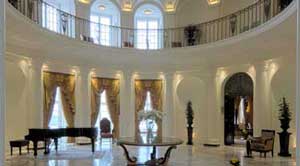
The name “Steigenberger” in the hotel business stands for hospitality at its best, and the Frankfurter Hof in Frankfurt, Germany doesn’t disappoint.  From the moment you walk through the stately pillars of the 136-year-old façade, across the courtyard with its outdoor dining tables covered with crisp white linens, into the elegant reception area, you sense the 5-star luxury.

From the doorbell in the hall to the “Tilevision” flat screen TV in the bathroom, the spacious rooms speak comfort. The beautifully appointed rooms boast a luxurious firm bed, large flat screen TVs, AC, high-speed internet access, a bathroom area with tub and double sink, and separate small rooms for the toilet and the shower. Bathrooms have hairdryers and outlets in both 110 and 220 volts that fit plugs for U.S. appliances without needing an adaptor.

Remarkable, considering the location of the hotel in the middle of Frankfurt’s business district, was the absolute absence of outside noise in the room, allowing for a good night’s sleep. 

The breakfast buffet is in the Hofgarten, one of the four restaurants at the Frankfurter Hof.  An order for coffee brings a small individual pot to the table.  Espressos are also available to order.  The buffet caters to all international tastes: from the German meat, cheese and Brotchen, to American bacon and eggs; from Asian specialties, to a full English breakfast; an omelet station, juices, cereals, grains, breads and pastries. Also open for lunch, the Hofgarten seating is available indoors or in the adjacent courtyard.

Other restaurants at the Frankfurter Hof include the Japanese IROHA, deemed among the best sushi restaurants in town; Oscar’s, a more casual bistro with its own terrace and bar; and the elegant gourmet Restaurant Francais, which has earned a Michelin star for the last three years.  

Another attraction in the hotel is the Autorenbar, or Author’s Bar, at which you can have a late continental breakfast, light lunch, or classic high tea.  With live piano music to entertain you in the evening, the room is especially popular during the annual Frankfurt International Book Fair, when it hosts receptions with visiting authors.

In the afternoons or evenings, smokers can relax in the Cigarrum lounge with a selection fine wines and chocolates. 

Opened in 1876, the Frankfurter Hof grandly offered 250 rooms, 20 banquet rooms, and dining for 800, with elevators and steam heating.  A few years later it boasted the first public phone and the first electric lighting in Frankfurt.  Its international popularity grew steadily until the Second World War. In 1940 Albert Steigenberger became the major stockholder of the hotel and took over its management. 

In March 1944 bomb attacks destroyed all but the façade of the hotel.  Rebuilding started four years later, and by 1961 the Frankfurter Hof was the largest hotel in the Federal Republic of Germany.  

While the Old World façade implies a sense of history, the deluxe hotel’s 280 rooms and 41 suites, 18 banquet rooms, four restaurants, bar and Wellness Club have been continuously restored and renovated, with the latest work on the second floor being completed just this past spring.  

It is ideally located in the center of Frankfurt’s business district, a short walk from the Frankfurt train station, the Main River, the shopping district, and the historic half-timbered building area around the town hall, called Roemer, where museums and restaurants abound.

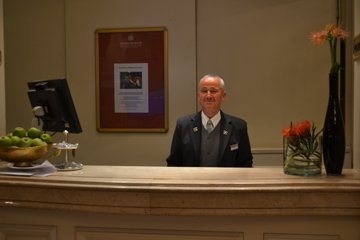
If the location and luxurious amenities aren’t enough to bring you to the Frankfurter Hof, come for its enthusiastic and knowledgeable concierge, Jurgen Carl.  With 50 years of experience at that post, Herr Carl rejected the idea of retirement to continue doing the job he loves.  With encouragement from his fans, he has even authored a book about his craft. He will greet you with a genuine smile, eager to answer your travel questions. 

Jurgen Carl, concierge

Since so many trips to Germany begin with a flight to Frankfurt, the Frankfurter Hof is an ideal place to pamper yourself with a good night’s rest, fortifying meals, and travel tips before you venture out on your European travels.

HOTEL INFO
Address: AM Kaiserplatz
60311 Frankfurt am Main
Germany
Phone +49 69 215-02
Fax +49 69 215-900
e-mail: frankfurter-hof@steigenberger.de
www.steigenberger.com/en/Frankfurt/

See the hotel’s photostream on Flickr: www.flickr.com/photos/steigenberger/sets/72157625885624181

Humble Onion Stars at Weimar Onion Market

A colorful autumn fair; a local market since 1653

Photos courtesy of German National Tourist Office

The humble onion is the star of the show at the Onion Market held in Weimar, Germany every October. These are no ordinary onions lumped together in crates or sacks; these are onions arranged together in the traditional way and decorated with dried flowers of yellow, white or lilac. They come in all sizes, too—from tiny ones to whopping big ones.

MARKET FOR BEASTS AND ONIONS
The market was first recorded in 1653 as a “market for beasts and onions” on what is today the Frauenplan, at a time when Weimar barely had a population of 5,000. There are many instances of the links between the German writer Goethe and the Market; he is said to have secured onion hearts to his desk, to have decorated his house with them, and to have praised the role of the onion in promoting good health.

In the 19th century, the market moved to today’s Schillerstrasse and developed into the major onion purchasing center for the whole of central Germany. Dealers came mainly from Heldrungen, 29 miles away, and that is still the case today.

In 1861 the market was extended to three days. In 1872 the city of Weimar passed an Onion Market Ordinance. Onions are offered as well as celery, radishes, garlic, leeks and marjoram, as well as other types of spices and vegetables. During the 20th century, world wars and inflation led to the decline of the market, and it was reduced to one day due to the limited produce available and high prices. It was not until the 1950s that the market began to pick up again, and by 1971 a record was set when 200,000 visitors attended.

ONION GARLAND
The sale of the famous market souvenir, the onion garland, has grown to 70,000 pieces, and onions and other vegetables, fruits, spices and handicrafts began to make their mark. In 1990 the Onion Market again became a three-day event. The market has also grown in size in the interim and now occupies the whole of the historic inner city. The number of visitors is now 350,000 annually.

For more info, contact the German National Tourist Office.

Starbucks Serves Swiss Rails

Photos Courtesy Swiss Travel Systems

The Swiss Federal Railways (SBB) and Starbucks have collaborated on a pilot project to launch the first ever Starbucks store on wheels.

SBB and Starbucks will open traveling Starbucks stores on two intercity (IC) 2000 bi-level trains between St. Gallen and Geneva, Switzerland; the project converts the current onboard restaurants into mini Starbucks stores small enough to fit inside double-decker trains.

Travelers can buy and sip their favorite beverages onboard and having the comfort of a familiar drink, while reading a favorite book, or gazing out the window at the Swiss scenery are sure to enhance travels even more. With this project, SBB plans to target young guests and business travelers looking for a quick afternoon pick-me-up.

SBB’s subsidiary, Elvetino, remains in charge of onboard restaurant operations. Elvetino operates 90 railway dining cars, 198 minibars and is in charge of onboard restaurant services of SBB trains throughout Switzerland, Germany, France and Italy.

Switzerland and Starbucks have a long history together: Starbucks opened the first store in continental Europe in Switzerland more than 10 years ago, and the coffee machines used by Starbucks were developed exclusively for Starbucks by Thermoplan, a manufacturing company located in Central Switzerland.

With the new Starbuck’s on-board train service, passengers will be able to stay alert to the inspiring Swiss landscape outside the window.

Compiled by Brittany Petrillo

For more info, go to: www.sbb.ch/en, or www.myswitzerland.com

When in Austria, Look for Dirndls

Photos courtesy Austrian Tourist Board

What is a Dirndl? If you have seen the movie “The Sound of Music,” you already know the basic elements that make up a Dirndl: skirt, bodice, apron and blouse. Simple, right? Far from it!

There is a veritable science to Dirndl cuts, fabric patterns, colors and embroidery.The main elements that make up a Dirndl are the wide skirt attached to a “Leiberl,” or fitted bodice, an apron (often with a hidden pocket) and a short Dirndl blouse.

The skirt usually starts at the waist or a little lower. You can choose between various lengths, depending on current fashion trends. The bodice used to be a separate item, but since the 1930s is sewn to the skirt. It comes in many different styles: with a high or low, round or square neckline, it is fastened with buttons, hooks, or ribbons.

An important element is the Dirndl blouse. It is generally very short (ends above the waist), with long, short or puffed sleeves. It can have many different necklines and is usually made of white cotton or linen. The Dirndl blouse accentuates the style of your Dirndl: Choose between delicately hand-embroidered pieces, blouses with extravagant ruffles and lace, or simple ones with straight sleeves.

Finally, there is the apron. Formerly worn to protect the dress underneath, it is now a purely decorative item. There are aprons for every-day wear and aprons for festive occasions which are usually of a more elegant fabric than the simple linen or cotton ones. Before you tie the knot—be sure to check on which side to place it—otherwise you might unwittingly send out the wrong message.

Different combinations of these elements make up the traditional Dirndl. There are different Dirndl styles for different occasions, even Dirndl styles that tell which region in Austria the wearer is from. With the recent “Dirndl Renaissance,” there are countless downright “unorthodox” styles that experiment with different fabrics, cross cultural references and punk elements.

If all these options seem daunting at first, remember: the most important thing is to have fun with the many different colors and patterns, and to choose a Dirndl that fits your personality.

FROM PEASANT GARB TO HIGH FASHION
The Dirndl has evolved from its humble origins centuries past as the work garb of peasants to a modern-day fashion superstar. With its feminine silhouette, its versatility and simple elegance, the Dirndl is a fashion “evergreen.” But where does it come from, and how did it get so popular?

Allegedly, the short Dirndl blouse we know today was originally a long shirt. Way back when, the shirt was actually one of the “basics” in the contemporary wardrobe of the rural population. Women wore a bodice, or even just a tightly wound cloth as an undergarment for warmth and support. Aprons were tied around the shirt to protect it from stains and dust. When people came home from the fields, the apron was simply switched to a different one for house work, or one for festive occasions.

Eventually, for reasons of practicality and perhaps vanity, the shirt was sometimes worn underneath the bodice and so the Dirndl was born. For a long time it was the garb of women in the countryside, and different styles developed for different regions.

Finally, in the middle of the 19th century, Emperor Franz Joseph and his court used to vacation in the Salzburg Lake district. The emperor took to wearing Lederhosen during his hunting exhibitions there, and a fashion trend was born. Suddenly, the Dirndl was all the rage and the Viennese aristocracy wore Dirndls and Lederhosen during their stay in the country.

Photo courtesy Ernst Licht German Imports

In the 1920s, the founders of the Salzburg Festival contributed to the popularity of the Dirndl by making it acceptable to wear during performances and society events. The Salzburger Dirndl manufacturer Lanz and the world-wide success of the operetta “Weisses Roessl” made the Dirndl an international hit.

Since then the Dirndl has conquered the international fashion world. In the last 10-15 years, the Dirndl and traditional costumes in general have experienced another huge surge in popularity, even outside of the regions in Austria where it has been an everyday item for generations.

WHERE TO BUY A DIRNDL?
With so many different styles to choose from, where do you start your own quest for the perfect Dirndl? Where to find authentic, traditional styles, and which Dirndl designers are known for fun and tasteful modern versions?

The best place to buy your Dirndl, of course, is at the “source.” The “real” Maria von Trapp used to mainly wear Dirndls and ordered new outfits with her favorite Dirndl tailor whenever she went back to her native Salzburg. Today, with Dirndls and Lederhosen in high demand, there are enough Dirndl manufacturers and stores to make your head spin.

For more info, go to www.austria.info/us

Flanders is a Festival

Flanders is a bucket-list destination for music lovers—big bands, unique scenes and tons of genres. With more than 280 festivals each year, there’s plenty to choose from.

Every summer millions of people gather in Flanders—a region full of history. You can enjoy live music in cities such as Antwerp, Ghent, Brugg and Boom as well as historical sites, exquisite food and shopping possibilities.

JAZZ MIDDELHEIM

Jazz Middelheim, founded in the late 1960s, has become an iconic jazz festival. The festival grounds in Antwerp are within walking distance of the famous sculpture park. The green surroundings of the Park den Brandt with a high quality infrastructure, including a playground for children and gourmet catering, attract not only a vast jazz crowd but also families with children who love to linger in the park and enjoy the live music.

Jazz Middelheim

GHENT FESTIVALS
After more than 160 years of existence, the Ghent Festivities have become one of the best festivals in Europe. Four international festivals take place there over a period of 10 days, with free music on 10 squares, children’s entertainment at various different locations in the city and hundreds of indoor and outdoor activities.

Ghent Festivals

MAFESTIVAL
One of the oldest classical music festivals with an international reputation takes place in Brugge. Daily concerts, competitions, workshops and lectures focus on the historical performance.

MAFestival

TOMORROWLAND
Yesterday is History, Today is a Gift, Tomorrow is Mystery. What started out in 2005 as a one-day festival has grown into a three-day festival. Two weekends are being organized for the 10th anniversary of Tomorrowland in Boom. Tomorrowland is one of the largest festivals with 360,000 attendees. Tickets sell out in one day for this popular festival.

For more info, go to www.visitflanders.us